Showing posts with label Frankenstein Monster. Show all posts

Thursday, October 27, 2016

It's Another Open Mic Night on the BAB


Doug: I was looking ahead in the queue and noticed nary a thing scheduled for today. Can't have that... So today why don't we have a little potpourri, a bit of a smorgasbord if you will, of conversation topics? It's Open Mic today, so whatever you've been wondering, worrying, or pontificating about, bring it before the throngs of BAB readers, won't you? I'll start --

I've been back into the Monster of Frankenstein trade that reprints that character's Bronze Age appearances. I'd gotten about halfway through it last year when the Halloween season ended. It was shelved until this year and I have to say it was worth the wait. When I left off I had just gotten into the B&W reprints from Marvel's Monsters Unleashed mag. Wow. I've said it several times before and will again -- I most regret, in all the Bronze Age offerings, missing out on the Marvel magazines. The art by Val Mayerik is phenomenal. He was very Wrightson-like in his detail, and the format really suited his style. Doug Moench was the author of those tales and successfully created the mood necessary for stories of that ilk. I've just gotten back into the color section, with a reprint of Giant-Size Werewolf by Night #2. Don Perlin and Vinnie Colletta were the art team, and while it was a jarring difference from the previous several stories, it wasn't horrible. The trade concludes with a couple of Marvel Team-Ups, so that should be fun.

I recently recorded and watched Logan's Run. It had been many years since I'd seen the entire picture. I had forgotten how quaint the special effects were, and the morality lesson in the dialogue toward the end. Maybe you've forgotten all that, too. But I know, if you were a red-blooded boy when it first ran back in the mid-70s, the one thing you did not forget was Jessica-6: Jenny Agutter. It's tough to believe that it's been 40 years since Logan's Run was in the theaters. Ms. Agutter is forever frozen for us as a 30-year old "runner" (she was actually 24 in 1976). Thank you, celluloid. 

Lastly, I've been digging the Billy Joel channel that's been playing again on Sirius-XM channel 18. As you may recall, my wife and I saw Joel at Wrigley Field back in August. I'm a sucker for covers, and there are a few that play in rotation on that channel. I also enjoy the narrative portions where Joel sits at the piano and discusses his homages to certain songs from the past in his own hits. Speaking of covers, one of the albums that's been in my own personal rotation over the past few weeks is The Smithereens Covers. There are 23 cuts from a plethora of artists -- all times, all genres. It's a lot of fun. The Billy Joel channel also features a bunch of live Joel, and that has also brought me several times back to the Deluxe Edition of The Who: Who's Next. There are 29 tracks on the album, about half of which are live versions of well known Who hits. Money.

OK -- I've been varied. Your turn. What's on your mind?


Thursday, December 24, 2015

Thursday, October 29, 2015

BAB Review: Frankenstein Meets The Wolfman (1943)


Frankenstein Meets the Wolfman (1943)

Karen: Yes, your friendly co-editor has been on a bit of a Universal Monsters binge of late! A week after I watched The Wolfman, I put the disc with this gem in the player and sat back and enjoyed the first genre cross-over event! This really is monumental in a way; it's the first time the Universal creeps shared a film, and by doing so, it established something of a shared universe, even if the continuity of said universe was shaky at best. Was this the first shared universe in popular culture? I'm not sure, but it seems like it may have been.

Despite the Frankenstein Monster getting top billing, this is really a Wolfman picture, as poor Larry Talbot (played again by Lon Chaney Jr.) is unfortunately brought back to life when his tomb is disturbed by some grave robbers, in one of the most chilling scenes in a Universal monsters film. Transforming into his hairy self, he rampages and passes out, and is taken to a hospital. Realizing that he can't die, he decides to seek out the Gypsy woman Maleva (the wonderful Maria Ouspenskaya again) who agrees to help him. She has heard of a doctor who might be able to cure him, a miracle worker by the name of -Frankenstein! The two head of across Europe to the village of Visaria, only to discover Frankenstein's castle in ruins, the doctor dead, and his legacy held in loathing by the townspeople.However, Larry eventually discovers the Monster, frozen in the sunken ruins. 


The Monster this time around is portrayed by horror veteran Bela Lugosi. To this point, we had seen the Monster played by Karloff in three films (the original Frankenstein, Bride of, Son of), then Chaney Jr. stepped in for Ghost of Frankenstein, and next came Lugosi.  Honestly, while I thought Lugosi made a terrific Dracula, and I absolutely love him as Ygor in Son of and Ghost, he is a lousy Monster. Part of it is just his physical characteristics don't go well with the established Monster -his face is round and full, whereas the Monster we know from Karloff has a gaunt look. But what hurts him even more is that much of his performance was cut from the film, and what remains appears to be idiotic. To explain: this Monster had the brain of Ygor, the scheming murderer who had manipulated the Monster in the previous two Frankenstein films. But he was also blind as a result of incidents at the end of Ghost of Frankenstein. The script for this film had the blind Ygor-as-Monster talking to Larry Talbot, helping him look for Dr. Frankenstein's hidden notes so he could try to find release from life. But when executives saw scenes of the Monster speaking in Bela's thick Hungarian accent, they felt it was ludicrous, and had all his speaking scenes cut. So there's no explanation of why the Monster is stumbling and fumbling around as if he's had too much to drink, or why Larry seems to think he can be of help.


I'd be unhappy if my speaking scenes were cut too.

Some critics have pointed out that it is Lugosi's version of the Monster - arms outstretched, hesitant, jerky walk - that has actually become the accepted cultural version of Frankenstein! This was also how later actor Glenn Strange played the role, so I guess we can blame him too.

Despite this, much of the film still works. Chaney is still a compelling sympathetic figure in his quest for death, and this time he's got angry villagers after him, which is fun to watch. The usual suspects are here - Lionel Atwill shows up as the Mayor, and Patric Knowles is Chaney's doctor, who suddenly decides he wants to follow in Dr. Frankenstein's footsteps. Ilona Massey is the late doctor's daughter, who spends the last part of the film in a nightgown and must be partial inspiration for Madeline Kahn's character in Young Frankenstein.


The confrontation between the two monsters at the end is perhaps a bit of a letdown, in this day of flashy films. Even though Lugosi has clearly been replaced at points by a bigger stuntman (either Gil Perkins or Eddie Parker) as the Monster, the action is fairly mild, with the Wolfman and Monster doing some wrassling, the Wolfman jumping around a lot, and the Monster throwing lab equipment, before the dam above the castle explodes and washes them away. It's funny watching these films as an adult, because I certainly had built the action up in my head as a child. Still, it has its charms, and I wouldn't want to see some bloated CGI version of it (we shall never speak of Van Helsing at the BAB. Ever.)


I can't end this post without leaving you with the most memorable scene from FMTW -no, I'm not talking about the monsters, I'm talking about the Song of the New Wine! Listen at your own peril; it's like It's a Small World -once you get it in your head, you'll never get it out.


Monday, August 17, 2015

Guest Writer - If I Had a Buck... Do the Monster Mash!


Doug: With apologies to our readers for the lack of a comic review today. I remarked to today's guest writer, the ever-helpful Martinex1 that at some point the speed of life was going to decrease. Not sure when that will be, but I'm looking forward to it whenever that does happen. So, until next Monday when Karen and I hope to have a partner review of the first appearance of the New Teen Titans, you're going to have to get your comics fix by discussing not nine but an even dozen books. And I think it's going to be a fun discussion, as ol' Mike S. has a good topic for us.


Mike S.: It is not Halloween, but it is time to consider the great horror titles of the past.   Enter the ever evolving virtual store for another $1.00 challenge of “If I Had A Buck”.   This time around we’ve got vampires, and werewolves, and ghouls, and monsters. 


Back in my youth, the comic rack seemed to be tipping with twisted tales.  Some were macabre anthologies of fear and suspense.  Others focused on creatures from the unknown.    There was quite a catalog of comics with misunderstood and tragic malcontents lurking about.  Many titles starred classic fiends that were repurposed as super heroes.  


What did you think about the horror heyday of the Bronze Age?   Did you lean toward the archetypal villains, the eerie heroes, or the hair raising tales?   Were any of these series dreadfully executed, or were they shockingly frightful?  Vile?  Ghastly?  Or Horrible?  Were there artists and writers you preferred for these types of tales?  Did the genre leave you cold or did you find balance in the heroic interplay?  How did you spend your dollar and what influenced the choice?  
 

You have quite a selection today, and like the strikes of midnight there are twelve choices this time around.  In creating the offerings, there were many titles to choose from, so if your favorite is not listed let us know what that is and why.  So if DC’s “House of Secrets” or “Haunted Tank” or Charlton’s “Ghostly Haunts” or “Ghostly Tales” float your boat, share your thoughts.  Heck, if you decide to segue into a discussion of the “Groovy Ghoulies” so be it.  


As always, have fun and spend wisely.  Here are the considerations; just pay the ferryman:


  • Creatures On The Loose featuring Man Wolf (Marvel) No. 33;  $0.25.  1975.  Cover by Gil Kane and Klaus Janson. “Deathgame” by David Anthony Kraft and George Perez.   John Jameson does his modern take on the werewolf tale with great early art by Perez.  I’m howling at the moon!
  • Adventure Into Fear with The Man Called Morbius The Living Vampire (Marvel) No. 29; $0.25 (Yeesh! I’m afraid that cover has more words on it than the entirety of any current issue’s 32 pages from Marvel!) 1975. Cover by Ron Wilson and Mike Esposito.  “Through a Helleye Darkly” by Bill Mantlo and Don Heck.   Another Spider Man villain gets a shot at a solo career.  Terrifying!
  • The Frankenstein Monster (Marvel) No. 6; $0.20 1973. Cover by Mike Ploog.  “In Search of the Last Frankenstein” by Gary Friedrich and Mike Ploog.   I like the corner circle but hate the sweater vest.  Chilling!
  • Ghost Rider (Marvel) No. 28; $0.35 1977. Cover by Ernie Chan.  “Evil is the Orb” by Roger McKenzie and Don Perlin.   Keep your eyes open, the Orb is back!
  • The House of Mystery (DC) No. 236; $0.25 1975.   Cover by Bernie Wrightson.  “Death Played a Sideshow” by Coram Nobis and Steve Ditko, and “Deep Sleep” by Jack Oleck and Paul Kirchner.  Much scarier than when Death uses Powerpoint!
  • Man Thing (Marvel) No. 5; $0.25 1974. Cover by Mike Ploog.  “Night of the Laughing Dead” by Steve Gerber and Mike Ploog.   I’m not laughing… I’m screaming!
  • Planet of Vampires (Atlas/Seaboard) No. 2; $0.25 1975.  Cover by Neal Adams and Dick Giordano.  “Quest for Blood” but John Albano and Pat Broderick.  The publisher and title were short lived.   So are the characters!   Fiendish!
  • Supernatural Thrillers featuring The Living Mummy (Marvel) No. 9; $0.25 1974.  Cover by Gil Kane and Allen Milgrom.   “Pyramid of Peril” by Tony Isabella and Val Mayerik.  Cover proves my point that most plumbing problems are caused by too much toilet paper! Bloodcurdling!
  • Saga of Swamp Thing (DC) No.35; $0.75 1985. Cover by Steve Bissette and John Totleben.  “The Nuke Face Papers” by Alan Moore and Steve Bissette.  Intimidating! Daunting! Petrifying! And I’m not talking about the writer!
  • Tomb of Dracula (Marvel) No. 68; $0.35 1978.  Cover by Gene Colan and Tom Palmer.   “The Return to… Transylvania” by Marv Wolfman (wolfman heh, heh) and Gene Colan with inks by Palmer.  All I have to say is wear dark pants when you read this one!
  • Werewolf By Night (Marvel) No. 34; $0.25 1975.  Cover by Gil Kane and Tom Palmer.  “Not All of the Shades of Death, Nor Evil’s Majesty” by Doug Moench and Don Perlin.   Just the cover gave me sleepless nights!
  • Where Monsters Dwell (Marvel) No. 4; $0.15 1970. Cover by Marie Severin and Tom Palmer.  Four tales of monsters and the macabre.   All reprints, but some fine work from Steve Ditko and Don Heck. Don’t go in the basement!


Wednesday, October 30, 2013

BAB Classic -- Ploog Power: The Frankenstein Monster 6


NOTE: This post originally ran on October 29 2011

The Frankenstein Monster #6 (October 1973)
"In Search of the Last Frankenstein!"
Writer: Gary Friedrich
Plot and art: Mike Ploog

Karen: Marvel was monster-crazy in the early 70s, and Mike Ploog was the undisputed king of monster artists at the time. His work on Werewolf By Night, Ghost Rider, and Man-Thing was perfectly suited to those books. But today we're going to look at his work on another interesting, if short-lived monster book, The Frankenstein Monster. This would be Ploog's last issue of the title, but he goes out with a bang. His layouts and panel design are innovative and fresh. Of course, it goes without saying that he manages to give the story an appropriate mood and feel -much like a classic Universal film.

Karen: The Monster is seeking out the last of the Frankensteins and returns to his creator's birthplace, Ingolstadt. Before he reaches the dilapidated ancestral castle, he comes across a young lieutenant from the village. The soldier is investigating some missing prisoners and suspects they might be in the castle. Although the Monster means the man no harm, he finds himself attacked and fights back. The soldier is knocked unconscious and the Monster enters the castle.

Karen: For those of you who haven't read any issues from this series, it should be mentioned that the Monster he
re is not the dull brute of popular culture but a thoughtful and articulate being, more in line with the novel.

Karen: Inside the castle, the Mon
ster finds nothing but ruins. He's about to give up when he hears a sound and spies a group of strange men marching along a dark corridor. The men are deformed and frightening -he concludes that they must be the work of a Frankenstein. They carry a bound man, whom they drop in a pit. Suddenly a man in a uniform with a visored helmet shows up, barking orders. The Monster decides to confront him, convinced he must be his creator's descendant. The masked man sics his servants on the Monster, and despite his strength, their sheer numbers bring him down. Just before he blacks out, he falls to the edge of the pit- and sees a gigantic spider! Ploog's art here is very strong; he gives the Monster an expressive if horrific face, and the twisted men are creepy as heck. 
Karen: The Monster awakens, chained to a wall in the cellar. His captor tells him that he too will become a mindless servant; the spider feeds on men's souls, leaving them husks of men with no wills of their own. The man leaves and the Monster struggles with his chains. Ploog does a great job conveying the Monster's power as he struggles against his restraints. He manages to pull loose one of the stones he is chained to, but when he does, a stream of water squirts through a crack! The Monster is stuck to wonder whether he should risk flooding the cellar with water or waiting until the man returns to take him back to the pit. As he ponders this, the young lieutenant he faced at the beginning of our story arrives on the scene. None too bright, he accuses the chained monster of killing the missing prisoners. The Monster tells him about his captor and the spider in the pit. The soldier sees the spider but refuses to believe a Frankenstein is responsible. "Jason Frankenstein left here more than 20 years ago!"

Karen: Right at that moment the mysterious masked man re-appears with his mob of soulless men. He is quickly revealed to be the colonel in charge of the p
rison. The colonel and the lieutenant engage in a sword fight while the Monster strains to break his chains. As water begins pouring into the chamber, the spider crawls out of its pit and comes towards the two men. The colonel, completely insane, believes he can control it. The young soldier implores him to leave with him but he ignores him. The Monster urges the young man out, telling him he will take care of the spider, even if it costs him his life. With that he makes a terrific effort -it reminded me somewhat of Spider-Man's struggle to raise the giant piece of machinery that pinned him in Amazing Spider-Man #33- and the wall comes tearing apart, with a huge wave of water instantly filling the room. Ploog's depiction of the water and underwater scenes are masterful -I would have liked to see what his Sub-Mariner would have looked like!

Karen: The colonel is carried down by the weight of his helmet and drowns. But the spider survives and grabs the Monster, squeezing him and carrying him back under. After several panels the Monster manages to break free of the arachnid's clutches and he wraps his chains about it, choking off its oxygen supply. But all i
s not peachy for the Monster -he needs air and he needs it fast. Things are looking grim -can a dead man die again? - when suddenly the chamber explodes in a great water spout that hurls the Monster up and out. Now free of the castle, the Monster looks back and wonders where he will find the last Frankenstein.

Karen: This was a really solid, done in one story. T
he search for the last Frankenstein was on-going of course, but you didn't need to know what came before to enjoy this book -which is good, because I don't have issues 1-5! I know many might argue that Gene Colan was Marvel's premiere horror artist, and while I respect his work on Tomb of Dracula, he really didn't handle any of the other horror books. Ploog did nearly all of them at one time or another and his work always has the proper tone and atmosphere -there's an eeriness to his art that can't be matched. Just look at some of these characters when handled by others -obviously, Don Perlin on Werewolf comes instantly to mind. There's simply no comparison. So here's to Mike Ploog, monster artist supreme!

Tuesday, October 2, 2012

Who's The Best...Frankenstein Monster?


Karen: Cinematically speaking, which is your favorite version of the Frankenstein Monster? I've added some images to prompt you, but feel free to choose any movie (or even TV version) you like.


Monday, October 1, 2012

BAB Frightfest: Monster of Frankenstein 1


Monster of Frankenstein #1 (January 1973)
"Mary Shelley's Frankenstein!"
Gary Friedrich-Mike Ploog

Doug:  Welcome to October, boys and girls, where we hope to provide a little monstrous fun on your five Mondays.  Karen suggested we use the Marvel Firsts books and do a series on some of our favorite Bronze Age horror stars.  We're kicking it off today with the Frankenstein Monster, and following up with the Tomb of Dracula, Werewolf by Night, the Living Mummy, and then a B&W beauty we've not yet chosen -- could be Morbius, or Tigra...  we shall see!

Karen: The Marvel Firsts are certainly a great source for early Marvel horror. The only problem is, they make me want to go out and get the following issues!

Doug:  We open in the Arctic Circle in 1898 where the explorer Robert Walton IV leads an expedition.  After leaving their cargo ship, what appears to be a brief walk later brings them to their target -- the frozen body of the Monster of Victor Frankenstein!  While Walton is inwardly giddy, he understands that his men do not share his enthusiasm and he is watchful of their nerves -- even the potential for mutiny -- as the men begin to hack the creature from the ice.  Soon, a force which they cannot control may be loosed on their ship.  Fear indeed.  As night falls, Walton orders the men to rest; an Eskimo among them offers to stand watch through the night; Walton tells him to be aware.  But as Canute succumbs to the brutal temperatures, a surprise ice crack snaps him back to consciousness; his warning come too late, though, as half of the crew is lost or killed in the natural calamity.  Walton wonders to himself if he's allowed his obsession with finding the Monster ruin his judgement; but his men know the path they wish to take.  One of the crew begins to chop wildly at the block encasing the Monster.  When Canute moves to stop him, he's struck down and nearly murdered before Walton intervenes.  The mutiny quelled, Walton orders the men to move the huge ice block onto the ship.

Karen: I'm curious why Friedrich - or really, I suspect, Roy Thomas -decided to set the story in 1898, about a hundred years after the original Frankenstein novel. The more obvious choices would have been to set it in the time of the book, or to set it in modern times. Of course, the series would eventually be moved into the modern day -which might have been a big mistake, in my opinion. Thomas did say, in Comic Book Artist #13, that he was pleased with this adaptation of the book, and he wished he could have done it himself, but didn't have the time.
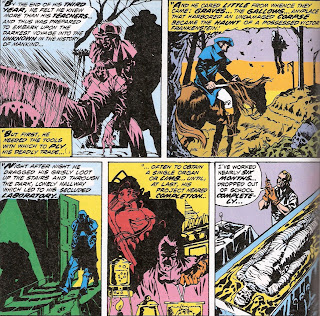
Doug:  I agree with you about the temporal setting -- what about the turn of the 20th century would scream "story possibilities!", as opposed to the turn of the 19th, in Europe?  Once the Monster is aboard (still in ice), it's placed in Walton's cabin.  A young sailor tends to the explorer and inquires of the creature inside the ice.  Walton, fearing "ruining" the young man with the truth, shrugs it off and tells him about the Monster anyway.  We then get an adaptation of the Shelley "origin" story of the so-called Frankenstein Monster".  We learn that the aspiring scientist Victor Frankenstein left his family and friends to attend the University of Geneva.  Frankenstein excelled in his studies, earning the praise of his professors.  But if there was one knock on the young man, it was his impatience.  And when the unit on human cadavers began...

Karen: If my memory is correct, most of this follows the book pretty well. I want to say that Ploog's art is just fantastic. He is certainly an illustrator -by this, I mean I could see his art inside magazines or books. It was really unusual for comics. He brings a wonderfully detailed and evocative look. I could also easily see him drawing a western story, or war story... I don't think I really appreciated him when I was younger, but I love his stuff now.


Doug:  Again, I agree with you -- Mike Ploog's pictures completely complement Gary Friedrich's words.  This is a wonderful collaboration.  By the end of Frankenstein's third year of university, he felt he'd outgrown the knowledge of his professors.  Victor Frankenstein began to rob bodies -- from graves, the gallows, anywhere he could find a newly-deceased person without bodily damage.  And he began to hoard these bodies in his personal laboratory, having dropped out of college altogether.  After six months of labor, he was ready to prove himself.  Unlike in the films, in this story Victor Frankenstein used injections to attempt to bring life to his creature.  Alas, seemingly having failed, the man turned away to look again at his calculations.  But at that moment, the creature stirred, and raised a hand from the fluids in which it soaked.  Frankenstein had created life from death -- his creature did live!

Karen: Ploog does a tremendous job with the use of lighting/shadows to cultivate the mood. Also, it would have been very easy to utilize imagery from the Universal Frankenstein films, which likely were familiar to him, but he shies from this. If anything, the tank reminds me of some of the Hammer films -which would have been much more recent.
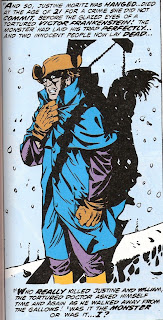
Doug:  Frankenstein was at first bursting with pride, but that increased pulse rate slowly melded itself to fear.  For the creation stepped toward him, and those menacing yellow eyes stared into Frankenstein's -- for this was no creation to celebrate, but now a monster to fear!  Fleeing, Frankenstein locked himself in his quarters, and fell exhausted onto his bed.  But suddenly, hours later, he sat bolt upright, his mind racing with the events he'd unleashed.  And there, standing right over his bed, was the Monster.  But artist Mike Ploog gives us the reader quite a different take on this scene than that perceived by Victor Frankenstein -- Ploog's Monster, while tall and strong, has a sympathetic, inquisitive face, as that of a child.  But Frankenstein doesn't see it that way and lashes out with a wooden chair.  In the melee the chair is shattered against the Monster and a large candlestick is reduced to a lump -- and we are told that the creature is fully 8-feet tall with the strength of ten men!

Karen: Of course, sympathy for the Monster is key to the story, in any version. The Monster is the unwanted child, completely rejected by his parent. Frankenstein's reaction seems so unwarranted. I think they did a nice job on the Monster too. They manage to avoid copying any movie version but still make a memorable Monster. And the yellow eyes are pure Shelley.
Doug:  I think Ploog has made a nice contribution to the pantheon of Monsters.  Victor Frankenstein fled out into the rainy night where he collapsed once again, and sleep encompassed him.  In the morning his best friend Clerval found him, and nursed him back to health over the next several weeks.  But it was to sad news that Frankenstein awakened -- his brother William had been killed by their father's ward, Justine.  Frantic from his own troubles, Victor nonetheless went to his father.  Victor was overcome with guilt at his creation, and paranoia as to its whereabouts.  As he entered his father's home he was greeted by his Elizabeth.  Briefed on the crimes that had occurred, he hypothesized about the events.  He wondered if Justine could have been framed, and the spectre of the Monster surrounded his thoughts.  But what truly consumed Victor Frankenstein was the paradox that he could save Justine from certain death, yet indict himself for the creation of the Monster at the same time.  No, that wouldn't do...  But what would win out?  His conscience or his fear?

 Karen: Frankenstein lets Justine die, which is a big clue who the real monster of the story is.
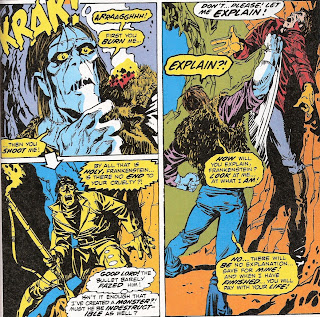
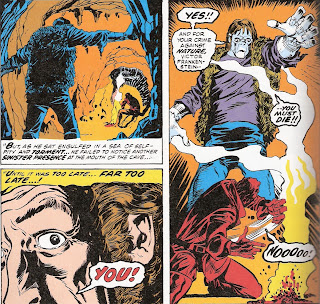
Doug:  On the day Justine was hanged, Victor Frankenstein left to hike into the Alps.  Seeking refuge from the horrible reality he'd created, he climbed higher and higher.  And when he stopped to rest, building a fire within a cave, his nightmare caught him -- the Monster was at the mouth.  The Monster had come to judge Victor Frankenstein, to punish him for crimes against nature.  Frankenstein, now frantic, lunged at the Monster with a torch, burning him about the neck.  He quickly obtained his rifle and put a bullet into the creature; but in bringing life to death, Victor Frankenstein had created a sort of unlife that was now an engine of destruction.  Lifting Frankenstein off his feet, the Monster held him high and affirmed who was now the master.  And the Monster began to tell Frankenstein a story...

Karen: The encounter is well done.The Monster is in the "costume" he'd wear through-out his Marvel career, one obviously inspired by the fur-vest look of Son of Frankenstein. The Monster's self-hatred is evident, and personally I don't feel an ounce of sympathy for Victor!
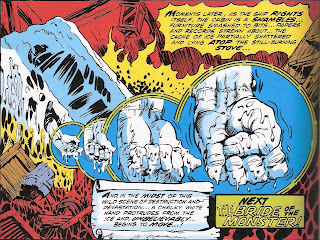
Doug:  The Monster, as I first "met" him, was rendered by Sal Buscema and Dave Cockrum in the "Celestial Madonna" storyline in the pages of the Avengers; so once he shows up in his furry vest, I felt right at home with him.  Back to the present of 1898, Walton stopped in the midst of the narrative.  Suddenly one of the sailors burst into his quarters with news that while the ship had set sail, a terrible storm was blowing in.  Walton ordered all hands on deck to fight the winds; but sensing that it was too much, Walton ordered that the sails be cut.  It was at that moment that the crew mutinied.  And not another moment later, one of the masts broke free.  Ordering his crew to safety in spite of their black hearts, it was Walton in a cruel twist of fate who was crushed beneath the tumbling log.  As the ship tosses on the raging sea, the huge block of ice down in Walton's cabin begins to slide.  To one side, near the stove, and then back.  But when the ship lurches hard, the ice slides strongly against the stove while a lantern topples on top of it.  And the huge block of ice begins to melt away rapidly, revealing a chalky-white hand... that moves.

Doug:  Wow -- this was as good as any of the Classics Illustrated I used to read in the school library when I was a junior high guy.  I was thoroughly engrossed by Friedrich's script.  Obviously Frankenstein, the Monster, Frankenstein's first obsession then paranoia... all are metaphors for societal conditions and ills. Mike Ploog's art was perfect for this sort of story.  I remarked to Karen in an email a couple of weeks ago when we were setting this up that Ploog's pencils seemed reminiscent of the Atlas work of Kirby, Ditko, and Heck.  Maybe it was the coloring of the Marvel Firsts that gave the art a heavy feel, but it seemed perfect for Friedrich's words.  Good stuff!

Karen: Agreed! I've been slowly tracking down issues of this title. But now I really want all of them!
Related Posts with Thumbnails