Showing posts with label Bill Everett. Show all posts

Friday, January 16, 2015

BAB Firsts - BAB Two-In-One: Two Bad Cats and One Good Move


This post was originally published on November 11 2009

Doug: Today you can tell all of your friends (and perhaps even a foe or three) that you were in on the ground floor of our next greatest sometimes-we'll-post-this theme: the Bronze Age Babies Two-In-One! Here's the premise -- while Karen and I will keep doing the tag-team comics reviews that have become one of the star features of this blog (as well as the Two Girls... blog), we are now going to occasionally branch out into comics that we uniquely own. In other words, Karen has a book that I don't, and vice versa.

Doug: I'm actually going to begin with two books I purchased on eBay about a year ago, The Cat #'s 3 and 4 from 1973. I'll confess that I had no prior experience with this character prior to Avengers #144 when Patsy Walker finds the Cat suit and upon donning it rechristens herself the Hellcat.

Doug: One thing I did know of this short-lived series is that it didn't seem to get off the ground creatively, and I say that strictly from the standpoint that all of the villains in the title were borrowed from other heroes' rogues galleries, including the Owl, Commander Kraken, and the Man-Bull. Another issue facing this series was scattershot artistic teams. Marie Severin, Wally Wood, Jim Mooney, Paty Greer, Bill Everett (who is really solid, unlike the criticisms we had of him in the Defenders books we reviewed a few weeks ago), Jim Starlin, and Alan Weiss all had a hand in the look of this series. Inconsistent artwork and a bi-monthly publishing schedule spells cancellation? I'd add bad publicity as well -- the teaser box at the end of #3 implies a storyline that is not close to what is between the covers of #4; #4 just sort of ends, and then there's a filler story of the Linda Fite-authored Marvel Girl origin (say what??).


Doug: Issue #3 begins with a boat chase on Lake Michigan. As a native Illinoisan, I was offended by author Linda Fite's claim that after crashing, the Cat's lungs filled with "salty" water (all of the Great Lakes are fresh water -- duh!). Anyway, the Cat is involved with some mystery-men and is captured by them. The reader is treated to a recap of events of the past couple of days that brought Greer Nelson to this point. The "bad guys" are sort of weird, referring to her as a "creature". They also can't seem to figure out the purpose of her costume.


Doug: To make a long story short, Greer is taken below the waters of the lake to a base. At this point she believes these dudes to be Navy. In the midst of her investigation of the base (after regaining consciousness, natch), she stumbles upon an intruder -- the Sub-Mariner's villain Commander Kraken. Should I be scared? After all, the guy looks just like Captain Hook, for crying out loud! A big fight ensues, the Cat and her "Navy" boys win, the Cat's sent back up to shore, and then the base blasts through the surface of the lake, revealing that it is an alien space ship. Yeah, I know -- I couldn't have made that up.


Doug: And if that wasn't dorky enough, I then start reading #4. The art this time around is by Jim Starlin and Alan Weiss -- this certainly ain't the Starlin we'd come to know in Captain Marvel! Also, I don't know much about Linda Fite other than she was married to Herb Trimpe at one time and is now a newspaper reporter. I would argue that she certainly didn't know much about Chicago back in the day, as she not only made the gaffe about the lake, but also sets this story in the Union Stockyards. Problem -- this issue is cover-dated June 1973; the Stockyards closed in 1971.


Doug: Because I can't hardly stand to belabor the point, Greer and a female pal encounter a heavy who turns out to be the Man-Bull. He's a big dope whether Man or Bull, and what's even more ridiculous is the fact that he's shown controlling a herd of cattle. Sort of like an orchestrated running of the bulls. Oh, lord, I could stick a fork in my eye... If you can avoid these books, do.


Karen: Well, I think I had better luck with my selection for our inaugural post. The issue I chose was Justice League of America #141, from 1976. I've always been a Marvel reader first and foremost, but I did (and still do) read DC as well. But back in the 70s, most of my DC interest was confined to the Legion of Super-Heroes, although I really wanted to like the Justice League. Like many kids, I knew who all the members of the League were, primarily from watching cartoons rather than reading comics. I had read some JLAs that my uncle had, which were from the mid-60s, but they just didn't grab me. The major problem for me was that the JLA seemed so bland. I was used to reading teams like the Fantastic Four or the Avengers. These were folks who worked together, and yet, they were all as different as could be. You could hide the pictures and just read the dialogue out of an issue of the FF, for example, and it would be pretty easy to tell who was who based solely on their speech patterns. But the JLA books I read featured characters that were practically interchangeable, at least personality-wise.

Karen: I would pick up an issue of JLA every once in awhile, just to check out the team, but was usually much more interested in The Avengers, FF, even the Defenders. But in 1976, the JLA experienced a change that brought me on board as a regular reader. It wasn't the addition of new members that did it - it was the addition of a new writer; a writer who was, in fact, one of my Marvel favorites: Steve Englehart.

Karen: As the story goes, when Gerry Conway ever so briefly took over the editor in chief reins at Marvel, he announced that he would be writing Avengers from now on. Englehart had been on the book for four years and was doing a great job. With Conway resolute, Englehart felt wronged, and offered his services to DC. New publisher Jenette Kahn asked him to take Justice League and make it more, well, Marvel-like. And that's just what Steve did. Under his brief guidance, the JLA developed realistic personalities and voices. They didn't all get along, and they didn't all sound the same!

Karen: His first story actually appeared as the second story in issue 139. But today I'm going to review issue 141, which is the second part of a fantastic Green Lantern-Manhunter story. Actually, if you're a fan of the animated Justice League, you'll recall the plot, since they used it in one of their episodes! The Green Lantern (Hal Jordan here) is being hunted by the Manhunters, intergalactic bounty hunters. It is believed -even by GL at first - that he accidentally destroyed an inhabited planet. The League tries to figure out what's going on and prove GL's innocence.

Karen: This is a long story - DC was doing JLA in 'giant' format - but it moves really well. The art by Dick Dillin and Frank McLaughlin is very pleasant, although not spectacular. However, I would have loved to have seen artists of their ability on Englehart's Avengers run. The JLA face battles on Earth and in space, and it is all crisply portrayed.

Karen: Englehart's trademark skill with developing relationships is in evidence here. We have a Wonder Woman who has only recently regained her powers, and who feels somewhat insecure, hence her picking on Flash, who seems somewhat uneasy with the Amazon princess. The Atom begins to voice self-doubt. As Englehart's run would go on we would get more insight into some of the other Leaguers (as well as the sort-of cross-over of his Avengers' creation, Mantis...but that's a subject for a later review).

Karen: This issue added to the Green Lantern Corps mythology and also did a good job showcasing the various members and their powers. Batman once again proves that his deductive reasoning is practically a super-power in itself. This was a fun read and I'd especially recommend it to any fans who always found the 70s and earlier JLA boring.

Karen: I can't help but wonder, though, what the regular DC readers thought of Englehart bringing in his 'Marvel style'. Were they offended? By 1976, with so many writers and artists starting to move between companies, did it matter?


Monday, December 22, 2014

Arc of Triumph? Captain America #137-138


Karen: Any love for this two-parter, where the Falcon decides to take on Spider-Man as part of a plan to prove himself? There's also the villainous Stoneface, who's straight out of  one of the Blackxploitation films of the era. Art chores on issue 137 were handled by Gene Colan and Bill Everett (and not my cup of tea, to be honest); issue 138 -the first issue of Cap I ever read by the way - was pencilled and inked by Jazzy Johnny Romita. Stan Lee wrote both issues. I think Romita did a fantastic Cap and Falcon, and of course his Spidey -well, nuff said!

It may go against all common sense, but I still kinda like the Falcon's crazy green and orange outfit...

Monday, September 29, 2014

What's So Golden (or Silver) About... Young Men 25?


Young Men #25 (February 1954) -- cover by Joe Maneely or Carl Burgos
"The Return of the Human Torch" -- Hank Chapman-Carl Burgos
"Top Secret" -- Scripter Unknown-John Romita, Sr.
"The Shark People" -- Scripter Unknown-Bill Everett

Doug: Did any of our readers secure the wonderful package of reprints that were for sale through the JC Penney Christmas catalog back in 1994? I actually snagged this set in a comics/sports memorabilia store in Anderson, IN maybe a year or so after that. From the Grand Comics Database, and speaking specifically of today's issue:
One of the 1994 JC Penney Marvel Vintage Pack reprints. These are second printings of Marvel comics from the 50's-70's. There are a total of 15 different comics in the set:

Amazing Adult Fantasy #13; Amazing Spider-Man Special [Annual] #5; Avengers #88; Captain America #109; Fantastic Four #66 & #67; Incredible Hulk #140; Sgt. Fury #13; Sub-Mariner #8; Thor Special [Annual] #2; Tomb of Dracula #25; X-Men #28, #62 #63; and Young Men #25.

Three issues are reprinted from reprints: Fantastic Four #66 is reprinted from Marvel's Greatest Comics #49; Sgt. Fury #13 is reprinted from Special Marvel Edition #11; and X-Men #28 is reprinted from X-Men #76.

This set of 15 comics was available through the 1994 JC Penney Christmas Catalog, for $14.99 plus shipping. The front covers of these comics look exactly like the originals, but inside, contain advertisements from 1994, except for Young Men #25, which has all the original inside ads. All of these reprints have the same back cover Stridex ad. "Second Printing" appears at the end of the indicia.

[Publication information from Roger Perez, STL COMICS web site, http://stlcomics.com/gallery/jcpenney_stridex/]
I'd strongly encourage you to visit the link just above. There were actually two other reprint sets of this nature, but the one we're dealing with today is by far the coolest (in this Bronze Age Baby's opinion).
Doug: It's strange how the creator credits for Young Men #25 are so sketchy, even down to the cover of the book. But nowhere could I find any hint that Stan Lee was the writer on any of the three stories we're going to examine. But it would be year's before readers could get their eyes on the names of those who crafted our favorite books. So armed with the limited information we have -- and I'm thankful we at least know who the pencilers were -- let's trudge ahead. But first, your mission (should you choose to accept it) is this: whenever I pick these decades-old books for some old school fun, it's usually with a Frederic Wertham-like sensationalism in mind. But as this issue would have seen print on the cusp of the DC Comics Silver Age, I think it behooves us to see if these three tales are more one-foot-in-WWII, or one-foot-in-the-Cold-War.

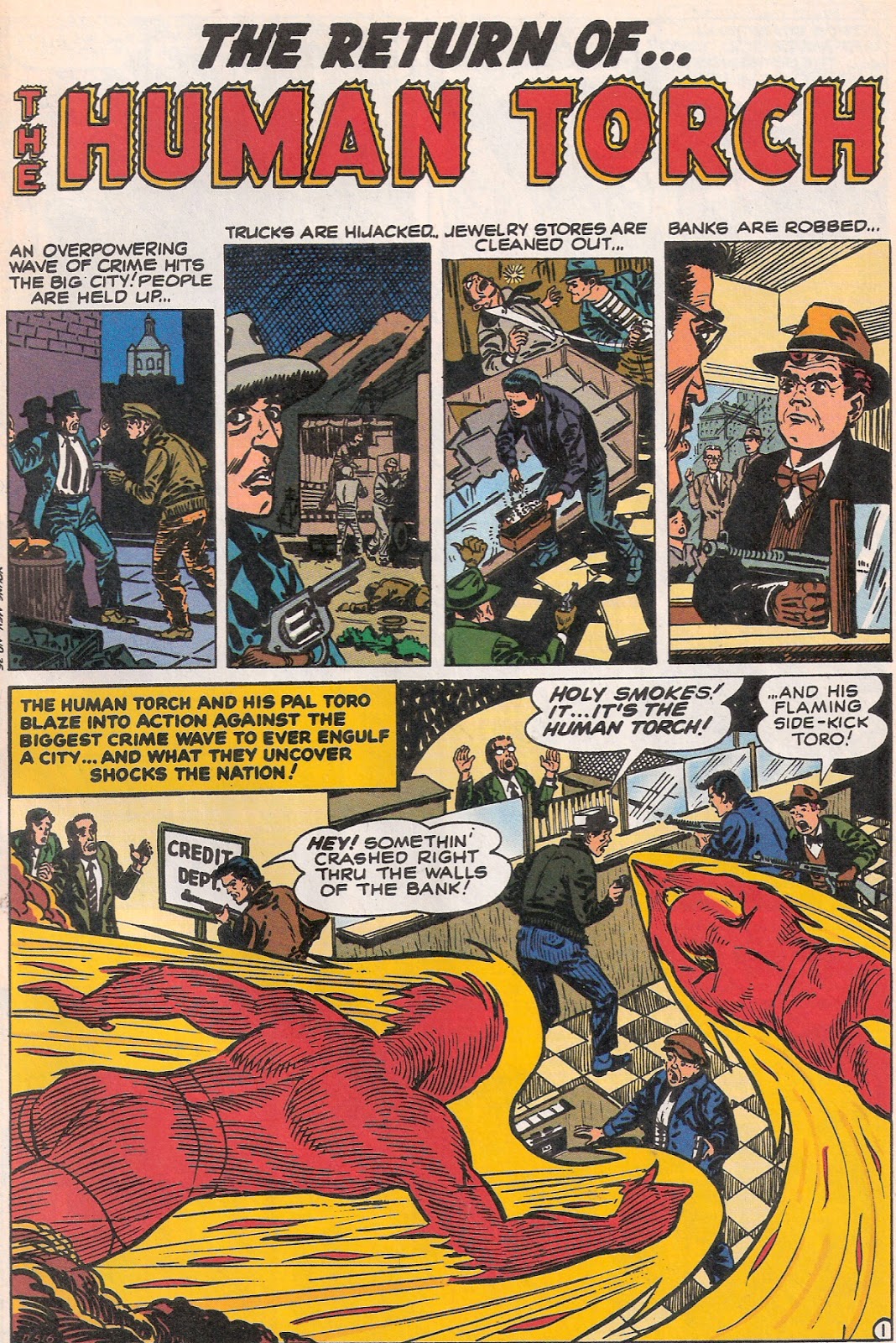
Doug: First up in the book is an 8-pager featuring the Human Torch and Toro. Of the three stories, this was probably most like the Golden Age stories. The artist is Carl Burgos, creator of the Torch, so I thought that was nice that after around a decade he was called back for the revival of Timely's Big Three (we'll see Sub-Mariner creator Bill Everett on the art chores in our third story).  Burgos's art had certainly evolved by the time this saw print, although I couldn't help but feel that this story was just an extension of what we'd seen in the Torch's first appearance. This is a gangster story, mashed right into an episode of The Twilight Zone (which would not premiere on American television for another five years!). There's been a spate of robberies around "the big city", all carried out by very young thugs. In fact, after some investigation, it turns out that all of the bad guys are 20 years old! The Torch and Toro arrive on the scene mid-crime and create a little havoc. After some gunplay and a little flame-spitting (has Johnny Storm ever done that?), one of the goons grabs a dame (Golden Age talk, you know) and puts his piece to her head. The Torches are forced to comply with an order to get into the bank's safe. The bad guys figure that since it's soundproof it must be air proof. And, since it's on a timed lock, the Torches will suffocate and that will be the end of them. By the way, no mention was ever made in this story that the Torch is an android -- a storyline that was abandoned not long into the character's run, from what I understand.
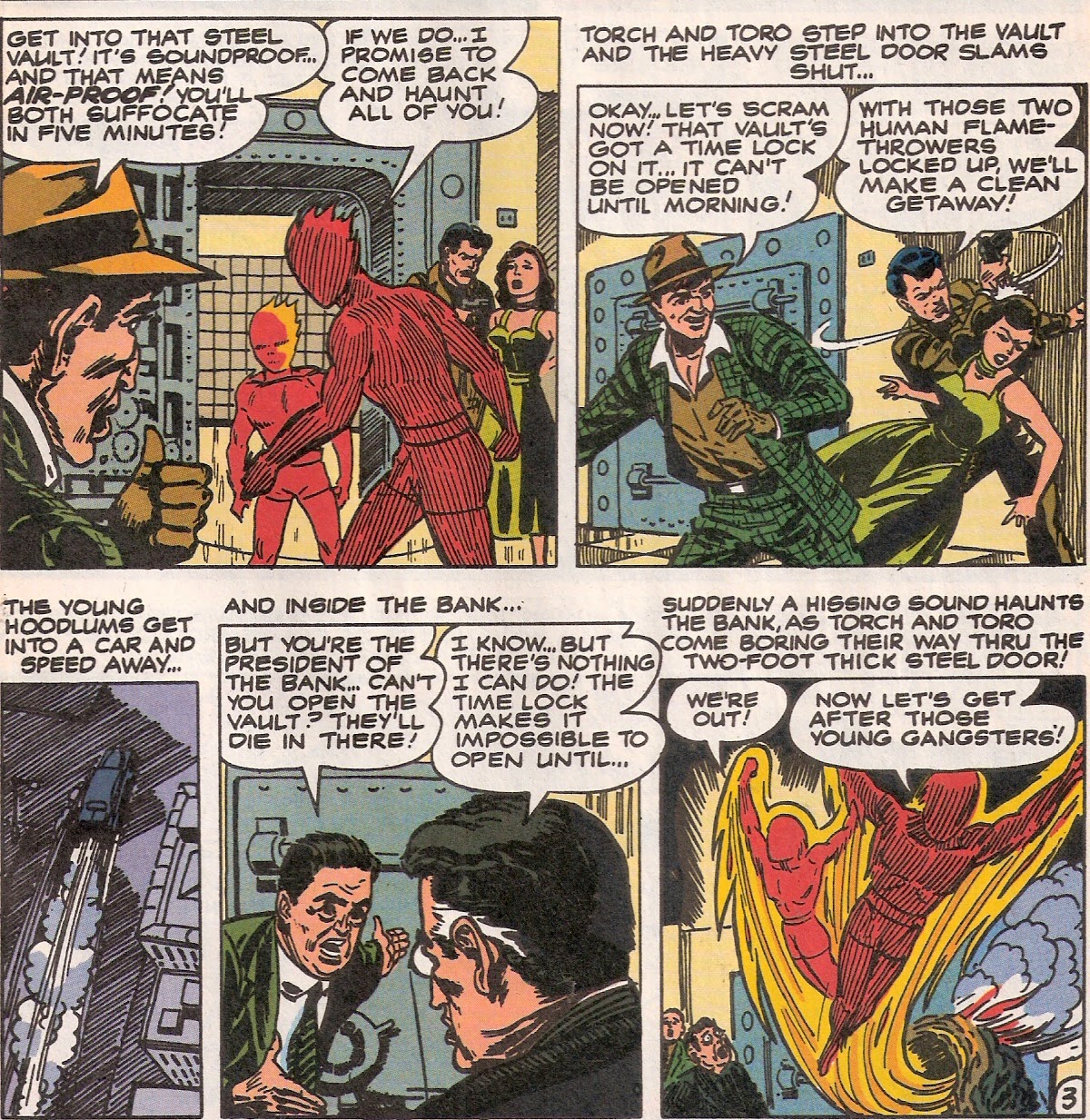
Doug: Of course the Torches flame their way out of the safe by melting through the thick door. A hasty pursuit later and the good guys have the bad guys corralled and dropped off at the local precinct. But the chief tells the Torch that he almost has no room for all of the young criminals. And he can't figure it out -- they are all young, none are professional gangsters, and they all seem to like being in jail! The Torches have no answers, so head back out on patrol. Flying through the night skies, they pass over a senior living home, where Toro's Uncle Julius was staying. But as they get closer, they see that it is boarded up. A quick investigation shows that it had to close for business due to no new old people! What?? The Torches do some further fact-finding and note that there don't seem to be very many old people in town anymore. This is going to require some undercover work.
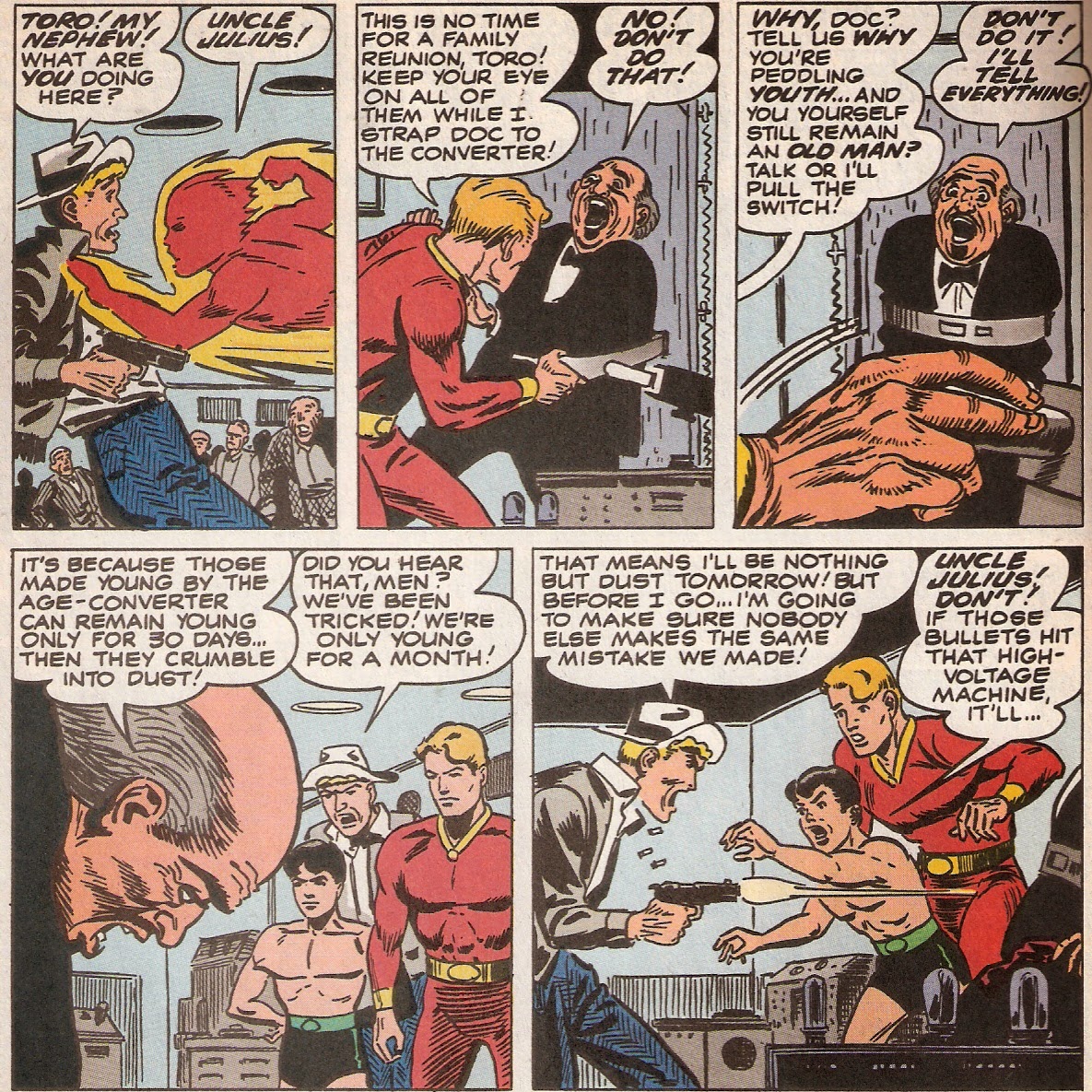
Doug: Back at the police station, our heroes are outfitted in "old guy" clothes and some make-up and hit the streets. It isn't long before a young man stops the two "oldsters" and asks them if they'd like to be young. The fact is, he says, he was 70 years old only last week -- and now he's 20! The disguised Torches want to know more, so go along with their new ally. Soon they are on the outskirts of town in a large mansion. A Doctor Markov (gotta love that Soviet bloc-sounding name in these Cold War years) tells the assemblage -- mostly older men -- that he can give them the vitality of a young man. In exchange, all they have to do is promise to rob and steal for him, and be willing to go to jail. The benefit of this scheme is, they are told, that as first-time offenders they won't be sentenced to more than five years behind bars. Once released, they will have the life of a 25-year old ahead of them! The old men begin to clamor to be first. Among those present is Toro's uncle. A few of the men go through the transformation, and then it's the Torches turns. Jim Hammond allows himself to be strapped into the machine, but right before the switch is thrown, he flames on and goes for the doctor while Toro moves against the young hood who brought them to the mansion. But as Toro flames on, the goon calls him his nephew! The guy they'd met on the street is Uncle Julius! The Torch binds Markov into the machine and threatens to do the switch on him, unless he fesses up to why he wants the guys to do the crime. Turns out that the men will only be 20 years old for 30 days -- after that, they turn to dust! Upon hearing that, Toro's uncle loses it and fires his gun. Despite a warning to stop unless he hits the high-voltage machine, one more bullet is fired -- and the place goes up. And up and away go the Human Torch and Toro, safely removed from the explosion.
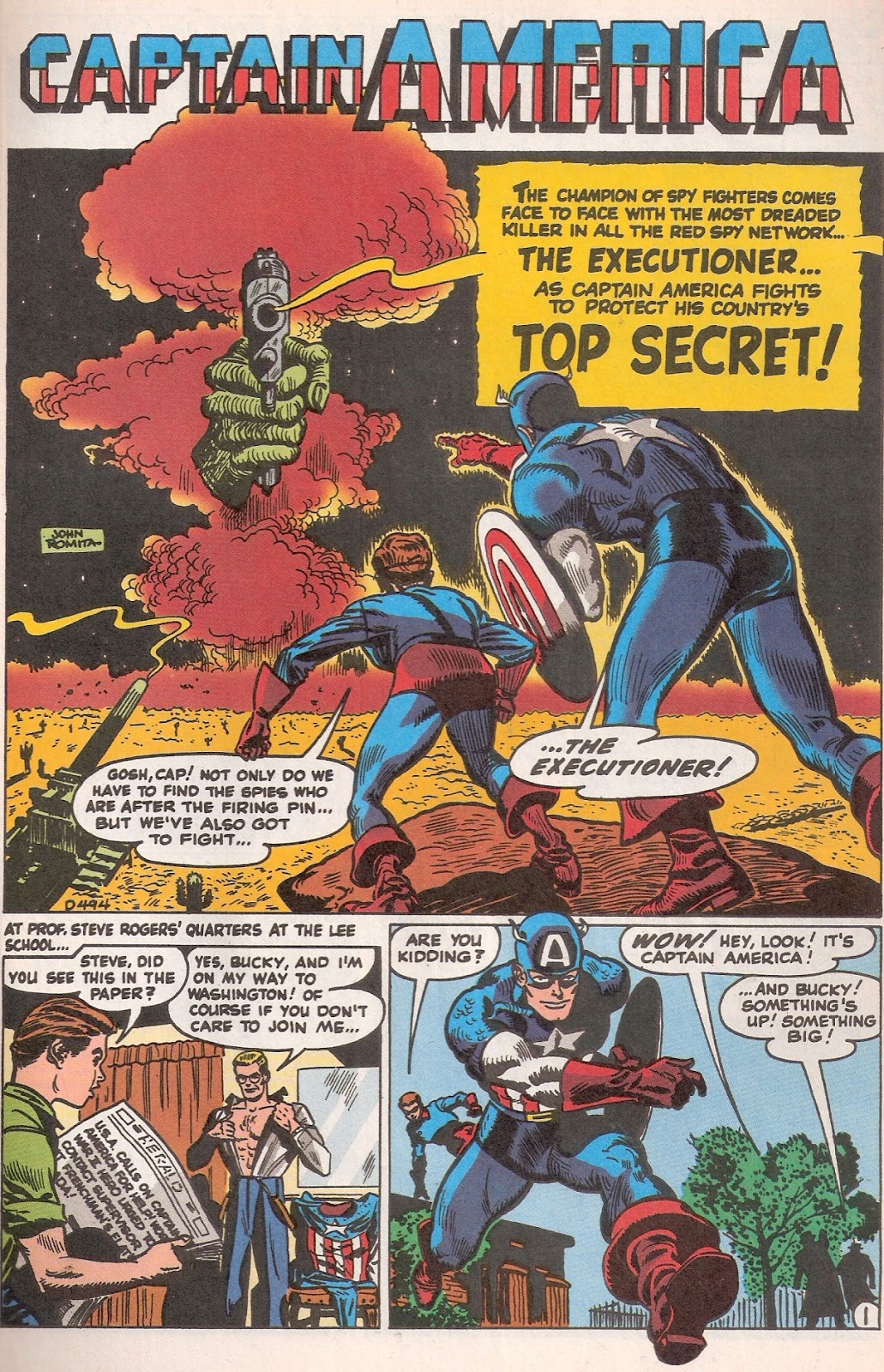
Doug: The Captain America story was the weakest of the three, but seems a novelty due to the pencils of John Romita. The Jazzy One wasn't all that jazzy here, but you can see some flashes of the sort of work he'd do on Amazing Spider-Man a little over a decade hence. This iteration of Captain America is of course that of the commie-smasher. The gist of this story is that the Americans have developed an atomic cannon, and they need to keep its secrets from falling into the hands of spies. Bucky tells "Prof." Steve Rogers that Captain America is being paged through the newspapers, so Cap and his young sidekick enter our story in an effort to thwart the so-called Executioner (no, not that big Asgardian oaf). Top scientist Jim Slade is the only guy who knows the secrets of the firing pin for the cannon. After a greeting with Cap and Bucky, Slade declares that he's off to Las Vegas to meet his girl. After his departure, Cap is shown a picture of the lady -- and immediately recognizes her as Lupa Lupoff, Red spy!
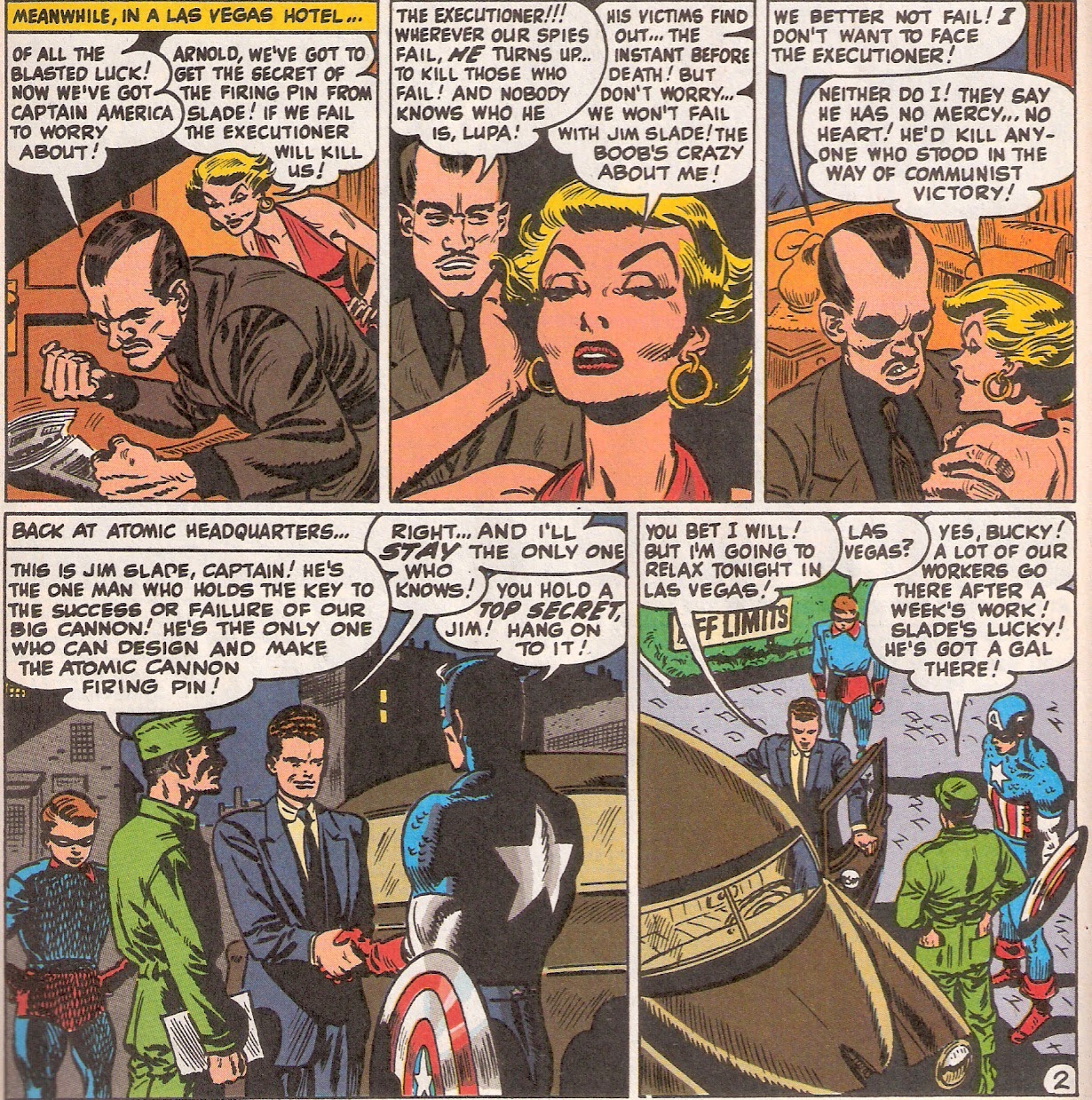
Doug: Our heroes head to Vegas to stop the shenanigans that they know are coming. Trouble is, they're too late, as Lupoff and her assistant have drugged Slade. The good guys arrive to find Slade being driven away. They attack, but a little gunplay ensures that Slade is lost to them at this time. Cap beats up a couple of toughs, and they remark to each other how they fear for their lives at the hands of the Executioner, because they've failed to stop Cap. But, just down the street there's a booby trap, and two other guys are able to detonate a bomb, potentially killing the Star-Spangled (not yet) Avenger! We cut then to the desert, near where an A-bomb test is about to go off. Slade's strapped to a cactus, while Lupoff and her dude-friend interrogate him for the firing pin secret. He basically tells them to take a flying leap. But then they, too, begin to worry about the Executioner should they fail to extract the secret from Slade. But just then Bucky arrives and takes out the dude. But Lupa's having none of it, and pistol whips James Barnes.
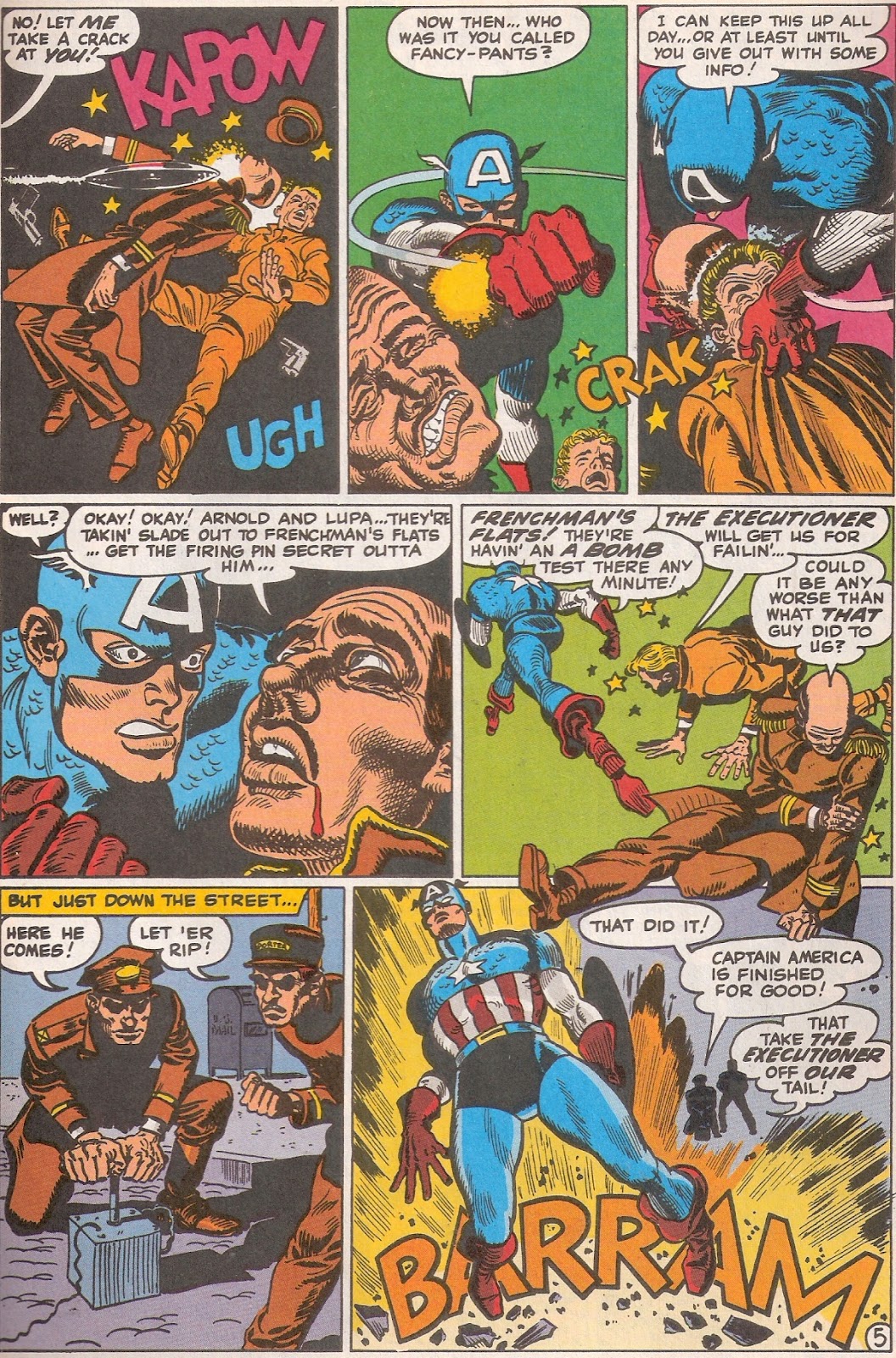
 

Doug: Now tied up with Slade, it looks like it's curtains -- until Captain America arrives to save the day! Turns out his shield had saved him from the blast. Cap tears into Lupa's man, and then in the melee Lupa turns her gun on the guy and kills him! With his dying breath he looks at his woman and says that she is the Executioner! And she is -- punishing those who fail, including herself as she takes her own bullet. With the threat now ended, the boys regroup to watch the A-bomb test. Cap says, "A glorious sight... when it's on our side in the struggle for world peace!"


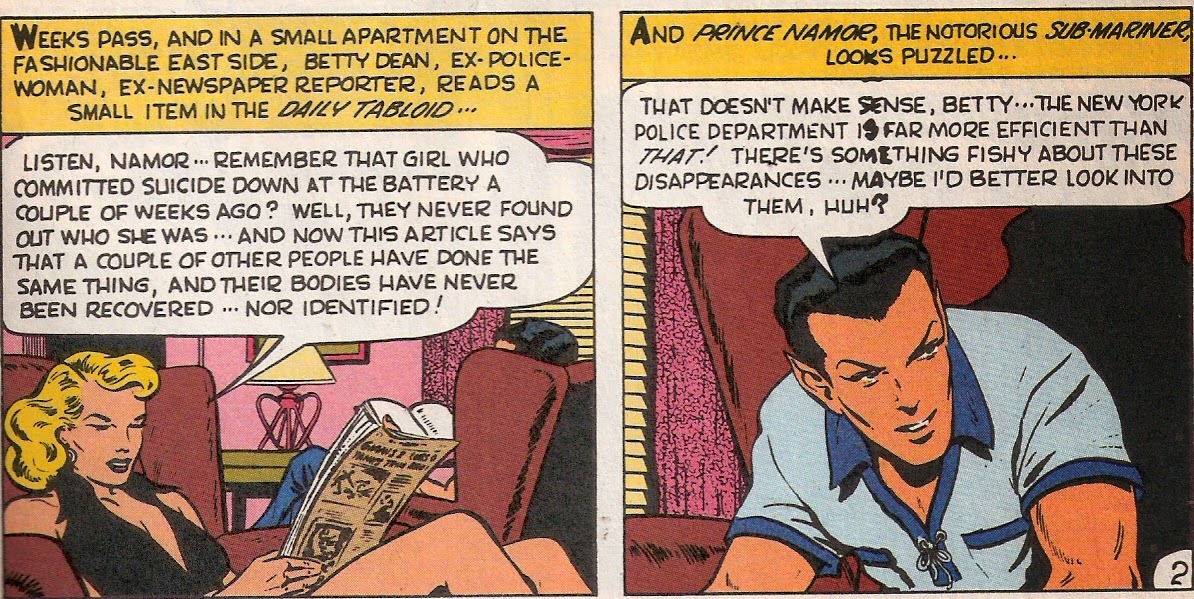
Doug: Bill Everett's art in the Sub-Mariner feature is the most sophisticated in this book -- it's just beautiful. The crime set-up is that people are jumping into or falling into the ocean, with many bodies washed ashore horribly mutilated. It looks to be shark attacks. We see a crowd scene, where the denizens of Battery Park await the Staten Island ferry. Suddenly a woman pushes through the crowd and leaps into the water. A man goes in after her, but surfaces with nothing but her clothes -- no other sign of the woman. The police are dumbfounded, as this has become a trend. In an apartment on the East side, Betty Dean and Namor, the Sub-Mariner, read the papers. Betty tells Namor of the goings on. Namor decides, because it doesn't all fit, that he will investigate.
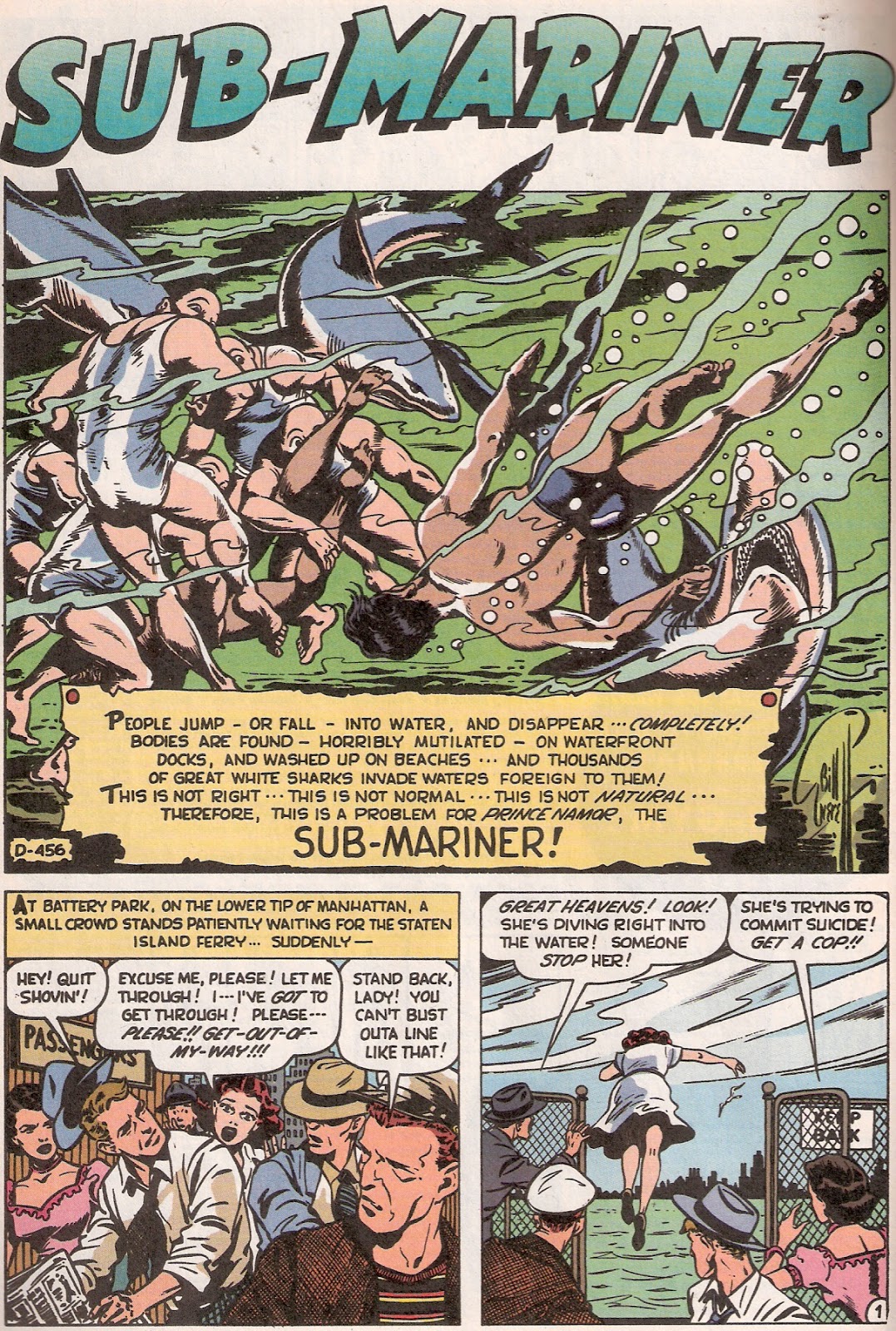
Doug: Later that evening, Namor is down on the docks by the river. He finds a bum, badly disfigured. Namor calls the authorities (there is no sign in this story of Namor's past problems with the surface world) and talks to the detective that shows up. The guy insists that a shark did it. Namor dives into the water to check it out, but decides that the water is too cold for sharks. However, out in the ocean a small pleasure vessel is capsized -- and the men aboard are eaten alive. Later, a Coast Guard boat picks up the wreckage, and later after that several bodies are found on shore. Namor is there again to investigate, but says he's still stymied. A weird-looking guy on the beach offers a hypothesis about the sharks, but Namor casts it away. That night, Namor walks the beach, looking for any clue he can muster. Suddenly the same strange man from that afternoon appears, removes his clothes, and walks into the ocean. Too offbeat for the Avenging Son, Namor dives in after him. Namor finds no sign of the man beneath the waves, but he very soon encounters a Great White shark. The beast bears down on Namor, but the crown prince is too fast -- he grabs the lower jaw of the fish and breaks it, King Kong style! You might have guessed -- soon after, the police find the body of a man washed ashore, his jaw horribly disfigured. I had to chuckle a bit, as the cop on the beach remarked about the horrible death the guy must have had. Namor says that before they call it a murder, there should be some further investigation. But later in the same panel, Namor suggests that they can file it as a homicide. Strange doings -- was the Sub-Mariner indicting himself in the man's/shark's demise?
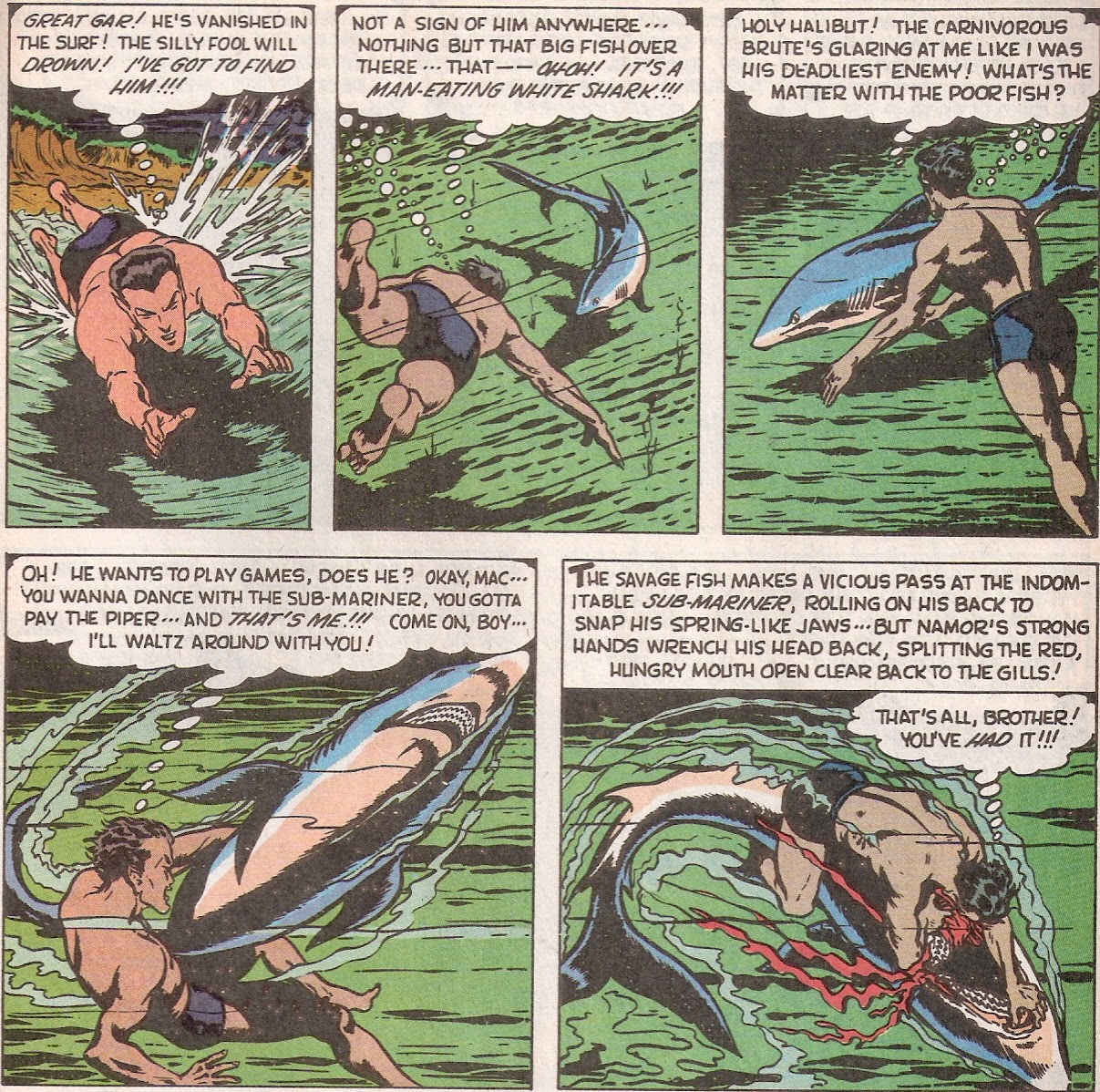
Doug: Later in the week, Namor is again on the beach at night looking for clues. A woman suddenly emerges from the waters. She's startled when she sees Namor, who hints at a theory he's developed about these strange goings-on. She's way too apprehensive, though, and turns on Namor. She lunges for him, but he evades and pins her to the ground. Letting her back up, she then narrates (in a whole lot of words) the explanation for our mystery, followed by its resolution -- you can find these panels at the bottom of the post. Too many art samples today, and to be honest -- I just couldn't get them to fit nicely together!

Doug: So where does this fit into this gray area between the Golden and Silver Ages? There are many elements of the 1940's -- teen sidekicks, lots of gunplay, and some serious violence (a woman is pistol-whipped in the Human Torch story). But the science fiction angles in both the Torch and Sub-Mariner tales place this a bit more toward the Silver Age. Of course, Cap's Red Scare-centered adventure falls right in between. I'd say this, though -- compared to the first few DC stories, including the Flash revival and subsequent stories, there's a lot more EC-type storytelling in Young Men #25 than we'll see only a short time later. Maybe that's why the revival of the Timely super-heroes didn't take off -- what is told here (and I'll have to assume in the other magazines that bore these new adventures) really doesn't require the presence of super-heroes for any resolution. The mad scientist in the first story could have just as easily been defeated by a Dick Tracy-type of character, and that holds true for the Cap tale. Namor, of the three, seemed most integral to the actual yarn that was spun. And what of the Comics Code Authority? Well look very closely back up at the cover -- notice the tiny star near the top left side of the book. In that little shape it says, "Conforms to the Comics Code". I guess as long as we don't have zombies or werewolves, we're good...


Sunday, January 26, 2014

Readers' Write (15): Who's the Best...Sub-Mariner Artist AND Version of a Character With Multiple Versions?


While Karen and Doug are on vacation in January, our readers have been entrusted with carrying on the daily conversations.  Today's "Who's the Best?" is a do-it-yourselfer.  As we've done in the past, the first commenter gets to pick today's topic of conversation.

Generally speaking, "Who's the Best?" is for historical topics.  For example, in the past we've started conversations such as "Who's the Best -- Thor Artist?" and "Who's the Best -- Frankenstein Monster?"  Start a conversation that is broad enough to elicit an ongoing conversation, and that even might lend itself to tangential musings.

Thanks for holding it down for us!

I'm going to exercise a bit of editorial control today.  Reader M.P. brought up the topic of the Sub-Mariner, which we discussed at length a few years ago.  However, frequent commenter Rip Jagger took M.P.'s mention of Jack Kirby's treatment of the character and turned the conversation toward Who's the Best... Sub-Mariner Artist?  That's a worthy topic, and one I don't think we've covered in the past.

Then our pal Osvaldo Oyola suggested a topic that plays off one we ran about 18 months ago when he asked Who's the Best... Version of a Character With Multiple Versions?

So that's what we're doing today -- two topics for you to mull over.  Thanks, everyone, for your participation over these weeks in January.  Karen and I return with new material next Saturday!

Doug

Wednesday, January 26, 2011

Finding Silver in Bronze: Marvel Super-Heroes 43


Marvel Super-Heroes #43 (May 1974)
From Tales to Astonish #88 (February 1967)"A Stranger Strikes From Space!"
Stan Lee-Bill Everett

"Boomerang and the Brute!"

Stan Lee-Gil Kane


Doug: Hey, look -- two days in a row with the Hulk! I know we've been really weak on ol' Jade Jaws on the BAB blog, but as I think I've remarked in the past -- I just don't have much Hulk!
If I had the dvd-rom, I'd be much more inclined to review more issues. But alas, until that comes to pass, you're going to have to make-do with guest appearances, etc. Today's fare comes from a Bronze Age lot I won on eBay over a year ago.

Doug: Our first story features Namor and is drawn by his creator, Bill Everett. The story has a real Golden Age feel to it -- in fact, on the splash page Stan quips: "Just for kicks we thought we'd try something different... an action-oriented Subbie tale with little or no psychological hang-ups or subliminal social significance! In other words, just a plain, fast-moving mystery yarn... like we used to do in the so-called "Golden Age of Comics"! It won't win any Nobel prizes, but we're hopin' that it grabs you!" Now, if that isn't a preemptive apology, I don't know what is. And to be honest, this story plays (and looks) like just that -- a story 20 years out of its time.
Doug: Here's the gist of the story: Namor whups Attuma yet again, so the barbarian sulks away with his tale tucked between his legs. He goes to his lair, where his lackeys egg him on to come up with a better plan to lay waste to Atlantis. Well, if fortuity is what you're looking for, you can't get much better than some advanced aliens who just happen to be speeding by the Earth when an engine of destruction falls out of a hatch and plummets to the Earth, landing right in Attuma's territory. I did not make that up. So the robot makes its way toward Attuma and the boys, they can't beat it, but do manage to subdue it long enough for Attuma -- the dumbest barbarian under the sea -- to monkey around with the control panel conveniently located on the robot's chest and reprogram it to attack Atlantis. Uh huh. Nice one, Stan. I'm telling you, this one wouldn't even have been worth Stan doing all of his jumping around his office acting it out. It's so lame, a one-sentence plot summary to Everett would have sufficed.

Doug: Next we come to the Hulk's portion of the book. You know, when I got this out to read, I'm thinking Gene Colan on Subby and either Marie Severin or Herb Trimpe on the Hulk. Nope -- Everett and Gil Kane. Don't get me wrong -- I appreciate the work of each man, and respect their contributions to comic book history. But given my druthers...

Doug: As the Hulk story kicks off, he's been declared a hero after defeating the deadly Hulk-Killer in the previous issue. The entire cast is assembled around him -- "Thunderbolt" Ross, Betty Ross, Glenn Talbot, and Rick Jones. But lurking in the shadows beyond the throngs of media is a garishly-dressed super-baddie -- the Boomerang! OK, exclamation aside, he's not that scary or interesting.
Truth be told, his power is no different than 100 other guys -- he throws projectiles that explode.

Doug: Boomerang launches one of those discs near the Hulk, startling him and setting him off; the environment had already been tense, and it didn't take much to get ol' Greenskin going. Of course Ross is all fired up and immediately flies off the handle. There's a very minor subplot involving none other than Tricky Dick himself -- Richard Nixon! Seems the President wants to pardon the Hulk if it's warranted, and cables Ross to inform him that if, under his authority, he feels that the Hulk should be acquitted of all charges the President will approve it. Fat chance!

Doug: The Hulk leaps away, but Boomerang follows. What basically happens to the end of the story is a slugfest, but with a twist. As they battle into the desert, Boomerang destroys a large dam, hoping to drown the Hulk.
Only problem is, Boomerang had subjected Hulk to a strong tranquilizer gas. Hulk sent Boomie reeling up against a mountainside, breaking his leg and destroying his boot jet. As Boomie yelped for help, Hulk/Banner was able to leap to save him, but couldn't hold him long enough to pull him to safety. As Banner took control, Boomerang seemingly fell to his death in the churning waters below.

Doug: I am pretty positive that if I'd seen this on the spinner rack when I was 8 I would not have bought it. The art is really bad, and even though I'm much more of an art aficionado, these stories are so lame it's really inexcusable. By 1968, there were a few writers in the Bullpen to take some pressure off of Stan Lee. He should have used them.

Monday, September 21, 2009

The Defenders: Non-team, or Avengers Lite?


Marvel Feature
#1-3 (December 1971- June 1972)

Writer: Roy ThomasPenciller: Ross Andru
Inker: Bill Everett (#1, 3); Sal Buscema (#2)

Karen: Most comic fans love super-hero teams. There’s something exciting about seeing a whole bunch of characters in one book. It’s easier to explain why the heroes are all together when they share a common background, such as the Fantastic Four or the X-Men. But more haphazard collections of heroes can also work, with team chemistry being manufactured, as in the case of many different line-ups of the Avengers, heroes who have no common ties other than the desire to fight evil.

Doug: Count me among those who have generally been a “group first” buyer. As a kid, I bought all of the titles Karen mentioned, as well as the Champions, the Teen Titans, the Secret Society of Super-Villains, and probably some others I’m forgetting. I always liked the interpersonal dynamics available in group books. While the solo heroes (Spidey, DD) could grow in characterization over the course of a series, there generally wasn’t the possibility for interplay between the hero and the cast – when he was the hero. Interplay was not a problem in a team book.

Karen: By the early 70s, Marvel had two very successful super-teams, the Fantastic Four and the Avengers. The X-Men had fallen into a period of near-dormancy, and other groups, like the Inhumans, never really caught on in their own books. With the increase in the number of titles Marvel was able to put out, it made sense to try to build another winning team.

Doug: Inhumans. Thank you. I knew I forgot to mention another book above. As for them specifically, I just don’t know how committed Marvel was to making them a success in their own book. Same thing for the Guardians of the Galaxy.

Karen: The catalyst for this would be Roy Thomas, the writer/editor who ushered in so many new concepts in Marvel’s second wave of success. Thomas had put together the uneasy team of the Sub-Mariner, Hulk, and Silver Surfer in Sub-Mariner #34-35 (Feb-Mar 1971), and the sales on those issues were better than usual. Marvel head honcho Stan Lee decided it was a good sign, and declared the team should have their own book, even coming up with the name, “The Defenders”.
However, he wouldn’t let Thomas use the Silver Surfer! The Surfer was his pet character and he didn’t want anyone but himself writing him. Instead, the third member of the team would be Doctor Strange. In retrospect, Thomas felt that this change worked out well, as Strange provided the glue that held the other two together. Recognizing the anti-hero nature of both Hulk and Sub-Mariner, and the unlikelihood of them forming any real team, Thomas defined the Defenders as “the non-team” – essentially, a group of guys who keep getting thrown together to face a common threat. Unlike the Avengers, the Defenders had no interest in staying together, but fate (and comic sales) kept them coming back.

Karen: Let’s take a look at Marvel Feature #1. The first thing one notices is the incredibly sketchy artwork! I always thought this was a terrible art job, and didn’t know why until recently, when I read the Marvel Masterworks Defenders,Volume 1.
In the foreword, Thomas explains that artist Ross Andru often drew multiple lines in his work, as if he couldn‘t decide where to stop. Inker Everett was apparently annoyed by this, and decided to just ink everything, giving the book a very rough appearance. It’s particularly painful with the facial expressions of the figures.
Doug: I read this for the first time for this discussion. I used the Essential Defenders, Volume 1 which is of course in black and white. While I am certain Marvel never intended to publish this story in one of their magazines, one almost has to wonder. As Karen says, it is such a departure from the usual linework. I’d also add that, if held to a visual pop quiz as to who the artist was for this story, I never would have come up with Ross Andru. While I’m a fan of his Amazing Spider-Man work from this same era, here none of the distinctive figures or faces are present. Bill Everett must have exerted quite a bit of influence on Andru’s pencils – perhaps Andru provided only lay-outs?

Karen: It seems from what Roy says, that it was typical for Andru to keep noodling around with his drawings, leaving multiple lines, and the inker had to pick which lines to ink! Apparently, Everett decided, “Screw it, I’ll ink ‘em all” as some sort of statement. But that didn’t go over very well when the inked work was returned!

Doug: No, it didn’t look good at all. You and I have complained on other forums that the modern-day John Byrne is scratchy – nothing like this mass of lines however.

Karen: I found the story to be rather pedestrian – the trio has to stop a foe of Strange named Yandroth who has built a device (‘the Omegatron’!) that will destroy the world. What kept me reading were the interactions between the three non-team-mates. Namor and Hulk both bridle at being given orders by Strange, who has a job more difficult than herding cats. At the end, they all agree that they never want to get together again – which of course they do in the next issue.

Doug: Call me a heretic, but sometimes Roy Thomas just isn’t the guy for the job. I don’t care for him on Spider-Man, and his Fantastic Four was only OK. I just thought he really had a tough time finding the different voices. I’m not a Dr. Strange fan by any stretch (never have been), but I found the dichotomy between having to save the world and intentionally and deceitfully pitting Namor and the Hulk against one another an interesting moral dilemma.

Karen: Doc’s treatment of the Hulk in particular was pretty arrogant. I do think I prefer the way Steve Englehart handled their relationship.

Karen: Marvel Feature #2 has a much more polished look, with Sal Buscema’s inking. The trio re-unites to defeat Dormammu and his minions. This issue also features Tom Fagan and the Rutland, Vermont Halloween parade, seen in a number of other Marvel books of that era, as well as a cameo by Roy Thomas himself. It’s funny, back in those days I got a kick out of comic creators putting themselves in books, but if anyone did it today I’d probably think they were an egotistical jerk! Oh well, different times.

Doug: I think that’s because some of them are egotistical jerks; why else would they think they have such free reign to cook in Stan’s and Jack’s kitchen the way they do? But I digress. I liked the Rutland Halloween stories that were in Avengers #119 and in Batman. Fun stuff – added some “real world” feel to the stories.

Doug: By this time, having read the pre-Defenders stories that had taken place in Doctor Strange, Incredible Hulk, and Sub-Mariner, I was getting a little perturbed that Dr. Strange’s baddies always seemed to be the villain du jour. How come he could give ‘em a beatdown by himself in his own book, but in Marvel Feature he needed help?

Karen: I found this issue much more enjoyable than the previous one. A large part of the reason for that must be the artwork. But I also thought this story was better constructed.

Doug: Agreed. Of the three issues we’re discussing, this was the “funnest”.

Karen: The team’s third go-round, in Marvel Feature #3, once again features Everett on inks, and again, I feel the art suffers. It’s not horrendous like the first issue was, but it lacks the smoothness that Buscema brought to Andru’s pencils.

Doug: I thought the Hulk looked dorky in all three issues. It seemed like his arms were too long, like he was drawn almost ape-like.

Karen: The Hulk definitely had a more monsterish appearance. Although Herb Trimpe was the artist on Incredible Hulk when I was a kid, I always liked Sal Buscema’s Hulk better. His Hulk seemed more capable of conveying a variety of emotions, yet he still felt big and powerful.

Doug: Yeah, I saw Trimpe’s stuff – I was never a regular reader of the Hulk. I agree with you in that when I think of the Hulk in the 1970’s, I see Sal’s work, or perhaps John Romita’s promo stuff.

Karen: This time the Defenders face Xemnu, a big furry weirdo who wants to kidnap Earth’s children and take them back to repopulate his own world. Xemnu had first appeared in Journey into Mystery #62, where he was known as The Hulk! Obviously, Thomas was having a little fun, digging this old monster out of the mothballs. It’s a quirky tale but pretty interesting.

Doug: Interesting that Stan cites Monsters on the Prowl #’s 11 and 14 for his footnote on Xemnu’s previous appearances. Marvel always was good at keeping older characters on the shelves in the pages of their various reprint mags. As for the story itself, I actually found it sort of annoying – I didn’t care for the astronauts or for Xemnu, and I just didn’t think Xemnu’s angle was ever really explained nor particularly rational (yeah, yeah, I know it’s a comic book…).

Karen: The Defenders would go on to their own title, and Thomas would hand the reins over to Steve Englehart. Sal Buscema would be the regular penciller, and the two of them would have quite a run on the book.

Doug: Both creators were at the height of their powers in this era. Good stuff couldn’t help but happen when they teamed up!

Karen: The Defenders was always a group that left me wanting more. There just seemed to be something missing. Considering the great characters that went in and out of the team – Dr. Strange, Hulk, Namor, the Surfer – there was the opportunity to leave a legacy of some classic stories. And yet, when I think about the Defenders as a whole, I can’t really come up with any truly great stories. You look at the FF, there’s the Galactus Trilogy and a bunch of great Lee/Kirby stories. The Avengers have the Kree-Skrull War, Under Siege. The X-Men have the Phoenix saga. But the Defenders? The Avengers/Defenders War was entertaining, but at least half of that was due to the presence of the Avengers. Yet I bought the book religiously as a kid, and enjoyed it. Steve Gerber’s run produced some stories that are memorable if for nothing else than their sheer weirdness. But classic Defenders stories? Outside of the aforementioned Avengers/Defenders War, I’m not sure there are any.

Doug: Just having read the Guardians of the Galaxy hardcover “Earth Shall Overcome”, which reprints (among other things) the arc that ran through Defenders 26-29, I can speak to those issues as a fun read. I bought those same issues off the spinner racks when I was a kid, and that’s about the closest thing to a “classic” story as far as I’m concerned. The book was always such a mish-mash of characters; it sometimes seemed like a “Marvel Seven-In-One” book. However, it was generally fun, and I liked getting my dosage of Dr. Strange and the Hulk, since I never followed them in their solo adventures. But time does tarnish those fond memories, doesn’t it?
Related Posts with Thumbnails