Showing posts with label D&D. Show all posts

Friday, 20 December 2013

Ian Livingstone and Steve Jackson Seminar: D&D, Games Workshop and Fighting Fantasy

Today's post needs little introduction. Its a video of Ian Livingstone and Steve Jackson discussing D&D, Games Workshop and Fighting Fantasy. It was recorded at Dragonmeet (the big roleplaying event in London) and is well worth a watch. Its quite lengthy, so I'd advise a tea, coffee or a beer before commencing your viewing. If you are on holiday now, like me, its the perfect little video to relax to. 

Enjoy. 


Orlygg

Sunday, 20 October 2013

D&D, WFRP and the birth of a fictional God: A (short) Interview with Phil Gallagher

Eye of the Beholder, and games like it, were my first contact with TSR and Dungeons and Dragons. Sadly, by this time the UK division was no more. 
Some months ago I began a very interesting dialogue with Phil Gallagher, one of the authors of the immortal first part of the Enemy Within campaign among many other notable works and roles. I found Phil to be an incredibly articulate man, full of stories and with the skill to tell them. No wonder that Mistaken Identity, Shadows over Bogenhafen and Death on the Reik were the milestones that they were! Now our conversations steered wildly all over the place before other commitments put the discussion on hold. 

His thoughts on his early days at TSR UK remained safely stored in my draft folder for quite sometime until I became interested in researching '80s British Fantasy gaming on a wider scale, inspired largely by the recollections of Paul Cockburn. As we have learnt, there was quite the influx of staff from TSR UK to Games Workshop after Dungeon and Dragons module writing company was dissolved. Many a name that would later be tied to WFRP and other GW products can be seen in the credits of the British D&D modules. But there wasn't much actual information on the company itself, or at least, I couldn't find any. 

Then I stumbled across a fantastic blog called Random Wizard, which published an interesting little article about TSR UK and I have quoted it in full below. It serves as a far superior introduction to Phil's recollection than anything I could write.


"The UK branch of TSR had an even shorter history than the parent company of TSR (and nearly as troubled in its ups and downs). There is a dearth of information regarding TSR UK Ltd but hints of what happened across the pond can be gleaned from interviews and other sources scattered around the Internet.

The excellent interview by Ciro Alessandro Sacco teased some information out of Gary concerning the European operations.

http://www.thekyngdoms.com/interviews/garygygax.php

It seems that Gary had a different vision of how to expand operations than what eventually occurred. Gygax seemed keen on working with local hobby shops, established residents of the area to give each TSR division its own local flavour. TSR's original presence in the British market was through Games Workshop (Ian Livingstone and Steve Jackson). When TSR's proposal for a merger with Games Workshop fell through, TSR UK was born. March, 31 1980
          Not merely an outlet for distributing material made by TSR in the states, the UK division of the company was tasked with making their own brand of modules and accessories. And what an impressive line up they made...

Fiend Folio, 1981
U1 Sinister Secret of Saltmarsh by Dave Browne with Don Turnbull
U2 Danger at Dunwater by Dave Browne with Don Turnbull
U3 Final Enemy by Dave Browne with Don Turnbull
UK1 Beyond the Crystal Cave by Dave Brown, Tom Kirby, and Graeme Morris
UK2 Sentinel by Graeme Morris
UK3 Gauntlet by Graeme Morris
UK4 When a Star Falls by Graeme Morris
UK5 Eye of the Serpent by Graeme Morris
UK6 All That Glitters... by Jim Bambra, 1984
UK7 Dark Clouds Gather by Jim Bambra and Phil Gallagher
B10 Night's Dark Terror by Jim Bambra, Graeme Morris, and Phil Gallagher
O2 Blade of Vegeance by Jim Bambra, 1986
X8 Drums on Fire Mountain by Graeme Morris and Tom Kirby
CM6 Where Chaos Reigns by Graeme Morris, Jim Bambra, and Phil Gallagher
I8 Ravager of Time by Graeme Morris and Jim Bambra
AC9 Creature Catalogue, 1986

So what would have happened if this format for expansion had continued? A really telling response that Gary gave, outlines how he expected to make a TSR France division to be headed by Francois Marcela Froideval (who later went on to write the Black Moon Chronicles). I rather like the idea of TSR expanding out on a country by country basis, with each division having its own particular flavour (much like the TSR UK modules were unique onto themselves). What would have been the next step? TSR Japan-- imagine anime infused modules and a more detailed version of Oriental Adventures. Then TSR Germany-- dark forest, witcher style flair.
       Sadly, it was not to be. Shannon Appelcline wrote an insightful commentary for the recent product description of UK7 Dark Clouds Gather.The Final Fate of UK. So why did the UK series end? It certainly wasn't due to sales. Imagine #30 (September 1985), published shortly before the release of "Dark Clouds," claimed that "after the Dragonlance epic, the UK modules are the best-selling series both here and in the USA."
       Ultimately, the UK series was probably doomed by TSR's financial problems of the mid-80s and the changing tides at the company - as Gary Gygax left in 1985 and Lorraine Williams took over. There were many changes in the surrounding years, with the upset in the UK offices being just part of that larger turmoil. TSR UK's Imagine magazine died first, after issue #30 (September 1985). Following that, the shutdown of TSR UK's creative division was just a small step."


Now we get on to Phil himself, as I said earlier, the interview was quite short, but was fascinating. I felt that rather than sitting on the text for any longer, I would share it. Hopefully, some time in the future we can complete 'Part Two' and really get to grips with the development and writing of the Enemy Within Campaign but this will have to serve for now. Can I just say a HUGE thank you to Phil for taking the time out to contribute to this blog and to the wider Oldhammer Community as a whole. I really do find it startling that we are barely two years into this little 'movement' as we have connected to some many of the authors of 80s Warhammer (and beyond).

Over to Phil....

RoC80s: If memory serves, you were on the TSR UK team by the mid 80s. Describe the journey from your young gaming self to a fully fledged member of a design studio, your influences at this point etc.
PG: I didn't get involved with fantasy gaming until my 3rd year at Cambridge in 1981 or so. I'd heard about D&D but didn't really know what it was, and I'd never done any miniature wargaming beyond playing with WW2 Airfix models as a kid. I was a huge Tolkein nerd - had read everything in print at that time, including the Silmarillion and Unfinished Tales, learnt the Tengwar, and Dwarfish runes - the whole nine yards. But outside of that, apart from a little Harry Harrison, the occasional Larry Niven (and Ursula Leguin, of course) I was not a huge fantasy or sci-fi fan. I thought Lovecraft was tedious in the extreme, I found Howard and Moorcock two-dimensional, and I hadn't even heard of Dune at that time! (I know, I know, how did I ever get a job at GW!?) I bought a copy of Basic D&D but couldn't quite get my head round how to run the module that came with it at that time (I think it was probably "The Keep on the Borderlands") - there were no real instructions about "how to be a DM", and I couldn't find enough saddoes to play with, anyway! Then I ran into a group of people who all wanted to play, an experienced DM, called Chris Moore, and that, as they say, was that. Chris was a great DM, we had fantastic fun, playing hours and hours at a time, and my starred first (that's the UK equivalent of a 4.0 GPA) was sacrificed on the altar of the great Gygax...   After graduation, I was struggling to make ends meet when I saw a job ad in White Dwarf for someone to join the design team at TSR UK. By luck, they were based a few miles way in Cambridge, and I thought "what the hell - might as well apply!" I was amazed to get an interview - with Tom Kirby and Graeme Morris - and even more surprised to be offered the job. Faced with a choice between being a starving, mostly out-of-work actor, or a paid lackey of TSR, I took the money! 
The early days were a fantastic time. When I joined the business, UK2 was just being put to bed - it was a case of final proof-reading, sticking in the pictures and then shipping everything off to the US for printing.
It was my first "proper" job after university and I enjoyed it immensely. The people were all very friendly and welcoming, the offices pleasant, and I had money in the bank. I learned about word processing (we used WordStar on some kind of IBM terminals, I think, with 12" floppy disks!), and DOS, and photo-electronic typesetting, and page design, and paste-up - state of the art, technology it was! 
Jim Bambra joined the team shortly afterwards and he has to take responsibility for introducing me to miniature wargaming. Outside of work we played a lot of Traveler, including 15mm Striker, and later moved onto Command Decision - at 6mm scale.
Jim and Graeme were the main writer/designers at TSR UK - I was principally editor, proof-reader, production guy, liaising with artists, and preparing materials for printing in the US. Jim always wanted input and suggestions and, over time, we developed a very collaborative way of working. He tended to be happiest starting with a blank sheet of paper, and I liked to fill in gaps and hone and polish. 
We all felt that we had a ridiculous number of hoops to jump through to please our US masters who had the final word on what we could and could not do. That would not have been so bad, had we not constantly encountered material from the US that clearly broke all the rules we were told were sacrosanct. One of Tom Kirby's roles at this time was soothing the outraged indignation of the UK design staff!


It was this omnibus edition of the first half of the Enemy Within Campaign that I recall playing with great affection. The journey through the von Wittengenstien castle was particularly terrifying, and I was the GM!
RoC80s: Were you part of Paul Cockburn's poaching of Imagine staff or did you join GW by some other route?
PG: The sequence of events - over a period of a few months - was:
1. TSR Inc closed down Imagine magazine and a half-dozen people lose their jobs. Graeme, Jim, and I were shocked when we heard the news. We had no idea it was even being considered. It was very unsettling, and left a big hole in the place.
2. Paul tried free-lancing for a bit and then landed a job at GW, just as Bryan Ansell was in the process of moving the publishing from London to Nottingham.
3. Tom Kirby left TSR UK to go work for GW. Jim and I, in particular, felt very exposed by his departure - he was one of the good guys on the management side, and it seemed that the writing was on the wall for TSR UK as a whole.
4. I called Paul in Nottingham to see if there were any jobs going. Graeme, Mike, Jim, and I were all interviewed by Bryan - pretty much en masse - and he offered us all jobs. It felt like there was a future at GW, a much flatter hierarchy, less politics, and the opportunity to be in "on the ground floor" as WFRP was created, so it was a pretty easy decision. Only Graeme decided he wanted to stay in Cambridge, but there were no more UK D&D modules.


Find Sigmar's Hammer? Who was this Sigmar bloke anyway?
RoC80s: One of your first roles was the further development of WFRP. How did you find the game when you began work and what input did you put into the finished product?
PG: How did I find the game? I just switched on my Amstrad word processor, and there it was - disk after three-inch full of files! I was little disappointed, and definitely surprised, at how much of WFRP had already been created when I arrived at the Design Studio in Nottingham. 
"Design Studio". It's a term that conjures images of stylish open plan rooms with lots of natural light, minimalist furnishings, and lots creative people with pony tails, sitting at drafting tables. Well, Enfield chambers wasn't nothing like that! True, the top floor had lost of drafting tables where the "paste-up"artists and graphic designers beavered away at page design and logos ("it needs another black keyline," was the standard comment from Bryan), while the typesetters turned the word processed documents from the writers into long 'galleys' of text. But then there were the miniature designers, mostly crammed together in one room on the second floor (although Kev "Goblinmaster" Adams had to be kept separate for some reason). I see them, through the distorting lens of memory, at high stools in front of customised wooden "desks" with a big curve to them, bent over green stuff, which they somehow manipulated onto wire armatures with dental tools (or at least that what it looked like to me!). Their tables were covered with bits of cork, castings of heads, weapons, brass rods, and so on. Finished pieces were "cured" under the heat from an angle-poise lamp. Us newbies from TSR were in a large office with Graeme Davis and I'm not sure who else! Marc Gascoigne (now of Angry Robot books), for sure was there. Richard Halliwell (Hal) was always wandering in to banter with us, but I think he and Jervis Johnson, and Paul Cockburn all had separate offices. Rick seemed to be mostly closeted in his little office pecking away at the computer, writing. Nothing if not prolific, Rick (perhaps because he didn't get constant interruptions from Hal!). There was an old dining table in the middle of the room - for conferences and bits of play-testing - its surface pock-marked by the tip of Chaz Elliott's big knife which he liked to hammer between the outspread fingers of his left hand with scary rapidity. And there was a battered old sofa (on which the same Chaz Elliott was supposed to have spent the night, when he left it too late to go home!) There were a lot of smokers back then, too, so the atmosphere was pretty fuggy, and the whole place was closer to a warren, than a "Design Studio"!
Anyway, I'd arrived thinking I was going to be part of creating "a better D&D", only to discover the rules were mostly written, and it was basically a more detailed version of Warhammer Battle. I wasn't a fan of percentile-based systems, and found the combat system a bit clunky for the kind of fast-paced roleplaying games I was used to. The magic system, in particular, seemed to me to be much more about mass battles than for small parties of adventurers, and I worried that, in the draft we were faced with, wizards would have too much power too easily. I felt like the Irishman in that joke where he gets asked by the tourist how to get to Dublin. "Well, I wouldn't start from here," he replies. If the idea was to create a roleplaying game to supercede D&D, I wouldn't have started with much of the material we were presented with. But it was too late to start again. And what did I know, anyway? I'd worked on a handful of D&D modules, and played a lot of Traveler. So, faced with the tons of stuff already written, and under pressure to get the thing finished and published, Jim and I focused more on giving the rulebook some structure, fleshing out the guidance for new or inexperienced GMs, and making the more powerful magics as hard for player characters to get as we could. 
As I recall now, the bulk of my work was editing and tweaking, rather than generating new material. I worked hard to make the rules as clear and unambiguous as I could - but feared the thing was going to be, basically, impenetrable! The thing, all these years later, I'm most proud of, was coming up with the idea of a hero who, in the distant past, was credited with uniting a bunch of warring tribes to found the Empire. Since that part of the Old World was kind of a parallel of the Holy Roman Empire, with a strong Germanic feel, I was originally going to call him Siegfried - after Wagner's hero from the Ring Cycle. In the end, I think I thought the link would be too obvious, so I opted for Sigmar. 
Jim and I had already decided to develop The Empire as the setting for the campaign we wanted to publish, so I expanded the description and background of the Empire in the rulebook, and tried to sow some seeds that we could use in what became The Enemy Within. 
I desperately wanted the rulebook to have a usable index and helpful cross-references (all my manuscripts were always littered with "(see page XX)"). However, the printing process we used in those days meant we had no way of knowing what the page count would be and what would be where, until the thing was well into production. So the index was dropped, many of the "(see page xx)" were excised, and some of those that remained never got an actual page number inserted instead of the xx!

To be continued....

Hopefully!

Orlygg

Saturday, 3 August 2013

Imagine: An Interview with Paul Cockburn

From White Dwarf 97
Change is inevitable and inexorable. It is unavoidable and sometimes unforgiving. But when speaking on this most subjective of topics, the great American motivational speaker and author, Denis Waitley, had this to say: "You must welcome change as the rule but not as your ruler." 
Change was afoot in the world of fantasy gaming in the mid nineteen eighties. Dungeons and Dragons, the most influential and far reaching game of its type, ever, was passing through its 3rd revision. In Britain, Games Workshop, the incredibly successful publishing and merchandising company, was undergoing a period of flux. Two of its founders, Steven Jackson and Ian Livingstone, had made themselves household names with the phenomenally received Fighting Fantasy books and needed to pass the running of their company to somebody else. In the end, their General Manager, Bryan Ansell of Asgard, and later Citadel Miniatures, fame bought Games Workshop outright and sensing that the tide was about to turn against the age of role-playing, sought to expand his company through wargames and the metal miniatures that went alongside them. Games Workshop had been based in London for over ten years. It had its own team, with their own contacts and freelancers, in the heart of the capital. But Citadel Miniatures was based in Nottingham, and the new owner was convinced that everything under the new GW brand needed to come out of that Midland city. 
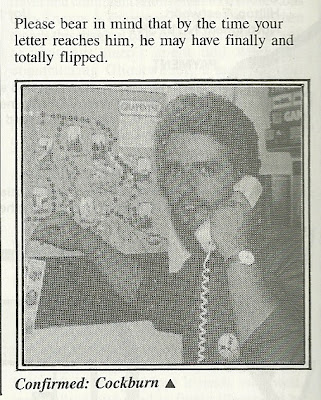
Imagine, the UK based Dungeons and Dragons magazine, had folded in 1985 after 30 odd issues. The magazine's remit had been to take on White Dwarf as the source of infomation and opinion about all things gaming, focusing on official D&D and AD&D rules releases. And through the years between 1983 and 1985, the magazine had published a wide range of different materials, most notably (in fantasy gaming) the Pelinore game setting. Neil Gaiman, the influential author, wrote film reviews for the magazine, a later published his first short story within its pages - Featherquest. The editor of this magazine was one Paul Cockburn. After trying his hand at an independent gaming magazine called Game Master, he was out of a job and a series of events, discussed below by the good man himself, found him put in charge of the mighty White Dwarf itself and given the inenviable task of moving the established magazine (and its properties and staff) many, many miles to the north of the country.
What follows is his story. A story of change. And resistance to change. The story of the 3rd editor of White Dwarf (after Ian Livingstone and Ian Marsh) who witnessed the biggest change in GW history.
RoC80s: Tell us about how you got into fantasy gaming/roleplaying in the first place and how this lead to working in the industry?
PC: I'd always played games as a kid, and I recall from some of those that me and my mates always used to 'roleplay' even if that isn't what we called it, and even if there were no rulebooks, dice or minis involved! But then I went along to one of the old London Games Days - this would be in 1981 or 1982. I bought a copy of Basic D&D, and we played it that night. With no-one to guide us, it was a completely different beast to anything I played since! And then I think there was an ad in the paper from TSR UK, who were in The Mill in Cambridge, for an editor for their new magazine, Imagine. I went up, interviewed, and though I didn't get the job, they took me on as Assistant Editor. Even before the first issue, the original editor was fired, so then I was in the hot seat! We just made everything up as we went along, determined only that we would try and muscle in on White Dwarf's circulation numbers.
RoC80s: Who was at TSR at the time you began working there?
PC: There was a photo kicking around on Facebook not that long ago, and a few of us were trying to remember everyone! The late Don Turnbull was in charge, and Tom Kirby, who went over to GW very shortly after I did, and who bought GW some time after I left, was the Carter to his Regan. The editorial team had Graeme Morris (the one I couldn't poach), Phil Gallagher (who took over my portfolio at GW when I left, and did pretty well in the USA), Jim Bambra and Mike Brunton, who followed me to the WD chair. Keith Thompson arrived to have editorial oversight, and Kim Daniel was editorial assistant, while Phil Kaye was graphics and art dude. The sales people and almost everyone there were decent people. I was genuinely sorry to leave The Mill when I was made redundant.
Issue 2 of Imagine
RoC80s: How did you come to work for GW? Were you headhunted? Did you apply for a position?
PC: I might not remember this all perfectly, but after Imagine was closed down (a juicy story in its own right), I played around with my own magazine for a while (GamesMaster Publications), and at some point, after a conversation with Ian Livingstone, I was 'interviewed' for a position-that-didn't-exist. Some while later, I spoke with Ian again, and he asked why I hadn't joined GW. I told him, and he suggested maybe he had put me in touch with the wrong person. I was interviewed by Bryan Ansell, and they made me an offer I couldn't refuse.
RoC80s: Tell us more about Imagine magazine. Was there an ethos other than 'muscle in' on White Dwarf? And what was the 'juicy' ending that you hinted at?
PC: Hmm... well, Imagine was going to be a British Dragon magazine, according to plan. Don wanted to create product in the UK, and he wanted a magazine. So, we had the UK series of AD&D modules, and Imagine. I think the point was that Don was a real contemporary of Ian Livingstone and Steve (UK) Jackson and wanted their level of kudos. So, we tried to make Imagine bigger and better, and since we had D&D, how could we go wrong? We'd clawed up to about half WD's circulation by the time we closed. Basically, the UK operation really couldn't sustain all this activity, and there was a level of... ummm... creative accounting when the time came, that pushed all the losses onto the magazine (or so I was told at the time by a very unhappy accounts lady). Don didn't last too long after that - he'd blown it with the powers that be in the USA, but by then the magazine was gone. A shame. I thought we were nailing it a lot of the time in the year before we closed.
Roc80s: You were working for GW doing the (still) controversial  move from London to Nottingham. What are your recollections about this time?
PC: Ah... now that was all a bit rubbish. Let me see. Day 1 of my new time at GW, and only 10% moved from Cambridge to Nottingham, BA sent me to London with a brief to move White Dwarf up to Nottingham. I was to audit all the gear, speak to someone about shifting it all to the Design Studio, and see what staff were willing to move. The crew on WD, well, only one of them was really willing to entertain the idea, and I think we all knew I'd gone there with a 'move or leave' offer. I'd always got on well with the likes of Paul Mason and Ian Marsh, but this wasn't the best conversation we ever had. So, I ended up having to edit White Dwarf because we had no staff! I poached the editorial team from TSR to come join us. I've no real view on whether closing all the London operation was a good thing or not - it was just going to happen. Bryan and Citadel were now in charge, and that meant Nottingham.
RoC80s: Your were Editor of White Dwarf from issue 78 to 83. What did the job involve at that time?
PC: Ha! Did I only do five? I really didn't want the gig, and if it shows in those issues, I apologise to all who had to read it. It was already clear that content was going to change. All non-GW product was going to be phased out, the focus was going to be on miniatures and painting, and WD was on its way to being a GW catalogue. I really didn't want that, and I think already you could see the signs that I was just not a GW kinda guy. I believe in gaming and a wider hobby, not just Warhammer and all that. I hired Mike Brunton from TSR to take over from me, so he really got the short end of the stick. What did it involve? A lot of talking about painted miniatures, and the photography thereof. We had some drama around reviews of other products - GW still had partnerships going with the likes of Chaosium and West End Games, so we featured their stuff. But Bryan had a plan I really hadn't bought into, and so I really was just a caretaker for WD after the move up from London.
Paul was responsible for several classic issues, including the iconic WD 79
RoC80s: Could you expand on the dramas you had around the reviews in White Dwarf?
PC: I don't have clear memories on all this, but I had a few scraps with Bryan over policy. And by the time I handed WD on, it was clear things were heading in a direction that would see the magazine only feature GW product. Along the way, we had a guest over from the USA, and we then proceeded to trash a product that he had written, in a WD review, pretty much while he was in the building. Stuff like that just showed we couldn't sustain a level of independent editorial policy. Everything was political.
RoC80s: Apart from editing the magazine, what other roles did you have during your time at GW.
PC: I'd gone up there to take on a wider editorial role, because there were big publishing plans. Warhammer (presumably 3rd edition-Orlygg) was in its early drafting stages, and then the TSR boys started work on WFRP, and Rick Priestley got started on 40k. We published Blood Bowl and loads of other cool games, some great hardback Runequest stuff, and so on. That's what I wanted to do, and the Publishing Manager thing was great for me. But I got involved in more and more battles, and then get side-lined onto a Special Projects department of one. I was pretty much out of the door from then on.
RoC80s: Many people that I have interviewed about life in the Design Studio have had very positive things to say about there time there. Is this a view that you share?
PC: Nah, not really. I mean, we had some excellent days, and produced some ace product (as well as some dross), but there was a management ethos there that was just moronic as far as I was concerned. I didn't like the strategy the company was following, but that wasn't really my biz. All my battles were fought around the games we published. I'm sure a lot of people who knew me then have memories of me being an arrogant, opinionated prick, and they may not be 100% wrong. I wanted to lead the editorial arm of the most creative games publisher there could possible be. Instead it was snotlings and goblins and all that. Apologies to anyone reading this who loved or loves their Warhammer or their 40k, but I hated them then, and I've ignored them since. I live in NZ now, and there is a GW store in my local city. I look through the door now and then and it just makes me feel old. It doesn't feel like anything ever moved on. I did - I sold what was left of my soul to the marketing profession. I only keep in touch with a very small number of people from those days, but I am glad I met the people I did in the games industry. I still play a lot of stuff, and I'm grateful that I saw that newspaper ad. It probably didn't do me a fantastic lot of good, career-wise, but I wanted to be in publishing, and I loved games. This particular chapter just didn't play out well, I guess.
RoC80s: You mentioned a dislike for Warhammer and Rogue trader, but mentioned other games more positively. What exactly was your contribution to the many games published during your time at GW?
PC: I had editorial oversight on quite a few things at the start. I tossed some ideas into WFRP, like how the Empire was set up, and edited Warhammer pretty hard. 40k, no, that's not me at all, but Blood Bowl has my editing stamp. I also interfered with a few of the boardgames, most notably Blood Royale, which may not have been my finest hour. Bits and pieces of my writing appear in a few products from that era, but I don't tend to have writing credits... I was just the guy in charge of that department. Kinda. Except that 'in charge' was always a bit of an odd concept. GW at that time ran under the Darwinian management philosophy.
And so the story ends. I am sure that you will join me in thanking Paul in giving up his time to be interviewed by this blog. After all, it cannot be easy to regurgitate memories for 25 years since when you are living a different life on the other side of the planet. I for one found his story fascinating, and learnt a great deal about the origins of Bryan Ansell's GW and the impact he had on the direction of British Fantasy gaming. 
I began this article with a quote. Denis Waitley's; "You must welcome change as a rule but not as your ruler." Certainly a view that Paul took in his approach to the industry. He clearly was (and is undoubtably still) a man not ruled by change. 
Have you been inspired by something you have read here today. Do you have an opinion on Imagine Magazine? Were you a reader, or indeed, a contributor? Or the shift in gear that GW took from roleplay to in house wargaming? If so, please share what you know below. 
Don't be scared.
The Realm don't bite!
Orlygg.

Friday, 14 June 2013

'80s Roleplaying Television Programme. MUST WATCH!

Have you ever wanted to watch Steve Jackson and Ian Livingstone, founders of Games Workshop, playing Dungeons and Dragons with a youthful (but impressively deep voiced) Jervis, creator of Bloodbowl, Johnson and the dishevelled writer of Blackadder, Ben Elton?

Well now you can!

Or perhaps a stroll through the original Games Workshop store to gaze in wonder at row upon row of classic 80s boxed RPGs, early Citadel miniatures, original art works and interviews with members of the Games Workshop team - and one or two of their customers?

Well now you can!

Or indeed, do you have a fascination with Live Action Roleplay, or remember fondly the thrill of entering dungeons weilding a sword you constructed in your kitchen out of several toilet tissue tubes, silver foil and cellotape? Did you Treasure Trap even?

Well, Realm of Chaos 80s has a video for you!

What I am about to share with you, in three parts, is an edition of the news programme, South of Watford made in 1984. It attempts to deal with the, by then, booming fantasy game market and the growth of Live Action Roleplaying. Strangely, its presented by Ben Elton as is well worth a viewing, especially the first video which seems to have filmed in the original Games Workshop store in London.

Do yoyself a favour. Make yourself a drink, find a quiet corner where you will not be disturbed for the next 30 minutes or so ans enjoy the programme. Can you spot a copy of First Edition Warhammer in there?

Enjoy,

Orlygg.