If music fans had Epstein and the Beatles... Who do we wargamers have as our Svengali?
Well, none other than the Malcolm McLaren of the Rules Mechanic himself; the prolific Rick Priestley! Now, if you've pushed models around a wargames board over the last 25 years or so, then no doubt you've played a game written by, or at least influenced by, Rick.
Effectively (and collectively), we owe him a debt of gratitude for his hand in creating the modern wargames scene. And so to repay his part of this debt, Orlygg dressed up in his chaos armour, took a Rennie to tame his uncontrollable flatulence, mastered his silly walk and terrified the famous games designer into giving an interview for this blog. We discuss life in the GW studio during Bryan Ansell's iconic tenure, Rick's work on WFB3 and RoC and what he has planned for us with The Gates of Antares - which in my view, has the potential to be the most exciting thing to happen to wargaming in 25 years.
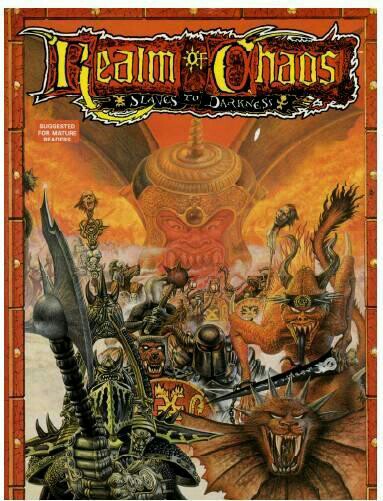 |
| Realm of Chaos had a chaotic development cycle that was legendary. |
RoC80s: When I approached you about doing this interview, you described beginning work on Lost and the Damned, after a few false starts, rather reluctantly. Does this mean that working on the project was a negative experience for you?
RP: Not quite – the RoC project had been around for a number of years and had passed through various authors and collaborators – none managing to do a job that Games Workshop’s then owner and boss was happy with. So it was something of a poisoned chalice really – with a long list of broken games developers and writers on the casualty list.
RoC80s: Realm of Chaos is famous for having a very contravolted development; it was first mentioned as a supplement to Warhammer 2 (IIRC) in '83 but didn't rear its head until '88. Why was this? Was it simply studio 'tradition' as Rogue Trader, WFRP etc suffered from a similar treatment?
RP: Yep – like I said – it had been around for a number of years! In fact, I had the first version well underway in 83 and we had a cover and everything – but in the end we decided to push ahead with WH2 instead and RoC had been written for WH1 – so we passed over it until we could get back to the idea. Then other things came up so that didn’t happen for a while! Then 40K was such a success that it was decided that RoC had to have 40K in it as well as fantasy – so that meant writing huge amounts more – so it became a bit of a monster really.
 |
| "Anyone fancy a kebab?" |
RoC80s: The Lost and the Damned saw you contribute short pieces of narrative fiction. Were staff encouraged to provide these or had they been written for any other purpose? Also, why no further fiction writing from yourself?
RP: Yeah, we all just knocked out the odd bit of text either to fill space where artists hadn’t managed to supply a drawing or to try and capture something of the quality of the world. At the time we had the first version of the Black Library going too, and some of our professional authors were commissioned to write short pieces – and that all helped I think. Actually I’ve written loads of narrative stuff for various projects over the years –we didn’t really think about it at the time – the GW writers in those days were a pretty literate and well-educated bunch – and this at a time when only about 5% of the population were university educated. I mean - we had three archaeology degrees between us! Phil Gallagher could speak Russian and Persian for goodness sake! So turning out short fiction was just part of the job to be honest.
 |
| Dark Future paintball anyone? |
RoC80s: There is also much debate about abandoned projects during the period we are discussing. Can you recall any 'almost made its' that never saw the light of day?
RP: Oh let me think… Richard Halliwell had a number of projects about that time which never made it past the finish line. They included an early version of Fantasy Epic, a spaceship game (proto-Battlefield Gothic), and a Doctor Who board game that featured revolving board segments representing different time zones. These segments articulated against each other during play facilitating movement between them – I think the licensing deal fell through on that one. We had a series of board games planned for release in the High Street – these were based on classic games like Snakes and Ladders and had beautiful artwork by Wayne England – I mean the most gorgeous drawings in the style of children’s book illustrations, really jewel like. The two I remember – aside from Snakes and Ladders – were The Great Race Game – vaguely based on an Around the World in 80 Days theme – and a version of Stratego which was to be called Offensive. As the whole series was to be styled ‘Wayne England’s’ such and such – e.g. ‘Wayne England’s Great Race Game’ - I do wonder what Wayne would have made of Wayne England’s Offensive! There was also a mad plan to start a new company that would do live action role-playing (i.e. paint balling) set in the Dark Future world. We all dressed up in Mad Max gear and sloped off to a wood to pot at each other with paint guns. Unfortunately no one thought to mention this to the local constabulary, and when the natives saw the GW crew running round with guns… well. The police were very understanding!
 |
| Just don't mention his dice roll modifiers..! |
RoC80s: You've gone on the record (maelstrom interview '11) that you felt that the third edition of Warhammer was the least playable, yet it remains the most fondly remembered. The passion and popularity of this book lies behind our group. In hindsight, do you consider this edition to be a failure in your view of what you (and your colleagues, such as Richard Halliwell etc) had in mind?
RP: No, I don’t see it as a failure at all – and we certainly didn’t at the time. I don’t think that we were at all concerned by the stodgy gameplay and extreme complexity when we produced WH3 and I don’t think anyone else was either – and as you say the passion and energy does come across better in that book than in any subsequent editions of the game. I think that’s right. I just don’t think it’s a very playable game when it comes down to it – the push back movement within the combats is tortuous – the combat resolutions swing wildly because of the double variable ‘to hit’ and ‘to kill’ – which meant that combats could often drop to 2+ followed by 2+ or 6+ followed by 6+. And all those modifiers – modifiers at every stage of the dice roll – to hit, to kill, save… really sluggish stuff! The next edition was way more energetic and actually got people playing Warhammer again (sales had really slumped prior to that). The trouble with the 92 version (4th) was we didn’t have any money because we’d just had the GW management buy out and suddenly we owed the venture capitalists £10M – so there was just no spare cash for anything. We’d gone to an early dtp system, which wasn’t as professional as the old typesetter (but reduced costs as it meant we didn’t need the extra staff), we had fewer artists, and we couldn’t afford the colour (the colour sections were exerted from WD to save money). There were also fewer design staff actually working on the game – pretty much just me with Jervis, Andy and Nigel helping. For 3rd we had half a dozen dedicated writers and another half dozen willing bodies – so we were able to do a lot more.
RoC80s: Didn't you sculpt the war machine for the goblin chiefs chariot in the early '80s? I am sure I've heard on the scene that it was signed by you good self? If so, did you sculpt anything else in the Citadel range?
RP: I sculpted the spear-chucker – because I wanted a spear chucker and we didn’t make one at the time – it wasn’t terribly good though I must confess! I did make a few pieces in the early days but mostly straight-line work: treasure chests, weapons, and a range of spaceships some of which survived for years in our general spaceship mix. Before I worked for GW I sculpted for Tabletop Games and Asgard – but it was a long time ago – expectations were not high in those days!
RoC80s: Having interviewed other people involved in GW during this period, they describe the atmosphere in the studio as being very creative and supportive, as well as being very loosely controlled when it came to design. Is this a view that you share?
RP: Erm… well the RoC books extend over such a long development period that the atmosphere in the studio probably went through some changes to be honest. But when we were in Enfield Chambers (prior to 91) the studio was a very easy going creative environment to put it mildly. We were left to our own devices for much of the time, and Bryan Ansell (owner and boss) pretty much kept the creative part of the business separate from the manufacturing and sales part. Bryan was a very creative and ideas driven man – I don’t think he’d mind me saying that – he always wanted to make great games with interesting mechanics and stimulating ideas – and he didn’t mind investing in creative staff. He was a real patron of the studio and took a real interest in all the models and artwork. Bryan always said that if the studio ever had to mix with the manufacturing and sales part of the business it would destroy the studio. And I have to say – he wasn’t wrong there! The modern studio isn’t a studio in the same way; it isn’t a collection of artists and creatives sharing ideas and driving each other on. It’s become the promotions department of a toy company – things move on!
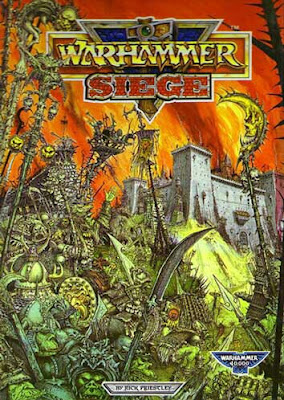 |
| Polystyrene castles anyone? |
RoC80s: The other Warhammer third edition supplements, Armies and Siege... Were these planned from the start or originated from elsewhere - like having to sell a polystyrene castle?
RP: I think we’d always wanted to do those things and the castle just provided the opportunity. We didn’t really plan much. We were very reactive in those days, but we were full of ideas so it was always just a case of picking something and going for it.
RoC80s: Right, fast forwards twenty five years... The way you have approached GoA is very novel, involving the players themselves in the design. Has this been something that you have wanted to do for sometime?
RP: I’ve always involved players in games design – it’s just usually those players are my mates or groups I’ve come to know and rely upon for feedback and help. With Antares we’re trying to extend that group via the internet and it just seemed like a good idea to be honest!
RoC80s: The sci fi wargame is a flooded market, both in miniature and software. How can you be sure that what you produce isn't going to be simply more 'generic' space marines/robots with big guns?
RP: Yes I know what you mean – and to some extent you do have to play to the archetypes to make the whole thing work. But we have some very talented sculptors on board and I’m confident we can make something that has a unique flavour and style, even if it recognisably fits into a genre that is perhaps more familiar now than it was back in 87 with Rogue Trader.
RoC80s: Will we see humour? This is something that I feel sets British gaming apart, even in the darkness of Realm of Chaos there were lots of amusing ideas. Will we see this reflected in the background and miniature ranges? (I would love to see a tongue in cheek set of counters that could be cut out, like in the back of RT and WFB3, and played with for play-testing!)
RP: I’d forgotten about the counters! I do try to write in a fairly light style and a certain amount of humour does tend to creep in… where it creeps from I am not too sure! I’m not setting out to write a book stuffed with gags – but we’ll see how it pans out. RoC has some very funny stuff in – often ideas contributed by the team – we had great fun coming up with all the Chaos mutations and many of those came from Bryan himself. We had to tone down the ruder ones!
RoC80s: Will you be taking GoA concepts etc along to any shows this year, such as Salute? I notice that the Alpha version of the rules will be available in April, so are demo games a possibility?
RP: Yes for sure – and we intend to do some club visits too – but a lot depends on where we get to with the kickstarter as that will determine how many of us there will be – if it’s just me I’ll be chained to the desk writing!
Big thanks to Rick for agreeing to this interview... Especially considering he must be up to his neck in his new project. If you are interested in supporting the kickstarter the link is here
http://www.kickstarter.com/projects/2037958218/beyond-the-gates-of-antares?ref=card, and you can find the GoA website (with some very stimulating forums) here.
http://www.darkspacecorp.com/
Enjoy,
Orlygg.