Showing posts with label Charlton. Show all posts

Friday, December 2, 2011

Comics Code Changes

A Code Wind Bloweth
The new issue of Roy Thomas' ever-fascinating magazine Alter Ego has a lengthy article about the effects of the Comics Code on American comics. Way back when Jim Vadeboncoeur and I used to hang out and scour old comics, we frequently encountered early Code-approved stories which had obviously been extensively retouched, often with bizarre results.

The advent of the Code threw the comics industry into a tizzy. Over a period of about a year and a half, comics appeared carrying stories written and drawn before Code censorship went into effect. Publishers were forced to overhaul them to meet Code demands. Weapons disappeared from hands, balloons were clumsily relettered or even blanked out, and endings were changed in sometimes ridiculous ways.

I urge you to check AE for the full story. It goes beyond the changeover period to document the Code's evolution and eventual demise. However for my money the best period was the Great Changeover. And my all-time favorite Code change craziness (not covered in the Alter Ego article) was "Face to Face" in Charlton's This Is Suspense #24.

Charlton took over This Is Suspense from Fawcett, reprinting stories from the pre-Code Fawcett run. The first and last stories in #24 are Fawcett stories with a redrawn and re-lettered panels. "Face to Face," though, may have been a Charlton original. It was drawn by Dick Giordano, who I believe didn't work for Fawcett. At any rate, the story encapsulates the craziness of the Code Changeover in one classic page.

The set-up: crook Quentin Ajax set up his twin brother Paul to take the fall for a swindle they both worked on. Now Paul has escaped from--oops! sorry, been let out of--prison, seeking revenge. The twins argue and Paul socks Quentin:There follows the old head-hits-the-edge-of-the-table gimmick. The helpful Paul decides...hell, panels two and three speak for themselves.
I don't want to leave you hanging off that fire escape, so here's the rest of the story. Paul is elated to discover his twin was hiding a fistful of money. Unfortunately he also learns that a notorious hit man intends to shoot Quentin on sight. The gangster will surely mistake Paul for his target.Suddenly a mysterious someone comes to the door...then lets himself in. Gasp...it's none other than--
I'll never know whether editor Al Fago intended the story to end this way (a less-peculiar "send an ending" feature had appeared in a different Fago Charlton comic), or whether the Code bounced the original ending and Fago threw up his hands rather than fix it. I suspect the latter is the case because the prize offer is not lettered in the same professional hand as the story. It looks more like the same guy who invented the fire escape.

Thursday, June 30, 2011

Secret Origin!

The Truly Secret Origin of The Watcher! Old school Marvel fans are well acquainted with THE WATCHER, that well-intentioned alien observer who can't seem to keep from meddling in the affairs of earthlings. Uatu, as he was later christened, first appeared in Fantastic Four #13 (April 1963), when the superhero team was on the moon, battling a ghostly Commie and his team of intelligent apes. [Even in those days it was a hard premise to swallow.] How many of you know that Uatu wasn't the first big bald guy in a hospital gown to go by the name of Watcher and set humanity straight? In fact, three years earlier (May, 1960), the original Watcher, Codin by name, made his first and only appearance. As you'll see, this Watcher wasn't sworn to non-interference. On the contrary, the Watcher band was formed specifically to meddle in the affairs of everyone in the universe. Their mission was to prevent the discovery of the "Forbidden Formula," a liquid which, if mixed, would cause "the entire galaxy [to] EXPLODE!" The stuff must have been easy to make, because Watchers headed off the deadly manufacture "eighty times a day" all over the galaxy. That's what I call job security. Anyway, from issue 18 of Charlton's Mysteries of Unexplored Worlds here's the only adventure of the original Watcher, told in just five awkwardly written and indifferently drawn pages. I believe the penciller is Lou Morales. Obviously the inker is Vince Colletta. By the way, I sincerely doubt Stan Lee was cribbing ideas from Charlton comics in 1960. This was surely another of those strange coincidences that happen from time to time in a high-volume industry like comics.

Thursday, June 16, 2011

Steve Ditko, comic artist


A Brush with the Ditko Brush

Here's a nice early Ditko strip from Charlton's Crime and Justice 18 (April-May 1954). I stumbled across it while researching the title at the Digital Comic Museum, an Internet blessing for comics fans. It's an episode from a series about two radio-car cops. This is the only entry in the series drawn by Ditko.

Most of Ditko's stylistic traits are in place. He's inking with a heavier brush than he used later, and I find the results delightful. Many people have mentioned Jerry Robinson's influence on Ditko. It's visible here, especially in the faces (both men shared a liking for big noses). I haven't seen it discussed much, but I believe early-middle-period Joe Kubert (about the time he was doing "Chuck Chandler" for Gleason) also influenced Ditko, especially in posing.

Ditko does a nifty turn with his brush in this strip. Check out the suggestions of architectural shadows in this detail:
Even in1954 Ditko's visual world was stuck in the early 1930s.


Wednesday, February 24, 2010

Storytelling--1

Plus That Script!
In an interview given many years ago, Alex Toth advocated that comic artists should "plus" a script when converting it into drawings. The term comes from animation, and refers to enriching a story by inserting visual bits--background details, poses, actions--that don't appear in the script.

It's similar to what happens in movies. If a scene features two actors talking, the actors seldom just stand there and yak at each other. They'll perform some sort of business that tells something about their character while adding movement to a static scene. For some reason, though comic artists frequently enliven scenes with interesting camera angles, they often don't go much further.

Recently I re-read two stories that showed what a master Toth was at plussing a scene. One was from the 1970s, when he was drawing romance stories for Charlton; the other is a Dell movie adaptation from the late 50s. Before looking at the Toth panel, let's look at a typical dialogue exchange from another story in the same issue. The penciller is Charles Nicholas.
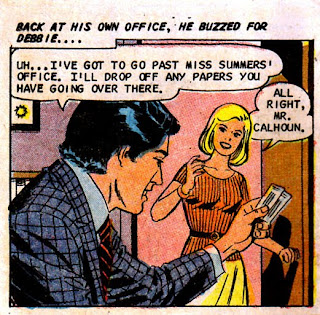
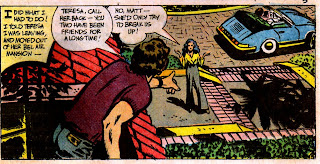
This setup tells the basic story well enough, but the eye-level camera and static poses lend the scene a generic look. The impression isn't helped by the casual background. This room has no personality; it could be any room anywhere. Now let's look at how Toth illustrated a dialogue exchange that could easily have been presented in the same way:Not much happens in this panel. The narrator (a movie star) drives away while her friend and the guy they both love discuss her departure. But the panel is exciting because everything Toth draws gives the scene a unique personality. Instead of a generic house Toth has created a "Bel Air mansion" appropriate to a temperamental movie star. He stages the scene in deep perspective. Matt strikes a dynamic pose we understand without needing to see his face. The star is driving off not in some generic car but an expensive Porsche. Its cockpit is crammed with luggage. All the smaller background details--the shadow of palm trees, the cobblestone street, the tile roof--shout "Southern California Richville." This scene has individuality, and the story is better for it.

Creating well-thought-out backgrounds is a great way to plus a script. Consider this panel from the Dell adaptation of Clint and Mac, a youth-targeted mystery-adventure set in London. It's easy to picture the script for what might have been a throwaway panel. Smith, the guy in the trench coat, returns to his apartment expecting to meet his accomplice Toby. Smith calls out but Toby isn't there. Here's how Toth interpreted the scene:
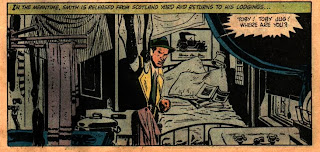
This panel is an entire book about Smith. As written the character is a typical bad guy without much depth. But when composing this scene Toth asked himself, "Who is Smith? How would he live?" So we see a cheap, impossibly cramped room with wet laundry hung over an old-fashioned stove to dry. A couple of magazines are thrown onto the rumpled bed. He's not a total slob, though: while his clothes are tossed over a chair, his dishes are done. Smith (like Toth) is apparently a car fancier: other than the calendar his only decoration is a print of an old automobile. The blind is pulled halfway down; Smith dislikes either the sunlight or prying neighbors. Smith has become a real person. This is what plussing a script is all about.

Still one might ask, "Is there a point to this?" It's a fair question. After all the Clint and Mac panel really was incidental to the story. Its basic idea could have been got across in a simpler way. Is Toth just showing off? Comics as a medium are admittedly less involving than movies. People tend to read them quickly without scrutinizing each panel. However I believe that, just as happens in movies, thoughtful plussing subliminally adds to a reader's experience of the story, allowing him or her to take away from it more than was originally there.