A-Maz-Ing Maz
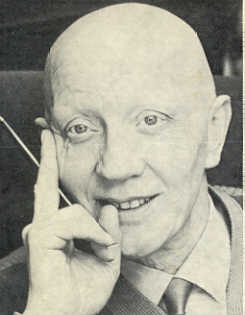 |
| Alfred Mazure |
A while back I posted
a Romeo Brown story drawn by Dutch cartoonist Alfred Mazure. Talented and prolific, Mazure worked as an illustrator, a comics artist, a novelist, and a filmmaker. I spent considerable time hunting for information about Mazure and his career. While I found a fair amount of material, there were frustrating holes in his story and not everyone agreed on several points. That aggravating Internet phenomenon, Read and Repeat, clearly affected several sites. For example those who described Romeo Brown as "a suave and sophisticated detective" obviously had never read a
Romeo Brown episode.
Therefore the following is a work in progress desperately in need of input from others. I'd especially like to hear from Dutch readers with access to offline material that might clear up some points. This isn't Primary Source material. Please don't cut and paste!
Alfred Mazure began his art career in his native Netherlands, where he was born in 1914 (some sources say 1913). The self-taught artist's first comic creation, a detective strip called
De Chef , appeared in 1932 when Mazure was only eighteen. It didn't make any waves. Mazure spent several years wandering about Europe and Africa.
Upon his return "Maz" tried again. This time he hit paydirt.
Dick Bos, which premiered in 1940, followed the adventures of a two-fisted private detective. The series got off to a slow start until Mazure hatched the idea of handing unsold copies out to school kids. It was a brilliant move. Before long Dick Bos was a star. Mazure both wrote and drew the Dick Bos stories, which were printed in an unusual pocket-sized format, about the size of a pack of cigarettes, with a single panel on a page. Soon the character was on his way to becoming a national institution.
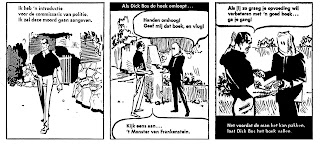 |
| From a Dick Bos story (source unknown) |
Unfortunately history intervened. World War II had begun in 1939 and the Netherlands had hoped to remain neutral. However in 1940, the same year
Dick Bos debuted, Germany invaded and occupied the country. The Nazi government noted Bos' popularity and asked Mazure to turn the detective into an SS officer. They offered a blank contract and a print run of a million copies an issue. It's unclear whether Mazure was an active member of the Resistance or simply a sympathizer; either way he rejected the offer. As a result his books were banned.
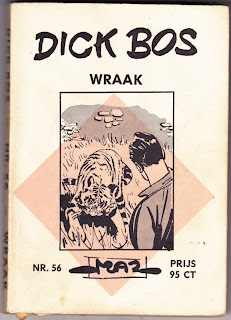 |
| 1960s Dick Bos magazine (source: Lambiek) |
Information about what Mazure did during the war is contradictory. Several sources say that he went into filmmaking. However some suggest he made films for the Resistance while others say he made films commercially, though without much success. He did apparently produce anti-Nazi comics and illustrations. Dutch readers, please clear this up for me. At any rate, after the war (1946) Dick Bos reappeared, first in reprints, then in new stories. The series was a hit all over again, appearing in both comics and novels. It seems to be at this time that Mazure signed a publishing contract that haunted the rest of his days. As has happened so often in comics history, Maz got very little while his publisher reaped huge profits from Dick Bos' growing popularity.
Exactly what happened next is unclear. Mazure was obviously unhappy with his contract, but he seems to have continued producing Dick Bos.Two subsequent events combined to end his Dutch career. I'm unsure which came first. One was a growing public sentiment against comics. The Ministry of Education accused comics of having a pernicious effect on youth. When, in 1948, a 16-year-old boy murdered his 15-year-old girlfriend, a media storm arose around his having been a comics reader. We Americans have heard this one before!
A second event damaged Mazure's personal reputation. For reasons I can't figure out, the artist got lumped together with a group of other creators alleged to have collaborated with the Nazis during the War. How this happened given his pro-Resistance work is a mystery to me. Again I beg Dutch fans with inside knowledge to fill me in.
At any rate, Mazure gave up and moved to England to start over. He worked there for over twenty years as an illustrator, author, and strip cartoonist.
He tried several times to recreate his success with
Dick Bos. In 1948, the Daily Mirror published Mazure's
Sam Stone, a detective who resembled Dick. The strip lasted two years. I also found several references to another detective strip called either
Bruce Hunter or
Bruce Bunter. I haven't found samples of either feature.
Hunter/Bunter supposedly ran from 1951 to 1953, which would have released him just in time to launch
Romeo Brown in the
Daily Mirror (1954). This strip established Mazure's reputation as a pretty-girl artist. Most of his subsequent projects involved sexy women. He left
Romeo in 1957 to illustrate another "girlie" strip,
Jane, Daughter of Jane.
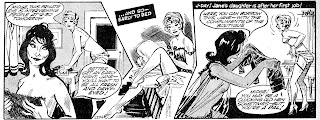 |
| Jane, Daughter of Jane (British Cartoonists Collection) |
This was an attempt to update the grandmother of all girlie strips,
Jane, which had titillated British soldiers during World War II. The attempt failed. The artist's next project seems to have been another clothing-challenged daily called
Carmen & Co. Of this strip I've found a single example on Lambiek.net.
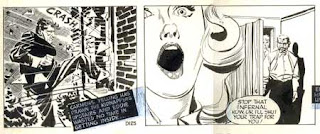 |
| Carmen & Co. (source: Lambiek) |
Somewhere in here--around 1960, apparently--Mazure returned to Dick Bos, both in print and in a film. How this came about I don't know. Maybe he was desperate: there is no record of his having renegotiated his contract, and sources imply that Mazure was always short on cash. This new Bos material seems to have ended around 1967, about the time Mazure wrote three English-language sexy-spy novels under the series banner
Sherazad. He also had one more fling with comic strip ladies in 1969-1970, when
Mayfair published
Lindy Leigh. Mayfair was a
Playboy-style magazine, and
Lindy appears to have featured more nudity and sexual situations than Mazure's earlier strips Again I haven't been able to find samples online.
Alfred Mazure died in 1974. He was only 59 years old. His creation, Dick Bos, is recognized as an important part of Dutch comics history. An excellent site,
dickbos.com, posts classic episodes and provides background about Mazure's career. Unfortunately a link promising further information about the artist is dead.