Begorrah! Shure an' 'Tis an Oirish Stereotype
When I was writing my 1930s aviation fantasy Crash Ryan I wanted to convey the idea that the pilots in the rival air forces had come from all over the world. A quick and easy way to do that was to have them speak in dialects reflecting their origins: the Swede, the Italian, the Cockney Englishman. It was a calculated use of comparatively harmless stereotypes to keep everyone from sounding the same. The attempt had mixed success. One critic complained it reminded him of reading old Blackhawk comics. This was a fair criticism. To linguists dialect refers to a regional variant of a language with a unique vocabulary, grammar or pronunciation. In entertainment dialect describes an attempt to render the way non-natives speak the local language. Dialect is both caricature and stereotype. Like all stereotypes dialect starts with a grain of truth, then exaggerates and embellishes to produce a sort of “super-accent” which the audience accepts as the way foreigners speak. Dialect can be used benignly to add variety to dialogue, as I did in Crash. More commonly it's used to poke fun at the speaker. The line between fun-poking and ridicule is thin, and dialect too often is a vehicle for hostility and prejudice.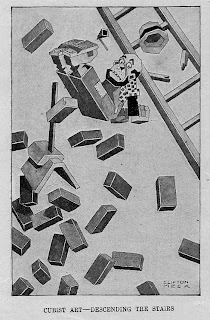
Dialect writers use three tools: catchphrases, orthography, and grammar. Catchphrases in the speaker's native language are sprinkled through dialogue for “authenticity.” Exclamations are always popular catchphrases: Frenchmen exclaim “Sacre bleu!” Italians say “Mamma Mia!” and Germans cry “Himmel!” Orthography re-spells words to suggest the way foreign speakers pronounce them. An Irishman says “nivver” for “”never” and an Italian says “beeg” for “big.” Grammar rearranges sentences to mimic speech patterns. A German says, “The radio to howl began,” an Irishman, “It's down to the corner I'm going.”
The late 19th and early 20th centuries were the heyday of American dialect humor. European immigration was at its height. Cities teemed with new arrivals from Italy, Ireland, Germany, Poland, Russia and eastern Europe. A babble of new accents made its way into popular entertainment. Comic Italians, Irishmen, and European Jews paraded across the vaudeville stage to be laughed at by native born and immigrant alike. Magazine cartoons presented almost as many ethnic situations as they did jokes about love and courtship. How-to books urged would-be public speakers always to have a few dialect routines ready.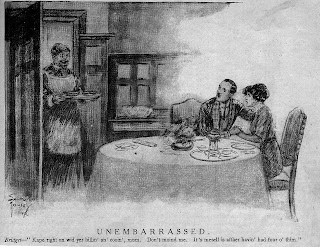
To a certain extent ethnic humor acknowledged and celebrated the new diversity. More frequently it reinforced the audience's sense of superiority. The readers of mass magazines were mostly established middle-class Anglo-Americans living in cities and larger towns. Presenting new foreigners as less-educated, less-intelligent objects of amusement soothed their fears that an immigrant horde would replace them at the top of the food chain.
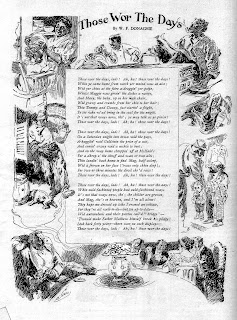
In America the main targets of dialect were the long-entrenched African Americans and the newly-arrived Irish. An astonishing amount of work went into short stories, comic essays, and cartoons featuring stereotypes of these characters. The fantastical dialect that resulted was often nearly unreadable. Here's an example of Irish dialect at its ripest:
Given how integral a part of American society Irish Americans are today, it's surprising to see how intensely they were despised in earlier times. In an upscale 1910 magazine an article offered “scientific proof” that the Irish were a separate race, inferior even to the “Negroes and the Mediterraneans,” so backward they could never be civilized. The gentlest option the author offered was expulsion. Obviously he thought extinction wouldn't be a bad idea.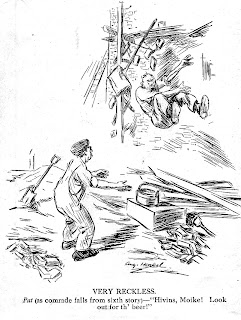
The stereotyped Irishman in turn-of-the-century humor was more than a dialect; he was a complete package. He had a brutish face and often wore chin whiskers. He dressed either in laborer's clothes or the traditional dress we now identify with leprechauns. He worked at manual labor, usually laying bricks or digging ditches. Oddly, though characterized as lazy, he was almost always shown working. He was unschooled in city ways and was an easy mark for con men. He boasted lightweight intelligence and a heavyweight wife (who almost invariably was employed as a domestic), smoked a clay pipe and was accompanied by a bottle of liquor. And he spoke in that arcane dialect.
After hearing native Irishmen speak, I wonder how some of these conventions got started. The “h” in words like “afther” is particularly curious. I think it's meant to signify the little puff of air following a hard “t.” Irish speakers soften the T and hold it slightly, followed by a quick exhale: “aft-(h)er.” But an American tends to read the word as “af-ther” with a “th” like that in “bath.” However if that explains the “h,” I'm still puzzled over the use of “Oi” for the first person singular. I hear a combination of “ah-ee” in Irish speech, not “oh-ee.” Nevertheless “Oi” was universal in Irish dialect.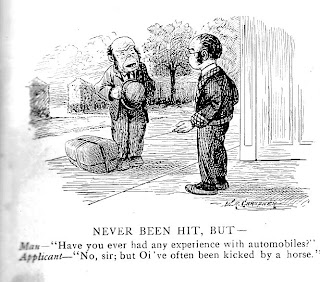
It's interesting that the Irish stereotype was nearly extinct by the time comic books came around in the 1930s. By then the remaining Irish stereotypes were the uncultured but honest Irish cop on the beat and the handsome hot-headed adventurer, like Terry and the Pirates' Pat Ryan. Both stereotypes are positive, if somewhat condescending. The reason probably lies in the Irish American's quick rise into mainstream society. Within a couple of generations many Irish Americans had gained wealth and political power, while countless more moved into the burgeoning middle class. They were no longer fair game. Meanwhile African Americans were still firmly confined to their place at the bottom of the ladder. Their stereotypes thrived for another twenty years.
I'm no expert in the subject, but my reading suggests that dialect was a peculiarly American obsession. In foreign comics I haven't found anywhere near the same attention paid to singling out linguistic differences. I'd love to hear from fans in other countries how dialect figures in popular entertainment in their own languages.