Showing posts with label Russian. Show all posts

Friday, 24 October 2025

Weissenfels, 29 April 1813

The war for the liberation of Germany begins. Sensing weakness after Napoleon's defeat in Russia, his allied European opponents attack his Germanic empire. Bonaparte, however, has pulled together a large but untested new army and plans to drive back his enemies. A French spearhead pushes towards the main Coalition force in Leipzig- the village of Rocken must be taken from the defending Russians.

French cross the Rippach Stream.

I played Général d'Armée 2* with my opponent's glorious 18mm AB figures. Each figure is 20 men, each base is a company, each unit a battalion in a brigade. We refought the clash near Weißenfels early in the German campaign, from the 1813 supplement

The French Général de Division Souham has four infantry brigades and a cavalry brigade to take the village of Rocken. The Rippach Stream, however, is a major obstacle and can only be crossed at the villages of Stroßwitz, Göhren, and Rippach.

I was the Russian General Winzingerode. I only had two infantry brigades to cover the three crossings, and three cavalry brigades to cover gaps. Can I slow the French advance to Leipzig?
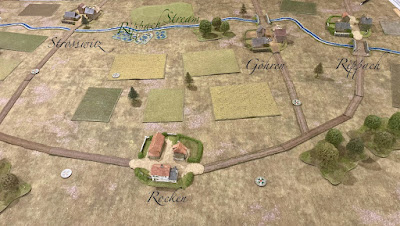
The Russian defenders' view. The stream separates the combatants.
I defended Göhren and Rippach and trusted the cavalry
to hinder advances from Stroßwitz. The ultimate French objective is Rocken.

I've broken the battlefield into three sectors to aid the reader:

1. The Russian left- The clash outside Stroßwitz


Cavalry canter across the fields opposite Stroßwitz,
as French infantry appear in the distance.
Untested French conscripts march throught Stroßwitz to the ford.
The Russian cavalry advances-
how will the conscripts respond?
They fail to form square, and fall back across the stream!
The cavalry trots back to offer a repeat challenge.
Nearby, an artillery battalion exchanges fire with
French cannon on a distant rise.
A second battalion crosses, and meets the hussars.
The French have a toe across the stream- can they break out?

2. The Russian right- crossing at Rippach


On the right, Chasseraux's infantry brigade at Rippach.
Skirmishers harry the Russians across the stream.
The French are across!
The French deploy into line...
... and exchange volleys with the Russians.
More French cross the bridge and deploy.
Both sides are being whittled down...
... but have they noticed the flanking dragoons?
The French form square and repulse the cavalry,
but will they be able to reach Rocken in time?

3. The assault on Göhren


As the French cross at Rippach,
the Russians have garrisoned nearby Göhren.
The French are slow to advance to this important objective.
The first wave advances...
... and is repulsed.
After a pause, the second wave crashes...
... and takes the village! But is it enough?

At this point, we had to call the game due to time as General Winzingerode had to collect his toddler from the military academy. We were on turn 7 of 14, and the French were across the stream but still a very long way from Rocken and victory. Can the Russians still hold them?

Game end state. I have cavalry on both flanks, off-camera.
My cossacks, somewhat unreliable and didn't move all game,
but too nice not to photograph.

Our previous clash was with Général de Brigade (was it really 2021? how time flies.). I found Général d'Armée 2 a more abstracted ruleset and much less fiddly. Both sides struggled with hesitant and untested units. It was challenging for the French with limited crossing spaces forming bottlenecks, and also for the Russians with limited defenders unable to defend in depth.

We estimated 700-800 figures on the table.

Behind the cossacks, General Winzingerode commands in Rocken.
* I don't care; I'm putting the accents back in because it's cool.

Friday, 1 May 2020

Soviet NBC troops

Is there anything more terrifying than Soviet gasmasks?

I painted ten of these Eureka figures over ten years ago and really liked them, so I got another five riflemen to round them out. I finally got around to painting these five last week- shame on me! I took the opportunity to finish off some details on my originals, and to rebase them. My paints and painting style have changed, but these were refreshingly quick compared to a lot of the GW stuff I've found myself slogging through lately.

GP-5 gasmasks

Leader has a GP-5m with 'voicemitter'

PKM machine gun

SVD marksman rifle

DP-12 Contamination Survey Meter. This figure is a ringer for art in Osprey Elite #12
Osprey Elite #12 Inside the Soviet Army today

AT-3 Sagger operator. Minimum range 500m!
So now I've gone and ordered a copy of Zona Alfa... I can see some sort of subterranean Stranger Things/ Delta Green thing coming on... The bear came over the mountains of madness?

PS: If you haven't seen HBO's Chernobyl, it is superb.

PPS: Oh no, I just saw Eureka has more figures in this range... may need to get them...

PPPS: I would love these in 15mm.

PPPPS: I really need a BRDM or a BTR...

Friday, 16 December 2016

Russia vs NATO: what the generals think

Modern wargamers frequently explore what-if scenarios involving conflict between Russia and NATO. Two fictional books explore this territory, with the fascinating commonality of being future histories written by British Army generals.

The Third World War

General Sir John Hackett & others (pub. 1978)


1985: The bear cornered. Facing difficulties at home, a troubled communist state tries to confound the new American president with a series of coordinated global crises. After initial successes, the USSR overplays its hand in Yugoslavia, and is drawn into direct conflict with the US. Claiming defence against NATO aggression, the USSR surges into Central Europe.


The Third World War is written as a 1987 post-war history, after the dust has settled. There is a somewhat dry description of the state of the world in 1984, leavened with colourful depictions of forces in conflict in various theatres. Hackett collaborated with experts in other military and economic domains. There are strategic maps showing the grand manoeuvres of both sides. There are photos captioned to represent the fighting in Europe and around the world. There are some chilling descriptions of the success (or otherwise) of home defence efforts in withstanding a nuclear strike.

The Third World War is the benchmark classic of 1980s Cold War Gone Hot alternative history. It depicts a detailed worldview, and also some vignettes of action within that bigger picture. There was a 1983 sequel (The Third World War: The Untold Story) which has more vignettes, and I would love to get my hands on a copy.

Hackett’s Third World War has influenced other writers. Harold Coyle used Hackett’s scenario explicitly as the background for his famous Team Yankee novel. Wikipedia says Max Brooks used the ‘post-event history’ format as inspiration for his own excellent World War Z.

Hackett did not forsee the changes to the British military in the early 1980s as a result of Thatcher and the Falklands, but otherwise his book stands up as plausible what-if.

Hackett served in WW2 in the Middle East, North Africa, and was seriously wounded at Arnhem. He was later promoted to General, commanded NORTHAG, and was (in)famous for writing a 1968 letter to The Times critical of the British Government’s lack of commitment to NATO. He signed it as a NATO officer, rather than as a British Army officer (once you are posted to NATO, where should your loyalties lie?).
General Sir John Hackett

2017: War with Russia

General Sir Richard Shirreff (pub. 2016)


2017: The bear resurgent. Having recently moved into the Crimea and eastern Ukraine, an emboldened Russia invades the Baltic states, which are NATO members. Putin threatens any NATO reaction with nuclear retaliation. European politicians, having reduced their conventional militaries and NATO commitments in the post Cold War years, are left grappling with this fait accompli.


This work is written in a somewhat Clancy-esque novel style, as opposed to Hackett’s history book. Shirreff describes his work as "fact-based prediction rather than fiction". Much of the action concentrates on Latvia. Shirreff has an everyman, Captain Morland of the Mercians, who is involved in a number of key small unit actions to stymie Putin’s fiendish plans. Back in Brussels, the Deputy Supreme Commander of NATO, General McKinlay, is clearly an analogue of the author, who held the same role at NATO headquarters. Like the real-life Hackett (and presumably Shirreff), he grapples with split loyalty to NATO and the UK.
Armata T-14 Prototype

There are no large scale actions in this what-if, unlike Hackett’s vision. Some ultra-modern Russian equipment is name-checked, such as the Sukhoi PAK-FA, Armata T-14, Su-34, and BMD-4. There is a lot of skirmishing between politicians and senior military officers, as Shirreff indirectly lectures us on what needs to be done to prevent his scenario becoming reality. There is frequent truly awkward expositionary dialogue:

“Damn’, said [Putin]. ‘Never mind. It is enough. We are telling the world the Americans opened fire on our pilots first and, thankfully, the wreckage of the Sukhoi fell behind our lines. That proves it was shot down over our airspace. Our friends are saying that this is not only naked aggression by America, it is also NATO attacking Russia. Russia is justified in defending herself. The only response is war. Get me Merkulov on the phone. Now.”

Shirreff did not forsee Brexit or Trump, and how this will affect NATO and the West’s relationship with Russia remains to be seen.

General Sir Richard Shirreff was Deputy Supreme Commander of NATO before his retirement in 2014. He deplores the military drawdown in Europe, noting along with his contemporaries that Russia is the only existential threat to the US and UK.
General Sir Richard Shirreff


Conclusion


It is a peculiarly British characteristic for a retired senior officer to publish fiction in order to convey a request for increased defence expenditure.

Hackett wrote in 1978 to demonstrate that with sufficient will, by 1985 NATO could be reinvigorated and be able to withstand Warsaw Pact aggression lest the USSR “enjoy the fruits of a military victory without having to fight for it.”

Shirreff gives a shorter timeline, writing in 2016 to warn against possible Russian aggression in 2017. He identifies Russia as the west’s strategic adversary. He describes his book as a wake-up call, whereby Putin’s annexation of Crimea and actions in Ukraine have “started a dynamic that can only be halted if the West wakes up to the real possibility of war and takes urgent action.”

Hackett's situation never occurred, but he writes a compelling what-if. Shirreff's less ambitious scenario is more plausible and just as concerning, but unfortunately less well written. He does give an insight into the difficulties facing NATO member cooperation, and the issues facing a NATO commander.

One can only hope that, like Hackett's work, Shirreff’s becomes a future source of war gaming what-ifs, rather than a prophetic vision.
All photos via Google Images


Saturday, 7 June 2014

15mm modern armour- T-72Bs

This is the Zvezda 1:100 T-72B. A nice, simple snap-together plastic kit. The kit has different armour from the box depiction. I accidentally snapped off the turret attachment- it's a fine fit, and the layer of spray paint on both surfaces made it stick... I hand-drilled appropriate holes and stuck a bit of paperclip to hold it together. I failed to learn from another blogger (whose post I can't re-find) who did the same thing...

One of the reasons I dislike painting armour is tracks and roadwheels. Thankfully, the Zvezda 1:100 T-72B has covered running gear so I only have to paint half as much! (not to mention they're single-piece tracks and wheels, so you don't have to assemble the damned things). Still, I wish I'd left the tanks partially disassembled for ease of getting into the nooks and crannies. It was still painful.

I painted and weathered it the same as my BTR-80, see here and here. Well, almost the same. After thicker brown and black washes, I picked out edge and panel lines with GI Green and Iraqui [sic] Sand. The increased contrast looks better at this smaller scale, but I'm still not entirely happy with it.
Before weathering

Zvezda 1:100 T-72B


It's a nice, mean-looking tank with a busy turret. Could do with a roof-mounted MG and smoke launchers.

Sunday, 1 June 2014

15mm modern armour- BTR-80 Part 2

In this post I'll show you how I weathered my Zvezda 1:100 BTR-80s. Again, there are many different techniques that you could use, but this is my current technique. To see how I got them ready for this stage, see my post here.

I use Woodland Scenics washes for my weathering. They're grittier and more pastel than, say, Army Painter washes. They dry quite flat. I water them down and apply to taste, trying to get more in dirtier areas- wheel wells, front plates, and dust build up at the junction of vertical and horizontal surfaces.

First, paint chipping using the sponge technique and German Grey. Concentrate around areas of wear and tear. It shows up best against the tan stripes.

Then, an all-over wash using Woodland Scenics C1221 Raw Umber. This tones down the model and acts as mud, oil and rust all in one!

Next I do a pin wash using Army Painter Quickshade Dark Tone, with a particular focus on hatches.

Finally, another all-over wash using Woodland Scenics C1217 Concrete to represent dust build-up. I  apply this over the hull and turret, and work this around the tread on the tyres. I drag off excess with my finger.

Finally, detailing. Black to the vision blocks. Light blue-grey to the headlights. Dark grey to the gun, and then drag a lead pencil over it. Dark grey to the smoke grenade covers. Dark red to the brake lights. Done!
Finished


Front

Rear

The final wash tones down the vehicle and ties it into the ground, but at the expense of tabletop presence. I'm rarely happy painting vehicles. My infantry have developed into a higher contrast 'pop', but my vehicles devolve into a labour-intensive attempt to get them looking like a 1/35th centrepiece. I think they lack a little je ne sais quoi on the tabletop. Maybe I should emphasise the highlights more.