Showing posts with label Anton Bruckner. Show all posts

01-07: Bruckner 7 / Schuricht 1964 - Feeder : Echo Park 2001 - Tesla Louisville 1989 - Bartok Complete String Quartets / Vegh Quartet 1972

Not shown: Jacobus de Kerle, Gallus Zeiler, Antonio Corbisiero, Josef Lipavský, Ramón Félix Cuéllar y Altarriba, Bobby Pratt & Arthur Leavins


1591 – Jacobus de Kerle (Flemish composer & organist)
1625 – Ruggiero Giovannelli (Italian composer & singer)
1678 – Johannes Flittner (German composer & poet, active in Sweden)
1736 – Ceslav Vanura (Czech composer)
1755 – Gallus Zeiler (German Benedictine abbot & composer)
1783 – William Tans'ur (English hymnist, teacher, music theorist  & composer of West Gallery music)
1790 – Antonio Corbisiero, composer, dies at 69
1810 – Josef Lipavský (Czech pianist & composer)
1833 – Ramón Félix Cuéllar y Altarriba (Spanish composer & organist)
1843 – Franz Schoberlechner (Austrian composer)
1868 – William Batchelder Bradbury (American organist & hymn composer, "Jesus Loves Me, This I Know")
1890 – Hans Matthison-Hansen (Danish organist, composer & painter)
1891 – Wilhelm Taubert (German pianist, composer & conductor)
1922 – Antonio Scontrino (Italian composer & bassist)
1936 – Guy d'Hardelot [Helen Guy Rhodes] (French composer, pianist & teacher, "Because")
1943 – Nikola Tesla [Никола Тесла] (Serbian-born American inventor, electrical engineer & pioneer of wireless transmission)
1946 – Adamo Didur (Polish operatic bass)
1960 – Luiz António Ferreira da Costa (Portuguese composer & pianist)
1964 – Colin McPhee (Canadian composer & ethnomusicologist, specialist in the music of Bali)
1964 – Cyril Davies (English blues harmonica player & singer)
1967 – Carl Schuricht (German conductor)
1979 – Zbigniew Turski (Polish composer)
1980 – Carl White (American R&B singer, The Rivingtons)
1980 – Larry Williams (American R&B & rock singer, songwriter, producer & pianist)
1981 – José Ardévol (Spanish-born Cuban composer & conductor)
1983 – Dame Edith Coates (English operatic mezzo-soprano)
1985 – Johnny Guarnieri (American jazz pianist)
1994 – Bobby Pratt (American jazz trombonist & pianist)
1994 – Jay Blackton (American music theater conductor & arranger)
1995 – Arthur Leavins (English violinist)
1997 – Sándor Végh (Hungarian violinist, conductor & teacher)
1998 – Owen Bradley (American country & rock record producer)
2001 – James Carr (American R&B & soul singer)
2002 – Jon Lee (Welsh rock drummer & guitarist, Feeder)
2009 – Maria Dimitriadi [Μαρία Δημητριάδη] (Greek singer & leftist political activist)
2010 – Willie Mitchell (American R&B, soul, rock & funk singer, trumpeter, record producer & arranger)


Today it's hard rock, and Bartók, and Bruckner. And rest assured the humor is not lost on me at how the presence of Tesla the band here is a bit of a stretch in more ways than one. But if you've been reading this blog for a while, you realize that it's entirely appropriate for us to be remembering Nikola Tesla on his deathday; for Tesla can claim as much right as Guglielmo Marconi to being called the "Father of Radio," and of course the effect of radio on the dissemination of music in the 20th century was incalculable.

And the pathway from Tesla the man to Tesla the band is shorter than it may seem, at least in this case. The live show presented here (in .wma format - I hope that isn't terribly inconvenient for most of you) is from 1989, when the band were touring in support of their second album, The Great Radio Controversy, whose liner notes indeed posit the notion that Tesla deserves more credit than Marconi for the earth-shaking invention. So, as you would expect, five out of the nine songs that make up this short but sizzling set are from that album.

Not only that, but it's also extremely likely that AC power (which, as used today, hinges largely on the work of Nikola Tesla) will come into play at one or more points when you're downloading, unpacking, importing, synching up, and listening to this Tesla show... so you see, it's all making sense here at YiDM!


12-29: Freddie Hubbard : First Light 1971 - Bruckner 8 / Takashi Asahina 1976 - Kosaku Yamada : Symphony Triumph & Peace etc. / Yuasa 2008 - Tim Hardin 1 1966

Not shown: Albert Christoph Dies, Charles-Joseph Tolbecque, Ferdinand Marcucci, Fritz Behrend & Gene Tanner


1785 – Johann Heinrich Rolle (German composer)
1819 – Josepha Weber (Austrian soprano, sister-in-law of Mozart & creator of The Queen of the Night in The Magic Flute)
1822 – Albert Christoph Dies (German painter, composer & early biographer of Joseph Haydn)
1825 – Giuseppe Cambini (Italian composer & violinist)
1835 – Charles-Joseph Tolbecque (French violinist, conductor & composer)
1836 – Johann Baptist Schenk (Austrian composer, multi-instrumentalist & teacher)
1847 – William Crotch (English composer, organist & artist)
1876 – Ferdinand Marcucci (Italian harpist & composer)
1898 – Georg Goltermann (German cellist & composer)
1915 – Charles Beach Hawley (American bass, choir director & composer)
1952 – Beryl Rubinstein (American pianist, composer & teacher)
1959 – Robin Milford (English composer, pianist, flutist & organist)
1964 – Miroslav Krejčí (Czech composer & teacher)
1965 – Kōsaku Yamada [山田 耕筰
] (Japanese composer & conductor)
1967 – Paul Whiteman (American jazz, pop & classical bandleader & violinist, commissioned Gershwin's Rhapsody In Blue)
1972 – Fritz Behrend (German composer)
1980 – Tim Hardin (American folk singer, songwriter, guitarist & pianist)
1986 – John Antill (Australian composer, known for Aboriginal-inspired ballet Corroboree)
1989 – Irma Beilke (German coloratura soprano)
1990 – Aulikki Rautawaara (Finnish soprano)
1994 – Gene Tanner (American R&B singer, The Five Royales)
1996 – Mireille Hartuch (French theatrical singer, composer, pianist, actress & teacher)
2001 – Takashi Asahina [朝比奈 隆
] (Japanese conductor, famed in particular for his performances of Bruckner)
2001 – Cássia Eller (Brazilian rock & MPB singer & guitarist)
2004 – Floriana Cavalli (Italian soprano)
2008 – Freddie Hubbard (American jazz trumpeter, cornetist, flugelhornist & composer)


Yay, Japan! Yay, Bruckner! Yay, Freddie Hubbard! Boo, Death!!


11-30a: Furtwängler : Beethoven 9 1954 | Bruckner 9 1944 | Schubert 9 1951 - Modern Jazz Quartet Fontessa 1956 - Gibbons | Tomkins | Weelkes : Deller Consort 1970s


1580 – Richard Farrant (English composer, choirmaster, playwright & theatrical producer)
1626 – Thomas Weelkes (English composer & organist)
1703 – Nicolas de Grigny (French organist & composer)
1764 – Dieudonné Raick (Flemish organist & composer)
1777 – Jean-Marie Leclair le cadet (French composer)
1798 – Friedrich Fleischmann (German composer)
1813 – Friedrich August Baumbach (German composer, conductor, author, singer, pianist, mandolinist & freemason)
1824 – Johann Georg Christoph Schetky (German cellist & composer)
1904 – Aldine Silliman Kieffer (American music teacher, publisher & proponent of shape-note notation)
1931 – John Hyatt Brewer (American organist & composer)
1931 – Marc Delmas (French composer)
1940 – Fritz Volbach (German organist, pianist, conductor, composer & musicologist)
1948 – Franco Vittadini (Italian composer & conductor)
1954 – Wilhelm Furtwängler (German conductor & composer)
1955 – Josip Štolcer-Slavenski (Croatian composer, musicologist, music theorist & teacher)
1957 – Beniamino Gigli (Italian operatic tenor)
1964 – Don Redman (American jazz multi-instrumentalist, bandleader, arranger & composer)
1972 – Hans Erich Apostel (German-born Austrian composer, pianist & teacher)
1993 – David Houston (American country singer & songwriter)
1994 – Connie Kay (American jazz drummer, Modern Jazz Quartet)
1995 – Stretch [Randy Walker] (American rapper, actor & producer)
1996 – Tiny Tim [Herbert Khaury] (American singer, ukelelist & guitarist)
2000 – Scott Smith (Canadian rock bass guitarist, Loverboy)
2008 – Munetaka Higuchi [樋口 宗孝
] (Japanese metal drummer & producer, Loudness)
2010 – Peter Hofmann (Czech-born German heldentenor & pop singer)


Speaks for itself.


10-11: Complete Atomic Basie 1957 - Aborto Elétrico : Ao vivo na Funarte 1981 - Edith Piaf Olympia 1955 - Bruckner 3 & 8 / Szell - Satie : Parade | Relâche etc.


1837 – Samuel Wesley (English organist, composer & violinist)
1896 – Anton Bruckner (Austrian composer & organist)
1897 – Léon Boëllmann (Alsatian organist, composer & pianist)
1942 – Leonid Nikolayev (Russian pianist, teacher & composer, piano teacher of Shostakovich)
1961 – Chico Marx (American comedian, actor & pianist)
1963 – Édith Piaf (French popular singer, songwriter & actress)
1963 – Jean Cocteau (French poet, playwright, artist, novelist, set designer & filmmaker)
1970 – Anis Fuleihan (Cypriot-born American composer, conductor & pianist of Lebanese heritage, composed Theremin Concerto for Clara Rockmore)

1985 – Tex Williams (American western swing singer, songwriter, guitarist & harmonica player, "Smoke! Smoke! Smoke! That Cigarette")
1996 – Johnny Costa (American jazz pianist & celesta player, Mr. Rogers' Neighborhood)

1993 – Jess Thomas (American Wagnerian tenor)
1996 – Renato Russo (Brazilian rock singer, songwriter, bass guitarist, guitarist & keyboardist, Aborto Elétrico, Legião Urbana)

2007 – Werner von Trapp (Austrian singer & farmer, Von Trapp Family Singers)
2008 – Neal Hefti (American jazz trumpeter & arranger & jazz, film & TV composer)

Well, despite the presence of only 14 poopers on the list, this edition will once again require TWO posts to complete, because A. it's full of notable folks you just have to hear and B. I couldn't possibly let it go without one of them being Jess Thomas, and you should be able to figure out what that means! Yes, it's another opera, and not just any opera, but one that's so long you're sure to doze off at some point during it. So, look for that second post a little bit later...

And you may have a similarly sleepy reaction during one of Anton Bruckner's massive symphonies, but this is a composer you must learn to love. It is verboten for you not to! For they are magnificent works, full of a primordial energy - from the roar of the sea, to the eruption of volcanoes, to the painfully slow drift of enormous glaciers. And they all, in a way, take Beethoven's Ninth as their starting place. No, none of them has a choral finale (although Bruckner did compose a good deal of choral music - his superb masses, motets and Te Deum are another part of his output which call out for exploration), but from his 3rd symphony onward, you have very long four-movement works (save for the incomplete three-movement 9th) which contain seemingly endless adagios, often have a Scherzo placed as the second movement, and, perhaps most notably, begin the first movement with that same sort of hushed, mysterious quality you find at the start of Beethoven's, and end it with that same thundering timpani you find at its climax. Of course, all the Austro-Germanic symphonists who followed the Bee (that's what Charles Bukowski calls Beethoven sometimes - I like that) felt like they were living in his shadow, but no others were so explicit and single-minded in paying homage to that greatest symphony of them all.

The problem with Bruckner, though, is the problem with Bruckner, and if you're a Brucknerite, you know exactly the problem I mean. And that is, which edition or revision of a particular symphony is "the best," or even whether there can be such a thing. You see, if you take Bruckner's nine symphonies, and count all the different versions of them, there are actually around 60 different symphonies! Why? Well, some versions were heavily abridged, sometimes by Bruckner himself, at the urging of well-meaning friends who thought his original creations were too long, sometimes by other well-meaning people. Let's not forget that everyone meant well in this matter!

And so there are some self-styled Bruckner "purists" who will claim that Bruckner's symphonies in their very longest form (which is generally their earliest edition) are the true and correct Bruckner symphonies. But think about this, now. For any other composer, we take that composer's final thoughts on a work, his last revision of it, as the gospel truth. But for Bruckner, we do just the opposite, and say his first thoughts were the "correct" ones? It doesn't make a whole lot of sense. Me, I'm a pluralist in the matter; I think all those versions can have a certain validity, although some perhaps more than others. I don't want to get in a fight about it! Listen to them all, if you have the time! And then figure out which recording, by which conductor, you like the best! I'm not going to shit you, folks. Being a Brucknerite is pretty much a full-time job in itself. It's kind of like running this blog, but with louder timpani!

Well... can't say something about everybody else, but there are a couple others I wouldn't want to pass over. Legião Urbana, with singer Renato Russo, were (and still are, even though they called it quits after Russo's death 15 years ago) one of the most famous and best-selling rock bands from Brazil. Russo's first band, the punk rock group (well, really post-punk: more Joy Division than Sex Pistols) Aborto Elétrico, is also still a cult favorite in Brazil. Maybe they can be a cult favorite in your mp3 player as well!

And hey, it's another small landmark here at YiDM: I've succeeded in finding, for the first time, an image which contains two people on our list who actually died on the very same day (of completely unrelated causes), and which I was able to therefore use, because doing so would not harm the strict chronological order I follow in putting together the collage. And that, of course, is the photo, just above the painting of Jean Cocteau, of Cocteau and Édith Piaf together. The two were friends (both of them had a lot of friends in the various arts), and Cocteau wrote his theater piece Le Bel Indifférent (1940) for her. So, you see, you actually have an image of both Piaf and Cocteau separately up there, plus one of them together! That wasn't an opportunity I could pass up. But that photo of them together is awfully small, isn't it? One of the unfortunate effects of having to be strictly chronological is that images often end up being much too large or small than they really should be, as to not disturb the overall form of the collage. I do my best, but sometimes my best isn't good enough. Well, here is a bigger version of that photo for you:
 

Much better, non? And now, what to say about the two of them? Well, Édith Piaf is universally considered France's greatest singer of popular song. She's adored, revered, practically considered to be a saint in France. There's not much one can add to that, is there? Oh, there is one other thing. If you slow down Édith Piaf, you get Jim Nabors. Or was it, if you speed up Jim Nabors you get Édith Piaf? Seems to me it should work either way! Anyway, it was my friend Clay Allison who demonstrated that to me on his turntable many years ago. Very humorous man, that Clay Allison. And as he would probably say to that, "Yes, I'm full of blood, and bile, and I've got some melon in my Collie, too! Oh, and I almost forgot all about my phlegm! You didn't know I was Phlegmish, did you?"

And Jean Cocteau. No, he wasn't a musician himself, but he isn't here because the Cocteau Twins used his name. Cocteau worked with many different artists in different disciplines, and musicians were no exception. He, along with Erik Satie, inspired the group of Parisian-based composers known as Les Six. He also wrote some ballet scenarios, most notably for Satie's Parade (1917), which also had choreography and dancing by Léonide Massine, set design by Pablo Picasso, and a program note written by Guillaume Apollinaire, wherein he in fact coined the term "surrealism." Yes, just a bunch of two-bit hacks involved in that production! The audience was not quite so pleased with it, however. Cocteau later wrote, "If it had not been for Apollinaire in uniform, with his skull shaved, the scar on his temple and the bandage around his head, women would have gouged our eyes out with hairpins." Well, now isn't that totally not-a-coincidence? For Cocteau also contributed the libretto (which he wrote first in French, then translated into Latin) to Igor Stravinsky's Oedipus Rex (1927). That's exactly what poor Oedipus does to himself with Jocasta's hairpins near the end of that feel-good Sophocles drama, isn't it?
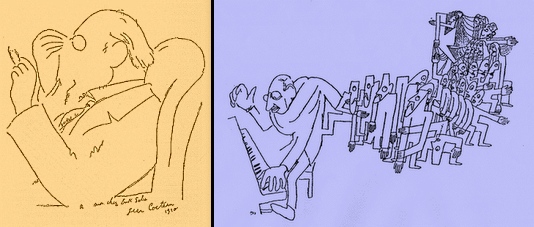
 
 
Cocteau drawings: L - Satie (1910); R - Stravinsky performing his Concerto for Piano & Winds (1924)
Well, that's more than enough from me. Big-ass Wagner opera coming up in just a little while...

La Commedia è finita!


If you've reached this post, it could be because I ran out of room for all the labels I needed for the last post! And it really is those operas that get you. Get one with a really big cast... and by "big" I mean... I mean really BIG... you know..? you know what I mean, really, really... BIG? We're talking BIG here... and that could be your whole 200-per-post character limit right there! Anyway, this other post is the one you want to read if you're interested in the labels for this post.  :B