Showing posts with label Gustav Mahler. Show all posts

01-11b: Mahler 7 / Tennstedt 1980 - T Rex Chicago 1972 | Vienna 1973 - Fabrizio De Andre : La buona novella 1970 - Jefferson Airplane Amsterdam 1968


1995 – Josef Gingold [Джозеф Гингольд] (Belarusian-born American violinist, pupil of Eugène Ysaÿe, teacher of  Jaime Laredo & Joshua Bell)
1998 – Klaus Tennstedt (German conductor, violinist & pianist)
1999 – Fabrizio De André (Italian folk & rock singer, songwriter, guitarist & anarchist)
2003 – Mickey Finn (English rock & folk drummer, singer & bass guitarist, T.Rex)
2005 – Spencer Dryden (American rock & jazz drummer, Jefferson Airplane, New Riders of the Purple Sage)
2005 – Jimmy Griffin (American rock & folk singer, guitarist, keyboardist, percussionist & songwriter, Bread)
2005 – Miriam Hyde (Australian composer, pianist, poet & teacher)
2007 – Puchi Balseiro (Puerto Rican pop & bolero composer, guitarist, singer & television host, producer & script writer)
2010 – Mick Green (English guitarist, Johnny Kidd & The Pirates, Billy J. Kramer & the Dakotas, Van Morrison)


We already had that T.Rex Chicago show a while back, but that link is now, like most of the band, dead. So here it is again, with a new link, plus another T.Rex show to boot! Get it? Boot?

Well, anyway... just in case you're wondering, Fabrizio De André was Italy's answer to Bob Dylan or Leonard Cohen... might not mean as much to you if you don't understand Italian, but definitely worth a listen anyway...


12-11: M.S. Subbulakshmi : Concert Album 1970 - Mahler 7 live / Kondrashin 1979 - Brahms 4 / De Sabata 1939 - Victor De Sabata Orchestral Works / Ceccato 2001


1831 – George Schetky (Scottish-born American cellist, composer, conductor, teacher & publisher)
1857 – Castil-Blaze [François-Henri-Joseph Blaze] (French musicologist, music critic, composer & music editor)
1911 – Thomas Ball (American sculptor, painter, violinist & singer, active also in Italy)
1955 – Franz Syberg (Danish composer & organist)
1964 – Sam Cooke (American soul, R&B & gospel singer & songwriter)
1964 – Alma Mahler (Austrian socialite & composer, spouse of Gustav Mahler, Walter Gropius & Franz Werfel)
1967 – Richard Stöhr (Austrian composer, author & teacher)

1967 – Victor De Sabata (Italian conductor & composer)
1975 – Lee Wiley (American jazz singer)
1983 – Simon [Szymon] Laks (Polish composer, violinist, pianist & author, head of prisoners' orchestra at Birkenau-Auschwitz from 1942–44)
1998 – Lynn Strait (American rock singer & songwriter, Snot)
2004 – M.S. Subbulakshmi [
மதுரை சண்முகவடிவு சுப்புலட்சுமி] (Indian Carnatic vocalist)
2007 – Christie Hennessy (Irish folk singer, songwriter & guitarist)


Alma mater? I thought you said Alma Mahler!

I'm disappointed that I was unable to find you a recording of some of the dozen-and-a-half-or-so songs composed by Alma Schindler Mahler Gropius Werfel. I really did have my heart set on it. But instead, here is the one symphony we haven't yet had from Hubby #1, in this our year-long remembrance of the 100th anniversary of his death. And the live performance here is a particularly exciting and relatively light-hearted one of this weirdest of all Mahler's works.

So, bummer on the Alma front, but good news in the way of Indian music. I've been bemoaning that I have so little information on death dates for many Asian musicians, but here we've lucked out. M.S. Subbulakshmi was one of the most lauded and highly awarded singers of Carnatic music, and I have not only her date of death, but also some excellent sources for transfers of a number of her old LP recordings. The 3-disc set offered here should do you nicely.

I'm also pleased to offer you a first here at YiDM: someone on our list, in separate roles as conductor and composer. (Of course, this doesn't include persons like Stravinsky and Copland whom we've had in both roles simultaneously.) Victor de Sabata was a fiery conductor of both the opera pit and concert stage. He hated the process of making recordings and thus left behind only a few, which are treasured by collectors. I've heard some of them, including this great Brahms 4th, but I've never heard any of the music de Sabata composed. So, I'll be listening to that along with the rest of you!


12-07: The Germs : GI 1979 - Kirsten Flagstad : Mahler 1957 | Wagner 1956 - Willaert Missa Mente Tota / Cinquecento 2009 - Clara Haskil : Mozart Piano Concertos 20 & 23 1956

Shown above: Adrian Willaert, Nicolas-Prosper Levasseur, Antoni Kątski, Ludwig Minkus, Adele Aus der Ohe, a book by Cecil Forsyth, Clara Haskil (many years before she achieved recognition), Kirsten Flagstad, Darby Crash, Victor de Narke, Dee Clark, John Addison, Frederick Fennell, Jerry Scoggins & Jay McShann.


1562 – Adrian Willaert (Flemish composer, founder of Venetian School, teacher of Zarlino)
1811 – Ignaz Spangler (German composer)
1823 – Johann Gottlieb Schwencke (German composer, organist & cantor)
1829 – Johann Christoph Kienlen (German composer)
1834 – Ludwig Schuncke (German pianist & composer, friend of Schumann)
1839 – Jan August Vitásek (Czech composer)
1841 – Johann Daniel Ferstenberg (composer)
1867 – Rudolf Viole (pianist & composer)
1871 – Nicolas-Prosper Levasseur (French operatic bass)
1899 – Antoni Kątski [Anton de Kontski] (Polish pianist & composer)
1917 – Ludwig Minkus [Léon Minkus, Людвиг Минкус] (Austrian ballet composer
& violinist of Czech & Hungarian ancestry, active in Russia)
1937 – Adele Aus der Ohe (German pianist & composer, pupil of Liszt)
1941 – Cecil Forsyth (English composer, musicologist, violist & author)
1944 – Julius Von Raatz-Brockmann (German baritone)
1948 – Godfrey Turner (American composer)
1960 – Clara Haskil (Romanian-born Swiss pianist)
1960 – Lila Robeson (American mezzo-soprano)
1962 – Kirsten Flagstad (Norwegian dramatic soprano)
1980 – Darby Crash (American punk rock singer & songwriter, The Germs)
1986 – Victor de Narke (Argentine operatic bass)
1990 – Dee Clark (American soul singer, "Raindrops")
1998 – John Addison (English film composer, Tom Jones, A Bridge Too Far, Murder, She Wrote)
2004 – Frederick Fennell (American band conductor, percussionist & teacher, Eastman Wind Ensemble)
2004 – Jerry Scoggins (American country singer & guitarist, "The Ballad of Jed Clampett")
2006 – Jay McShann (American blues & jazz bandleader, singer, pianist & composer)


Really been slacking off. I slacked off so much on the collage, I'm now telling you who IS in it, instead of who isn't. Slacked off so much on Johann Daniel Ferstenberg and Rudolf Viole I didn't even dig deep enough to determine their nationalities. I should have put down Ferstenberg as Swedish and Viole as Belgian just so you wouldn't lie awake tonight wondering about it.

Anyway, looks like I'll be slacking off on this part too. But is me telling you that Willaert was one of the most important composers of the 16th century, or that Haskil was one of the supreme interpreters of Mozart and Beethoven, or that Flagstad was probably the Wagnerian soprano par excellence, or that Frederick Fennell did more than anyone else to elevate the artistic level of wind-band music really going to change anything?

You know... this blog is really for me, if you hadn't figured that out by now. It's for my own personal edification, and it gives me a sort-of fun hobby to work on. I only offer you these "goodies" to get butts in the seats, as it were. But once again, what other blog in the world will give you serene sacred works from the Renaissance and brutal late-70s punk rock in the same post? I mean, fer realz.

11-20: Section 25 : From the Hip 1984 - Chris Whitley Boulder 2001 - Pierre de la Rue : Requiem / Clemencic 1990 - Mahler Das Lied : Baker / King / Haitink 1975 - Anton Rubinstein Solo Piano Music / Howard 1997


1518 – Pierre de la Rue (Flemish composer)
1758 – Johan Helmich Roman (Swedish composer, "Father of Swedish Music")
1827 – Alexey Titov [Алексей Титов] (Russian composer, violinist & cavalry officer)
1851 – Wenzel Sedlak (Czech clarinettist & composer)
1882 – Béla Kéler (Hungarian bandmaster & composer)
1894 – Anton Rubinstein [Анто́н Рубинште́йн] (Russian pianist, composer & conductor)
1908 – Albert Hermann Dietrich (German composer & conductor, friend of Brahms)
1927 – Wilhelm Stenhammar (Swedish composer, conductor & pianist)
1939 – Désiré Pâque (Belgian organist, teacher & composer)
1950 – Francesco Cilea (Italian composer)
1951 – Thomas Quinlan (English opera impresario)
1957 – Weldon Hart (American composer & violinist)
1964 – John Tasker Howard (American musicologist, radio host, writer, lecturer, composer & curator of NY Public Library)
1984 – Alexander Moyzes (Slovak composer)
2004 – Jenny Ross (English post-punk singer & keyboardist, Section 25)
2005 – Chris Whitley (American blues, rock & alt-country singer, songwriter & guitarist)
2005 – James King (American tenor)
2010 – Roxana Briban (Romanian operatic soprano)


I know, we already had one excellent Das Lied von der Erde for our commemoration of this year's Mahler death centenary. But this Das Lied is really, really good too! And since we'd yet to feature any of the fabulous Janet Baker or Bernard Haitink (much less James King), this is an opportunity I could hardly pass up.


11-02b: Mahler 6 "Tragic" Mitropoulos 1959 - Decapitated : Winds of Creation 2000 - Mississippi John Hurt 1928 - Berlioz Romeo & Juiliette | Debussy La Mer | Strauss Dance of 7 Veils / Mitropolous


1960 – Dimitri Mitropoulos (Greek conductor and composer)
1962
Felice Lattuada (Italian composer)
1966 – Mississippi John Hurt (American blues singer & guitarist)
1968
Ernst Hess (Swiss composer)
1991
Fran Stevens (American singer & actress)
1994
Pete Pitterson (Jamaican-born British jazz trumpeter)
1996 – Eva Cassidy (American roots-music singer & pianist)
2007 – Vitek Kiełtyka (Polish death metal drummer, Decapitated)
2011 – Sickan Carlsson (Swedish actress & singer)


No, cause of death does not generally figure into our lists around here. Vitek Kiełtyka was killed in a car accident, but he was not decapitated. That was the name of the band he drummed for. When Decapitated recorded their first album, Vitek was just 15 years old.

Somebody once said that Beethoven's symphonies are all different from each other, while Mahler's symphonies are different from all others. Well, what a crock of crap. It makes it sound like all Mahler's symphonies are similar to each other, as compared to Beethoven's symphonies. That's an evaluation that might fit a symphonist like Bruckner, but not Mahler. Mahler's symphonies are in some ways radically different from one another. It's hard to imagine, for instance, that two symphonies more different from one another than his 3rd and 4th could come from the pen of the same composer.

And so, Mahlerstodfest 19112011 continues. We've heard all now but symphonies nos. 7, 9, and today's offering, 6. So, what makes the 6th so special, as compared, say, to the 5th and the 7th? Well, the comparison is quite apposite, in fact. Mahler's 5th and 7th are both progressive, rhapsodic, "modernistic" works, and both are in five movements. Both begin and end in keys that are relatively remote from one another, given what one expects from a symphony. And both represent the transition from darkness to light whose symphonic expression was first and most famously manifest in Beethoven's 5th Symphony. And in fact they're in some ways the two Mahler symphonies that are most similar to one another.

The 6th is not like those at all. It seems, viewed from a distance, like a "normal," "conventional" symphony. It both begins and ends in the same key, A minor. It's in the traditional four movements. Only, the movements are massive. And they're played by a massive orchestra, the largest Mahler was ever to use for one of his purely instrumental symphonies. There are about 20 each of woodwind and brass instruments (as compared to only 14 of each for the 5th), and a very large percussion section that includes an infamous large non-metallic hammer which strikes two or three blows (depending on the conductor's preference - Mitropoulos does three, and makes the third the loudest) during the finale. The exact implement used for this is not specified by Mahler, and is generally improvised for any given performance; however, something like this is what one often finds:


What is Mahler's 6th symphony "about," then? Well, from its subtitle, "Tragic," we know from the outset that this symphony is going to be a huge downer. And it is! Quite devastatingly so! It's the apotheosis of tragedy itself - a grandiose orchestral catharsis that leaves one drained and pale, 80 minutes later, from a roller-coaster ride of emotions that culminate in the merciless, inexorable destiny of a final and irreversible defeat. Enjoy!

(Oh, and don't miss out on Mississippi John - the sweetest damned country-folk blues you ever did hear!)

10-26: Mahler 10 Cooke version / Noseda 2008 - Hoyt Axton Joy to the World 1971 - Gieseking : Bach Inventions 1950 | Beethoven Piano Concerto 4 1939


1607 - Philipp Nicolai (German pastor, poet & composer)
26/10/1678 - John Jenkins (English composer, lutenist & lyra violist)
1706 - Andreas Werckmeister (German music theorist, organist & composer, early developer of well-tempered tuning)
1733 - Antonio Veracini (Italian composer & violinist, taught violin to his nephew Francesco Maria)
1749 - Louis-Nicolas Clérambault (French organist, harpsichordist & composer)
1756 - Johann Theodor Roemhildt [Römhild] (German composer)
1823 - Josef Preindl (Austrian organist & composer, pupil of Albrechtsberger)
1858 - Isaac Baker Woodbury (American composer & publisher of church music)
1867 - John Fawcett (English organist, choir director, composer & shoemaker)
1874 - Peter Cornelius (German composer, writer about music, poet & translator)
1903 - Sir Herbert Stanley Oakeley (English composer & organist, active in Scotland)
1903 - Victorin de Joncières [Félix-Ludger Rossignol] (French composer & music critic)
1952 – Hattie McDaniel (American singer & actress, Gone with the Wind)
1955 - Arne Eggen (Norwegian organist & composer)
1956 – Walter Gieseking (French-born German pianist & composer)
1966 – Alma Cogan (English popular singer)
1976 - Deryck Cooke (English composer, musicologist & broadcaster, prepared first complete performing edition of Mahler 10th Symphony)
1984 - John Woods Duke (American composer & pianist)
1994 – Wilbert Harrison (American R&B singer, pianist, guitarist & harmonica player)
1995 – Gorni Kramer (Italian jazz bandleader, songwriter & multi-instrumentalist)
1999 – Hoyt Axton, American actor and country music singer-songwriter (b. 1938)
2006 – Tillman Franks, American songwriter (b. 1920)
2009 – George Na'ope, American musician (b. 1928)


It is only with great effort that I post this, being presently in extreme discomfort after having just completed my celebration of the American holiday of Thanksgiving. Please pardon me if my explications are a bit more on the aphoristic side than usual. The presence of Deryck Cooke on our list allows Mahlerstodfest 2011 to continue, with Cooke's performing edition of Mahler's Tenth Symphony. And remember that a well-tempered tuning is not the same thing as an equal-tempered one. I don't know nothin' 'bout tunin' no Claviers, Miss Scarlet. That is all. Ugh. Where did I put that Alka Seltzer...

10-14b: Hate Eternal : King Of All Kings 2002 - Mahler 1 2 3 & 10 Adagio / Bernstein 1987 - Freddy Fender Greatist Hits 2 CDs

1990 – Leonard Bernstein (American composer, conductor & pianist)
1994 – Gioconda de Vito (Italian-born British violinist)
1998 – Frankie Yankovic (American Slovenian-style polka accordionist)

2002 – Norbert Schultze (German film composer & songwriter, "Lili Marleen")
2004 – Vlassis Bonatsos [Βλάσσης Μπονάτσος] (Greek singer, actor & entertainer)
2006 – Freddy Fender (American country, Tejano & rock singer, songwriter & guitarist)
2006 – Jared Anderson (American death metal bassist & singer, Hate Eternal, Morbid Angel)

2007 – Big Moe (American rapper & soul singer)

Being from South Texas myself, it's hard for me to say what people elsewhere think of Freddy Fender, or even if they think of him at all. He does have a star on the Hollywood Walk Of Fame, but then again so do Kenny G, Rip Taylor, and Woody Woodpecker. Of course, none of the three of them have attained virtual sainthood anywhere like Freddy has 'round these parts. But perhaps I speak too soon; any residents of Fire Island, please let us know in the comments how well Rip's reputation is holding up. Wait a tick... Rip isn't R.I.P. yet, is he? I was certain he was, but he apparently is still with us, along with Abe Vigoda, Richard Dawson, Jim Nabors, and Rick Perry's presidential aspirations. See, now, belonging to the When You Die I'll Be Surprised Because I Thought You Were Dead Already Club probably qualifies one for a certain level of sainthood all on its own.

Well, that was one of my more tangential tangents in recent memory. And I didn't even mention how Fender took country music, old-time rock 'n' roll, Tejano and Cajun music, and fused them into a style all his own. And while we're on the subject of things I must not forget to mention, no, Frankie Yankovic was not the father, or the uncle, or whatever, of "Weird" Al, at least as far as I know. But like Freddy Fender, he could sure play a mean polka!

I'm going to resist saying anything about Leonard Bernstein. If I get started, I'll never be able to stop. Podium histrionics. Whoops... I let something slip out... see how dangerous this is? Bernstein was only the most famous orchestra conductor the U.S. ever produced; in fact, he may be the most famous conductor in world history, possibly even more famous than Herbert von Karry-On Luggage. Yes, I have taken my medication today. No, I don't feel like being not-silly, just because I'm talking about one of the greatest musicians of the 20th century. Maybe, one day I'll say something relevant about him, or anybody. But for now, you're getting exactly what you paid for. Oh, just go to the damned supplemental reading, already...

10-08: Mahler 4 | Kindertotenlieder : Walter / Halban / Ferrier - Procol Harum 1967 expanded 1997 - Iry LeJeune Cajun's Greatest - Mondonville Violin Sonatas : Leonhardt / Fryden 1968


1683 – Philipp Friedrich Böddecker (German court organist & composer)
1728 – Anne Danican Philidor (French composer & conductor, founder of the Concert Spirituel)

1772 – Jean-Joseph de Mondonville (French violinist & composer)
1834 – François-Adrien Boïeldieu (French composer, known for his operas, "the French Mozart")
1842 – Christoph Ernst Friedrich Weyse (Danish composer & organist)

1865 – Heinrich Wilhelm Ernst (Moravian violinist, violist & composer)
1895 – Charles Oberthür (Alsatian harpist & composer, active in England)

1897 – Martin Plüddemann (Pomeranian composer & conductor, active in Germany)
1912 – Wilhelm Kuhe (Czech-born German pianist, teacher, composer, conductor & concert promoter, active in England)
1953 – Kathleen Ferrier (English contralto & pianist)

1955 – Iry LeJeune (American Cajun accordionist)
1962 – Solomon Linda [Solomon Ntsele] (South African Zulu singer & composer, "Mbube")
1971 – Johanna Bordewijk-Roepman (Dutch composer)
1975 – Alberto Hemsi (Turkish composer, pianist & ethnomusicologist of Sephardic Iberian ancestry, active also in Greece, Egypt & France)

1977 – Giorgos Papasideris [Γιώργος Παπασιδέρης] (Greek folk singer & songwriter)
1978 – Tibor Serly (Hungarian violist, violinist, composer & teacher, pupil of Kodály & Bartók, completed posthumous Bartók Viola Concerto)
1988 – Ernst Hermann Meyer (German composer, musicologist & writer, teacher of Hanss Eisler)
1990 – B.J. Wilson (English rock drummer, Procol Harum)
1993 – Manke Nelis [Cornelis Pieters] (Dutch levenslied bassist & singer)

1995 – Christopher Keene (American conductor)
1996 – Harold Watkins Shaw (English musicologist, teacher & writer, editor of 1965 critical edition of Handel's Messiah)

Well, I was excited that we had two women composers on the list, but I was a bit premature. Turns out the only one we have is Johanna Bordewijk-Roepman (that's her just above Alberto Hemsi). Anne Danican Philidor, phrom that phamous phamily of Philidors, was in phact not a phemale... that's right, Anne was a man! However, there's another lady on our list who gives us an opportunity to once again remember Gustav Mahler during this, his death centenary year, and that's the gorgeous Kathleen Ferrier, certainly one of the finest contraltos of the past century, who excelled in so much concert and lieder repertoire. 

And we also remember Iry LeJeune and Solomon Linda, each an important master in the formative years of his respective genre. LeJeune was one of the most important Cajun accordionists in the period before there was even such a thing as zydeco music, and Linda wrote a song which by itself spawned an entirely new kind of music.

Mbube music actually took its name from the title of Linda's song, which means "lion" in Zulu; the mbube vocal genre was later to develop into the smoother isicathamiya (pronounced with a dental click on the 'c') style of singing, typified most notably by the group Ladysmith Black Mambazo. The song "Mbube" is actually world-famous, and you would recognize it in an instant, in the version with English lyrics which became a number one hit for doo-wop group The Tokens in 1961 (and which has become a big hit again since 1994 thanks to its use by Disney in The Lion King and its spin-offs), under the title "The Lion Sleeps Tonight." The song had previously been recorded under the title "Wimoweh" by other artists in the 1950s, such as The Weavers, Jimmy Dorsey, Yma Sumac, and the Kingston Trio, and Miriam Makeba had recorded it under Linda's original title in 1960. But the original recording, made by Linda himself with his group The Evening Birds, was made, believe it or not, in 1939!

Sadly, Linda lived long enough to see his song become a big hit, but died many years before he would get the credit he deserved for it. In 2000, Rolling Stone featured an article by South African journalist Rian Malan in which he estimated the song had earned $15 million from its use in The Lion King alone. This piece prompted filmmaker François Verster to make his Emmy-award-winning 2002 documentary A Lion's Trail, which tells Linda's story and exposes injustices within the corporate music publishing industry. Finally, after many years of legal wrangling, Linda's descendants successfully reached a settlement with the song's publisher in 2006, and are finally benefiting from royalties they should have been receiving decades ago.

Well, I think we'll leave it there.


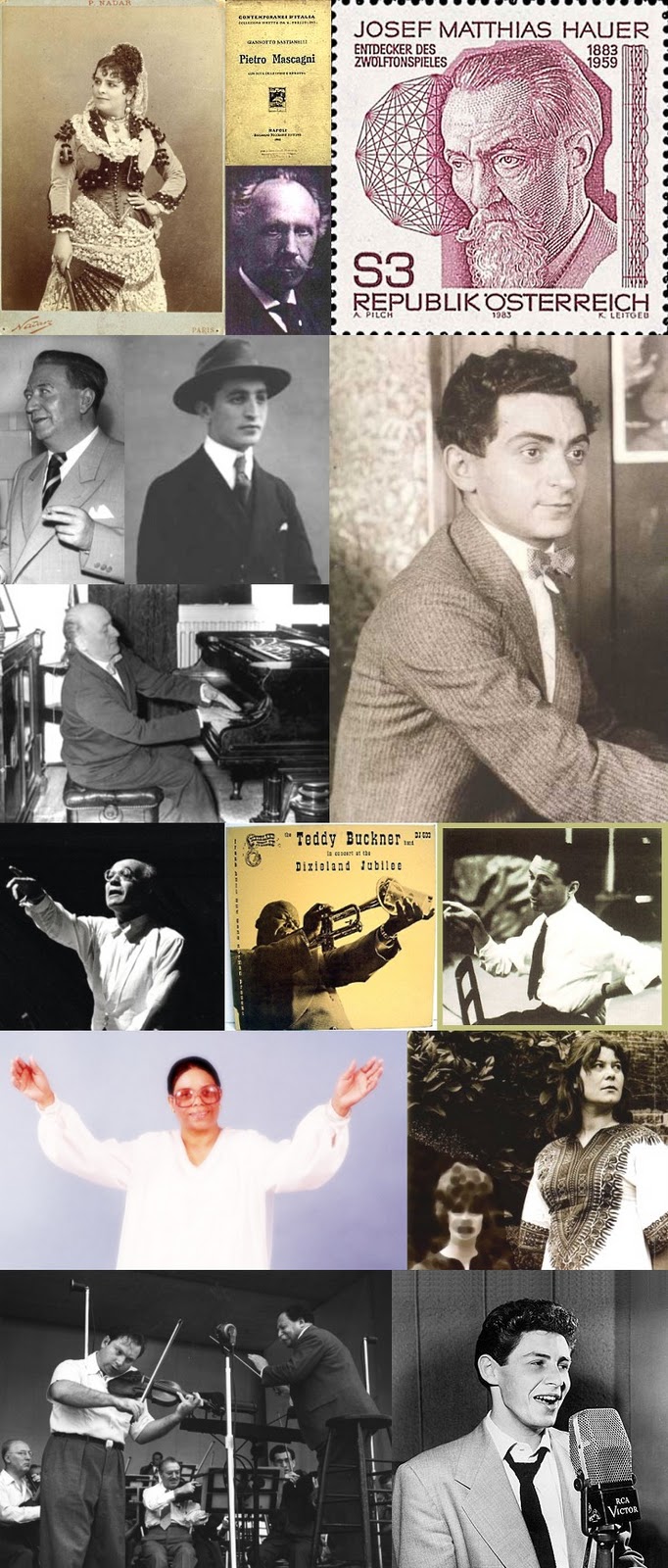
09-22: Mahler 5 Abravanel 1974 - Schleiermacher Music at the Bauhaus 1999 - Brahms Stern Rose Ormandy 1964 - Eddie Fisher Sings Irving Berlin 1954


1905 – Célestine Galli-Marié (French operatic mezzo-soprano, creator of title role in Carmen)
1927 – Giannotto Bastianelli (Italian musicologist & author)
1935 – Karl Schröder II (German cellist, composer & conductor)
1959 – Josef Matthias Hauer (Austrian composer & music theorist)
1975 – Franz Salmhofer (Austrian composer, clarinetist, conductor & poet)
1981 – Harry Warren [Salvatore Antonio Guaragna] (American composer & lyricist of stage & screen)
1987 – Louis Kentner (Hungarian-born British pianist & composer)
1989 – Irving Berlin [Israel Isidore Baline] (Russian-born American composer & lyricist of stage & screen)
1993 – Maurice Abravanel (Greek-born Swiss-American conductor & pianist of Sephardic ancestry)
1994 – Teddy Buckner (American jazz trumpeter)
1994 – Leonard Feather (British-born American jazz music critic, pianist, composer & producer)
1994 – Mattie Moss Clark (American gospel choir director & mother of The Clark Sisters)
1995 – Dolly Collins (English folk keyboardist, arranger & composer, sister of Shirley)
2001 – Isaac Stern [Исаак Стерн] (Ukrainian-born American violinist)
2010 – Eddie Fisher (American pop singer & actor)


Ugh. These lists are going to have to be pared down brutally if I ever hope to get caught up. But do you like the color scheme I used today? I went with off-blah.

Yesterday we had two great electric bassists, one who outshone the other. Today it's the same deal, except with Tin Pan Alley songwriters: the great Harry Warren (42nd Street, etc.), being overshadowed by Irving Berlin, who was probably the greatest of them all.

We also have the creator of the title role in Bizet's Carmen, Célestine Galli-Marié, who was a high mezzo-soprano. For many years, such a mezzo was referred to as a "Galli-Marié."

There's also Josef Matthias Hauer, who came up with a system of composing with 12 tones just a year or two before Arnold Schoenberg did, although Hauer's methods were quite different. Central to the Hauer approach was the classification of any 12-tone succession into one of 44 tropes, or pairs of complementary unordered hexachords. You don't get it? That's okay, you don't have to understand everything. If you did, you'd be God, and just think how boring that would be. Seriously, doesn't God get bored, knowing there's nothing for Him to discover, nothing that will ever be mysterious to Him? Don't ponder that question. You'd be better off to stick with learning more about Hauer's tropes.

If you've got more than half a dozen jazz albums in your collection, at least one of them probably has liner notes written by Leonard Feather. Also along jazz lines, there's trumpeter Teddy Buckner, an old-time Dixielander, who not only sounded but also looked very much like Louis Armstrong.

Eddie Fisher passed away just last year. Most of you out there would probably know him better as Princess Leia's dad than for his singing.

Mattie Moss Clark was a pioneering figure in the world of gospel choir singing. The standard disposition of three-part harmony for such choirs was of her devising.

And from the world of classical performance, there's Maurice Abravanel, music director of the Utah Symphony between the late 40s & late 70s. He was another Mahlerian, and so we get another chance to remember Gustav Mahler during this, his death centenary. We'll have several more chances before the year is up, so don't worry that we've only addressed Mahler's 5th & 8th symphonies and Das Lied von der Erde so far.

And Issac Stern, one of the great violinists of the past century. My old violin teacher from high school was not fond of his sound. Her comment on him was "Crunch! Crunch! Crunch!" Yeah, he did crunch a bit with the bow. It was an assertive sound - not for everybody, I guess. I attended a master class Stern gave in the early 90s. He asked those assembled to raise their hands if they played the violin. Then he did the same for the cello. And the piano. And that was it. As a violist, I felt a bit left out. On the other hand, I was spared the embarrassment of anybody knowing I played the viola...


09-17: Mahler DLvdE Klemperer 1967 - Jimmy Yancey 1940 - Mozart Requiem Messner 1950 - Hildegard von Bingen Sponsa Regis 2009 - Kabeláč Symphony 8 Neumann - Prokofiev Concerto 2 Francescatti 1952


1179 – Hildegard von Bingen (German abbess, composer & author)
1762 – Francesco Geminiani (Italian violinist, composer & music theorist)
1803 – Franz Xaver Süssmayr (Austrian composer, Mozart's copyist & friend, completed Requiem K.626)
1884 – Louis Schubert (German violinist, teacher & composer)
1907 – Ignaz Brüll (Austrian pianist & composer)
1951 – Jimmy Yancey (American blues & jazz pianist, composer & lyricist)
1960 – José [Josep] Sancho Marraco (Spanish composer & church musician)
1966 – Fritz Wunderlich (German lyric tenor)
1973 – Hugo Winterhalter (American easy listening arranger, composer & conductor)
1979 – Miloslav Kabeláč (Czech composer, conductor & pianist)
1982 – Manos Loïzos (Egyptian-born Greek composer & guitarist of Cypriot descent)
1988 – Hilde Gueden [Güden] (Austrian lyric soprano)
1991 – Zino Francescatti (French violinist)
1992 – Roger Wagner (American choral conductor & teacher)
1994 – John Delafose (American zydeco accordionist, composer, fiddler & bandleader)
1996 – Jessie Hill (American blues & R&B singer & songwriter, "Ooh Poo Pah Doo")
1999 – Frankie Vaughan (English pop & easy listening singer)
2005 – Alfred Reed (American composer & conductor)


Write-up pending... the goods are below, though :>


09-05: Antonio Mairena : Actuaciones Historicas - Mahler 5 & 8 Solti - Wolfgang Fortner : Triplum etc. Wergo 1967


1629 – Domenico Allegri (Italian composer & singer, younger brother of Gregorio)
1734 – Nicolas Bernier (French musician & composer)
1803 – François Devienne (French composer, flutist & teacher)
1890 – Ludwig Deppe (German composer, conductor, pianist & teacher)
1910 – Franz Xaver Haberl (German priest, church musician & musicologist, friend of Liszt)
1910 – Julian Edwards (American composer & popular songwriter)
1921 – Joseph Mann (Polish-born Austrian operatic tenor)
1962 – Alessandro Granda (Peruvian operatic tenor)
1964 – Giórgios Kokoliós (Greek operatic tenor)
1965 – Stephan De Jonghe (Belgian musicologist)
1969 – Mitchell Ayres (American conductor, arranger & composer, Perry Como, The Hollywood Palace)
1969 – Henk Bijvanck (Dutch composer)
1973 – Petre Ştefănescu Goangă (Romanian baritone)
1975 – Georg Ots (Estonian baritone of opera, art song, folk song & film)
1980 – Don Banks (Australian composer of concert, jazz, & commercial music)
1983 – Antonio Mairena (Spanish flamenco singer)
1987 – Wolfgang Fortner (German composer, conductor & teacher)
1993 – René Klijn (Dutch pop singer & photo model)
1994 – Billy Usselton (American jazz tenor saxophonist, clarinetist & oboist)
1995 – Pigmeat Jarrett (American blues singer & pianist)
1997 – Sir Georg Solti (Hungarian-born British conductor)
2003 – Gisele MacKenzie (Canadian-born American pop singer, violinist, actress & TV personality)
2007 – Saint Thomas [Thomas Hansen] (Norwegian alt-country singer, songwriter & guitarist)
2011 – Salvatore Licitra (Italian operatic tenor)


Sometimes you go with what you can. For Domenico Allegri's much more famous brother Gregorio (he of the sublime, if not entirely his own, Miserere), there is a good etching of his likeness. For Domenico, we have a receipt from his employer.

The most recent addition to our list of names is that of Salvatore Licitra, an excellent tenor whose star only began rising about 12 years ago. Things really picked up for his career in 2002, when he debuted at the Met unexpectedly, substituting for Pavarotti as Cavaradossi in Tosca after the ailing legend cancelled at the last minute. He passed away this September 5th after a motor-scooter accident in Sicily that left him lingering in a coma for several days. Our condolences to his family, friends, and many colleagues, who mourn the tragic loss of a singer who has been dubbed "the New Pavarotti," and a tenor "worthy of the great Italian tradition."

Our next most recent passage was that in 2007 of Norwegian alt-country artist Saint Thomas, who died as a result of an unfortunate deadly combination of prescription drugs, at the age of 31. He was another artist who'd only recently begun to achieve international attention, touring with Lambchop in Europe and Of Montreal in the U.S. during the mid-00s.

On a brighter note, our long-awaited major Mahler conductor has finally shown up, in the form of Sir Georg Solti, whose tenure at the Chicago Symphony Orchestra rivalled those of the legendary Frederick Stock and Fritz Reiner years. An energetic conductor of both concert music and opera, his Wagner Ring cycle (with the Vienna Philharmonic) and Mahler symphony cycles are treasured by many, if not to everyone's taste. But pretty much everyone agrees that his Mahler 8th from 1971, with its superb roster of vocal soloists, is one of the very best available... (Read more below)

09-04: Mahler 8 Stokowski live 1950 - Stellakis & Rita Rebetiko - Bach / Albert Schweitzer 1935 - Grieg Holberg Suite / Oslo Camerata 2006


1759 – Girolamo Chiti (Italian composer & biographer of Giuseppe Pitoni)
1827 – Michael Pamer (Austrian composer & conductor)
1844 – Oliver Holden (American minister & hymn composer)
1853 – Jonathan Blewitt (English organist & composer, active in Ireland)
1903 – Herman Zumpe (German conductor & composer)
1907 – Edvard Grieg (Norwegian composer & pianist)
1937 – Giovanni Salviucci (Italian composer & organist)
1937 – Stanisław Dobrzański (Polish tenor)

1937 – Vasily Petrov (Ukrainian operatic lyric bass)
1965 – Albert Schweitzer (Alsatian theologian, physician, missionary, philosopher, organist & Bach scholar)
1977 – Stellakis [Stelios Perpiniadis] (Greek rebetiko singer, songwriter & guitarist)
1991 – Carlos Alexander (American baritone)
1991 – Charlie Barnet (American jazz saxophonist, composer & bandleader, "Cherokee")
1991 – Dottie West (American country singer, songwriter & guitarist)
1995 – Chuck Greenberg (American new age musician & producer, Shadowfax)
1997 – Belle Stewart (Scottish folksinger)
2002 – Vlado Perlemuter (Lithuanian-born French pianist)
2003 – Tibor Varga (Hungarian violinist & conductor)
2003 – Lola Bobesco (Romanian-born Belgian violinist)
2006 – Astrid Varnay (Swedish-born American dramatic soprano of Hungarian ancestry)


Write-up pending. Won't really be all that much to say, though. I mean, you got your Grieg, you got your Dottie West, you got your Charlie Barnet, you got your Albert Schweitzer (he didn't just give medical attention to African children, he played the organ and wrote about Bach, too), and you got some pretty famous violinists & singers. You also got your first chance to pay a little attention to Gustav Mahler, like we're trying to do during this, his death centenary year. Haven't been any Mahler conductors of note on our lists in the past month, but baritone Carlos Alexander fits the bill, thanks to a certain landmark Carnegie Hall performance he participated in. Of course, he was just one performer among, oh, about 1000 others, I guess (*wink*wink*), but he does get a big solo in one part.

You know what, forget about the "write-up pending" nonsense. I'm going to go ahead and call this one finished, even though it might have been nice to say some things about Stellakis Perpiniadis, and Lola Bobesco, and Belle Stewart, and Astrid Varnay, and even Edvard Grieg, famous as he is. Go, now, and do what you know you must...