Showing posts with label J. Barbirolli. Show all posts

12-21: Albert King Montreux 1977 - Milstein : Tchaikovsky 1940 | Bruch 1942 | Mendelssohn 1945 - Gade : Symphonies 2 & 8 / Hogwood 2001 - Mozart Exsultate Jubilate : Raskin / Szell 1964

Not shown: Philipp Hyacinth Lobkowitz, Caspar Ruetz & Charles-François Dumonchau


1734 – Philipp Hyacinth Lobkowitz (Czech nobleman, lutenist & patron of Arcangelo Corelli)
1755 – Caspar Ruetz (German cantor & composer)
1807 – John Newton (English sailor, minister & hymn writer)
1820 – Charles-François Dumonchau (French composer, pianist & cellist)
1843 – Edward Bunting (Irish folksong collector, author & organist)
1864 – William Henry Fry (American composer & music critic)
1890 – Niels Gade (Danish composer, conductor, violinist, organist & teacher)
1906 – Adalbert von Goldschmidt (Austrian composer)
1957 – Eric Coates (English composer, conductor & violist)
1964 – Thomas Nassi (Albanian composer, conductor, teacher & flutist, active also in the United States)
1965 – Claude Champagne (Canadian composer, teacher, violinist, pianist & organist)
1982 – Abu-Al-Asar Hafeez Jalandhari [
ابو الاثر حفیظ جالندھری] (Pakistani writer, poet & composer of Pakistan's National Anthem)
1984 – Judith Raskin (American lyric soprano)
1987 – John Spence (American alternative rock singer, No Doubt)
1989 – Ján Cikker (Slovak composer, conductor & organist)
1992 – Albert King (American blues guitarist, singer & songwriter)
1992 – Nathan Milstein (Ukrainian-born American violinist)
1997 – Amie Comeaux (American country singer)
1998 – Karl Denver (Scottish pop singer)


You might find the fellow in the upper-right corner, William Henry Fry, to be a bit familiar. That's because I mistakenly already included him on September 21st, when he actually belongs in December... another example of my often-faulty sources failing me. But I suppose Fry is worth remembering twice, since was one of the more important American composers of the 19th century. I even had a download for him in that previous post in which he appeared, but don't bother looking for it... it was another Megaupload! So, an all-around FAIL, any way you look at it... but anyway, it's going to be another big day around here tomorrow, so I'd better catch up on my beauty sleep...


12-10: The Band : NY Palladium 1976 - Henry Cowell Piano Music : Cowell 1963 - Heifetz : Sibelius Concerto 1935 / Tchaikovsky Concerto 1937 - Il Giardino di Giulio Caccini 2003

Not shown above: Friedrich Franz Hurka, Dieudonné-Pascal Pieltain, Mariano Obiols i Tramullas & Pablo Hernández y Salces
1618 – Giulio Caccini (Italian composer, lutenist, gambist, harpist, singer, author & teacher, a pioneer of opera)
1665 – Tarquinio Merula (Italian composer, organist & violinist)

1805 – Friedrich Franz Hurka [František Václav Hůrka] (Czech tenor & composer, active in Germany)
1826 – Benedikt Schack [Žák] (Czech tenor & composer, active in Austria, friend of Mozart & creator of Tamino in Die Zauberflöte)

1833 – Dieudonné-Pascal Pieltain (Belgian violinist & composer)
1877 – Federico Ricci (Italian composer & teacher, brother of Luigi)

1888 – Mariano Obiols i Tramullas (Spanish composer)
1910 – Pablo Hernández y Salces (Spanish composer)
1921 – Viktor Jacobi (Hungarian operetta composer)
1938 – Mario Pilati (Italian composer, music critic & teacher)
1939 – Wilhelm Grosz (Austrian composer, pianist & conductor, active in the UK & US, "Red Sails in the Sunset")
1965 – Henry Cowell (American composer, music theorist, pianist & teacher)
1966 – Boris Koutzen (Russian-born American violinist, composer & teacher)
1967 – Brasílio Itiberê da Cunha Luz (Brazilian folklorist, composer & author)
1967 – Otis Redding (American soul singer, songwriter, producer, arranger & talent scout)
1967 – Ron Caldwell, Carl Cunningham, Phalin Jones & Jimmy King (members of American R&B group the Bar-Kays)
1969 – Franco Capuana (Italian conductor)
1969 – Leigh Harline (American film composer, "When You Wish Upon A Star")
1982 – Roy Webb (American film composer, The Magnificent Ambersons, I Walked with a Zombie, Notorious, Mighty Joe Young)
1986 – Kate Wolf (American folk singer, songwriter & guitarist)
1987 – Jascha Heifetz (Lithuanian-born American violinist)
1991 – Headman Shabalala (South African singer, Ladysmith Black Mambazo)
1994 – George van Renesse (Dutch pianist & conductor)
1995 – Darren Robinson [Buffy, Buff Love, DJ Doctor Nice] (American rapper & beatboxer, The Fat Boys)
1996 – John Duffey (American bluegrass singer & mandolinist, The Country Gentlemen)
1997 – Violet Carlson (American comedienne, actress, singer & dancer)
1999 – Rick Danko (Canadian rock & folk bass guitarist, singer, songwriter & multi-instrumentalist, The Band)
2008 – Didith Reyes (Filipino actress & singer)


This is getting really difficult. And I don't just mean finding links for you. (Some of the hosts have now gone into a kind of lockdown mode, where only those who uploaded a file can download it.) I'm talking about all the carnage, too! Heifetz, Otis Redding and most of his backing band, Henry Cowell... Rick Danko... it smarts something awful.


10-19a: Son House 1941-1942 Library of Congress - Jacqueline Du Pré : Elgar | Delius | Saint-Saëns 1


1758 – Johan Helmich Roman (Swedish composer, the "Father of Swedish Music")
1786 – Pietro Alessandro Pavona (Italian organist, composer & church music director)
1932 – Arthur Friedheim [Артур Фридхайм] (Russian pianist, conductor & composer, active in Britain, the United States & Canada, pupil of Liszt)
1956 – Isham Jones (American jazz bandleader, saxophonist, bassist & songwriter, "It Had To Be You")
1959 – Stanley Bate (English composer & pianist)
1960 – Günter Raphael (German composer & music editor)
1961 – John Fernström (Swedish composer, conductor, teacher, violinist, poet & author)
1987 – Jacqueline du Pré (English cellist, spouse of Daniel Barenboim)
1988 – Son House (American blues singer, guitarist & songwriter)
1992 – Maurice le Roux (French conductor & composer, pupil of Messiaen, known for soundtracks)
1995 – Don Cherry (American jazz pocket trumpeter, cornetist, pianist & composer)
1997 – Glen Buxton (American rock guitarist & songwriter, Alice Cooper)
2000 – Hortense Ellis (Jamaican reggae singer, younger sister of Alton)
2005 – Dallas Cook (American ska-punk trombonist, Suburban Legends)


Jacqueline du Pré, Son House, and Don Cherry. There are three names that likely wouldn't be mentioned in the same book, much less in the same phrase, if it weren't for October the 19th. But they do have one other thing in common, which is that all of these musicians were at the absolute top of the heap within their respective genres - namely, classical violoncello, Delta blues, and avant-garde jazz. Let's examine the three of them chronologically, but according to year of birth, rather than year of death, as above.

Son House was not from that very first generation of Delta bluesman who were born in the 1880s and 90s, and which was occupied by the original himself, Mr. Charlie Patton. However, with a birthdate of 1902 he lay, along with Skip James, in a middle-ground between Patton's generation and that second generation of Delta bluesman, represented most famously by Robert Johnson (b. 1911). But any way you wanna slice it, it cannot be denied that with Son House's passing in 1988, it really was the end of an era, because it meant that the very last of the old-time Delta bluesman who'd made their first commercial recordings in the 1920s was now gone.

And what a great bluesman he was. Often using a slide on his National steel guitar, House infused his fervent vocal performances with a rare amount of borrowings from the style of 19th-century black spirituals, and the hypnotic repetitiousness of plantation work songs. It may represent as close a performance style as many 20th-century performers ever got to the proto-blues of those years before recording technology existed, or before people who had access to such technology thought music of this sort was worth using it for.

Don Cherry, player of both the tiny pocket trumpet and the normal-sized cornet, was one of the pivotal figures in some of the most exciting developments in avant-garde jazz in the 1960s thru 80s. He's most associated with the free jazz of Ornette Coleman, nine of whose albums he played on between the late 50s and early 70s. He also appeared with Charlie Haden's Liberation Music Orchestra, and was one of many players to appear on Carla Bley's avant-garde jazz opera Escalator Over The Hill.

But Cherry also led a couple dozen visionary sessions of his own, in which his musical explorations led him to what would become known as "global fusion," a style which signaled jazz finally dissolving into the larger world of music, incorporating not just jazz and rock but potentially all music of all peoples into its improvisational framework. In the hands of Cherry, and similarly-minded individuals, jazz was now becoming not just the music of African-Americans, and of hip and educated European-Americans, but of the whole planet.


(more on Jackie later...)

10-17a: Chopin Bonanza! Cortot | Lipatti | Rachmaninoff | Richter - Janácek / Haas / Szymanowski Quartets arr. Tognetti 2002 - Hummel Mandolin & Trumpet Concertos : Stephens / Agnes / Shelley 2001


1825 – Peter Winter (German opera composer & violinist)
1837 – Johann Nepomuk Hummel (Austrian composer & pianist)
1849 – Frédéric Chopin (Polish composer & pianist)
1890 – Prosper Sainton (French violinist))
1910 – Julia Ward Howe (American abolitionist, author & poet, "The Battle Hymn of the Republic")
1944 – Pavel Haas (Czech composer, pupil of Janáček, perished at Auschwitz)

1972 – Billy Williams (American R&B & pop singer)
1979 – Karel Reiner (Czech composer & pianist, the only classical composer to survive Theresienstadt)
1981 – David Guion (American composer & arranger, inspired by soundscape of the American West)


Another uncanny coincidence, in that Karel Reiner should have died on the 35th anniversary of the day the promising composer Pavel Haas was murdered at Auschwitz. Both of them had been been housed at Theresienstadt, a somewhat less hellish concentration camp, which the Nazis had established in a Polish Jewish ghetto, in part to make a propaganda film demonstrating that their musically gifted "detainees" were being treated well and allowed to flourish musically (in fact, the orchestra in the film were surrounded by flowerpots to hide the fact their shoes had been taken away). Reiner was the only classical composer at Theresienstadt to survive the war. But the story of Haas's untimely demise was later related by another survivor, conductor Karel Ančerl, who claimed he was standing next to Haas at Auschwitz the day they both arrived (many of the Theresienstadt prisoners having been transported there as soon as the filming was finished), and that originally it was he, Ančerl, who had been among those chosen for the gas chambers, but that Haas had a bad cough which caused the commanding officer to change his mind and send him instead. Ančerl went on to have a brilliant career with the Czech Philharmonic Orchestra. We can only guess at what great things Haas would have accomplished had he lived a full life, as Reiner and Ančerl did.

Well, Chopin is one of those composers it's hard to have too much of in your record collection. His works are open to so many interpretive possibilities, making it difficult to decide on just one version of the Ballades, or the Mazurkas, or the Scherzi, or what have you. Plus, all his works are so gorgeous, so emotionally satisfying, and so amazingly well-crafted - all things that make Chopin perhaps the piano composer par excellence. The only others who might come close are Schumann, Liszt, and Rachmaninoff, but even they seem to fall short of the almost universal appeal of Poland's greatest composer. And Chopin's life was a good six years shorter than Pavel Haas's was. Tuberculosis, you know. So, he was also coughing shortly before the end. How many more of those perfect little masterpieces he might have had inside him. Keep reading about him!

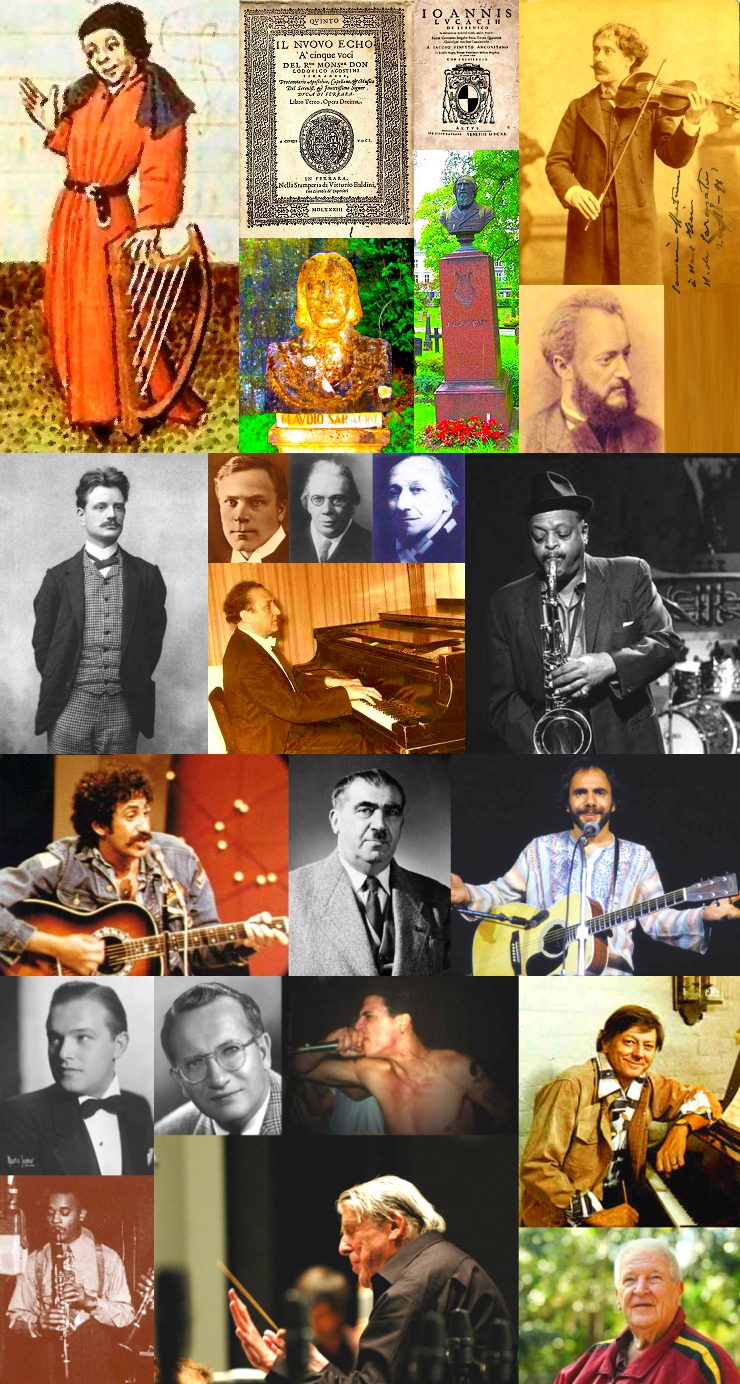
09-20: Sibelius 1 2 5 7 Barbirolli - Link 80 Killing Katie 1997 - Ben Webster Ballads 1955 - Gilles Binchois / Discantus 2009 - Sarasate Zigeunerweisen Heifetz 1937


1460 – Gilles Binchois (Franco-Flemish composer)
1590 – Lodovico Agostini (Italian composer, singer, priest & scholar)
1630 – Claudio Saracini (Italian composer, lutenist & singer)
1648 – Ivan Lukačić (Croatian-born composer & church musician, active in Italy)
1896 – Johan Gottfried Conradi (Norwegian conductor & composer)
1897 – Karel Bendl (Czech composer & conductor)
1908 – Pablo de Sarasate (Spanish violinist & composer)
1957 – Jean Sibelius (Finnish composer)
1957 – Heino Kaski (Finnish composer & pianist)
1960 – Michel Brusselmans (Belgian soundtrack composer)
1967 – Henri Mulet (French organist & composer)
1968 – Frank Pelleg (Czech-born Israeli harpsichordist, pianist, conductor, composer & teacher)
1973 – Ben Webster (American jazz tenor saxophonist & pianist)
1973 – Jim Croce (American singer-songwriter & guitarist)
1974 – Robert Herberigs (Belgian composer)
1984 – Steve Goodman (American folk singer-songwriter, "City of New Orleans")
1994 – Jule Styne (English-born American Broadway composer & pianist)
1994 – Jimmy Hamilton (American jazz clarinetist, tenor saxophonist, arranger, composer & teacher)
1996 – Paul Weston (American pop pianist, arranger, composer & conductor)
1997 – Nick Traina (American punk/ska singer, Link 80, son of Danielle Steel)
2006 – Armin Jordan (Swiss conductor)
2006 – John W. Peterson (American composer of hymns & cantatas)
2010 – Leonard Skinner (American high school gym teacher, namesake of Lynyrd Skynyrd)


Some great favorites here. Both Gilles Binchois and Ben Webster were one of the Big Three in their day. "Wha??" you say? That's right... Binchois, considered by some the finest melodist of the 15th century, was one of the most prominent members of the Burgundian School, along with Guillaume Dufay and John Dunstable - composers who served the court of Burgundy and represented the first generation of composers we think of as "Renaissance." And Ben Webster was one of the three greatest tenor sax players to come out of the swing era, along with Coleman Hawkins and Lester Young.

They called Webster "The Brute" or "Frog" because of the rough, raspy tone he used on rhythm tunes - although his sound became sweetly coy and sentimental on ballads. In fact, it's safe to say that with Ben Webster, we get a greater timbral variety, from wispy, breathy warbles to petulant growls, than we do with just about any other sax player in jazz. And look, there's reedman Jimmy Hamilton on the list, too! Both Webster and Hamilton were alumni of Duke Ellington's great orchestra in the 30s & 40s... Hamilton stayed on with Ellington for decades longer, but Webster had a falling-out with the Duke (in which he apparently cut up one of Ellington's suits - ouch!) and went off on his own in 1943. Webster would go on to do his best work in the 50s, perhaps most notably on Soulville from 1957, considered to be the very first soul jazz album in the history of jazz... and, soul.

The real bigwig on the list, however, is the national composer of Finland, Jean Sibelius. It must suck to be any Finnish composer coming after Sibelius - always being compared to this musical giant who had such an idiosyncratic artistic voice. And boy, it must have really sucked to be poor Heino Kaski... a much lesser-known Finnish composer, pooping on the same day as Sibelius. Sibelius, who for many years was widely performed little elsewhere than in the Nordic countries and Britain, is known primarily for his seven symphonies, his violin concerto, and his many symphonic poems based on Finnish lore and legend. He's also known as one of the last of the great late Romantic composers, who somewhat like Richard Strauss lived into the mid-20th century as a symbol of a bygone era as several fads of modernism came and went. Unlike Strauss, Sibelius decided he'd said all he wanted to by the late 1920s, and committed hardly a note to music paper for the last 30 years of his life, preferring instead to focus his energies on fostering interest in performances and recordings of his existing body of works. See you on the other side of the early retirement...