Featured Post

SIX KEYS TO A LITERARY GENETIC CODE

In essays on the subject of centricity, I've most often used the image of a geometrical circle, which, as I explained here,  owes someth...

Showing posts with label doom patrol. Show all posts

Sunday, April 12, 2026

DENSITY=EXCESS

 This essay exists for the most part to draw a line between both 2013's THE NARRATIVE RULE OF EXCESS and its corollary from 2017, EXCESSIVE COMBINATORY FORCE, and the more recent LOVE, DENSITY AND CONCRESCENCE from 2025. In the last of these, I wrote:

because density has a stronger association than does concrescence with the quality of some physical substance, it also proves somewhat better for describing the finished product. I might say, using my most recent emendations of my potentiality terminology, that "Dave Sim's work excels at dealing with didactic cogitations, while Grant Morrison's work excels at dealing with mythopoeic correlations." That quality of excellence can be metaphorically expressed as a given work's density, in that such density shows how thoroughly the author was invested in a given set of fictional representations (sometimes, though not usually, on a subconscious level).


In contrast to my meager usage of the term "density," I probably have many references to "excess" scattered throughout this blog, since that philosophical concept was thoroughly explored by one of my major influences, Georges Bataille, particularly in the first of his works I ever read, VISIONS OF EXCESS.  In the two linked essays above, my main concern was to apply Bataille's concept to my own concepts of the two forms of sublimity. I won't get into those formulations here, for I'm concerned that excess is a general rule, like density, for judging the presence or absence of excellence in fictional works.   

The difference between the two concepts relates to authorial motive. The author who achieves excellence in one or more of the four potentialities does so because he/she becomes engaged enough with the material to DESIRE to give it a density, a thoroughness, that seems to be like that of lived experience. The creator of a poor work, within whichever potentiality one judges the work by, has no desire, or next to none, to convey investment in the material to his audience. The creator of a fair work has some desire, but only up to a point. It's only the creator of a good work who's totally invested with respect to at least one potentiality.

One example of authors investing "excess effort" in various potentialities can be seen in a comparison I floated between the Lee-Kirby FANTASTIC FOUR and the Drake-Premiani DOOM PATROL. I still believe that the Lee-Kirby work shows an excess of the mythopoeic imagination and that the Drake-Premiani work does not. However, I now realize that the later issues of DOOM PATROL put forth a density of specification with respect to the dramatic potentiality. More simply put, even though the Lee-Kirby FF set the early standard for using soap-opera dramatics, one might argue that Drake was, over time, better at finding interesting ways to exploit the dramatic conflicts of the team and its opponents, at creating the illusion of character progress. In contrast, though Stan Lee was the boss in the collaboration with Kirby, he often let Kirby "have his head"-- and Kirby was not really a "details man." On close study the sixties FANTASTIC FOUR has a rather herky-jerky progress with respect to its characters' serial development, even if Lee's dialogue usually managed to paper over any perceived discontinuities. I said that I doubted that artist Premiani contributed much original material to the collaboration; he probably just drew whatever Drake related in his full scripts. Drake wasn't often capable of mythopoeic imagination, unlike Kirby. But he conveyed a sense of density in the interrelations of the Patrol members, because that was the part of his inspiration to which he best related.              

Wednesday, April 10, 2024

MYTHCOMICS: ["THE KINGDOM OF NO"], DOOM PATROL #26-29 (1989)

[The umbrella-title I've bestowed upon these four issues is taken from the solo title of issue #29.]


I analyzed the second appearance of Grant Morrison's absurdist "Brotherhood of Dada" in this 2019 post, because I liked it better. But the Brotherhood's first appearance is a well-crafted mythcomic as well, though the absurdity takes a different form.

The two Brotherhood stories summon to my mind a dichotomy I explored in a 2009 post, THE UNBEARABLE FULLNESS OF EMPTINESS. In this post, I commented upon an essay by literary critic David Sandner, who suggested a hermeneutic approach to the super-genre of fantasy, depending on whether the author utilized his fantasy-concepts to stress the emptiness of existence (Lewis Carroll) or its fullness (J,R.R. Tolkien). I won't take the time to expatiate on any notion that Morrison's TALES OF HOFMANN belongs to the hermeneutic of fullness. But a story with the title THE KINGDOM OF NO fairly broadcasts its indebtedness to a philosophical penchant for absence.


Following a prologue introducing a couple of the master villain's hench-persons, Morrison and Richard Case give their readers their first look at Mister Nobody, a cubist distortion of a human figure standing in a cluttered room in Paris. Nobody descants to his newly formed band of nutzoid supervillains on the room: "All the toys, all the comic books, all the silly, useless things that people lose or throw away: they all end up with me." It's perhaps counter-intuitive for Morrison's character to blather about easily abandoned commodities, given that he's writing a comic book aimed largely at a readership of hardcore comics-collectors. Still, the metaphor passes muster, since comic books were originally conceived as throwaway entertainment.


Nobody takes six pages to detail his origin, or rather, his rebirth. He had been an ordinary henchman to the original Brotherhood of Evil, foes of the original Doom Patrol, but he decided to subject himself to an experiment designed to give him superhuman powers. For "three days and three nights, the traditional Celtic period of mystical trial," he endures sensory isolation, and the result is that he transforms into Mister Nobody, taking his new cognomen from the famous if anonymous children's poem. He then rejects the original Brotherhood's acceptance of the meaningless terms of good and evil by bestowing on his five henchmen the title of "The Brotherhood of Dada," referencing the Dadaist movement of the early 20th century.


Nobody's doctrine of meaninglessness doesn't keep him from expounding on such luminaries as the writer Thomas DeQuincey and the artist Piranesi, who are clues leading to Nobody's absurdist Holy Grail: a painting that devours the reality within which said artwork was created. The villains find and steal the painting from its owner, and then unleash its power, which begins by swallowing up the whole city of Paris.


The new Doom Patrol, however, is well suited for combating such esoteric threats. While Robotman remains the one "normie" link to the original group, the new version of Negative Man discourses on humanity's occupation of a "virtual universe recursion," while new member Crazy Jane derives her powers from her plethora of multiple personalities. The three of them invade the painting, where they find that their foes can now confound with purely artistic principles, derived from such movements as impressionism and futurism.


However, the over-confident super-crooks don't realize that their presence calls forth an apocalyptic menace, "The Fifth Horseman," who apparently got left out of the New Testament like, well, someone's discarded comic book. 


Yet, although Crazy Jane is integral to staving off the Horseman's power for a time, it's nonsense-meister Nobody who triumphs in the end. Since Jane says the Horseman feeds on "ideas," Nobody, his henchmen and the Patrol manage to steer the monster into the artistic realm of Dada, "the kingdom of no, where even language fails" (and thus the perfect place for a Lewis Carroll hootenanny). The threat is nullified, the heroes escape the painting, and the capricious criminals are left inside the recursive art-universe, though Nobody alone will manage to break free for his second outing by Morrison and Case. And so the world of normality is apparently preserved, though the reader is more than a little persuaded that the only true presence is actually an absence.

Saturday, August 27, 2022

MYTHCOMICS: "THE DEATH OF THE DOOM PATROL" (DOOM PATROL #98, 1965)


I've occasionally noted my liking for the Silver Age DOOM PATROL  for an assortment of reasons. One was that it was one of the first DC features to successfully ape the "soap-opera adventure" mode popularized by Marvel Comics. Another was that writer Arnold Drake was the only talent who even came close to Stan Lee in the department of making witty quips. That said, Lee also benefited from the fabulous design-abilities of his collaborator Jack Kirby. Drake's DOOM PATROL collaborator, the Italian Bruno Premiani, produced visuals with a wonky charm (partly because of his dicey use of forced perspective), but he probably didn't bring any new ideas to the table.


The feature had been running about two years by the time of "The Death of the Doom Patrol." Like a lot of shock-based concepts seen at Silver Age DC, it depends on a sudden upheaval in the status quo, when the Patrol's wheelchair-bound mentor, The Chief, tells his freaky superhero subordinates that he's terminating their employment. 


Nothing daunted, the heroes proceed to build their own HQ (with what resources, Drake does not specify). Then, rather than waiting the entire length of the tale for the big reveal like many DC stories, Drake provides two panels in which The Chief confirms his self-diagnosis of imminent death. He's only kicked out his proteges in order to force them to make their own way in the superhero game, which is a adult-to-child psychological trope that's appealing, however problematic.


Meanwhile, the newly independent Patrol is confronted by their first new super-villain, Mister 103, named for the number of elements on the periodic table in 1965. The dorky-looking fellow successfully robs a bank vault by turning into such diverse elements as lead, neon, magnesium, sulfur and magnetic iron, all in a mere two pages. The team's first encounter with the villain is a total failure, and they immediately "run to daddy" for advice. They learn learn the reasons for the Chief's rejection and the nature of his malady, a fatal infusion of radioactive copper. However, it just happens that the very thing the super-scientist was investigating during his accident is the thing that can defeat the Atom Master.


Armed with a new weapon, Robotman and Negative Man (who get all the action, Elasti-Girl being consigned to weeping over her dying mentor) confront 103 and paralyze him with an alien freeze-ray. Negative Man saves the day by figuring that if 103's element-transformation ray can give the villain the power to change himself, it can also change an individual human into one element-- that of pure copper-- and then totally reverse that transformation. I confess that even for a comic book, this problematic science doesn't even make as much sense as the Tootsie Pop ad at the bottom of page 16, and the quick reversal of the Patrol's "death" is not all that mythic in and of itself.


What "Death" does well, though, is to play upon the cosmological fascination of the elements of nature, through the lens of a superhero adventure. I've addressed the idea of "element-villains" a couple of times on this blog, noting that the earliest example known to me, the Justice Society tale "Vampires of the Void," failed to develop the epistemological patterns implicit in the theme. Then with the advent of the Silver Age, a number of DC writers seemed to become fascinated with the periodic table as a source of villain-powers. The first mythic villain of this kind was 1958's Mister Element, quickly followed by a less well developed fellow, Bill Finger's Elemental Man in DETECTIVE COMICS #294 (1961). A year later, metals, rather than elements, were turned into crusading crimefighters in the form of Robert Kanigher's METAL MEN (1962), and 1965 also brought to DC a new "Element Man" in the form of Bob Haney's Metamorpho. But one of the more interesting aspects of the Drake story is that the Chief's illness via "radioactive copper" plays upon the body's real need of copper in the formulation of hemoglobin, and upon the fact that too much copper can poison a human body-- giving this comic-book illness a bit more vraisemblance than was usual.


Tuesday, December 17, 2019

MYTHCOMICS: :"TALES OF HOFMANN" (DOOM PATROL #50-52, 1991)

The three-issue sequence I've termed "Tales of Hofmann" (after the first issue's title) might be the first "Christmas in the comics" story  in which Xmas only plays a niggling role. As the cover of one
collected edition shows, the Patrol's perennial villain "Mister Nobody" is seen wearing a Santa hat in a few panels, and apparently the story does take place at Christmas, since the chimerical character is seen giving away a toy-store's merchandise to thrilled kiddies. However, there's not much Yuletide content in the three issues. Nobody and his comical cronies also parody the Last Supper, though that theme would seem to have more to do with Easter. 


To be sure, the date that most concerns writer Grant Morrison in this sequence is not December 25, but Election Day 1976, when some parodists, probably associated with the Yippies, started the first "Nobody for President" movement. Morrison doesn't directly reference that historical event, but "Hofmann" is a positive ode to all things Yippie-ish, and to all aspects of the counterculture's determination to break down "the doors of perception." For instance, the "Hofmann" of the title is not the horror-story writer associated with the famous opera, but Albert Hofmann, the Swiss scientist who first synthesized and ingested LSD. 

Mister Nobody, originally a minor functionary in the Silver Age DOOM PATROL, was re-imagined by Morrison and artist Richard Case as an opponent for their version of the Patrol. However, whereas the original Patrol had contended against the preachily named group of villains known as "the Brotherhood of Evil," Mister Nobody brought together a bunch of freaky fiends to become his "Brotherhood of Dada." Though his original group were exiled from Earth, Nobody returns to the mortal plane, and promptly recruits yet another merry band of pranksters, and then decides to run for president of the United States. The members of the current Doom Patrol-- Robotman, Rebis, and Crazy Jane-- don't quite know how to deal with this non-destructive rampage, any more than cops of the sixties and seventies knew how to cope with the planned insanity of the Yippies.


As in most if not all of his DOOM PATROL scripts, Morrison firmly endorses an ethics of ecstasy and resistance to the "tedium" of ordinary existence. That said, he might be a little more cautious than the average Timothy Leary disciple, given that he does show a "bad trip" on the part of one of the recipients of Nobody's distribution of LSD-like experiences. However, even if the superheroes aren't quite ready to shut down these wacky malefactors, the U.S. government is more than prepared to do so.


While Morrison could have simply created some standard government super-operative, in "Hofmann" he shows his enthusiasm for "found art." The cover of DOOM PATROL #51 reproduces, albeit with alterations, an unused cover for a DC series that was never launched, concerning a disguise-master named "Yankee Doodle." Probably this aborted concept owed something to similar fare like the pulp-character SECRET AGENT X, but naturally Morrison's concern is to show his version of Yankee Doodle as an agent of the repressive status quo.

The one thing that keeps "Hofmann" from being the best example of a Morrison DOOM PATROL script is the fact that the three issues utilize a somewhat bizarre melange of contributing artists: not only the dominant penciler Richard Case but also Stan Woch, Rian Hughes,, and (most jarringly) Jamie Hewlett. But Morrison still presents a rich discourse regarding humankind's problematic ability to imagine anything, versus their confinement to the Tedium of Ordinary Life.


Thursday, February 2, 2017

MYTHCOMICS: FLEX MENTALLO (1996)

To repeat my criteria from POMO AND PLURALISM, I’m judging works as “modernist” or “post-modernist” based on the author’s attitude toward the nature of the universe on which the work is modeled. A modernist work starts with the proposition that the fictional world depicted is modeled on a single “realistic” world that can be largely explained by science and rationality. A post-modern work states or implies the possibility of a multiplicity of worlds in the story, which may imply a similar statement about the reader’s real world, if only in metaphorical terms. Alan Moore’s MIRACLEMAN stands as an example of the first type, reading various superhero tropes, mostly from franchises like “Superman” and the Golden Age “Captain Marvel,”as pointless escapes from a unitary, mundane realty.


Though the Internet is rife with various descriptions of a personal feud between Alan Moore and Grant Morrison, there’s no reason to assume that Morrison’s commentary on superhero tropes, either in FLEX MENTALLO or elsewhere, is necessarily a response to Moore’s treatment of them.  That said, MENTALLO also gives a great deal of emphasis to tropes associated with Superman and Captain Marvel, as well as those of The Question, Steve Ditko’s most philosophically representative creation, whom Alan Moore parodied in WATCHMEN as “Rorshach.”

The character Flex Mentallo first appeared as a fully formed concept in issue #42 of Morrison’s DOOM PATROL. This was also an endorsement of the relativity of reality, in that Flex was a character created in an amateur comic book by a kid named Wally Sage. Sage’s latent psychic powers brought Flex to life in the “real world”—or at least, as real as the Earth of DC Comics could get. 

Flex was also “unreal” in that he was modeled on the once prevalent ‘Charles Atlas” bodybuilding ads that appeared in commercial comics for many decades. Yet instead of depending on physical strength as did the character in the ads, Flex’s power was to project waves of energy from his unified “bodymind.” Nowhere in the DOOM PATROL or in this mini-series does Flex actually hit anyone in the old-fashioned way. Morrison didn't even stress any continuity between the miniseries and Flex’s previous appearances. Flex seems to exist in a world that barely has any superheroes left, which means that it can’t be DC-Earth. He does seem to share the same world as his now-adult creator Wally Sage. The two of them never meet, though they both encounter some of the same supporting characters.

The plot of FLEX MENTALLO isn’t intended to be especially coherent, so I won’t spend time summarizing it. The story more or less begins with the musclebound protagonist looking for one of his long-vanished crime-fighter colleagues, the Fact (who is in part Morrison’s take on The Question). Flex wanders through his unnamed city, having mystifying encounters with the remnants of the native superhero world, or with super-people who seem to be emigrants of some disintegrating cosmos.


Counterpointing Flex Mentallo’s peripatetic quest are the largely verbal divagations of Wally Sage. He spends most of the mini-series talking on the phone with an unseen volunteer for a crisis hotline—said crisis being that the reality-hating Wally has taken pills in an attempt to commit suicide. True, Wally is so addled that he’s not sure whether he took barbiturates or M&Ms. In many respects he seems to be the epitome of the escapist superhero fan with his head up his ass, for all he can talk about is his juvenile love of superheroes:

“…when you think about it, they’re like archetypal… they come right up from the depths, those things—how can they that stuff’s stupid?”

The imputation that superheroes are juvenile escapism is the place where most elitist critiques of the genre both start and stop. But even though Wally’s pretty messed up, Morrison implies that the character's desire for visionary experience allows him to tap into a deeper level of reality. Wally has suppressed memories that initially seem to be recollections of sexual abuse, but turn out to be a childhood encounter with “the Legion of Legions,” who are some of those emigrant superheroes mentioned earlier, trying to manifest in a nearly superhero-less world.


There’s also one more subplot: Flex has an ally on the police force, name of Harry, and for some reason Harry enlists the help of an imprisoned super-villain to investigate the threat of world destruction. The villain’s name, The Hoaxer, is a patent reference to The Riddler, making him the only major reference to DC’s Bat-mythology.

Although Morrison’s main project is to demonstrate the reality of the superhero world, if only in archetypal terms, he doesn’t neglect to picture the limitations of ordinary reality. He devotes several pages to an unnamed junkie/ male prostitute who desires transcendence so badly that he takes a drug designed to make him feel like a superhero, but he dies in the attempt. Flex tries to save him by resorting to a magic word written on a piece of paper, but finds that he’s lost the paper. 


This absurdist subversion of a standard “life-saving” trope is also another standard trope of elitist critiques. Nevertheless, Wally survives while the “last boy on Earth” (as the junkie calls himself) perishes, even though Wally clearly knows his way around a pharmacy as well. It's possibly meaningful that Wally's insights go beyond his own personal welfare, as when he conceives that the emigrant superheroes “live in a factory where ideas are made.” Further, Wally’s visions are oriented not only on himself but upon humanity as a whole, saying of superheroes, “We can be them.”

To be sure, Morrison’s vision of what superheroes mean doesn’t resemble that of most critics, even though at one point Wally declares, “Frederic Wertham was fucking right!” Clearly Morrison isn’t thinking about sexual superheroes in the same way Wertham did: as seductive power-fantasies devised to seduce innocent children. Sexual realization is part of Morrison’s program of visionary fulfillment.

Nowhere is this seen more clearly than in the author’s validation of the Silver Age of Comics, which is, as many fans know, the comics-age Morrison experienced as a young fan. Wally observes that the Golden Age of superheroes was “pretty simple,” boiling down to the “Charles Atlas hard body homoerotic wish-fulfillment.”  (I disagree, but this one interpretation doesn’t undermine the general strength of Morrison’s theme.) Wally then observes that the Silver Age changed the paradigm. “Strange transformations, multiple realities, dreams, hoaxes… it was like the hard body began to turn soft...” I could carp that this description mostly applies to the line of Superman comics supervised by Mort Weisinger, with a little Julie Schwartz on the side, but it’s still a stimulating reading.

The miniseries concludes on the implication that the emigrant superheroes will indeed break through to Wally’s fallen reality. I’m not quite prepared to term this a Jungian katabasis, given that I think Morrison is at best a dilettante Jungian. Nevertheless, when he has Wally speak of a “synchro-interaction with readers” of this “ultra-post-futurist comic,” I’d like to think that he, as much as Jung, is trying to show the favorable aspects of understanding more worlds than just the one in front of one’s nose every day.


Monday, October 5, 2015

RETHINKING THE UNDERTHOUGHT

I started out OVERTHINKING THE UNDERTHOUGHT with this quote from Frye:

Meaning is derived from context, and there are two contexts for verbal meaning: the context of literature and the context of ordinary explicit or intentional discourse. When we first read a concentrated and difficult poem, we first try to grasp its explicit meaning, or the prose sense of what it says. We often call this the “literal” meaning, but actually it is a translation of the poem into a different verbal context, and is not what the poem really means at all. Gerard Manley Hopkins draws a distinction between the poet’s “overthought” or explicit meaning, and his “underthought,” or the meaning given by the progression of images and metaphors. But it is the “underthought” that is the real poetic meaning, and the explicit meaning must conform to it ...-- Northrop Frye (fuller context here).

I didn't use Hopkins' term "overthought" in the essays I directed at a couple of elitist critics, but I did state that they were guilty of "overthinking:" of taking narratives made up of "images and metaphors" and locking them into predetermined complexes of ideas. Within the scope of my essays, "overthought" might describe this tendency, while "underthought" described the reader's tendency to read the narrative's images and metaphors first and foremost as things that aroused either sympathetic or antipathetic affects in him. These emotional responses then lead to the abstract ideas, rather than the other way around.

While I agree with Frye's basic conclusion from the material given, I don't think Hopkins' original thesis goes far enough. I think the "literal meaning" is not something that looms "over" the poem, as a dialectical theme can be descried 'from above." The literal meaning is, amusingly enough, also the "lateral meaning;" one arrives at it by following the progression of events and expressed feelings from point A to point Z, and that is "what happened."

The word "overthought," in my opinion better properly describes a hyper-intellectual approach to art that Frye himself described in his essay "Mouldy Tales," collected in A NATURAL PERSPECTIVE:

{Certain critics] feel that [literature's] essential function is to illuminate something about life, or reality, or experience, or whatever we call the immediate world outside literature. Thus they tend... to think of literature, taken as a whole, as a vast imaginative allegory, the end of which is a deeper understanding of the nonliterary center of experience...

"Underthought," obviously, I would keep just as it is, with the caveat that just because one believes in starting one's critiques by talking about the progression of images and metaphors, that does not mean one has nothing to say about how the "images of intuition" can become ordered into "structures of dialectic thought."

It may be that my revised versions of overthought and underthought will in future serve me as shortened forms for the respective effects that "the function of thinking" and "the function of intuition" have upon literary narrative.  I concluded in REFLECTIONS IN A MERCURIAL EYE PART 3   that both myth-critics and ideological critics were in a similar unenviable position as far as converting the majority of readers to pursue more abstract readings of texts. Most readers quite logically are concerned with lateral meaning, which takes in both "the function of sensation" and "the function of feeling"-- and in truth, the abstractions of both overthoughts and underthoughts are only possible when constructed on the foundation of concrete experience. Thus, I personally can still enjoy many narratives that don't have much in the way of abstract meaning, as long as they excel in terms of sensation, feeling, or some combination thereof.  Many of my favorite comics from my early days will not make the grade as myth-comics, such as the 1960s DOOM PATROL, which did its level best to emulate the charisma of the 1960s FANTASTIC FOUR. The Drake-Premiani stories are still fun to read for their lateral meaning, for their appeals to sensation and feeling-- but overthought and underthought will not appear nearly as much as they do in the Lee-Kirby FF-tales.

Friday, September 26, 2014

VICTIMOLOGY 101, PT. 2

The book I mentioned in Part 1 of this essay-series is Mike Madrid's 2009 book on superheroines, entitled THE SUPERGIRLS.

In many respects I ought to like this book. The author appears to be a Silver-Age kid like myself. Just as I have devoted a blog to the topic of empowered female characters here, Madrid's introduction depicts the author as having an inveterate interest in comic-book super-heroines, if not for reasons identical to my own.
And unlike the only previous work on the subject-- Trina Robbins' GREAT WOMEN SUPERHEROES, a very detailed history of superheroines in comics, albeit with some major omissions-- THE SUPERGIRLS is an attempt to interpret the depiction of superheroines in cultural terms, as the book's subtitle indicates: "Fashion, Feminism, Fantasy, and the History of Comic Book Heroines." (Despite Madrid putting "fashion" first, possibly to appeal to academics, there's really very little about the specifics of fashion in fantasy or reality.)

Unfortunately, SUPERGIRLS is a prime example of an interpretative work laboring under a cloud of false victimology. I'm sure that Madrid must have in his mind some notion of the perfect superheroine, a figure that provides a "happy medium" between a type who is too wholesome and a type who is too oversexualized. But he does not succeed in depicting such a paradigm in the pages of his book. Thus, all through the pages of SUPERGIRLS, Madrid always seems to be carping at the imperfections of almost all those who have depicted comic-book superheroines, without establishing his grounds for true excellence.

The first two chapters don't raise many objections. Madrid divides the majority of Golden Age heroines into a few convenient, perhaps slightly oversimple, categories, and he devotes special attention to comparing and contrasting the two heroines who were arguably both the most influential and best-known comics-heroines; Sheena and Wonder Woman. However, even on page 2, he starts the victimology by claiming that "for now [i.e., 1947] women would have to be content to put on scanty costumes and assume a disguise in order to act like themselves." This sounds for all the world like one of many supercilious putdowns of patriarchy, easily countered by the observation that male superheroes are also predicated on acting like fools and diletttantes to camoflague their real natures. And if one should need a source for this observation, one can find it-- on page 5 of SUPERGIRLS, where Madrid himself admits that male superheroes had to "dumb themselves down" to mix with mortal kind.

However, when Madrid gets into the third chapter, entitled "The Girlfriends," he goes into victimology overdrive-- and both his logic and his accuracy go out the window. I'll try to keep my complaints to the most egregious examples.

Page 12-- Madrid asserts that the girlfriends of featured heroes-- the Hawkgirls, the Bulletgirls-- crusade against crime only to impress their boyfriends. It's one thing to believe this, but Madrid offers no textual proof of this species of victim-crying.


Page 36-- Madrid claims that in William Moulton Marston's WONDER WOMAN origin, "Hercules allows himself to be beaten by Hippolyta." That's not in any Marston origin I've read: as I remember, Hercules loses a fair fight, and then plots revenge through deception.


Page 56-- Madrid claims that "the most important female figure in [Batman's] world" is his "sainted, slain mother," despite the fact that the character rarely thinks about Martha Wayne at all in most of the Golden Age stories. This is a superficial Freudian reading put forth years ago by Michael Fleischer, but there's no evidence that the Oedipus Complex informs the Batman mythos. The idea that this complex is proven simply by the absence of lasting romantic relationships in the hero's life is a clear case of putting the cart before the horse: i.e., romantic relationships are *primarily* absent  from the series because they would interfere with the open-ended setup of the franchise, not because of Batman's personal trauma.
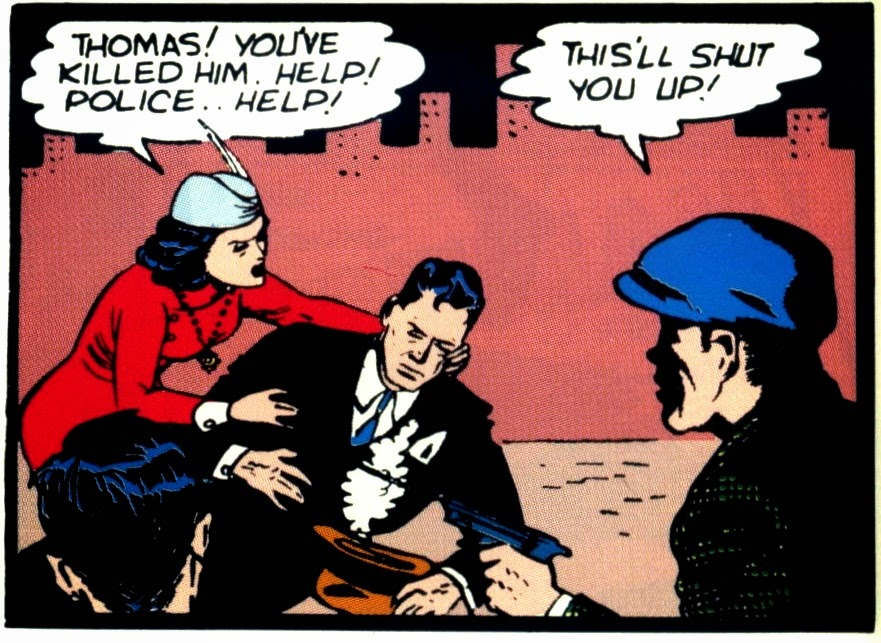


Page 92-- Madrid, having spent a long time chronicling the career of the Silver Age Supergirl, complains that she "didn't show any signs of ever growing up to be a Superwoman"-- apparently another carp about men keeping women down, even though by that time it should have been evident that both male and female characters did not age, given that the readerships were assumed to turn over every few years.


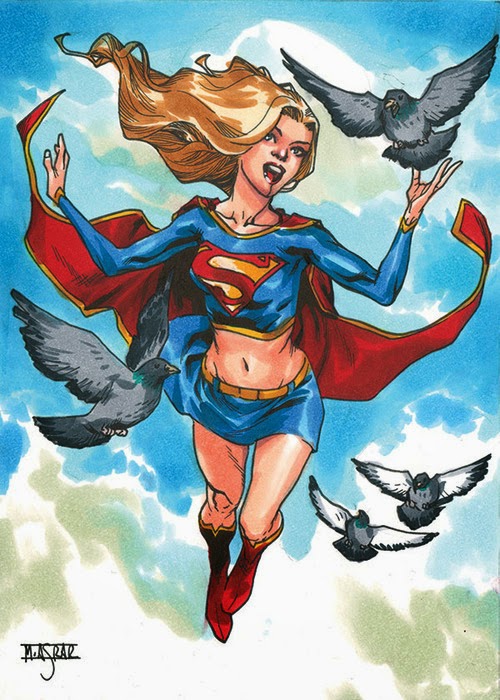
Page 98-- He tells us that the 1990s version of Supergirl "was clearly meant to be a male fantasy, and no longer a character to attract or inspire female readers"-- yet, he has just finished complaining that the tame Silver Age version, which he compares to singer Leslie Gore, also never reaches any sort of potential, even though she was putatively aimed at female readers. There's also, throughout the book, no dealing with the possibility that sometimes female readers enjoy sexual fantasies themselves.


Page 103-- Madrid describes the Silver Age in very inaccurate terms, particularly when he claims that "Magic was a mysterious enemy, meant to be defeated." Granted, a lot of DC's Silver Age books are hot for science more than sorcery, but there are a fair number of magical heroes-- the Spectre, the Enchantress, Zatanna-- and I see no evidence that magic is despised, even by heroes like Superman, who numbered it among his vulnerabilities. This may be extrapolated from Madrid's view that all magic went out the window in the WONDER WOMAN book once Kanigher displaced Marston, but I don't think Kanigher used magic any less; he just didn't use it the same way Marston did.
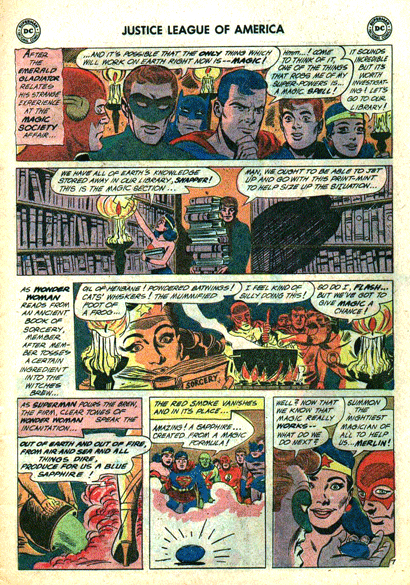


Page 105-- Madrid claims that there's a victim-based reading possible from the fact that Superman and Batman did not make regular appearances in the early JUSTICE LEAGUE title, griping that "Wonder Woman is not considered to be in the same 'league' as Superman and Batman." This too is better explained by extrinsic rather than intrinsic factors. Many pros and fans have attested that DC editor Mort Weisinger maintained, or attempted to maintain, a close hold on these characters, since he Weisinger edited all of the Superman books and arguably influenced the artistic direction of the Batman books even when they were 0being edited by Weisinger's associate Jack Schiff. It's been rumored, with whatever truth, that Weisinger lobbied to keep Superman and Batman out of the Justice League, and I for one find this a more likely explanation for the duo's early JLA absence than some mysterious pecking-order.

Page 112-- After claiming that the Invisible Girl's original powers are useless-- somehow overlooking that she defeats Doctor Doom in FANTASTIC FOUR #5 and engages him in single combat in #17-- Madrid claims that Sue Storm's force-field powers come about because "Reed has figured out a way to boost Sue's powers." Madrid doesn't bother to cite the issue number where this happened-- though he's careful to cite issue #12 as evidence of Sue's non-importance-- but the fact is that in FF #22, Reed only suspects that Sue has powers she hasn't used yet. The scientist's "nuclear-powered" measuring device *accidentally* stimulates Sue into manifesting her new powers, which are, like the powers of the male heroes, attributable to the original cosmic-ray accident they all endured.


Page 139-- Light Lass, Dream Girl, and the White Witch are said to thwart the sorcerer Mordru in a LEGION story. Apparently all short-haired girls look alike to Madird: 'twas Princess Projectra, not Light Lass.

Page 159-- Marvel's Black Widow is said to be facing "hard personal choices" when she deserts her romantic partnership with Daredevil to accept the more "prestigious membership" of the Avengers. Yet what the character actually thinks is not some feminist assertiveness: she accepts the membership because she wants to have time to think about her relationship with Daredevil! The Widow also only remains with the Avengers for two issues in this period; in all likelihood Marvel editors simply wanted an excuse to terminate the ongoing Daredevil-Black Widow relationship for one reason or another.

Page 189-- "Numerous stories focused on the world's obsession with learning Wonder Woman's secret identity in an effort to find her weakness."-- Gee, that's such an original notion. Uncover a superhero's ID to compromise said hero. I guess Wonder Woman must have been the first hero ever to have suffered such investigations. Or, if she wasn't the first, surely this only happens to female heroes, as a marker of the indignities they alone suffer.

Page 221-- "Out of style, Wonder Woman was also erased"-- Uh, yeah, and it was because she was going to be rebooted, as Madrid himself tells us on p. 208.

Page 249-- "The jungle antics [of jungle queens] ended in 1954"-- again, no, Atlas Comics kept jungle comics, including two jungle queens, going until 1957.


On the same page, Madrid has problems with the nefarious Catwoman becoming a "good girl." He overlooks that she only reformed during the years 1951-52, and that she went back to being a "bad girl" for three 1954 stories-- and it was at this point that she was excluded from the DC universe until 1966. Since she was "bad" at the time of her forced retirement, the goody-goody Catwoman did not "pave the way for Batman's new love interest, the more buttoned-up and sexless Batwoman."


These are others, but these examples of inaccuracy and false reasoning are the most egregious. If most of them had been simple matters of misperception-- remembering Light Lass in place of another heroine, for example-- I probably wouldn't have written this review. But most of these citations grow out of Madrid's pervasive victimology: his hectoring insistence that nearly everything ever done with comic-book heroines is wrong, wrong, wrong.
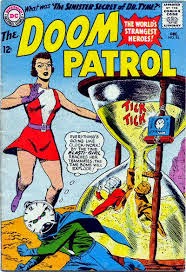


Well, with a few exceptions. Madrid does at least give props to the creators of THE DOOM PATROL for a gutsy lady crime-fighter-- which is more than Trina Robbins did, when she conspicuously omitted Elasti-Girl from her own book. But to elevate the model of Elasti-Girl, Madrid has to drag down the Marvel superheroines using pretty much the same knocks Robbins used in her book : they're too weak, they're too girly, they "pose and point."  Given that Madrid's whole project involves the "close reading" of the ephemera of comic books, one might wonder why he chose to read them so loosely.

Unfortunately, the only explanation I can devise is that he wanted to make comic-book heroines sympathetic for their having been so roundly victimized, whether they were turned into virgin schoolgirls (1960s Supergirl) or teeny-bopper whores (1990s Supergirl). But the question arises-- do we respect these heroines more for being victims-- or for being heroes, irrespective of gender? It is, unfortunately, a question Madrid doesn't even try to address.

Friday, January 7, 2011

CHIEF CONCERNS


Back in October, Scipio of THE ABSORBASCON wrote an impassioned salute to the character Niles Caulder (aka "The Chief") of the 1960s DOOM PATROL comic by Arnold Drake and Bruno Premiani, here. As a longtime fan of the DOOM PATROL title of that period, I agreed with almost everything Scipio said about Caudler, except for his contempt from Grant Morrison's rewriting of the original character. In the comments-thread I said:

I'll play Odd Man Out here and say that the Grimmy Grittification of Niles Caulder is very nearly the only such major rewriting that I *DON'T* consider worthless, and that's because Morrison had a Thematic Point To Make in trashing the old Caulder. Fans can try if they like to find Theme in the trashing of Doctor Light or Captain Atom or whoever, but all they shall find is dross.

That doesn't mean that I don't consider Drake's Niles Caulder a superior creation, though.

I like to think that when Morrison travestied Caulder he was then still under the spell of Evil Alan Moore, and that Moore's really the one to blame. But that's me.


By this time, I'm sure Scipio has forgotten that he challenged me to elaborate:

What "thematic point" did Morrison have to make by trashing Caulder? And... was it worth it?


Nevertheless, the following meditation on "continuity" is my belated answer to that question.

*****

In a sense, real “continuity” would be very like death, because it would be a state in which everyone came to resemble everyone else. George Bataille’s EROTISM emphasizes that the nature of living beings—at least those that propagate by sexual reproduction is “discontinuity,” in the sense of the organisms being non-identical with one another, cobbled together from the discontinuities of each organism’s parental units.

In comic books the usual connotation of “continuity” applies to the illusion of seamlessness between the many adventures in an open-ended serial, which, if it lasts long enough, may be worked on by many raconteurs. It’s inevitable that none of these raconteurs will have the same set of interests or priorities, no matter how much one of them may strive to write like a model.

To be sure, even though serial seamlessness is an illusion, it’s a valid part of the way we expect our serials to unfold. A raconteur is expected not to radically change the nature of the game he’s hired to play--unless, of course, he’s hired to write new rules.

Example time: One of my favorite superhero serials of the 1960s was THE DOOM PATROL. Though writer Bob Haney created the characters with artist Bruno Premiani, Haney quickly yielded the title to colleague-writer Arnold Drake, who wrote the remainder of the stories until the feature’s cancellation in 1969.

Within the continuity of Drake’s stories, the best character may have been Niles Caulder, the “Chief” of the Patrol. Drake made the crippled genius a man of immense feeling and humanity, who brought together three “freaks” to become superhero icons, and in so doing, fostered a kind of ersatz family. Drake leavened Caulder’s saintliness with occasional moments of hauteur or bad temper, but on the whole he was a believably good man. By the rules of the DOOM PATROL game—which began again when the title was inevitably revived—every subsequent depiction of Caulder should’ve been the same.

But, as it happens, the best revival of the DOOM PATROL did exactly the opposite. Grant Morrison’s DP was his breakout-series with American comics-fandom, but one of the big changes he brought about was to present a “Chief” who was not only brittle and arrogant, but who turned out to be toward the end of Morrison’s run, a villain.
No logic-parsing could ever reconcile the selfless and self-deprecating Drake character with the coldly manipulative Morrison version, who admits in DP #57 that he actually engineered the catastrophes that cost his heroes their normal status.


As this Chief reveals his hidden history to Robotman, he rationalizes that “we need shocks in our lives… Catastrophe forces us to think in new ways.” Of course, a page earlier this Caulder admits to some baser motives in the case of Elasti-Girl: “Impotent in my wheelchair, I wanted to exert control over a beautiful woman.”


But though Morrison’s Caulder is a villain, Morrison clearly means us to take his rationale seriously, especially in respect to Morrison's own rewriting of old continuity. It’s a bit shocking to an old fan like me to see a favorite character like Caulder rewritten, but unlike many raconteurs who do so with no greater theme in mind, Morrison clearly has a point to make. He’s not just trying to keep the illusion of seamlessness—though he is faithful to some aspects of old “continuity”—but rather, he’s showing what does and must happen whenever a later talent attempts to follow in an earlier one’s footsteps.

To put it simply, Grant Morrison makes the inevitable discontinuity an overt part of the continuity, and makes a virtue of showing off the seams amid the apparent seamlessness.