Featured Post

SIX KEYS TO A LITERARY GENETIC CODE

In essays on the subject of centricity, I've most often used the image of a geometrical circle, which, as I explained here,  owes someth...

Showing posts with label fawcett comics. Show all posts

Friday, November 28, 2025

MYTHCOMICS: "THE GREAT OXYGEN THEFT" (THE MARVEL FAMILY #41, 1949)

 For a change, here's a Golden Age story in which the name of its artist is lost to time, but GCD attests that the writer was Otto Binder, known to Fawcett fans as having been responsible for a great quantity of stories about Captain Marvel and his kindred. "The Great Oxygen Theft" is not one of Binder's more celebrated stories, but it merits a little notoriety for rendering elementary-school environmental science into a decent cosmological myth.


THEFT wastes no time in setting up the action of this 10-page tale. A radio summons from the evil Doctor Sivana lures the Marvel Family to an unnamed, inhabited world in the star-system of Sirius. Sivana gives the heroes a story about his having reformed and directs their attention to the fact that the world's plant life is almost gone thanks to a plant-killing blight. The inhabitants haven't noticed this mass extinction, but they start paying attention when they start finding it hard to breathe, due to the lack of plants generating oxygen. Sivana then leaves the good guys to sort things out while he jets back to Earth, revealing that he created the blight just to keep the Marvels out of his non-existent hair.


   The Marvels' first task is to save the populace. Mary Marvel purifies the soil of Sivana's poison, Captain Marvel Jr disperses the excess carbon dioxide that has built up in the absence of plant life, and Captain Marvel brings in a glacier of frozen oxygen to give the air-breathers temporary relief.

The Marvels then play Johnny Appleseed, transporting Earth-plants to the Sirius-world. Naturally, Binder doesn't trouble with ALL the scientific niceties regarding the practicality of one world's vegetation adapting to a totally different environment. However, on one of the heroes' trips to Earth, they find that certain areas of their own world have been hit with the plant-blight. Before they even have to wonder if the blight might have travelled back to Earth on their boots or capes, Sivana announced that he's responsible, and that he wants supreme power to keep Earth's plants healthy.


  Since THEFT is as I said just a ten-page story, Binder needed a quick wrap-up, so he cheats a little. Captain Marvel gets the bright idea that just as miners had used canaries to test for bad air inside mines, he and the other Marvels can just pick up a random potted plant and use it to "detect" the presence of plant-poison in Sivana's ship. It would probably made just as much sense for the Marvels to race all around the world until they made a visual sighting of the ship-- which, after all, they all got a look at, back on the unnamed planet. But Binder also knew his audience would like a little ironic touch at the end, in which a villain who poisoned a world's plants gets defeated by the use of another plant. The unknown artist even shows, in the penultimate panel, Sivana "wearing" the potted plant atop his bald head, leading one to assume that some hero "crowned" him with it. THEFT probably violates as many scientific principles as those that it gets right, but the payoff at the end, with the Marvels expressing their appreciation for plants and the order of nature, is not diminished by said violations.    
  

Friday, October 18, 2024

MYTHCOMICS: "MARY MARVEL GOES OVER THE RAINBOW" (WOW COMICS #14, 1943)


This 1943 tale, written by Otto Binder and probably drawn by his brother Jack, is "metaphysical" in the sense of taking discriminate phenomena and attributing abstract aspects to them. I analyzed a story with a similar trope-- that of "light versus darkness"-- in THE PERIL OF PAINGLOSS. Here Mary Marvel encounters a war between "color" and "blackness," the latter to be understand in the visual sense, as the absence of all color perceptions.


In her civilian ID of Mary Batson, the heroine reads a newspaper story in which a reputable scientist claims that the legend of the "Pot of Gold at the Rainbow's End" is real. Mary, being patriotic, wonders if this treasure could be used for America's war effort. At the same time, a crook named Porky Snork talks his gang into seeking out the same golden horde. Meanwhile, Mary finds out that the person claiming to have seen the pot of gold is not reputable science-guy Tinkerman but his self-important son Creighton.


When Porky and his thugs show up, Mary changes into her heroic identity, but can't manage to stop the malcontents from stealing the balloon Creighton meant to use to track down the rainbow's end. Mary flies after the balloon, towing Creighton behind her, perhaps less for his guidance than for his potential for comedy relief. When both protagonists and antagonists arrive at rainbow's end, they learn that the rainbow actually creates the pot of gold, as all the colors of the spectrum "drip" off the rainbow and coalesce into the fabled treasure.


Mary contends with the petty thieves, and the balloon drifts to the top of the rainbow, where all see a colorful city dwelling. Mary rather rashly punctures the balloon, and the crooks fall from the basket. However, the greedy men are rescued by a "Batplane" piloted by Mister Night, a mysterious figure in black. Mary clouts the new villain, but he escapes with Porky's gang, so Mary and Creighton decide to investigate the city. It turns out to be inhabited by "sky spirits" whose purpose is to dispense color to the mortal world.


King Color informs Mary that Mister Night was exiled from Rainbow City, and that he's probably planning some fell scheme against his former brethren. Sure enough, Night has apparently been waiting around for some plug-uglies to fall into his lap, since his first gambit is to send the thugs after Jack Frost.


(Jack Frost, incidentally, comes into the matter because there was a tradition in which the frosty fellow was portrayed as being the entity who "painted" plants with autumnal colors.)


Mary thwarts the thugs but Mister Night rescues them, while revealing that his real purpose was to kidnap "Aurora, Spirit of Dawn." The dark villain's true plot is to eliminate all colors from the mortal world, so that he can become Earth's ruler. Mary flies to "Night Land" to rescue Aurora, without whom dawn can't transpire on Earth. However, for all her myriad powers, Mary can't see in absolute darkness. She changes to her human self so that the magic lightning will illuminate the landscape. The same light allows Night to see and capture the intruder. However, because the story's running out of space, the fiend doesn't take the time to either clobber or gag Mortal Mary. She easily "shazams" her way back to her super-powered ID and slugs Night, though he escapes into the darkness of his domain. 


With Aurora returned to her celestial duties, all that's left is the wrapup, as Porky's gang once again tries to acquire the pot of gold (with the use of a toboggan, yet), only to be captured by Mary. She also returns Creighton Tinkerman to his home, though one can wonder how much approbation he received for the discovery of Rainbow City, whether Mary donated the pot of gold to the war effort or not. I haven't found evidence that Mister Night ever returned, though Binder helpfully equates the shadowy evildoer with real-life world-beaters like "Hitler and his henchmen."

The inventiveness of Otto Binder's story is underscored by the writer's clear avoidance of the standard association of "pots of gold" with "leprechauns." How this association came to pass has received some online speculation, and I rather like (without necessarily advocating) the idea that rainbows became associated with wealth because at times heavy rainfall might uncover buried gold. Of course that's probably too reductive by half, and the real correlation is probably all sorts of supernatural spirits have been tied to underground stores of wealth, whether of natural or man-made provenance. Binder makes a strong association between "wealth" and the pleasures humans feel at the variety of natural colors, and extrapolates those pleasures into a race of color-bestowing spirits. Of course, the title suggests that Binder was aware of the use of the phrase "Over the Rainbow" in a famous song for the 1939 WIZARD OF OZ. There aren't any strong similarities between this story and the OZ film, though of course the latter also foregrounds the experience of prismatic beauty. It's interesting, though, that he includes Jack Frost as one of these dispensers of color-beauty, because when Frost paints plants with autumnal hues, that presages the "temporary death" of such plants worldwide, when Winter, the time of darkness, holds sway. I suppose Binder could have had Mary capture Mister Night like she would any common troublemaker. But it's fitting that he did not do so, since the darkness symbolizing Death is inextricably intertwined with the forces that bring forth light and Life.   

Monday, November 21, 2022

DEPARTMENT OF COMICS CURIOSITIES #11

 Never mind all the fuss about whether or not the Joker has a boner... here's a villain whose name now means "an oral sex act."


On a more analytical note, Mister Scarlet's foe "The Hummer" can be considered an example of a "freakish flesh" villain for the same reason as two Dick Tracy villains, Mumbles and Gargles, because he makes weird sounds rather than having anything unusual about his physical appearance.

Tuesday, May 10, 2022

MYTHCOMICS: "THE DEMOCRACY SMASHER" (MARVEL FAMILY 67, 1952)

 In the last few years of Fawcett Comics' existence before the lawsuit with DC forced them to shut down their superheroes, premiere writer Otto Binder showed no sign of flagging creative powers. In CAPTAIN MARVEL ADVENTURES #125 (1951), Binder and artist C.C. Beck introduced a new villain, King Kull, the last survivor of a race of ancient beast-men. 


He was also supposedly the source of all mortal legends about "boogiemen," though I have to say that this character-- whose name may owe less to the Robert E. Howard hero than to a traditional king of Irish myth-- doesn't really look like he could terrify anyone. In his original appearance, Kull pops out of the Earth for the first time in decades and immediately starts trying to kill off modern mortals, the descendants of the ancients who slew his people (admittedly in self-defense). Kull, who possesses incredible technology for a caveman type, starts unleashing a cataclysmic doom on the world, and Captain Marvel comes to the rescue. The hero wins but the villain escapes.

I'm not sure if "The Democracy Smasher" from MARVEL FAMILY #67 was Kull's second outing or not, but the book-length script shows a much greater concentration by Binder on the thematic thread of ancient horror menacing modernity. 


This time, before Kull strikes, the three members of the Marvel Family just happen to be taking part in a newly minted local holiday, "Democracy Day," in which Billy Batson and his buddies celebrate the historical tradition of democracy. Slightly later, Old Shazam summons the Marvels to his sanctum, claims that he gave Billy the idea for the new holiday, and shows the heroes three statues of "three torches" that "are the world's hope for democracy and peace."


Kull, once again emerging from the chthonic womb of the Earth, swears to destroy the democratic way of life, and tries to make the statues of mankind's great evils help him crush his enemies. 


Batson and friends transform into their heroic identities, but while they're saving themselves, Kull not only steals the torches, he extinguishes them with a pill filled with "distilled evil" in a nearby subterranean river. Kull escapes and lights a "torch of evil" that makes modern humans despise their democratic traditions. 


The Marvels figure out that the only way to re-light the three beneficial torches is to travel back in time to each of the three times when democracy's light was kindled. First, they go back to Athens, and manage to ignite one of their magical torches from the original one, though they have to fight an earlier incarnation of King Kull to do so. Binder of course was writing for children, so he oversimplifies the extent to which Greek philosophers championed democracy, to say nothing of conflating that supposed tradition with the practice of "torch races" in the early Olympics. 


While Mary Marvel takes her lighted torch back to 1951, Captain Marvel and his junior partner journey to England to light another torch during the signing of the Magna Carta. Naturally this idea of a "flame of freedom" from that historical period is based in nothing but Binder's imagination, and thus this is the least interesting of the three voyages. Still, Marvel Jr gets to light his fire and he also returns to 1951.


Captain Marvel soldiers on alone to 1776, for the signing of the Declaration of Independence, and we finally get to the heart of all this torch-imagery: that of the torch held by the Statue of Liberty. Perhaps to get around the fact that the authentic statue was not erected until 1886, Binder imagines that three of the grey eminences supposedly present at the signing-- Ben Franklin and the country's first two presidents-- just happen to have a simulacrum of the Statue of Liberty there in the room. Kull raises his beastly head again, but the hero sends him packing and re-lights the last of the magical democracy-torches. (One witty line: Washington remarks that they've been "saved by a redcoat.") Then, back in 1951, all three heroes return and douse Kull's torch of dictatorship, but can't prevent the sub-man from returning to his subterranean domain. The story ends on a predictable but still pleasing denouement, in which the heroes once more affirm the traditions they hold sacred.

Wednesday, April 10, 2019

MYTHCOMICS: "THE SIVANA FAMILY STRIKES" (MARVEL FAMILY #10, 1947)

During the Golden Age of Comics (1938-54), DC Comics' Superman and Fawcett Comics' Captain Marvel competed on newsstands for the dimes of juvenile readers and in courts for the right of the Big Red Cheese to challenge the Man of Steel. But who won the aesthetic battle, if one concentrates only on the stories that appeared up to 1954? (Partly in response to the court-case, Fawcett quit publishing Captain Marvel and its other adventure-characters in 1953.)

Both of these super-powered characters had extremely resonant origins, as I've analyzed here and here. However, later adventures of Superman, Captain Marvel, and the various starring characters linked to the Captain tended to be very simple, gimmick-oriented short stories. This shouldn't be surprising, since the majority of all Golden Age stories in all genres are on the same aesthetic level. The most one could say is that the level of writing and artwork in the Captain Marvel universe was probably a little higher than was seen in the Superman mythos.

The Fawcett universe builds up some features of the hero's mythology-- the role of the Captain's literally spiritual mentor Shazam, the role of the ancient gods in assorted stories-- while, in contrast, DC only rarely used the world of Krypton to give Golden Age Superman a mythic background. Yet even though mythic elements were more present in the Captain Marvel cosmos, they still weren't all that well developed-- with the exception of this 1947 story, authored by Otto Binder and drawn by a bevy of artists, including C.C. Beck, Pete Costanza, Jack Binder and Bud Thompson. Binder may have striven to come up with something a little more elaborate this time, given the momentous nature of the encounter between the heroes (the Captain, his sister Mary Marvel and buddy Captain Marvel Jr) and the titular "Sivana Family." Although Doctor Sivana had appeared in Marvel's first outing, while his evil offspring Georgia and Sivana Junior had shown up in separate stories, this was apparently the first time all the Sivanas joined to fight all of the Marvels. In many ways this story combined both a "brains vs. brawn" theme and a "science vs. magic" theme, with the result that magic is represented by good-looking brawn (including the demure-looking but powerful Mary Marvel) and science by ugly nerds.
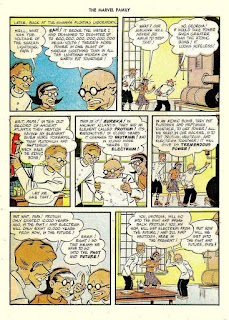


Sivana starts the hostilities by informing his kids that he can soon destroy the Marvel Family with a special machine, though his machine needs "power even greater than that of the atomic bomb." Binder, building on erroneous research to the effect that atom bombs back then used two existing elements (plutonium yes, neptunium no), has Junior tell his papa that there's another powerful element capable of yielding the power they want. The element exists in three different forms-- electrium, neutrium, and protium, which Binder has transparently named after the traditional three particles of the atom-- but these forms don't exist in the same temporal era. Protium is the earliest form, which will transform into neutrium in 10,000 years, and then into electrium in another 10,000 years. None of the element-forms alone will give the Sivanas the power they want, but the villains can obtain all three forms by using time-travel.

Here's one of two places where Fawcett's concepts of magic and science overlap willy-nilly. Sivana and his kids board a spaceship, for the good doctor has already invented FTL travel. "According to Einstein"s formula," the mad scientist exults, going at light-speed will throw the ship "out of the universe, into Eternity." I rather doubt Einstein said anything like this, especially since Fawcett's idea of this realm of space-time is that it's dominated by Old Shazam's personal mountaintop, the Rock of Eternity. Unscientific though the trope is, it provides one of Fawcett's most mythic uses of the mountain, as a cosmic axis around which real space-time revolves. Once Sivana's ship lands on the Rock, it's easy for him and his kids to employ three separate space-crafts to zoom through time to the respective eras where they'll find the necessary element-forms.

The spirit-form of Old Shazam, seeing the villains' advent, alerts the Marvels. The heroes change from their mortal forms into the Marvel Family and each of them pursues one of the time-ships.


Now, Binder could have simply sent the Sivanas and their pursuers to three unrelated locations. Gardner Fox had done something similar in a 1942 JUSTICE SOCIETY story. Instead, Binder links the element-quest to one of the West's enduring legends, that of the sunken city of Atlantis.


Mary Marvel follows Georgia Sivana to the ancient era when Atlantis had not yet sunk beneath the ocean-waves, so Mary's segment gets to explicate the pattern for the next two segments. Georgia uses archaeological remains to track down the element protium to a scientist, Chal-Patzun, who, like another Jor-El, has failed to convince his fellow Atlanteans of their common danger. The scientist plans to use the protium to prevent the city's inundation, but Georgia interferes by trying to steal the precious element. Mary Marvel arrives to stop the nasty girl, and then finds out that Chal-Patzun has laid plans to assure that, even if he can't save Atlantis, future members of his family will revive the sunken city in a far-off era.


Binder's attempt to extend the family-metaphor not only to the scientist and his descendants but also to the element-forms is a bit strained, but better too much ambition than too little. Since Mary can't be allowed to win this easily, she suffers a reversal when she transforms into her mortal form. Georgia gets hold of one vial of protium, but leaves two others behind, so that over thousands of years they will take on the forms that Sivana and Sivana Jr, will seek. Georgia also absconds with the bound Mary and leaves Atlantis to its historical doom.


The segments devotes to the exploits of Captain Marvel and Captain Marvel Jr inevitably follow the same progress. Sivana seeks out the 20th century, where a scientist named Patterson, descended from Chal-Patzun, rather improbably knows all about the situation with the three elements, and even knows (but has never revealed) the location of the sunken city. Sivana forces Patterson to seek out Atlantis, and once there, the villain promptly steals a second vial of the element, which has now converted into neutrium. Captain Marvel shows up, but Sivana uses an artificial means of transforming the hero into his helpless mortal form. For good measure, Sivana shoots Patterson dead, but since the scientist was too good a villain to lose, there are never any consequences for this murder.


And much the same happens in the far far future to the two Juniors. In the future a young scientist, Chass Passon, finds his way to sunken Atlantis after locating the records of his ancestor. Miracle of miracles, the ancient machine built by Chal-Patzun, and it even works with the one remaining vial, which now contains electrium. Captain Marvel Jr attacks Sivana Jr, but can't keep the wily youth from getting away. In due course, this hero too reverts to his mortal form and gets knocked out by Junior, who gets away with the electrium and with his captive. Chass Passon is injured but apparently not slain, and perhaps lives to enjoy the repute of re-discovering Atlantis.


The evildoers converge on Sivana Senior's laboratory and power up his mystery machine with the three element-forms. Then Sivana twists the knife on the three de-powered heroes, revealing that they can no longer call down their magic lightning because the machine sets up an "electron shell" around the planet Earth.


For the second time, magic and science overlap in a way that another junior, John W. Campbell, would never have countenanced. And for the capper, the Sivanas-- who believe that their great science will make them lords of the world once the Marvels are gone-- decide to execute their enemies through the supposed "sport of kings"-- which should really have been called "the most dangerous game."


However, even if the Marvels don't have deep-thinking brains, they possess as much if not more cunning than the villains, and in due time the Sivanas are once more defeated and imprisoned.

Golden Age Superman stories often avoided the fantasy-potential of their heroic character in favor of mundane mysteries and romantic melodrama. In contrast, the Captain Marvel line never suffered from a shortage of fantasy-concepts. Yet it was rare for the fantasies to be given the symbolic density of this Binder story. All too often, Fawcett authors "coasted" on the general sense of fairy-tale whimsy. Ironically, after Fawcett was out of the superhero business, DC's Superman line began employing ex-Fawcett people like Binder, and the Super-Universe began using more fairy-tale elements. However, perhaps because Superman had more of a romantic tradition-- in contrast to Fawcett, which usually avoided romance-elements-- the Silver Age super-books crossbred fantastic whimsy with the deeper emotionality of melodrama, yielding a product superior to either of the Golden Age concepts.

Here's the entire "Sivana Family" tale.


Friday, December 11, 2015

MYTHCOMICS: "SUPERDUPERMAN" (MAD #4, 1953)

Looking through the seminal early MAD issues, one often finds a lot of clever puns and inversions of pop-culture tropes. However, the famous "Superduperman" story goes a little further into the realm of psychological myth than its contemporaneous fellows, like "Plastic Sam" and "Batboy and Rubin." At a time when the superhero genre was at its arguably at its lowest ebb in the history of American comic books-- when said genre certainly was nowhere near dominating the medium as would be the case from the 1980s onward-- Harvey Kurtzman and Wally Wood crafted a story that embodied the anti-mainstream arguments of Adorno and Wertham: the argument that I summarized thusly:

In elitist criticism, it's a given that all escapist fiction is by its nature a "negative compensation" that insulates the audience from reality, as I've noted with respect to Theodor Adorno in particular. "Positive compensation," if one could put the elitists' convictions into Adler's terms, would presumably be the sort of "high literature" that validates the intellectual's struggle for personal meaning.
Kurtman and Wood, being concerned with gonzo slapstick and puns, don't put forth any grand schemes of meaning in "Superduperman," but by making their spoof-hero a real nebbish instead of a pretend-one, they cast a critical eye upon the idea of superheroes as compensation for one's failures in life-- a fair enough subject for satire, given that creator Jerry Siegel himself framed Superman's appeal in such terms:


Clark Kent grew not only out of my private life, but also out of Joe Shuster's. As a high school student, I thought that someday I might become a reporter, and I had crushes on several attractive girls who either didn't know I existed or didn't care I existed.-- Jerry Siegel.
In addition, over ten years before Julies Feiffer suggested that Superman might be a "secret masochist," Kurtzman and Wood present their nebbishy ne'er-do-well "Clark Bent" as the helpless thrall of "Lois Pain's" charms.


Shortly after this encounter, Bent changes into Superduperman and goes looking for the story's mystery thief, "the unknown monster."  The heist artist obligingly reveals himself to be a fellow superhero, Captain Marbles, who has decided to quit fighting crime and to begin looking out for number one. Countless critics have mentioned that the year of this story's publication was the same year Fawcett Comics quit publishing Captain Marvel features as well as discontinuing their comics-line, largely in response to the expensive plagiarism suit DC Comics had filed against Fawcett. It's hard to tell whether or not the outcome of the super-dudes' battle is a comment upon the legal battle, but it's at least significant that Superduperman must resort to a dirty trick in order to win.


Lastly, Kurtzman and Wood undermine the wish-fantasy implicit in the Superman mythos, and in many-- though certainly not all-- superhero narratives. Instead of responding to Superduperman's bulging muscles, Lois rejects the hero and knocks him on his ass just as she did when he was Clark Bent, averring that his super-bod doesn't obviate him still being "a creep."


 I might argue that no single comics-story of the period-- not Kurtzman's war-stories, not Barks' duck-stories-- had more effect on the intellectual development of comics-fandom than "Superduperman." I can't say that it was always the *best* effect. But "genre politics" aside, it's no less a masterful story of its kind.

Tuesday, September 29, 2015

MYTHCOMICS: WHIZ COMICS #2 ("CAPTAIN MARVEL," 1940)

“For … various offenses Tantalus was punished in Tartarus.   For he was kept perpetually famished and parched, standing chin-deep in water and with laden boughs of fruit just above his head … Alternatively (or additionally) a great stone hung over his head, suspended by a thread, so that he lived in everlasting terror.”—Grant and Hazel, Who’s Who in Classical Mythology, p. 309.


By way of following up on my assertions in STRIP NO-SHOW, I find that the origin story of Fawcett Comics' Captain Marvel provides the best-known example of a comic book story which conjures up a wild set of mythopoeic images to support a fairly simple story.

The earlier success of DC's Superman was the proximate cause for Captain Marvel to come into existence. However, as chronicled in Jim Steranko's HISTORY OF COMICS, writer Bill Parker's original idea was to present a team of characters with powers derived from the Greek gods. Thanks to Superman, this idea was converted into the notion of a single superhuman who could draw on an assortment of powers from mythic personages.  Yet this particular Superman-imitator-- which in its genesis at least, seems mostly the creation of scriptwriter Parker rather than artist C.C. Beck-- ventured more deeply into what I've called "the realm of intuition and its mythic images."

Consider the opening, in which homeless preteen Billy Batson is approached by a dark stranger.


In the hands of most uninspired imitators, the stranger would have quickly doffed his hat and coat and revealed that he was X of the planet Y, and that he planned to give Billy fabulous new powers. Instead, Parker troubles to imply that Billy's descent into the subway is also a descent into a figurative underworld, with a weird subway train taking the place of Charon's boat. Parker's description of the car having headlights "like a dragon's eyes" inevitably suggests that Billy is traveling within an analogue of a living creature. It's significant that one of the figures from whom Billy will derive power, Hercules, survived passing through the belly of a giant beast.


The journey, though short by comparison with Dante's subterranean tour, brings Billy into contact with devil-like figures: the "Seven Deadly Enemies of Man," who are in essence a reshuffling of the Seven Deadly Sins of early Christianity.


Billy then finds himself in the company of the beneficent-looking old wizard, while his shadow-guardian-- possibly patterned on the Greek notion of the *psychopompos*-- simply isn't around any more. The old wizard Shazam shows Billy the personages from his name is derived, and then informs the boy that he knows how the boy was flung out into the cruel elements by his nasty uncle following the death of his parents.


Immediately following the scene of the evil uncle counting his ill-gotten gains, the story reveals that Shazam is standing under a stone block, suspended by a thread close to breaking. Shazam's only explanation of this extraordinary circumstance is to say that his time  is almost up, which is the reason he's summoned Billy to his domain, so that Billy will take Shazam's place as a fighter against evil-- in essence, replacing Shazam as the younger generation inevitably replaces the older. By pronouncing the wizard's name, Billy can become Captain Marvel:


After a quick demonstration that this transformation is reversible, the wizard asks Billy to transform into Captain Marvel a second time-- and just as the youngster does so, the stone block drops down. Shazam's implicit death is concealed by decorous thunderclouds. In addition, as soon as Shazam dies, Billy finds himself back on the city-street, where he remarks that his experience seems like a dream.
However, by the end of the story, Billy finds that he can bring the power of Captain Marvel into the real world as well.


Not only does Billy use his new power to thwart the designs of the mad scientist Sivana-- who bears a slight resemblance to Billy's evil uncle-- the hero's altruism is rewarded when he's given a job as a radio-reporter, a job which to my knowledge the character keeps for the entirety of the feature's run. It's interesting that though the main narrative function of Billy's job is the same as that of Clark Kent, being a means of keeping the hero on the scene for various troubles-- it also alleviates the boy's poverty-stricken condition. In essence, the much later origin of Spider-Man recapitulates the same pattern, in which the path of heroic altruism also rewards the hero with a source of remuneration for his efforts. Unlike Captain Marvel, Spider-Man even contemplates finding a job that will pay him for his exploits, but that somewhat non-heroic notion was quickly squelched.

I haven't come close to reading all of the fantasy-oriented comic strips of the early 20th century, but I have sampled most of them, and I've not come close to finding any strip-- "Little Nemo," "Popeye," or the overrated "Krazy Kat"-- that displays this density of mythopoeic images for a given sequence.
Admittedly, those three strips are probably on the whole better than Captain Marvel in a formal artistic sense. But by my lights none of these three really commit to their fantastic concepts in a manner that Parker and Beck do here.

Further, though most stories headed by either the Captain or his "Marvel Family" relations are not this dense in their imagery, there always seems to be a total commitment to whatever fantastic entities, events or objects come into the heroes' purview. This may have been the key to the long success of the Fawcett "Marvel Family" line. If so, it was a strategy that DC's Superman titles did not manage to pursue with any regular success, as noted in this essay on the Weisinger-era titles. Though Fawcett closed its doors in 1953, it seems it took roughly five years for the DC editor to feel that he had the freedom to bite the Fawcett style.