Featured Post

SIX KEYS TO A LITERARY GENETIC CODE

In essays on the subject of centricity, I've most often used the image of a geometrical circle, which, as I explained here,  owes someth...

Showing posts with label master thread/trope. Show all posts

Wednesday, December 24, 2025

THE LOVER, THE DILETTANTE, AND THE CLINICIAN

 For once the new terms I'm tossing out are not full-fledged aspects of my personal literary theory. They're just approximations of the different orientations I find in different creators. 


THE LOVER is the type of creator who finds something deeply important to him/her in whatever fictional narratives he/she encounters, and who seeks to reproduce those moving elements or tropes in his/her own works. That doesn't preclude working on projects that do not excite the Lover personally, but if the Lover has a sustained career, the Critic can usually see one or more favored tropes, often a "master trope," repeated again and again. As a kid Jack Kirby (born 1917) belonged to the first generation of American juveniles to be exposed to periodicals centered upon the still gestating genre of science fiction (beginning with AMAZING STORIES in 1926). The totality of SF-tropes, far more than the related tropes of horror and fantasy, became an endless resource for Kirby, and I would venture that his creative "master trope" was the ceaseless exploration of all the most famous sci-fi scenarios-- lost cities, prehistoric domains, alien worlds. I for one see this trope in everything from TUK, CAVEBOY to FANTASTIC FOUR to CAPTAIN VICTORY.


 THE DILETTANTE might sound like a putdown in comparison to the Lover, but it merely signifies that the creator in question didn't become strongly cathected to a particular theme or trope. From what I've read, Stan Lee probably enjoyed the SF/adventure pulps of his time as much as did Kirby, but I don't see any particular trope from any particular genre looming large in Lee's oeuvre. That doesn't mean that he didn't have particular tropes that he used again and again, only that he used them more for professional convenience, rather than for personal expression. I might argue, hypothetically, that over time Lee became invested in using the trope of "the suffering savior" that one can find in his fifties SF-stories (like this one) on through SPIDER-MAN and SILVER SURFER. But I can't really claim that trope dominates his work anymore than that of the "quarreling best buddies" trope I see in pairings from "Millie and Chili" to "Ben and Johnny."


For THE CLINICIAN I cheated on my categories a little, for my initial example is Timely/Atlas publisher Martin Goodman, who was not to my knowledge a creator of any kind. However, the ALTER EGO article referenced establishes that at times he did show a rough, if not always correct, instinct about what sort of stories would prove popular with his target audience. Of course, Goodman is most famous for indiscriminately flooding newsstands with quickly produced titles, purely to grab shelf-space, so it's fair to say that he didn't make many, if any, decisions based on what moved him personally. I call him a Clinician because I see in him a clinical attitude toward creative efforts. 


But of course I can find many more examples of all three types in all media. Michael Carreras, who wrote and directed several movies for Hammer Films (founded by his father James), strikes me as another Clinician. I've never read a biography of MC, but from looking over the movies he did before and after the birth of Hammer horror, I get the sense that he like Goodman just went with the flow most if not all the time. In my review of THE CURSE OF THE MUMMY'S TOMB, I took note of how he used a complex Egyptian myth-tale for no better purpose than to make one more mummy-movie. A Clinician type of creator can produce exemplary work, though in Carreras's case, CURSE and the risible PREHISTORIC WOMEN are probably at the top of his creative roster.


In line with some of my recent ruminations on LOST, I tend to think that some of its blown potential stemmed from the different creative types involved. In the early seasons, I might have believed that head honcho J.J. Abrams to be a Lover ensorcelled by a multitude of tantalizing tropes. But exposure to his work on the STAR TREK and STAR WARS franchises showed me that he was at best a Dilettante. Had he remained active in guiding the six seasons of LOST, the show still might have emerged as a media landmark. But the producers to whom he relegated LOST were in my estimation just Clinicians with not much skill at keeping the tone and content consistent-- which is why, in this month's LOST essay, I said that the only way I could analyze the program would be to go armed with both a "good shit" detector and a "bad shit" detector-- or words to that effect.        


Friday, November 28, 2025

EMINENCE AND STATURE

Technically, "eminence" and "stature" are the same words with which I characterize the significant value of centricity in literature, but each one was reached by a different path, so I'll probably keep using both in their respective contexts.

Though I wrote four essays here in which "charisma" was the term I applied to superordinate icons and "stature" to all subordinate icons, I reversed this terminological use in the 2020 essay EQUAL AND UNEQUAL VECTORS OF AUTHORIAL WILL PT. 2. That formulation of both "stature" and "charisma," then, was tied to my effort to finding a broad terminology for all the icons in a given narrative.

"Eminence," though, was an attempt to find a structural metaphor that described how centricity looks when one focuses only upon a given centric icon, in comparison to everything else in the narrative. As my most recent essay on the topic specifies, "eminence" is more explicitly linked to what sort of "master-trope" dominates the author's propositional conceptions. Thus, for example, no individual character dominates either Pierre Boulle's PLANET OF THE APES novel or any of the film versions, for the icon of the environment is the star of the show. Wells' TIME MACHINE depicts a similar situation, though the nameless time-traveler visits two distinct time-periods. I tend to think both of them share eminence because they share a common purpose in Wells' proposition: to show the complete irrelevance of human ambitions and priorities in the face of a universal principle of entropy.   

EMINENT ICONS AND PROPOSITIONS PT. 3


So if centric icons within a narrative are "organizational matrices," is there a better term to assign to the organizing principle? Astute readers of this blog (are there any other kind?) will guess that the previously unused term of "eminence" will now assume that position...-- EMINENT ICONS AND PROPOSITIONS.

Looking over this essay and its companion from last July, I don't think I adequately defined the organizational interactions of icons and propositions, which takes place through the agency of a master trope, rather than just tropes in general, as I said here.

I offered a definition of tropes long ago, back in 2018, but the best breakdown is that tropes describe actions: "orphan must learn the secret of his birth," "hero may refuse the call to adventure but must in time answer said call and do heroic things." In contrast, icons are like "solidified" tropes, concretized into particular entities, forces, or settings in order to invite the identification of a work's audience. --MY SHORTEST POST YET. 

The one thing I left out in the above formulation is that any professional author decides in advance what sort of proposition will govern his narrative, and this means becoming more specific as to what sort of icons will work best for his master trope. Charles Dickens can't just put "orphan must learn the secret of his birth" out there; he must decide who the orphan is-- Oliver Twist-- and what the secret is; that Oliver still has a living relative from whom he and his mother got separated. 


Thus, there's an operative difference between a "generalized trope," which can be applied to many works, and a "specialized trope," which applies only to a particular work, or a particular linked set of works. Other aspects of the work will include "bachelor tropes" that are not nearly as important as the master trope. Oliver must meet some opposition so that his discovery of his secret heritage doesn't seem to be too easy. That opposition doesn't have to be Fagin and his faux-family of thieves, so that part of the proposition comprises a bachelor trope in relation to the master trope.  


OLIVER TWIST is a monadic work with no further iterations, so its proposition is unitary. Serial works are cumulative, given that even the most stereotypical serial-- I might cite my earlier example of the Golden Age BLUE BEETLE from a related essay-- may have a specialized trope (Blue Beetle protects his city from crime) that is barely distinguishable from a generalized trope ("hero protects his city from crime.") 


However, in cases where the cumulative narratives of the series are not broadly stereotypical, the specialized trope must be refined. Will Eisner's SPIRIT varies between direct confrontations with evildoers and indirect encounters with either human error or simple fallibility. In the cover Will Eisner prepared for a Kitchen Sink reprint of the 1940s SPIRIT stories, the artist depicts a scene that doesn't literally transpire in the story "Gerhard Shnobble," but one which symbolizes a key moment in the tale. The Spirit's crimefighting activities take second place in "Shnobble" to the tragic end of the title character, which the Spirit doesn't even personally witness. Nevertheless, even in stories where the dominant action takes place in the life of a one-shot character, the Spirit still provides a moral compass for Eisner's implied reader, even when he has no impact upon the one-shot character's life. So even though the SPIRIT series started out with a specialized trope like "The Spirit protects his city from crime," that master trope became in time inaccurate because of changes in the propositional priorities. Thus a more appropriate specialized trope, capable of taking in all of the propositions Eisner offered to readers, would be something more like, "The Spirit bears witness to the many manifestations of human fallibility."  


Tuesday, November 11, 2025

THE VIRTUES OF THE UNOBVIOUS PT. 3


I offered a definition of tropes long ago, back in 2018, but the best breakdown is that tropes describe actions: "orphan must learn the secret of his birth," "hero may refuse the call to adventure but must in time answer said call and do heroic things." In contrast, icons are like "solidified" tropes, concretized into particular entities, forces, or settings in order to invite the identification of a work's audience. -- MY SHORTEST POST YET.

...I don't even expect plots to be fresh.  They are like skeletons.  I think one skeleton looks more or less like the others, but when they are fleshed out, you get a unique person.  So with movie plots. -- poster "atenotol" on Classic Horror Film Board (quoted with permission) 

 I doubt that I'll ever again use the terms "obvious" and "unobvious," given that I only did so in response to my having read George Orwell's 1942 essay on Rudyard Kipling. Though in part 2 I disagreed with many of Orwell's criteria for evaluating Kipling, I must admit that his calling Kipling's works "a monument to the obvious" is almost as quote-worthy as many of the familiar phrases of Kipling. Indeed, the fact that Kipling's "gnomic" utterances were so eminently quotable was the main reason for Orwell to call him "monumental"-- though if familiarity of quotes were the sole measure of one's obviousness, then Shakespeare would outdo Kipling there by that appeal to across-the-intellectual-spectrum familiarity.      

It was also mostly a coincidence that I happened to have read Orwell's online essay a few days before the end of October, which is also when I re-screened, for the first time in perhaps 30 years, the famous "bad movie" BLOODY PIT OF HORROR. Thus I began thinking about what elements of PIT were or were not "obvious," not so much in the specific way Orwell used the word but in the general sense. I noted how much PIT owed to many other Gothic narratives before it, stating, "BLOODY PIT is really not very different from dozens of other Gothic stories in which travelers show up at an old castle or manor and fall afoul of the malefic entity therein." The unobvious element, though, was the idea that said entity "looks like a cross between a masked wrestler and the hero of an Italian muscleman movie." I was of two minds on the effects of the scripters' plunge into unpredictability. On one hand, it caused a lot of viewers to make fun of the film, though on the whole PIT has more mythopoeic content than the average "so bad it's good" flick. On the other hand, PIT's foray into a very unobvious type of menace made a lot of people watch the film who would not have watched the similarly themed PLAYGIRLS AND THE VAMPIRE. 

Now, in the terms I've established in my above definitions of the terms "trope" and "icon," the basic setup for PIT would be the master trope of the story. But no audience can relate just to a trope, which is just a base description of plot, sometimes with a smattering of a character-arc. Tropes must be "solidified" into icons to make them relatable. If one boiled Orwell's screed down into a trope-icon argument, then Orwell would be saying that Kipling was popular because his tropes were so simple and direct that anyone, no matter how intellectual or non-intellectual, could relate emotionally to them, so in that sense, Kipling's tropes would be appeals to the obvious.

But in my disagreement with Orwell in Part 2, I stressed that emotional appeal was not enough; that Kipling was celebrated because he was a master of literary myth. No matter how improbable intellectuals might deem the author's Cockney soldiers or talking animals, they succeeded because Kipling had an "unobvious" approach to such material. If there was an "obvious" appeal to one of his tropes, like that of a common British soldier seeking to profit from the Raj's presence in India, Kipling was capable of "fleshing out" that trope. His fiction, then, might be considered more of a "monument to the unobvious," since he radically reinterprets the basic structure of the trope he emulates and puts a personal spin of some sort upon it. The same is true of the writers behind BLOODY PIT OF HORROR, though they did not receive, and probably will never receive, much credit for their relative innovation. (I add that being innovative alone is not my sole criterion for distinction. BLOODY PIT and TROLL 2 are both "unobvious" transformations of familiar tropes, but PIT carries an abstract meaning and TROLL 2 does not.)

I also find the poster atenotol's metaphor of skeletons and flesh persuasive. Tropes may not all be alike in design-- and indeed, all human skeletons aren't exactly the same, either. But tropes are always structuring principles, just as skeletons provide scaffolding for all the rest of the human body's organs. Human flesh, particularly with respect to countenances, provides social relatability in the real world, while in the literary world, we need icons-- even when they may be as far from flesh as Lovecraft's "Colour Out of Space"-- in order to make the power of the trope come alive.


Monday, July 28, 2025

EMINENT ICONS AND PROPOSITIONS PT. 2

 Before preceding to the discussion of the new category "eminence," which will connote "the organizational power of centric icons," I'll touch on another line of thought about centricity, though one that, unlike the resonance formulation, won't need to be discarded.

The 2020 essay EQUAL AND UNEQUAL VECTORS OF AUTHORIAL WILL, PART 1 was my first attempt to apply Whitehead's concept of vectors to my Schopenhauer-influenced concept of authorial will, going back to 2009's SEVEN WAYS FROM SCHOPENHAUER. The definition I cited for "vectors" is worth repeating.

A quantity that has magnitude and direction and that is commonly represented by a directional line segment whose length represents the magnitude and whose orientation in space represents the direction.

"Magnitude and direction" are still applicable in my system, but it's worth reiterating that, in contrast to the discrete forces we know from physics, these are vectors of the author's intentionality-- often conscious intention, sometimes subconscious as well. The author gives his centric icon or icons the magnitude and direction that makes its/their vector superordinate to those qualities in other icons. But he does so because the proposition he most wants to advance can best be organized around one icon rather than any of the others.  

I use the phrase "the proposition he most wants to advance" in keeping with my previous observations that a given work may advance many propositions as easily as one. In short narratives, there's usually only room for one proposition. However, longer works can incorporate a wide variety of propositions. In MYSTERY OF THE MASTER THREAD PART 2, my main example was Melville's monolithic MOBY DICK, and I argued that the organizing proposition of the book-- what I called the "master thread," and later rechristened "the master trope"-- was that of the "myth of the Hunter and the Hunted." 

I'm not sure that, prior to this essay-series, I'd ever noticed that over the course of my investigations, I had attributed an organizing principle both to the abstract propositions put forth by a fictional narrative AND to the icons within that narrative, the icons which (as I mentioned here) make possible audience-identification. However, after discarding the unhelpful concept of resonance as a metaphor for the organizing principle, I found myself turning back to the thoughts expressed in the 2013 essay JUNG AND SOVEREIGNTY.

Wherever Jung derived the term "sovereignty" from, he used in a manner apposite to my own: to suggest an organizing factor within the multiplicities of the human mind. His argument doesn't have any great relevance to literary criticism, but I did consider using his term for my principle of organization. However, the word "sovereign" suggests an uncompromising rulership, which is not quite in line with some of my literary concepts. Yet a trip to the synonym dictionary gave me "eminence," and that birthed my new term birthed my new term for all of a narrative's organizing factors, whether related to icons, propositions, or some combination thereof. It also didn't hurt the new term's appeal that Philip Wheelwright had used the term "eminent instances" in his book THE BURNING FOUNTAIN. Wheelwright's use of the phrase, appropriately derived from Melville's BILLY BUDD, is not identical to my evocation of the word here, but the base meaning still seems roughly parallel.

Lastly-- and there must be an ending, for the time being-- I prefer "eminence" to "sovereignty" because the former seems more malleable. In PHASED AND INTERFUSED PT. 3, I asserted that when Lois Lane stars in her own series, a "phase shift" occurs in which she and Superman reverse their respective subordinate/superordinate positions. This alteration in their respective centricities is elucidated by my formulation that Lois, a charisma-figure within SUPERMAN stories, shifts into a position of eminence while Superman's eminence recedes. This takes place for the purpose of relating propositions not possible in the SUPERMAN features-- propositions about what it might mean to be "Superman's girlfriend," which are also the sort of stories might have held particular appeal for young female readers. I added that Lois will probably always be considered "charisma-dominant" because Superman is, culturally speaking, a much more "eminent instance." But she does still have a low degree of stature thanks to having been in a position of organizational eminence.          

ADDENDUM: I must admit that the word "eminence" doesn't automatically connote the idea of an organizational principle. But a person who is "eminent" is, like a sovereign, often the person whose authority serves to organizes others into action, and thus the word works for me to denote how authors organize the elements of their stories/propositions to have a desired effect. An interesting coincidence: the day after writing this, I encountered the word "eminence" in its little-used geographical sense-- that of "a natural elevation"-- in a re-read of Jack Vance's THE DYING EARTH.      

Monday, September 30, 2024

THE READING RHEUM: THE WINTER OF THE WITCH (2019)


In my reviews of the first two books in Katherine Arden's fantasy-trilogy set in medieval Russia, I registered some minor complaints about the thoroughness of Arden's conception of her villains, in contrast to the rich detail she provided for main heroine Vasya Petrovna, her supporting characters, and the mysterious death-god Morozhko the Winter-King. While I maintain that Koschei, the main villain of the second book, could have used some improvement, the culminating book of the trilogy expands greatly on both "Medved the Bear," the evil spirit of the first book, and on his sibling-like relationship to Morozhko. I believe that Arden was doling out just enough information in the first book to establish that particular conflict, while the culminating novel provides greater context to the status of both deity-like beings, who seem to exist in a world in which gods spring forth from the beliefs of human beings.

A complaint I had about Book 2 was that I felt the character of Vasya's brother Sasha, who was given a detailed backstory in Book 1, was reduced to being a purely reactive presence when he once more encountered his sister. Since Sasha became a Christian monk at a young age while his sister allied herself to the pagan mysteries of her people, I thought Arden neglected to develop how each character represented different facets of the Russian experience of religion, with respect to both the early folkways and the more piety-based beliefs of Orthodox Christianity. Arden never does use Sasha and Vasya as opposed spokesmen for their belief-systems, though arguably another monk, the subordinate villain Konstantine, fills that role, at least partly. But in WINTER it's clear that though Arden wasn't interested in a philosophical comparison of belief-systems, forming a "detente" between the two conceptions may be the defining narrative trope of the entire trilogy. In fact, in Arden's "author note" at the end of WINTER, she makes clear that she grounds her theme in her interpretation of Russian culture.

There are some minor faults in WINTER as well: after raising the prospect that at some point the sorcerously-inclined Vasya may be obliged to induct her young niece into the mysteries of witchcraft, but this plot-point dwindles at novel's end because there's so much else going on. But Arden delivers on the more important plot-elements, not least the ambivalent romance between Vasya and the immortal, inhuman spirit called Father Frost. I confess I didn't foresee how Vasya would ultimately deal with her opponent Medved, and since I knew little about Russian history, I didn't anticipate that Arden was reworking certain real-world medieval events into a fantasy-tapestry. I don't know what if any reaction the trilogy may have received from actual Russian readers. But Arden's syncretic union of Russian history with famous myth-figures-- Father Frost, the Firebird, Baba Yaga-- might be viewed as parallel to J.R.R. Tolkien's desire to use magical fantasy to formulate a "myth of England."

Sunday, July 28, 2024

MYTHCOMICS: ["ON THAT DAY, I MET SENPAI"], PLEASE DON'T BULLY ME, NAGATORO, PTS. 140-144 (2023)

 One compensation for the conclusion of the NAGATORO manga is that as a critic I can now view it as a finished work. Had I never seen the ending for any reason, I believe my determination in this essay-- that the manga is principally governed by the dramatic potentiality-- would still have been valid. But viewing the actual conclusion gives me the opportunity to reinforce that opinion.

My title for the essay, SO THE DRAMA, SO THE MYTH, held a touch of irony, since I argued that the particular set of NAGATORO melodramas I had analyzed did not have the "long range" symbolic qualities that I seek in pinpointing literary myths.

Thus, when I search for a psychological myth, I look for an elaboration of symbolic resonances into mythopoeic concrescence, which is only possible when the author is a "long-range" mode. A dramatic concrescence can be formed from any number of "short-range" emotional states, but that concrescence does not depend on any abstractions as does the mythopoeic type. 

And now that I've seen the whole design of the series, aside from a forthcoming epilogue, I can assert that all of the NAGATORO stories I've looked at so far are at best "near-myths." Only in one section, about ten installments from the end of the main narrative, does author Nanashi develop his characters into deeper symbolic presences. But the symbolism does not involve the Buberian arguments I invoked in my last two essays, but an opposition that arguably is more central to Japanese culture: the conflict between instinctual existence and a disciplined, reasoned outlook.

For almost eighty installments, Nanashi keeps the reader in the viewpoint of the male protagonist Naoto, a.k.a. "Senpai." There are two or three exceptions where the viewpoint is Nagatoro's-- she has a nightmare, she talks with her sister-- but the reader is never privy to Nagatoro's thoughts, while Naoto's thoughts are ever-present. As Naoto is drawn out of his protective shell by his "kohai's" teasing and demands for attention, he becomes more interested in learning more about her life apart from him. After Part 80, Nanashi begins developing parallel plotlines for the two protagonists with respect to the avocations they have pursued: Naoto with respect to becoming a better artist, and Nagatoro's with respect to mastering the sport of judo. Both avocations will become pathways to general career goals, as indicated by the final episode. But the paths followed also indicate the process by which each protagonist has assimilated aspects of the other's "strong points," with the tightly wound Naoto becoming more open to following his instincts, while Nagatoro becomes more focused, more disciplined.


Episode 140, the one from which I take my umbrella-title, is the first one to delve into Nagatoro's thoughts. Previous episodes have revealed to Naoto that though Nagatoro had been practicing judo since elementary school, she abandoned the hobby after suffering a humiliating defeat at the end of her last middle-school year. Up to that point, Nagatoro's judo depended on her innate abilities-- her superlative speed and her instinctive mastery of techniques. But a rival, one Orihara, was so frustrated by Nagatoro's superiority that she trained until she reached Olympic levels of accomplishment, and so handed Nagatoro her first real defeat.


During Nagatoro's first year at high school, she and her friends accidentally encounter Naoto, and get a look at the fantasy-manga he draws. In the first episode, the reader has no idea why Nagatoro chooses to bully Naoto far more than her friends, though it's soon evident that it's wrapped up in a physical attraction that she won't admit to others and barely admits to herself. According to her mental dialogue, her judgment of her senpai's art is ruthless, calling it "awkward" and "delusional." Yet at the same time, she senses that "he tried his best," and that appeals to her on some level-- an instinctual one, since Nagatoro, though she reads manga, does not have any interest in art as such.


There is, without doubt, a classic bullying-angle to her aggression: because of a failure in her own life, Nagatoro is moved to humiliate someone weaker than herself. But because Naoto becomes solicitous about her having abandoned her passion for judo, she forces herself back into the fray. In fact, Nagatoro's meditations on the past take place in the middle of a climactic battle with her rival Orihara at a school-sponsored judo tournament, with Naoto cheering her on. 


Nagatoro wins her match with Orihara. Yet while Naoto is glad for his almost-girlfriend, he feels that she's assumed a dominant role in their relationship once more. Amusingly, he imagines her as a malicious horned oni-demon, complete with an iron club and a tiger-skin bikini (which sounds more like Lum of URUSEI YATSURA than any traditional Japanese folk-myth.) And though in reality she presents no physical danger to Naoto, his fears are justified by the fact that she still loves to harangue him, presumably as a cover for her own feelings. Not surprisingly, Naoto flashes back to his first encounters with his kohai, when she attacked him with demonic sadism.


Thus, when the young fellow overcomes his trepidations in order to confess his feelings, he becomes far more outspoken than ever before, admitting that his first encounter with her was like a meeting with a wild beast. This doesn't exactly please a cute high school girl, and she retaliates that she thought of him as a "really really gross wharf roach." Yet Naoto simply rolls with the insult, admitting that her bestial attack served the purpose of dragging him out of "the shadows" and into "sunlight." 


Then, once Nagatoro works through all of her protests about Senpai's "grossness," she's finally able to admit that when they met, she was just as purposeless and adrift as he was, once she surrendered her passion for judo.


And so the young lovers reach a rapprochement as they finally become a couple, though once again, Nanashi reminds his readers that even if Nagatoro doesn't wield an iron club, she still has a lot of "the oni" in her.

After I selected this section of NAGATORO as the serial's only concrescent myth-discourse, I did a little research and learned that when Nanashi created his prototypical version of the series, in the form of a five-part webcomic, he ended that comic on a scene parallel to this one, with the Naoto-prototype confessing to the Nagatoro-prototype. I have not read the webcomic and from what summaries I've seen, it didn't go into a lot of character depth but rather portrayed its Nagatoro as a thoroughgoing sadist. This might make for an interesting comparison somewhere down the line, but as far as the series proper is concerned, the protagonists' struggle between the instinctive life and the life of premeditation remains the "master trope" of the narrative as a whole.

Wednesday, November 29, 2023

STALKING TWO PERFECT TERMS

 In contrast to some of my revisions, these two should be relatively painless.

I've only used the term "postulate" three times. In the essay THE INFORMAL POSTULATE, I tossed out the titular term in response to a critic's use of the phrase "formal postulate." Then I wrote two linked essays, Part 1 and Part 2 of FORMAL AND INFORMAL EXCELLENCE. The only limitation I see in the use of the word "postulate" is that I don't think it has as much broad applicability as my previously used term "proposition," even though the two words mean approximately the same thing. So from now on, I will only speak of formal and informal propositions.

I have used the linked terms "master thread" and "bachelor thread" more often, both beginning in 2020. Here's my rationale for the metaphor from the first part of MYSTERY OF THE MASTER THREAD:


I’ve frequently pictured these vertical meanings as either being “over” or “under” a narrative’s lateral meaning, but for current purposes maybe it might be better to imagine them as many disparate threads running through the (potentially) labyrinthine structure of the narrative. A single narrative can incorporate more than one vertical meaning. However, to be coherent said narrative needs what I’ll henceforth call a “master thread.”

About two months later, I formulated the complementary term "bachelor thread" as a pun on "masters' degrees" and "bachelors' degrees." In the essay DEGREES OF MASTERY AND BACHELORDOM, I was particularly focused upon the fact that what I called "open serials" usually did not manifest master-threads.


All of these types of open serials are far too disorganized to maintain a master thread as such. At best—and here I reference the setup of my essay-title—one could devise “bachelor-threads,” which are, as per the collegiate metaphor, not as advanced as the masters. Bachelor-threads simply codify the most prominent story-motifs used in the open serial, but there’s no sense that they all add up to a coherent discourse.

Of course, this formulation was not exclusive only to serials, open or otherwise. It's possible for any narrative, whether a serial, part of a serial or a monad, to sustain only a master thread and nothing more, which is the way I used that term in MYSTERY OF THE MASTER THREAD PART 3, even though I specified that the master threads in my first two examples were relatively simple in symbolic development next to my third example. In monad-narratives, bachelor threads usually manifest when the author chooses to develop other concerns peripheral to the master thread. In MYSTERY OF THE MASTER THREAD PART 2, I spoke of "meaning-threads" in MOBY DICK being subordinate to the book's master thread, and this conception was simply later borne out in the formulation of the complementary "bachelor thread" term.

However, though I still like the "thread" metaphor, henceforth I'll speak only of "master tropes" and "bachelor tropes," in order to make my take on literary thematics hew closer to my analysis of what literature is made of, as per my statement in 2021'S QUANTUMS OF SOLIPSISM.


just as quantum particles would be of no relevance to human Will as discrete particles, narratological particles only assume significance in the form of “molecules.” These molecular assemblages I relate to the idea of “tropes.”

Indeed, all of the statements I've made about both types of "threads" are symbolic scenarios that take the same form as "tropes," and thus I don't see any difficulty in making the change, except that now all the categories that used to read "thread" will now read "thread/trope" to reflect this altered priority.


Friday, August 25, 2023

MASTERING EPISTEMOLOGY

As I look over my various posts on both the topic of "epistemological patterns" and that of the "master thread," I don't think I ever managed to show how the former plays into the latter. 

I have been reasonably consistent about showing how different literary works display different levels of mythicity because their authors either do or do not render the four epistemological patterns with a sense of their complex possibilities. In 2018 I dubbed the process of mythic coalescence as "concrescence," and attempted to link it to the Aristotelian concept of "the unity of action," even though I almost immediately revised that standard phrase into a "unity of effects."

In 2020, I proposed "master thread" as a substitute for the familiar "theme statement" formulation, given that the image of a "master thread" could better account for all the "lesser threads" that might be tied into the dominant one. The essay was also the beginning of the end for the terms "overthought" and "underthought," both of which appear therein. Now, having claimed that master threads are either dominantly didactic or dominantly mythopoeic, I won't bother with those outmoded terms in future. But I didn't really set down how the process of concrescence depended on translating ideas and intuitions about the four epistemological patterns so that they become such a master thread.

Following the same pattern I'd used to argue THE LINE BETWEEN FAIR AND GOOD, I offered three types of "master thread" as they occurred particular stories on the same theme in the 2020 essay MYSTERY OF THE MASTER THREAD PART 3. This essay requires updating in line with the formulation of the necessity for epistemological patterns in the process of concrescence.

All three cited stories depend on the same type of master thread, which I stated to be "hero must defeat evil counterpart." The purpose of such confrontations are always to better define the hero's virtues as against the vices of the counterpart, and so the reigning epistemological pattern is psychological.


The first example, which had a *poor* level of mythicity, was "The Haunted Island" from CHALLENGERS OF THE UNKNOWN #43. I noted the various ad hoc elements of the story, but at heart its greatest weakness is that the "evil counterparts" aren't given any psychological grounding. The mutants, having survived weird transformations but continuing to live on, draw an irrational comparison between themselves and the heroic Challengers, simply because they think that the latter are also living on "borrowed time." The author can only explain this association by falling back on the makeshift rationale that the mutants have gone mad, which in theory frees the author from coming up with a plausible psychology for his villains.

The next cited story, with a *fair* level of mythicity, was "And So My World Ends," from JLA #71. This story actually had an editorial agenda behind it, as much as did "Haunted Island," in that the story eliminated all civilization on J'onn J'onzz's version of Mars and also provided an exit scene for the Martian Manhunter, who had lost his regular berth and was no longer a good fit in the JLA. But this time the writer gave the villain, Commander Blanx, a reason for his decimation of his homeworld: his utter contempt for the way his people have become "weaklings." This heightens the tragedy felt by J'onn as he mourns his world's fate at the hands of "one individual, sick with the need for violence."

And in the example of *good* mythicity, I claimed that "The Injustice Society of the World" was one in which the titular Society succeeded in showing their devotion to crime and evil just as intransigently as the Justice Society defend justice and goodness. None of the individual villains are any more "psychologized" any more than the heroes are. But I argued that the story was a landmark because the villains as a group were atypically portrayed as being just as super-competent as the heroic team, and they display their warped psychology by putting the good guys on trial for their opposition to criminal activity. 

All of these takes on the "evil counterpart" master thread are mythopoeic rather than didactic. But the level of concrescence rises according to the density of correlations that the author brings to all the respective evil counterparts, with the result that the first is not symbolically compelling at all, the second is only compelling in a limited way, and the third has been compelling enough that the Injustice Society remains a myth-presence to be reckoned with in current comics, while the other villains are either wholly or nearly forgotten.


Monday, August 21, 2023

MYTHCOMICS: BATMAN: THE LONG HALLOWEEN (1996-97)


In contrast to the many admirers of the Loeb-Sale LONG HALLOWEEN, I didn't get much out of the collected issues after two separate readings, aside from appreciating Sale's art. I'm not sure that I realized that it was supposed to be a direct sequel to Frank Miller's celebrated BATMAN: YEAR ONE, though obviously HALLOWEEN had to occur early in Batman's career due to the absence of any members of his Bat-family. 


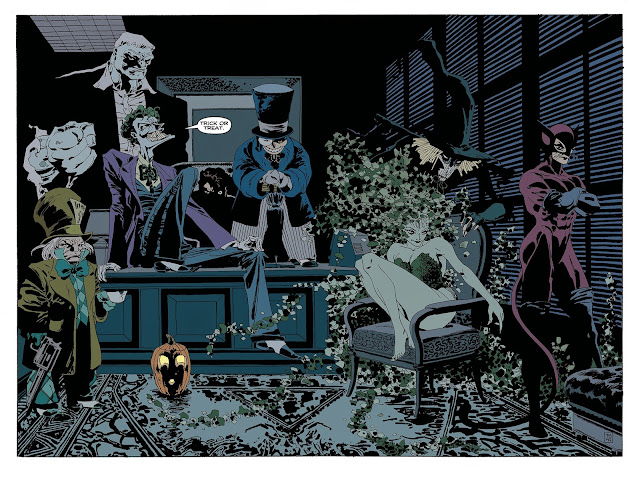
In this iteration Batman has just barely started to make inroads against the entrenched "Roman Empire," the reigning crime family in Gotham, represented by local godfather Carmine Falcone, aka "the Roman." The Caped Crusader has already won the confidence of police captain James Gordon, and much of the action in HALLOWEEN centers around the way Batman and Gordon also bond with D.A. Harvey Dent in their attempt to bring down criminals. Organized crime is the true foe of these do-gooders, while the notorious super-villains of Batman's mythos are regarded as "freaks," particularly by the career criminals. Batman has met most of his big-name foes at this time-- Joker, Riddler, Penguin, Scarecrow, Mad Hatter, Catwoman, and Poison Ivy-- though Loeb and Sale also make use of two lesser lights in the Bat-mythos, Calendar Man and Solomon Grundy. At this point in time, Harvey Dent has not yet undergone his transformation into Two-Face, and indeed that transformation is the culmination of HALLOWEEN's main plotline.
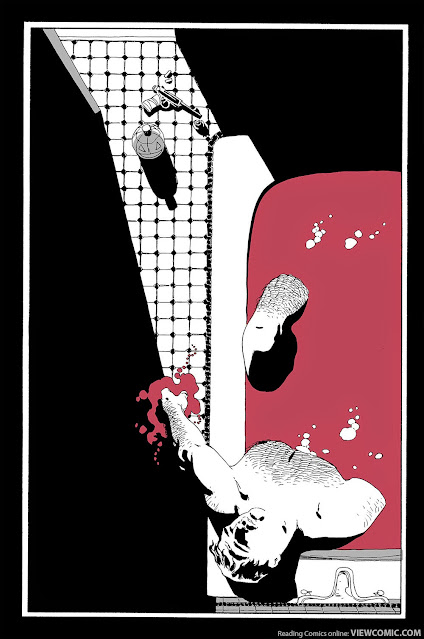


Still, I wasn't deeply impressed with the Loeb-Sale treatment of either the ordinary crooks or the super-crooks, nor with the retelling of Dent's transformation, or with the "serial killer" mystery that extended across all 13 issues of HALLOWEEN. Each issue represented a month in the Bat-universe, during which Batman proved unable to keep the mysterious assassin Holiday from executing at least one victim a month, always on a popular holiday. Most of Holiday's victims are also members of the Falcone crime family, and so a major part of the mystery is the attempt to determine whether the killer belongs to a competing family-- or someone who hates crime but has decided to go outside the law-- someone like Harvey Dent.
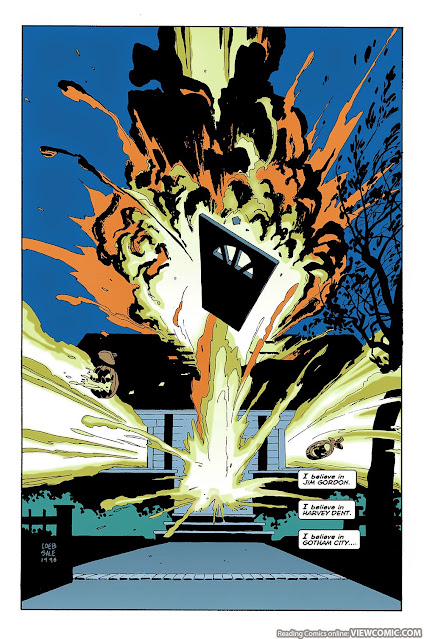


I confess that even though I'm not a great admirer of Christopher Nolan or his collaborator David Goyer, their prologue to a 2011 collection of HALLOWEEN gave me a new insight. Both filmmakers stated that the Loeb-Sale work had been a seminal influence on their first two Bat-films. Remembering how much THE DARK KNIGHT plays off of HALLOWEEN's leitmotif about "belief"-- particularly with the phrase "I believe in Harvey Dent"-- I realized that whatever I thought about the films, HALLOWEEN was about how even among good men, belief is always vulnerable to corruption.
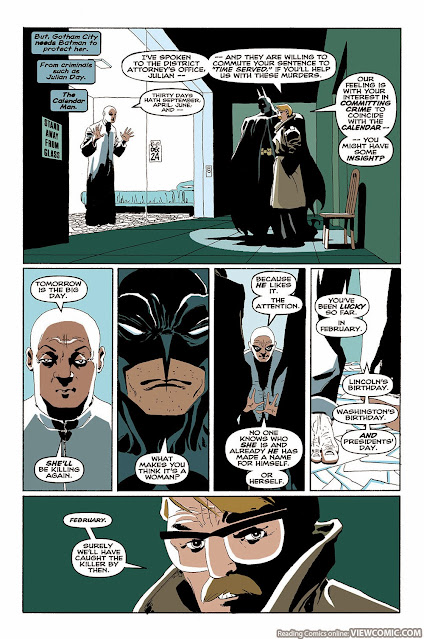


In most Batman stories, the hero can track down any serial killer, because the murderer always conveniently leaves clues that enable the crime-fighter to track down the miscreant. HALLOWEEN goes to the other extreme. Even though Holiday leaves behind some holiday-themed token every time he (or she) kills, Batman learns nothing from the tokens, and he almost nver manages to anticipate where Holiday might strike next, despite knowing what day the assassination will take place. Holiday remains "off-camera" for most of the story, since Loeb and Sale were creating a genuine mystery, even if their denouement is somewhat ambivalent. Oddly, one of the few super-villains who has some mythic presence here is the lower-tier felon The Calendar Man. Though Julian Day is not directed involved in the Holiday killings, his obsession with seasonal occurrences gives him in HALLOWEEN a function like unto that of Hannibal Lecter in RED DRAGON. Batman consults with Calendar Man as Clarice consulted with Lecter to learn the nature of the Red Dragon-- with the main difference being that Calendar Man only provides one useful yet highly ambivalent clue, as if he were a Greek oracle dispensing problematic advice.
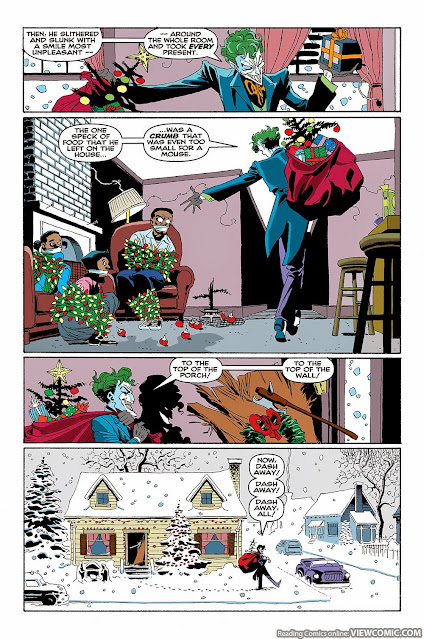


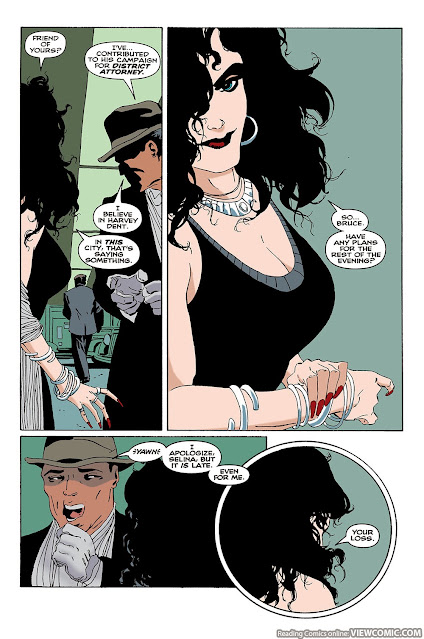
The other super-villains almost function as date-markers during Holiday's year-long campaign of targeted killings, and all of them are pretty routine. The Joker is crazy. Catwoman is unpredictable. Poison Ivy uses her hypnotic plants to suborn Bruce Wayne's will. Arguably none of them shine, because the focus is on Harvey Dent, whom the reader knows is destined to become Two-Face. 


None of the "ordinary crooks" in HALLOWEEN get any better treatment, despite Sale's borrowing from visual elements in THE GODFATHER. All of the hoods knocked off by Holiday are ciphers, while Loeb doesn't bring any interesting dynamics to Carmine Falcone and the various literal members of his family: wife, sons, daughter. There's a minor subplot revealing how, many years ago, Thomas Wayne saved Falcone's life, but not much comes of it.
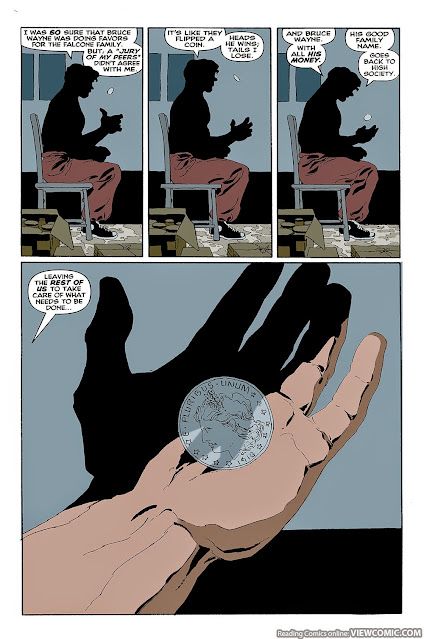
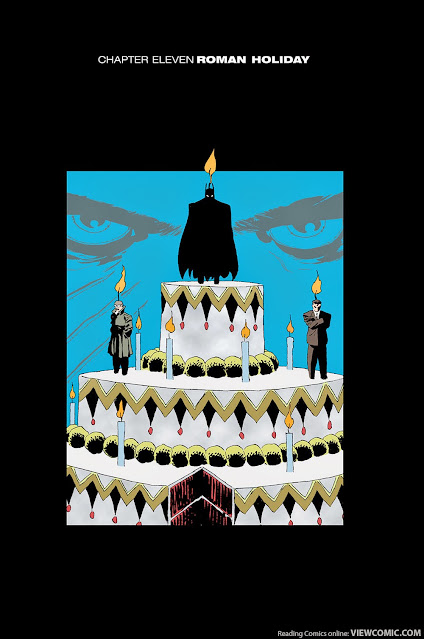


Though no one cares about the bickering of the criminals, freakish or normal, Loeb and Sale spotlight the trials of the just at every opportunity. Dent's busy schedule as prosecutor causes him to neglect his wife Gilda, and on one occasion she's injured by a bomb intended to kill both of them. Because of Thomas Wayne's past action, Dent tries unsuccessfully to prove that Bruce Wayne has some collusion with Falcone, though of course the fighting D.A. does not know that Wayne's other identity. The troika of Batman-Gordon-Dent is strained as the first two suspect Dent of having adopted the identity of Holiday in order to murder the ganglords of Gotham. 
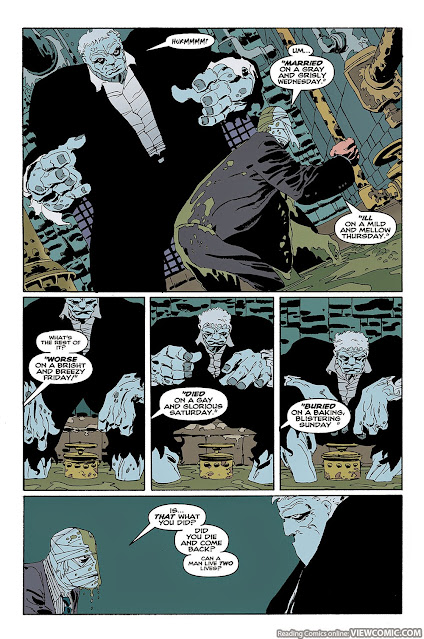


But before Batman and Gordon have the chance to accuse Dent, one of the crime-lords strikes a decisive blow: assailing Dent's face with acid. Crazed by pain, Dent flees to the underworld of Gotham's sewer system, where he forms an odd bond with the undead monster Solomon Grundy, simply because Dent knows the "Solomon Grundy" rhyme. And although Harvey Dent is not guilty of the Holiday murders, his ambivalence about the law's effectiveness transforms him into Two-Face. Only with the passage of a full year do Batman and Gordon finally figure out how to trap the real Holiday, and that's only with Calendar Man's help. But the damage is done. Two-Face uses Grundy to liberate the other fiends from Arkham Asylum, and though Batman manages to corral them all, he can't prevent the formerly righteous D.A. from going over the line and killing Carmine Falcone.  
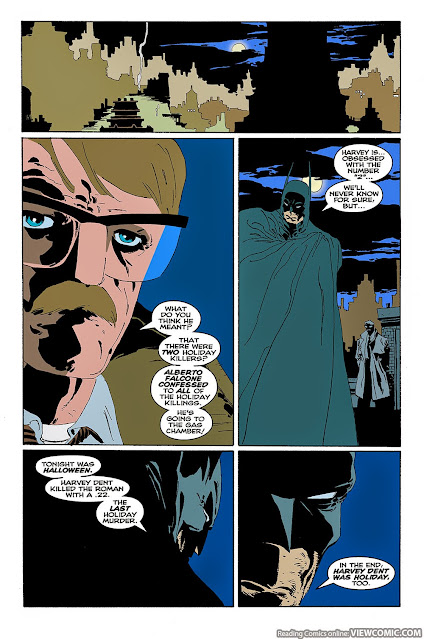


Two-Face is arrested as well, but he's beyond the pale to his former friends, and they can only ask themselves if their actions were just. Loeb and Sale then throw in a last "teaser" to suggest that there's an angle to the Holiday killings that the two crime-fighters will never learn.

One podcast professed the opinion that HALLOWEEN was all about how the ordinary crooks were displaced in the Bat-mythos by the super-crooks. On the contrary, I think the diminished importance of the super-crooks' deeds in the story indicates their transitory effects on the crime scene. Yes, by the end of the story "the Roman Empire" has fallen, but every Bat-reader knows that other crime families simply filled the void in present-day Gotham. Sale's deliberately cartoon-like art frequently exaggerates the super-fiends to the point of absurdity. When Batman punches the Joker in one scene, the villain's neck stretches like the body of a jack-in-the-box. In the Penguin's brief appearance, he sports a monocle so big that no human eye-muscles could hold it, and Poison Ivy has "leaf-hair" that's longer than her entire body. Compared to the scourge of ordinary criminals and the poisonous effect they have even on righteous people, the super-fiends themselves are like the calendar's holidays: attempts to punctuate the dull round of human existence with the celebration of non-rational customs. And that is the "master thread" by which BATMAN THE LONG HALLOWEEN can be accurately read as a mythcomic.


Wednesday, April 26, 2023

NEAR-MYTHS: "RESURRECTION NIGHT" (BATMAN #400, 1986)


I discussed the most ambitious arc in Doug Moench's BATMAN run here, but as it happened the writer continued to script Bat-tales until late 1986, and within that time-frame his last one seems to be this celebration of the Caped Crusader's four hundredth issue of his own title. Oddly, the long-term Bat-writer who had immediately preceded Moench, Gerry Conway, also departed by writing an "anniversary" issue of sorts, that of Batman's 500th appearance in DETECTIVE COMICS. That celebration, like Moench's, depended on pitting the crusader and his allies against a huge smorgasbord of  villains.

Neither story is anything special, since the trope of assembling of so many evildoers in one tale creates a "too many crooks spoil the broth" situation. But "Resurrection Night" has a better gimmick, in that Moench's story was illustrated by a round-robin group of established artists, as seen on the cover above. This was the main attraction of "Night," giving fans the chance to see Batman and his cosmos rendered by many artists who wouldn't ordinarily work on the regular titles. 


The plot is necessarily simple: on the actual anniversary of Batman's genesis (I think-- Moench is vague on the matter), the mastermind Ra's Al Ghul liberates twenty-something villains from prison and from Arkham Asylum, in order to make a massed attack on the crusader and his allies. Said allies include "Jason Todd Robin" and Batman's competing love-interests Talia and Catwoman, both of whom are wearing their good-girl hats this time. I did appreciate that Moench almost immediately rids his story of about a dozen malcontents who simply refuse to play along with the big scheme against Batman. This economizing kept Moench and his collaborators from making an error like the one Conway made in his opus. That 1983 villain-rally began by showing the Penguin meeting up the rest of his criminal cronies--after which Conway evidently forgot that the Birdman Bandit was part of the story, since the Penguin vanished from the tale thereafter. 


So the villains break up into separate units, which makes it all the easier for the round-robin artists to handle separate sections of the peripatetic plot. IMO the most enjoyable outing is that of independent artist Ken Steacy, who made only irregular contributions to either of the Big Two. 


But what if anything justifies my calling "Resurrection Night" a near-myth? The closest the story comes to a "master thread" appears in a segment penciled (in a strangely hyperactive style) by Bill Sienkiewicz. Ra's, after unleashing this gang of ghouls upon Gotham, appears in the Batcave and offers the hero his idea of a "temptation in the desert;" offering to kill off all of Batman's foes if Batman will put aside crimefighting and join the mastermind's League of Assassins. Most Bat-readers will not think this an  especially well-thought-out idea, and of course Batman utterly rejects trading one evil for another. The most one can say for the master villain's plan is that he also has his pawns kidnap four innocents, including Alfred the Butler, so on some level Ra's hopes to guilt the hero into forswearing heroism. After the defeat of the pawns, Batman finds Ra's holed up in a windmill and defeats him, 


The Brian Bolland art for the near-finale is also a standout, but the coda is a little more psychologically interesting, First, after the heroes and their friends meet in the Batcave for a cheery anniversary party, It's then that we're told that the windmill where Ra's was defeated (in the usual fiery explosion) created an aftershock that just happened to punctuate the celebration with a stalactite of death. Batman being Batman, he takes the occurrence as a justification to stalk away and brood. Does he reflect on how his destiny has tied him inextricably to a world of freaks and fiends? Well, Moench doesn't exactly say so, but that's what I got out of it. As usual, some of Moench's poetic tropes are labored. The stalactite that impales the cake is a "candle?" And being just one candle, that means it signifies the "resurrection" of Batman's crimefighting career (albeit in other hands than those of Moench)? Not his most inspired symbol-correlation. But "Night" is certainly a better wrap-up for Moench's tenure on BATMAN than the rather piddling stories that appeared in the post-Nocturna months.


Wednesday, February 15, 2023

SO, A THREAD-PULLING VECTOR


 My title for this essay spoofs a title I used for two essays way back in 2011, SO, A THREAD-PULLING NEEDLE, Part 1 and Part 2, which in their turn had punned on one of the lyrics from THE SOUND OF MUSIC. I confess I didn't even remember what those essays were about. I just wanted to create a title for this essay that brought the terms "thread" and "vector" together in some halfway-felicitous manner. As it happens, I did find some relevant content in those 2011 essays-- more on which at this essay's conclusion.

This essay sprung into being the way a lot of them do: taking a morning walk for exercise and letting my mind ruminate over the various categories I've created like the proverbial cow chewing her cud. This time, I randomly started associating my idea of "the master thread"-- which usurped all my old conceptions of "theme statements" in this April 2020 essay-- with the Whitehead-ian idea of "vectors" that I first broached in August 2020. Whereas the master thread concept was oriented only upon the way the author organized the "vertical meaning" of his narrative, vectors were designed to describe all category-domains in my system.

...all aspects of art—characters, settings, plot-tropes—derive from authorial will. Similarly, all of the multifarious literary categories I’ve introduced on this blog—dynamicity, mythicity, the combinatory-sublime and so on—are the prisms I use to view patterns of authorial will, patterns formed by the unceasing interactions of authors swiping from each other, competing with each other, and writing love letters to each other.

So far, I have applied the vector-term to such domains as centricity and phenomenality, but not to the differing emphases of a narrative's vertical meaning. However, something akin to vectors is implicit within the first example I offered of those differing emphases, in the essay MYSTERY OF THE MASTER THREAD PART 2.

To my knowledge, no written work of fiction provides a mythopepic discourse denser than that of Herman Melville’s MOBY DICK. This sprawling tale is replete with many threads of mythopoeic vertical meaning, ranging from the relationship of white men to colored men (which theme preoccupied Leslie Fiedler) to the nature of fate (Fedallah’s MACBETH-like prophecies). But all of these meaning-threads are subordinate to the master thread, which, if removed, would unravel the whole kit and kaboodle. The master thread for MOBY DICK consists of the myth of the Hunter and the Hunted—with the additional fillip that the Hunted is either God or the agent of God’s inscrutable will, so that the Hunt itself is inevitably doomed.


So what, aside from my bare assertion, determines that the trope of "The Hunter and the Hunted" is the "master thread" of MOBY DICK, and not one of the subordinate threads (which I later dubbed "bachelor threads")? When I state that removing the putative master thread would "unravel the whole kit and kaboodle," that should imply that it's too big and complicated to be removed without damaging the whole. And the master thread got big and complicated because Herman Melville concentrated the greatest vector of his authorial will upon that theme, while the bachelor-threads, while important, might be removed without necessarily damaging the whole. 


The idea of removing such a master-thread is not mere theory; it's the sort of thing that often takes place with adaptations of famous works. I have not yet reviewed the 1956 film adaptation of Melville's nautical novel, nor have I seen it in several years. But my recollection is that scripter Ray Bradbury decided to elide most of the religious content of the novel, except for a puerile "Ahab overstepped the bounds of a reasonable mortal" that sounds more like FRANKENSTEIN than MOBY DICK. Banal as this vertical meaning is, though, it's still the master-thread for the 1956 movie because it shows the greatest vector of Bradbury's authorial intent. I should note in passing that my conception of vertical meaning-- in which there is one superordinate thread amidst one or more subordinate threads-- mirrors my conception of centricity, in which one icon, or group of icons, proves superordinate and everything else in the narrative is subordinate in nature. The subordinate threads, like subordinate icons, just don't have that much authorial attention given to them, resulting in lesser will-vectors.

Jumping back eleven years, the first part of SO A THREAD PULLING NEEDLE came about when AT-AT Pilot asked me to provide some guidance on the subject of what I'd called "myth criticism." I responded in part with a perhaps labored metaphor in which I would seek to provide an "Ariadne's thread" through the "labyrinth" of modern discourse about mythology. It didn't occur to me back then that the usual interaction of threads and needles, that of binding cloth together, was the exact opposite of the use of thread in the Minotaur story. However, Part 1 at least shows that the thread-metaphor was one I liked then as much as I do now.

Part 2, though, is the essay with the aforementioned "relevant content" with respect to more recent writings. Riffing on a famous misquote of Heidegger, I wondered whether one could discern a "unifying thread" in all of my ruminations on this blog, and I came up with the quest for an answer to the question:

"Why is there complexity where there doesn't need to be any?"

And my answer, seeking to get away from the more abstract explanations, was to posit that mythic complexity is simply a fun thing for authors to put in their stories, even when they don't expect anyone to find that particular Easter-egg. I still believe this, that all the factors that go into making fiction come about because authors like best the play-element in fiction. Thus in fiction the sense of play has the greatest force-- the greatest vector, one might say-- than even the most sedulous desire to convert others to some moral message.