Featured Post

SIX KEYS TO A LITERARY GENETIC CODE

In essays on the subject of centricity, I've most often used the image of a geometrical circle, which, as I explained here,  owes someth...

Showing posts with label neal adams. Show all posts

Thursday, July 3, 2025

HOSTS, HEAVENLY AND OTHERWISE PT. 3


I started thinking once more about the topic of "story-hosts" after re-reading Batman's visit to "The House of Mystery" in BRAVE AND BOLD #93, courtesy of Denny O'Neil and Neal Adams. In a previous installment of this essay-series, I had talked about how certain issues of that rotating team-up title, because those stories paired Batman, a superordinate icon, with such subordinate icons as The Joker, the Riddler and Ra's Al Ghul, none of whom have ever progressed beyond the subordinate level (in contrast, say, to a rare character like The Catwoman, who made her superordinate mark in the 1990s and who has kept that stature thereafter). 


But at least all of the villains so featured were actual icons. In the story "Red Water, Crimson Death," the two "headliners" are Batman and Cain from DC's "House of Mystery" title-- but not only do they not interact with one another, the latter character has, as far as this story is concerned, no power to interact with Batman or anyone else. He might best be termed a "null-icon" here, as he is in most if not all of the horror-stories he hosted. Thus, in contrast to what I wrote in COSMIC ALIGNMENT PT. 6, in all such narratives Cain would be neither Prime nor Sub. I'm aware that he becomes a Sub in the SANDMAN comic, which parallels what I also wrote in the above essay about the EC story "Horror Beneath the Streets." In that tale the three EC horror-hosts come into "reality" to berate the comic-book makers-- but only to make the humans assign the hosts to their already established venues. Technically they are Primes and the comic-book authors are Subs-- though the categorization is made more difficult in that story-hosts are essentially identical with their authors. They serve the same purpose as omniscient narrators, but as "null-icons," they convey a sense of personality absent in such narrators.


So in my book, "Crimson" is essentially a Batman story, concerning his adventure when he tries to take a vacation from being Batman. He meets a young Irish boy, Sean, during an ocean voyage , and though Bruce Wayne has no idea that Sean is involved in a criminal case, he ends up accompanying the boy back to his small fishing-isle, and thus, getting some necessary exposition-- and an introduction to a supernatural manifestation.          


I won't recount the whole story here, but suffice to say that there's a human agency behind the so-called "red tides" and the never-specified deaths of Sean's parents. However, there's also a superhuman agency that manipulates the Gotham Guardian into intervening to capture the criminals and save Sean's life. And yet, though as scripted this is a Batman story, with no crossover elements, O'Neil and Adams structured the tale as the sort of thing that could have run in HOUSE OF MYSTERY. And suppose that it had been reworked to be just such a story, with Batman ejected and replaced by just some basic one-shot viewpoint character? Then the centricity would have shifted from that POV type to either King Hugh, the ghost that renders aid to the boy's protector-- or even to Sean, since O'Neil's backstory slightly suggests that the boy, still grieving for his lost parents, may have subconsciously summoned the spirit of his dead relative to enact vengeance.


Sunday, September 1, 2024

CURIOSITIES: WHAT NEAL ADAMS DID WAS CRIMINAL


Or rather, KRIMINAL.


That's assuming these KRIMINAL issues came first. If the art-swipe went the other way, just reverse the metaphor.


Thursday, January 3, 2019

NEAR-MYTHS: "THE DEMON LIVES AGAIN" (1971), SON OF THE DEMON (1987)


In the mythos of Golden Age Batman, as with those of many heroes in that era, criminality is a short-term menace. World-conquerors in this period are relatively few, and the various spies and agents of foreign powers represent a different type of villainy. Batman’s best-known rogues seem content to rip off company payrolls and visiting potentates. Sometimes they even commit crimes with no real end beyond dueling with Gotham’s premiere protector.


In 1971, however, writer Denny O’Neil and artist Neal Adams added two characters to the rogues’ gallery that became as well-known to Bat-fans as any of the classic Golden Age malcontents: Ra’s Al Ghul and his daughter Talia. In various interviews O’Neil averred that his primary inspiration for these characters were that father-and-daughter team created by Sax Rohmer: the world-conquering Fu Manchu and his daughter Fah Lo Suee. Like Fu Manchu, Ra’s Al Ghul—whose name is routinely translated as “the Demon’s Head”-- has used weird science to live far longer than his normal span of years. Further, like Fu, Ra’s commands a covert army of Oriental assassins, with whom Ra’s hopes to change the entire structure of Earth’s sociopolitical system. However, there are also important differences.


In his early adventures Fu Manchu has no daughter. That said, the first story-arc introduces a femme fatale, Karameneh, and when Doctor Petrie asks who she might be, Fu’s perpetual opponent Nayland Smith speculates that she might be the arch-fiend’s own spawn. Rohmer doesn’t introduce Fah Lo Suee until 1930, after which the character remains a permanent feature of the prose-series. Fah Lo Suee is often seen aiding her father’s schemes, though when convenient she lends aid to Nayland Smith and Petrie. When she does help the Englishmen, it’s because of her amour fou toward Nayland Smith, an amour of  which her father definitely does not approve.


O’Neil, however, introduces Talia Al Ghul slightly before her father’s debut, and when Ra’s shows up, he first puts Batman through a series of ordeals. Then the vaguely Arabic-seeming overlord announces to the hero that because Talia has fallen in love with him, Ra’s wants Batman to give up the life of a crime-fighter and inherit Ra’s mantle, the governance of the League of Assassins.  Batman of course opposes the criminal plots of his would-be father-in-law, even though the hero reciprocates Talia’s feelings.


Most of the Ra’s/Talia stories don’t reach a high level of mythicity. However,  in one respect Ra’s improves on his model. Whereas Fu Manchu simply uses an alchemical elixir to cheat death, Ra’s is first seen literally rising from the dead in a two-part 1971 arc, thanks to the help of a supernatural resource: a “Lazarus Pit.” The second part of the story,  “The Demon Lives Again”(BATMAN #244), develops this revelation by positing that when Ra’s first comes back from death, he becomes temporarily insane as well as having “the strength of ten,” equally temporarily. Thus he might seem to be the horror of bridegrooms everywhere: the father-in-law who’s never really out of his little girl’s life.


Yet perhaps the most mythic aspect of Ra’s culminating narrative is his battle with Batman beneath the desert sun of Old Araby. Fu Manchu is never seen fighting his enemies, but Ra’s, despite his great age, is every bit as battle-worthy as his prospective son-in-law. “Demon” concludes with Ra’s and Batman doffing their shirts and fighting with swords beneath the Arabian sun. Briefly, the desert seems to intercede on the behalf of its human representative, for a scorpion stings Batman, presaging his death. But Talia, in her first real betrayal of her father, slips an antidote to the hero. Batman then returns to face his foe again, giving “the Demon’s Head” his first opponent who seems to match Ra’s for deathlessness.


For fans of BATMAN, the comic book rarely exceeded the intensity of this Oriental romanticism. Over the years, this scenario, in scripts both by O’Neil and by other DC writers, the “eternal triangle” between Batman, Talia and her fanatical father proved a fruitful source of high melodrama, particularly as Ra’s becomes increasingly portrayed as an “eco-terrorist,” out to purge the world of humankind’s corrupting influence. But with the possible exception of Grant Morrison’s BATMAN INCORPORATED serial-- which I’ll address separately— no one succeeded in giving the Ra’s-myth deeper connotations.


In the 1987 graphic novel BATMAN:  SON OF THE DEMON, writer Mike W. Barr and artist Jerry Bingham create an “alternate-world” scenario for the threesome, about a year or so after Frank Miller did the same with his vision of THE DARKKNIGHT’S RETURN. Without speaking to the personal involvement of the authors, SON seems to be aimed firmly at the “Talia-shippers” among Batman-fandom, since the story alters the “triangle-scenario” to make the three characters one big happy family, complete with a little one on the way.


To achieve this familial bliss, Barr creates a mutual enemy for Batman and the Al Ghuls: a terrorist named Qayin (the Arabic version of the name given to the Bible’s first murderer). Batman encounters one of Qayin’s terrorist-cells in Gotham, and almost immediately Talia shows up on his doorstep, inviting him to join her and her father in rooting out this world-menace—who just happens to be an indirect part of the Al Ghul family, since Ra’s is Qayin’s godfather. Talia’s reasons for pursuing Qayin are more personal than Batman’s, for Qayin slew her mother Melisande. (Parenthetically, this seems to be the first extensive accounting for the absence of Talia’s female parent.) Batman is invited to join not only in hunting down the terrorists, but to join with Talia in holy matrimony. On rather short notice, Batman not only puts aside his commitment to Gotham City and becomes the de facto son of Ra’s Al Ghul, so that the hero can remold the League of Assassins into a paramilitary force trained in the crusader’s non-lethal techniques. Further, Batman puts a bun in Talia’s oven, hence giving Ra’s his first grandson. Although Talia is now depicted as a kung-fu mistress—for the first time, I believe-- Batman tries to protect her from harm.  However, she loses the child, and after Batman vanquishes Qayin and his nuclear threat, the hero returns to Gotham. The novel then ends on a peculiar note: suggesting that Talia faked losing the child and sent the baby away to be adopted, though Barr supplies no hints as to why she might do so.


The most mythic aspect of SON OF THE DEMON would be the story’s evocation of the trope of “the hero tries to walk away from his destiny.” Barr’s handling of the myths of both Batman and the Al Ghuls is pedestrian at best, while Qayin is a make-work villain. He becomes embittered toward Ra’s because Ra’s sent Qayin’s parents on a mission that resulted in their deaths, which by itself is banal. Further, the circumstances under which he kills Melisande don’t track either. She surprises her godson messing around near one of Ra’s Lazarus Pits, but it’s not clear if he has some idea of using the Pit to bring back his patents, or if he just wants to deprive Ra’s of the resource. To complicate things needlessly, Barr also reveals that at some point Qayin becomes terminally ill, which apparently accounts for his willingness to destroy the whole world—which is also extremely jejune in terms of any discourse, symbolic or otherwise.

However, simplistic as SON OF THE DEMON is, it did contribute some tropes to the Bat-mythos that proved vital to Morrison’s massive “encyclopedia of all things Batman.”

Wednesday, February 7, 2018

MYTHCOMICS: "THE KREE-SKRULL WAR" (AVENGERS #89-97, 1971-72)

Not a few critics have chosen to see the superhero genre as something apart from the confluence of tropes that are called "the SF genre." It's a dubious separation in a critical sense, but it makes sense in terms of marketing. Genres are formed more from reader-expectations than anything else, and it can be fairly said that, say, a character like Superman raises different expectations from a character like Adam Strange.

Marvel's FANTASTIC FOUR blurred the marketing distinction between the genres more than any prior superhero title. Though the heroes spent some time fighting super-crooks like the Frightful Four, they're better known for the many SF-concepts elaborated by Lee and Kirby-- the extradimensional Negative Zone, the "lost race" of genetically modified Inhumans, and the alien race, the Kree, who fostered the Inhumans' advancements, to name the three that have the greatest impact on Roy Thomas's "Kree-Skrull War."

By contrast, though the Avengers had their share of encounters with aliens and lost races, the feature always seemed squarely in the superheroic domain. Further, during the long tenure of writer Roy Thomas on the title, it sometimes seemed like "Fantastic Four West," in that Thomas borrowed a considerable number of villains from the FF: Diablo, the Thinker, and so on. Not until the Kree-Skrull continuity, though, did Thomas make a concerted effort to bring a "sci-fi" flavor to the series.
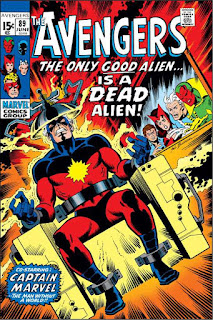


That said, AVENGERS #89 wasn't precisely Thomas's first effort to blend superheroes with SF. Marvel Comics's version of Captain Marvel debuted in a 1967 Stan Lee story, after which Thomas wrote five more stories before ceding the character to other hands. Thomas's first, very short run with the character-- a soldier of the Kree race, posing as a superhero on Earth-- is noteworthy for revealing a long-standing animus between the Kree and an earlier group of Lee-Kirby aliens, the Skrulls, whom Stan and Jack had mostly ignored for the latter part of the 1960s. Over a year later, Thomas returned to the hero's adventures, and attempted a reboot of the character with Gil Kane art and a new costume (seen in the illo above). Even this reboot was somewhat indebted to the FF feature, since it involved placing Marvel in the Negative Zone, which he could only escape by "trading atoms" with Earth-juvenile Rick Jones.

Thomas wasn't writing the CAPTAIN MARVEL feature at the time he began the Kree-Skrull continuity, but the character is the linchpin that brings the Avengers into a greater SF-tapestry. Issue #89 is largely concerned with revealing to the title heroes the relationship of Marvel and Jones, though it also informs the reader that there's been a power-shift on the Kree homeworld. The Supreme Intelligence, ruler of that world, is deposed by his former underling Ronan (both, incidentally, also FF creations). As soon as Ronan takes power, he sends a robotic Sentry to take Marvel prisoner, while Ronan himself speedily travels all the way to Earth to bring about the total devolution of the human race.
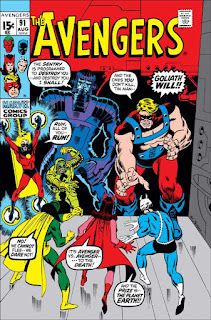

This plot, which lasts over the next two issues, is along the line of "what the Kree giveth, they can also take away." As mentioned above, an earlier generation of the Kree visited the Earth eons ago, and chose to foster the isolated race of modified beings, the Inhumans (whose adventures in their own title Thomas also wrote at one point). The Avengers pursue the abducted Captain Marvel and his captors, and prevent the Earth from returning to Bedrock-status.

Often in comic books, the defeat of an alien invasion had no repercussions on Earth's society. However, the three active Avengers in #89 all belong to groups that weren't quite human: the android Vision and two mutants, Quicksilver and the Scarlet Witch. Moreover, by the early 1970s Marvel writers tended, more often than not, to play up their heroes' sense of disaffection from their communities. Thomas goes so far as to have the Vision assert that "superheroes are, by definition, misfits"-- which observation foregrounds the result of the invasion: a massive anti-alien hysteria, at least in the U.S. (Other parts of Marvel-Earth do not weigh in.) Issue #92 is particularly prescient in having two Avengers argue the "government security vs. civil liberaties" question that later informed the CIVIL WAR arc of the 2000s. 

Meanwhile, for no cited reason, the Skrulls declare war on the Kree, forcing Ronan to hurry back to his homeworld. However, now the Skrulls, seeing Earth as a possible resource for their enemies, infiltrate the planet as well. The formidable Super-Skrull tries to destroy the city of the Inhumans, simply so that the Kree cannot enlist their super-powers. The villain also tries to subvert Captain Marvel, so that the Kree officer will reveal a special weapon that can turn the tide in the war. Some of the Avengers, as well as the captain, are abducted, forcing the other heroes to voyage into space to rescue their comrades, while simultaneously trying to keep the two alien races from wrecking the cosmos with their conflict.


The specific breakdown of the back-and-forth battles isn't mythically significant. However, it's interesting to see how Thomas developed of the "Chariots of the Gods" concept put forth by Lee and Kirby in their Kree stories.


By 1971, there was nothing new-- at least in prose science fiction-- about the idea that whole races of aliens and/or Earthmen had evolutionary pathways, or that some of those races still held advancement potential while others had stagnated. The aforementioned Rick Jones, the "ordinary guy" amidst the costumed champions, is Thomas's means of demonstrating this heritage. In order to quell hostilities, the Supreme Intelligence stimulates some deep psychic talent in Jones. His enhanced power literally stops the war. and, for good measure, conjures up a bunch of 1940s superheroes, as a way of celebrating the Golden Age's simpler images of super-humanity.
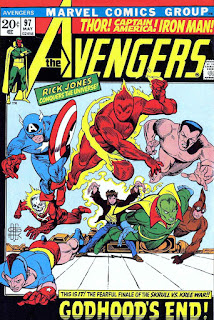


Thomas's script has a handful of plot-holes, but his basic SF-indebted conception passes the test for a fairly complex symbolic discourse. The narrarive of Kree-Skrull War is somewhat compromised by its noodlings about matters of continuity. This includes not just Thomas finishing up old plotlines (like the status of Black Bolt during Thomas's INHUMANS run) but also creating new narratives irrelevant to the war-story. It's in issue #93 that Thomas lays groundwork for further complications about the Vision character, with a derivative-- but still fun-- reprise of the 1966 FANTASTIC VOYAGE movie, replete with some gorgeous Neal Adams art. 


Friday, September 4, 2015

NULL-MYTHS: "HOW DO YOU FIGHT A NIGHTMARE?" (GREEN LANTERN #82. 1971)


My choice for a null-myth mirrors the theme of the week's mythcomic: the theme of feminine sovereignty.

As written by Denny O'Neil and pencilled by Neal Adams, the last fourteen issues of the Silver Age GREEN LANTERN feature-- which changed its masthead title to GREEN LANTERN/ GREEN ARROW during that period-- remains one of the touchstones of the early Bronze Age. I won't attempt to critique the entire rum here, which has both its fans and its detractors. It's enough to say that the revised feature followed the lead of the "relevance craze" in popular fiction of the late 1960s and early 1970s. This meant that the GL/GA stories dealt with social problems in a compartmentalized, one-social-topic-per-story fashion, whether the problem was drugs, Native American problems, censorship, Black American problems, and so on.

I don't know whether or not advance advertising on "Nightmare" positioned the story as an examination of the "problem" of feminist concerns. I recall that at least some of the lettercol mail attacked the story as a travesty of those concerns, but the text of O'Neil's story doesn't foreground the narrative as a "cause of the month." Mythologems about femininity make their appearance in the story, but it's hard to see what value O'Neil meant them to have. Hence, "Nightmare" qualifies not as just a mere bad story, but also an inconsummate one, in terms of its symbolic discourse.

Long before the beginning of the Silver Age, the writers of DC comics became notorious for the use of heavily plotted stories which often depended on the contrivances of villains seeking to trap or hoodwink the stories' heroes. "Nightmare" is first and foremost a "trap" story, beginning with an absurd but eye-catching opening. Green Arrow, somewhat on the outs with his girlfriend Black Canary, decides to buy her a box of roses. He shows up at her house, greets her (in her civilian ID as Dinah Lance), gives her the box-- and out of the box spring a pair of creatures that resemble the harpies of Greek myth. Arrow and Canary try to fight the monsters, then flee the house-- only to find that the harpies disappear a moment or two later. The archer calls on his power-ring partner to help him investigate the attack-- and therein lies the trap. Without dwelling too much on the particulars of the ramshackle plot, Green Lantern's old foe Sinestro and his previously-unseen sister are behind the whole thing: they contrive to menace the Lantern's friends in order to draw him out of hiding, so that they can lay their trap.

It's useless to critique O'Neil's story in terms of verisimilitude-- to object that a villain as resourceful as Sinestro surely could have found a more efficacious way to draw out the Emerald Guardian; one less dependent on anticipating Green Arrow's wooing habits. In all likelihood O'Neil contrived this wild, thoroughly improbable opening primarily to sell the issue to young readers and for no other reason. A secondary benefit is that the flower-store gimmick gives Arrow and Canary something to investigate after the Lantern has been trapped, and the same gimmick makes it possible for them to save their friend after having accidentally put him in danger. But more importantly, such a critique is ultimately irrelevant, since I'm concerning myself not with consistency of character, but the way the symbols are utilized.

The substance of Sinestro's trap is that he tricks an entire civilization-- one made up of the harpies, a group of huge Amazon women, and a ruler who calls herself Medusa-- into doing his dirty work in trying to kill his enemy. Green Lantern, upon encountering these leftovers from the mythic past, gets a quick-and-dirty explanation for their animus toward men. Their entire city was hurled into a dimensional other-world by an ancient wizard, who was pissed because Medusa laughed at his marriage-proposal. Apparently this is the only "feminist" issue in the story-- essentially, that some men do some shitty things to women-- although once or twice Black Canary gives Green Arrow a hard time for his overbearing masculinity.


Even for comic books, dumping together harpies, Amazons, and snake-haired Medusa makes for a pretty motley myth-crew (further complicated by Adams dropping the motif of Medusa's scary petrifying face, and instead giving her a headful of snakes that can strangle their victims). I must admit that some mythographers, notably Robert Graves, have argued that the legendary Amazons of Libya worshipped Medusa as a more horrific version of the martial goddess Athena. I suppose it's possible that Denny O'Neil happened across this factoid and wrote it into his story, but I've read many of O'Neil's comics-tales and he doesn't impress me as a mythophile. It could just as easily be true that O'Neil was unaware of the mythographers' connection between Medusa and the Amazons, and that he just associated these figures because in their traditional stories they are opposed to normative Greek patriarchy-- the Amazons, because they maintain a role-reversed female-centric society, and Medusa because she's raped by Poseidon but goes on to menace mortals as a monstrous gorgon. Still, harpies don't really have a place in the equation. They've been variously interpreted as wind spirits and spirits who torment the dead, so they really don't fit in with the theme of women treated badly by patriarchal males. It may be that they're only there because Neal Adams felt like drawing harpies.

O'Neil's script states that Sinestro stumbled across the exiled Amazons by accident, somehow figured out that they were man-haters, and so enlisted his sister, the so-called "Witch Queen" to approach the Amazons. One of the martial maidens sums up their program: "to make all men pay for the crime of the wizard." But, even granting comics' penchant for absurd premises, it's hard to see how Sinestro's sister could convince the Amazons and harpies that any particular man should be pulled into their world and executed, as they attempt to do to Green Lantern.

One fan complained that the O'Neil/Adams story trivialized the subject of feminism by simply using a bunch of female monsters as the hero's adversaries. I might have validated a story that was simply out-and-out gynophobic, like certain EC horror-stories that I'll be addressing in future. But O'Neil and Adams maintain the butt-kicking Black Canary as an icon of formidable femininity, so the creators certainly aren't downgrading women as a whole. Perhaps the key to this awkward, inconsistent tale is that of male melodrama, for when Green Lantern is hauled before Medusa, he's condemned to death simply for "being like he who banished us" Black Canary shows up and talks Medusa out of killing the hero by revealing that they've been manipulated by another man, rather than being helped by a fellow female. So the moral, such as it is, is not to assume that shared sex organs mean shared interests.

It's also interesting that although the Amazons don't like being in the dimensional otherverse, nothing whatever is said in the story's hurry-up-and-finish conclusion about Green Lantern or his fellow superheroes freeing them from their exile. Granted, such a motley crew wouldn't fit in on modern Earth, but it seems like even the narrative's author wanted to get rid of these female foes as soon as he'd conceived them-- an interesting contrast to the more incisive treatment of feminine concerns in the earlier "Star Sapphire" stories in this title.