Let's start off the holiday season with a selection of 22 singles from way back when. We have familiar tunes in less familiar performances and some little-known songs as well. These come from 78s spanning 1934 to 1956, and include many genres - mostly pop, but also gospel, country, jazz and what-have-you. Something for everyone to love in this season of good cheer.
We start off with "Santa Claus Is Comin' to Town" in what is perhaps its first recording, dating from 1934. It is by
George Hall and His Hotel Taft Orchestra. Hall is best known for his records with Dolly Dawn, but this single predates the coming of the Dawn and has a vocal by Sonny Schuyler (later Skylar), who achieved some renown as a composer as well as singer. He didn't write this tune, though. You can blame J. Fred Coots and Haven Gillespie for it. George Hall and His Hotel Taft Orchestra did indeed perform at that New York establishment. I used to work across the street from its successor, and just yesterday came across a hanger from the place.
Also from 1934 we have another song that was new at the time, "Winter Wonderland," as performed by
Angelo Ferdinando and His Hotel Great Northern Orchestra. That hostelry also was in New York, but I don't have a hanger from it. Ferdinando's was not the hit version of "Winter Wonderland"; that was by the better-known Richard Himber. This one is pretty good, though. It has a vocal by Dick Robertson, who was on seemingly every other record made during the era. Ferdinando left the music business not long after this 78 was issued, but made a comeback in 1937 with a simpler name - Don Ferdi.
We move on to 1937 and two versions of Irving Berlin's excellent "I've Got My Love to Keep Me Warm," introduced in the film
On the Avenue. First is a very good budget version from
Sterling Young's West Coast band, with vocal by Billy Mozet. Then there is the better known Victor from
Ray Noble's crack American ensemble, with Howard Barrie as singer. This was just after Al Bowlly completed his tenure as the band's vocalist.
Returning to "Santa Claus Is Comin' to Town,"
Alvino Rey brings us a 1941 reading with the King Sisters presenting lyrics that had been updated to reflect the hip lingo of the time. I wonder what lyricist Haven Gillespie thought of such couplets as "He knows if you're a ickie / He knows if you're a gate." My guess is that he was OK with it so long as the checks kept comin' to town. The record also gives you a chance to hear Rey's Hawaiian-style "Gibson Electroharp" in a swing context, where it sounds odd.
The year 1945 brought us the Cahn-Styne classic "Let It Snow! Let It Snow! Let It Snow." Among the lesser-known versions from that year was the offering by radio tenor
Danny O'Neil, issued on the short-lived Majestic label.
 |
| Clyde Burke |
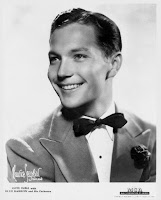
New in 1947 was Gordon and Lee's "Christmas Dreaming," familiar to Sinatra fanciers via his classic version. Here's an lesser-known reading from
Blue Barron's orchestra, with a vocal by Clyde Burke. The singer also made records with Sammy Kaye, Glen Gray and Raymond Scott.
Art Kassel and his band revived "Winter Wonderland" for the 1947 selling season. The song's arrangement could have dated from the 1930s, what with the soupy saxes and tightly muted brass that Kassel deploys. The vocal quartet is more modern sounding, though, and all in all, it's an enjoyable record.
Also from 1947 was a new number called "The Winter Song" or "Look Out the Window," depending on what record you consult. By whatever title, it didn't become a standard, although it is still heard occasionally. Our first effort comes from the Coral label and the little known
Gil Downs, along with a backing band and the vocal group 4 Hits and a Miss. The latter troupe also was known as "3 Hits and a Miss" and "6 Hits and Miss," presumably based on the number of male vocalists who showed up for the session.
 |
| Tex Williams |
So far we have been strictly in pop territory, but now we move into the country-western genre with Western swing's
Tex Williams taking up the same "Winter Song" in his resonant baritone, for the Capitol label.
Since Frank Loesser's "Baby, It's Cold Outside" was introduced in Esther Williams' 1949 aquatic adventure
Neptune's Daughter, it has been the subject of countless performances and the object of some surprising controversy. Around here, we prefer an irreverent approach to the tune. Last year we had the knowing
Pearl Bailey and the lupine Hot Lips Page. This year we present a highly amusing country version with
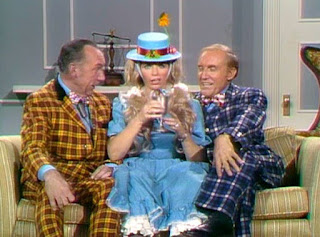
Homer and Jethro trying to persuade backwoods siren
June Carter to stay out of the weather ("Say, what's in this here drink?" / "It ain't sarsaparillee.") The trio
recreated their performance for television in 1971.
 |
| Jethro, June and Homer on TV |
Singer
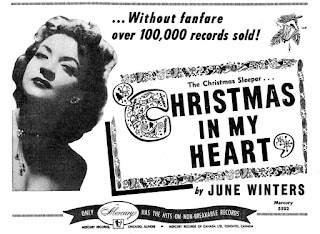
June Winters is little remembered today, but at mid-century she was known as the children’s music character "Lady in Blue." She and her husband, producer Hugo Peretti (Hugo & Luigi), had started the kiddie label Mayfair in the 1940s. Here she presents the appealing "Christmas in My Heart" on a 1950 Mercury release.
 |
| Billboard, December 9, 1950 |
We now turn to the miraculous
Mahalia Jackson with a two-sided Apollo label release, also from 1950 - "Silent Night" and "Go Tell It on the Mountain."
Also from that year comes the obscure but prolific
Dick Stratton and His Nite Owls, with a tremendous honky-tonk performance of "I Wouldn't Have You on a Christmas Tree." Stratton and his band were mainstays of the small Jamboree label.
Staying in the country realm, we move on to 1951's "Blue Shadows on a White Christmas Tree" from
Eddie Hazelwood and his Carolina Woodchoppers. Hazelwood was vocally under the spell of Hank Williams, but it's a good record even so. "Blue Shadows" was a Hazelwood composition; his best known numbers were "Sick, Sober and Sorry" (Johnny Bond) and "On a Honky-Tonk Hardwood Floor" (Johnny Horton). This single was issued by Intro, owned by Aladdin. Hazelwood also recorded for Imperial and Decca, including a cover of Big Mama Thornton's "Hound Dog" way before Elvis.
 |
| Jimmy Collett |
Jimmy Collett is another little-remembered country artist. In 1953 he recorded two sentimental items, "I Don't Want to Be Alone for Christmas" and "I Remember Christmas," for the Arcade label. Born in Arizona, Collett worked mainly in New Jersey, recording regularly and when he wasn't singing, plying his trade as a dentist. Here he drops his dental tools and country manner, and shows his roots as a Crosby-style crooner, even whistling like Bing.
We move to the small Diva label and a recording of "Santa's Ride" written by label owner Frank Serritella and sung by
Frankie Ross, who was actually the famous but ill-fated jazz trombonist Frank Rosolino. I don't have an exact date on this one, but it was probably pre-1954, when Rosolino moved to the West coast.
Staying in the jazz realm, alto saxophonist
Herb Geller and his group had a go at Leroy Anderson's "Sleigh Ride" in 1954, with interesting results. Also on the date are Lorraine Geller (p), Curtis Counce (b) and Larance Marable (d).
Next, a quick detour to Chicago and polka king
L'il Wally with another "Santa Claus Is Comin' to Town," this one from 1956 and Wally's Jay Jay label. If I haven't tried your patience enough with this song, wait 'til you hear juvenile vocalists Lenny and Judith, who make Patience and Prudence sound like Simon and Garfunkel. The two had to be related to L'il Wally.
 |
| Pete Rugolo |
For our final selection, we return to jazz and bandleader
Pete Rugolo's 1956 arrangement of "Snowfall." Composer Claude Thornhill conceived the song as a peaceful rendering of snowflakes falling. Rugolo instead offers a Latin beat punctuated by blasting Kenton-style brass. No surprise there - Rugolo had been a Kenton arranger
I found these 78s up near the North Pole of the Internet Archive, and remastered them for your holiday listening. Best wishes of the season to all, and a special greeting to blog follower Lennonka, with hopes that he will be doing better soon!