 |
Muir Mathieson
|
This post supersedes and builds on one from the early days of the blog devoted to music from British films of the 1940s. It now is more than twice as extensive - including 16 examples drawn from the best films composers of the era - Vaughan Williams, Rosza, Addinsell, Mischa Spoliansky, Allan Gray, Bax, Alwyn, Ireland, Charles Williams and Arthur Benjamin - all in vintage performances. These come primarily from two albums, as detailed below.
Also today, to mark the transition between seasons, David F. has provided us with two of his fine compilations.
Summer Turns to Autumn
David has prepared a set of songs both for the waning of summer and for the coming of fall - "A Farewell to Summer" and "Autumn Auguries." These total 60 selections by artists known and obscure, as always well programmed and carefully considered. The downloads (links in comments) include David's thoughts on the music and the seasons.
One of our readers recently called his compilations "brilliant" - and I won't disagree!
'Music for Films' - the Columbia Entré LP
My 2009 post was mainly devoted to an early 50s Columbia Entré LP,
Music for Films, which was almost entirely composed of British releases of the 1940s. The various recordings originated with EMI, and included performances by the Queen's Hall Light Orchestra as conducted by Charles Williams or Sidney Torch, and the Philharmonia conducted by Ernest Irving.
Here is what I wrote about these recordings a decade ago, much augmented.
The only well-known item on the record is the one American item, Miklos Rózsa's music from Spellbound, here in a performance led by Charles Williams.
The best-known
composer represented is Ralph Vaughan Williams, whose beautiful score
for the Loves of Joanna Godden was almost unknown until a more recent re-recording. Here the music is performed by the Philharmonia and Irving, the music director of Ealing Studios.
 |
| | Ernest Irving and Ralph Vaughan Williams at a recording session |
|
The little-known composer Allan Gray appears with two very effective items - the memorable prelude from
Stairway to Heaven and the theme from
This Man Is Mine. These pieces are apparently all that was ever recorded of Gray's film music. The composer left Germany after the ascension of the Nazis, as did Mischa Spoliansky, also represented in the collection.
 |
Mischa Spoliansky
|
Much of the Entré LP, in fact, is devoted to three pieces by the now little-known (but very talented) Spoliansky.
His "A Voice in the Night," from Wanted for Murder, is one of the most
effective of the many quasi-romantic film concertos that turned up following the 1941 success of Richard Addinsell's "Warsaw Concerto." The album also contains Spoliansky's music from Idol of Paris and That Dangerous Age.
 |
Lord Berners in repose
|
Finally, the Entré LP includes the Nicholas Nickleby music from the eccentric composer-novelist-painter Lord Berners (Gerald Hugh Tyrwhitt-Wilson), who wrote concert as well as film music and was a friend of Constant Lambert and William Walton. I don't care for Berners' music, but he cut quite a figure!
'Film Music' - the 1947 Decca-London Album
Like EMI, UK Decca was active in the film music realm during the 1940s. I have included a new transfer of a six-sided 78 album,
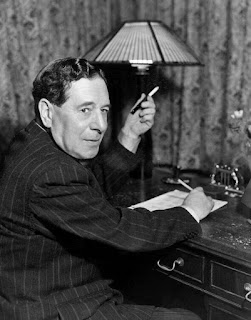
Film Music, from the London Symphony and Muir Mathieson, the music director for a large number of British films.
Mathieson's set is largely given over to composers better known for concert than film music. It leads off with one of the most beautiful themes ever written by Vaughan Williams - the hymn-like Epilogue from the film 49th Parallel.
 |
Arthur Benjamin
|
Next is what is possibly Arthur Benjamin's greatest hit - the "Jamaican Rhumba" of 1938, which doesn't seem to be film music at all [thanks Boursin for the tip!]. Benjamin's other popular favorite ishis "Storm Clouds Cantata" (not included here), featured at the climactic moments of both versions of Hitchcock's
The Man Who Knew Too Much.
Sir Arnold Bax's music for the short film Malta G.C. was one of his few scores for the screen. It concludes with an Elgarian march.
 |
William Alwyn
|
We return to Jamaica for another well-known use of its music, as captured in William Alwyn's score for The Notorious Gentleman. Neither the Alwyn nor Benjamin pieces were what you would call authentic, but are enjoyable nonetheless. Alwyn was equally renowned for his film and concert scores.
The final composer in this set - John Ireland - only composed for one film, The Overlanders, which involved a cattle drive in Australia. (One wonders how they attracted people into the theaters for that scenario.) Ireland was an uneven composer, and this is not among his best work, although it has enjoyed several recordings, all of which I seem to own.
Bonus Items
 |
Richard Addinsell
|
The talented Richard Addinsell was not represented on either album above, but I have
added two of his finest themes as a bonus. First is the original
recording of music from
Passionate Friends by the
Philharmonia Orchestra and Muir
Mathieson,
which comes from another Entré album that otherwise does not contain film
music. (Parenthetically, I saw David Lean's
Passionate Friends a long time ago, and remember it as excellent.)
I also wanted to include perhaps the most popular and influential
piece of film scoring from that period - Addinsell's "Warsaw Concerto" from Dangerous Moonlight. Here from the original 78, Muir Mathieson conducts the London Symphony with uncredited pianist Louis Kentner.
As a final bonus, I have included the "Dream of Olwen" music from
While I Live, another notable quasi-concerto of the period. The composer
was Charles Williams, who conducted several of the works on the Entré LP above. In this
recording William Hill-Bowen was the
pianist, with George Melachrino leading his orchestra on an HMV 78.
All transfers are from my collection, except for the bonus items, which are remastered from lossless needle-drops from CHARM and the Internet Archive. The sound is good in all cases.