26 October 2021

Tchaikovsky's 'The Seasons' with Morton Gould and Lev Oborin

Detail of Tchaikovsky portrait by Nikolai Kuznetsov
The headline says this post is devoted to Tchaikovsky's The Seasons. So why does the Morton Gould record cover below say The Months?

That's something we would have to ask Gould, were he still around. The composer called his suite The Seasons, and most other recordings I have seen call it the same.

Gould did have logic on his side. Tchaikovsky wrote the work on a month-by-month basis for the publication Nuvellist in 1875-76, and the individual pieces are subtitled for the appropriate month. But the composer and the publisher still called the suite The Seasons.

By whatever name, we have two versions of this piano work for you: one an arrangement by Gould for piano and orchestra, the other a Russian recording by Lev Oborin of the original suite.

The Months with Morton Gould

The title was not all that Gould changed. The suite was written for piano, but Gould orchestrated the work in Tchaikovsky's style, retaining a piano part.

It all works quite well in this 1951 recording, made in Columbia's 30th Street Studio, and a bit more steely sounding than usual from this source. It's a light suite, most similar in approach to the composer's ballet scores. (He was orchestrating Swan Lake at about the same time.)

The best known selections are probably the "Barcarolle" (June) and "In the Troika" (November). The latter is sometimes heard at Christmas, even though the composer assigned it to the previous month. Tchaikovsky's composition, however, is not heard as often as Prokofiev's "Troika" from the Lieutenant Kijé Suite.

I don't want to slight Tchaikovsky's December piece, which is one of his most felicitous waltzes.

Morton Gould in the recording studio

The Seasons has been arranged for orchestra several times. Most recordings use the orchestration by Russian conductor Aleksandr Gauk. As far as I can tell, this is the only recording of Gould's version. It has not been reissued for many years, to my knowledge.

The Seasons with Lev Oborin

Although his name is not often heard these days, Lev Oborin (1907-74) was a distinguished Russian pianist who won the first International Chopin Competition in 1927. Oborin often performed with David Oistrakh, and Aram Khachaturian dedicated his Piano Concerto to him.

Lev Oborin

Oborin's recording dates from 1950. This version is from a 1963 LP issued on the small Bruno label, possibly a quasi-bootleg. The LP was reissued many times on LP in Russia, but I haven't turned up any CD issues nor any other Western releases, save for a UK Parlophone album (that was, incidentally, titled The Months).

The recording is adequate; the performance is splendid, although Oborin's troika just ambles along, apparently in no hurry to get to Babushka's house. The pianist does, however, excel in the concluding waltz.

Thanks to my friend Ernie, who alerted me to the Gould LP on Internet Archive.

16 October 2021

'Toscanini's Hep Cats' - The New Friends of Rhythm, Plus Maxine Sullivan

The New Friends of Rhythm, 1938: Sylvan Shulman, Harry Patent, Zelly Smirnoff, Laura Newell, Tony Colucci, Alan Shulman, Louis Kievman
They were known as "Toscanini's hep cats," at least to the Victor publicists, because most of them played in the Maestro's NBC Symphony in its heyday. Their "formal" name, however, was the New Friends of Rhythm, a takeoff on the New Friends of Music, a New York concert society.

Today's post is devoted to these friendly hep cats and the complete set of their 16 1939-40 Victor recordings. Plus there is a bonus six-song album the group recorded with vocalist Maxine Sullivan in 1947.

About the New Friends

The New Friends specialized in a sort of genteel swing, usually involving riffs on classical pieces. At its base it consisted of the Stuyvesant String Quartet (originally Sylvan Shulman and Zelly Smirnoff, violins, Louis Kievman, viola, and Alan Shulman, cello) and harpist Laura Newell. The Shulmans, Kievman and Newell were members of the NBC Symphony. The NBC studio orchestra supplied Smirnoff, guitarist Tony Colucci and bassist Harry Patent. In 1940, Harry Glickman succeeded Smirnoff in the second violin chair.

Alan Shulman was the guiding force behind the group. His arrangements were to become highly influential; he taught Nelson Riddle, perhaps the most famous pop arranger of the 20th century. Riddle's biographer Peter Levinson acknowledges the influence in his book September in the Rain, while noting that Shulman himself acknowledged being shaped by the work of Robert Russell Bennett. 

These Shulman arrangements emphasize lightly swinging textures, but Shulman also had a romantic bent, which can be heard in a 1946 Risë Stevens collection of love songs, which I uploaded a few years ago. Sylvan Shulman conducted that set. Alan was also a fine composer whose work was often heard on concert programs of the day.
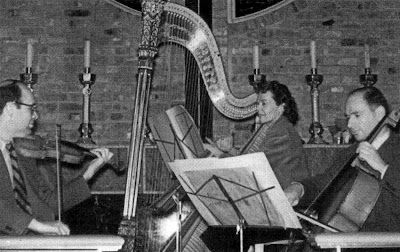
Sylvan Shulman, Laura Newell and Alan Shulman

The group both literally (see photo above) and figuratively revolved around harpist Laura Newell. The download includes an article on her and the group by Alan's son Jay from the American Harp Journal. It provides a detailed background on the New Friends, starting with the story that the Shulmans gifted Toscanini with their records as a Christmas present. (This, too, sounds like a publicist's confection.)

Laura Newell has appeared on the blog in Debussy's Sonata for Flute, Viola and Harp with Julius Baker and Lilian Fuchs.

My friend Bryan featured the Stuyvesant Quartet several times on his blog, The Shellackophile, now regrettably dormant. His posts include music of Prokofiev, Shostakovich and Bloch, reflecting the group's commitment to contemporary music. Also there are another recording of the Debussy sonata with Laura Newell, and her recording of the Ravel Introduction and Allegro with the Stuyvesants and others. Bryan even has a disc by the Kreiner String Quartet, which the Shulmans played in while enrolled at Juilliard. The links remain active.

The Complete Victor Recordings

The New Friends owed their Victor recording contract to NBC's Frank Black, who had heard them play and put them on NBC's "Magic Key" program, sponsored by RCA. Enzo Archetti of the American Music Lover praised the performance. He inaccurately claimed that the group was "a combination of Raymond Scott, the Hot Club of Paris and a jam session, and yet original enough to be quite fascinating." Actually, the Friends had nothing to do with Django and certainly their written-out parts were hardly the makings of a jam session. The only connection with Scott's music was its tightly arranged numbers and its offbeat titles, which usually gave a clue to the music's origins (which in any case were decoded on the labels of the crew's Victor 78s).

Hubert shoots the Schubert
Most of the numbers are classical takeoffs, and Shulman manages to keep them from the cheesy quality that afflicted the swing bands' usual classical adaptations, and avoids the parody element that Spike Jones among others brought to the music. There also were a few of Alan's originals and some miscellaneous arrangements.

The group's first session was in late March 1939, and encompassed Mozart, Tchaikovsky, Paganini and "When Johnny Comes Marching Home." They were back in the studio in late June for Back, Raff, more Tchaikovsky and the "Londonderry Air."

In November, they took on Brahms, Stephen Foster, Shulman's "High Voltage," and Schubert. The latter bore the title, "Shoot the Schubert to Me Hubert." This was undoubtedly related to Tommy Dorsey's record of "Shoot the Sherbet to Me Herbert" of a few months earlier.

The Friends' final Victor session was in May 1940, and devoted to Dinicu, Paganini, "Sweet Sue" and Shulman's "Mood in Question."
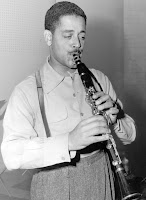
Buster Bailey
The Friends' Victor recordings did garner some good reviews (several are in the download) and had sold some 20,000 copies by June 1940, per a Time magazine article that surely was relying on a group's publicist. That seems like a lot, but didn't represent hit status even back then, which may be why the Victor output ceased after the May 1940 session.

The final session, which apparently wasn't released until 1943, featured the welcome addition of Buster Bailey, one of the most gifted and fluent of all jazz clarinetists. In its review, the jazz magazine Downbeat opined. "This disc is a direct slap at all those who claim strings impede swing. Here the strings themselves sensibly don't try for any solos. They aren't jazz men and they don't claim to be able to do that sort of thing - but their background is rich and colorful, and gives Bailey a terrific basis on which to swing." 

The 1947 Session with Maxine Sullivan
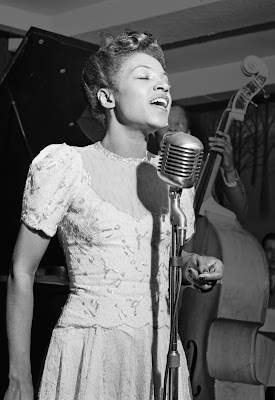
Maxine Sullivan in 1947

The New Friends of Rhythm returned to recording after the war with two 1947 sessions for the small International label: one on their own, the other with the superb singer Maxine Sullivan. I don't have the former set, but the latter makes up the second part of our program.

Sullivan had come to prominence with her 1937 recording of the Scottish tune "Loch Lomond," made with a small group led by Claude Thornhill. It was a huge hit, and led to her featuring such traditional fare throughout her career.

The six-song International album is split between three of these swinging-the-old-tunes numbers and three standards. A remake of "Loch Lomond" leads off the proceedings, which also include "If I Had a Ribbon Bow" and "Jackie Boy," both of which she had recorded before. The pop songs were Noel Coward's "Mad About the Boy," the Vernon Duke -Ira Gershwin "I Can't Get Started" and the Dorothy Fields-Jimmy McHugh "I Must Have That Man." 

It's always a pleasure to hear a singer as accurate and clear as Sullivan. Her ability to swing most any kind of material is welcome, as well. Swinging was really not the forte of the New Friends, although harpist Laura Newell and guitarist Tony Colucci were helpful in that regard. They are augmented on this date by Hank D'Amico, a good jazz clarinetist who nevertheless was not the equal of Buster Bailey, who appeared on some of the Victors. For the 1947 sessions, the string quartet had a new second violinist, Bernard Robbins, and a new violist, Ralph Hersh.
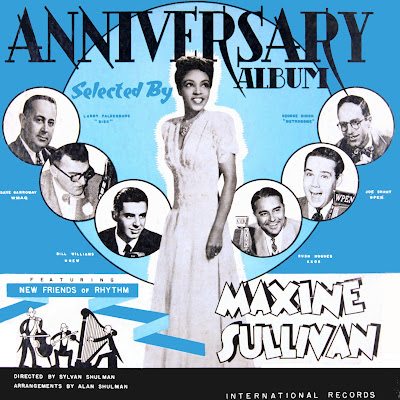
International called the set Sullivan's "Anniversary Album," explaining in the notes that it marked her 10 years in show business. Actually she had been singing since 1934, but only started making records in 1937. The selections were supposedly chosen by six well-known DJs and writers, whose mugs appeared on the cover. This transparent publicity ploy was common back then. Among the collaborators are Metronome magazine editor George Simon and deejay Dave Garroway. The latter was an important figure, first in radio and then on television. His relaxed, conversational approach become influential during his tenure as the first host of NBC's Today show. Garroway even lent his name to a few albums for RCA Victor, although he actually only appears on one of them.

Alan Shulman's arrangements for Sullivan are facile, and particularly show his influence on Riddle in his backing for "Mad About the Boy," which is something of a pre-echo of Riddle's Close to You arrangements for Sinatra. For those, Riddle utilized the Hollywood String Quartet along with harp, clarinet and several other instruments.

The sound on this album is more than adequate; the Victor singles are uniformly excellent. All were remastered from lossless needle drops on Internet Archive.

04 October 2021

Historic Delius Recordings from Sammons, Moiseiwitsch and Harrison, Plus Bonuses

The composer Frederick Delius (1862-1934) benefited from the impassioned advocacy of conductor Sir Thomas Beecham during his lifetime and until Beecham's own demise in 1961.

So pervasive were the conductor's efforts that it almost seems like he was Delius' only champion. But that is far from the truth. Notable early recordings of the composer's music included those by violinist Albert Sammons, cellist Beatrice Harrison, pianist Benno Moiseiwitsch and conductors Eric Fenby and Constant Lambert, none of which involved Sir Tommy. These form today's post, which is centered on a World Records Club LP from 1975, with the addition of several transfers from the original 78 issues.

Also today, we also have a bonus in the form of one of David Federman's much appreciated compilations, this one called "When Tourists Trod the Earth - A Farewell to Summer." Details below.

LP cover
The Violin Concerto with Albert Sammons and Malcolm Sargent

Albert Sammons by Alexander Akerbladh
Delius' concertos are not usually considered among his best or most characteristic compositions, although it is difficult not to enjoy these works in good performances. Here the Violin Concerto of 1916 is performed by its dedicatee, the eminent English instrumentalist Albert Sammons (1886-1957), who is also particularly associated with the Elgar concerto.

Malcolm Sargent
Sammons' was the first commercial issue of the Delius concerto. He, the Liverpool Philharmonic and its then-conductor Malcolm Sargent recorded the work in early July 1944 in Philharmonic Hall. Beecham followed up a few years later with his own version, done with violinist Jean Pougnet.

Sargent has been featured on this blog many times, including my transfer of his first Dream of Gerontius recording, with the Liverpool Philharmonic. Sammons has only appeared in a brief recording, that of Grainger's Molly on the Shore, which can be found in this compilation.

The Piano Concerto with Benno Moiseiwitsch and Constant Lambert

Benno Moiseiwitsch
The Russian-born British pianist Benno Moiseiwitsch was an ideal choice for Delius' Piano Concerto, which is more extroverted than much of the composer's oeuvre. It's been compared the Liszt's concertos; conductor Constant Lambert may have been an apt choice for the recording because of his affinity for the Abbé's music.

Moiseiwitsch was strongly associated with the Romantic repertoire, particularly Rachmaninoff and Schumann. To me, the Delius concerto is temperamentally more similar to the ruminative qualities of those masters than to Liszt's concoctions. The opening of Delius' work, for example, is directly indebted to Rachmaninoff. Moiseiwitsch is ideal in this music.

Constant Lambert
To record the work, the pianist, Lambert and the Philharmonia assembled in Abbey Road Studio No. 1 in August 1946. Depending on how you look at it, this was either the concerto's first or second recording. Beecham and his then-wife, pianist Betty Humby, had recorded it in late 1945, but that version was never issued. They remade the concerto in October-December 1946, and that was the one that HMV sent to market.

In 1946, Beecham sponsored a Delius Festival in London, recording a good number of the composer's works at the same time, including  the violin and piano concerto recordings mentioned above. I transferred these pieces for my own listening several years ago and can post them here if there is interest.

Delius also wrote a Double Concerto for violin and cello, which did not receive a recording until 1965, per the Delius Society discography. I also have that LP is anyone is interested.

The Caprice and Elegy with Beatrice Harrison and Eric Fenby

Beatrice Harrison
Today, perhaps the least known soloist in this set is the cellist Beatrice Harrison (1892-1965), another musician closely associated with Delius. Harrison and her sister May premiered the Double Concerto, which Delius wrote for them in 1915. Here she performs two works that the composer also wrote for her, the Caprice and Elegy, charming pieces that are lovingly played here.

The Caprice and Elegy recordings come from 1930, and are performed with small orchestra as scored and conducted by Eric Fenby. The latter was closely associated with Delius in the composer's last years, and is generally called his "amanuensis." That's a fancy term for scribe, but Fenby was far more than that. To my knowledge, he had only this one opportunity to conduct a Delius recording until many years later, when he produced a superb set for the Unicorn label.

Frederick Delius with Eric Fenby and Beatrice Harrison
The transfers of the Caprice and Elegy included here come from the original 78s, which have more immediate sound that the LP I used for the concerto transfers.

Bonus: Additional Delius Recordings from Constant Lambert

In addition to the Piano Concerto above, Constant Lambert also recorded Delius' On Hearing the First Cuckoo in Spring, the Intermezzo and Serenade from Hassan, and La Calinda from Koanga. They have appeared here before, but I am including them in this package as well.

Bonus: When Tourists Trod the Earth - A Farewell to Summer

David takes us on a tour of the past in his latest 30-song compilation, "When Tourists Trod the Earth - A Farewell to Summer." As he says in his notes, "As befits escapist fare, this medley is heavily enriched with Hawaiian music and music played through the lens it provided musicians everywhere to gaze at the songs of their own homelands." But it also continues into the 70s, "as it makes room for the Brazilian paradise that replaced the Hawaiian one."

David makes note that, "One of my favorite songs of all-time, 'On a Little Street in Singapore,' is sung by Dick Stewart - an earnest voice who made only one album I know of." I have that album myself and may transfer it if I can find it.

Thanks, David, as always for your contributions!