Showing posts with label Analytics. Show all posts

Sunday, May 24, 2026

An Opponent Desert

Today, we consider a follow-up question in Wargame, Soldiers, and Strategy's The Great Wargaming Survey (GWS), 2025 edition.  In a previous installment, I examined the question of opponent availability at a high level (see Do You Have Enough Opponents?).  From that analysis, I concluded that wargamers, often, find themselves isolated from available opponents mainly by disconnects in discovery and compatibility.  Plenty of opponents may be out there, but these barriers can prevent or frustrate meaningful gaming connections.

Can any other insights into gamer behavior be deduced by examining a handful of respondent attributes?  For this exercise, I single out five attributes from the survey for further study.  The selected attributes are Group Size, Game Venue, Population Density, Travel Time, and Location.  Each of these attributes will be compared in two settings.  One, for those saying that they have enough opponents (Opponents are Plentiful).  The other, for those gamers stating that they did not have enough opponents (Opponents are Few).  For those with few opponents, I give them the label of living in an "Opponent Desert."  Let's see what the survey says.

Group Size: Few
Group Size: Plentiful
When respondents state opponents are few, nearly 80% report a Group Size of four or fewer (25.1% for solo and 52.3% for groups of between one and four).  Comparing the "Plentiful" group, solo gaming drops to 8% while groups larger than four players increases markedly.  Not surprisingly, gamers with larger existing groups tend to be more likely to feel they have enough opponents.

Survey results on group size may suggest that once a player becomes part of an established gaming group, opponent scarcity diminishes.  Gaming isolation can be a self-reinforcing deterrent, though.  As smaller groups struggle to grow, there are fewer introductions, fewer games, and less scheduling flexibility.  In this case, group discovery and compatibility is more important than raw population numbers.


Game Venue
Gaming Venue: Few
Gaming Venue: Plentiful
Players reporting plentiful opponents appear more likely to play in clubs, stores, conventions, or organized venues.  Isolated players rely more on solo or private gaming either at home or at a friend's house.  As mentioned in the introduction, public venues may act as discovery engines to help bring wargamers together.  Having regular meeting places helps overcome the friction of finding compatible players.  Visibility through association matters.  That is, gamers often cannot find nearby gamers until a dedicated venue or group connects with them.  The survey supports the notion that opponent deserts are often networking failures rather than demographic failures.

Population Density
Population Density: Few
Population Density: Plentiful
Urban and suburban gamers are more likely to report plentiful opponents than do rural gamers.  More densely populated areas naturally create more overlap between potential members of a niche hobby like wargaming.  Geography still matters.  The gap between urban and rural gamers, however, is not absolute.  Some players in urban areas still feel isolated.  Proximity alone does not create gaming communities.

Travel Time
Travel Time: Few
Travel Time: Plentiful
Not surprisingly, gamers with plentiful opponents generally report shorter travel times.  With the exception of solo gamers, gamers reporting fewer opponents tend to tolerate longer trips.  Results suggest that there is a limit to the number of minutes spent in travel, though.  A travel time of between 30 and 60 minutes seems a common limit to both groups.  Even when a wargaming group exists nearby, a long drive and frequent participation become unrealistic.  Travel cost (in time, effort, and cost) increases with age, family obligations, and scheduling.  This result may help explain wargamers fracturing into small regional or local clusters.

Location
Location: Few
Location: Plentiful
The pair of gamer location charts suggests that outside of the UK/Ireland and US/Canada, there is not significant variation by geographic region between the "haves" and the "have nots."  For the UK/Ireland and US/Canada, the former seems more likely to have plentiful opponents while the latter tends toward more isolation.  The problem appears broadly structural rather than tied to one country or region.

Conclusion
Survey results suggest that “Opponent deserts” often present as discovery, compatibility, logistical, and social challenges rather than true population shortages.  In other words, many gamers are not alone geographically.  They are disconnected socially.  Wargaming communities may fail more from fragmentation than from scarcity.  How to overcome a fragmentation into small disconnected "tribes?"  Survey Results hint at a networking effect.  That is, once a wargaming group reaches a certain size and game regularity, the group becomes self-sustaining.  Failure to attain that threshold often results in the group struggling to gain momentum. 

These results present a useful insight not only for the wargaming community, but for many niche hobbies and local-interest groups.  Is tabletop wargaming more akin to a social network rather than a consumer market.  I reckon that it may be.  "Opponent deserts” may actually be "Coordination deserts."

Thursday, April 23, 2026

Do You Have Enough Opponents?

Today, we consider another new question added into Wargame, Soldiers, and Strategy's The Great Wargaming Survey (GWS), 2025 edition.

That question addresses opponent availability and asks,

Do you feel you have enough opponents within reasonable travel distance?

If the answer is "No" then survey respondents can choose from a Pick List of possible reasons why this is the situation.  Besides the provided Pick List, respondents could also add in their own reason as to why opponents are lacking.

Figure 1 illustrates the distribution of responses from the 2025 survey.  Nearly two-thirds of respondents state that they have enough opponents available within a reasonable travel distance.  The remaining 34% marked that they did not have enough opponents at hand.  
Figure 1
For those in the latter camp who lack enough opponents, the reasons why and those counts are detailed in Figure 2.
Figure 2
Based upon survey responses, the key take-aways for having not enough gaming opponents are:
  • Lack of Awareness of Nearby Opponents.  The leading reason, by a large margin (43.28%), is that wargamers simply don't know other potential players in their vicinity.
  • Mismatched Interests.  Even when opponents are nearby, opponents' interests might not agree with your own specific wargames or game type (15.86%). Differences in ruleset preferences (9.79%) also present a barrier to finding opponents.
  • Geographic Distance.  When distance is a factor, (11.56%) opponents are too far away for regular play.
  • Time Constraints.  Wargamers, themselves (10.32%), and opponents (3.30%) are often too busy to play more frequently.
  • Dislike of Nearby Opponents.  A small percentage of players (1.30%) simply dislike potential nearby opponents.
  • Finally, the "Other" category (4.60%) lumps all of the free text responses that could not easily be classified into one of the Pick List choices.
The survey results highlight a core issue.  That is, many wargamers are isolated either by not being aware of local players or finding that potential local players don't share their specific interests or schedules. While there are many wargamers who prefer solo play, an opponent shortage seems more driven by network and information disconnects than by a dislike of gaming with others.  This pattern suggests a fragmented local gaming community.  Enough players may exist nearby, but these gamers are either not visible to each other, or they play different periods, rules, or styles.  While distance and scheduling challenges matter too, these two traits seem to present smaller issues than discovery and compatibility.  Opponents are probably out there.  The challenge for many is that gamers either cannot find opponents or lack enough agreement in choices to actually to set up a game.  What can we do to improve this situation?

If we want to increase our available gaming pool, the biggest bang for the buck is improving visibility.  Make it easier for players to find other players.  Find out what others play and know when they meet.  A close second is improving compatibility by categorizing possible gamers by rules, period, and preferred game size.

My solution to this challenge was to embrace remote gaming by promoting and supporting the use of Zoom (or similar platforms), Vassal Engine, Tabletop Simulator, wargame-specific online platforms, and other virtual or remote tabletop environments.

The 2021 Great Wargaming Survey (see Remote Gaming in a Changed World) found that remote gaming significantly increased gaming frequency for many gamers and broadened their circle of gaming friends.  It did for me!  Survey responses suggested that gamers who gamed more frequently were more likely to try remote gaming.

By addressing the barriers identified above, the wargaming community can effectively increase opportunities for players to find and engage with opponents even from all over the world.

I am not finished with this survey question just yet.  There are a number of possibilities to explore to see where differences and commonalities exist between the two groups of respondents.  That study is for another time.

Do you have enough opponents within a reasonable travel distance?  If not, which of the reasons listed drive your response? 

Monday, March 16, 2026

Wargaming as an Escape

Keith Flint, in his Wargames, Soldiers, and Strategy #137 essay on wargaming as an escape (see WSS#137 Let's Escape pp 62-63) offers an interesting perspective covering several topics.  Some of his brief thoughts on this topic can be read on his blog at In Which I Became a Global Influencer.

To briefly summarize the escapism portion of Keith's essay, Keith highlights a quote that he has heard from wargamers that,

Wargaming allows me to escape everyday life, and it allows me to be someone else for a while.

Now, I have never heard anyone utter similar words and if they did, I would take such claim in a figurative and not a literal context.

Given this statement's literal weighting, Keith argues that we should reject the notion of hobby escapism that allows one to step away from everyday stresses, work, or reality.  Keith posits that this thinking is misguided since one cannot truly escape the real world.  The wargaming hobby is an extension of the real world and an extension of who we are.  Framing the hobby as an escape tends to discredit both daily life and the hobby.  A more wholesome approach is to view hobby time as a constructive shift between different and complementary aspects of life.

How does this tie back to the Great Wargaming Survey?

In an earlier analysis, I examined the question of why we wargame.  In Why We Wargame: A Closer Look, survey results show that when the top three choices are aggregated across all respondents that "Fun and escapism" contributes only about 13% of the top choices. "Fun and escapism" comes in at Rank #5 of 7.
Figure 1
Figure 2
Now, "escapism" is lumped in with "fun" so separating the two is impossible from the 2025 survey.  If this question is asked again, perhaps, "fun" and "escapism" ought to be separated to identify those seeking escapism solely? 

A related question that examines the role of the hobby as an outlet for stress is present in the 2025 survey.  That question asks, 

Would you agree that wargaming helps you forget about the stresses of daily life?

The results are overwhelmingly one-sided.  Figure 3 illustrates that 62.1% of respondents entirely agree that wargaming helps forget about stresses of daily life.  Fully 93% either somewhat agree or entirely agree with this statement.
Figure 3
Rather than looking at the wargaming hobby as a literal escape, perhaps, wargaming ought to be viewed as a relaxing, constructive shift between our different aspects of life? I think Keith would agree. Keith, thank you for offering up some food for thought!

Do you view the hobby as an escape from real life?

Friday, February 13, 2026

Why We Wargame: A Closer Look

In a previous post, I examined the top reasons for why we wargame as given by the survey results from Wargame, Soldiers, and Strategy's 2025 The Great Wargaming Survey (GWS).  As a refresher, the choices were:

  • Creative and hobby aspects
  • Fun and escapism
  • Historical (or fictional background) interest
  • Social connection and camaraderie
  • Storytelling and narrative
  • Strategic challenge and intellectual stimulation
  • Training and education
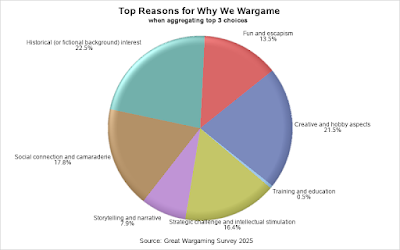
When aggregating the Top 3 choices, the distributions of these top choices are illustrated in Figure 1 by counts and in Figure 2 by percentage of total.
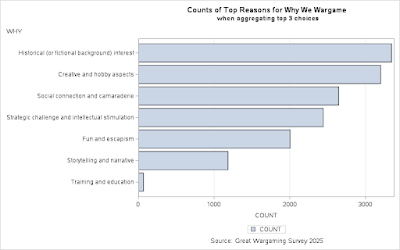
Figure 1
Figure 2
While these results show, in aggregate, how survey respondents selected their Top 3, can the survey offer up any additional insight into why these choices were selected?  What if a handful of respondent traits and preferences are added into the mix?  Will these additional inputs offer any interesting insights over a simple accounting in a popularity contest?

As seen in a number of previous analyses, we turn to multiple correspondence analysis (MCA) for answers to these questions.

Trait Selection
From a long list of survey questions and respondent attributes from which to choose, only a handful of variables or traits are included to keep the graphical analysis manageable.  After consideration, the following traits are included in the study. 

First up is the main thesis.  That is, Why We Wargame.  Since those responses are lengthy, some recoding is necessary in order to not overcrowd the resulting MCA plot.  The recoding is as follows:
  • Creative and hobby aspects - "Creativity"
  • Fun and escapism - "Fun"
  • Historical (or fictional background) interest - "Background"
  • Social connection and camaraderie - "Social"
  • Storytelling and narrative - "Storytelling"
  • Strategic challenge and intellectual stimulation - "Challenge"
  • Training and education - "Education"
The other traits (and responses) under consideration are:
Primary Interest with values of "Historical","Fantasy/Sci-Fi","Mixed".
Group Size with values of "0 (solo)","01-04","05-09","10-15","16+".
Game Venue with values of "At a game store","At home","At a club","Online".
Competitive Gamer with values of "Non-Competitive","Competitive".

MCA Plot
As a brief reminder, MCA graphs show patterns of association between categories (responses) of several categorical variables.  In this case, we examine the choices for Why We Wargame with the four traits of Primary Interest, Group Size, Game Venue, and Competitive Gamer.  Could other variables have been included?  Sure.  To keep the resulting plot readable, I limited the number of categorical variables to five.  The resulting MCA plot is shown in Figure 3. 
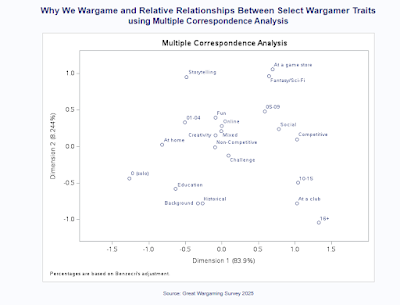
Figure 3
Figure 3 shows a readable spread of trait responses with just enough separation to see what is what graphically.  Does this plot provide a useful tool for interpreting these results and how to interpret this plot?  Let's give this plot a closer look.

Since Dimension 1 (horizontal, 83.9%) is the dominant contrast, points far right versus far left represent very different gaming contexts and preferences.  Dimension 2 (vertical, 8.24%) adds a weaker secondary contrast (top vs bottom) that refines, but does not overturn, the main story from Dimension 1.  To divine the main story, bifurcate the plot into a left (blue) and right (yellow) regions split down along the origin.  See Figure 4.
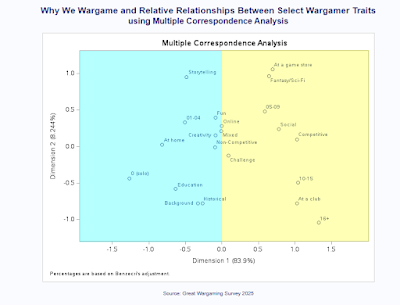
Figure 4
Ignoring the attributes clustering along the origin for now, in the blue region, the top choices for why we wargame include Background, Education, and Storytelling.  As Figure 4 shows, these choices are associated with gaming at home and either in small groups or solo.  This group tends to hold a primary interest in historical wargamin
g.

For the yellow highlighted side of the plot, the top reason for wargaming is the social aspect of the hobby.  Gamers on this side of the plot tend to focus on Fantasy/ Sci-Fi gaming in large groups at either game stores or clubs.  They tend toward competition as well. 

One interesting side effect of MCA is that results can lead to interpretable and meaningful labeling of the dimension.  For example, the classification of these categorical variables could suggest that the blue region denotes a reflective wargaming stance.  The yellow region could be labeled as having a sociable stance.  See Figure 5. 
Figure 5
Now, what about the attributes clustering along the origin?  Being close to the origin means these categories are relatively average or weakly discriminating.  These traits do not strongly define the main contrast between the blue and yellow regions.  Here, within the red rectangle, Fun, Creativity, and Challenge are common to both groups and styles of play.  Mixed, Non-Competitive, and Online traits are found in both groups as well.  See Figure 6.
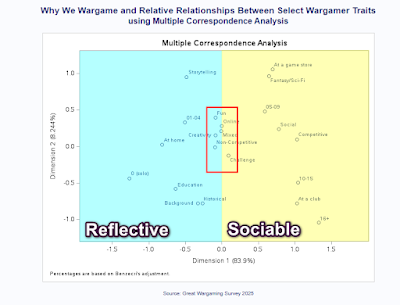
Figure 6
What can be said about the results of the MCA analysis?  This exercise suggests that the choices we make for why we wargame can be associated to some of the traits that attract us to the hobby.  Of course, correlation is a two-way street.  If you are a solo historical wargamer, there is a tendency that storytelling, education, and historical background will hold more importance to why you wargame when compared against the Sociable group on the other side of the plot.

Remember that these results suggest relative tendencies.  Do these tendencies hold true for you?

Monday, January 26, 2026

Why We Wargame

Another new question in Wargame, Soldiers, and Strategy's The Great Wargaming Survey (GWS), 2025 edition asked respondents to list the Top 3 reasons why they play a wargame.  The choices were:
  • Creative and hobby aspects
  • Fun and escapism
  • Historical (or fictional background) interest
  • Social connection and camaraderie
  • Storytelling and narrative
  • Strategic challenge and intellectual stimulation
  • Training and education

Having given this topic some thought over the years, getting hard data through the survey might offer worthwhile insight into this question as applied to a broader population.  While I hold a mental notion of my top reasons for wargaming, these top reasons can move around a bit over time, interest, and mood.  Others may have similar thoughts on what drives them to wargame too.  

What does the survey say?  Well, let's find out.

Top Choice in Why We Wargame
The survey asked respondents to rank up to their three top choices.  To begin the analysis, only the top choice is examined.  In counts of reasons why we wargame (variable "WHY" in Figure 1), "Historical (or fictional background) interest" came in at the top spot by about 500 responses.  The top choice was not close.  The results are aggregated by percentage in the pie chart illustrated in Figure 2.
Figure 1
Figure 2
As primarily an historical wargamer, the top choice makes sense to me.  The result that surprises me is that "Strategic challenge and intellectual stimulation" comes into the rankings ahead of "Social connection and camaraderie."  In the rankings, 
"Social connection and camaraderie" comes in at #4.  While I enjoy the challenge and puzzle-solving aspects that wargaming brings to the table, my anecdotal inclination would have been to see the social aspects of the hobby rise more toward the top.  Are many of the respondents primarily solo gamers or in it for the challenges of competition?  A question, perhaps, for another analysis.

Top Three Choices in Why We Wargame
Since the survey asked for the top three choices, do the rankings change much when all three response choices are aggregated?

Figure 3 shows that the top two spots in the rankings remain the same as in Figure 1.  "Creative and hobby aspects" reason closes the gap with "Historical (or fictional background) interest" making up a lot of ground and coming in at a very close second place in the rankings.  "Social connection and camaraderie" and "Strategic challenge and intellectual stimulation" swap places in the rankings when the top three choices are included.  
Figure 3
Figure 4
Interesting to see that "Fun and escapism" and "Storytelling and narrative" fall to near the bottom of the rankings.  Almost no one lists "Training and education" as a top choice.

Why do fun and storytelling sink to the bottom among the collection of reasons why we wargame?  These survey results suggest that we do not game simply for fun and narrative building!  Perhaps adding a "Competition" choice might be telling?

I plan to return to this question and analysis again for a deeper dive into these data.  In past analyses, preferences tend to shift and become more nuanced as other qualifying attributes are brought into the computations.  Adding stratifications by primary interest, age groupings, and a few other attributes might provide a clearer and, perhaps, another interesting perspective.

If you completed the 2025 GWS (or even if you did not!), what are your top reasons for wargaming and why?  Have these top reasons for wargaming changed over time?  I wonder if your choices and rankings could be predicted if other qualifying attributes mentioned above are brought into the equation?

Saturday, January 17, 2026

Year in Review: Figures Painted

I really did not set out a goal for the number of figures I wanted to get painted at the beginning of 2025.  What I did make as a recurring goal was to paint more figures than purchased.  Even without a goal on the number of figures painted, 879 figures crossed over from unpainted to painting in 2025.  Not bad.  On the painting more than I buy front, I still came out with a reduction in The Lead Pile of 481 figures.  Not as substantial as the 2024 result of -945 figures but respectable.  Had I not succumbed to some late year purchases, totals would have been more in line with 2024.  I plan to keep up the effort of reducing The Lead Pile in 2026.  Wish me luck.
Looking back through the Painting Log over the last 32 years, the last two years have shown a gradual decrease from the 1,000 figures or more painting output.  Still, a good variety of projects saw some activity to explore a bit later.  For figures painted, one foot, one gun, and one cavalry figure each count as one.  No increased counts for horse and rider.   
Let's examine the 2025 figure counts in more detail.

Monthly Totals
As the chart below shows, much of 2025 averaged a monthly output of about 60 figures.  Not helped out by the big drops in May and October.  As is typical of my seasonal painting output, production began to pick up as the year closed out.  January and September saw big spikes up in production.  As seen in the September/October bars, a big increase in one month is often followed by a drop in the next.  A big push in one month is likely followed by exhaustion, I suppose.  
Totals by Era and Scale
Switching from the monthly bar chart to a pie chart, the total effort given to the SYW project continued into 2025.  Nearly 30% (259) of all figures painted were in this period.  While the FPW project popped into second place in 2024, 2025 saw FPW take top honors with 288 figures painted.  Biblicals rounded out the top 3 with 119 figures painted.  After several games featuring the Reconquista project hitting the table in 2025, 49 additional figures were added into the collection as my motivation was high to push out just a few more units.  I managed to almost deplete The Lead Pile of these figures.  Well, not quite as successful as first thought.  I recently uncovered about a dozen packs of Artizan and Crusader figures for the Reconquista.
Translating actual figure counts to Painting Points, the 25/28mm projects see some gains in their capture of the overall percentages.  Good to see the Great Italian Wars project climb out of obscurity from the "Other" category.
When the counts are broken out by figure size (scale), it is no surprise that the emphasis on painting 15/18mm SYW and FPW figures pushed the weight to that figure size.  As in 2024, more than 60% of all production was in the 15/18mm figures sizes.  The chart below illustrates that nearly 64% of all figures painted fall into the 15/18mm classification.
When these actual figure counts are translated to Painting Points, 25/28mm figures shift the emphasis and effort to their side of the painting ledger.  Now, almost 57% of effort is concentrated into the 25/28mm projects.
In summary, 2025 was a solid year at the painting desk.  2025 saw a slight reduction in figures painted from 2024 but not much change, really, especially since 2025 saw more 25/28mm figures painted than in 2024.  What about goals for 2025?  Well, that is something to ponder another time.

Thursday, January 1, 2026

Year in Review: Games Played


The number of games played in 2025 nearly reached the 100-game mark.  Close but not quite.  Gaming in 2025 saw an increase to 97 games played compared to the 76 games played in 2024.  Why the increase in games played?  Well, Commands & Colors saw a huge increase in the number of games played and that in a F2F setting.  With the large number of Commands & Colors games, the mix between remote and F2F saw a significant shift too with F2F enjoying a resurgence in frequency.

I ended up hosting 40 out of the 97 games played.  This seems a lower proportion than years past, but that may not be true.  My impression is that I hosted fewer games, though.  As mentioned in last year's review, games remotely hosted by others dropped off in 2024.  Records show that I participated in 17 hosted remote games in 2025.  Without going back to confirm, that is likely an increase over 2024 totals. Remote games hosted by me totaled 23.  That is a pleasant and reasonable mix in hosting vs playing in remote games.  Nice having the workload spread around, isn't it? 

Let's get on with the games played review!  In a gaming retrospective, these 97 games were distributed over a variety of rules and periods.  I take a look at each area individually. 

Rules
2024 saw 14 different rulesets in use. The number of rulesets to hit the gaming table jumped to 17 different rulesets.  In the graphic below, note that ten of these rules are first time playing for me.  That is quite a lot of new rules to encounter.  The core rules that I use for remote games continue as in previous years with Basic Impetvs and Fields of Honor seeing repeated action.  Although seeing repeated action at the gaming table, these two rulesets witnessed a marked drop off in play throughout 2025.  Perhaps these rules will see more action in 2026?  As mentioned above, Commands & Colors (including CC Hoth) saw heavy rotation.  Sliding into second place is my Work in Progress WotR rules, Blood 'n Roses.  Expect to see more activity here in 2026 as more battles are brought to the table for testing.  The table below shows Counts of Games Played by Ruleset in 2025 for details.
Wargaming Period
What if these total games played are broken out by wargaming period?  What were the popular periods in 2025?
While the graphic above shows that 17 different periods saw action, Ancients was far and away the most popular period to see action on the table.  Star Wars (both in CC Hoth and Squad Hammer) and Wars of the Roses round out the Top 3 gaming periods.  Quite a diverse mix of periods.  Who could have predicted that Sci-Fi floats up to near the top of the chart in 2025?  Not me! 

Memorable Moments
2025 continued the trend of my hosted games refighting a particular historical battle multiple times.  Below is a listing of some of those memorable games.  I expect this trend to continue into 2026.  I wonder which battle will be first out of the gates in 2026?

Battle of Agnadello: Great Italian Wars - 2 games.
Battle of Solden Hill: Wars of the Roses - 3 games.
Battle of Mortimer's Cross: Wars of the Roses - 4 games.
Battle of Quistello: War of Polish Succession - 3 games.
Battle of Zallaqah: Spanish Reconquista - 4 games.
Adobe Wells: Western Gunfight - 4 games.
Of course, every game has memorable moments but with repeated playings, one gains a deeper understanding of the battle, its likely direction, crucial decision points, and possible outcomes.  I always learn a lot from these repeated outings with respect to rules, scenario design, and scenario development.  Thanks to all who played in one of these games.  I always enjoy your willingness to join into a game.

If you participated in any of these battles or simply read some of the battle reports, which game or games stand out to you?

The next time I return to the yearly review, I dive into the Painting Log and see what 2025 held.

Tuesday, December 2, 2025

How Did You Become Aware of the 2025 Survey?

For Wargames, Soldiers, and Strategy's Great Wargaming Survey (GWS) in 2024 and 2025, the drop-off in responses was significant.  When asked what have contributed to these results, I often hear that gamers did not see any promotion of GWS2025 and missed filling it in.  Now, there are likely other forces at play, but I was curious where gamers actually saw a GWS promotion.  To get some data on the topic, a question was added in 2025 to examine the reach of GWS promotions.

While the question allowed free text responses, a standard pick list was available too.  Now, a number of respondents opted for free text entry even when one of the standard choices was a suitable option.  To aggregate as many of the responses as possible, responses were parsed and recategorized into one of the existing standard responses.  One respondent even wrote in that "he saw it on Jon's blog!"  That person gets a Gold Star from me.  When all of the responses were recoded and tallied, the distribution of responses show that the top four media sources were:
  1. Wargaming website (17.1%)
  2. Facebook (15.9%)
  3. YouTube (12.3%)
  4. WSS (12.2%)
Almost 60% of respondents saw the survey promo in one of these top four sources.

Interesting distribution and, perhaps, a reasonable gauge on where gamers consume hobby information.  While many of these sources are somewhat foreign to me, clearly this is not the case for the larger survey population.  Given my lack of familiarity with some of these media sources, I decided to examine these media distributions by Age Group.  Could my age group offer insight and help explain why there are large, missing chunks in my media exposure?  It is not me, it’s my age.
What stands out from the graph above is that media source tends to be age driven.  It could be my age!  The younger age cohorts predominately rely on YouTube for finding survey promos.  As age increases, respondents tend to increasingly turn to Wargaming websites and WSS.  Probably no surprise here but, perhaps, something to consider for marketing.

What if these data are cross-tabulated by Primary Interest rather than by Age Group?  Will a different picture emerge? 
While not surprising that respondents having Historical (16.2%) and Mixed (12.3%) primary interests see promos in WSS, Fantasy/Sci-Fi (2.7%) barely produces a signal.  For the Fantasy/Sci-Fi group, Friends (9.1%) and Discord (15.4%) are outsized drivers compared to the Historical/Mixed groups.  Hmm.  Why do primarily non-historical gamers rely on word-of-mouth from friends more than the other two groups?

These results suggest that one must know and tap into each audience's preferred media to pinpoint the promo campaign that targets any particular audience.

Where did you see the promo?