 |
| Robert Redford & Natalie Wood were an intriguing screen couple: his cool and her warmth. |
Why
on earth did Paramount try to expand a 15-minute one-act play, This Property is Condemned, into a 1966 film?
Because it was Tennessee Williams, baby!
Williams
plays had been prolifically and profitably adapted into films for 15 years: The Glass Menagerie, A Streetcar Named Desire, The Rose Tattoo, Baby Doll, Cat on a Hot Tin
Roof, Suddenly, Last Summer, The Fugitive Kind (from Orpheus Descending), Summer and Smoke, Sweet Bird of Youth, as well as his novel The Roman Spring of Mrs. Stone, and his comedy Period of Adjustment.
That any studio thought they could conjure up a feature-length story from a wisp of writing from Tennessee Williams, the greatest playwright of his time, is typical Hollywood hubris. A dozen screenwriters took a whack at constructing this slight Property. As always, Tennessee Williams complained about the compromised results of his work—and yet Williams sold his plays' film rights away for huge paychecks. In Property’s case, he threatened to have his name removed from the credits. Funny, since 1968’s Boom was just around the corner!
 |
| This expanded Tennessee Williams one-act is not a classic, but doesn't deserve to be condemned. |
Despite
the disappointing results of 1965’s Inside
Daisy Clover, Natalie Wood and Robert Redford re-teamed for This Property is Condemned. Though
Redford felt the film was tailored as a Natalie Wood vehicle—why Robert found
this an issue is odd, as Natalie was a huge star then, and he wasn’t—Bob
accepted. He also got his buddy Sydney Pollack as director.
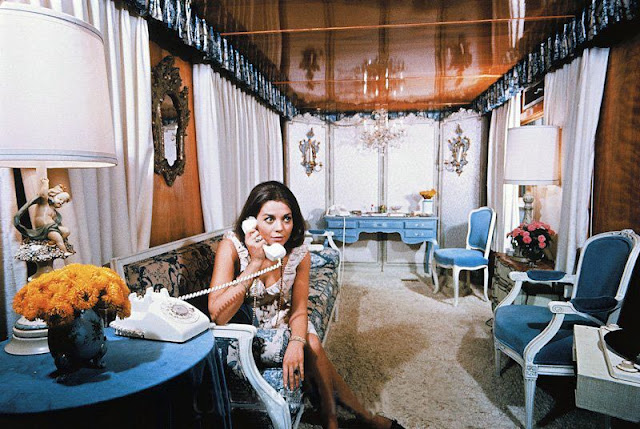 |
| Natalie Wood, at the height of her stardom, when she had a big say about her leading man & director. |
Here’s
the expanded story of This Property is
Condemned: Owen Legate (Redford) comes to a Depression-era small town in Mississippi
to lay off some railroad crew. He meets Alva Starr (Wood) and her kid sister,
Willie (Mary Badham), at their mother’s boarding house. Though taken by
fanciful, vivacious Alva, she is the total opposite of his buttoned-down,
pragmatic persona. While they spark and spar in a love-hate relationship, Mama
Starr schemes to set her daughter up with an older man from the railroad, so he
can provide for them. Aside from Owen, complicating things too is Mama’s young
beau, J.J. (Charles Bronson) who has the hots for Alva. When Owen hands out the
pinks slips and several railroad workers punch him out, as well as the time
clock, it’s quitin’ time. He invites Alma to join him in New Orleans. Mama
interferes and the couple fall out, with Owen leaving alone. Alva gets back at
Mama by upsetting her plans and eloping with J.J. The morning after, Alva goes
to New Orleans, hoping to find Owen. Their reunion does not end happily ever
after.
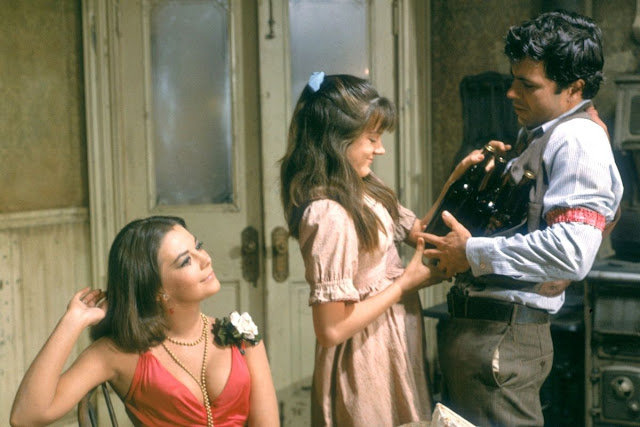 |
| Natalie Wood, like Alva Starr, was 'the main attraction' here. With Mary Badham as sister Willie, and Robert Blake. |
 |
| Alva just can't get sensible Owen to see things her fabulous way. |
This Property is Condemned
was released to poor reviews and even worse box office returns than Inside Daisy Clover. However, I find Property
far more watchable than Clover. The
greatest debit against this Property
is that it was produced literally in the last gasp of the Hollywood censorship
code, and is one of many movies made in the first half of the '60s that feels
like it still has one foot stuck in Hollywood’s house style of the '50s.
 |
| Still, who wouldn't mind gazing into her crystal ball, or those big beautiful brown eyes? |
Still,
why do some critics and online pundits still beat up on this movie, while there
are revisionists who drool all over same-era bombs like Marnie and Bunny Lake is
Missing? I think it’s mainly because those films feature past their prime
directing legends Hitchcock and Preminger, whereas Sydney Pollack merely became
a skilled studio director. Also, This Property
is Condemned is considered minor Tennessee Williams, though comparing an
intimate one-act to A Streetcar Named
Desire or Cat on a Hot Tin Roof
is apples and oranges. And Natalie Wood has never been a critics’ darling, then
or now. Natalie was far from a being a Bette Davis or Meryl Streep. Yet, compared
to wooden non-actress Tippi Hedren and wan starlet Carol Lynley, Wood was a
natural, engaging, intense, and charismatic performer.
Even
if a film doesn't ultimately work, I can still enjoy the aspects that do come
together or stand out. Walter Matthau once commented that even bad films
usually have something to recommend them, whether it’s a great performance, dialogue,
or even a costume. And while I feel this movie is as much of a hot mess as Alva
Starr herself, This Property is Condemned
is still highly watchable.
 |
| Robert Redford as Owen Legate: Understated or underwritten? |
The
acting in this Property is its
strongest selling point. Wood and Redford make a good team. Both were perfect
examples of mid-twentieth century attractiveness. Young Redford looks like a
compact version of Tab Hunter, a former Wood co-star; Natalie is a Keane
painting, come to life, the dark eyed pixie. Interestingly, it's been written
that both stars felt uncomfortable with the "movie star" side of
their images—and yet both fell back on it, over and over, throughout their
careers. Still, Wood's warm yet intense screen presence is a complementary
contrast to Redford's cool, detached demeanor. And their personas are in
exactly in sync with the characters.
What
to say about Robert Redford as Owen Legate? He’s not the typical Tennessee
Williams hero, all cool and reserved, but his character just feels
underwritten. Redford’s never been the most emotional actor, but his appraising
manner and reticence work here. It’s just a shame that what makes Legate tick
is never revealed. At times, Owen’s behavior toward Alva just seems cruel.
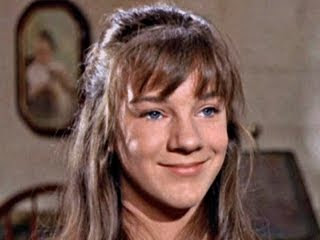 |
Mary Badham, beloved as Scout in 'Mockingbird,'
is great here as Alva's kid sister, Willie. |
Mary
Badham, famed forever as Scout from To
Kill a Mockingbird, gives another naturalistic performance as Alva’s
no-nonsense kid sister, Willie. Badham is the observer to the drama and
provides some comic relief, looking like a cross between Pippi Longstocking and
Delta Dawn. It also helps that the young actress was actually from the south.
Badham was in her teens here and looks a bit gawky in the way Peggy Ann Garner
did after A Tree Grows in Brooklyn.
Badham retired from acting in ’66 after Property and a William Castle horror
flick, Let’s Kill Uncle.
Kate
Reid as Mama Starr is one of Williams’ monstrous older women. Reid, with her
deceptively loveable face, is unrelenting in her survival plan for the poor
family. When the boarding house lady’s bawdy mask drops, look out! Her haranguing
of Natalie’s Alva is terrific and terrifying. John Harding gives solid support
as Mr. Johnson, the older man with an invalid wife, who wants to set Alva up.
Though he’s not exactly sympathetic, Harding plays him as a lonely man who is
taken by lively young Alva. Robert Blake has several sweet moments as Sidney,
one of Alva’s many admirers. Of course, Blake’s big breakthrough as an adult
performer came the next year, with In
Cold Blood.
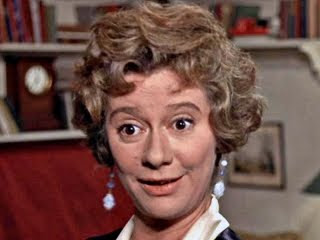 |
| Kate Reid is a killer Tennessee Williams mama! |
Cinematographer
James Wong Howe does some stellar work, along with Pollack’s penchant for
camera showmanship, which he really went to town on in the later They Shoot Horses, Don't They? The
authentic Mississippi and New Orleans location scenery and studious production
detail are a bit offset by huge, obvious sets, like the main floor of the
boarding house or the New Orleans street where Alva lives. Still, This Property is Condemned is one of the
few ‘60s movies that are reasonably authentic to another era.
 |
Natalie, as Alva, turns the tables on manipulative Mama, played by Kate Reid.
Wood was only 8 years younger than Reid! |
Natalie
Wood as Alva gives one of her best adult performances. It’s not her fault that
the character is a mash up of many Williams’ heroines. My only criticism is
that Wood strived for realism and authenticity, but too often falls back on
being movie star glamorous, with an endless array of tight-fitting frocks and
perfect ‘60s makeup. One example: When Alva does the walk of shame out of town
after drunkenly marrying Mama’s stud, Wood is beyond bedraggled. Yet, as she
gets off the train in New Orleans, with a cloud of smoke behind her, Natalie
looks radiant.
Still,
as a vehicle for the actress, Wood gets to shine in a number of set pieces: the
birthday cake scene, where Owen first sees flitting and flirting Alva,
literally glowing in candlelight; Alva’s boxcar tour for Owen, where the two
try to understand one another’s outlook on life; the scarecrow scene; after
Legate’s beat down, where Owen finally lets his guard down to Alva; the
argument where Mama guilt trips Alva into her plan by citing vicious comments
made by her late father; the final scene where Mama finds Alma in New Orleans;
and the best, the mother-daughter barroom showdown with drunken Alma.
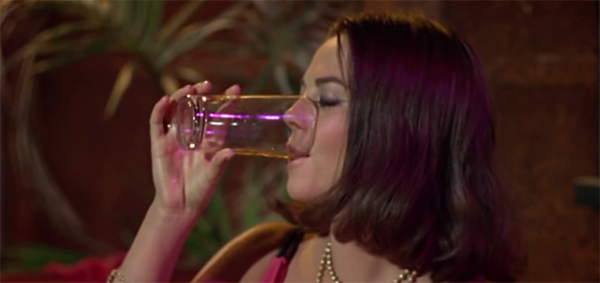 |
Gossip has grown over the years as to how much Natalie drank in this scene.
IMO, Wood is too on the ball here to be blotto. |
One
of my pet peeves is Hollywood "anecdotes" that become taken as
absolute truth in the Internet age. Here, in Property, it is said Natalie got drunk to do the big showdown scene
between her and Kate Reid. I don't doubt that perhaps Wood had a drink or two
to get in the mood of playing drunk, as she was at times a tensed up actress.
But you have to be pretty high functioning to play Tennessee Williams blitzed.
In this scene, a drunken Alva is toying with her aging admirer, goading her
mother, and taunting her mama's younger boyfriend. The scene is mostly on
Natalie’s shoulders, and it’s easily the best one in the movie.
 |
| Director Pollack with his stars, who enjoyed working together. |
About
Wood drinking for the scene, director Pollack told Natasha biographer Suzanne Finstad: "I don't necessarily
believe in tricks like that, but in this case, I thought it worked very well.
She had two glasses of wine and it just took the edge off."
But
a few years later, Pollack told Gavin Lambert for his 2004 Natalie Wood: A Life bio:
"We
started in the morning and it didn't feel quite right. Not enough charge. So I
decided to break early for lunch, and gave Natalie a glass of wine. She drank
it but said, 'You son of a bitch, are you telling me I can't play this scene
without getting drunk?' Then she laughed, and as the wine started to wear off,
she asked for more. She drank six glasses in all, played the scene
wonderfully—and threw up after finishing it."
And
this is how show biz “stories” grow—in this case, starting from the director.
Either way, the point here was that the wine was to relax Natalie, not serve as
a substitute for acting.
Another
myth is that This Property Is Condemned
was made to bolster Natalie's career after a long string of bombs. Not true.
While Natalie's adult career took off with West
Side Story, Gypsy, and her best
screen performance in Splendor in the
Grass, along with Love with the
Proper Stranger, her box office was fine for the first half of the ‘60s.
The problem was that while they were big money makers, 1964’s Sex and the Single Girl and ‘65’s The Great Race were fluff. And when
Natalie attempted to stretch with Redford in ‘65’s Inside Daisy Clover and This
Property is Condemned, this is when her box office first suffered. But it
is important to remember that, on a more modest scale, Natalie had a similar
career arc as Elizabeth Taylor. Wood was a popular child star who became a
substantial ingénue with Rebel without a
Cause and The Searchers. Solid
hits, if not classics, like Marjorie
Morningstar, Kings Go Forth, and Cash McCall followed. Natalie Wood grew
up in front of mid-century moviegoers. While troubled, she wasn’t a scattershot
star like Tuesday Weld or later, Patty Duke. Like Elizabeth, the show always
went on, and Natalie worked steadily.
 |
| Natalie Wood with one of her two Keane paintings. The other portrait was Nat as a child. This shot is haunting, I think. |
That
is, until after Property, when Wood’s
on-again, off-again lover, Warren Beatty, wanted to reunite with her as fellow
gangsters in Bonnie and Clyde. She
turned that and Barefoot in the Park
down, to work on her emotional well-being. The sabbatical was much needed. It's
been written that Natalie attempted suicide during the filming of Property. This actually happened after filming. Wood took an overdose of
pills after the Christmas holidays, apparently depressed and lonely, in early
1966. She had made her first suicide attempt after the filming of The Great Race near the end of ‘64. And
her most serious overdose came in the summer of '66, depressed about her
career, and most concerning, over being single and childless. Whether the
attempts were emotional cries for help, a couple of these were quite serious,
medically.
 |
Though Natalie and Elizabeth were two of the few stars to make the transition
to adult stardom, their lives weren't easy. |
From
Suzanne Finstad’s 2001 Natasha, an
interview with director Sydney Pollack included this apt observation about
Natalie: "There was a fragility in her, and the emotions were very close
to the surface: scratch her and get to an emotional color right away. There's
something breathless about her, and you feel it, and you feel a kind of
quivering just below the surface, a very appealing and vulnerable part of her.
She had it in person, too. I've only seen that color twice in actresses. In
her, and years ago, I sat at a dinner table with Elizabeth Taylor, and she had
the same thing."
Yet,
there was a major difference between Natalie Wood and Elizabeth Taylor. While
stars both were intense and vulnerable, Elizabeth was totally at ease on
screen, and not afraid to muss up her image. Wood wasn't as secure. Natalie's
performance mirrors the ‘50s and ‘60s dichotomy of This Property is Condemned itself. Wood never looked more luscious
or lovely onscreen—except that she was playing poor white trash. Compare her
work with Jane Fonda’s just three years later for Sydney Pollack in They Shoot Horses, Don’t They? Fonda’s
desperate Depression era starlet/hooker is gritty and grim, compared to
Natalie’s Alva.
 |
| Even 5 years prior, ET was too overripe to play Alva Starr in 'Property.' |
In
Property, the character ages are
skewed. While Natalie could pass for girlish, she's cutting it close here at
28, as Alva is 18, a bit like Elizabeth Taylor at 27 playing 20ish Catherine
Holly in her one-act Williams
expansion, Suddenly, Last Summer. (Actually, Elizabeth was first announced as
Alva, with Montgomery Clift as Owen Legate, and Richard Burton directing—a
decade earlier ET and Monty would
have been great.) Kate Reid, as the monster mama, was only eight years older
than Wood, but looking a bit blowsy, pulls it off. However, as Mama’s boy toy J.J.,
Charles Bronson at 45, a sinister stud in the Stanley Kowalski mold, already
looks weathered.
The
big problem of Property, other than
expanding a one-act, is that Hollywood censorship and studio self-censorship
wreak havoc with character motivations. Alva Starr's morality is constantly
teased, but as coy as the character herself, and is left ambiguous. Is Alva a
huge flirt in the Scarlett O’ Hara manner? Or is she a glorified whore, who
draws male clientele to her mother’s Depression era boarding house? Or is she
in denial, ala Blanche Dubois, while carrying on at the Tarantula Arms on the
down low? Redford’s character calls her a whore at several key points, Alva’s
monster mother throws in her face that she’s slept with every man in town.
Despite earlier indications this is true, Alva’s crushed by these accusations.
 |
| Owen is alternately enchanted and exasperated by Alva's tales. |
After
the climactic scene between Alva and Mrs. Starr, the movie runs out of steam.
According to Pollack, in the original script, after their
showdown, Alva still runs away. But instead of meeting up with Owen, she
becomes a prostitute in New Orleans, picking up men at the train station. In a
Williams-esque moment, when one travelling salesman compliments her, Alva asks,
"Did you say beautiful?" As he says it again, she responds, "My
name is Alva Starr. Starr with two R's."
Instead,
the movie reunites the couple, only to have vengeful Mama expose Alva’s prior actions.
Owen is angered again, and this sends Alva fleeing into the rainy night. The
film takes us back to Willie, back on the railroad tracks, to conclude the
tale, explaining that Alva died of a “lung affliction.”
However,
I’ve also read that the “Alva as prostitute” scene took place after she runs away from Mama and Owen, followed
by her Willie’s railroad epitaph. This makes more sense, or it would have been
a 90 minute movie otherwise. Dabney Coleman is listed on various sites as “The
Salesman.” In a recent interview, Coleman
commented that his pal Pollack got him the role, but it was cut—though he was
thrilled to play a scene with Natalie Wood.
 |
| Natalie Wood & Dabney Coleman, in a deleted scene, with Alva waiting for more than a train. |
This Property Is Condemned
was filmed and released at the same time as Who’s
Afraid of Virginia Woolf, but their directors’ takes are totally different.
With Woolf, director Mike Nichols fought
the Warner Brothers’ interfering and fears, and the result was a film that was
an artistic victory, broke the censorship codes, and was a smash hit. Property's studio and producer John
Houseman held sway over the production, smoothing away the rough edges. Sydney
Pollack was just as much a film novice as Mike Nichols, but pegged himself
early on as a skilled but obedient studio director. And so this Property suffered accordingly.
 |
| In another deleted scene, Wood with 40-something boy toy Charles Bronson. |
At
the time, Williams' once-daring work seemed dated compared to the realistic
style of the ‘60s and early ‘70s, making him passé. However, Tennessee
Williams’ work has passed on into classic status, especially after he died. Although
Natalie Wood is often first remembered for her mysterious death, I hope she will
also be remembered for her best work.
I am not a film fabulist, who insists there is
movie magic where there is actually none. But I do think that Natalie Wood was much
underrated as an actress, especially here, as Alva Starr. Like her friend Elizabeth
Taylor, Wood’s range wasn’t huge, but within her reach, Natalie was naturally
appealing and hauntingly memorable.
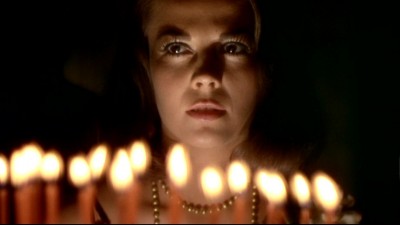 |
| The lovely moment where Redford's Owen sees Natalie's Alva Starr for the first time. |
FYI: I put all the movie overflow on my public FB movie
page.