 |
Miss Marple in "The Mirror Crack'd" turned out to be a sneak preview for
"Murder, She Wrote" and its star Angela Lansbury. |
The
1980 take on the thrice-told The Mirror
Crack’d looks better in retrospect than it did on release. While not in the
same league as the ’74 classic, Murder on
the Orient Express, this Mirror
is worth a look.
Judging
from reviews in recent years of The
Mirror Crack’d, the film’s reputation has improved, versus the poor initial
reception. When this Agatha Christie adaptation came out Christmas 1980, the
response was cool, after Orient Express.1978’s
Death on the Nile got a better response,
though disappointing, too. When Mirror
opened, without exotic locations or younger stars, Mirror’s English village and middle-aged cast seemed mild, at best.
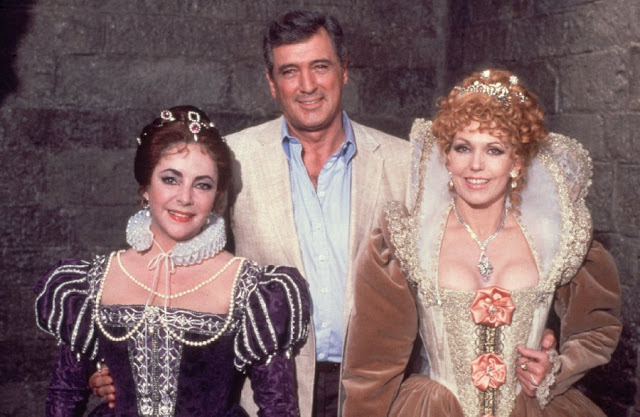 |
Elizabeth Taylor and Kim Novak are dueling divas Marina and Lola, with Rock Hudson
as the poor director! |
Some
Agatha Christie fans have criticized this take on Mirror as unfaithful to the novel, The Mirror Crack’d from Side to Side. Considering that the movie Mirror was conceived as a vehicle for
the superstar cast, the streamlined version does keep the core story. The time
frame is set back a decade—so what? And making Marina and Lola actress old enemies
instead of casual, catty acquaintances is a brilliant way of condensing the
story and heightening its tension. Even the two British TV remakes, more true
to the book, lifted a few things from this film.
The Mirror Crack’d investigates
several murders and further attempts that indicate someone is trying to kill
the leading lady of a movie production. Luckily, the film folk are in proximity
of ace amateur detective, Miss Marple!
 |
| Miss Marple, played by Angela Lansbury at 55, has the solution for every mystery. |
Mirror benefited
from lovely British locations and a stellar supporting cast that feel authentic
to another era. Ironically, it’s the ‘50s star quartet who literally looks a
bit generic. Taylor and Novak’s costumes, while flattering, don’t feel fab
fifties at all. Hudson looks like ‘70s Rock, and Tony Curtis wears his usual
bizarre suits that predate Prince’s one-of-a-kind duds. Novak sports her Lylah Clare wig and Elizabeth got Alexandre
of Paris to recycle her spiky Boom!
bouffant. The leading ladies wore their fave late ‘60s ‘dos, however, the film
is set in 1953.
 |
Kim, Rock, and ET in a candid shot promoting "The Mirror Crack'd."
Of the three, Rock looks best here, better than he did in the actual film! |
Before
the Internet and 24 hour news cycle, stars were not in our eyes 24/7. Post-Watergate
reporting style on public figures had taken hold, but technology hadn’t—yet!
So, back in 1980, it was one thing to see Elizabeth Taylor Warner as an
overweight political wife in the tabloids, but quite another to see “Liz”
looking “larger than life” on the big screen. Add dissipated Tony Curtis, distinctly
middle-aged Rock Hudson, and a still-curvaceous but slightly drag queen-esque
Kim Novak, all sharing the screen. For audiences, to watch their middle-aged
idols, playing ‘50s movie folk, then deemed depressing. As time went by, Elizabeth,
Rock, Kim, and Tony went from first viewed as falling stars, to a last chance
to watch such Hollywood greats together. As a bonus, add Angela Lansbury, who
soon became a beloved institution after Murder,
She Wrote.
 |
| It's showbiz folk versus village sleuths in "The Mirror Crack'd." |
The Mirror Crack’d
was filmed the summer of 1980. At 48, Elizabeth Taylor had trimmed down a bit
from her all-time high of 180-plus pounds as Senator Warner’s fried-chicken
lovin’ wife. By next spring, Taylor would be down over 40 pounds for her
Broadway debut in The Little Foxes. In
Mirror, I’d say ET’s about half way
there, and the extra weight shows more in her body than face.
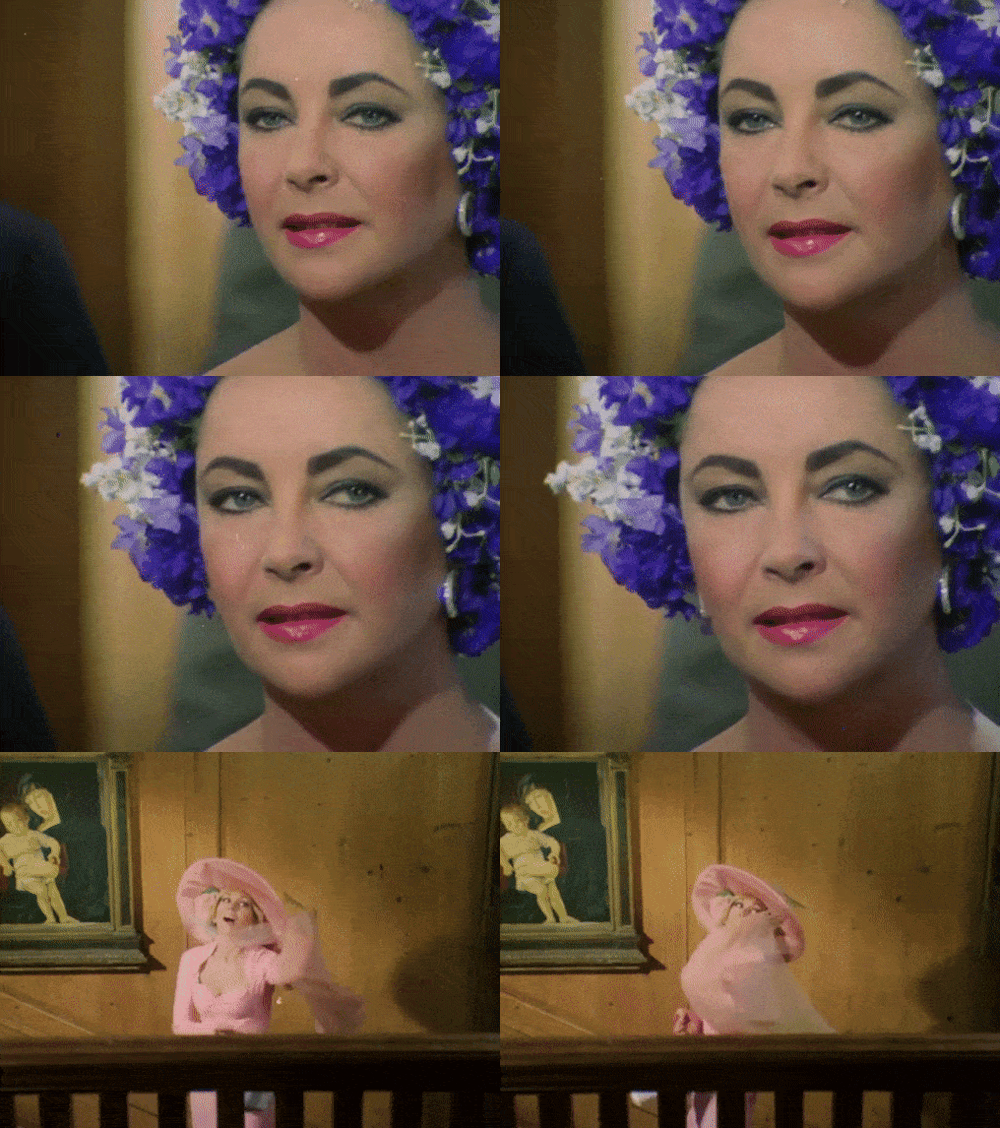 |
| They say film acting is all in the eyes. Well, ET knew how to wield those famous violet eyes! |
The
biggest departure from the Christie mystery was screenwriter Barry Sandler’s
tweaking the story to “mirror” the legendary ‘50s stars. In the book, Taylor’s
Marina Gregg was already a multi-married, middle-aged movie star making a
comeback. Marina’s newest marriage and pastoral home are supposed to offer the star stability. All this sure sounds like
Elizabeth Taylor Warner to me! What Sandler added was cracks about Marina’s
weight and her abuse of pills. Though Marina’s nerves call for constant doses
of “Calmo” in the novel, the film makes greater references to
Marina/Elizabeth’s prodigious pill use. Was this already common knowledge in
the business? I wonder, since Betty Ford was only three years away for ET.
Life
imitated art when, in the film, Taylor’s star is referred to as Marina Gregg,
but the credits list her as Marina Rudd, after the character’s latest husband,
Jason Rudd. Off screen, Elizabeth reportedly requested to be billed as
Elizabeth Taylor Warner, but was turned down by the studio. In retrospect, good
call!
 |
| The recycled humor of "The Mirror Crack'd" is hardly highbrow, but mildly amusing. |
Considering
Taylor’s latter day flair for bitchy comedy, Marina’s zingers are the least zesty
aspect of her performance. This is partly because screenwriter Sandler’s wit is
a bit wanting—it comes off like bitchy “ba-dum-tss” drag show patter. More than
a few stale show biz jokes get recycled here, such as Taylor gazing in the mirror,
wearily wishing: “Bags, bags, go away. Come right back on Doris Day.” The
camera cuts to a mild double take of frequent Day co-star Rock Hudson. Director
Guy Hamilton sets up the dramatic moments better than those with a comedic
tempo, which comes across as abrupt or intrusive.
 |
| Maureen Bennett as Heather Babcock, Marina Gregg's biggest fan! |
Still,
Marina Gregg is one of Elizabeth’s best latter day portrayals. I read an
interview with director Hamilton, who had great affection for Taylor, about the
making of Mirror. Guy said that
Elizabeth was indeed full-bodied, and though she was a good sport to spoof her
figure, he instructed the camera man to take time to photograph her still-beautiful
face for her big scenes. This wasn’t common practice once ‘70s realism came into
vogue, and striking the balance between cinema verite and star vanity was just
converging in the ‘80s. Taylor’s grand entrance, plus the extended scene where
Marina is transfixed by what the first murder victim-to-be shared, is visually most
generous toward Taylor. The violet flowered turban may be a bit much, but Taylor
sported such headgear in her heyday. Elizabeth’s face is framed flatteringly
here, and she knowingly raises her chin up when a local photographer requests a
snap of the star. When Taylor’s Marina has her startling epiphany, Elizabeth uses
those fabled eyes expertly.
 |
| Taylor's troubled star, Marina Gregg, has her big moment of revelation. |
Post-murder,
Inspector Craddock (Edward Fox) comes to interview Marina. This set piece
offers Elizabeth Taylor a mini acting marathon. The scene begins simply, but Taylor
gradually becomes hysterical. The movie fan inspector plays along for a bit, and
then exposes her ruse. Marina’s recycling a dramatic moment from one of her old
movies. Elizabeth’s Marina response is a raucous Taylor cackle. ET also just
spoofed her own “emotional” movie image. Marina seemingly comes clean, showing
the detective threats she’s received, which reminds her of a painful childhood
incident. Taylor plays this scene in her most open style.
 |
| "You didn't!" ET is terrific in this extended scene, twitting the Inspector for not falling for her "act." |
Kim
Novak has a comic field day as Lola Brewster, a no-talent hack and tough broad,
who is arch enemies with Taylor’s Marina. Novak, who made a career of being
breathy, hesitant, and vulnerable, is obviously enjoying herself as the
superficial Lola. It’s lucky for Joan Collins that Dynasty producers didn’t cast Kim as super bitch Alexis. It would
have made Blake Carrington look a bit like John Derek, with a harem of past and
present blonde wives, but Kim might have been quite marvelous! Anyway, Novak
preens, parries, and thrusts that still-fabulous body, while skewering everyone
in sight. First up is her reunion (next round) with Marina, with cracks about
each other’s age, hair, weight, and just about everything else. Kim gets to be
the comic to Taylor’s straight woman retorts. I love Kim’s line reading of this
catty question to ET: “So, tell me. How does it feel to be back, after being
gone for so-ooo long?”
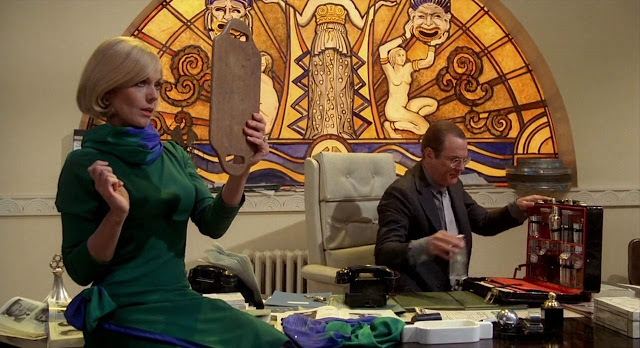 |
| As Lola, Kim Novak checks out her "Lylah Clare" wig, while Tony Curtis' producer makes them a drink. |
Kim’s
vamping and evading the detective’s questions is nearly upstaged by the
pushed-up Novak knockers! Kim is again quite funny, with her husky voice
pitched so low that you think she’s channeling The Legend of Lylah Clare. When the Inspector Craddock brings up an
unpleasant past incident, when she fired a gun at Marina, Kim’s delivery of
this line is a hoot: “So, I was a little miffed!” When Novak’s Lola isn’t
sparring with Taylor’s Marina, or toying with the detective, she blasts
Hudson’s director, that she could eat a can of Kodak and puke a better film!
Novak and her onscreen husband, Tony Curtis’ crass producer, are both amusing
caricatures. Kim’s deep voice and vamping, and Tony, dressed in black,
including a fedora, remind me of Natasha and Boris Badenov!
 |
| Whatever Lola Brewster wants, Lola gets! Tony Curtis goes gangsta as producer Marty Fenn! |
 |
| Tony's inspiration? |
 |
| Ruta Lee: A contender for Lola Brewster? |
Kim
Novak, 47 when Mirror was made, had
recently wowed Oscar audiences with a trimmer than ever figure in a black
sheath gown. It’s obvious from the candid shots that Kim hadn’t gone down the
plastic surgery road just yet. Guy Hamilton also plays to Kim’s strengths
favorably. With her favorite page boy wig, skin tight clothes, and stylized
makeup, Kim came away with the kudos for her appearance in this Mirror.
 |
| What's bothering Taylor's Marina more... Novak's Lola or that painting in the background? |
Rock
Hudson, usually a warm, sympathetic screen presence, plays a bit of a departure
here. As director Jason Rudd, Hudson’s character is challenged: directing an
emotionally fragile wife trying for a comeback; keeping a voracious
ex-girlfriend at arm’s length; tangling with crass producer; and keeping his
secretary close, but not too close. One thing that may complicate things—is
Jason the murderer? Hudson has a number of scenes where his character is
distant, very effectively making you wonder if he’s more than just an
unfaithful husband. As Jason Rudd, Rock has a number of scenes where he’s comically
yelling on the phone or the set. When we wonder what Rock’s up to in the quiet
scenes, that’s when Hudson is most effective.
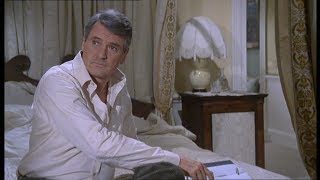 |
| Rock Hudson as Jason Rudd, director and long suffering husband of Taylor's Marina Gregg. |
Tony
Curtis is the natural comedian in The Mirror
Crack’d, as crass, fast-talking Marty Fenn. I’ve never cared much for
Curtis as a person, but admire his flair for comedy and strengths as a dramatic
actor. Tony seems to be enjoying his bad self here, taking pot shots at the
industry, and has a deflective one-liner for every occasion. Like Kim Novak,
Tony has the cartoonish comic role, and both perform as well as they can, given
the material.
 |
| Tony Curtis as slick producer Martin N. Fenn, whose middle initial stands for... Nothing! |
Angela
Lansbury makes a fine Miss Marple, but even she got nitpicked by some critics
at the time. There were complaints that Marple got sidelined by an ankle injury
was a story liability. Some considered Lansbury too young and that the old age
makeup was a stunt. I think Miss Marple is integrated into the mystery and Angela’s
makeup is realistic, as well. Lansbury’s scenes with Edward Fox, as her nephew
Inspector Craddock, show a nice rapport, in solving the mystery together. Angela’s
owlish features also lend itself to playing an older woman, and she shows a both
serious and humorous side as the brilliant armchair detective. You just
automatically believe Angela as Miss Marple, the grand matriarch of her village
and home. There were supposed to be more Miss Marple movies with Lansbury but Mirror’s demise ended that line of
thought. Still, it proved to be a great dry run for Angela Lansbury’s
mid-career comeback as Jessica Fletcher.
 |
| Angela Lansbury as Miss Jane Marple, who I thought was terrific, as usual. |
Geraldine
Chaplin is well-cast as the neurotic, mousy secretary, having a not-so-secret affair
with Marina’s husband. Chaplin gives snap to her many catty lines, most of them
aimed at divas Marina and Lola. She definitely has a way with a comic delivery,
never becoming tiresome. Geraldine also creates some sympathy for the
character, as Ella is clearly in love with Jason, and she’s obviously just a
shoulder for his ego to cry on. Again, amidst the campy humor, Geraldine Chaplin
creates a real character here in Ella Zielinsky.
 |
| Along with her crisp way with a catty one liner, Geraldine Chaplin is also touching as Ella. |
Edward
Fox, often the villain, is endearing as the occasionally clueless Inspector
Craddock. His flustered scenes with Novak’s brash Lola are funny, and Fox seems
to have great fun in his big scene with Taylor’s diva, Marina.
 |
| Edward Fox is fun as the inspector who is frequently outwitted by his Aunt Jane Marple! |
The Mirror Crack’d
boasts a supporting cast of character actors: Margaret Courtenay as Mrs.
Bantry, the pickle puss who’s given up her house to Marina and Jason; Charles
Lloyd-Pack as the vicar, Maureen Bennett in her film debut as Marina Gregg’s
biggest fan, Heather Babcock; Wendy Morgan as Miss Marple’s maid, Cherry; and plus
great cameos from the “cast” of Murder at
Midnight, the fun film-within-a-film. These actors and more bring some
atmospheric heft to this lightweight mystery.
And
how about Pierce Brosnan in his first role, as Marina’s Mary Queen of Scots
paramour, with big ‘80s hair! Pierce later said he lost 35 pounds after seeing
himself onscreen—five when he got a haircut?
 |
The second most embarrassing moment of Pierce Brosnan's career? In his first movie,
Pierce probably made Elizabeth Taylor jealous that his hair was bigger! |
Elizabeth
Taylor, Rock Hudson, Kim Novak, Tony Curtis, and Angela Lansbury were at a lull
in their careers when they made The
Mirror Crack’d in 1980 and what came after was significant for all.
Three
years after Mirror was released, Elizabeth
Taylor became the first celebrity to go public about going into the Betty Ford
Clinic, for severe drug and alcohol issues. Ironic, since Taylor had recently played
a movie star addict Marina in Mirror
and an alcoholic divorcee in ‘83’s Between
Friends. Elizabeth Taylor found much needed sobriety, went on to become an
AIDS activist, perfume mogul, and even tried one more marriage—and reclaimed
her great beauty until old age and illness finally set in. Elizabeth died at
age 79 in 2011.
 |
Elizabeth Taylor at Cannes, 7 years after "The Mirror Crack'd,"
in 1987, at the height of her Betty Ford renaissance. |
Rock
Hudson, looked distinguished in his middle age here, in spite of his years of
heavy drinking and smoking. In reality, Rock had only a few more years until he
was diagnosed with AIDS, the first film star to admit to the disease. Less than
five years after the release of Mirror,
Hudson was gone, but Rock put a famous face on the AIDS epidemic. Since 1985,
Hudson’s plight as an actor in the closeted era has been viewed with greater
empathy, as well.
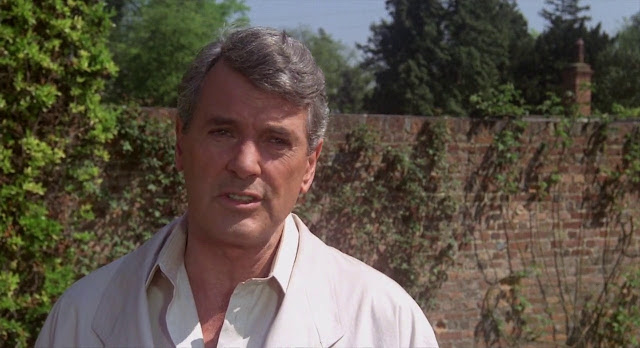 |
Rock Hudson's legacy runs the gamut of putting a famous face on AIDS, to classic comedies
with Doris Day, to films with Douglas Sirk, and "Giant," with BFF Elizabeth Taylor! |
Like
Elizabeth Taylor, Tony Curtis had yet to find sobriety, and looks much older in
Mirror than fellow former Universal
heartthrob Hudson. Curtis, Hudson, and Lansbury were all born in 1925, age 55
the year that Mirror was made. Tony eventually
did straighten up and fly right, got plastic surgery, and his thinning, dyed
black hair was replaced by a luxurious silver wig. Tony Curtis continued to work
and tell tall tales about his life in show biz until his death in 2010.
 |
| Tony Curtis in "The Mirror Crack'd." |
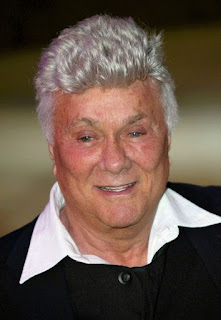 |
| Tony, sober and silver! |
At
the time of Mirror, Kim Novak was
considered a well-preserved, but lightweight star. A few years later, with the
restoration of Vertigo and its
ongoing revivals, Kim’s reputation as an actress was revitalized. As for Kim’s
later cosmetic enhancements, Novak looked great without looking overdone until
the last decade or so. It’s puzzling that Kim went this far, as she’s seldom
acted onscreen since she left Hollywood in the mid-1960s. Novak lives in
Washington, long happily married and a talented painter, too. Kim Novak has opened
up over the years about her issues and seems happy today, at 86 in 2019.
 |
Kim Novak was in great shape at the 1980 Oscars, in a gown by Ron Talsky,
who was dating Raquel Welch at the time... he knew his curves!
Nearly 40 years later, Kim is still renowned as a classic Hitchcock blonde. |
And
who would guess that character actress Angela Lansbury would be the star to
enjoy the greatest career renaissance. People talk, and rightly so, about Joan
Collins’ huge TV comeback as Alexis Carrington on Dynasty. But even more extraordinary was Lansbury’s megahit with Murder, She Wrote. Angie’s show
outlasted Dynasty by 3.5 seasons, 12 total
years, plus four Jessica Fletcher TV movies after the show ended. Lansbury also
had great control over the show, and her renewed stardom led to a slew of TV
movies, a memorable turn as Teapot in Beauty
and the Beast. When the series ended, she was an even bigger draw where she
had the most success, the stage. And Angela still acts at age 95!
 |
The financial failure of "The Mirror Crack'd" ended the idea of
more Miss Marple movies, but if only Angela Lansbury knew what lie ahead! |
So, if you’re in the mood for a light, comedic take on an Agatha Christie murder mystery, enjoy some great star gazing in The Mirror Crack’d.
 |
When Elizabeth Taylor was cast as a washed up actress, some unkind souls called it typecasting.
The next year, ET trimmed down and took on Broadway in 'The Little Foxes.'
And that was just the beginning of the last act of Elizabeth Taylor! |