Showing posts with label African Cinema. Show all posts

Tuesday, June 25, 2019

Bad Black (Uganda, 2016)


With Who Killed Captain Alex¸ Ugandan zero-budget auteur Isaac Nabwana, aka Nabwana I.G.G., proved his marketing acumen by allowing the film to be released for free on YouTube, paving the way for it to become a meme-producing internet phenomenon. With Bad Black, he further proves his savvy with the time tested practice of putting a white American actor at the forefront of his film. Given that white American is his charismatic co-producer Alan Hofmanis, that strategy has seemed to bear fruit, as evidenced by the heat the film has generated on the festival circuit.

Nabwana also exhibits a higher level of artistic ambition with the film, along with a developing social consciousness, given he positions it, to some extent, as a gritty portrait of life on the mean streets of Wakaliga, the Ugandan slum that plays home to Nabwana’s Ramon Studios. And the portrait of Wakaliga that Nabwana paints, while affectionate, is not a pretty one.

The film starts with Swaaz, a young father, and his son committing a violent bank robbery in order to pay the hospital bills of his wife, whose life is threatened by a compromised birth. After a car chase involving many delightfully naïve miniature effect, Swaaz is killed by the police in a video-game like CG explosion. Back at the hospital, Swaaz’s wife, when informed of his death, seemingly drops dead herself.


This leaves their infant daughter Sarah an orphan. She is turned over to an older woman, whose husband, several years later, casts Sarah out onto the street. The couple already has mouths to feed and, Sarah, not being their biological child, seems like an unnecessary expense to him. Thus little Sarah walks the darkened streets of Wakaliga, where, within minutes, she is kidnapped by a Fagin-like street boss who forces her to be part of his gang of child criminals. Adjusting awkwardly to this life, she is frequently abused by the boss and is even, at one point, shot by him. It’s a pretty grim episode that is only lightened by things like one of the kids wearing a bootleg Rugrats tee-shirt, which is probably a pretty accurate representation of what a street kid in Wakaliga would wear. I could almost hear M.I.A.’s “Paper Planes” welling up on the soundtrack.

Skip forward a decade or so and Sarah, now played by Nalwanga Gloria, has become Bad Black, a philanthropic gangster who shares the spoils of her wrongdoing with the city’s poor while exacting vengeance against those who made her childhood miserable. At the same time we meet Dr. Ssali (Hoffmanis), a kindly American doctor who provides free medical care to the impoverished children of the village. The product of a military family, Ssali wears the dog tags of his father, mother and brother around his neck at all times. When these are stolen by members of Bad Black’s gang, he confides the loss to his assistant, a little kid named Wesley Snipes (really). Hilariously, the kid reacts by punching Ssali in the face and telling him to stop being such a pussy. Someone from a family of commandos would not take such an offense lying down, the child admonishes him.


This launches us into the best training montage ever, as this kid constantly punches and beats the mild mannered doctor with a stick while running him through a series of calisthenics and fight maneuvers that will ultimately turn him into a badass, kung fu fighting engine of vengeance, which it of course does. Then follows an absurd sequence in which Ssali, now armed with a huge machine gun (crafted from scrap metal by the Ramon props department), goes on a violent rampage through the city in search of his stolen dog tags. This eventually brings him face-to-face with the none-too-amused Bad Black.

Bad Black owes an obvious debt to the female-fronted American Blaxploitation films of the 70s, such as Coffee and Foxy Brown. As influences goes, you could do a lot worse. But what Bad Black has that those films don’t is the presence of freeform narrator VJ Emmie, who, as he did in Captain Alex, peppers the soundtrack with his energetic yammerings. These range from heroic exhortations (“You are a commando!”) to subtle observations (“What an asshole!”) to lamenting the conditions in Wakaliga (“Poo poo everywhere!”) to rye commentary (‘This doctor needs borders!”) to Tourettes-like single word exclamations (“Subaru!” “Movie!”) This time Emmie debuts something new in his bag of tricks by loudly proclaiming a long expository scene “boring” and fast forwarding the film to the next action scene. I have to admit that, being forewarned of Emmie’s presence in the film, I found him far less jarring than I did while watching Captain Alex and even laughed at a lot of his lines. This is also because I appreciate his role in making Nabwana’s films less prone to mockery by showing that the filmmakers themselves don’t take what they present all that seriously.


During the chaotic final battle scene, VJ Emmie contents himself with simply shouting the names of various Hollywood action stars as the Ugandan characters appear on screen; “Schwarzenegger!” “Stallone! “Van Damme!” Of course, this is a symptom of the unabashed movie fandom that makes these movies so fun to watch. But when, in the battle’s aftermath, Hoffmanis delivered the kiss-off line “Don’t fuck with Americans”, it made me wonder what a Wakaliwood that was not so self-consciously in Hollywood’s shadow might look like. Even the name Wakaliwood begs the comparison.

Not that that is all bad, mind you. In Bad Black’s accompanying materials, Hoffmanis states that the film had a budget of sixty-five dollars, while acknowledging that Captain Alex, rather than the reported two hundred dollars, had a budget closer to eighty dollars. That these films can delight as much as they do is more impressive for the fact that they do so free of Hollywood’s reflexive irony and cynicism. Clearly Nabwana and his crew make movies because movies are fun, inspiring, and often empowering. I imagine those simple facts are hard to see on the opposite end of a two hundred million dollar budget.

Sunday, August 21, 2016

Just 3 Days, Part II (Ghana, 2015)


Is it ironic that it took me four days to watch Just 3 Days? The problem wasn’t just that the film in total is over two and a half hours long. It’s more that, once I got through Part I and started in on Part II, the film became so abundant with craziness that I was making screen captures at a rate of two a minute. Seriously, if you are someone who comes to a movie like this for the crude special effects, outrageous violence, CG blood spatter, and abundant backyard kung fu fights, Ugandan action auteur Ninja has done you the favor of back loading all of that into Just 3 Days’ manic second installment. Of course, that is not to say that the first half, with its unique blend of Christian evangelism and kick-boxing, is not worth an at least cursory look.

Part II begins right where Part I left off, with the trio of kick-boxer Desmond (Akwasi I. Kwarteng), his sister Sophia (Priscilla A. Annabel--who is also credited with Make-up and “Welfare”), and off-and-on best friend Lucas (Osei Owusu) escaping from the Underworld with a magical golden box that they believe will lift the bad luck that has befallen them due to the ill-fated marriage of Desmond’s miniature brother, Dominic (Jospeh Osei) to the allegedly cursed Annah (Elizabeth Arthur.) [Pauses for breath.] Never mind that this magic golden box answers more accurately to the description “yellow plastic box.” What matters is that its theft has roused two of the box’s guardian spirits, who take off in pursuit of Desmond and his partners.

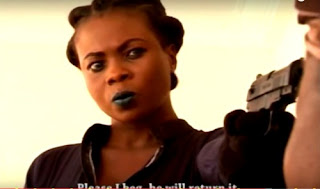
The first of these spirits is Iron Eagle (Akwasi Kwarteng), a primitive computer animation of a giant robot eagle who, upon entering the mortal world, transforms into an imposing and brooding human figure in Ray-bans and a hooded black nylon cape. The other is Tanya (Mabel Amitoh), a flaming statue who likewise transforms into a fiery eyed vixen who, in a nice Max Headroom-like touch, has cornrows the size of actual corn rows. Tanya’s attire is limited to a black sports bra and biker shorts. If you have ever wondered if there was a mall in Hell, and, specifically, if it had a Sports Chalet, Iron Eagle and Tanya’s combined attire should answer your question.

Immediately upon her arrival, Tanya hooks up with two prostitutes who, inspired to pity by her meager coverings, offer to take her in. Meanwhile, Iron Eagle wastes no time in tracking Desmond down and offering him an ultimatum: return the gold box within just 3 days or die horribly along with all of his loved ones. And, yes, you are correct in noting that Ninja has waited until well into his film’s second installment to provide a context for its title.


Just 3 Days being the film that it is, Desmond takes this news home to Sophia and Lucas, after which the three of them engage in a shouty debate over what they should do. Meanwhile, the unsubtly named Pastor Christian (Iddrisu Mohammed Abdallah), a character whose every entrance is marked by the sudden appearance of Christian soft rock on the soundtrack, pays a visit to Dominic and his mother, Madam K (Rose Mensah). Christian has somehow learned of the theft of the box and beseeches Dominic and Madame K to solve their problem through prayer rather than black magic. Thus does this scene set in motion the see-saw that will characterize Just 3 Days concluding half, with sequences in which people’s heads are impaled with katanas alternating with—and being given equal weight as—those in which characters carry on sincere sounding debates about faith.

Such is the dichotomy of Ghanaian cinema, whose country of origin boasts a powerful Christian majority—most of whom, like many other people in the world, nonetheless want to see movies in which shit blows up and people get gorily mowed down with machine guns. Given this, it is legitimate to wonder whether Ninja—whose credits for Just 3 Days include Executive Producer, Writer, Director, Editor and Special Effects director—has a sincere commitment to such issues of faith, or whether presenting them is simply part of the dance he must perform in order for his films to be commercially successfully. It’s conceivable that, like Uganda’s Isaac Nabwana, he’d prefer to skip the religion altogether and just get to the explosions.


If that’s the case, the judiciousness with which Ninja weaves this moral debate into the film’s action is all the more commendable. Unlike the Nigerian film 666 (Beware The End is at Hand), whose surfeit of prosthelytizing made it leaden despite its preponderance of digitally rendered insanity, Just 3 Days trots along at an energetic pace despite it. It also has to be said that what scenes there are of people sitting on their front porches and arguing while fanning themselves accomplish, as they do in 2016, the mean feat of infusing this tale of murderous hell robots with the homely rhythms of everyday life. It is hot in Ghana, after all, so is it not conceivable that its people, made testy by the heat, might wile away the hours by lazily bickering with one another over Mirinda sodas?

Back in the story of Just 3 Days, Desmond, Dominic, and Sophia’s numerous expendable and as-yet-unnamed siblings find the rhythms of everyday life becoming an ever-diminishing commodity as they are killed one by one by Iron Eagle and Tanya. In response, Madam K, a former soldier, goes commando, confronting Tanya in full combat gear—only to beat a hasty retreat when Tanya’s head turns into a flaming death's head before her eyes (not unlike Fantomah.) Later, Tanya further proves that she is a formidable foe, murdering someone simply by spitting magic into her cell phone.


Finally, Desmond and Lucas go to an apparently very well connected kick-boxing promoter named Owen (Emmanuel Afriyie) for help. He presents them with a pair of magic candles, which he will give them on the condition that Desmond waves his payment for an upcoming, high-profile fight. These candles, once the proper incantations have been intoned, provide the men an audience with an underworld being known as the Wise Man. This creature promises to give them a pair of bracelets that will render them invincible if they will provide him with two human hearts—women’s hearts, to be exact. Desmond and Lucas agree to this without hesitation. This is followed by a well-executed sequence in which shots of Desmond’s match alternate with shots of Lucas stalking and killing two women on a deserted country road.

And it is here that Just 3 Days put us on harsh notice that the men we have been positioned to see as its protagonists may not be worthy of it—and that a conclusion in which good triumphs over evil may not look the way we earlier might have assumed it would. What we can be certain of, however, is that that conclusion will only come on the tail end of a lot of kick boxing.


Within the context of African action cinema, Just 3 Days strikes me as an ambitious film—and an indication that Ninja, in his own excitable way, is trying to drag that cinema into the 21st Century. For one thing, its melding of genres—sports drama, horror film, family melodrama, religious parable—seems deliberate and self conscious, rather than the usual reckless hodgepodge of commercial elements. Also, it juggles audience expectations with an unexpected—and almost malicious—deftness. Both of these are indications of a growing confidence on the part of the filmmaker, and bode well for the future of his industry. While so many of the national cinemas covered in this blog have seen their heydays come and go, Africa’s is still an electrifying work in progress whose best days are yet to come.

Monday, August 15, 2016

Just 3 Days, Part I (Ghana, 2015)


When we last checked in on Ghana’s Ninja Productions, they were providing us with as much spectacle as a single digit special effects budget could provide in 2011’s presciently named 2016, a film about a small Ghanaian town invaded by baby-punting ColecoVision aliens. 2015’s Just 3 Days tells a somewhat more complicated tale, involving kick-boxing, family secrets, and an ill-advised journey into Hell.

Ninja stock player Rose Mensah stars as Serwaah, the mother of kick-boxer Desmond and his brother Dominic, a sweet natured soul who is also, among many other things, a little person. Dominic is played by another Ninja standby, Joseph “Wayoosi” Osei. Due to Osei’s uniquely child-like appearance, it’s often difficult to tell whether he is meant to be playing an adult or an especially precocious (and often evil) kid. In this case, specific reference is made to his condition, which gives the actor a rare opportunity to portray a character that is presented in a sympathetic light. Osei truly steps up to the task, delivering what I have to say is an accomplished performance. A scene in which Serwaah details the hardships of raising and caring for Dominic as he sobs quietly in the background is especially affecting.


Anyway, it seems that Serwaah and her family have been plagued by a prolonged streak of bad luck, which seems to have coincided with Dominic’s marriage to Anna, the sister of Desmond’s best friend, Lucas. They assume that Anna must be under some kind of curse, as one well might. Desmond confides this to Lucas, who, despite being sworn to secrecy, immediately runs and tells his mother, forcing her to come clean with him and his siblings. They are indeed cursed, she tells them, and it is the result of one of their ancestors entering into a “bad covenant”, one in which he or she chose to exchange happiness in love for long life. As a result, the members of their family live to a very advanced age, but always, upon finding true love, suffer the death of that loved one very shortly afterward. Their women are also sterile and those children that are born, like Lucas and Anna, are kind of dumb—and, as a result, unable to go to college and get a good job (something that Just 3 Days repeatedly stresses the importance of.)

Desmond’s sister, Sophia, another dummy, somehow overhears this conversation among Lucas’ family and rushes home to tell her mother. And if at this point you’ve guessed that Just 3 Days is set in the same town as the other Ninja movies I’ve reviewed--i.e. a sun-blasted hell hole of malicious gossip and neighbor-on-neighbor back stabbing (and which I have to assume is somewhere in, or on the outskirts of, Kumasi)—, you deserve to give yourself the most sparkly sticker in the box. Almost every plot development in this movie is driven by someone nosing around in someone else’s business and then summarily ratting them out, and, in this case, it leads to Serwaah making a startling revelation to her kids.


She tells them how, on a recent trip to Israel, she met a “strange woman” who, upon hearing of her predicament, presented her with three magical items--which comes as a harsh blow to those of us who went to Israel and came back with only a souvenir dreidel. Serwaah presents these items to her children, an event whose solemnity is undermined somewhat by those items being wrapped in a used FedEx envelope like those supplies you stole from the office last week. They are revealed to be a book, a map, and a key. These, Serwaah tells them, will open a gateway to the “underworld” and lead them to a golden box that, when opened, will free them of their curse.

This revelation sets off all of the shouting and quarreling that fills in the non-action parts of so many Ghanaian action movies. One might think it was a country in which no argument was settled in a calm and reasoned manner. It’s all people sitting on their front porches and dabbing the sweat from their brow as they thunder away irritably at one another. (No soda consumption was observed, however.) At least in the case of Just 3 Days these squabbles were subtitled, so I knew what was being discussed. And what was being discussed was not just strategy, but faith. Serwaah, for instance, wants her children to use those magic items to spelunk into Hades and fetch the golden box. Sweet natured Dominic, on the other hand, feels that they should instead seek release from their curse through prayer. Serwaah scoffs at this notion—which is an odd position to take for someone who believes in a literal hell that you can actually visit.


Anyway, because of their town’s aforementioned shittiness, news of the magic key and its companions quickly makes its way back to Lucas and his family. Lucas wastes little time in attempting to steal them in a violent home invasion robbery. When Desmond and his family respond with kick-boxing and bullets, Lucas’ brother Austine swallows the key, only to have it magically extrude itself from his throat when he takes a shot to the head. Desmond and Sophia then recruit a repentant Lucas to take the journey to the underworld with them.

The Underworld, as you might guess, looks like a video game environment, with a lot of looped screaming on the soundtrack to give it that "dude, we are so totally in hell" ambience. The trio makes quick work of capturing the golden box, only to rouse Iron Eagle, the box’s guardian. This Iron Eagle, mind you, should not be confused with the movie starring Louis Gossett Jr.—unless that movie featured a fierce-looking, man-sized robot hawk.


And it is here that Just 3 Days, Part I ends—as it, like all of Ninja Productions’ films, has been transformed into companion films by a simple click of the editor’s blade. While this is a cagey way of getting people to pay twice for the same film, it also alleviates some of the problems common to sequels, like all of the actors looking obviously older than they did in the first film. Also, it’s unlikely that anyone has ever credibly claimed that their childhood memory of Just 3 Days, Part I was “raped” by Just 3 Days, Part II.

Although I am going to emulate the makers of Just 3 Days and take a powder between reviews, I wanted to say that, at this point, I’m enjoying the movie quite a bit. It seems like an improvement on the earlier Ninja Films, both in terms of having a more cinematic look and uniformly good performances. Which is not to say that it doesn’t have its flaws; some clumsy scene transitions among them, as well as a series of noisome in-film plugs that, while refreshingly honest, make Hollywood’s approach to product placement seem subtle by comparison.


In any case, I enjoyed Just 3 Days, Part I enough that I am now looking forward to seeing what Just 3 Days, Part II holds in store. Let’s hope that it doesn’t disappoint me. (You wouldn’t like me when I’m disappointed.)

Tuesday, September 29, 2015

2016 Part 2 (Ghana, 2011)


I approached 2016 Part 2 with a lot of excitement. Really. That’s because all of the highlights from the mind blowing 2016 trailer were in Part 1, which meant that Part 2 was mostly uncharted territory. I mean, I won’t go so far as to say that 2016 Part 2 was cloaked in mystery, but it at least had a light cardigan of mystery draped casually over its shoulders. Who could imagine what it might contain?

In my review of Part 1, I related to you that that film ended with our hero, Mr. Oppong, receiving some kind of ultimatum from the aliens. That, it turns out, was wrong. It was an assumption on my part, based on untranslated dialog—and, as we all know, “assume” makes an “ass” out of someone named “Ume”. What was actually happening is that Mr. Oppong was eavesdropping on the aliens without their knowledge and just happened to hear their next plan of attack. BTW, I am here and only here going to entertain the conceit that 2016 Part 2 is a separate film from Part 1 by saying that Ebenezer Donkor here returns as Mr. Oppong, even though it is clearly one movie that has been arbitrarily cut in half in order to sell more VCDs.


Soon we are gifted with another dispatch from Ghana’s least invested TV news anchor, who distractedly gives us the English version of the Aliens’ master plan. It seems that the aliens have somehow managed to turn the cell phones of everyone in Ghana into bombs. “By tomorrow at 12:00,” she tells us, “every phone is going to explode.” Then, in strict adherence to the journalistic code, she advises her audience to “pass this message on”. She further advises them to turn their cell phones off, ensuring that every person over 60 who never turns their cell phone on will mistakenly turn it on and be blown to smithereens as a result.

Sincerely, though, you’d think that such a simple plan of action might be easy enough to follow through on, but in 2016 Part 2 it only gives the characters further reason to bicker at each other while consuming endless bottles of soda. These people clearly didn’t get the same memo about Ghana being “the most peaceful land on Earth” that the aliens did, as they are seemingly incapable of communicating other than with balled fists and bared teeth. Only the character played by little person actor Joseph "Wayoosi" Osei shows any industry, attempting to hack into his phone and disarm it. Even Oppong’s teenage daughter, Cara (Prescilla Anabel, who is also credited with doing the film’s makeup and something called “Welfare”) can only carry this news so far down the road before stopping to have a screaming match with somebody.


All of this takes up most of the film’s first twenty minutes, during which we see very little of the aliens. In fact, 2016 Part 2 is very stingy with its aliens throughout, only pausing occasionally for one of them to stroll rigidly into frame to chuck a horribly rendered CG motorcycle at someone or decapitate them with an also horribly rendered boomerang. In most cases, their presence is only indicated by shots of people running away while looking fearfully over their shoulder at nothing. It is hard for me to believe that the effects sequences in this movie would be so costly that cutting back on them would be a budgetary decision, but that might just be my First World privilege talking.

Likewise, 2016 Part 2 does little to add upon the creative carnage of its predecessor, but for one thing: Apparently the aliens have taken the time between parts 1 and 2 to learn kung fu. This means that, if you felt the films in the Alien and Predator franchises were lacking for not having scenes of their titular creatures delivering flying kicks to the faces of unsuspecting humans, you will now feel that a grave injustice has been righted.


Anyway, now that the aliens have truly revealed themselves as typical low budget action film villains, the solution to the problem they present is obvious. All that’s needed is the creation of a Terminator-like cyborg to fight them, a task that Mr. Oppong completes in record time. This stoic killing machine (Ntul Andrew, in a role in every way identical to the one he played in B 14) is then set loose to casually stroll along the same quiet suburban streets that all of 2016’s action takes place in and dismember any alien he comes across.

There then follows more bickering, lots of it, and mostly between women, which gives this portion of the film the feeling of a Bravo reality show sponsored by Orange Crush. There is also a prayer circle with people speaking in tongues. Finally, in a scene lasting literally less than 10 seconds, the cyborg leaps into space and somehow blows up the alien mother ship, which prompts the statement/question: “So wait… You mean you could’ve done that all along?”


Because I loved both 2016 Part 1 and B 14, I really wanted to at least like 2016 Part 2, but, sadly, the film’s ceaseless Housewives of Kumasi style caterwauling—minus the mitigation of people angrily spraying soda pop on one another--erased every last scrap of charity in my heart. You’d think that filming a movie in one go and then cutting it in half would be an ideal way to avoid the dreaded sequel slump, but, perhaps honoring tradition, 2016 Part 2 beats the odds and delivers the very type of bitter disappointment that we have long ago become accustomed to. Given that, my only advice is to ignore its existence completely.

As a public service to those of you who plan to download 2016 Part 1, and would like to walk away from it with a sense of closure, I suggest you append to it the following title card, which I offer free of charge:

(Spoiler)