Showing posts with label Kung Fu Cinema. Show all posts

Tuesday, July 8, 2014

Tonight! The 4DK Monthly Movie Shout Down zeroes in on ZODIAC FIGHTERS!

The debut of distinguished fightress Polly Shang Kwan as a subject of the 4DK Monthly Movie Shout Down is as auspicious as Santo's was back in May. And tonight is the night! The stars are favorable, the planets are aligned, and all signs point to ZODIAC FIGHTERS, a full version of which is linked below (be sure to forward through any pesky ads at the beginning).


All you need to do is log on to Twitter tonight -- that's Tuesday, July 8th -- at 6pm PDT, fire up the movie and, using the hashtag #4DKMSD, join in what will no doubt be a pretty freewheeling conversation. I'll be looking forward to hearing from you!

Tuesday, March 4, 2014

The 4DK Monthly Movie Shout Down is coming!


The time is next Tuesday, March 11, at 6pm PST. The film is FURY OF THE SILVER FOX, a wildly entertaining example of What-the-Fu directed by and starring the inimitable Pearl Chang Ling. When the time comes, I'm hoping all of you will log on to Twitter and -- using the YouTube link provided on this blog and the hashtag #4DKMSD -- join in the conversation as we all watch and comment along to this twisted masterpiece together.

For more information on the film and its director/star, you can either read my review and/or check out the deluxe, two part episode of the Infernal Brains podcast in which Tars Tarkas, special guest Durian Dave of the Soft Film blog, and myself provide a detailed overview of Pearl Chang Ling's career (Part I, Part II).


The effort might serve you well, as I will be tossing out Pearl related trivia questions throughout the movie. Those quickest to tweet an answer will receive a custom picked DVD pack from my bountiful white elephant pile (to be henceforth referred to as the 4DK Classics Collection™). Say, would that be a partially loved copy of 1980's FOXES starring Jody Foster and the Runaways' Cherie Currie? You bet your diseased spleen it is! AND IT CAN BE YOURS!

Visit the official 4DK Monthly Movie Shout Down website for more information, as well as to see a schedule of all the amazing movies that we're going to be tweeting along to over the course of the year. You'll be glad you did.

I look forward to joining you all next Tuesday. Let's send this thing off right!

Monday, July 30, 2012

The Infernal Brains Podcast, Episode 13


It's been three weeks since we posted the first half of our discussion of Pearl Cheung Ling. In the interim you've had to distract yourselves with trifles like The Dark Knight Rises and the Olympics. But now the wait is over. This time around, Tars Tarkas, special guest Durian Dave and myself get into the specifics of Pearl's films, with an emphasis on such self-directed efforts as Wolf Devil Woman and Matching Escort. As per usual, you can either download the podcast here or watch it with a workplace approved slideshow below.

Monday, July 23, 2012

Chinatown Capers (Hong Kong, 1974)


Chinatown Capers is the sequel to the 1973 Polly Shang Kwan action comedy Back Alley Princess. In that one, Polly played the feisty street urchin “Chili Boy”, whose true gender was the worst kept secret in all of martial arts cinema. That did not, however, prevent the entire cast from being gob-smacked when, at the film’s conclusion, it was revealed that Chili Boy was in fact a guh… a guh… excuse me (hastily takes a drink of water, and in best Don Knotts voice) A GIRL! Not the least stricken was Polly’s co-star Angela Mao, who had started to find herself getting Beiber Fever for Polly-as-a-boy.

By contrast, Chinatown Capers doesn’t bother itself with such issues, preferring to leave Chili Boy’s troubling androgyny just that, and instead devoting its attentions to a showy shift in scenery. The trailer for the film touts the fact that the Hong Kong production was “filmed entirely in U.S.A”. And indeed it appears that all of it, interiors included, was shot in and around the San Francisco Bay Area. For a native of that area, that makes the film a treat on two levels. For one, there’s the thrill of seeing one of my favorite stars moving through an assortment of warmly familiar locations. For another, there’s the time capsule aspect that preserves both landmarks currently fading from memory -- the long gone Chinatown Wax Museum, Capwell’s -- and those that predated some current destination spots. For instance, who knew that, back then, there was a grassy park where the New People Theater and Super 7 now stand?


That Chinatown Capers’ location is somewhat intended to be the star of the movie is reinforced by the prosciutto thinness of its plot. Chili Boy and his/her dimwitted partner from the first movie, Embroidered Pillow (Samuel Hui), arrive in San Francisco and take jobs as waiters at the restaurant run by family friend Uncle Wang (Wong Sam). Hilarity ensues as a result of Chili Boy’s overconfidence in her(his?) English language skills, not to mention white people’s ignorance of Chinese cuisine. Polly haltingly directs one round eye patron to the chop suey and sweet and sour pork, only to have him respond in Chinese that he doesn’t want food for “foreigners”, while a Caucasian dining party later reinforces his(her!) prejudices by ordering those very items absent her/his prompting.

Amid all this culture clash humor, director/writer Low Wei establishes, albeit in the most leisurely manner imaginable, that Chili and Pillow have a secret purpose for their visit. It turns out that they’ve been entreated by a wealthy Hong Kong businessman to track down his daughter, Sylvia (Sylvia Chang Ai-Chia), who, after coming to the states to pursue her studies, has fallen off the grid for one reason or another. This being the drug and hippy infested San Francisco of the early 70s, you can probably guess what that reason was. And sure enough, it’s not long before our two bumbling amateur sleuths have found out that Sylvia’s crippling marijuana addiction has lead to her being kicked out of school. Now heavily in debt to the scummy band of pushers who got her hooked, she has been forced to square accounts by acting as their runner.


Meanwhile, Chili and Pillow must deal with problems resulting from their combined lack of money and our city’s stringent new “sit/lie” laws. After being rousted from the park by officer whitey, they decide to go with the flow of things and become street musicians, entertaining our city’s beardy inhabitants with songs about Americans’ loose mores and provocative clothing. Ironically, this only earns them enough money to lodge in a rat trap inhabited by a bunch of mini-skirted whores who act more like overzealous groupies. Finally, the two stupidly tip the scales by informing Sylvia’s unsavory associates of her moneyed background, which leads to the gang deciding to hold her for ransom.

And it is at this point, once Chili and Pillow have themselves become targets of the gang and feel the need to resort to disguise, that Chinatown Capers’ enters its most worrisome phase, ignoring the transgender issues that have been screaming from its sidelines since the very first frame in favor of exploring entirely other aspects of, um, identity. First the two profane our Christian holidays by dressing as Santa Claus. Then, for some reason, they find it best advised to dress up as a pair of soul brothers with huge afros and blackened faces -- Polly going for added authenticity by affecting an exaggerated pimp strut while repeatedly shouting “anybody there?” in what I think is supposed to be a Southern accent.


Sadly, the filmmakers deemed this above described act of minstrelsy in itself sufficiently comedic to warrant a long sequence consisting entirely of the two stars walking through an assortment of locations in their get up, occasionally stopping to crack up at each other because it’s all so manifestly hilarious. And while I have to admit to laughing at it myself, if only in utter disbelief, it’s every bit as awful as it sounds. Not even Polly’s infectious energy and good natured charm, abundantly in evidence throughout the rest of the picture, can save it.

I can’t be sure, but I would guess from the look of things that a lot of Chinatown Capers’ location scenes were shot without permits (this is unmistakably the case with the murky footage taken at San Francisco airport that opens the film), which would explain why so many of its fight scenes have a decidedly improvised, spur of the moment feel to them. It’s like everybody just piled out of the bus and got to it the minute they found a suitably unsupervised spot. This is especially true of the climactic fight, which has an absurdly high number of participants, including an eleventh hour, cross-promotional cameo by Slaughter in San Francisco’s Don Wong, who I assume happened to be in town at the time. The chaotic, backyard throw-down aspect of these sequences actually makes them a lot of fun, despite -- or perhaps even because of -- their lacking the type of showy choreography we’re used to seeing in HK films from this period.


At Chinatown Capers’ conclusion, in the wake of that final, dizzying melee, Chili, Pillow and their allies stand over a prostrate field of assorted hippies, thugs and doper scum, all blanketing the landscape like a sodden quilt woven from Richard Nixon’s worst nightmares. And speaking of, with congratulations in order, the film then bids us farewell with a horribly composited shot of Polly Shang Kwan and Samuel Hui being photographed alongside Tricky Dick himself in front of the U.S. Supreme Court building. Thus was Chinatown Capers cemented in my mind as the most unutterably bizarre thing yet to bare the Polly Shang Kwan brand, which you know is saying an awful lot.

Wednesday, July 4, 2012

The Infernal Brains Podcast, Episode 12


Durian Dave of Soft Film and his impeccable Mandarin pronunciation return to The Infernal Brains for a spirited discussion of the goddess Pearl Cheung Ling. It turns out that Dave, Tars Tarkas and I had a lot to say about Pearl -- so much so that the episode had to be divided into two parts, with Part II to be posted in a couple of weeks. But for now, please enjoy Part I: Down the Rabbit Hole with Pearl Cheung Ling. As always, you can either download the podcast here or watch it accompanied by a captivating parade of images below:

Tuesday, June 19, 2012

Dark Lady of Kung Fu (Taiwan, 1981)


Some of you may have noticed that, over the past couple of weeks, Tars Tarkas, Durian Dave and myself have all been literally filling the internet to bursting with Pearl Cheung Ling. Could it be that we have something planned? Mmmmmmmmmmmmmmmmmmmmmmmm mmmmmmmmmmmmmmmmmmmmmm perhaps.

Still, the fact is that I wouldn’t be writing about Dark Lady of Kung Fu if not for Tars’ recent positive review of it over at his site. You see, I saw the film quite a while ago and, while I have never officially reviewed it, I haven’t made much of a secret of the fact that I didn’t care for it much, either. I am always game to give a movie I’ve maligned a second chance, however. I’m a cantankerous sort, after all, and it’s not outside the realm of possibility that unrelated stressors lead me to spew undeserved rancor upon a defenseless Taiwanese kung fu movie. Hey, it’s better than kicking the dog.


And whatever I might think of it, Dark Lady of Kung Fu is worthy of note for being Pearl’s directorial debut, kicking off a trio of auteur efforts that continued with 1981’s Wolf Devil Woman and 1982’s Matching Escort, both of which are films that I love beyond reason. As with Wolf Devil Woman, she also wrote and produced the film, which, while pretty much putting her in the responsibility seat as far as its perceived flaws and merits, was also a pretty rare position for a woman to inhabit in the world of 1980s martial arts cinema. For that and other reasons, I have, over the course of writing about her career, developed a lot of respect and real affection for Pearl that I felt would surely color my response to DLOKF on the second pass.

Or not. Granted, I did recognize this time around that DLOKF indeed contains pretty much all of the elements that made me love those other films of hers that I’ve mentioned, yet I found the film overall to be a bit of hard work. It starts off promisingly, with Pearl portraying the Butterfly Bandit, a Robin Hood figure in an outlandish winged costume who literally flies and crawls along ceilings in the manner of her namesake. This is accomplished by way of the wild wire work and herky jerk editing of which Pearl is so fond, and it is characteristically charming and delightful. Arrayed against the Butterfly is a, well, array of ham handed officials and competing miscreants whom she mocks with bravado. Among these are a character called the Killer Prince and a testy itinerant swordsman called No Name, who, in his brief time onscreen, delivers one of my all time favorite badly dubbed lines of kung fu movie dialog:


  “Piss off! I told you before: My name is No Name. No is my surname, and my name… is Name!”

However, after all the dazzling dimestore derring-do of its opening, the film introduces us to the Butterfly’s alter ego, a Fagin-like figure leading a quartet of arguably adorable urchins whom she calls “Monkeys” in a life of subsistence level petty crime. Pearl has a tendency to at times play the clown in her self-directed films, but that usually serves to establish an unselfconscious vulnerability that makes the heightened melodrama and tragedy that follows all the more potent. Here the escapades of Pearl and her monkey gang come across as pure shtick, a procession of slapstick interludes, laboriously set up gags and, for lack of a better word, “monkeyshines” that calls to mind the Three Stooges or Our Gang comedies as much as anything else. This may constitute Pearl’s rebellion against all those steely eyed, vengeful swordswoman roles she’d had to play up to that point, but it all goes on for so long that you’d be forgiven for thinking that Pearl doesn’t have much of a story to tell beyond it.

But the fact is that she does, and, as it turns out, it’s a quite crowded and convoluted story that Pearl’s character at times feels somewhat peripheral to. Let’s see: there’s a mysterious swordsman called Shadow who provides a kind of love interest for Pearl, a much coveted necklace called the Blue Rose that gets hidden inside a dead body, something about hermaphroditism, a super weapon being built in secret, plus all of the usual baroque clan rivalries that we’ve come to expect in the mythical martial world -- all of which feel like they’ve been crammed uneasily into the half of the film that remains once all of the aggressive zaniness has subsided. Granted, these various plot elements provide for their share of crazy fights and mind-bending set pieces -- this is a Pearl Cheung Ling film, after all -- but I couldn’t help feeling that they were pretty incoherently presented. At the same time, it is very possible that I was just too ground down by the film’s attempts at comedy by the time they came around to be arsed to sort it all out.


And, to be fair, that comedy is not uniformly unfunny, though how much of that is attributable to a particularly chuckleheaded English dub that christens characters “Laurel”, “Hardy” and “Cool Hand Luke” I can’t say. It also should be said that the movie contains a few examples of Pearl’s trademark loopy surrealism at its finest: When hypnotized by a scheming magician (called “Houdini” in the English version), our heroine appears to either levitate or grow to a towering height, her brightly colored robes elongating around her like an enormous pyramid. Then there’s the stone automaton with a giant pestle that Pearl employs both to prepare meals and to bonk her misbehaving minions on the head, and a recurring visual pun that sees Pearl emerging from her hideout’s various shell-shaped appurtenances.

Alongside these, though, there are also moments where the film’s time and budgetary constraints clearly seem to have let Pearl down, in particular a couple of oft seen and quite obviously hastily constructed sets whose color schemes, even to one with a taste for the hyper-real like myself, are downright headsplitting. I mean, I’m all for contrarian aesthetics and championing the underdog and all, but sometimes ugly is just ugly.


Yet, as noisome and tiring as it may become, Dark Lady of Kung Fu, like Wolf Devil Woman and Matching Escort after it, is nothing if not a testament to Pearl’s eccentricity. Even when she fails, she fails weird. As, true to her name, does she shine. For, despite all my complaints, let it be understood that she never fails here to provide a likeable presence at the center of the Necco wafer colored maelstrom she has created. All of Pearl’s films, after all, give the impression of being on the verge of spinning out of control, so we can at least thank her, in the case Dark Lady of Kung Fu, for giving us a good natured glimpse of what it’s like when one of them goes completely off the goddamn rails.

Sunday, June 10, 2012

Miraculous Flower (Taiwan, 1981)


Pearl Cheung Ling starts out Miraculous Flower in a role that she had pretty much trademarked by that point in her career: that of the ragged kung fu vagabond. Truly, if Chaplin earned the nickname “The Little Tramp” in silent era Hollywood, Pearl was just as deserving of it in the world of 1980s martial arts cinema. In this case she even has a mournful song, sung by Pearl herself, playing on the soundtrack to underscore her debased condition, lamenting the fact that she is doomed to wander the Earth alone -- with no direction home, one could say, and like a complete unknown, although that would be another song entirely. Of course, as is not uncommon in Pearl’s films, her character will go through a transformation over the course of Miraculous Flower, a sort of blossoming of identity that makes the film’s title that much more apropos.

Miraculous Flower was one of a pair of Pearl’s films that, in video release, were misleadingly titled as sequels to her notorious auteur effort Wolf Devil Woman -- the first being 1982’s Matching Escort, which, despite being made after Miraculous Flower, was rechristened Wolf Devil Woman II, while Miraculous Flower became known in some circles as Wolf Devil Woman III. It must be said, however, that Miraculous Flower differs from both of those films in a couple of important ways -- and that’s putting aside the fact that it’s a standalone film that in no way continues the story of either. First and foremost is the fact that, unlike WDW and Matching Escort, it was not directed by Pearl herself, but by Fong Ho, a director about whom there appears to be little information on the English language Internet. Pearl is, on the other hand, credited with coming up with the film’s story, though the actual script was written by none other than Godfrey “Ninja Terminator” Ho. Secondly, while not free of the oddball fantasy elements that make Pearl’s most well known films so endearing, it is nonetheless a somewhat more sober affair, as well as a somewhat less rough hewn one.


Here Pearl is May, a young girl of apparently humble origins who, in a somewhat daunting opening information dump, is directed by her dying mother to undertake a complex quest that will somehow end in her learning a “big secret” concerning the nature of her origins. May thus sets out, swathed in the classic Pearl Cheung Ling garb of rough cut skins and apparent carpet scraps, on a long journey that takes her across barren, snow swept peaks and lonely expanses of deeply forested woods. Eventually she crosses paths with the dirt-phobic itinerant scholar Lord No-Dust (Tsung Hua), who takes pity on her and brings her back to the opulent home of his father (Wang Hsieh). After May aids in fending off an attack by a vicious rival of the father’s known as Lonely Fly (Peng Kang), the father decides to adopt her, thus leading into Pearl’s first transformation in Miraculous Flower; that from grimy tomboy into, if only briefly, a radiant lady of the manor. Soon thereafter, she stumbles upon the knowledge that No-Dust is leading a double life as a masked avenger called the White Swordsman and, in exchange for her silence, enters into an arrangement with him to train her as a fighter.

Eventually, after learning everything that she can from the young lord, May sets off again on her quest, whereupon she soon meets up with yet another mentor figure, the Happy Fairy, as played by the prolific Chinese actress Gua Ah Leh. True to her name, Happy Fairy imbues May with powers that are somewhat more magical than those taught by No-Dust, with no small amount of extravagant wire work expended toward depicting May soaring this way and that across the landscape as a result. The Fairy also reveals to May the secret of her origins. In brief, it turns out that her true family were casualties of one of those bloody free-for-alls that are all too common in the mythical Martial World, and that the object of that free-for-all, as is so often the case, was a weapon of legendary power, in this instance the appetizingly named “Bowel Cutting Blade”, which it turns out May has had in her possession the whole time. This revelation paves the way for Pearl’s final transformation within the film, into the fearsome, black garbed avenger of the film’s title, who leaves a telltale flower at the site of each of her kills. Unfortunately, May will ultimately find that her kill list contains the names of some whom she has come to love along the way.


If you wanted to see a Pearl Cheung Ling film that was really quite strange, I would recommend Wolf Devil Woman, but if you wanted to see a Pearl Cheung Ling film that was really quite good, I would recommend Miraculous Flower. This is not simply because of the film’s more consistent dramatic tone, but also due to the breathtaking nature of its many fight scenes, which for once provide a decent showcase for Pearl’s physical skills, which actually turn out to be pretty impressive. Noteworthy for their combination of exciting choreography, dazzling wire work, and dynamic shooting technique, these fights also stand out for the spectacular settings in which they play out, taking place everywhere from atop raging waterfalls, to sheer cliff faces, to snowy tundras. And to top it all off, we get a desperate climactic battle that takes place within the fiery bowels of an active volcano.

Don’t get me wrong, though. Wolf Devil Woman and Matching Escort are both films that I deeply love. It’s just that, while those movies inhabit a strange universe all their own, Miraculous Flower is capable of going head to head against more conventional and professionally mounted examples of its genre on their own terms -- while at the same time nonetheless bolstering Pearl’s image as a true eccentric of kung fu cinema. It is Pearl’s status as a weirdo that I cherish above all, but I respect her even more for being a weirdo who was clearly capable of following a more well trod path, yet who chose not to nevertheless. Miraculous Flower is a resounding bitch slap to anyone who might have previously entertained doubts about her skills as a martial artist (perhaps myself most of all -- ouch!), and as such can’t be recommend highly enough.

*********

For more information about Pearl Cheung Ling, please be sure to check out my esteemed colleague Durian Dave's series of posts about her over at his blog Soft Film, as well as his Tumblr Fuck Yeah, Pearl Chang!

Tuesday, May 31, 2011

Bruce Lee vs. Gay Power, aka Kung Fu contra as Bonecas (Brazil, 1975)


This past year or so has been unusual for the number of films long thought lost that have made a sudden reappearance. And, now, with the surfacing of Bruce Lee vs. Gay Power, we see the appearance of a movie that many were beginning to think never existed in the first place. Like a lot of people, I first became aware of Bruce Lee vs. Gay Power via a fleeting reference in Pete Tombs’ book Mondo Macabro, and from there quickly went on to join the ranks of those unshakably enthralled by the monolithic stupidity of both that title itself and of the underlying film it suggested. And the stubborn unavailability of said film, as is so often the case, only made the spell that much more potent.

However, the extent to which Bruce Lee vs. Gay Power actually exists under that title is still arguable. For, behind the great and mighty Oz of that thuggishly high concept moniker cowers a comparatively humble Brazilian comedy that came into this world as –- and, judging by the Portuguese language version I watched, in its native country still goes by -- Kung Fu contra as Bonecas (“Kung Fu against Dolls”). And, despite the opacity of the Portuguese language to yours truly, what Kung Fu contra as Bonecas appears to be, first and foremost, is a broad spoof of Brazil’s then popular Cangaco film genre. Now, mind you, only twelve months ago I would not have been able to identify it as such, as it was not until late last year, when a friend came back from Brazil with a passel of Cangaco films under his arm, that I even became aware of that genre and the history behind it in the first place.

To briefly recap, Cangaco films alternately romanticized and sensationalized the exploits of early 20th century Brazilian bandit tribes known as the Cangacieros. First appearing in the early 50s, these films started out as a sort of Brazilian answer to the Hollywood Western, but as the genre continued through the late 60s and 70s, they became more rough and exploitative in their content. Kung Fu contra as Bonecas establishes a strong tie to the genre through its casting of actor Mauricio do Valle as its chief Cangaciero. In addition to starring in numerous Cangaco films throughout his career, Do Valle played the pivotal role of the Cangaciero hunter Antonio das Mortes in 1964’s Black God, White Devil, which is widely considered to be one of the greatest of all Brazilian films, and is probably the Cangaco genre’s toniest iteration.


Now, I’m hoping that someone out there will help me out with this, but I’m entirely unclear on just how Kung Fu contra as Bonecas came to be known as Bruce Lee vs. Gay Power in the first place. Was there actually an English language release of the film under that title, or was it simply an informal name by which it came to be known in fan circles? In either case, I suspect that the title just might be the work of someone who was attempting to contextualize some of the more unusual aspects of the Cangacieros for a non-Brazilian audience, chief among those perhaps being the bandits' manifest fanciness. The vanity of the Cangacieros, who were known to prettify themselves with stolen cosmetics, is well documented. However, as the invention and subsequent overuse of the term “metrosexual” demonstrates, vanity in a man does not equal gay. And, while perhaps it’s simply a matter of my gaydar being off, the Cangaceiros in Kung Fu contra as Bonecas, as flamboyant as they may be, do not read as gay. Perhaps it’s all of that heterosexual sex, both consensual and not, that they’re shown having throughout the film.

Nonetheless, there is something undeniably odd about the appearance and comportment of the Cangacieros that, to the uninitiated, could conceivably demand an accounting. With their distinctive headwear and uniquely ornamented leather outfits, it’s understandable that someone not in the know might assume that they were just some fanciful construct of a filmmaker’s imagination, and a pejorative one at that. (I’ve noticed that some English speaking reviewers of the film, struggling for a corollary, have referred to the Cangaceiro as looking more like “pirates”, while others mistakenly interpret the term Cangaceiro as an anti-gay slur.) It doesn’t help that Kung Fu contra as Bonecas’s director and star, Adriano Stuart, often shows the Cangaceiro rank and file doing shuffling, chorus line style dance routines in the background of scenes, presumably as a parody of the stagey song and dance numbers that typically dotted the Cangaco films of the era.

This is a spoof after all, and for proof that it is an especially broad one, we need look no further than our hero, played by the aforementioned Stuart. Clearly the target of satire here was less Bruce Lee than it was David Carradine’s character in the TV series Kung Fu. And, in case that wasn’t made clear enough by Stuart’s appearance and the frequent flashbacks to his character’s training at the side of his master (during which he is shown wearing a cap and gown like a highschool graduate), his character is also outfitted in a pink wife beater with the words “Kung Fu” clearly printed on it beneath an illustration of Carradine in the role of Caine. That shirt was distracting for me, because I kept musing over just how much a Mission District hipster would today pay to have the honor of wearing it ironically. Seriously, it’s a good shirt; I will be mentally dressing baristas with it for months to come.


Stuart demonstrates some fighting aptitude, but it doesn’t appear to have anything to do with kung fu. I’m far too ignorant of the subject to judge, but I’m guessing that perhaps some of the moves –- which are very heavy on the kicking –- originate with Capoeira? Anyway, what’s most impressive about Stuart’s character is not the way he fights, but the noises he makes while fighting. One of these is sort of a prolonged nasal shriek that sounds like a skunk caught in a bear trap. The other, even more stirring, is a slowed-down guttural roar that sounds like Mr. T yelling through a didgeridoo. Overall, the fight scenes in Kung Fu contra as Bonecas are played straight, except for those instances in which they’re not, during which there’s a lot of emphasis on crotch damage.


The plot, to the very limited extent that I can understand it, seems to involve Stuart’s itinerant martial arts badass arriving in a town besieged by Do Valle’s colorfully clad gang of Cangaceiro misfits. True to the state of the Cangaco genre at the time, few punches are pulled in terms of portraying the bandits’ cruelty, and, though undeniably goofy, they are clearly shown to be a violent and horny bunch. One of their victims is the father of the character played by, I think, Celia Froes, who turns out to be as good at swiftly kicking Cangaceiro groin as Stuart is. (Froes, by the way, is as iconic a 1970s fox as you could hope for: one part Joyce DeWitt and one part Joan Jett, with a mean spin kick to top it off.) Together the two fighters join forces and set out to clean up the town, also finding a little time for some good old, family strengthening heterosexual romance on the side. And, of course, some other stuff happens, but my inability to understand the dialog prevents me from adequately describing it to you.

Throughout all of this, Kung Fu contra as Bonecas does present us with a number of instances of what could be interpreted as gay-based humor, but it is just as often our “Bruce Lee” character who is the butt of the joke. Both he and Do Valles’ character are shown at different times lounging with curlers in their hair, preening exaggeratedly in front of mirrors, and generally mincing around in a not traditionally masculine manner. There is also a ladyboy character whom Stuart’s character appears to hook up with at the end. In addition, I thought it was interesting that, upon his arrival, the effeminate looking Stuart is jeered at by the town’s children, who pelt him with garbage. However, not knowing what they were saying, I couldn’t say for sure whether this sequence had anything to do with his character’s perceived sexuality or not. In any case, most of the above seemed intended more to take the piss out of macho stereotypes than it did any kind of homophobic “us vs. them” mockery.
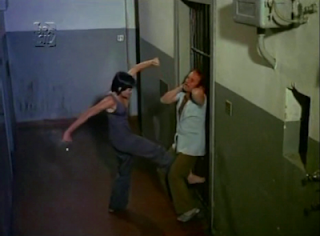
So, in the final analysis, it seems that we might have at last found Bruce Lee vs. Gay Power in order that we may finally let it go. But letting go is hard. Without any knowledge of the somewhat tame film that hid behind it, that title promised so much. With its suggestion of an archetype of hetero masculinity pitted in violent opposition to its exact antithesis, we cult film enthusiasts saw in our minds something thrillingly un-“PC”. What was promised was yet another opportunity for us to, however ironically, display our hard earned callousness in the face of exploitation cinema’s relentless and reflexive flaunting of liberal sensitivities. The real article, however, is something far less mean spirited. It turns out that Bruce Lee vs. Gay Power, as a concept at least, may simply have been too absurd to exist after all.