Showing posts with label Science Fiction. Show all posts

Thursday, August 29, 2019

The day Mars invaded India


I've decided to revisit some of the films I reviewed during the early days of 4DK and write new, more detailed reviews of them that make use of all the increased perspective, wisdom and unfounded self-regard that I've gained during the interceding years. The first film to get this treatment is the 1967 Indian spy-fi epic Wahan Ke Log, which I first reviewed way back on September 23, 2008. Check out the resulting review, which has just been posted over on Teleport City.

Monday, December 10, 2018

Star Virgin (Japan, 1988)


I approached Star Virgin expecting lightweight Japanese erotica, but what I got was something altogether more charming. What it was instead was a frenetic procession of goofy rubber monsters, robots, fun miniature effects and perky idol pop, all revolving around an appealing heroine.

Pin-up model and actress Eiko Kuroki stars as Eiko, an alien visiting Earth in the guise of a normal teenage girl who turns into the bikini clad superhero Star Virgin by way of a “transformation bracelet” given to her by her scientist father. When we first meet Star Virgin, at the film’s opening, she is tied to a crucifix and being threatened by a giant spiny frog with an endlessly extendable tongue. Two ineffectual hand puppet aliens look on. After she punches her way out of this sticky situation, she makes her getaway on a flying scooter as her catchy disco theme song plays in the background. And with that, as they say, we’re off.


In short order, Eiko returns to Earth and reunites with her nerdy friend Koh, only for the two of them to be immediately attacked by a maurading futuristic tank. They are next stalked from the air by a gigantic, bird-of-prey like spaceship, and then a virtually indestructible robot. All of this turns out to be the work of one Colonel Arashiyama (Isao Sasaki) a demented scientist type who heads the Tsukenerawa Organization, an evil cabal that conducts its world domination plans from a lair inside a hollowed out volcano. But this no ordinary hollowed-out volcano, as it is also a hollowed-out volcano that flies.

With her skimpy attire, indomitable cheerfulness, game physicality, and evident baby fat, Star Virgin reminds me a lot of the Philippines’ Darna, especially as played by Wilma Santos – and longtime readers of this blog will know that that is not a comparison I make lightly. And despite a montage of Eiko Kuroki posing that looks like a magazine spread, there is very little salaciousness to the way she is depicted. Mind you, one synopsis I read of the video game that either inspired or was inspired by the movie (details are unclear) described Star Virgin as having a super power that allows her to detect when a man is planning to rape her. This doesn’t seem like too much of a super power, as one of the super powers that men are sorely lacking in is the ability to be subtle when they’re horny. Japanese exploitation films are likewise ham fisted in portraying male horniness, so given I didn’t see any Oafish perverts chasing Star Version in Benny Hill-style fast motion, I feel I can conclude, even without subtitles, that that story element was left out.


I want to be careful not to over-praise Star Virgin, but I would be lying if I said I didn’t enjoy it. It is clearly a film of modest ambitions, but it doesn’t use those ambitions as an excuse not to do the best it can. While its special effects are far from convincing, they are always clever and fun (I mean, if I’m seeing a flying volcano hideout, I really don’t care how well it's executed; I just want to see that shit.) Likewise, its acting, while not of awards caliber, is always enthusiastic and appropriately cartoonish. In short, I would recommend Star Virgin to anyone who doesn’t have a huge stick up their ass, while urging anyone with a huge stick up their ass to seek medical attention immediately.

Thursday, October 11, 2018

Shoktir Lorai, aka Banglar Robocop (Bangladesh, 19??)


If you enjoyed the “Sweded” version of Robocop presented in Michel Gondry’s Be Kind Rewind, you should get an equal kick out of Shoktir Lorai, a Bengali film that is popularly known as “Banglar Robocop.” It could be said that the whole process of Sweding was invented in the B, C, and Z movie industries of countries like Turkey and India, where a budget of a few hundred dollars was never seen as an impediment to remaking a Hollywood blockbuster that cost many tens of millions to produce.

Shoktir Lorai is a perfect example of this bold practice. Throughout its running time, there is never a moment when you are not reminded of how cheap it is. The Robocop costume appears to consist of a few metal plates hung loosely over a black body stocking and barely bridges the uncanny valley between Robocop and the Tin Woodsman. The sets are often comprised of as little as a few props scattered on a barren stage. Musical cues are often just needle drops on someone’s well-worn copy of John Williams’ Superman, The Motion Picture soundtrack.

 
Even the story is stripped down, completely eschewing both the satirical subtext and arch religious symbolism of Paul Verhoven’s original in favor of a basic “villain seeks to steal secret formula and is thwarted by righteous hero” plot. In short, if you are not overly concerned with the faithfulness of the adaptation, but can really appreciate thrift and a knack for cost-cutting, this may be the film for you. It’s conceivable that Shoktir Lorai’s budget was just a couple of coupons.

The film begins with young scientist Dr. Johan (Danny Sidak) and his mentor Dr. Mola working in a laboratory suggested by the presence of a couple of tables and some fishbowl sized decanters containing what looks like carbonated Jello. What they have just invented, according to the computer screen they are staring at throughout the process, is “Brain Wash.” My surmise is that this is a product that comes in handy when your brain has that “not so fresh" feeling.


A dapper, Ajit-like master criminal named Sharif Mohammed has other ideas about the formula, however, deeming it worthy of being acquired at all costs. Before this can happen, though, we must consume a sequence of Johan, his wife (Banglar King Kong star Munmun) and daughter Rita, who could conceivably be played by a miniature 35 year-old woman, frolicking on the beach in an idealized representation of family harmony that is just begging to be disrupted by the incursion of evil. This, of course, happens in short order, when a gang of hooligans show up to beat up Johan and harass his wife.

The family is saved by the intervention of handsome young police officer Inspector Suhil, who, despite being a cop and appearing throughout the rest of the film, is not destined to become Robocop. Another thing about Suhil that has little bearing on the rest of the film is that his girlfriend is Dr. Mola’s youngest daughter, who is introduced for the purpose of becoming a captive during the film’s final act. Other than that, this brief beach adventure serves to establish the fact that Johan is kind of a lightweight and set us to speculating about how neat it would be if he were given robot powers.


The first attempt by Sharif Mohammed’s goons to steal the Brain Wash formula results in an anonymous old man being murdered on the street. Johan witnesses this, and is subsequently forced to drive the thugs back to the vicinity of their hideout, whereupon he is released. Sharif Mohammed is as baffled by this turn of events as you are, and demands that Johan be killed.

An attempt on Johan’s life outside his family home results in little Rita taking a bullet. In her death throes, she executes a bizarre, slow-motion pirouette that Sofia Coppola would have done well to take a cue from. Her sacrifice is for nothing, though, as Johan is also killed. This leads to Johan ending up on the table in Dr. Mola’s lab, where Dr. Mola, for reasons lost to translation, sees fit to turn him into a cyborg with advanced killing power. This process appears to have involved Johan being given the Brain Wash, as, when it is done, an opening in Johan’s robot mask allows us to see his eyes staring out at us like those of a frightened deer (in this way, Johan is like a robot version of the wolf in the Caperucita Rojas movies.)


And it is at this time that Shoktir Lorai becomes the movie that we have wanted it to be for the last forty-five minutes. After Johan has a flashback to Rita’s death--followed by a Darth Vader “NOOOOOOO” moment--he sets out to get bloody, robotically enhanced revenge against her killers with his also pretty pissed off wife at his side to cheer him on. Finally Sharif Mohammed decides to fight fire with fire. He kidnaps Mola’s daughter and forces him to perform the cyborg process on his imposing female minion Julie, whom he summarily shoots and kills to get thing under way. This leads to an absurdly protracted climactic fight sequence in which Johan and Julie repeatedly throw each other into and smash various barriers, walls and other impediments to human-assisted flight as they make lots of loud grunting and gasping noises. I don’t want to spoil things, but one of them ends up getting thrown into an active volcano.


I have been aware of these Bengali knock-off movies—Banglar King Kong, Banglar Hulk¸ etc.—for some time, but, to be honest, Shoktir Lorai is the first one of them I’ve seen. My impressions are that it’s scrappy, rough-hewn nature reminds me a lot of exploitation films from India’s Telugu language cinema and, even more so, Pakistan’s Pashto region, with the fact that it is an attempt to recreate a big budget Hollywood film being the icing on the cake. The degree to which it falls short of that goal lends it a subversive quality that, while probably not intentional, is extremely funny nonetheless. I’d like to think that the people who made Shoktir Lorai are okay with people laughing at (or with) it, because, from where I stand, Danny Sidak in his scrap heap Robocop costume is every bit as funny as Jack Black in his.

Tuesday, July 10, 2018

Creature (India, 2014)


Last Monday, I went vinyl record shopping with my nephew in the East Bay, and ended up in an Indian DVD shop on University Avenue, where the voluble sales clerk talked copies of Baahubali and Ek Tha Tiger into my hands. I was grateful for this guidance, because it had been a very long time since I had seen a Bollywood movie of even remotely recent vintage—since before I started writing Funky Bollywood, to be honest—and also because I ended up liking both films.

But there was one more film that I walked out of that store with, one that I had chosen myself by virtue of the cover alone, which advertised a CGI monster movie in which beauty-turned-scream-queen Bipasha Basu faces off against a horrific part dinosaur/part man. The film’s title: Creature (also known as Creature 3D, if you are watching it in 3D—or if you are one of the characters in the movie, who is experiencing the creature as part of their natural field of vision.)


Like its title, Creature is a pretty on-the-nose affair, as are most of Indian cinema’s first stabs at a particular genre, taking the modern day monster movie, as presented by Hollywood, and stripping it down to its basic machinations. All of the expected tropes and plot points arrive right on time, from the jump scares down to the ironically portentous dialogue (“I’m glad we honeymooned here, rather than in London or Paris,” says one newlywed immediately before being torn into pieces.)

All of this is woven into an engagingly slick little package by director Vikram Bhatt (Raaz) who, armed with a budget of Rs. 18 crore (roughly 2.7 million U.S. dollars), even comes up with CGI effects that rise above passable quality. This latter makes Creature a must-see for anyone (like me) who has ever made fun of Jaani Dushman: Ek Anokhi Kahani, a film whose only purpose seems to be to make Mega-shark vs. Giant Octopus look like Jurassic Park by comparison.


The creature in question bears a slight resemblance to Ray Harryhausen’s Ymir from 20 Million Miles to Earth, and benefits considerably from the obviously great care taken in designing its movements. This is a monster whose personal mantra appears to be “Always Be Hunting”. When he is stalking his prey, he moves in a slithering crawl that is almost sickeningly visceral, then breaks into a loping gallop when it’s time to strike. Less care was taken, unfortunately, with the sound design; we’ve all heard about the ingenious combinations of sound and technique that were combined to fashion Godzilla’s iconic roar. In the case of the creature from Creature, what we are obviously hearing is a gruff voiced man yelling “ROAR” into a microphone, perhaps with his hands cupped around his mouth.

The film also seems to be holding its nose a bit in its presentation of gore, but it does give us one shot of a severed leg and, in another scene, a severed arm. And, if it is at all possible to over-react to such a sight, the actors do their earnest best to pull it off.


Of course, in addition to special effects, Creature also has a plot, and that concerns Ahana Dutt (Basu), a fiercely determined young woman who, in the wake of a family tragedy, moves to Northern India’s lush Himachal Pradesh region to realize her dream of building and operating a “boutique hotel”. This, in defiance of everyone else’s characterization of the surrounding area as a “jungle”, she names the Glendale Forest Hotel, and true to that name, it is a very Western-looking, almost chalet-style construction that could just as easily be in Northern California as the Swiss Alps.

We join the Hotel’s grand opening party in progress, where Ahana meets and immediately makes googly eyes at Karan (Pakistani dreamboat Imran Abbas), a man who shows up with an acoustic guitar despite later claiming that he is only posing as a musician, even though he has just made that one acoustic guitar sound like an entire orchestra. This was in one of only four songs in the movie, just two of which are picturized on the actors. On the DVD, each of these songs is accompanied by a super title announcing where you can download them as ringtones (you stay classy, T-Series.)


Sadly, by the time of the party, we have already been privy to the two newlyweds and one hapless maintenance man being slaughtered by the creature. Ahana is soon privy to this, too, and as the killing continues, attendance at the hotel drops, leaving her prey to another monster, the profit-hungry bankers who threaten to repossess the hotel from her.

It has to be said that the best part of Creature is Bipasha Basu’s portrayal of the very well-written character of Ahana, an admirably rugged heroine who insists on taking the lead in every battle, be it against the monster or her creditors, all while fiercely holding on to her dream of entrepreneurship. In this way, Creature sort of comes off like a sci-fi retelling of Once Upon a Time in the West, in which, rather than Henry Fonda, Claudia Cardinale’s Jill must protect her ranch against the predations of Godzilla. Casting Basu against Imran Abbash in all his emo-ish frailty goes even further toward establishing her as a total boss.


As I’ve mentioned elsewhere, one of the joys of watching Indian takes on genre cinema is in seeing how the chosen genre’s tropes collide with the idiosyncratic traditions of Hindi cinema. Sadly, no such joys are to be had with Creature, as the film tamps down on its Indian-ness as furiously as Ahana tries to put a Western face on her endeavors in the hospitality industry, doing so in open defiance of the wilds that surround her. This is true from the locations, which could be literally anywhere in Europe or the Northern United States, to the dialogue, roughly 40% of which is spoken in English.

It is suggested that Ahana’s actions have unleashed the monster, and that it is somehow the personification of some past sin of hers. Is Creature, then, a cautionary tale about post-diaspora Bollywood’s ever-increasing Westernization? If so, what is the monster that has been, or will be, unleashed? Until we know the answer, Creature merely comes across as a slickly engaging, though pretty generic creature feature.

Tuesday, June 19, 2018

Abar: Black Superman (United States, 1977)


Abar: Black Superman has bubbled up to the surface of the pop cultural conversation in recent weeks, thanks to the phenomenal success of Black Panther. Taking a cue from its title, some writers are calling it “the first black superhero film”, and I won’t disagree with that—though I will point out that it’s tag line at the time of its release was “the first black science fiction film” and that it is as much a tale of mad science as it is of costumed heroics. On top of all that, it is also a thoughtful examination of being black in America circa 1977.

The film starts with Dr. Ken Kincaid (J. Walter Smith) and his family moving into the all white Los Angeles neighborhood of Meadow Park. The neighbors excitedly queue up to meet the new arrivals, until it is revealed that the Kincaids are black, at which point they completely lose their shit. One woman insists, to Dr. and Mrs. Kincaid’s faces, that they are not in fact the Kincaids, but rather their maid and chauffeur. When the Kincaid’s correct this notion, the whole neighborhood explodes into a collective racist hissy fit.
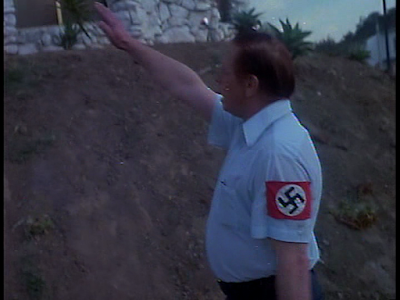
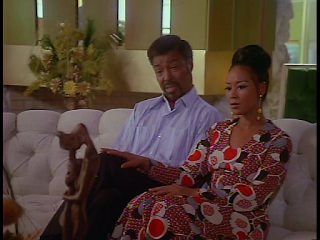
Crude signs (“NO SCHOOL BUSSING”, “GO BACK TO YOUR BLACK GHETTO”) are made and brandished, the N word is tossed around like it is going out of style, the Kincaid’s two children are called “Pickaninnies”, garbage is thrown at the house, and one tubby nebbish with a swastika armband walks around giving the “sieg heil” salute. That night’s local news leads with “A black family has moved into the Meadow Park,” and soon the City Planning Commission is meeting to discuss ways of quelling the situation. It as if the entire city’s equilibrium has been knocked off balance by the movements of this one modest family.

Of course, thing were different in 1977, but Abar’s depiction of white racism in Los Angeles as being so naked and vocal doesn’t quite jibe with my experience of Los Angeles when I was living there in the nineties. Sure, it was a racist city; jaw-droppingly so. But its racism was more insidious in nature, more ingrained (one could even say “institutional”). People didn’t talk openly about being racist, like they did so preposterously in Crash. Otherwise they might taint the city’s liberal, easygoing image. Instead, divisions within the city’s populace were enforced by the unspoken social force fields that confined people within neighborhoods like South Central, Westwood/Beverly Hills, and West Hollywood and insured that many residents of those areas never ventured into or met anybody from the others. In contrast to such a diabolically elusive system, the screaming, self-identifying harridans of Abar come off as overly broad, ridiculous caracatures, stereotypes even. But if that’s the price white people have to pay for a hundred years of African American actors having to wear bones through their noses in countless cheap jungle adventures, then I’d say that we got off pretty easy.
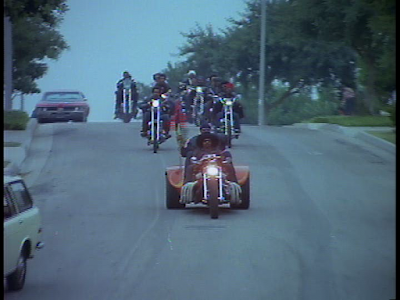
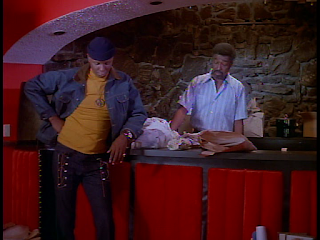
Anyway, as the racism of the Kincaid’s neighbors is so virulent that it can be seen from space, it is not long before it comes to the attention of John Abar (Tobar Mayo) and his fellow social justice warriors in the Black Front of Unity, or BFU. A cross between the Black Panthers and the Hell’s Angels, the BFU hop on their hogs and head toward the Kincaids’. Of course, the sight of black people on motorcycles alone is enough to send the white protestors scurrying back into their homes like scared rabbits, whereupon Abar introduces himself to the Kincaids and is invited inside, whereupon we see that the Kincaid’s home, with its succession of richly upholstered, primary colored rooms, is more like the dance academy in Suspiria than any home in a white middle class neighborhood has a right to be.

Dr. Kincaid shows Abar to his beaker-filled basement laboratory and reveals that he is working on a serum that will give a man superpowers – that is, if he can find the right subject to test it on, hint hint. This is more than Kincaid has told his wife (Roxie Young), to whom he has only referred to this project in the most mysterious terms, telling her that it is of “such tremendous magnitude that one day it will alter the destiny of the world.”
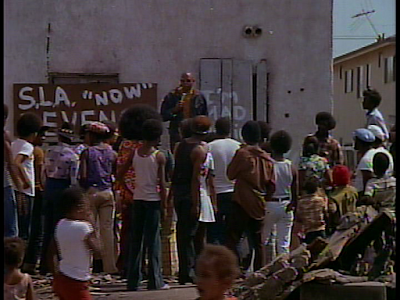

After this encounter, Abar returns to Watts, where he is normally seen preaching on a street corner in front of a large sign that says “SLA AVENGE ‘NOW’.” He has agreed to act as the Kincaid’s bodyguard, but is not around to prevent one of the bigoted local crazies from disemboweling their tabby and hanging it from their front door. Soon after, Kincaid’s son Tommie (Tony Rumford) comes across a thug planting a bomb on the property. When the thug makes a hasty retreat in his van, Bobby takes off after him, only to be run down and killed by him. This proves to be the tearing point for Abar, who bursts into Kincaid's lab and lustily chugs down the serum, then heads out onto the streets of honkytown to explore his superpowers. In a weird twist, this somehow convinces Kincaid that Abar is a “psychopath” who needs to be stopped. Gun in hand, Kincaid takes off after him.

It has been amply stated that the acting in Abar is uniformly dreadful. I won’t disagree, though I will conjecture that the poor actors may have just been overwhelmed by the amount of dialog they were asked to recite, which is a lot. In this way, the film follows in the discursive tradition of black community (or “gospel”) theater, in which metaphorical representation is eschewed in favor of the characters having long discussions in which the play’s themes are laid out in a very on-the-nose fashion.


In Abar, the primary topics of discussion are whether Kincaid is betraying his people by moving into a white neighborhood, rather than staying in the Ghetto where he is most needed. When he is not urging Kincaid to move back to the ghetto, Abar engages with him in plural discussions of the relative virtues of Dr. Marin Luther King’s non-violent approach to protest and Malcolm X’s more confrontational one. This affords the opportunity for portions of King’s “I Have a Dream” speech to appear on the soundtrack.

To be fair, not all of Abar’s actors are amateurs, although some clearly are. The children, in particular, have that dumbstruck monotone delivery typical of so many first-time child actors, coming off like twin versions Dee from What’s Happening. This is especially taxing on credulity when young Tony Rumford is required to exclaim melodramatic lines like  “I hate them! I hate them all! They killed our cat.” J. Walter Smith, on the other hand has an authoritative purr worthy of Morgan Freeman, and it serves him well in the scenes where he is debating Abar, though he has a tendency to turn to granite when more warmth is required. As his wife, Roxie Young, has the thankless task of playing the buzz kill spouse who exists only to hector her husband to give up doing his awesome experiments in his basement labs in favor of becoming a staid family man. Nevertheless, she projects an admirable kind of patient strength while modeling a colorful array of Afro-centric fashions. Meanwhile, Tobar Mayo's shaved head, delicate features and soft voice give him an alien quality that well serves his portrayal of Abar, who seems to exist on a plane above the petty squabbles taking place around him.


In keeping with Abar’s thoughtful tone, Abar’s superpowers, once revealed, turn out to be more mental than physical. This means that he can undo both white racism and the ghetto with his mind. In a dizzying closing montage, he goes from turning a bum’s wine jug into a quart of milk to willing a gang of truants to go to college and graduate, all in the course of a few seconds of screen time. Finally, he mentally commands a hurricane to descend upon Meadow Park and literally blow all the bad white people away. In the aftermath, the woman who earlier accused the Kincaid’s of being their own servants comes to them begging forgiveness, claiming that her hostility was due to her being a black woman passing for white. Kincaid patronizingly tells her that he was aware of this fact, and also aware of her Sickle Cell Anemia diagnosis. Burn.


Abar is the sole directing credit of one Frank Packard, who is also credited with playing "Jonah" in The Spectre of Edgar Allen Poe. Packard seems to have been infatuated with the interior of the Kincaid home, and is at his best visually when exploring it's assortment of bizarre color schemes and weird modish details. Aside from this, he does little to prevent Abar: Black Superman from being called a cheap and poorly acted film.

And let's be honest: It is. But, because of that, some people will tell you that it is also stupid, which it isn’t. True, its message does sometime get garbled by its limitations, but at least it has something to say. I’d choose it over Crash every time.