Showing posts with label Superheroes. Show all posts

Friday, April 19, 2019

El Aguila Descalza, aka The Barefoot Eagle (Mexico, 1971)


Though Christa Linder is forcefully stripped to her skivvies at one point, El Aguila Descalza is still somewhat less lowbrow than most Mexican genre parodies of its day. Whether that presages its director’s subsequent arthouse cred is a guess best left to the tea leaves.

El Aguila Descalza was the directorial debut of Alfonso Arau, who, under the mononym “Arau” also played dual lead roles in the film. If his name is familiar to you, that is probably because, some two decades later, Arau directed Like Water For Chocolate, the movie that muscled out the competition to become that year's one foreign film embraced by mainstream America in 1992 (you could say it was the Roma of its day.)


In the film, Arau portrays Ponchito, a hapless man-child who still lives with his mom and works by day as a product tester at a pogo stick factory. An avid comic book reader, Ponchito indulges his superhero fantasies by night, roaming the city in the guise of the The Barefoot Eagle, a masked crimefighter. Though whether the Eagle’s intention is to fight evil or promote it is initially unclear, as, in an early scene, he breaks into the house of his boss, Don Carlos Martinez (Jose Galvez), only to spy on his beautiful daughter Sirene (Linder) as she sleeps. However, when an American mobster named Englepass (also played by Arau) kidnaps Don Carlos and Sirene, Ponchito takes it upon himself to rescue them.

While most superhero films traffic in fantasies of transformation, El Aguila Descalza injects into that fantasy the nagging realization that, if one were to attempt becoming a costumed hero in real life, he or she would make an absolute fool of himself. Ponchito’s costume consists of what looks like a dime store pirate costume topped by a backwards baseball cap with eyeholes cut in it. Though this is a result as much of Ponchito’s dire economic circumstances as it is of his haplessness, as the film pulls no punches in depicting the grime and squalor of the lives of Mexico’s working poor.


This aspect of the movie lends an aspect of pathos to Ponchito’s slapstick humiliations that you wouldn’t see in a film starring the likes of Eleazar “Chelelo” Garcia, Jose Angel “Ferrusquilla” Espinosa, or any of the other Mexican comedians whose names require a quotation bracketed diminutive. Which is not to say that the film doesn’t draw upon Mexico’s tradition of broad, MAD Magazine-style screen comedy, although it at the same time hints at the arch pop cultural savvy of the hip, adult oriented comedies that were starting to proliferate worldwide in the late 60s.

This tendency accounts for the film's few winking references to the lucha genre, which was, at the time, on the upward end of a decline in favor with Mexican audiences. Englepass’ henchmen are a team of burly masked luchadores, anonymous bullies whose threat to the malnourished Ponchito not only cements his status as an underdog, but also makes it that much more comedic when they are humiliated by him. Santo appears both as the subject of a comic book Ponchito is reading and in a wedding scene where the ring-bearer is a small boy in a child-sized version of the Enmascarado de Plata’s iconic mask.


It could be said that Aguila Descalza employs something of a comic book motif. Among other examples, Chona, Ponchito’s would-be girlfriend (Ofelia Medina), is seen reading a Kaliman comic and another of Ponchito’s friends has a Batman poster on his wall. Comic book racks are prominently displayed in a couple of the bustling establishing shots. All of this could be meant to underscore the cruel irony of the powerless seeking refuge in fantasies of super power, or perhaps Alfonzo Arau just really liked comic books.

But, of course--and perhaps predictably—Ponchito is not powerless. With Don Carlos and Sirene locked away, Englepass puts his whip wielding goons in charge of Don Carlos's factory and imprisons the workers families in cages. Ponchito's appeals to the authorities fall on deaf ears and he and Chona are thrown into an insane asylum right out of Marat Sade. They of course affect a clever escape and crash Englepass' forced wedding to Sirene with an army of lunatics.This adds an extra air of mania to that classic 1960s comedy climax in which every member of the cast takes part in a madcap brawl rife with trippy sight gags as, all the while, psychedelic rock plays on the soundtrack. Take that, respectable society!


While I have to credit Aguila Descalza for being a hair more progressive and socially conscious than films like Cazadores de Espias and Agente 00 Sexy, I have to shamefacedly admit to sometimes wishing that it was as fun as those films were. But with the vaguely hippie-ish tone of some of its comedy comes the awareness of all of those things that, in the dark days of the late 60s/early 70s, the hippie culture rose up in opposition to: war, corruption, and repression. That the film brings to its subject an unexpected amount of empathy and compassion makes it worthy of a compensatory admiration, while at the same time giving it an ineffable charm.

Thursday, October 11, 2018

Shoktir Lorai, aka Banglar Robocop (Bangladesh, 19??)


If you enjoyed the “Sweded” version of Robocop presented in Michel Gondry’s Be Kind Rewind, you should get an equal kick out of Shoktir Lorai, a Bengali film that is popularly known as “Banglar Robocop.” It could be said that the whole process of Sweding was invented in the B, C, and Z movie industries of countries like Turkey and India, where a budget of a few hundred dollars was never seen as an impediment to remaking a Hollywood blockbuster that cost many tens of millions to produce.

Shoktir Lorai is a perfect example of this bold practice. Throughout its running time, there is never a moment when you are not reminded of how cheap it is. The Robocop costume appears to consist of a few metal plates hung loosely over a black body stocking and barely bridges the uncanny valley between Robocop and the Tin Woodsman. The sets are often comprised of as little as a few props scattered on a barren stage. Musical cues are often just needle drops on someone’s well-worn copy of John Williams’ Superman, The Motion Picture soundtrack.

 
Even the story is stripped down, completely eschewing both the satirical subtext and arch religious symbolism of Paul Verhoven’s original in favor of a basic “villain seeks to steal secret formula and is thwarted by righteous hero” plot. In short, if you are not overly concerned with the faithfulness of the adaptation, but can really appreciate thrift and a knack for cost-cutting, this may be the film for you. It’s conceivable that Shoktir Lorai’s budget was just a couple of coupons.

The film begins with young scientist Dr. Johan (Danny Sidak) and his mentor Dr. Mola working in a laboratory suggested by the presence of a couple of tables and some fishbowl sized decanters containing what looks like carbonated Jello. What they have just invented, according to the computer screen they are staring at throughout the process, is “Brain Wash.” My surmise is that this is a product that comes in handy when your brain has that “not so fresh" feeling.


A dapper, Ajit-like master criminal named Sharif Mohammed has other ideas about the formula, however, deeming it worthy of being acquired at all costs. Before this can happen, though, we must consume a sequence of Johan, his wife (Banglar King Kong star Munmun) and daughter Rita, who could conceivably be played by a miniature 35 year-old woman, frolicking on the beach in an idealized representation of family harmony that is just begging to be disrupted by the incursion of evil. This, of course, happens in short order, when a gang of hooligans show up to beat up Johan and harass his wife.

The family is saved by the intervention of handsome young police officer Inspector Suhil, who, despite being a cop and appearing throughout the rest of the film, is not destined to become Robocop. Another thing about Suhil that has little bearing on the rest of the film is that his girlfriend is Dr. Mola’s youngest daughter, who is introduced for the purpose of becoming a captive during the film’s final act. Other than that, this brief beach adventure serves to establish the fact that Johan is kind of a lightweight and set us to speculating about how neat it would be if he were given robot powers.


The first attempt by Sharif Mohammed’s goons to steal the Brain Wash formula results in an anonymous old man being murdered on the street. Johan witnesses this, and is subsequently forced to drive the thugs back to the vicinity of their hideout, whereupon he is released. Sharif Mohammed is as baffled by this turn of events as you are, and demands that Johan be killed.

An attempt on Johan’s life outside his family home results in little Rita taking a bullet. In her death throes, she executes a bizarre, slow-motion pirouette that Sofia Coppola would have done well to take a cue from. Her sacrifice is for nothing, though, as Johan is also killed. This leads to Johan ending up on the table in Dr. Mola’s lab, where Dr. Mola, for reasons lost to translation, sees fit to turn him into a cyborg with advanced killing power. This process appears to have involved Johan being given the Brain Wash, as, when it is done, an opening in Johan’s robot mask allows us to see his eyes staring out at us like those of a frightened deer (in this way, Johan is like a robot version of the wolf in the Caperucita Rojas movies.)


And it is at this time that Shoktir Lorai becomes the movie that we have wanted it to be for the last forty-five minutes. After Johan has a flashback to Rita’s death--followed by a Darth Vader “NOOOOOOO” moment--he sets out to get bloody, robotically enhanced revenge against her killers with his also pretty pissed off wife at his side to cheer him on. Finally Sharif Mohammed decides to fight fire with fire. He kidnaps Mola’s daughter and forces him to perform the cyborg process on his imposing female minion Julie, whom he summarily shoots and kills to get thing under way. This leads to an absurdly protracted climactic fight sequence in which Johan and Julie repeatedly throw each other into and smash various barriers, walls and other impediments to human-assisted flight as they make lots of loud grunting and gasping noises. I don’t want to spoil things, but one of them ends up getting thrown into an active volcano.


I have been aware of these Bengali knock-off movies—Banglar King Kong, Banglar Hulk¸ etc.—for some time, but, to be honest, Shoktir Lorai is the first one of them I’ve seen. My impressions are that it’s scrappy, rough-hewn nature reminds me a lot of exploitation films from India’s Telugu language cinema and, even more so, Pakistan’s Pashto region, with the fact that it is an attempt to recreate a big budget Hollywood film being the icing on the cake. The degree to which it falls short of that goal lends it a subversive quality that, while probably not intentional, is extremely funny nonetheless. I’d like to think that the people who made Shoktir Lorai are okay with people laughing at (or with) it, because, from where I stand, Danny Sidak in his scrap heap Robocop costume is every bit as funny as Jack Black in his.

Tuesday, June 19, 2018

Abar: Black Superman (United States, 1977)


Abar: Black Superman has bubbled up to the surface of the pop cultural conversation in recent weeks, thanks to the phenomenal success of Black Panther. Taking a cue from its title, some writers are calling it “the first black superhero film”, and I won’t disagree with that—though I will point out that it’s tag line at the time of its release was “the first black science fiction film” and that it is as much a tale of mad science as it is of costumed heroics. On top of all that, it is also a thoughtful examination of being black in America circa 1977.

The film starts with Dr. Ken Kincaid (J. Walter Smith) and his family moving into the all white Los Angeles neighborhood of Meadow Park. The neighbors excitedly queue up to meet the new arrivals, until it is revealed that the Kincaids are black, at which point they completely lose their shit. One woman insists, to Dr. and Mrs. Kincaid’s faces, that they are not in fact the Kincaids, but rather their maid and chauffeur. When the Kincaid’s correct this notion, the whole neighborhood explodes into a collective racist hissy fit.
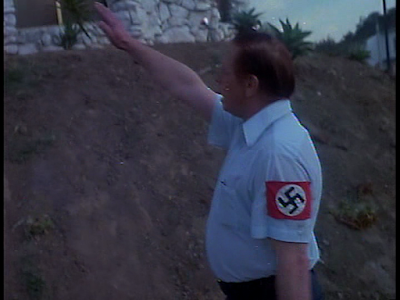
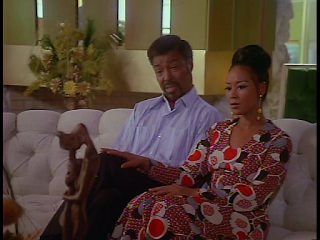
Crude signs (“NO SCHOOL BUSSING”, “GO BACK TO YOUR BLACK GHETTO”) are made and brandished, the N word is tossed around like it is going out of style, the Kincaid’s two children are called “Pickaninnies”, garbage is thrown at the house, and one tubby nebbish with a swastika armband walks around giving the “sieg heil” salute. That night’s local news leads with “A black family has moved into the Meadow Park,” and soon the City Planning Commission is meeting to discuss ways of quelling the situation. It as if the entire city’s equilibrium has been knocked off balance by the movements of this one modest family.

Of course, thing were different in 1977, but Abar’s depiction of white racism in Los Angeles as being so naked and vocal doesn’t quite jibe with my experience of Los Angeles when I was living there in the nineties. Sure, it was a racist city; jaw-droppingly so. But its racism was more insidious in nature, more ingrained (one could even say “institutional”). People didn’t talk openly about being racist, like they did so preposterously in Crash. Otherwise they might taint the city’s liberal, easygoing image. Instead, divisions within the city’s populace were enforced by the unspoken social force fields that confined people within neighborhoods like South Central, Westwood/Beverly Hills, and West Hollywood and insured that many residents of those areas never ventured into or met anybody from the others. In contrast to such a diabolically elusive system, the screaming, self-identifying harridans of Abar come off as overly broad, ridiculous caracatures, stereotypes even. But if that’s the price white people have to pay for a hundred years of African American actors having to wear bones through their noses in countless cheap jungle adventures, then I’d say that we got off pretty easy.
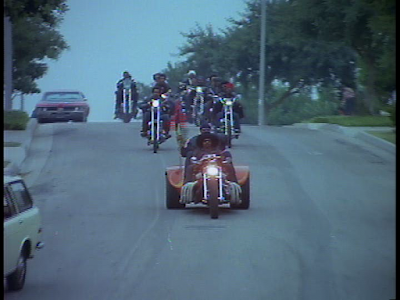
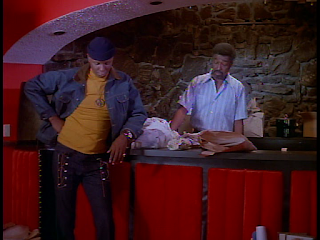
Anyway, as the racism of the Kincaid’s neighbors is so virulent that it can be seen from space, it is not long before it comes to the attention of John Abar (Tobar Mayo) and his fellow social justice warriors in the Black Front of Unity, or BFU. A cross between the Black Panthers and the Hell’s Angels, the BFU hop on their hogs and head toward the Kincaids’. Of course, the sight of black people on motorcycles alone is enough to send the white protestors scurrying back into their homes like scared rabbits, whereupon Abar introduces himself to the Kincaids and is invited inside, whereupon we see that the Kincaid’s home, with its succession of richly upholstered, primary colored rooms, is more like the dance academy in Suspiria than any home in a white middle class neighborhood has a right to be.

Dr. Kincaid shows Abar to his beaker-filled basement laboratory and reveals that he is working on a serum that will give a man superpowers – that is, if he can find the right subject to test it on, hint hint. This is more than Kincaid has told his wife (Roxie Young), to whom he has only referred to this project in the most mysterious terms, telling her that it is of “such tremendous magnitude that one day it will alter the destiny of the world.”
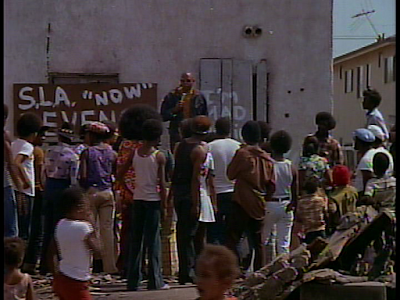
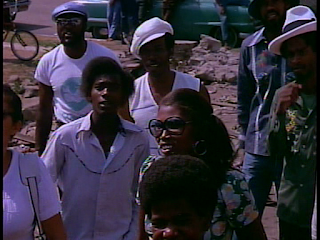
After this encounter, Abar returns to Watts, where he is normally seen preaching on a street corner in front of a large sign that says “SLA AVENGE ‘NOW’.” He has agreed to act as the Kincaid’s bodyguard, but is not around to prevent one of the bigoted local crazies from disemboweling their tabby and hanging it from their front door. Soon after, Kincaid’s son Tommie (Tony Rumford) comes across a thug planting a bomb on the property. When the thug makes a hasty retreat in his van, Bobby takes off after him, only to be run down and killed by him. This proves to be the tearing point for Abar, who bursts into Kincaid's lab and lustily chugs down the serum, then heads out onto the streets of honkytown to explore his superpowers. In a weird twist, this somehow convinces Kincaid that Abar is a “psychopath” who needs to be stopped. Gun in hand, Kincaid takes off after him.

It has been amply stated that the acting in Abar is uniformly dreadful. I won’t disagree, though I will conjecture that the poor actors may have just been overwhelmed by the amount of dialog they were asked to recite, which is a lot. In this way, the film follows in the discursive tradition of black community (or “gospel”) theater, in which metaphorical representation is eschewed in favor of the characters having long discussions in which the play’s themes are laid out in a very on-the-nose fashion.


In Abar, the primary topics of discussion are whether Kincaid is betraying his people by moving into a white neighborhood, rather than staying in the Ghetto where he is most needed. When he is not urging Kincaid to move back to the ghetto, Abar engages with him in plural discussions of the relative virtues of Dr. Marin Luther King’s non-violent approach to protest and Malcolm X’s more confrontational one. This affords the opportunity for portions of King’s “I Have a Dream” speech to appear on the soundtrack.

To be fair, not all of Abar’s actors are amateurs, although some clearly are. The children, in particular, have that dumbstruck monotone delivery typical of so many first-time child actors, coming off like twin versions Dee from What’s Happening. This is especially taxing on credulity when young Tony Rumford is required to exclaim melodramatic lines like  “I hate them! I hate them all! They killed our cat.” J. Walter Smith, on the other hand has an authoritative purr worthy of Morgan Freeman, and it serves him well in the scenes where he is debating Abar, though he has a tendency to turn to granite when more warmth is required. As his wife, Roxie Young, has the thankless task of playing the buzz kill spouse who exists only to hector her husband to give up doing his awesome experiments in his basement labs in favor of becoming a staid family man. Nevertheless, she projects an admirable kind of patient strength while modeling a colorful array of Afro-centric fashions. Meanwhile, Tobar Mayo's shaved head, delicate features and soft voice give him an alien quality that well serves his portrayal of Abar, who seems to exist on a plane above the petty squabbles taking place around him.


In keeping with Abar’s thoughtful tone, Abar’s superpowers, once revealed, turn out to be more mental than physical. This means that he can undo both white racism and the ghetto with his mind. In a dizzying closing montage, he goes from turning a bum’s wine jug into a quart of milk to willing a gang of truants to go to college and graduate, all in the course of a few seconds of screen time. Finally, he mentally commands a hurricane to descend upon Meadow Park and literally blow all the bad white people away. In the aftermath, the woman who earlier accused the Kincaid’s of being their own servants comes to them begging forgiveness, claiming that her hostility was due to her being a black woman passing for white. Kincaid patronizingly tells her that he was aware of this fact, and also aware of her Sickle Cell Anemia diagnosis. Burn.


Abar is the sole directing credit of one Frank Packard, who is also credited with playing "Jonah" in The Spectre of Edgar Allen Poe. Packard seems to have been infatuated with the interior of the Kincaid home, and is at his best visually when exploring it's assortment of bizarre color schemes and weird modish details. Aside from this, he does little to prevent Abar: Black Superman from being called a cheap and poorly acted film.

And let's be honest: It is. But, because of that, some people will tell you that it is also stupid, which it isn’t. True, its message does sometime get garbled by its limitations, but at least it has something to say. I’d choose it over Crash every time.

Sunday, June 5, 2016

Three Supermen at the Olympic Games (Turkey, 1984)


Three Supermen at the Olympic Games looks like what happens when the universe itself rises up in defiance at the existence of yet another entry in the Three Supermen series. One cannot so much review it as draw a chalk outline around it, so does it resemble a sloppy corpse left behind by a disorganized killer. Of course, many of its deficits can be understood when you consider that it was one of the few Turkish entries in the Three Supermen series, which seem to exist only to make the Italian Three Supermen films look like Avengers movies by comparison.

Still, Three Supermen at the Olympic Games is shoddy even by the standards of Turkish trash cinema. There is the usual needle-dropped score (mostly John Williams’ themes to Superman: The Motion Picture), but, beyond that, evidence of the film being used as a sort of clearing house for misbegotten footage from other films is plentiful. Actors were apparently asked to recite their dialogue in close-up against a plain green backdrop, presumably to serve as a kind of narrative glue for insertion into the film as needed. I can’t tell whether this was done out of ignorance of the meaning of the term “green screen”, or if there had been some intention to insert backgrounds behind the actors at some point and someone eventually just said ‘fuck it.” Whichever the case, this practice only serves to increase the disjointed feeling of the movie--with these pallid looking shots of the actors reciting their lines at an uncomfortably intimate remove frequently interrupting the already mismatched scenes.


Given all this, summarizing the plot of Three Supermen at the Olympic Games would be difficult under any circumstances – the IMDB threw up its hands with “Three supermen go to Olympics and mayhem ensues”—which means that watching it without English subtitles, as I of course did, makes it as indecipherable as an alien message in a Stanislaw Lem novel. Still, here’s my best shot:

The Three Supermen (Levent Çakir in a canary yellow wig; Yilmaz Koksal as the stuttering, mentally challenged Superman; and Stefano Martinenghi, the son of director Italo Martinenghi) somehow end up in the service of the Greek goddess Hera (Filiz Özten) and fend off an assortment of medieval knights and modern day gangsters before finally rescuing a stolen briefcase from some pirates. The end.


As you might have guessed from the above, Three Supermen at the Olympic Games’ sense of period is pretty fluid, allowing for elements of ancient Greece, Medieval Europe, and modern day Turkey to intermingle freely on the screen without any kind of visual transition. Probably the most welcome of these anachronisms is a LOT of recycled footage from the comparatively delightful earlier Supermen film 3 Supermen vs. Mad Girl. Returning for a well deserved encore are the colorfully garbed Mad Girl herself (Mine Sun), her army of minions in satiny green Klansmen’s robes, her boss in his dime store devil mask, and, most welcome of all, that silly cardboard box robot with his unmistakably phallic laser gun. The only problem with this footage is that it’s vibrant, comic book inspired color scheme makes the rest of Three Supermen at the Olympic Games look pretty drab by comparison.

You might think that I’m oversimplifying Three Supermen at the Olympic Games, and you’re probably right. For instance, you Syd Field acolytes out there might ask what the point of all its muddled action is—or, to put a finer point on it, what is exactly at stake in it. Could it be, as the title suggests, the Olympic Games themselves? It’s questionable, since we see only a little of those games at both the films’ beginning and end, and there’s reason to suspect that the stock footage used is not of the Olympics at all.


Also, I have to confess to my synopsis being marred by my inability to account for certain of the film’s repeated bits of business, such as the brief clip of Levent Çakir looking into the camera while “flying” (i.e. either being hoisted on a crane or lying on an elevated plank) over a small boat that pops up with numbing regularity. Especially vexing was the Fu Man-Chu wannabe using a mixing console for a control panel who shows up on a television screen at irregular intervals to spout a mouthful of (presumably) expository dialog. Admittedly, these bits, had I understood them, might have smoothed over some of the films more jarring transitions, and if so, that’s my bad. Or is it? Is it my fault that this movie was not in English? I’ll let you decide.

Three Supermen at the Olympic Games’ director Italo Martinenghi, a producer of the original Supermen films in his native Italy, had brought the series to Turkey in the hope of lowering production costs. Three Supermen at the Olympic Games’ stands as testament to the fact that he was resoundingly successful in achieving that goal. It’s hard to imagine it looking any cheaper. If I could recommend it for any reason, it’s that the footage from Supermen vs. Mad Girl it contains is, in most cases, much crisper than that seen in the version of Mad Girl that’s currently available. All the better to appreciate the mighty Dickbot in the light that he so deserves.