Showing posts with label Melodrama. Show all posts

Wednesday, January 22, 2014

The Addict (Egypt, 1983)


Khaled, the title character of Youssef Francis’ The Addict, has the kind of idyllic family life that you only see at the beginning of a movie where things are about to go radically and rapidly south. So overwhelmed is he by the narcotic bliss of middle class complacency that he fails to observe even the most basic principles of driver safety. Out for a recreational spin with his wife and young son, he attempts to steer with the kid in his lap, while at the same time playing the harmonica and canoodling with his wife (no, I am not making that up). The result is a weird, fake (I think) slow motion car crash that sees Khaled thrown from the car while his wife and son, trapped inside, slowly roll into a shallow marsh. This somehow kills them, and the injured Khaled wakes up in a hospital ward as a screaming morphine addict. When the doctors try to wean him off the drug, he stages a violent escape to stagger wild eyed among the populace.

The Addict is what folks nowadays would call a “recovery narrative”, but what strikes me about it is how much it resembles a classic monster movie. Ahmad Zaki, a highly regarded Egyptian actor who has played both Nasser and Sadat, plays Khaled as a sort of reverse Jekyll and Hyde who, when deprived of his drug, transforms into a caterwauling, preverbal beast barely capable of human congress. He is, however, a tragic beast – in the mold of Karloff’s Monster or Laughton’s Hunchback – shambling about with a pathetic stoop, one arm stiff at his side, and a look of utter bafflement on his face. There’s even a scene where his doctor has to protect him from an angry mob. When Zaki really wants to underscore his anguish, he throws an arm across his forehead like a consumptive in a Victorian melodrama.


Eventually, Khaled’s doctor, Doctor Ahmed (as played by another heavy hitter, Adel Adham, whom we last saw in Ayna Tukhabi’un Al-Shams) turns his care over to his physician daughter Layla (Nagwa Ibrahim). Layla, however, has wounds of her own to heal, having just had the surprise of seeing the fellow doctor she’s been maintaining a long distance romance with step off a plane with his new wife. All of the groundwork is laid for Layla to make as much of an addiction of Khaled’s treatment as he does of the morphine. And Khaled indeed makes for a challenge, escaping at the nearest opportunity by clobbering Layla’s female assistant and scrambling noisily through the streets of Cairo like a recently tasered bonobo. Layla is thus forced to scour the mean, mostly back lot bound side streets and back alleys of the city to find him. Once she does, she resolves to avoid a repeat performance by locking herself in with him in the facility in which he is undergoing withdrawal.

Aside from one graphic injection scene, The Addict spares us any of the actual, gritty details of narcotic addiction and withdrawal. We will see no projectile chundering or Trainspotting style bed shitting. Instead what we get is an eventual cut to a smiling Khaled wearing a crisp suit and speaking in complete sentences as Layla looks on approvingly. And, because this is a movie, they have fallen in love. Now all that remains is for Khaled to return to the scene of the accident to confront and expunge his guilt over it (even though, to be honest, it totally was his fault). But then arises the little matter of a box of Morphine, stolen from the hospital Khaled has just left; will the resulting suspicion shatter Khaled and Layla’s new love before it has even begun?


Director Youssef Francis was a painter and author as well as a filmmaker, yet there is nothing particularly painterly or novelistic about The Addict. It exhibit the same high level of technical acumen seen in most Egyptian commercial productions, if perhaps on a slightly more low budget scale, as well as a pastel color scheme that cements it firmly within the early 80s. What makes it, excuse me, addictively watchable, however, is the hysterically over-the-top quality which the performances of Zaki and Nagwa Ibrahim bring to it.

As enjoyable as it may be, though, one thing no one should ever do is mistake Zaki’s performance for an accurate portrayal of addiction. I mean, if narcotics actually had that effect on a person, how would all of that great jazz music ever have gotten made? Or this review. THANK YOU, DRUGS!

Tuesday, July 31, 2012

Atlantis (Denmark, 1913)


Atlantis proves that the whole "too soon" concept was as pertinent one hundred years ago as it is today, greeted by a wave of consternation upon its release for its depiction of a Titanic-like disaster only a year after the actual tragedy occurred. Norway even went so far as to ban the picture entirely.

Yet to say that Atlantis was "inspired" by the sinking of the Titanic is a somewhat dicey proposition, as the film was in truth based upon a novel by Nobel Prize winning author Gerhart Hauptman, which famously and uncannily depicted events very similar to the sinking a month before they happened. Whether real life occurrences had a hand in inspiring the selection of Hauptman's book as source material, however, is another matter entirely.


As Atlantis opens, distinguished bacteriologist Freidrich von Kammacher (Verdens Undergang's Olaf Fønss) is having a crap day. Not only has his new treatise been rejected by the University of Berlin, but his wife (Lily Frederiksen) has gone completely off her noggin, endeavoring, with wild eyed abandon,  to cut up everything in sight with a pair of sewing scissors, including, it seems, Friedrich himself. You see, this was back in those day when women would become unaccountably broken and have to be sent off to the brain doctor -- preferably one in as remote a European locale as possible -- for repair, which is what pretty unceremoniously happens to Mrs. Kammacher within the film's opening minutes.

Seeing that Kammacher has become broody and disconsolate in the wake of these events, his doting mother suggests that he leave his three children in her care and take a rejuvenating trip abroad. And so he does, heading off to Berlin, where he soon becomes smitten with famed "artistic" dancer Ingigerd Hahlstroem -- and this despite the fact that she looks like a dowager and dances with all the grace of an anesthetized polar bear.


Ingigerd is played by Ida Orloff, whose casting was insured by a clause in author Hauptman's contract that required that certain parts in the film be played by the actual people who inspired them. Orloff, a former lover of Hauptman's, may indeed have been an accomplished dancer at one time. But the fact that she was past her prime is clearly demonstrated by her one performance in the film, a number called "The Spider's Victim" in which she clumsily tromps around in a butterfly costume before being scared by a giant prop spider, then dies after badly pantomiming being trapped in a web. Another figure who won his role in this manner was Charles Unthan, an armless violinist who portrays "Armless Wonder" Arthur Stoss, a character whose contributions to the story in terms of either depth or agency are somewhat mysterious.

Since it's not cheating if your wife mistakes you for a textile, Kammacher sets himself to ardently pursuing Ingigerd, going so far as to book passage on the same ocean liner when she sets off for an engagement in New York. Providing an obstacle to his stalking is the dancer's entourage, which consists of her father, a handsome suitor, her agent, and an angry pet monkey that on several occasions appears to be actually biting Orloff (who does an admirable job of maintaining a cheerful demeanor regardless). Undeterred, Kammacher instead enjoys an aborted flirtation with a young Russian immigrant on board. However, his cruise on the Love Boat is to be an abbreviated one, as it is not long before the ship has collided with an unknown object while passing through a dense fog and begins to rapidly take on water.


Atlantis' depiction of the ocean liner's sinking is both spectacular and impressive, in itself enough to earn the film its place as a landmark in Danish cinema -- and in cinema as a whole, for that matter. It's easy to understand audiences of the time being both startled and disturbed by its realism, which was apparently accomplished by the use of a near full-sized mock-up of the ship, along with the employment of hundreds of extras to splash about frantically in Denmark's bay of Køge. Yet, as central to the film as that scene is, and as much as its reputation has eclipsed everything else about the film that surrounds it, it was not Atlantis' sole reason for being.

You see, Atlantis was made during a more primitive cinematic age, back before people knew how to build an entire movie around a sinking boat (oh, how much we have learned since then). Director August Blom would come within closer striking distance of the classic disaster movie template with his subsequent Verdens Undergang -- aka The End of the World -- but was here trying to tell a larger story of which disaster was just one small component. Not that it's always easy to keep a firm grasp on what that story is, mind you. Atlantis takes the job of being Denmark's first feature-length film seriously, clocking in at over two hours, almost all of which consists of scenes filmed in long, static, medium shots with a minimum of intertitles. Amid this, it's easy to get a sense of something in Hauptman's original book being lost, and perhaps also the sense that silent film was not quite as ideal a medium for the novelistic approach to story telling as would be the sound variety.


In any case, the shipwreck at least performs the utility of killing off Ingigerd's father, suitor, and monkey, thus leaving her fair game for Kammacher once the two of them finally make it to New York. Unfortunately, this also affords Kammacher the opportunity to sample in full Ingigerd's capacity for shallow vanity. Thus he fucks off to hang out with a bunch of arty types instead, whereupon he handily meets Eva (Ebba Thomsen, also of Verdens Undergang), a sculptress with whom he ignites the initial sparks of romance.

Meanwhile, we get a lot of intriguing period footage shot on location in Manhattan, as well as of a public exhibition performed by the "Armless Wonder" Stoss. This consists of Stoss/Unthan playing a trumpet with his feet, playing cards with his feet, lighting a cigarette with his feet, and, finally, uncorking and pouring a bottle of wine, also with his feet; in short: his entire performance in more or less real time. It's the kind of scene, like others in Atlantis, that leaves you thankful for those modern editing techniques that make it impossible to tell which robot is punching whom, or whether we're looking at Mila Kunis' ass or Justin Timberlake's. Moan all you want about the limited attention span of today's audience, but it was an earlier audience's development of a capacity to be bored with cinema's novelty that was a necessary and revolutionary step in the advancement of the art -- something you will be frequently reminded of while watching Atlantis.


Atlantis' final act involves the distraught Kammacher retiring to a friend's isolated mountain cabin (which is presumably supposed to be near New York, but looks like it's in Siberia) in order to mend his shattered nerves. The loneliness proves too much for him, however, and he soon starts to succumb to madness, and then illness. Happy tragic news eventually arrives in the form of a telegram announcing the death of his wife, after which Eva fortuitously arrives to pledge her devotion and nurse him back to health. Thus, after a full recovery, is Kammacher able to make a triumphant return to the homeland with a new mother for his children in tow. Hooray!

The DVD of Atlantis includes an alternate ending that was shot exclusively for the film's Russian release. Russian audiences accounted for a significant portion of producer Nordisk Film's foreign revenues at the time, and such changes were typically made due to a perception that said audience had a marked taste for tragic endings. (It's not for nothing that Gershwin wrote that line about seeing "more skies of gray than any Russian play can guaranty".) Thus was shot a conclusion in which Kammacher summarily dies immediately upon Eva's arrival, after which a "THE END" title card is hastily rushed on screen. It's hilarious for seeming every bit as cursory and tacked-on as the typical happy ending, and as a result makes the actual happy ending seem paradoxically hard won. I imagine the Russians would have been happier if they'd just ended with the shipwreck.

Sunday, July 17, 2011

Jalte Badan (India, 1973)


Jalte Badan is a cautionary tale about drugs and the youth of "today" (1973) that combines the tone of the most overwrought and clueless high school scare films of the 60s with everything that's great about 1970s masala cinema. What's more, it may be the only film in which the movie magic of Indian special effects pioneer Baubhai Mistry is put to the task of realizing a full blown psychedelic freak out. If that sounds wildly entertaining, well, it is. But, putting aside kitsch and unintentional comedy, the film also scores in a range of other unexpected areas, making it a surprisingly satisfying viewing experience for those, like myself, with a high tolerance for the more hysterically pitched aspects of Hindi popular cinema.

Our story concerns Kishore (Kiran Kumar), a young scion of a wealthy land owning family in a small Indian village.  Kishore,  to the chagrin of his elders, has fallen in love with Ganga (Kum Kum), a tribal girl from a community of snake charmers. Sadly, as the film opens, Kishore is heading off to Bombay to continue his studies, but has sworn to keep Ganga in his heart. Ganga, for her part, worries that life in the big city will change him and drive a wedge between them. On the train, Kishore runs into village bad girl Malti (Padma Khanna), also bound for Bombay, who expresses her own doubts about his being able to maintain his interest in the perpetually shoeless Ganga and her "family" of cobras once he's tasted a bit of Bombay night life.

However, what everyone but Kishore is underestimating is exactly how much of a tight ass Kishore is.  Once in Bombay, he finds himself deeply shocked by the rebellious attitudes of his classmates, in particular their public displays of affection, lack of respect of authority, and the very idea that a woman would expect him to ride on the back of her motor scooter. Because of this, Kishore is singled out by a gang of 30 and 40-something bad  kids lead by the wild eyed  Kuljit (Kuljeet), who make it their project to get him hooked on hard drugs.

Despite all their highfalutin talk about being the "new generation" and their desire to overturn oppressive social institutions like marriage, it turns out that Kuljit and his pals are merely pawns in a racket run by another one of those Bollywood villains who seems to only be referred to as "Boss" (Manmohan). The scam is to turn wealthy kids like Kishore into addicts so that Boss can then blackmail their parents with the threat of exposure. Malti, it turns out, is also part of the gang and, through her job as a dancer at Boss' nightclub, is used to lure the innocent into a life of debauchery and drug whoredom. Boss also has a Boss of his own to answer to, a mysterious, English speaking "European" (Sujit Kumar) whose motivations seem much more, er, philosophical than they are profit driven.


And Bollywood, ever eager to please, hears "youngsters drowning in a sea of drugs and sex" and replies, "Coming right up!" Honestly, I seriously considered making the scene that I am about to describe the entire subject of this review, rather than the movie that contained it, so great is its power to astonish and delight. First we get a view of Boss's nightclub, a cavernous, smoke saturated hell in which, among the usual blissed-out looking white hippie extras, the lost youth of India stagger into one another like loose strung puppets, a rock combo playing behind them on stage. (And BTW, as for the crazy music fueling this wild new generation's rebellion, all we get, aside from the very standard Laxmikant-Pyarelal original tunes penned for the film, are "Pipeline" by The Ventures, a galumphing bar band version of Tony Orlando's "Candida", and, during a particularly boisterous moment, an impromptu singalong by the bad kids of "Underneath the Mango Tree" from the James Bond film Dr. No.)

After we've been allowed a moment to let this whole shameful spectacle sink it, Padma Khanna descends from the ceiling in a cage, wearing a nude body stocking. She then proceeds through a lascivious song and dance number whose high point, arguably, is the moment at which she gets on top of a table and starts tossing bottles of Vat 69 to the crowd. This provides the musical backdrop for Kishore's seduction into vice, which involves pretty much every person in the club shoving a smoking opium pipe into his face. Needless to say, throughout this, the effects of being under the influence of narcotics are presented in an unflinchingly sober and gritty manner.


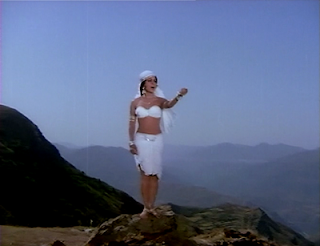
Just to make the message that much clearer -- for those, I suppose, who have never been exposed to any kind of fictional narrative ever -- these scenes are interspersed with scenes of Kum Kum's character Ganga, dressed, to the extent that she's dressed at all, in pure white, standing alone on a high hilltop giving voice in song to her fears for Kishore's well being. Even considering the possibility that Ganga is able to, like the Mothra twins, project her song to its object over a great distance, she is outmatched in the battle for Kishore's soul. As a result, the young man falls like a house of cards, not only smoking the dope, but also guzzling the whisky, and, finally, taking to bed with one of the gang's female members.
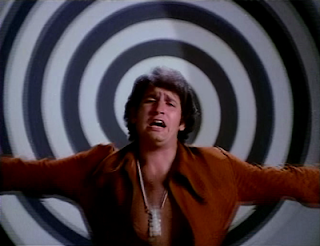
From here, Kishore's relationship to drugs follows the expected scare film trajectory, from opium and booze to mysterious "red pills" that cause hallucinations to a dependence on heroin, and from there to madness and rapid physical decline. Surprisingly, the closest thing he has to a savior throughout all of this is Malti, who, moved by Kishore's recounting of his love for Ganga, has started to see the error of her ways (and from which point on might as well be holding an "I am going to die" sign over her head). That is, until Ganga and her elderly father arrive in town, a situation that makes for a lot of amusing "fish out of water" hijinks, including a scene where Ganga's snakes get loose in Boss's nightclub and scare all the drugged out hippies.

As you might have gathered, Jalte Badan is a film that is indeed pretty conservative in its values. It's been said that the 70s were for India much like the 60s were throughout the West, with a marked increase in the type of student unrest that had been comparatively absent during the previous decade. As such, it's not surprising that some among the establishment might have viewed that unrest as being essentially "un-Indian" in character. Jalte Badan, following the classic "patriotic" Bollywood formula, goes so far as to imply that it is a willful and malignant import, and has the film's virtuous "straight" kids denounce the "bad" ones as being enemies of the country. Given that, I found those aspects of the film that were comparably progressive that much more startling.

For instance, I like that those aforementioned "good" kids are shown participating, along with the "bad" ones, in the student strike that's called early in the film. The only difference is in how each group spends their new found free time. While the bad kids' rebellion against authority is depicted as being essentially nihilistic and absent of any real political character ("long live youth, down with love", they chant at one point), the goodies dedicate their free time to activism in earnest, and launch a campaign to feed, clothe and house the poor of Bombay. Granted, it's an appropriately wholesome, socially approved form of activism, but the depiction shows that at least an effort was made on the part of the filmmakers to not present youth's passion for social change as a necessarily destructive force.

Even more surprising was a scene during the film's final act involving the character Girija, one of the straight kids, who is played by the actress Alka. Boss tries to entrap the unemployed Girija into a life of prostitution by luring her to his lair with the promise of a legitimate job, then having one of his thugs rape her. Girija, however, manages to fight the goon off and get the drop on both him and Boss. Boss then reveals to her that he's taken suggestive looking photographs of her grappling on the bed with his man, and threatens to release them publicly if she doesn't submit to his demands. At this point, I was fully expecting Girija to follow the old Bollywood route of offing herself in order to preserve her honor -- an expectation born of watching many Bollywood films in which just that happened, a majority of them being of more recent vintage than Jalte Badan. However, what we got instead was this:


Girija goes on to say: "Times have changed. You can go and print those photos everywhere. You can make posters of it. But remember, a decent girl's honor cannot be removed with her clothes." Pretty bad ass. (Of course, it helps a lot that she's holding a gun while saying all of this.)

Though Kiran Kumar does an impressive job of looking completely off his head on a variety of controlled substances, Jalte Badan is a film that truly belongs to its women. Alka's above described scene was, for me, the film's dramatic high point, even though the character of Girija disappears completely from the narrative from that point on. And Padma Khanna, by virtue of that one musical number alone, deserves to walk away with it all. As for Kum Kum, this film -- along with Lalkar -- proves that, in the early 70s, some ten plus years after we saw her starring opposite Dara Singh in King Kong, she was at her absolute peak of hotness. There's just something about Kum Kum's earthy sexuality that makes it seem like even the sight of her standing there fully clothed wouldn't have made it past India's strident censors, much less that of her doing a skimpily attired native fire dance, as she does here. Alongside that, she once again exhibits the flair for easy comedy that always makes her such an agreeable screen presence.

Overall, Jalte Badan is an effective, if florid, melodrama, the kind that, when there's no one else in the room, we can happily let ourselves be swept away by. And if its image of the threat posed by drugs is comically misjudged (which it is), we can perhaps, at least, luxuriate in the extravagant scorn it heaps upon those too quick to hand over control to lesser powers. ("You will lick the feet of the one who will kick you", spits one character at a strung-out Kishore.) Yet, for those of us who have lost people we care about to drugs, all of that tearing of hair and rending of garments might seem, in hindsight, like a more appropriate response -- in many cases preferable to the measured words and solicitous silences that, in the real world, so often enable the damage in the first place.


Tuesday, April 5, 2011

Dukhda Khame Ee Dikri (India, 1981)


Watching Dukhda Khame Ee Dikri proved that a second dip into the filmography of Gujarati superstar Naresh Kanodia on my part perhaps wasn’t entirely necessary. Then again, the disc was there, and –- given that this is one of those rare instances where I actually found a film I wanted to review on Netflix –- the longer it remained so meant a continuing logjam in my queue, meaning that it would also be that much longer before I received Cats & Dogs: The Revenge of Kitty Galore or whatever.

My experience with the first Naresh Kanodia film that I reviewed, Sorat No Saavaz, lead me to expect that Dukhda Khame Ee Dikri would be a similar mix of cartoony swashbuckling and chest-thumping revenge melodrama. Instead it was something else altogether: a maudlin chronicle of naggingly detailed yet ultimately unexamined female suffering of the type that, though common in Indian cinema, I have so far been pretty successful at avoiding.

This time around, Kanodia, unlike in Sorat No Saavaz, plays the child of privilege, Halaji, whose love interest is the lowly but lovely Chandan (Anjana). Hilaji and Chandan wish to be married, but Hilaji’s ma refuses to allow it, because Chandan’s father is suspected (wrongly, it turns out) of murdering ma’s brother many years previous. This leaves Chandan vulnerable to the machinations of her evil landlord, who, in return for forgiveness of a debt, strong-arms her father into promising her hand to the landlord’s wicked son Ruda. Hilaji and Chandan are determined to be wed, however, and end up pulling a wedding day switch-a-roo. As a result, Ruda unwittingly ends up married to Jivli, a village belle whom he ditched after robbing her of her honor, yet who still wants to marry him because she is now damaged goods and has no other options.

Chandan, for her part, ends up moving into Hilaji’s family home, where she is treated like a slave by Hilaji’s mother and sister-in-law while Hilaji is out gallivanting around with his comic relief sidekick who repeatedly breaks the fourth wall to needlessly explain plot points to the audience. Throughout, we are treated to a mournful, endlessly repeated song about how it is a woman’s place in this world to make sacrifices. Somewhere in all of this, Chandan rescues a cobra from a hunter, and in return the cobra bites her, giving her the gift of ESP. I know that sounds like something I made up to make this movie sound more interesting, but it’s not. And while you’d think it would bode well for the remainder of D.K.E.D., the sad fact is that this device only ends up being used to hurtle over a couple of minor narrative gaps later in the story.

Finally, the vengeful Ruda and Chandan’s nasty sister-in-law decide to steal a golden naag statue from a shrine in Hilaji’s home and frame Chandan for the crime. Ruda’s father casts further suspicion on the girl by insisting upon lending her father an exorbitant sum of money to pay Chandan’s dowry, and then later denying it. Faced with this denial, Hilaji chooses to believe the word of the father of his sworn enemy over that of his own wife, presumably because Ruda’s father doesn’t have a vagina. Hilaji then goes home and hits Chandan.

As opposed to Sorat No Saavaz, in which he was quite the high-kicking stunt machine, him slapping poor Anjana around is about the only evidence on view of Kanodia’s status as a man of action. Okay, he does have a couple of major fight scenes, one near the beginning and one at the end of the movie, and in both he ends up getting his ass resoundingly kicked. At the end, it is only due to Chandan’s ESP that he ends up being rescued from being buried alive by the bad guys. Once this is accomplished, and with all misunderstandings cleared up, Chandan is happy to fall back into his once again welcoming arms -- because, hey, he’s the “hero” and she is but a mere woman, even if she does have ESP and Hilaji can't fight his way out of a threadbare sock.

As I said, I’m aware that films of Dukhda Khame Ee Dikri’s breed are not uncommon in Indian cinema, the only difference between it and other examples being that I had done a much better job of seeing those others coming. Thus, I guess D.K.E.D. should at least be given credit for sneaking under my radar and giving me a face full. Hey, they can’t all be gems. But they also don’t have to be this.