Showing posts with label Amitabh. Show all posts

Monday, October 22, 2012

Shahenshah (India, 1988)


I’ve had Shahenshah in my sights ever since I reviewed the dreadful Amitabh Bachchan superhero joint Toofan a few years back. In that review, I mentioned that Toofan was one of a string of underperforming late 80s comeback vehicles that Bachchan released upon the abrupt end of his ill-fated foray into parliamentary politics. Shahenshah, also a superhero film, was both the first and the most successful of those comeback vehicles, which lead me to hope that it might be an improvement upon Toofan. Unfortunately, it seems that Toofan was merely an attempt to recapture the lighting that was Shahenshah, as the two have much in common, flaws included.

Shahenshah’s lengthy prologue sees the righteous policeman father of young Vijay framed in a bribery scandal by “J.K.”, an unscrupulous developer and all-around crumbum. Dad then – like a boss – hangs himself in the family home where his wife and young son are sure to be the first to find him (don’t do this). Flash forward a few decades and Vijay is now a policeman himself, albeit a buffoonish, betel leaf chewing one who appears to be accepting bribes for real from various corners of the underworld. Thing is, though, that those offering graft later receive a visit from Vijay’s alter ego, Shahenshah, a pitiless vigilante armed with the rope necessary to enact his self assigned job as judge, jury and executioner.


Shahenshah’s is sort of a de facto origin story, pretty much taking for granted that we’ve seen enough of these superhero shows to know that of course Vijay would reinvent himself in adulthood as a freakishly agile nocturnal avenger. And given the tendency of modern tent pole films to want to show us how our superhero sausage is made over and over and over again, it’s refreshing. Still, though, there are a few details I’d be curious to see fleshed out a bit. For instance, I’d like to know how Shahenshah settled on his costume, which involves a silver emo wig and a single chainmail sleeve, plus leather. I’d also like to know how Shahenshah, just being a normal guy, is able to so easily beat up several muscle bound and well armed goons in one go. (I know you can train, but doesn’t a life of crime also make a person pretty good at fighting? I mean, they’re called “toughs” for a reason.)
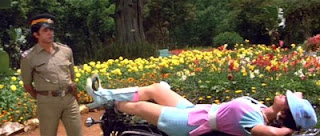
Finally there’s the suggestion that it’s Vijay the bumbling cop who’s the fictional persona, while Shahenshah is the real deal. We even see Vijay trying to integrate the two identities toward the end of the film, when he attempts to adopt Shahenshah’s righteous and fearless demeanor in his guise as a policeman. This split is also examined via that old shtick of having Vijay’s love interest (Meenakshi Sheshadri, who was also in Toofan) fall head over heels for Shahenshah and missing no opportunity to make unfavorable comparisons between the two. I would love to never see this particular trope played out again, but, then again, sticking to watching only films aimed at adults might do the trick in that regard.


In any case, it soon becomes obvious that Vijay is not accepting bribes in earnest but instead as a means of tricking the forces of corruption into revealing themselves. This plot point gains particular interest when you consider that Bachchan’s political downfall came as a result of his proximity to an influence peddling scam. Although the film’s screenplay was written by Santosh Saroj, it was based on a story idea suggested by Bachchan’s wife Jaya, which makes it tempting to wonder whether she had intended it as some kind of rebuke to Bachchan’s political critics. (Bachchan, by the way, was ultimately cleared of all wrongdoing, but felt burned enough by the experience to resign anyway.)

Shahenshah, like Toofan, suffers first and foremost from giving us far too little of its titular superhero and far too much of his goofy alter ego. This is especially frustrating because Shahenshah, on those rare occasions when he does show up, is pretty cool. He has a killer catch phrase (in response to a trembling goon asking “Who are you?”, his unvarying reply is, “I am greater than you. My name is Shahenshah!”) and there’s this weird Darth Vader noise that accompanies his every entrance. Vijay, by contrast, is a shrill annoyance. There’s just something about Bachchan’s mugging comic relief turns in these later films that strikes me as painfully undignified. I realize that, as a star of masala films, he had to master broad comedy as well as badassery, and that he played the fool on numerous occasions during his heyday. Yet, as in Toofan, there’s a desperation on display here that makes it feel as if he’s running a particularly humiliating gauntlet.


Compensating for Shahenshah’s weak center is a terrific cast of supporting players. Chief among these is the great Amrish Puri, whose presence alone elevates Shahenshah well above Toofan in terms of melodramatic stakes. In fact, J.K. is such a boilerplate Puri villain that the actor needs to make little more than a minimal effort in order to provide a satisfying baseline of bug-eyed, whisky swilling malevolence. (By the way, never turn down Chivas in a Bollywood movie -- as J.K. does in favor of Black Dog here -- or people will apparently lose their shit and figure out that you’re the Antichrist.) Also on hand is what Lazy Writing 101 decrees I call a “veritable who’s who” of iconic Indian character actors: Pran! Aruna Irani! Prem Chopra! And also Jagdeep in a giant cowboy hat and, at one point, nothing else.

Also in Shahenshah’s favor is the fact that it concludes with what is by far the most insane courtroom scene I’ve ever witnessed. This begins with Shahenshah delivering a key witness by driving a 4x4 through the wall of the courtroom, and continues with a defense attorney pulling a rifle on the judge and forcing him to make a false confession in order to prove a point of law. Finally there is a massive brawl that concludes with Shahenshah essentially lynching Amrish Puri right in the middle of the courtroom. (Sorry, spoiler.) As is the case with most vigilante movies, Shahenshah is peppered throughout with embittered diatribes about the sorry state of the legal system, and seeing as the legal system here is apparently run with all the restraint and integrity of an interspecies cage match, I see what they’re talking about.

Wednesday, February 24, 2010

Seven days of 70s Bollywood: Don

[This post is part of a week long blog-a-thon, masterminded by Beth of Beth Loves Bollywood, paying tribute to the films of 1970s Bollywood. Be sure to check out the other participating blogs for more about the best decade ever in the history of Indian film-making!]

Don (1978)
Directed by Chandra Barot
Written by Javed Akhtar & Salim Khan
Starring: Amitabh Bachchan, Zeenat Aman, Pran, Iftekhar
Music by Kalyani-Anandji


For many a ferangi viewer, Don was the gateway drug into 70s Bollywood. And while some were later disappointed to find that not all Hindi films from the period borrowed so liberally from American blaxploitation films, or had heroines quite so kick-ass as Zeenat Aman's Roma, many more found much that lived up to the promise of that initial dose. After all, the badassery of Bachchan, the killer funk of Kalyanji-Anandji, and the mad convolutions of masala appeared to have been in near inexhaustible supply during that decade. Of course, seldom did they come together quite so irresistibly as in this sure-fire little addiction starter.

Read Keith's review of Don at Teleport City.

Friday, December 4, 2009

Paa? Gaa!

This post will alert all of my in-the-know readers to just how out of touch I am with current Bollywood releases. I mean, who has time to keep up when so many of Dara Singh's old movies are being released on borderline unwatchable, unsubtitled VCDS? So rich and creamy is my obliviousness in this area that I have only just today become aware of Paa, a film released to India's theater screens this week amid much fanfare. It stars Abhishek Bachchan as the father of a 13 year old boy afflicted with the rare, age-accelerating disorder Progeria. And the actor portraying that boy? Why, it's Abhishek's 67 year old dad, Bollywood icon nonpareil Amitabh Bachchan! WTF?! That sound you hear is Oscar hungry, stateside father and son acting duos kicking each other in the ass for not having come up with this truly inspired concept in stunt casting first. Expect an American remake starring Tom and Colin Hanks to be in production by the end of the week.

People, remind me not to turn my back on Bollywood again. Because, obviously, when I do, things get really frigging weird

Wednesday, October 21, 2009

It's the 4DK Animalympics! Round 6


Badal from Mard

Skill Set: Telepathy, hand-to-hoof combat

Handicaps: Has trouble distinguishing between a real horse and a statue of one, which may limit his breeding potential.

Let's face it, we love Amitabh and the horse he rode in on. Even if, as in this case, that horse is upstaged somewhat by his canine costar. Sad, really, because Badal was just one stream of urine and Bob Christo's face away from being Mard's number one anipal. Nonetheless, let's give it up for Badal.

Wednesday, October 14, 2009

It's the 4DK Animalympics! Round 5


Allah Rakha from Coolie

Skill Set: Aerial combat, optic surgery, courier service

There has been some speculation that Allah Rakha from Coolie and Sheroo The Wonder Bird from Dharam Veer are one and the same, but that's simply not possible. Sheroo, after all, was a name star who got prominent billing in the earlier Dharam Veer. It's inconceivable that he would have accepted an uncredited role like that of Allah Rakha, even for the opportunity to work with Amitabh Bachchan. Still, despite being unable to prevent Amitabh from impaling his spleen on that table corner in Coolie's ill-fated fight scene, Allah Rakha shows a level of heroism approaching that of Sheroo by engaging in a dogfight with a helicopter during the film's prologue. Said scene is a joyful piece of unalloyed awesomeness that makes everything in Coolie that follows it pale by comparison, earning Allah Rakha his rightful place among the animal royalty paid tribute to here.

(Screen grab courtesy of Memsaab.)

Tuesday, September 2, 2008

Faraar (India, 1975)

Faraar is sort of a Bollywood take on the 1955 William Wyler film The Desperate Hours, but with enough twists of its own to make it far more than a simple remake or retread. Given my recent diet of overblown masala films, it was nice to be reminded that seventies Bollywood was capable of turning out taut, small ensemble dramas like this one.

In the film, Amitabh Bachchan plays a young artist who takes the law into his own hands after a rich man murders his sister and uses his wealth and influence to walk free. Now a murderer himself, Bachchan ends up hiding out in the house of the very police investigator (Sanjeev Kumar) who has been charged with tracking him down, taking the investigator and his family hostage. Complicating things considerably is the fact that the policeman's wife (Sharmila Tagore) turns out to be a former lover of Amitabh's -- and that Amitabh is privy to a secret former life of hers of which her husband is unaware.

Faraar is seriously entertaining, thanks to crisp direction by Shankar Mukherjee and good performances all around -- in particular a lean and hungry turn by Amitabh in the days just before the double whammy of Deewaar and Sholay would launch him into the upper reaches of superstardom. Almost overshadowing all of those contributions, however, is the film's set design, which, in the case of the family home where most of the action takes place, is simply masterful. The incorporation of marbled and tinted glass and a variety of latticework provides opportunities for all kinds of striking effects of light and shadow, as well as a number of evocatively constricting framing devices for the shots of the actors. As a result, rarely is anyone seen entirely clearly, making the house a perfect physical manifestation of the murky moral landscape in which its adult inhabitants find themselves.

I also really enjoyed Mukherjee's reliance on some somewhat old fashioned, but totally charming graphic-oriented visual storytelling devices:

After a flashback shows us the prosecution's version of events, the defendant has his say...

...but the psychedelically-colored negative effect tells us that it's all just a crazy tissue of lies.

Who will Sharmila choose? Sanjeev....

...or Amitabh?
The Amitabh-o-gram not only reads itself to you, but shows you Amitabh's face as it does.

All in all, Faraar brings to mind classic cinematic melodrama in the tradition of Douglas Sirk and Nicholas Ray, That, to me, adds up to a pretty high recommendation.

And, of course, Weng Weng as "Bobby".

Monday, August 11, 2008

Parvarish (India, 1977)

1977 was a very good year for Manmohan Desai. The director helmed four massive hits during that year, including one undisputed classic (Amar Akbar Anthony), one personal favorite of mine (Dharam Veer), one film that I know virtually nothing about (Chacha Bhatija), and Parvarish, a film that I watched over this past weekend.

Parvarish has pretty much everything you'd expect from a Manmohan Desai masala film: redistributed siblings who only discover their true parentage during the final fifteen minutes of the film, a villain with a lavishly appointed high-tech lair, primitive yet weirdly evocative special effects, and a star-stuffed cast -- including Amitabh Bachchan, Vinod Khanna, Shammi Kapoor, Neetu Singh, Shabana Azmi and Amjad Khan.

Shammi Kapoor actually has top billing here and, though he's well into the beardy obesity of his mid-life career, takes part in one musical number that allows him to show flashes of the goofy old Shammi that earned him that tribute. Amitabh and Vinod play the brother gone right and the brother gone wrong, respectively, and Neetu and Shabana play their love interests. The two female stars also provide a contrast to Bachchan and Khanna's brother roles by portraying sisters whose characters are so indistinguishable from one another that, if not for the need to pair them off with the male stars, they might as well have been one person. (Though if this was by design, or simply the result of a hasty writing job, I'm not entirely sure.) Finally, Amjad Khan plays the... oh, come on, you know what Amjad Khan plays.

Parvarish was just okay for me. It was a suitably diverting way to spend a lazy Sunday afternoon, but it lacked the wild plot convolutions and lysergic production design that made Dharam Veer so irresistibly compelling. Nor did it quite approach the level of overheated comic book narrative drive of another one of my favorite Desai films, Mard. What it did have, however -- in the form of Amjad's icicle-bedecked HQ with its red scrimmed perpetual go-go girls -- is one of the greatest supervillain lairs in the history of masala movies, right behind Sunil Dutt's wax-figure-laden, bubble-sauna-equipped digs in Geetaa Mera Naam. In addition to that, Neetu and Shabana perform a pistol-packing song-and-dance bit sure to please fans of the "Girls With Guns" genre. And finally, there is a Thunderball-inspired climactic scuba battle that packs all the overwhelming mitigating power of the Amitabh vs The Airplane sequence in Toofan (and yes, I really will use any excuse to link to that clip). And since Parvarish has nowhere near Toofan's number of sins to compensate for, that adds up to one big win-win.

Here, for your Monday enjoyment, is a brief sample of Parvarish's thrilling underwater action:

*The above poster comes from the fantastic Hotspot Online, a real rabbit hole of a site for dedicated fans of offbeat films in all their wonderful variety that'll suck you in for life if you're not careful.

Monday, July 14, 2008

Naseeb (India, 1981)

Naseeb is a huge, sprawling picture -- one that, for better or worse, gives Manmohan Desai, the king of over-stuffed 1970s masala movies, the opportunity to give free reign to his most extravagant impulses. It's so huge, in fact, that, on several occasions when Amitabh Bachchan showed up on screen, I realized that I had completely forgotten that he was in the movie. This is understandable when you consider that the film, not content to give us just one villain, gives us all of Amrish Puri, Amjad Khan, Prem Chopra and Kader Khan to torment our heroes, and also provides overlapping love stories that involve various combinations of Amitabh, Shatrughan Sinha and Rishi Kapoor and Hema Malini, Reena Roy and Kim. For a good part of Naseeb, it simply feels like plot elements are being unreeled like an endless fishing line without any of it ever coalescing into an actual plot, but then a hurried attempt to tie everything together in the final hour sends the narrative rocketing into the stratosphere. As a result, the viewer is rewarded for his endurance with a surplus of frantic spectacle, the highlights including some actually pretty competent for the time, Towering Inferno-style special effects, and a dramatic entrance by all three heroines, arriving to save the day on the back of a motorcycle that crashes through the exterior of Singha's fabulous glass-walled mansion (in slow motion, of course).

Naseeb is also famous for a sequence that became the inspiration for the touted all-star party scene in Farah Khan's recent Om Shanti Om. While the similarities are obvious, one difference that struck me was that -- while, in Om, Shahrukh was playing a Shahrukh-like superstar who could party with the assembled gods and goddesses of the screen on equal terms -- Amitabh plays a lowly waiter who has to serve the crowd of Bollywood royals, which includes some of his famous co-stars from previous movies. So, as much as I love the aforementioned scene in Om, I've got to say that Amitabh wins out over Shahrukh in terms of humility and good sportsmanship. I also loved that the event ostensibly being celebrated in Naseeb was the golden jubilee of Dharam-Veer, which occasioned the banquet hall being decorated by a giant standee of Dharmendra in his leather miniskirt.

Monday, June 2, 2008

Ganga Ki Saugand (India, 1978)

Ganga Ki Saugand is another one of those movies that I was going to watch eventually no matter what. It's an Amitabh Bachchan action thriller from his peak year of 1978 that not only pairs him with his greatest onscreen foe, Amjad Khan, but also with one of his greatest leading ladies, Rekha, and also features a score by the fantastic Kalyanji Anandji (Don, Qurbani, Bombay 405 Miles, etc.). And it's got Pran in it. That it still manages to be pretty mediocre just goes to show that there was no surefire formula when it came to these movies, though one suggestion might have been to not poop them out with such alarming frequency (this is just one of at least nineteen movies that the Big B appeared in between 1977 and 1979) and instead focus more on things like maintaining consistent narrative momentum and making sure that those things that are interesting about your film get more play than those things that aren't. Just a thought.

Things do pick up a lot during the last hour when Amitabh finally makes the transformation from village simpleton with a funny haircut to badass dacoit with a manly 'stache. It must also be said that Amjad Khan, for all his many dastardly turns, comes off as a particularly nasty little shit here, playing a thakur who banishes his own mom when she threatens to come between him and his apparent plan to rape every innocent young girl on his estate. Pran also has a nice role as a noble untouchable with a proverb for every occasion. My favorite line of his -- and I liberally paraphrase -- is when he tells a corrupt priest that bathing in the Ganges won't make him any purer because, after all, the fish that swim in it everyday don't stink any less.

Because it lacks the urban setting that would occasion some of their funkier freak-outs, K-A's score is relatively subdued, though still features some nice tunes. My favorite among these is a choice example of the "Prophetic Item Number", which is picturized in classic style. Khan's Jaswant Singh is simply too arrogant and filled with self regard to realize that the nautch girl is singing about what a douche he is and the terrible fate that awaits him, but Jeevan, playing one of his minions, keeps making these "Oh no, she di'n't" faces.

Ganga Ki Saugand ends with an Amitabh vs. The Airplane scene that presages the finale of Toofan, though it is in no way as wicked awesome (Amitabh refrains from going airborne). Still it does lead to a great/awful miniature shot in which a toy plane putatively containing Amjad Khan crashes into the Ganges. This conclusion underlines one of the picture's main themes: the Ganges as ultimate equalizer, making a mockery of man's systems of caste and class with it's unbiased giving and taking of life. I didn't hate Ganga Ki Saugand, and, if I hadn't come to it hoping for something brisk and funky along the lines of Be-Sharam, I might have enjoyed it more. Still it wasn't a star-on-the-calendar moment in terms of my ongoing relationship with Amitabh. Maybe next time.

Wednesday, April 30, 2008

The Amitabh Collection: Just in time for Summer

Be-Sharam is a brisk and somewhat trashy distillation of everything that's fun about Amitabh Bachchan's action films from his late 1970s heyday. For the uninitiated, that means you get a driving Hindi-funk score, lots of two-fisted action, and some truly mind-blowing menswear. See my full review, just posted over at Teleport City.

Sunday, April 20, 2008

No fan of Toofan

When Keith over at Teleport City says jump, I say "How high?" So when Keith asked me to review the 1989 Amitabh Bachchan superhero masala Toofan, I agreed, even though I had already seen the film and knew that, despite that one amazing clip on YouTube, it was a bit of a steamer. Still it's not without its points of interest. For one thing, it's one of the first films that Bachchan made after his disastrous venture into Indian parliamentary politics, at a time when the sheen of superstardom was rapidly fading and he desperately needed a hit. Needless to say, Toofan would not be that hit. Read my full review here.

Wednesday, February 6, 2008

Be-Sharam (India, 1978)

If you wanted to, it seems like you could draw up a sort of family tree of the films Indian superstar Amitabh Bachchan made during his late seventies to mid eighties prime, tracing each of those movies' origins along three very distinct lines, each leading back to a particular career-defining blockbuster that provided the template for much of what was to come. Of course, while Bachchan would star in films that were virtual remakes of Deewaar, Sholay and Don over the course of his career, the lines leading back to those three classics would not always be perfectly straight. For one would also have to consider films like 1978's Be-Sharam, which draw upon elements of all three...

Read the full review at The Lucha Diaries