Showing posts with label Shaw Brothers. Show all posts

Wednesday, August 13, 2014

"Call me Ping Pong, the boss of Hong Kong."


Supermen Against the Orient is not an easy film to watch. It's kind of racist; its theme song is terrible; and, with talent like Shaw brothers stars Lo Lieh and Shih Szu at it's disposal -- and Jackie Chan as its alleged fight choreographer -- it gives prominence to a toilet-based subplot over its action.

Still, I think that watching it made the Shout Down crew stronger... so much so that next time we're going to tweet along to a PowerPoint presentation about estate planning. We are that hard.

Anyway, below is the Storified transcript of Tuesday night's going on:


And here, as has become tradition, is a carelessly thrown together trailer for next month's Shout Down that I made on my phone:


Tuesday, August 12, 2014

Tonight! The 4DK Monthly Movie Shout Down withstands SUPERMEN AGAINST THE ORIENT


You know the drill, folks. Log on to Twitter tonight -- that's Tuesday, August 12th -- at 6pm PDT, using the hashtag #4DKMSD, and join the Shout Down crew as we gawp and gripe at the Italo-Hong Kong co-production Supermen Against the Orient. See Lo Lieh don a bright red super suit that just may be the greatest indignity he's ever suffered on screen! See the famous Shaw Brothers sets play host to mustache farmin' super studs who look like they stepped right out of an Umberto Lenzi movie! Feast your ears on the worst movie theme song OF ALL TIME! See so much that you cannot UNSEE!

The link to tonight's feature is below:


Like the song says, you'll be creamed, reamed, and, of course, redeemed. How can you miss out on that?

Tuesday, August 5, 2014

Next Tuesday: The 4DK Monthly Movie Shout Down suits up for SUPERMEN AGAINST THE ORIENT!

In a reflection of world events, it's everybody against everybody and Supermen against all in the next 4DK Monthly Movie Shout Down, in which we try to reckon with Supermen against the Orient. The film is a late entry in the confoundingly long-running series of Italian superhero spoofs featuring the Three Supermen, a trio of bumbling FBI agents and their gymnastics-enabling super suits. This one was co-produced by Hong Kong's legendary Shaw Brothers Studios -- who were apparently in a real "what the hell" mood at the time -- which allows for the appearance of Shaw Brothers stars Lo Lieh (King Boxer, aka Five Fingers of Death) and Shih Szu (The Thunderbolt Fist, Lady Hermit) alongside some of the Italian regulars. Sound interesting? Here, check out this trailer I made on my phone:


The fun starts at 6pm sharp PDT next Tuesday, August 12th. At that time, I invite you to join the Shout Down gang on Twitter as, using the hashtag #4DKMSD we tweet along to this goofy world pop cinema hybrid. I will provide a link to the film here on the blog on that date, or you can refer to the official Shout-Down site for both the film and further info on what this Shout Down business is all about.

In any case, I hope you'll be among us!

Wednesday, July 2, 2014

Ago Go 67 (Singapore, 1967)


Produced by Shaw Brothers’ Malay language division under the direction of Nordin Arshad, Ago Go 67 hews very closely to the template set by the “pop review” type of films -- think Pop Gear, or Live It Up -- that were issuing from Britain during the 1960s. We have two nice kids with dreams of stardom, disapproving parents, slick music biz types, rapturously frugging teens, and just enough of a plot to serve as the connective tissue between numerous musical vignettes showcasing the hitmakers of the day. Along the way, those of us at a historical remove from the proceedings are given an alluring snapshot of the Beatles-influenced “Pop Yeh Yeh” movement that was exploding throughout Malaysia at the time.

A pair of popular young actor/singers, Aziz Jaafar and Noor Azizah, respectively play Johari (“Joe”) and Fauziah. Fauziah works days as a shop girl while Joe labors at a stable with the film’s designated comic relief (S. Shamsuddin). Nights, however, are dedicated to practicing with their beat band, Dendang Perindu, which, as far as I can tell is played by the real beat band Dendang Perindu. This is an activity that Fauziah must keep secret from her father (Ahmad Nisfu), a blustering martinet who loudly objects to the youth music of today with all of its “yeah yeah yeah”-ing and such.


While visiting a recording studio at the behest of a slick music biz type played by Kuswadinata, the kids in Dendang Perindu see a poster for a record company sponsored talent showcase that just may provide them with their big break. It just may also provide Ago Go 67 with the opportunity to present us with a string of musical performance clips by groups with names like Wan Intan & The Mods, M. Ishak & The Young Lovers, The Terwellos, and Orchid Abdullah & Les Coasters.

One thing I learned from Ago Go 67 and my subsequent research into same is that the associations between Malay singers of the era and the bands who backed them up were somewhat transient, with the bands allying themselves with whichever performer opportunity -- or, perhaps, commerce -- smiled upon at that moment. For example, The Rythmn Boys (sic), who here perform behind singer S. Mariam, became one of the most in-demand backing bands on the scene after winning a Dave Clark 5-themed talent contest, and resultantly played with a number of different artists. On the other hand, singer Siti Zaitan, who here beams through an energetic, spy-themed number called “Alam Seni” to the accompaniment of The Hornets, was more often seen fronting a group called The Firebirds.


Despite defying the prevailing naming conventions, Denang Perindu ultimately win the big break we all knew they would. Unfortunately, as fate and the necessities of three act structure would have it, it is at this time that Fauziah’s father chooses to bring the hammer down on her musical activities. Providing further complications is Salvia, the singer for a rival band played by Malay sexpot Norma Zainal, who has unwelcome romantic designs on young Joe. It will take all of the moxie these teens can muster to make sure everything is set right before the producers of Ago Go 67 see fit to cram in another uninterrupted block of musical performances.

While Fausiah’s dad getting all het up about it provides the required note of generational tension, there really isn’t much on display in Ago Go 67 that one could imagine presenting much of a threat to the status quo. The music is undeniably fun, but lightweight, perfectly suited to the wholesome prancing of the clean cut -- shirts and ties for the boys, knee-length jumpers for the girls -- dancers who shimmy along to it.
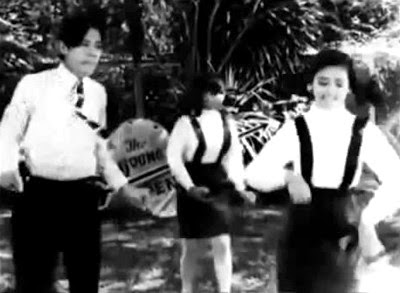

This is not to say that there are not standouts among the performances, the aforementioned Siti Zaitan & The Hornets’ being one of them. On top of that, there is the striking androgyny and haunting vocal of D4-Ever singer, D. Hatta, who came into this world as one Mohamed Hatta Abdul Wahab (like some Jewish American singers, Malaysian singers of the era appear to have had a tendency to deracinate their stage names -- perhaps understandably, given the racial strife that was gripping the country at the time). Elsewhere, Blind singer S. Jibeng -- rather than presenting himself as an inspirational figure like so many other disabled artists before him -- seems to be milking his condition for pathos with the song “Nasib si Butah” (“Blind Luck”). He starts by dropping his cane onto the set from off-screen, as if by accident, and then scrambles for it pathetically on the ground before launching into his mournful tune.

Also bearing mention is the level of musicianship on display in Ago Go 67, which is exceptional. The guitar instrumentals of groups like The Ventures and, especially, The Shadows had an enormous influence on Southeast Asian beat groups at the time, which is given ample testament here. The resulting prominence of busy and interweaving, melodic guitar lines requires a lot of lightning-fingered picking on the part of the axemen in these groups. This, of course, does not cancel out the need for showmanship, as equal prominence is given to lots of choreographed guitar moves -- a tradition that I wish would return, along with the practice, abundantly in evidence here, of conveniently labeling the kick drum head with the band’s name.


A movie like Ago Go 67 was likely seen as a quick money maker for Shaw, unworthy of the vibrant color lavished on its Hong Kong productions. Still, one can’t help wishing it could have been otherwise, especially when considering the delightfully campy designs of the individualized sets on which each group performs. All of the staple elements of 1960s variety show mise-en-scène are on view: the giant musical notes, the ascending rampways to nowhere, the stylized street scenes populated by bizarre, human-like effigies. Singer S. Mariam is even provided with an on-stage vanity table and mirror, into which she stares with delicious melancholy, like a Malay Francoise Hardy, brushing her hair absently as the intro plays. What M. Ishak & The Young Lovers did to have their song, “Menari Go-Go”, simply performed in someone’s backyard, I’ll never know.


I think it goes without saying that Ago Go 67, which is currently available in its entirety on YouTube, is a real treat for fans of world pop, be it of the musical or cinematic variety. If, like me, you are a fan of both, it is a little slice of heaven. As an added bonus, the steadfastly formulaic nature of its plot renders subtitles completely unnecessary. For example, I don’t need to speak Malay to know what Fauziah’s father, predictably humbled and chagrined at the film’s end, is saying. Darn those crazy kids!

Friday, December 6, 2013

Operation Lipstick (Hong Kong, 1967)


The Shaw Brothers’ spy movies are almost a genre unto themselves, so distinctive is that studio’s house style. Though, paradoxically, part of that style involves how reliably these films serve up the internationally agreed upon ingredients of the 1960s spy thriller. Take Operation Lipstick. Does it feature a kidnapped scientist? A henchman with a metal hook for a hand? A coveted microfilm containing plans for some kind of doomsday weapon? Yes, yes, and yes. But Operation Lipstick also has a secret weapon of its own in the form of Cheng Pei Pei, who -- despite the presence of the Shaws’ answer to Sean Connery, Paul Chang Chung -- is our hero for the evening.

Japanese director Umetsugu Inouye brings his usual cotton candy light touch to Operation Lipstick, exploiting Cheng Pei Pei’s background as a dancer more than he does the steely swordswoman persona she honed over the course of myriad wuxia films. Utilizing a backstage setting similar to that of his duo of Hong Kong musicals, Hong Kong Nocturne and Hong Kong Rhapsody -- the former of which also starred Cheng -- he gives the star a singing and dancing introduction, emerging from a giant cake to regale a nightclub audience with the sung details of her previous life of crime. In fact, you could say that, in terms of tone and style, Operation Lipstick inhabits a middle ground between Inouye’s musicals and campy espionage adventures like The Brain Stealers, perhaps sitting snugly aside romantic capers like his later The Venus Tear Diamond.


In the film, Cheng portrays Lee Bing, a former thief who now makes her living as a nightclub entertainer. When Chen Er (Lee Kwan), one of her former cohorts, narrowly escapes the police after stealing a wallet, the now straight arrow Bing insists that he return the wallet to its owner. This proves difficult, as, upon arriving at the man’s apartment, they not only find him murdered but the place overrun by armed goons. In the course of fleeing, Bing stumbles into Zhang Yee (Paul Chang Chung), a cavalier professional thief who, like the goons, is after the very wallet that Bing has in her possession.

Soon Lee Bing finds herself before the chief of the International Counter-Intelligence Organization (the subtitles say “anti-intelligence”, but I think that’s what they meant), who asks her help in apprehending an espionage ring called the Chu Loong Syndicate and, in the process, unmasking their shadowy leader Hung Ying. It turns out the wallet belonged to the assistant to a murdered scientist, who has hidden a microfilm containing the very valuable plans to that scientist’s new atomic weapon. In the wallet is a key that, it is hoped, can unlock whatever kind of container the microfilm is hidden in. The chief hopes that, by advertising her possession of the key, Lee Bing can draw the Chu Loong gang out into the open.


Fortunately, Lee Bing comes from a whole family of thieves -- overseen by her cheerily dishonest father Lee Peng (played by Pigsy himself, Pang Pang) -- who are happy to assist in her mission. Also happy to participate, but more importantly share in the spoils, is Zhang Yee. For the Chu Loong’s part, they immediately bring out the big guns in the form of dueling femme fatales, dispatching Tina Chin Fei’s Juan-Juan and Lau Leung-Wa’s Yu Mei Dei to flush out the key. Chin Fei, she of the revered Temptress of a Thousand Faces, poses as the widow of the wallet’s owner and, so she thinks, seduces Lee Peng into an alliance.

It is by following Juan-Juan that Lee Ping and her crew are lead to the microfilm’s assumed hiding place, a locker in a Turkish bath that instead turns out to contain a small lion statue. The bathhouse makes for the setting of an antic chase and fight between Chen Pei Pei, Chin Fei, and Lau Leung-Wa once Lee Ping snatches the statue, a chase and fight for which she, for some reason, feels compelled to strip down to just a bath towel... not that I’m complaining, mind you. Later, when markings on the statue indicate the existence of a second statue, Lee Ping’s dad, a forger of antiques, makes a replica of it, which Lee Ping takes to the Choo Loongs with an offer to sell.


And it is when Lee Ping arrives at the Syndicate’s front operation, an establishment called The Silver Dice Nightclub, that the slower among us get a clear idea of just how seriously Umetsugu Inouye and all those involved in Operation Lipstick really take the whole endeavor. For, you see, a trap has been set for Lee Ping. And as soon as she and her friends take their seats, a banjo playing trio takes the Silver Dice stage, boisterously introduced as being comprised of members of a “famous assassination organization”. We’ve already seen these guys backstage, placing guns inside their specially equipped banjos, and, once they hit the stage, they launch into a song that’s all about assassinations and killing people (sample lyric: “We are best at murder”), all the while pointing their banjos threateningly at Lee Bing’s table. What’s going on is pretty obvious, yet, when it finally dawns on Lee Ping, she looks like this:


Is Operation Lipstick an enjoyable film? Yes. Umetsugu Inouye seems to have been as incapable of making a movie that wasn’t fun and entertaining as Uwe Boll is of not sucking. Are his films lightweight? I prefer to say that they have an ease to them, a calm confidence born of a director riding the wave of his own cozily familiar passions, which in Inouye’ case is a passion for all the artifice, color, and froth that only the movies can give us. With a familiar collaborator in the person of Cheng Pei Pei, Inouye seems to be especially at ease with Operation Lipstick, and the results are breezy, beguiling, and boss.

Thursday, July 18, 2013

Dark Rendezvous (Hong Kong, 1969)


It's paradoxical, but it's gotten to the point where, if I haven't in a while muddled my way through an un-subtitled foreign film in a hapless display of half baked assumptions and clumsy guestimation, I feel like I'm letting you readers down. And so I give you Dark Rendezvous, a film about which this review will tell you as close to nothing as is possible while still warranting being called a review at all.

Dark Rendezvous is one of a handful of stylish thrillers from Shaw Brothers Studios that were long considered MIA until turning up a couple years ago on the Ziieagle Movie Box, a set so voluminous that it had to come on its own external hard drive. The film is less of a boilerplate genre entry than some of those other missing films -- like, for instance, 1967's near slavish Bond pastiche Kiss and Kill -- and so lends itself less easily to interpretation by a monolingual philistine such as myself. Still, I can clearly see that Dark Rendezvous features a suave private eye caught up in a web of intrigue (Ling Yun), a beautiful femme fatale with a knack for killing (Angela Yu Chien), and a mysterious nightspot called the BBB Club where patrons, staff, and entertainers alike all wear domino masks. That is, I can understand enough to know that I'd like to understand more.


The film was one of three Shaw titles shepherded by Japanese director Murayama Mitsuo between 1969 and 1970. Mitsuo's other work seems to consist largely of a string of war pictures produced by Daei during the same period. Still, despite an efficiency that put him at the helm of five pictures in two countries over the course of two years, the director clearly didn't see the need to skimp on style. In terms of visuals,  Mitsuo brings to Dark Rendezvous the best of both Japanese and Hong Kong pop cinema circa 1969: Starkly formalist compositions that make the most of the wide Shawscope frame and a sensual and effusive use of color that takes the studio's typically saturated palette to its limits.

While I did not understand a lot of what I was seeing while watching Dark Rendezvous, I did make a shit ton of screen caps of it. And so let those serve as a placeholder until I can find a translated copy of the film and give you a proper review. I hate to say it, but sometimes, in the battle between reviewer and un-subtitled films, the movie wins.


Saturday, March 10, 2012

Kiss and Kill (Hong Kong, 1967)


Though, for Western fans, the parsing out has been more of a trickle than a deluge, it looks like, if we all eat right and exercise, we just might live long enough to see all of those many Shaw Brothers films in the Celestial vaults that have yet to see DVD release. However, to those of you for whom that is the only reason you’ve been clinging to this mortal coil, I must warn that, thanks to the Shaws’ easy relationship with formula, you may be able to look forward to some thrills, but perhaps few surprises. Still, that doesn’t mean that life doesn’t offer some other very attractive incentives to stick around. For instance there’s -- oh, we’ve already lost a few, haven’t we?

Perhaps the above reason is why so much of Shaw’s long M.I.A. spy caper Kiss and Kill seems so cozily familiar. The studio took a fairly uniform approach to its mining of the James Bond craze and, in Kiss and Kill, that’s evidenced not only through a distinct house look, style and sound, but also the personnel involved. The film was directed by Japanese import Takumi Furukawa, who, under the pseudonym Daai Go-Mei, directed the earlier reviewed The Black Falcon during the same year (Takumi also worked for Nikkatsu, where he directed the initial film in the phenomenally popular “Sun Tribe” cycle, Season of the Sun, as well as the nihilistic crime drama Cruel Gun Story).


Continuing the happy associations, we have in front of the camera Paul Chang Chung, the actor whom, out of all the male stars to headline Shaw’s secret agent thrillers, seems to have been the one the studio most aggressively promoted as Hong Kong’s answer to Sean Connery. Chang’s suave-ish take on the unflappable superspy archetype graces not only the aforementioned The Black Falcon, but also the previous year’s The Golden Buddha and the yet unseen (by me) Umetsugu Inoue joint Operation Lipstick. Also no stranger to Shaw’s Bondian treadmill is actress Tina Chin Fei, who, in addition to her appearance here, also starred in the fabulous Temptress of a Thousand Faces, as well as Lo Wei’s Summons to Death. And to round things out, we also have a supporting cast rife with recognizable spy film faces, including reliable bad guy Tang Ti and the giant Siu Gam, who essentially reprises his role as a towering henchman from The Black Falcon.

All of which is not to say that Kiss and Kill doesn’t distinguish itself in some ways. From its cheesecake-laden opening titles to its rapid fire action set pieces to its pervasive tongue-in-cheek tone, it is, for starters, perhaps the most Bondian of all Shaw’s Bond-alikes. Furukawa’s lensing goes a long way toward establishing this, making up for the film lacking the globe-spanning scope of the 007 adventures with a richness of visual scope, exploiting to the fullest both Shaw’s typical widescreen process and saturated color schemes while also providing a lush depth of composition. It’s a look that is somehow distinctly Japanese (you’d think at times you were watching a Toho film of the era), giving the film a classy, modernist sheen that contrasts with the comic book flatness typically seen in, for example, Lo Wei’s many spy efforts.


While the version of the film I watched lacked subtitles, its elements were generic enough for me to follow along with a minimum of mental strain. As our macguffin, we have that old standby, the death ray, which in the opening scene is shown blowing to smithareens a toy jet straight out of a Gamera movie. And in pursuit of that death ray -- in competition with Chang’s good guy secret agent -- is the nefarious lady spy played by Chin Fei, who is not above stripping down to her granny panties to throw our hero off the scent. Chin Fei is part of a criminal organization whose food chain is topped by Tang Ti’s super villain, who is in turn in cahoots with a Caucasian who looks like a cross between a bellman and a soviet general. This latter character has a lair whose identifying insignia prominently features a bear, suggesting that this may have been one time when the normally politics-averse Shaw Studio decided to cast its villain within a recognizable geopolitical context, however noncommittally.

Chang’s search for the death ray eventually puts him on the trail of a mysterious woman played by Diana Chang Chung-Wen. A clue in the form of one of those conveniently discarded business cards that are often so helpful in these movies leads in turn to a truly fantastic nightclub sequence, and then, of course, to a big fist fight. Many fist fights, car chases and narrow escapes follow, leading to a climax in the villain’s subterranean lair that finds the four protagonists -- which now include the turncoat Chin Fei –- suspended side-by-side above an acid pit, all amusingly wearing the sheepish expressions of school kids who have been caught playing hooky.


Kiss and Kill is a film that does an awful lot of good-natured winking at its audience, and there are times at which its tone threatens to veer from the sardonic into the downright farcical. One lengthy episode involves Chang and his partner -- a borderline comic relief character played by Ngai Ping-Ngo -- going undercover as a married couple, with Ngai dragging it up as the wife. Nonetheless, Furukawa manages to maintain an impressive level of consistency, assuredly steering the film away both from being too violent or mean-spirited on the one hand or from falling too far into slapstick territory on the other. What Kiss and Kill ends up being instead is something agreeably breezy and lightweight, an entertainment as buoyant and fun as the twangy surf rock that accompanies so many of its onscreen brawls. Sure, we’ve seen a lot of it before, but among that there’s a lot that bears repeating.