Showing posts with label Naresh Kanodia. Show all posts

Tuesday, April 5, 2011

Dukhda Khame Ee Dikri (India, 1981)


Watching Dukhda Khame Ee Dikri proved that a second dip into the filmography of Gujarati superstar Naresh Kanodia on my part perhaps wasn’t entirely necessary. Then again, the disc was there, and –- given that this is one of those rare instances where I actually found a film I wanted to review on Netflix –- the longer it remained so meant a continuing logjam in my queue, meaning that it would also be that much longer before I received Cats & Dogs: The Revenge of Kitty Galore or whatever.

My experience with the first Naresh Kanodia film that I reviewed, Sorat No Saavaz, lead me to expect that Dukhda Khame Ee Dikri would be a similar mix of cartoony swashbuckling and chest-thumping revenge melodrama. Instead it was something else altogether: a maudlin chronicle of naggingly detailed yet ultimately unexamined female suffering of the type that, though common in Indian cinema, I have so far been pretty successful at avoiding.

This time around, Kanodia, unlike in Sorat No Saavaz, plays the child of privilege, Halaji, whose love interest is the lowly but lovely Chandan (Anjana). Hilaji and Chandan wish to be married, but Hilaji’s ma refuses to allow it, because Chandan’s father is suspected (wrongly, it turns out) of murdering ma’s brother many years previous. This leaves Chandan vulnerable to the machinations of her evil landlord, who, in return for forgiveness of a debt, strong-arms her father into promising her hand to the landlord’s wicked son Ruda. Hilaji and Chandan are determined to be wed, however, and end up pulling a wedding day switch-a-roo. As a result, Ruda unwittingly ends up married to Jivli, a village belle whom he ditched after robbing her of her honor, yet who still wants to marry him because she is now damaged goods and has no other options.

Chandan, for her part, ends up moving into Hilaji’s family home, where she is treated like a slave by Hilaji’s mother and sister-in-law while Hilaji is out gallivanting around with his comic relief sidekick who repeatedly breaks the fourth wall to needlessly explain plot points to the audience. Throughout, we are treated to a mournful, endlessly repeated song about how it is a woman’s place in this world to make sacrifices. Somewhere in all of this, Chandan rescues a cobra from a hunter, and in return the cobra bites her, giving her the gift of ESP. I know that sounds like something I made up to make this movie sound more interesting, but it’s not. And while you’d think it would bode well for the remainder of D.K.E.D., the sad fact is that this device only ends up being used to hurtle over a couple of minor narrative gaps later in the story.

Finally, the vengeful Ruda and Chandan’s nasty sister-in-law decide to steal a golden naag statue from a shrine in Hilaji’s home and frame Chandan for the crime. Ruda’s father casts further suspicion on the girl by insisting upon lending her father an exorbitant sum of money to pay Chandan’s dowry, and then later denying it. Faced with this denial, Hilaji chooses to believe the word of the father of his sworn enemy over that of his own wife, presumably because Ruda’s father doesn’t have a vagina. Hilaji then goes home and hits Chandan.

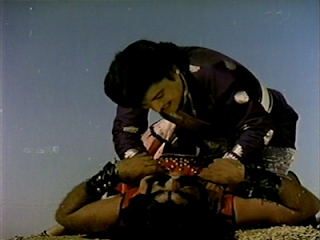
As opposed to Sorat No Saavaz, in which he was quite the high-kicking stunt machine, him slapping poor Anjana around is about the only evidence on view of Kanodia’s status as a man of action. Okay, he does have a couple of major fight scenes, one near the beginning and one at the end of the movie, and in both he ends up getting his ass resoundingly kicked. At the end, it is only due to Chandan’s ESP that he ends up being rescued from being buried alive by the bad guys. Once this is accomplished, and with all misunderstandings cleared up, Chandan is happy to fall back into his once again welcoming arms -- because, hey, he’s the “hero” and she is but a mere woman, even if she does have ESP and Hilaji can't fight his way out of a threadbare sock.

As I said, I’m aware that films of Dukhda Khame Ee Dikri’s breed are not uncommon in Indian cinema, the only difference between it and other examples being that I had done a much better job of seeing those others coming. Thus, I guess D.K.E.D. should at least be given credit for sneaking under my radar and giving me a face full. Hey, they can’t all be gems. But they also don’t have to be this.

Sunday, March 6, 2011

Sorat No Saavaz (India, 1985)


The Gujarati film Sorat No Saavaz has a storyline that's well familiar from other regional South Asian films of its day: a roiling stew of crossed romances, solemn vows of honor, rape, revenge, fists-to-the-heavens melodrama, mustaches, dishBOOM, and, of course, lots of wearingly broad comic relief. Like the Telegu action films of K.S.R. Doss, or those of Punjabi superstar Sultan Rahi, it is not just unsubtle, but anti-subtle. In an early musical number, Sonal, the lover of Amar, our hero, sings, "My pot is new", while helpfully indicating her rear end, and playfully admonishes Amar not to break it. Later, when the evil bandit Joravar rapes Amar's crippled sister, the camera moves away from the crime to show us a pot breaking. The girl, as was and is depressingly common in these films, then takes her own life, and farther on down the road, when it is time for Joravar's comeuppance, Amar mercilessly beats him with her crutch, which he has been saving for the purpose.
Amar is played by Naresh Kanodia, one of Gujarati cinema's most beloved stars. Here Kanodia embodies a somewhat softer version of the righteous commoner hero commonly played by Sultan Rahi, but departs from Rahi in that he appears like he might have known joy at some point in his life. For one thing, he has a number of songs pictured on him, something that I have yet to see Rahi do in one of his films (Rahi typically just folds his arms grumpily and stands in for the tree that Anjuman would otherwise be frolicking around.) This being in touch with his tender side also allows Kanodia to indulge in a bit of peacock-ery, accompanying his blindingly white jodhpurs with a series of increasingly colorful, flouncy man blouses.


In Sorat No Saavaz, Kanodia's Amar stands at the center of a palaver born of lust, jealousy, and, at least in some cases, just plain old horniness. While he is in love with the village belle Sonal (she of the crockery-based euphemisms for virginity), Sonal is in turn coveted by Guman, the Queen's conniving administrator. Meanwhile, the Queen of the small kingdom in which Amar and Sonal live becomes smitten with Amar after seeing him win the kingdom's annual horse race. The Queen, it should be said, is a woman of appetites, as we see her, on more than one occasion, having her way with captive village men, whose exhausted bodies are then carted off by one of the Queen's hulking goons to be summarily tossed from a cliff into a nearby lake.

Fear not that a woman's possession of a libido will go unpunished, however. It is the classic fate of The Vamp that awaits the Queen, who realizes only too late the error of her "lusty nature", and has to suffer the full consequences for it despite her best efforts to make amends. What's interesting, though, is, for an Indian film, how frank Sorat No Saavaz is about those things that it chooses to be so suffocatingly conservative about. The Queen makes no attempts to be coy about her intentions toward Amar, telling the captive hero at one point -- via some oddly translated subtitles -- "Today I wish to play and enjoy with your body". Elsewhere, those scenes showing the aftermath of her forced liaisons with hapless villagers, while not explicit, are none too difficult to parse, either.

Though made in the 80s, Sorat No Saavaz should hit most of the sweet spots for those in love with the excesses of 1970s Bollywood. There is the classic "Everuhbody was-uh kung fu fighteeing" finale so essential to the best Masala films, with everyone and their mom joining in the climactic fray. Even the Queen sets aside her regal bearing to do some back flips and high kick some guys in the face. And then there is Amar's animal companion, a wonder bird by the name of "Sheru" (though, notably, not Sheroo; big difference) who, for the most part, is played by a life-sized puppet and is always ready to swoop down with talons at the ready whenever his master is in trouble.

If anything I have said about Sorat No Saavaz has indicated to you that it is at all intentionally thought provoking or engaging on a deeply emotional level, I apologize. It is neither. As far as I'm concerned, the only thing that you should take away from this is that it's the only Indian film I've seen that features what is essentially a female rapist, and that the hero has a life-sized puppet bird for a sidekick. That's a recommendation, by the way.