Showing posts with label Anthony M. Rud. Show all posts

Saturday, August 24, 2024

Weird Tales: The Thirtieth Anniversary

In its March issue of 1953, Weird Tales magazine printed a letter from Irving Glassman of Brooklyn, New York, in observance of the thirtieth anniversary of the magazine. Glassman had one other letter in Weird Tales. That one was printed in the May 1952 issue and reprinted in H.P. Lovecraft in "The Eyrie", edited by S.T. Joshi and Marc A. Michaud (1979). Glassman referred to H.P. Lovecraft in his first letter and made an oblique reference to Lovecraft in his second:

The Editor, WEIRD TALES
9 Rockefeller Plaza, New York 20, N. Y.

My calendar informs me that with the next issue WEIRD TALES celebrates its thirtieth anniversary. I would like to be among those who offer their congratulations to the most long-lived of all imaginative magazines.

I, myself, am too young to have read those early issues of The Unique Magazine but I have read many of those stories in later editions of WT as well as in the Arkham House books. I have in my library a copy of The Moon Terror which, I believe, was the first anthology of stories taken exclusively from your magazine. The Moon Terror is something of a rara avis today and I'm quite proud to own that book.

It would be fitting on this occasion to present a list of what I consider to be the ten best stories to have appeared in WT but such a task, I find, is impossible. At least 50 outstanding phantasies come to mind and there are more than that number which are equally good but which have, for the moment, escaped my memory. For every poorly-written tale that is printed in WT (and that only proves that the editor is human, after all) there are at least a dozen readable ones and of that dozen you will find that about half of them are potential classics. This is not merely my opinion; it is shared by all the readers of your Unique Magazine. Please keep up the good work.

Every best wish to you.

Yours by the Doom that came to Sarnath,
Irving Glassman, Brooklyn, N. Y.

There weren't very many Irving Glassmans in public records. Unfortunately, I can't say for sure who he was.

Weird Tales, March 1953, with a cover story "Slime," by Joseph Payne Brennan and cover art by Virgil Finlay. This is one of my favorite covers by Finlay for "The Unique Magazine." I think it's also one of his best. "Ooze" by Anthony M. Rud was the cover story for the first issue of Weird Tales in March 1923. "Slime" has some similarities to "Ooze." As I wrote recently, it also has some similarities to "It" by Theodore Sturgeon.

Original text copyright 2024 Terence E. Hanley

Sunday, June 2, 2024

Recent Reading No. 2

In our most recent weird fiction book club we read stories by Theodore Sturgeon (1918-1985). Although Sturgeon had eight stories in Weird Tales in 1947-1949, we didn't read any of those. Instead we read several that were in science fiction and fantasy magazines, beginning with "It," published in Unknown in August 1940.

On March 23 of last year, I wrote about swamp monsters in an entry called "The Internet Ooze, Blobs, Jellies, & Slime Database" (click here). Because I had never read it and didn't know anything about it, I did not include it--or "It"-- in my database. It definitely belongs there. I wonder if the monster in "It" was the first swamp monster or muck monster in literature.

Last year and the year before I wrote pretty extensively about Joseph Payne Brennan  as well as his story "Slime," published in Weird Tales in March 1953. In his writing "Slime," think that Brennan was very likely influenced by the first Weird Tales cover story, "Ooze" by Anthony M. Rud, which had preceded it in print by exactly thirty years. A couple of comic book writers and artists of the early 1950s also seem to have been influenced by "Ooze." See Beware #13 (Jan. 1953) and #15 (May 1953).

As I read the first few paragraphs of Theodore Sturgeon's "It," I was struck by the similarity between "Slime" and "It." See what you think.

Here are the first few paragraphs of "It" by Theodore Sturgeon:

     It walked in the woods.
     It was never born. It existed. Under the pine needles the fires burn, deep and smokeless in the mold. In heat and darkness and decay there is growth. There is life and there is growth. It grew, but it was not alive. It walked unbreathing through the woods, and  thought and saw and was hideous and strong and it was not born and it did not live. It grew and moved about without living.
     It crawled out of the darkness and hot damp mold into the cool of a morning. It was huge. It was lumped and crusted with its own hateful substances, and pieces of it dropped off as it went its way, dropped off and lay writhing and stilled, and sank putrescent into the forest loam.
     It had no mercy, no laughter, no beauty. It had strength and great intelligence. And--perhaps it could not be destroyed. It crawled out of its mud in the wood and lay pulsing in the sunlight for a long moment. Patches of it shone wetly in the golden glow, parts of it were nubbled and flaked. And whose dead bones had given it the form of a man?
     It scrabbled painfully with its half-formed hands, beating the ground and the bole of a tree. It rolled and lifted itself up on its crumbling elbows, and it tore up a great handful of herbs and shredded them against its chest, and it paused and gazed at the gray-green juices with intelligent calm. It wavered to its feet, and seized a young sapling and destroyed it, folding the slender trunk back on itself again and again, watching attentively the useless, fibered splinters. And it snatched up a fear-frozen field-creature, crushing it slowly, letting blood and pulpy flesh and fur ooze from between its fingers, run down and rot on the forearms.
     It began searching.

And here are the first few from "Slime" by Joseph Payne Brennan:

     It was a great gray-black hood of horror moving over the floor of the sea. It slid through the soft ooze like a monstrous mantle of slime obscenely animated with questing life. It was by turns viscid and fluid. At times it flattened out and flowed through the carpet of mud like an inky pool; occasionally it paused, seeming to shrink in upon itself, and reared up out of the ooze until it resembled an irregular cone or a kind of gigantic hood. Although it possessed no eyes, it had a marvelously developed sense of touch, and it possessed a sensitivity to minute vibrations which was almost akin to telepathy. It was plastic, essentially shapeless. It could shoot out long tentacle feelers, until it bore a resemblance to a nightmare squid or a huge starfish; it could retract itself into a round flattened disk, or squeeze into an irregular hunched shape so that it looked like a black boulder sunk on the bottom of the sea. 
     It had prowled the black waters endlessly. It had been formed when the earth and the seas were young; it was almost as old as the ocean itself It moved through a night which had no beginning and no dissolution. The black sea basin where it lurked had been dark since the world began--an environment only a little less inimical than the stupendous gulfs of interplanetary space. 
     It was animated by a single, unceasing, never-satisfied drive: a voracious, insatiable hunger. It could survive for months without food, but minutes after eating it was as ravenous as ever. Its appetite was appalling and incalculable.

By that, I think it likely that Brennan was influenced not only by "Ooze" but also by "It." Notice that both passages include the word ooze.

Here's something else to think about: modern-day squatchers believe that signs of Bigfoot in your woods include twisted trees. Here's a smaller passage from the larger passage above:

It wavered to its feet, and seized a young sapling and destroyed it, folding the slender trunk back on itself again and again, watching attentively the useless, fibered splinters.

So another connection is made between the swamp monsters or muck monsters of both fiction and comic books and the Bigfoot creatures of later pseudoscience.

Marvel Comics adapted "It" in the first issue of Supernatural Thrillers, published in December 1923. The cover artist was the essential Steranko.

Original text copyright 2024 Terence E. Hanley

Monday, September 4, 2023

Dr. Dorp by Otis Adelbert Kline

As far as I can tell, Dr. Dorp was the first series character to appear in Weird Tales magazine. Created by Otis Adelbert KlineDr. Dorp was in three stories all together, two in Weird Tales and one in Amazing Stories. Those three stories are:

  • "The Phantom Wolfhound" in Weird Tales, June 1923
  • "The Malignant Entity" in Weird Tales, May/June/July 1924 (Kline was editor of that issue.)
  • "The Radio Ghost" in Amazing Stories, September 1927

"The Malignant Entity" was reprinted four times, in Amazing Stories, June 1926; Amazing Stories Quarterly, Fall 1934; Strange Offspring (American Fiction #10), edited by Benson Herbert and published in 1946 by Utopian Publications Ltd.; and Amazing Stories, February 1966. Although it's a little derivative, "The Malignant Entity" is the best in the series, I think. If any one of them was going to be reprinted, this one was it.

Dr. Dorp is an occult detective. His identifying characteristic is his gray van dyke beard. He might have a personality. If he does, it doesn't show very well in the stories, which include a lot of exposition. Kline's investigator was probably based on a combination of Sherlock Holmes and William Hope Hodgson's Carnacki, the Ghost-Finder.

* * *

"The Phantom Wolfhound" was in the issue of June 1923. It opens like "The Weaving Shadows" by W.H. Holmes, which was in Weird Tales in March 1923, with the investigator in his home being visited by a detective and the detective's client. The detective is named Hoyne, whereas Holmes' detective is named Rhyne. So Hoyne in Kline and Rhyne in Holmes. The client is named Ritzky. He is an older man who shares his household with his twelve-year-old orphaned niece. In other words, this is something of an Uncle story. And in other words, the girl is of the right age to bring on some poltergeist activity. (There is a girl in "The Weaving Shadows," too.) Dr. Dorp and Detective Hoyne witness ectoplasm, called "psychoplasm," issuing from her mouth as she sleeps. Dorp takes a sample of the stuff, which is an actual material substance, just as in "The Thing of a Thousand Shapes," Kline's serial from the March and April issues of "The Unique Magazine."

Dr. Dorp is called a "psychologist" in this story. He is the author of a book called Investigations of Materialization Phenomena. Like Carnacki, he uses mechanical equipment to detect ghosts. Again, as in "The Thing of a Thousand Shapes," ghosts or spirits are treated as material phenomena. Sir Arthur Conan Doyle is referred to in the story, as is Baron Von Schrenk, also known as Albert Freiherr von Schrenck-Notzing (1862-1929), a real-life investigator and author of Phenomena of Materialization: A Contribution to the Investigation of Mediumistic Teleplastics (1923). Dr. Dorp's title is similar to Baron Von Schrenk's. Both "The Phantom Wolfhound" and Von Schrenk's book were published in 1923.

Professor James Braddock, the uncle in "The Thing of a Thousand Shapes," is Dr. Dorp's friend and colleague, although he doesn't make an appearance in the story. Like that earlier story, "The Phantom Wolfhound" is set in Chicago. ("The Thing of  Thousand Shapes" is also set near Peoria, Illinois.) There are detailed descriptions of a complex physical environment within the Ritzky home. That's okay, I guess, in a detective story, but descriptions of complex environments don't really make for good prose or good storytelling. James Agee was able to pull it off in Let Us Now Praise Famous Men, but then that was a documentary work.

"The Phantom Wolfhound" is, like I said, an Uncle story. As it turns out, the uncle was slowly poisoning his niece so that he could get her fortune. She kills him off with her psychoplasmic hound, which Uncle had shot in life. The hound comes back in death and the niece thereby exacts her revenge and defends herself against impending murder at Uncle's hands. The story ends in all italics.

Dr. Dorp is not like Sherlock Holmes in that he doesn't have a discernible personality. Hoyne acts as his Watson, and the dead Russian wolfhound as something like the Hound of the Baskervilles.

* * *

"The Malignant Entity" was in the triple-sized anniversary issue of May/June/July 1924, edited by Otis Adelbert Kline. It's definitely the better of the two stories. And like the first Dr. Dorp story, it's connected to an earlier story, for "The Malignant Entity" is essentially "Ooze" in the city. (As you know by now, "Ooze," by Anthony M. Rud, was the cover story of the first issue of Weird Tales, March 1923.)

Mr. Evans, a writer, is the narrator of the story. ("The Phantom Wolfhound" is told in the third person.) Chief McGraw is a detective, and there are two Irish police officers, Rooney and Burke. Other characters include a fingerprint expert named Hirsch and the coroner, named Haynes. Haynes was in Kline's earlier story "The Corpse on the Third Slab" (Weird Tales, Aug./Sept. 1923). There is also mention of a dead man named Immune Benny, who "is alleged to have committed numerous crimes, among which were several revolting murders, without ever having been convicted." We don't know it yet, but Benny appears to have been a psychopath. His face shows up at the end of "The Malignant Entity," and the story itself ends, once again, in all italics.

There is another dead man. He was Professor Albert Townsend, who, although he was a professor and although he was named Albert, was not the same man as Professor Albert Randall in "The Thing of a Thousand Shapes." And his daughter, named Dorothy, is not the same daughter as in Kline's previous story. Her name is Ruth. Both Dorothy's mother and Ruth's mother are missing in action. Note to all women: never marry a scientist or pseudoscientist engaged in research on the fringes. Yes, you will have a beautiful daughter, but then you will die.

Dr. Dorp says of Professor Albert Townsend: "Who hasn’t heard of him and his queer theories about creating life from inert matter?" After a while, Dorp adds, "He has been working day and night in his effort to prove his theory that a living organism can be created from inorganic matter." Townsend's subject was protoplasm, the stuff that was supposed to have been in the primordial ooze from which all life spontaneously arose. In other words, Townsend was pursuing a pseudoscientific idea held by supposed scientists and science-minded people from the 1800s even unto today. Look where it got him.

In "Ooze," the giant amoeba lives in a pond on the grounds of a backwoods Alabama estate. In "The Malignant Entity," it's in a vat of "heavy albuminous or gelatinous solution" in Townsend's laboratory. In a long and interesting passage, Dr. Dorp postulates:

     "What is life? Broadly defined as we recognize it on this earth, it is a temporary union of mind and matter. There may be, and probably is another kind of life which is simply mind without matter, but we of the material world know it not. To us, mind without matter or matter without mind are equally dead. The moneron [sic] has a mind--a soul--a something that makes it a living individual. Call it what you will. The professor's cell of man-made protoplasm has not. Can you conceive of any possible way in which he could, having reached this stage, create an individual mind or soul, an essence of life that, once united with his cell of protoplasm would form an entity?"

     "It seems impossible," I admitted.

     "So it seems," he replied, "yet it is only on such an hypothesis that I can account for the mysterious deaths of the professor and Officer Rooney."

     "But I don't see how a moneron [sic] or a creature remotely resembling one could kill and completely devour a man in less than two hours," I objected.

     "Nor I," agreed the doctor. "In fact I am of the opinion that, if the professor did succeed in creating life, the result was unlike any creature large or small, now inhabiting the earth--a hideous monster, perhaps, with undreamed of powers and possibilities--an alien organism among billions of other organisms, hating them all because it has nothing in common with them--a malignant entity governed solely by the primitive desire for food and growth with only hatred of and envy for the more fortunate natural creatures around it."

I have speculated before that the psychopathic killer is a blank, that is, a man without a soul. In Dr. Dorp's theorizing, maybe that killer is matter without mind, i.e., without spirit or a soul. The psychopath kills, and so does the giant amoeba or murderous cell in "The Malignant Entity." Being without a soul, it envies and hates those beings that have souls, or an animating spirit. (Remember that anima means "soul" or "spirit.") One of my ideas is that the psychopathic killer wants to know what makes us go, and so he cuts us apart in order to get at what he can only believe is the mechanism beneath the skin. Knowing that he lacks something but not knowing what it is, he is murderously envious and full of hatred for the rest of humanity.

There is a memorable sequence in "The Malignant Entity" in which Dorp and his associates chase the nucleus of the cell around the laboratory like in the old sing-along activity of following the bouncing ball. The nucleus escapes but remains within the building. Described as "plasmic jelly," it consumes a mouse in the basement, and that's where it is finally caught. The nucleus is also described as putting out pseudopods, and at one point it is said to look like a cuttlefish, which is of course a tentacled creature. Now we're back to earlier themes in this series on one hundred years of Weird Tales. In his diary, discovered in a hidden safe, Townsend wrote that his giant amoeba was made of "syntheplasm." Townsend finally brought it to life on September 23 of an unknown year. Maybe that was one hundred and one years ago this month.

In "The Malignant Entity," Otis Adelbert Kline continued in his habit of mixing real people and fictional characters in his stories. In this case, the real-life psychic investigator was Sir Oliver Lodge (1851-1940). That leads to a broader point, namely, that Kline seemed to have been building a universe of interconnected characters, themes, and concepts, drawing from his own stories but also seemingly inspired by other authors published in Weird Tales. He even has his own grimoires in books written by real-life investigators. If this had been Lovecraft, we might call it a mythos.

* * *

Published in Amazing Stories in September 1927, "The Radio Ghost" takes place in the Chicago area, just like its predecessors. Once again, Evans is narrator. There's another niece, Greta Van Loan, and her uncle, the late Gordon Van Loan, who like other uncles in Kline's stories is an investigator of psychic phenomena. Her cousin is Ernest Hegel, who turns out in the end to be a Scooby-Doo-type villain. There is mention of the Society for Psychical Research, also of real-life psychic and medium Eusapia Palladino (1854-1918). (She was real-life. Being a psychic and a medium is of course not real-life.) Fictional characters are Easton, a civil engineer; Brandon, an electrical engineer; and detectives Hogan and Rafferty. Hogan has an Irish accent. Among the words in his vocabulary is shenanigans.

Radio figures pretty prominently in "The Radio Ghost." The title tells you as much. Remember that the last of these Dr. Dorp stories was in a magazine published by radio and television pioneer Hugo Gernsback. Gernsback's book Radio for All, published in 1922, is mentioned in "The Radio Ghost." I would call that an early example of product placement in a work of fiction. In fact, I detect in the whole story a strong odor of commercial promotion of Gernsback, his products, and his ideas. There are detailed descriptions of technology in "The Radio Ghost," as was so common in early science fiction. It's no wonder Gernsback published this story, although you might consider that "The Radio Ghost" is not even really a story but a how-to and a speculation on radio and the uses of radio, then and into the future.

* * *

Otis Adelbert Kline was an interesting case. He wasn't the best or most imaginative author. He was entirely too caught up in the nineteenth-century hoax/fraud of Spiritualism, mediumship, and ectoplasm. And yet he was capable of formulating interesting ideas as a basis for his stories. The passage quoted above about mind and matter suggests an insight into a human problem, that is, of the man who hates his fellow creatures because he cannot understand them, coming as he does from the outside, and lacking as he does a soul or spirit, or what makes a man a human being after all. Sometimes you feel like giving up on a writer after you have read a little of what he wrote. I'm not ready to do that yet with Otis Adelbert Kline. However, if a body of fiction is a coat, a writer should avoid hanging his on the hook of a shabby and pathetic belief system such as Spiritualism, Theosophy, Marxism, or Scientology. It will only end up on the floor, dusty and rumpled, trod upon and ruined.

William F. Heitman's illustration for "The Malignant Entity" by Otis Adelbert Kline in Weird Tales, May/June/July 1924. The character in the middle is Kline's occult detective, Doctor Dorp. That's poor Professor Townsend on the floor.

And an illustration by Frank R. Paul for Hugo Gernsback's Radio for All, published in 1922. The view is of an office worker fifty years into the future. Many of the things in this fanciful illustration have actually come about, though not necessarily by 1972 and not only by way of radio technology.

Original text copyright 2023 Terence E. Hanley

Monday, July 3, 2023

The Last of Colloids & Tentacles

A colloid is a suspension of one or more substances in another. Two thirds of the ingredients of a peanut butter and jelly sandwich are colloids. A long time ago, I knew a guy who liked banana and mayonnaise sandwiches. (They smelled like house paint.) Only one third of his ingredients--mayonnaise--is colloidal. Protoplasm is a colloid, too, so when John Corliss Cranmer's giant amoeba gulped down first his daughter-in-law, then his son, people were the meal and the colloid was the eater of the meal. But then the people were made of cells brimming with protoplasm, too, and so it was a case of one big colloidal mass eating lots of little ones--if you're a reductionist, that is.

The word colloid is from the French, originally from the Greek. It means "a substance in a gelatinous or gluey state," originally, simply, "glue." Colloid as a word and a scientific concept is from the mid-nineteenth century, as so many things in our daily lives and so many of the ideas in our busy little brains are. There are other gluey concepts in science, collagen, for example, also the subatomic particles called gluons. There are also gluey crafts and gluey art forms. The collage is the most obvious example of these.

People have made collages for a long, long time, but the collage as a work of art dates from the modern period, maybe from the eighteenth century, certainly no later than the nineteenth or early twentieth century. Georges Braque and Pablo Picasso made collages and coined the term papier collé. Those two artists, along with Juan Gris, were originators first of analytical cubism, then of synthetic cubism. In analytical cubism, the artist looks at his or her subject from many different points if view. That's why, in a work by Picasso for example, you can see both eyes in a portrait seemingly done in profile. So, no, Picasso's people are not part flounder. In synthetic cubism--I think a more playful and not so mathematically exacting variation--a work of cubistic art is synthesized by gluing together scraps and cuttings of paper, thus the collage or papier collé. I guess making collages would have been hard to do before there was a mass and popular press as a source of material.

In moving towards synthesis, or what we might call literary collage, modern authors followed modern artists, I think. The art seems to have come first--synthetic cubism was in flower, if you can call it that, in 1912-1914. Then came the literary works, "The Waste Land" by T.S. Eliot, for example, in 1922, Show Girl by J.P. McEvoy in 1928, John Dos Passos' U.S.A. trilogy in 1930-1936. I think we can include "The Call of Cthulhu" by H.P. Lovecraft (Weird Tales, Feb. 1928) in that list, too. Several stories in the first issue of Weird Tales (Mar. 1923) include notes, clippings, diary entries, and so forth, as if the story were a scrapbook or a collage. That kind of thing would continue in future issues.

"The Call of Cthulhu" also has an analytical approach, as do other works of weird fiction that refer or allude to weird geometries, outré mathematics, and multiple dimensions. Maybe pulp fiction wasn't very far behind mainstream literature in the 1910s-1930s in its move towards modernism. But maybe the pulp fiction genres--especially science fiction--were a little bit ahead because they were in such close contact with the scientific developments of their time. Mainstream authors of the early twentieth century could disregard science. F. Scott Fitzgerald, William Faulkner, Ernest Hemingway, and John Steinbeck didn't write science fiction. But then science and the future barged into the room and Walker Percy, Cormac McCarthy, and Margaret Atwood did and have. How times change.

There will be more on Ms. Atwood in a minute.

Dr. Frankenstein made a kind of collage using parts from different bodies, plus an Abby Normal brain. His goal was the synthesis of life from non-life. "I had worked hard for nearly two years," he wrote, "for the sole purpose of infusing life into an inanimate body." Lightning was the literal spark of life by which he would do it. And so his monster lived. A long line of proto-scientists, semi-scientists, pseudoscientists, and maybe the rarest kind, real scientists, has proposed that early in the earth's history lightning infused life in what they have called the primordial soup or primordial ooze, ooze being a species of colloid. Anthony M. Rud seems to have alluded to the primordial ooze--or jelly in H.G. Wells' formulation--in his story "Ooze" (Weird Tales, March 1923). Since the early nineteenth century, real-life scientists seem to have followed the example of Victor Frankenstein. We, the world over, recently had a deadly encounter with their Frankensteinian brand of science in the form of a lowly virus raised to the top of a Chinese/U.S. government-built Tower of Babel. They'll do it again. We can be sure of that. Next time it's likely to be worse, but that will be good for them because they can take more of what is ours in the process.

Life arising from non-life, called spontaneous generation, was debunked a long time ago. But I guess debunked things don't always stay that way. For example, there are yet again people who believe that a person can change his or her bodily form by some magical process of mind or by a series of practices they call "care," practices that the rest of us can only consider criminal, immoral, and unethical mutilations of the human body, a kind of witch-doctory or pseudo-medical falling-back on superstition, ultimately a literal diabolism. People who can supposedly transform themselves used to be called shape-shifters or skin-walkers, and they did what they did by supernatural processes. Now they go by a different name and we're supposed to believe that there is science behind it.

From the moment we ate from the tree of the knowledge of good and evil, we have believed ourselves to be as gods and to hold in our hands godlike power, godlike authority, and godlike wisdom. Our punishment was expulsion from the Garden and a realization of death. The difference is that we once knew shame and walked in shame, out of the gates and into exile. Now there isn't any shame, only pride, or Pride as it is now capitalized. Now we walk in history every day, as the worst among us might say. Anyway, I guess if we're gods, we can create and mold bodies and parts of bodies, just as Dr. Frankenstein did. In creating our modern-day monster, we will fashion his/her whole body--his veins, his feet, his hands, his organs--everything, including a Frankenstein's schwanzstucker made from the flesh of her forearm--according to our own whims. It won't be real, but we will be required to call it real and her a man. It will in fact be grotesque, a monstrous simulacrum, at once a symbol and a manifestation of our reaching into hell in our efforts to reach into heaven, where we believe we are or shall be enthroned. And, no, she's not gonna be very popular because of it.

Margaret Atwood, who has been called a TERF because she knows what everybody in the whole history of the world knew until ten minutes ago, famously said, "Science fiction is rockets, chemicals and talking squids in outer space." As we know, squids are cephalopods and the bearers of tentacles. So Ms. Atwood has offended not only people who don't know what a woman is, but she has probably also offended a lot of science fiction fans with her opinions on these things. If you're an offended Star Wars fan, though, you might want to just slink away, the reason being that in the Star Wars universe, there is a literal talking squid. His title is Admiral and his name is Ackbar, and though his tentacles are small (they're more like the barbels of a catfish), he is a member of a race called the Mon Calamari, meaning, in una bella lingua of a faraway planet spinning on its axis a long, long time in the future, squid. (The noun is Italian, the possessive pronoun French.)

There are other tentacled aliens in the Star Wars universe. Oola is one. Ahsoka is another. They have tentacles coming out of their heads. The Thermians in Galaxy Quest (1999) are, in their true form, tentacled. They are one form but take another. Call them trans, I guess. Cthulhu of course has tentacles. In Frank Frazetta's interior illustration for The Chessmen of Mars by Edgar Rice Burroughs (1922), there are tentacled heads, called Kaldanes in the story, that frighten and horrify Tara of Helium. In Gino d'Achille's  cover version, the Kaldanes are more spider-like. I believe the Kaldanes have both kinds of members, though, both tentacles and jointed legs. Maybe a Burroughs fan can let us know for sure. That reaching down through the neck to control a host body is also in The Puppet Masters by Robert A. Heinlein (1951), the Star Trek Episode "Operation -- Annihilate!" (1967), and, if I remember right, a skit on SCTV in which cabbage leaves attach themselves to the backs of people's heads. In the Star Trek episode at least, the controlling aliens are colloidal, made by the prop master from bags of fake vomit. By the way, the ninth book in Burroughs' Mars series is The Synthetic Men of Mars, originally published in 1939, and so we have another example of Frankensteinian synthesis in genre fiction.

Colloids are sometimes fun. Give a child a bottle of Elmer's Glue-All along with some construction paper and glitter and see how she entertains herself. But in science fiction, fantasy, and weird fiction, colloids are more often gross, nasty, disgusting, and revolting--when they are not creeping, crawling, encroaching, and deadly in the way shoggoths or the Blob is. We have a different reaction to tentacled creatures, owing, I think, to our hundred-thousand-year experience with them. They are real, discrete, recognizable, nameable, alive. They look back at us with the biggest eyes in nature. And the smartest of them are very smart. More than any of that, though, they seem alien in their star-shaped or radially symmetrical bodies. It's no wonder tentacled creatures became the aliens of science fiction, or more accurately, why science fiction authors, beginning with H.G. Wells, would have fashioned the tentacled creatures of earth into aliens from outer space. Maybe we have atavistic memories of when octopuses first came to our planet, raining down on us in their iron spaceships.

We were made in the image of our Creator, and so we wish to create, thus our art and literature, among so many other great and wonderful things, including most of all love, which allows us an escape into eternity. Where we make our mistake is in believing we can create or re-create the things that he first created. And so Frankensteinian scientists, engineers, and technicians are busy. They believe they can create life (or that life was created) from non-life. They believe they can alter unalterable facts about human nature, human anatomy, and human biology. They believe they can make of us something beyond human, better than human, other than human, transhuman. They're working on synthesizing new forms from fragments of previously existing ones. The coronavirus and a million dead are one result of that. The supposedly counteractive "vaccine" and a million more dead are another. They also believe they can transfer the human mind into a machine, thus surviving their own deaths.* In fact, they appear to see little difference between the ghost and the machine. One can be the other. One is the other. And so we will soon have machines taking the place of human beings. Soon after that, our machines will probably enslave or kill us. If you have never read "I Have No Mouth, and I Must Scream" by Harlan Ellison (1967), you probably should, like right now. It may give you a glimpse into our caliginous--not collagenous but caliginous--future. Anyway, thanks, scientists, but ultimately, thanks, all of us, for we have all done this. Scientists--others, too--are only at the vanguard of our limitless depravity in our fallen state. We fall. The asymptotic curve of our pursuit of perfection--of a perfect and limitless depravity--moves forever upwards.

-----

*Having eaten the forbidden fruit, they believe that the knowledge they have thereby gained will reopen the gates and allow them back into the Garden.

"To Tara's horror, the headless body moved, took the hideous head in its hands and set it on its shoulders." Illustration by Frank Frazetta from The Chessmen of Mars by Edgar Rice Burroughs.

Text copyright 2023 Terence E. Hanley

Friday, June 30, 2023

The Return of "Ooze"

I have a couple of things left over concerning the first Weird Tales cover story, "Ooze" by Anthony M. Rud. I also have something new.

The first Weird Tales cover and the only illustration in the first issue was Richard R. Epperly's depiction of the events in "Ooze." Epperly's illustration isn't of just one scene from "Ooze," though. In fact, it combines different characters and different parts of the story into one image.

In the illustration, a young man rushes in from the left, brandishing a rifle and a long knife. In the center of the image is a frightened young women in the grip of a monster, a kind of land-octopus.

However, in the story, Lee Cranmer, the son, is first on the scene. He carries only a rifle.

John Corliss Cranmer, the father, is next to arrive. By the time he is on the scene with his pistol and knife, his son and daughter-in-law have already been engulfed by the giant amoeba.

The wall, shown in the background of the illustration, comes later in the story. John Corliss Cranmer has it built in order to keep the amoeba from escaping.

And of course the creature is not octopoidal (if that's a word) but protoplasmic, an eyeless and limbless colloidal creature made from ooze.

And in the story to ooze it returned.

* * *

After beginning this long series on the origins of ooze and the first issue of Weird Tales, I read "A Song for Lya" by George R.R. Martin. This was part of our weird fiction book club, conducted by my friend Nathaniel Wallace. Thanks always to Nate.

"A Song for Lya" was first published in Analog Science Fiction/Science Fact in June 1974, forty-nine years ago this month. In other words, Mr. Martin's story came along about halfway between "Ooze" and now. It shows how much things had changed in the time before and how little they seem to have changed in the time since it was published. Anthony M. Rud came of age before the Great War. His story is set in 1913, in the year before the war began, you might say before a long, sad withdrawing of the sea of faith that formerly ringed the world, or, at least at that late date, America. Now we find ourselves high and dry.

In both stories, there is the image of a woman being absorbed by a blob or protoplasmic mass. In "Ooze," that image is horrifying, so much so that it drives the elder Cranmer insane. That shocking and terrible image, though not made so vivid in Rud's prose, is very vivid in my own imagination. It sticks with me even now. It's no wonder that Cranmer's mind went off its hinges, for he had seen what he had wrought in the most terrible of ways.

George R.R. Martin described his own ooze-like creature:

Its color was a dull brownish red, like old blood, not the bright near-translucent crimson of the small creatures that clung to the skulls of the Joined. There were spots of black, too, like burns or soot stains on the vasty body. I could barely see the far side of the cave; the Greeshka was too huge, it towered above us so that there was only a thin crack between it and the roof. But it sloped down abruptly halfway across the chamber, like an immense jellied hill, and ended a good twenty feet from where we stood.

And what it looks like when the creature, called the Greeshka, absorbs one of the natives of his faraway planet, the Shkeen:

     I looked. His beam had thrown a pool of light around one of the dark spots, a blemish on the reddish hulk. I looked closer. There was a head in the blemish. Centered in the dark spot, with just the face showing, and even that covered by a thin reddish film. But the features were unmistakable. An elderly Shkeen, wrinkled and big-eyed, his eyes closed now. But smiling. Smiling.

     I moved closer. A little lower and to the right, a few fingertips hung out of the mass. But that was all. Most of the body was already gone, sunken into the Greeshka, dissolved or dissolving. The old Shkeen was dead, and the parasite was digesting his corpse.

That is soon to be the fate of the title character, who seeks union and in realizing it leaves her lover, named Robb, behind. He's devastated, but maybe only a little and not for long. (Strange devastation.) On his way off of the planet, he hooks up with another woman, who is also seeking union but has failed to achieve it with her now ex-boyfriend, the planetary administrator Valcarenghi. Valcarenghi is an individual, with boundaries he has established around himself like the wall Cranmer has built to keep in the amoeba. He does not seek an individual- or boundary-dissolving union with another person. He also believes in God, though perhaps only in an offhand way. He appears to be an untroubled man, or a man who keeps himself and any troubles he might have very carefully under control.

In "Ooze," union with a colloidal creature is terrible and horrifying. No one wants it. The woman, John Corliss Cranmer's daughter-in-law, goes to her doom involuntarily. She is the prey of the amoeba. In Mr. Martin's story, on the other hand, union is made to seem somehow attractive and desirable. The title character Lya willingly goes to her own dissolution. She wants to lose herself and be joined in love with others within the mass of the Greeshka. Cranmer, creator of the giant amoeba, believes in God. Lya and her lover Robb do not. They are devoutly atheistic. By turning away from God, Lya believes that her only hope for love and union is--to reduce things in the way materialism and reductionism require--to be dissolved in protoplasm. To his credit, Robb doesn't want to go out that way.

In the twentieth century, as in all others, there were those who burned with a desire to lose their identities and their individuality by being taken into a mass of men. This was one of the insights behind The True Believer, subtitled Thoughts on the Nature of Mass Movements, written by Eric Hoffer and published in 1951. Little is known of Hoffer's origins or early life. Call him the Nictzin Dyalhis of a wider American philosophy and culture. He is supposed to have been an atheist, like Lya and Robb, who observes, "The Union is a mass-mind, an immortal mass-mind, many in one, all love." Mr. Martin may be an atheist, too. I can't say for sure. But that seeking after love and union, seemingly so necessary among us, also satisfied by a belief in God and actions based on such a belief, would also seem to be behind the worldly or atheistic drive after the dissolution of the self and of individual identity and autonomy. God offers us one thing. We refuse it and desire to replace it with something of our own making. Like children, we want to do it ourselves. And in the process, we--either gradually or suddenly--destroy ourselves or as much of the rest of humanity as we can. We need look no further than the murderous mass movements of the twentieth century--still alive in our own--as evidence of that. We seek after the eternal, the infinite, and the absolute without seeing that our seeking is in itself evidence of the Creator of all things eternal, infinite, and absolute.

I'll close by saying that being dissolved in protoplasm is in my view horrifying in both "Ooze" and "A Song for Lya." The difference is that it's made to sound not so horrifying and to be actually desirable in "A Song for Lya," at least by some of the characters in that story. I suppose that readers of today prefer the later horror over the earlier one, even if both are essentially the same. What a difference a century--actually only half a century, 1923 to 1974--has made.

"A Song for Lya" by George R.R. Martin was originally in Analog Science Fiction/Science Fact in June 1974. The cover art, by Frank Kelly Freas, is for a serial entitled "Stargate." Interior illustrations for "A Song for Lya" were by James Odbert. This is where the connections begin.

The author of "Stargate" was Tak Hallus, a pen name, the meaning of which, in Urdu and Persian, is apparently "pen name." In "A Song for Lya," the title character's lover is named Robb. I can't help but associate his name with the word robot, more distantly with the character Robby the Robot, in other words, with something mechanical, material, and non-human.

"Stargate" is also the title of a television show. The premise of the show seems to be based in an older concept, one example of which is in the novel Gateway (1977) and its sequels, written by Frederik Pohl. The main character in Pohl's Gateway is named Robinette. He is human. His psychoanalyst, a robot named Sigfrid, is not, though, like Pinocchio and Data, he wishes to be.

Anyway, like I said, Tak Hallus is a pen name. (It sounds like a character name in one of Nictzin Dyalhis' stories of Venhez and Aerth.) The author's real name was Robinett, Stephen Robinett to be exact, who also went by the name Stephen Robinette.

Robinett's first genre story was "Minitalent," also in Analog, in March 1969. In "A Song for Lya," the psychics Lya and Robb are called Talents, for their psychic powers. So in 1974, when "A Song for Lya" was published, decades had gone by and yet there were still stories about psychic powers in Analog, which was, before that, called Astounding Science Fiction, and which was, of course, edited by a man who believed he had discovered a scientific basis for such things. We're still waiting for his results.

I haven't read "Stargate" by Stephen Robinett. But I wonder if Frederik Pohl could have been inspired by him and his story in conceiving and writing his own novel Gateway. Or maybe his use of the character name Robinette is just a coincidence.

By the way, Matthew Arnold's poem "Dover Beach" (1867) figures very prominently in "A Song for Lya." I sneaked in an allusion to it earlier in this essay. "Dover Beach" is an essential poem. Anyone who reads in English ought to read it and know it and return to it, again and again, like a wave on the beach.

Original text copyright 2023 Terence E. Hanley

Wednesday, June 28, 2023

One Reader Responds to the First Issue

There are thirty-three items in the first issue of Weird Tales. Twenty-six are stories. Six are nonfiction fillers. The last is the letters column, "The Eyrie." I will look only at the twenty-six stories.

First, I'll set aside four of the short short stories. These are:

  • "Fear" by David R. Solomon
  • "The Closing Hand" by Farnsworth Wright
  • "The Sequel" by Walter Scott Story
  • "The Gallows" by I.W.D. Peters
These stories are not very well developed. None of them is especially good or interesting. "The Closing Hand" is one of the least interesting stories in the first issue, but it's not really offensive. "The Sequel" on the other hand is a swipe and an attempt to remake Edgar Allan Poe's original "The Cask of Amontillado." In my opinion, "The Sequel" is a story that should never have been written. Then again, maybe I'm taking it too seriously.

Next I'm going to cross out some stories that are either pretty poor or of only middling quality:
  • "The Ghost Guard" by Bryan Irvine--An unremarkable and pretty conventional ghost story.
  • "The Chain" by Hamilton Craigie--A lot of story to little effect. Craigie's protagonist is not very interesting. He could have been, but he isn't. Worse yet, Craigie's prose is overheated and pretty purple.
  • "The Accusing Voice" by Meredith Davis--An entirely implausible tale. In my opinion, the poorest or one of the poorest stories in the first issue.
  • "The Scarlet Night" by William Sanford--A short study in psychopathology and another pretty unpleasant story.
I don't like "The Dead Man's Tale" by Willard E. Hawkins. There is real cruelty in it and undertones of misogyny, if only in the narrator. "Hark! The Rattle!" by Joel Townsley Rogers is an interesting story, but it's too idiosyncratic, I think. The thing to do when you're telling a story is to tell your story and not put yourself or your technique on display.

"The Ghoul and the Corpse" by G.A. Wells is based in a good story idea, but it isn't very well done. The two main characters, for example, are basically lunkheads. They're like college chums instead of serious men. I think this was still too early in the evolution of science fiction, science fantasy, and weird fiction for an author of limited imagination and talent to have pulled it off, even if his idea was a good one.

"The Place of Madness" by Merlin Moore Taylor isn't a bad story, but it also isn't very strong or memorable. "Nimba, the Cave Girl" by R.T.M. Scott has the beginnings of a weird-fictional awareness of great scales of time and space, but it's marred by the author's sexual interest in his title character, also by its faintly Theosophical content. Like Scientology and other wacky belief systems, Theosophy makes me uneasy.

"The House of Death" by F. Georgia Stroup is not a bad story, but also not an especially strong one. It's brief and consists of a single episode, in truth a tale rather than a story. It tells of a sad and terrible event, something that's hard for me to take with all of the recent losses in my family. "The House of Death" is remarkable for being the first story by a woman author to appear in Weird Tales.

"The Skull" by Harold Ward is also based on a good and workable idea, but I think as readers we need someone with whom we can sympathize in a story. I remember how unpleasant it was to read Couples by John Updike (1968) because of its lack of sympathetic or likable characters. Only one character of that kind, one of the women, remains as such in my memory. I told myself I would never again read one of Updike's books because of the effect this one had on me and I never have. In getting back to "The Skull," you're kind of glad when the two main characters meet their ends.

"The Ape-Man" by James B. M. Clark, Jr., starts out well and does pretty well until you reach the anticlimax. I'm afraid the ending isn't very satisfying.

Now we come to a special case, that of Otis Adelbert Kline, author of "The Thing of a Thousand Shapes" and probably also of "The Young Man Who Wanted to Die." Willard E. Hawkins' story "The Dead Man's Tale," a story outright of the occult and of psychic pseudo-phenomena, came first in Weird Tales. "Ooze," an early science fiction story, came second. Third in order is the first installment of Kline's serial "The Thing of a Thousand Shapes." Whether Kline had read Hawkins' and Rud's stories or not, he seems to have attempted to bridge the gap between them, for his story, which also includes occult and psychic elements, is actually a kind of science fiction or science fantasy story. That's an interesting enough idea. More interesting in both of Kline's stories--I assume that "The Young Man Who Wanted to Die" was his--are the protagonists' travels through vastnesses of time and space. This was still early in the evolution of weird fiction. Kline wasn't there quite yet, and his protagonists' travels are not real or actual. They take place instead only in their own minds as they experience altered states of consciousness. In one case, it's a kind of dream-vision. In the other, it's a near-death experience. These two stories are not especially good. The inclusion of ectoplasm in "The Thing of a Thousand Shapes" really weakens it. But we can't simply dismiss them, the reason being that they are two of the earliest examples of weird-fictional odysseys and weird-fictional treatments of time and space to appear in Weird Tales. And they were written by a firsttime author.

"Ooze" is the most well-developed of all of the stories in the first issue. Written by a science-minded author--Rud was the son of two medical doctors and studied medicine himself--"Ooze" is fairly strong as an early science fiction story. It's also an early example of the monster made by science, in the mode of Frankenstein's monster. (I think we can call them both lab leak stories. If the coronavirus plandemic has done anything good at all, it has given us a real-world, unifying idea that may lie behind so much of our genre fiction, i.e., the lab leak, or, put another way, hubristic science gone wrong.) Good monsters make good jumping-off points for genre fiction. Swamp monsters are always popular. Beyond that, "Ooze" is probably the only story in the first issue that was capable of carrying it. I'm not sure that any other story could have provided such a strong centerpiece. Few would have made good cover stories.

That leaves what I think are the best or strongest--or maybe only my favorites--in the first issue of Weird Tales. In addition to "Ooze" these are:
  • "The Mystery of Black Jean" by Julian Kilman--An out-of-the-ordinary story, almost like a folktale, fairy tale, or fable.
  • "The Grave" by Orville R. Emerson--A really terrifying tale if you consider the possibility that it could have been based in fact. One of the most even and sober accounts in the first issue, at least in the voices of the two American soldiers.
  • "The Unknown Beast" by Howard Ellis Davis--Yes, it includes the n-word, but I think we have to disregard that as an artifact of early twentieth-century life in the South. Remember that word is used both by a white man and a black man in their everyday conversation. Beyond that, Ellis could have developed his story a little more and to greater effect.
  • "The Basket" by Herbert J. Mangham--Sober, concise, insightful, no flab, and no purple prose. I think that Marvin Kaye and John Gregory Betancourt were right to include this story in their anthology of the best of 1923.
  • "The Weaving Shadows" by W.H. Holmes--A flawed story to be sure and not fully developed, but interesting nonetheless. Possibly ahead of its time in the development of Weird Tales.
  • "The Extraordinary Experiment of Dr. Calgroni" by Joseph Faus and James Bennett Wooding--A little adolescent--its authors were very young when they wrote it--but still interesting. It could be a plot for a comic book story. Alternatively, it would have fit in with magazine science fiction of the 1920s and '30s.
  • "The Return of Paul Slavsky" Captain George Warburton Lewis--Another out-of-the-ordinary story for that first issue. The character Olga Slavsky is memorable, and what she does to one of the detectives is both weird and gruesome.
I think I have one more article on the first issue of Weird Tales. I would like to look at subsequent issues of "The Unique Magazine," but only in summary. In this, its centenary, we're still only partway through a look at that first year.

Vincent Napoli's illustration and the first page of the reprinting of "Ooze" by Anthony M. Rud in the January 1952 issue of Weird Tales.

Text copyright 2023 Terence E. Hanley

Sunday, June 25, 2023

Editors Respond to the First Issue

Out of twenty-six stories published in the first issue of Weird Tales, only four were reprinted in the era before books became something other than books, that is, before the early 2000s. "Ooze" by Anthony M. Rud has been reprinted most often, first in The Moon Terror, the first Weird Tales book, published in 1927. Farnsworth Wright was the uncredited editor of that collection. "Ooze" was also reprinted in the January 1952 issue of Weird Tales when Dorothy McIlwraith was editor. And it was reprinted in the expanded and enhanced edition of The Weird Tales Story, originally edited by Robert Weinberg and edited in this version by Bob McLain (2021).

Hamilton Craigie's detective story "The Chain" was also reprinted in Weird Tales, in November 1952, again under Dorothy McIlwraith. "The Mystery of Black Jean" by Julian Kilman was included in Angels of Darkness: Tales of Troubled and Troubling Women, edited by Marvin Kaye and published in 1995. Finally, "The Grave" by Orville R. Emerson and "The Basket" by Herbert J. Mangham were reprinted in The Best of Weird Tales: 1923, edited by the late Mr. Kaye and John Gregory Betancourt and published in 1997. And that's it as far as I know.

In The Weird Tales Story, Robert Weinberg briefly discussed "Ooze" without offering much of an opinion on it. "Less notable," he wrote, "was 'The Dead Man's Tale' by W.E. Hawkins," continuing with the judgment that "[t]he tale was an overtly sentimental muddle [. . .]." I'm not sure that I would call "The Dead Man's Tale" a muddle, but to me it's an unpleasant and cruel story that disregards the seriousness of the narrator's actions and the suffering of the man whose body he possesses, moreover of the man's wife, who is badly wounded in body and spirit by the dead man's actions.

Otis Adelbert Kline earned mention in Mr. Weinberg's essay. Kline's serial "The Thing of a Thousand Shapes" was his first professional sale. Unfortunately, according to Mr. Weinberg, "His first story was less than exceptional," indeed, "mediocre." (All quotes are from Chapter 4, page 19.)

Marvin Kaye was a dissenting voice when it came to "Ooze." He considered it to be "poorly written." He said as much in his introduction to The Best of Weird Tales: 1923. He also passed on Joel Townsley Rogers' "Hark! The Rattle!", calling it "a purple exercise." Kaye described "The Mystery of Black Jean" by Julian Kilman as "excellent," but he settled on "The Grave" by Orville R. Emerson and "The Basket" by Herbert J. Mangham for inclusion in his anthology.

An early announcement for the coming publication of Weird Tales called "The Dead Man's Tale" "a masterpiece of gooseflesh fiction," comparing it favorably to "The Murders on the Rue Morgue" by Edgar Allan Poe. Editor Edwin Baird was the author of that announcement. It appeared in the February 1923 issue of The Student Writer, which, as it so happens, was edited by Willard E. Hawkins, author of "The Dead Man's Tale." Baird's announcement and Hawkins' publishing of it looks like a case of "You scratch my back, I'll scratch yours." (Source: The Thing's Incredible! The Secret Origins of Weird Tales by John Locke, 2018, p. 31.)

There has been a lot of other opinion on the stories in that first issue. This is the Internet after all and any yahoo can say his piece among all of these electrons. 

Next: A Yahoo says his piece.

Original text copyright 2023 Terence E. Hanley

Saturday, March 25, 2023

Otis Adelbert Kline (1891-1946)-The First Serial

Otis Adelbert Kline (1891-1946) was a man of a dozen talents, a hundred friends, and a million words. He was an old-fashioned wordsmith who cranked out story after story over the years. As a manuscript reader, editor, and literary agent, he also helped other writers in their work. According to what I have found in the Internet Speculative Fiction Database and The FictionMags Index, Kline's two-part serial "The Thing of a Thousand Shapes" was his first published genre work. It was likely his first published story of any kind. It was also the first serial in Weird Tales, even if its two parts, taken together, still come out at only short-story length.

Along with Farnsworth Wright, who was also represented in the first issue of Weird Tales, Kline acted as a manuscript reader, helping editor Edwin Baird wade through myriads of submissions during that first year in print. After Baird's departure, Kline edited the first-anniversary, jumbo-sized issue of May-June-July 1924. He also wrote, anonymously, the Weird Tales manifesto in that issue, called "Why Weird Tales?" The first-anniversary issue of Weird Tales was the only one edited by Kline.

Kline's output declined in his later years, no doubt in part because of his work as a literary agent, including for Robert E. Howard. Like Howard and Lovecraft, he died prematurely, in his case at age fifty-five. I have written about Otis Adelbert Kline before. For his biography, click here. For that and other articles about him and his family, click on the label "Otis Adelbert Kline" on the right. (1)

Otis Adelbert Kline's Story:

"The Thing of a Thousand Shapes" begins with a letter summoning young William Ansley, the narrator of the story, to his uncle's farm outside of Peoria, Illinois. The summons, whether it be a letter, a telephone call, or some other kind of message, is a good and common way to kick off a story, especially a weird fiction story. In Kline's story, it gets the narrator out of the city and into an isolated rural setting, very often a necessity if weird events are going to unfold properly. Peoria might not be Arkham or Innsmouth, but at least it's not Chicago.

The setting is made definite not only by the mention of Peoria but also by the narrator's letting us know that he works as a bookkeeper on South Water Street in Chicago, also that his parents were killed in the Iroquois Theatre fire when he was twelve years old. That fire was a real and terrible event that took place in Chicago on December 30, 1903. My own family has a connection to the fire, as do many, I'm sure, in Illinois and Indiana. Like his protagonist, Kline was twelve years old at the time that it happened. At the time the events in the story take place, the protagonist Ansley is a young man. Presumably, then, "The Thing of a Thousand Shapes" is set in the 1910s or early 1920s.

Ansley travels to Peoria where his uncle and benefactor, James Braddock, lived and died on his 320-acre farm. That's a sizable piece of land, half a square mile, or half a section. Maybe the idea is that this is the equivalent of an English estate. Anyway, Ansley lets us know that Braddock was "a scientist and dreamer," adding: "His hobby was psychic phenomena." So maybe he was the equivalent of an eccentric English gentleman, too. The story takes place when scary stories should, in October. (October is the month in which Edgar Allan Poe died mysteriously.) Once at his uncle's house, Ansley begins experiencing and witnessing occult occurrences. He resolves to investigate these occurrences in a scientific manner. When a Professor Albert Randall and his beautiful daughter show up (what do genre fiction writers have against the mothers of beautiful daughters?), Ansley becomes assistant investigator. It is Professor Randall who solves the mystery at hand.

In its two parts, "The Thing of a Thousand Shapes" becomes a potpourri of psychic phenomena, complete with ectoplasmic manifestations, mental telepathy, automatic writing, mediums, trances, and hypnosis. There is talk of vampires and an onset of mass hysteria because of it. (Because this is America, the locals arm themselves with rifles, pistols, and shotguns rather than pitchforks and torches as they would in a European setting. Thank God for America.) There are also dream-visions and dream-regressions through time.

"The Thing of a Thousand Shapes" is not an especially good story, although I think we should give Kline a break. After all, this was his first published story. There's no real problem with his prose, nor with his plot or the mechanics of his story, although the scheme at the climax is convoluted beyond necessity. There's also a fair amount of melodrama and a pat, everything-turned-out-okay and they-lived-happily-ever-after Hollywood-scenario-type ending. I think the real problem with "The Thing of a Thousand Shapes" is that it came at the beginning of one hundred years of weird fiction. Its only material had come before it either by way of ancient folklore--i.e., the vampire myth--or from the nineteenth-century, mostly American hoax/pseudoscience of Spiritualism. In its sentimentality and somewhat melodramatic events, the story is also more or less from the nineteenth century. In short, Kline had only worn-out conventions with which to work. He wasn't ready yet for innovation and not yet developed well enough as a writer to come up with something very new. Put another way, Kline and writers like him had not yet figured out what weird fiction is, and there were not yet powerful, convincing, and vibrant substitutes for those old and worn-out conventions that came before it, Spiritualism of course being the most obvious example. Kline may have been onto something by taking a science-fictional approach to his story. He simply went down the wrong path in chasing after ectoplasm.

In "Ooze" by Anthony M. Rud, the previous story in that first issue of Weird Tales, there is a short discussion of what the author called "the pseudo-scientific story," what we now call science fiction. That passage acts in part, I think, as a guide to the reader, or as an explanation as to what the story and the magazine are all about. Call it the beginnings of a literary theory, or perhaps to an editorial approach that Weird Tales would take in this and its many issues to come. Well, there is a similar passage in "The Thing of a Thousand Shapes." In this case, Kline wrote in regards to the supernatural:

     "It is but a step," I reflected, "from the natural to the supernatural."
     This observation started a new line of thought. After all, could anything be supernatural--above nature? Nature, according to my belief, was only another name for God, eternal mind, omnipotent, omnipresent, omniscient ruler of the universe. If He were omnipotent, could anything take place contrary to His laws? Obviously not.
     The word "supernatural" was, after all, only an expression invented by man, in his finite ignorance, to define those things which he did not understand. Telegraphy, telephony, the phonograph, the moving picture--all would have been regarded with superstition by an age less advanced than ours. Man had only to become familiar with the laws governing them, in order to discard the word "supernatural" as applied to their manifestation. (2)
     What right, then, had I to term the phenomena, which I had just witnessed, supernatural? I might call them supernormal, but to think of them as supernatural would be to believe the impossible: namely, that that which is all-powerful had been overpowered.
     I resolved, then and there, that if further phenomena manifested themselves that night. I would, as far as it were possible, curb my superstition and fear, regard them with the eye of a philosopher, and endeavor to learn their cause, which must necessarily be governed by natural law.

With that passage, Kline placed the supernatural back under nature, thereby making it explicable by way of scientific investigation. The effect seems to be that this story of the supernatural, at the very least, can actually be seen as a kind of "pseudo-scientific story," similar in its way to "Ooze." In "The Thing of a Thousand Shapes," hypnosis and mental telepathy are accepted as valid, presumably scientific phenomena. There is also a scientific explanation offered for the existence of ectoplasm. As for the current state of Braddock in his casket and the tragedies that have befallen the local people, prompting their vampire hysteria, there is a medical, i.e., scientific, explanation for that, too. These events aren't so weird after all, meaning, they all have a scientific explanation, as long as you can accept Spiritualism as being based in science.

Unfortunately, Kline's transformation of one type of story--the supernatural story or ghost story--into another--the pseudo-scientific story--isn't very convincing, the reason being that he threw into "The Thing of  a Thousand Shapes" so many of the ragged and decrepit remains of nineteenth-century Spiritualism that it isn't able to take off very well. By 1923, discerning readers, writers, and thinkers would have known that there is nothing to Spiritualism. Harry Houdini was famously skeptical, but he wasn't alone. (Ambrose Bierce was also a skeptic.) Writing about Spiritualism at such a late date was like writing about the luminiferous ether after Albert Einstein had proposed his special theory of relativity in 1905, except that the existence of the ether was proposed in earnest, while séances, knocking, and ectoplasm are all frauds. You can differ with me if you'd like, but Kline was right when he wrote that there isn't anything above God. There is plenty worth exploring under God in his and our very mysterious universe, it's just that ectoplasm isn't one of them. What's missing from "The Thing of a Thousand Shapes" is an awareness of and apprehension of weird.

Speaking of God, both "Ooze" and "The Thing of a Thousand Shapes" mention him. If I had to guess, I would say that these things were offered in assurance to observers, readers, and critics that Weird Tales was not and would not be profane, godless, atheistic, or otherwise a bad influence on anybody. These stories are offered for fun, entertainment, and momentary distraction and not at all to subvert or corrupt anyone or anything.

"The Thing of a Thousand Shapes" is like Willard E. Hawkins' story "The Dead Man's Tale" in that automatic writing and the psychic or occult investigator make their appearance. The text of "The Dead Man's Tale" is presumed to have been composed entirely from automatic writing. The psychic investigator is mentioned only in the introduction to the story. In Kline's story, there is less automatic writing, but it comes at a turning point in the story. The role of the psychic investigator is far more prominent, and it is that investigator, Professor Randall, who figures it all out. By the way, Randall is dean of the local college. He and his daughter had gone to Indianapolis, only to return to Peoria when they heard of Braddock's death. So the two cities where Weird Tales was born, Chicago and Indianapolis, receive mention here. 

Again, "The Thing of a Thousand Shapes" is like "Ooze" in that it lets the reader know that the writer and editor know that God is still above everything. Both are also pseudo-scientific stories, although "Ooze" is far more convincing in that respect. Kline's story is unlike "Ooze" in that the scientist (the elder Cranmer in "Ooze") and the dreamer (the younger Cranmer) are combined in the same person, James Braddock in "The Thing of a Thousand Shapes." The narrators in both stories take on the role of investigator, Rud's narrator well after the fact, Ansley in the middle of things. Both take a scientific approach to their investigations.

By Charles Fort's theorizing, all phenomena are continuous, even if science has excluded and damned certain kinds. In his own theorizing on things natural versus supernatural, Kline seems to have followed Fort's lead. It seems likely that Kline, like many well-known and prominent tellers of weird tales, had read and would continue to read the works of Charles Fort. Fort himself wrote about psychic and paranormal phenomena in his last book, Wild Talents (1932), which you might say issued from his grave.

The "Thing" in Kline's title is ectoplasm, a kind of ooze that issues from Braddock's inert body in every shape and form. Ectoplasm is equated in the story with protoplasm. (There's even an amoeba!) In his investigations and theorizing, Professor Randall has postulated the existence of what he calls psychoplasm, a material substance that emanates from the bodies of people in a state of catalepsy. Ansley has unwittingly secured a residue of psychoplasm from a book he used to crush an ectoplasmic bat. (Could the book have been by Ernest Lawrence Thayer?) It is Randall's first sample of this substance. He examines it, concluding, "While it is undoubtedly organic, it is nevertheless remarkably different, in structure and composition, from anything heretofore classified, either by biologists or chemists." (From Part II of "The Thing of a Thousand Shapes," Weird Tales, April 1923, page 146.) Again, in "The Thing of a Thousand Shapes," supernatural things are reduced to merely natural ones, and all is explained by science.

Two more things about ectoplasm. First, it is sometimes supposed to be a fabric-like or fibrous substance. That's what made me think of cotton candy and Barbapapa. In Kline's story, it's more gelatinous. Second, in ufology, there is a substance called "angel hair." Its resemblance to ectoplasm is undeniable. UFOs or flying saucers are like the ghosts of the twentieth century, a technological manifestation of what was previously supposedly supernatural. Every encounter with a ghost and every sighting of a flying saucer turns out the same: "I saw something and then it went away (without leaving any evidence)."

I have covered both parts of "The Thing of  Thousand Shapes" here. Most of the action takes place in Part II, including a sequence in which Ansley dreams himself into the prehistoric past. He rushes from his dream into the path of a car. Professor Randall and his daughter Ruth are in the car, returning from Indianapolis (where Weird Tales came about and where C.L. Moore had just turned, in January 1923, the Golden Age of Twelve). It is Ruth that nurses him after he has been struck, and the three of them together save poor Uncle Jim.

One last thing: a distinction is made in Kline's story between urbane and well-educated people versus local farmers and other bucolic types. As always, there is an awareness of and a resorting to class distinctions in the popular fiction of the late nineteenth and early twentieth centuries. Arthur Conan Doyle did it in his Sherlock Holmes stories. So did George Barr McCutcheon in Graustark. Anthony M. Rud and Otis Adelbert Kline did it in Weird Tales. (Rud's bucolic character is a backwoods Cajun.) And of course H.P. Lovecraft did it in so much of what he wrote. In these stories, main characters are high characters and they speak in perfect, unaccented English. Low characters can never be main characters. They speak in imperfect, accented English, for example, in Kline's story, a German man named Glitch, who sounds like the Captain from The Katzenjammer Kids, and another local yokel who talks like Jed Clampett. It's an annoying characteristic of fiction from that period. You wish that writers had had more imagination.

Notes
(1) Otis Adelbert Kline was the author of several non-fiction fillers published in Detective Tales in September and October 1923. The first many issues of Weird Tales also had non-fiction fillers. I wonder if Kline was also the author of at least some of those short features.
(2) This anticipates Arthur C. Clarke's famous adage, "Any sufficiently advanced technology is indistinguishable from magic." Other authors have written variations on the idea. More wondering: was Kline first among them?
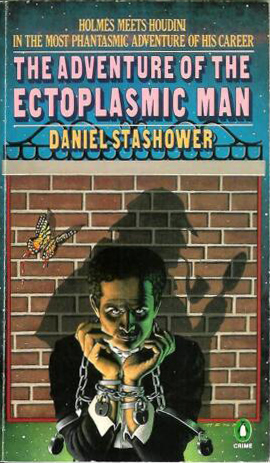
Holmes, Houdini, and ectoplasm, all in the same book. What more can you ask for? The Adventure of the Ectoplasmic Man by Daniel Stashower (1986).

Original text copyright 2023 Terence E. Hanley