Fine Artist, Illustrator, Writer
Born November 11, 1928, Superior, Wisconsin
Died December 2, 2015, Anoka, Minnesota
PulpFest is four months gone and only now am I finishing up with topics from that event and notes I made there. The high point of the show for me was my meeting and talking with artist Jon Arfstrom. At age eighty-six, Mr. Arfstrom was, at the time I met him, one of the last living artists to have drawn for Weird Tales. (Gahan Wilson is in that category.) And, at age eighty-six, he was still drawing in his sketchbook diaries, some of which he showed me. Jon Arfstrom's drawings are beautiful, colorful, and effortless. They show skills undiminished by age and illness. I have to admit that I have felt daunted by the prospect of writing about such a wonderfully good artist. After having written about Theodore Roscoe--another topic from PulpFest--I have at last arrived at Mr. Arfstrom. Today (Dec. 10, 2015) I find that he has passed away.
John Douglas Arfstrom was born on November 11, 1928, in Superior, Wisconsin. He later dropped the h to set himself apart from other boys who shared his first name. The dropping of a letter proved unnecessary, however, for his art was more than enough to set Jon Arfstrom apart.
Jon's parents were born in Sweden. His father, Fred Arfstrom, was a painter and a jack-of-all-trades. His mother, Thyra Westlund Arfstrom, was a chef. Jon's older half-brother, Ralph "Bud" Molene, was a commercial artist at the Magill-Weinsheimer Company in Chicago. Jon grew up in Minnesota and studied at the Minnesota School of Art and by correspondence with the Famous Artists School.
"Every kid in the 1930s read the pulps," he told me at PulpFest. Jon Arfstrom was no exception. He liked Westerns, also Blue Book, one of the premier magazines of its kind. The Shadow was one of his favorites, and in 1942, Jon wrote a letter to Doc Savage, his first appearance in the pulps. Among artists, he was influenced by Hal Foster (Prince Valiant) and Alex Raymond (Flash Gordon), later by Salvador Dali and Pablo Picasso. The influence of surrealism on his work is unmistakable. "Whether my art is called surrealistic, metaphysical or poetic," he said in a 1983 interview, "the essence of it is to search the imagination, to delve into the subconscious, to reach deep into hidden recesses of that psychological world that is our heritage. . . ."
Too young for service in World War II, Jon lied about his age (at fourteen) and got a job on board ships plying the Great Lakes. At sixteen he was a freight foreman. He married shortly after the war and with a family to support started selling his artwork. He began work as a commercial artist in 1950. According to the Internet Speculative Fiction Database, his first published genre art was an illustration for "Jonathon's [sic] Blanket" by William Jones Wallrich, published in The Fanscient #9, Fall 1949. Jon turned twenty-one in that same season.
Jon worked many different jobs before settling into his first full-time and long-lasting day job with Brown and Bigelow in Minneapolis in 1954. In his forty and more years at Brown and Bigelow, he produced illustrations for calendars and coloring books. He turned out to be one of the last artists to work for the company. He also freelanced in that time. In the fields of fantasy and science fiction, that freelance work came mostly at the beginning (1956 and before) and end (1985 and after) of his full-time career. Jon also did illustration work for Gamble-Skogmo and Lakeland Color Press.
Like his father, Jon was a jack-of-all-trades. He was equally adept at graphic art, pen-and-ink illustration, watercolor, oils, and acrylics. In 1975, he cofounded the Northstar Watercolor Society and had an astonishing ease in that medium. His one-man shows and awards were numerous. His work is or was in the collections of Grinnell College, Normandale Community College, and the Tweed Museum, among other institutions.
Jon created cover illustrations--mostly in color--for more than a dozen books and magazines. His interior illustrations numbered three dozen, of which two-thirds were for Weird Tales. He also painted three covers for "The Unique Magazine." The first, a cemetery scene showing a mysterious figure in a red cloak, was merely a sample or portfolio piece. The editor, Dorothy McIlwraith, liked it and bought it. Jon's reformatted art was published on the cover of January 1952 issue of the magazine.
It seems clear that Jon Arfstrom contributed to science fiction and fantasy magazines when he had the time and close to the outset of his career at Brown and Bigelow. He returned to those genres late in his career and in retirement. In the meantime, he painted hundreds of works for himself, many of which are surrealistic in their themes, subjects, and moods. At PulpFest, he had prints of some of his best paintings. I feel fortunate to have bought one from him and to have him sign it. I wish now that I had picked up another that I liked.
In 1994, Jon won a Bram Stoker Award from the Horror Writers Association for his cover art for The Early Fears by Robert Bloch. We should note that Bloch (from Wisconsin) and Donald Wandrei (from Minnesota) were both native to the states Jon called home.
Following are lists of Jon Arfstrom's credits from the Internet Speculative Fiction Database. These lists may or may not be complete:
Cover Illustrations
- The Dark Other by Stanley G. Weinbaum (Fantasy Publishing Company, 1950)
- The Omnibus of Time by Ralph Milne Farley (Fantasy Publishing Company, 1950)
- Fantasy Advertiser, Vol. 4, No. 4 (Sept. 1950)
- Spacetrails #5 (1953)
- Etchings & Odysseys #3 (1983)
- The Devil Made Me Do It by Paul Dale Anderson (Miskatonic University Press, 1985)
- Colossus: The Collected Science Fiction of Donald Wandrei (Fedogan and Bremer, 1989)
- Smoke of the Snake by Carl Jacobi (Fedogan and Bremer, 1994)
- The Early Fears by Robert Bloch (Fedogan and Bremer, 1994)
- Don't Dream: The Collected Fantasy and Horror of Donald Wandrei (Fedogan and Bremer, 1997)
- Tales of the Unanticipated (Minnesota Science Fiction Society, Winter/Spring/Summer 1997)
- Kaldar: World of Antares by Edmond Hamilton (plus frontispiece, Haffner Press, 1998)
- The Vampire Master and Other Tales of Terror by Edmond Hamilton (Haffner Press, 2000)
- Swedish Lutheran Vampires of Brainerd by Anne Waltz (Sidecar Preservation Society, 2001)
- Scream Quietly: The Best of Charles L. Grant (PS Publishing, 2012)
Interior Illustrations
- "Jonathon's [sic] Blanket" by William Jones Wallrich in The Fanscient #9 (Fall 1949)
- "S. Fowler Wright: Master of Fantasy" by Thyril L. Ladd in The Fanscient #9 (Fall 1949)
- "The Drawings of Franklin Booth" by Jon Arfstrom in Fantasy Advertiser, Vol. 4, No. 2 (May 1950)
- "Atomic Error" by Forrest J Ackerman in Other Worlds Science Stories (July 1950)
- "Enchanted Village" by A.E. van Vogt in Other Worlds Science Stories (July 1950)
- "The Job Is Ended" by Wilson Tucker in Other Worlds Science Stories (July 1950)
- "No Approach" by Randall Garrett in Other Worlds Science Stories (Oct. 1951)
- Interior illustration in Science Fiction Advertiser, Vol. 5, No. 6 (Mar. 1952)
- "The Golden Guardsmen" by S.J. Byrne in Other Worlds Science Stories (June 1952)
- "Battle of Wizards" by L. Ron Hubbard in Spaceway (Feb. 1954)
- "Do Fairies Really Exist" by Frank Patton [pseudonym] in Mystic Magazine (Mar. 1956)
In addition, Jon drew three covers and twenty-five interior illustrations for Weird Tales. These are listed below. There is actually a twenty-sixth Arfstrom illustration in the magazine, but Virgil Finlay is the credited artist, despite Jon's clear signature. I'm afraid I don't know which illustration has been wrongly attributed to Finlay. I hope someone can help. The only hints I can offer are that the drawing appeared when Jon was contributing to the magazine (1950-1954) and that it was a scratchboard drawing.
As an artist in Minneapolis, Jon was far from the bustling big cities of New York and Chicago. Nonetheless, he knew John Berkey (1932-2008), who also worked at Brown and Bigelow for a time during the 1960s. As a youngster, he collaborated with Jack Gaughan (1930-1985), though only by mail.
In August 2015, Jon Arfstrom was a special guest at PulpFest, the annual pulp magazine convention held in Columbus, Ohio. On Friday evening, August 14, he sat for an interview with David Saunders, son of pulp artist Norm Saunders. Jon's mild manner and very good, though dry, sense of humor were immediately apparent. You can listen to the interview on the website The Pulp.Net, here. The next day, I met Jon, his daughter Tory, and his son Gary in the main room at PulpFest. I sat and talked with Jon for some time. He told me that in working with Weird Tales, he would receive a manuscript and be told the dimensions for his illustrations. The rest was up to him. He admired Virgil Finlay and Edd Cartier. I think you can see the influence of both men in his early black-and-white art. Jon's last illustration for Weird Tales appeared in the May 1954 issue, only five months before the magazine came to an end, which, according to him, came without any warning.
Jon showed me a couple of his sketchbook diaries. I can tell you that he was a true and dedicated artist, drawing all the time and everywhere he went. He handled even difficult subjects with ease. His draftsmanship was sure and his sense of color impeccable. Although his health was not good, he had flown in from his home in Minnesota for PulpFest. His mind and memory were sharp and his drawing hand was still sure. I asked if I could write about him and show his artwork on my blog, and he said yes. I'm afraid I have written too late. Jon Arfstrom died eight days ago, on December 2, 2015, at his home in Anoka, Minnesota. He was eighty-seven years old. I would like to say to his family that I am sorry for their loss. As for the rest of us, we still have his extraordinary and imperishable artwork.
Jon Arfstrom's Illustrations for Weird Tales
Covers
Jan. 1952
July 1952
Sept. 1953
Interior Illustrations
"Djinn and Bitters" by Harold Lawlor (May 1950)
"The Last Three Ships" by Margaret St. Clair (May 1950)
"The Mississippi Saucer" by Frank Belknap Long (Mar. 1951)
"The Bradley Vampire" by Roger M. Thomas (May 1951)
"Hideaway" by Everil Worrell (Nov. 1951)
"The Night They Crashed the Party" by Robert Bloch (Nov. 1951)
"Morne Perdu" by Alice Drayton Farnham (Mar. 1952)
"The Horror at Red Hook" by H.P. Lovecraft (Mar. 1952)
"Rhythmic Formula" Arthur J. Burks (May 1952)
"Alethia Phrikodes" by H.P. Lovecraft (July 1952)
"Hell's Bells" by Eric Frank Russell (July 1952)
"There Was Soot on the Cat" by Suzanne Pickett (July 1952)
"Island of the Hands" by Margaret St. Clair (Sept. 1952)
"Table Number 16" by Curtis W. Casewit (Sept. 1952)
"The Chain" by Hamilton Craigie (Nov. 1952)
"Hand of Death" Marjorie Murch Stanley (Jan. 1953)
"Six Feet of Green Willow" by Carroll F. Michener (Jan. 1953)
"Caveat Emptor" by L. Sprague de Camp and Fletcher Pratt (Mar. 1953)
"The Dream Merchant" by Harold Lawlor (Mar. 1953)
"The Vengeance of Kali Mai" by Garnett Radcliffe (May 1953)
"The Sea-Witch" by Nictzin Dyalhis (July 1953)
"I Loved Her with My Soul" by Everil Worrell (Sept. 1953)
"The Beetle" by Garnett Radcliffe (Sept. 1953)
"The Banshee of Patrick O'Bannon" by Joe Bishop (May 1954)
"The Return of Simon Carib" by Frederick Sanders (May 1954)
Further Reading
"Etchings & Odysseys Interview: Recipe from the Other Side--Jon D. Arfstrom" in Etchings & Odysseys #3 (1983), pp. 43-49.
"Jon Arfstrom--Last of the Weird Tales Artists" on the website for PulpFest, here.
"Special Guest Jon Arfstrom" on the website The Pulp.Net, here.
"Obituary: From Watercolors to Weird Tales, Illustrator Jon Arfstrom Did It All" by Mary Abbe on the website of the Star Tribune, December 8, 2015, here.
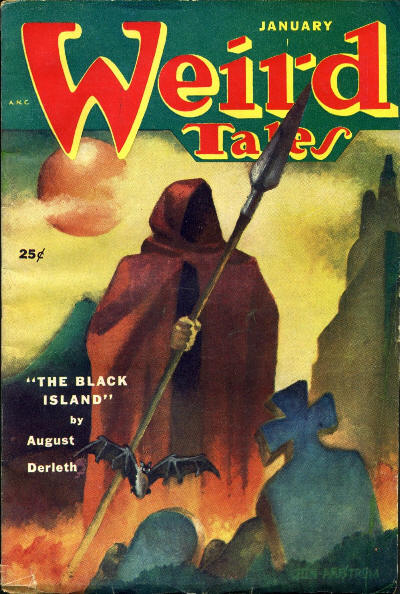 |
| Weird Tales, January 1952, with Jon Arfstrom's first cover for the magazine. I had thought this was a watercolor, but I came to find out it was actually an oil painting. Originally a sample piece, Jon's art was reformatted to fit the cover. Note the green band at the top. |
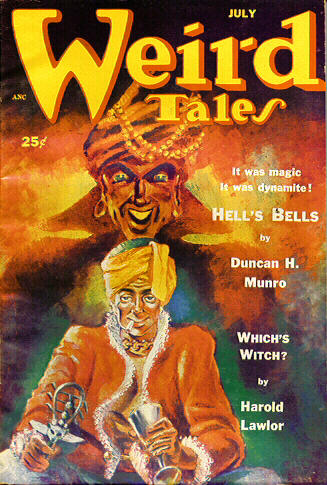 |
| Weird Tales, July 1952, Jon's second cover. He also had three interior illustrations in this issue. |
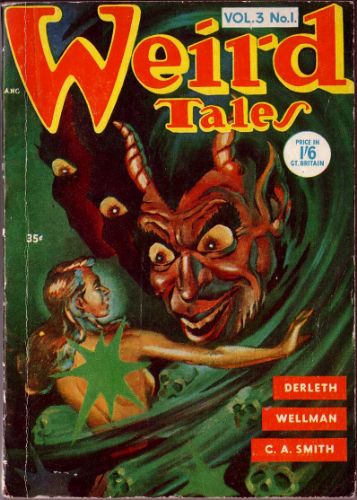 |
| Weird Tales, September 1953, in the British edition. This was Jon's last cover for and the beginning of the last year of the magazine. |
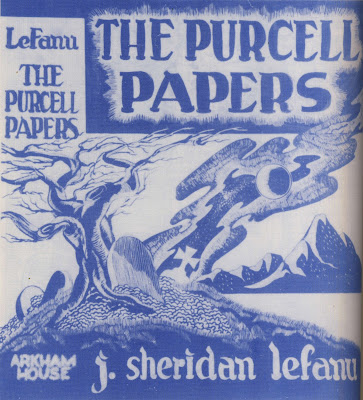 |
| In 1949, Jon Arfstrom created a dust jacket design for The Purcell Papers by J. Sheridan Le Fanu, to be published by August Derleth's Arkham House. After some delays and problems, Derleth accepted the artwork and paid Jon a fee of $25. Unfortunately the book went unpublished for another quarter century and without Jon's drawing on the dust jacket. You can read the full story in "The Original Cover for The Purcell Papers" by R. Alain Everts in Etchings & Odysseys #3 (1983). The image above is from that article. |
Original text copyright 2015, 2023 Terence E. Hanley