Showing posts with label John Giunta. Show all posts

Friday, January 13, 2017

Fiends and Murderers of the 1940s and '50s

There was less murder and fiendishness on the cover of Weird Tales in the 1940s and '50s. That might be because the editor was a woman. Maybe she didn't want any more of that menacing and threatening of women. As you can see, none of the following four covers fits easily into this category, at least at first glance. I have read The Damp Man series, though, and I can tell you that the title character is the very definition of a fiend.

Weird Tales, January 1942. Cover story: None. Cover art by Gretta. This cover, by Joseph C. Gretter, is kind of a throwback to the 1920s or '30s. This was a time of transition in Weird Tales. Gretter, an artist of those decades (though he later assisted on Riley's Believe It or Not!), seems to have been a fill-in artist, and this was his only cover for "The Unique Magazine."

Weird Tales, March 1944, Canadian edition. Cover story [?]: "The Valley of the Assassins" by Edmond Hamilton. Cover art by an unknown artist. I'm not so sure about putting this cover in the category of fiends and murderers. The man on the right kind of looks like one of the undead. Or maybe he's a sorcerer of some kind. Anyway, here it is. You'll see this cover again.

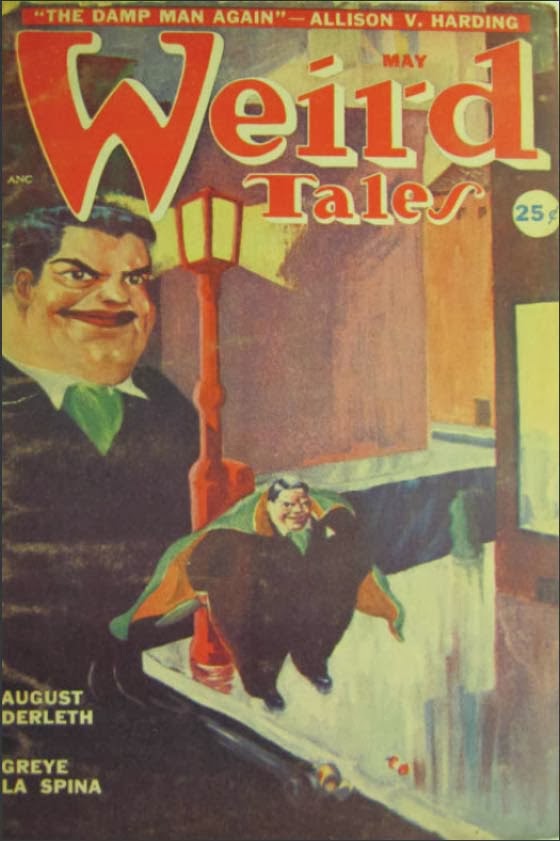
Weird Tales, May 1949. Cover story: "The Damp Man Again" by Allison V. Harding. Cover art by John Giunta. That's the Damp Man himself, a real creep and a fiend.

Weird Tales, March 1950. Cover story: "Home to Mother" by Manly Wade Wellman. Cover art by Lee Brown Coye. The figure on this cover looks like he could be a murderer or fiend, but he could be just another one of Coye's decrepit souls. Note the crescent moon, Coye's trademark.

Now it's on to Human Sacrifice and Executions.

Text and captions copyright 2017, 2023 Terence E. Hanley

Thursday, November 20, 2014

Aliens on the Cover of Weird Tales

Weird Tales was a magazine of fantasy, horror, weird fiction, and the supernatural, but it also published science fiction, especially after World War II, when that genre took over our popular culture and aliens seemed to be watching us in all of our little ant-like movements. I count nine covers in this category, but only three that came after the war. I assume that all of the creatures on these covers are aliens. If anyone knows different, please let me know, too. It's worth noting that neither Margaret Brundage nor Virgil Finlay drew any aliens on the cover of Weird Tales. Note also that six of the nine aliens shown here are green.

Weird Tales, January 1925. Cover story: "Invaders from Outside: A Tale of the Twelve Worlds" by J. Schlossel. Cover art by Andrew Brosnatch. Look carefully. You'll find him.

Weird Tales, April 1925. Cover story: "When the Green Star Waned" by Nictzin Dyalhis. Cover art by Andrew Brosnatch. If I remember right (not that I was there), in the 1920s there was a discussion among the readers of Weird Tales on whether the magazine should print science fiction. The April 1925 cover seems to have provided an answer, but readers should not have forgotten that the first cover story in Weird Tales, "Ooze" by Anthony M. Rud (Mar. 1923), was also science fiction, before that genre even had the name by which we know it today. (The term science fiction didn't show up in print until 1929.) The "Green Star" in the title is Earth. A year after the publication of Dyalhis' story, in April 1926, Amazing Stories, the first American science fiction magazine, made its debut.

Weird Tales, May 1928. Cover story: "The Bat-Men of Thorium" by Bertram Russell. Cover art by C.C. Senf.

Weird Tales, Feb. 1929. Cover story: "The Star Stealers" by Edmond Hamilton. Cover art by Hugh Rankin.

Weird Tales, Jan. 1932. Cover story: "The Monster of the Prophecy" by Clark Ashton Smith. Cover art by C.C. Senf, one of his best covers, I think.

Weird Tales, November 1944. Cover story: "The Dweller in Darkness" by August Derleth. Cover art by Matt Fox. This was Matt Fox's first cover for Weird Tales. I'm not sure that these creatures are aliens. They may actually be demons or supernatural monsters. I have put them in this category because the imagery is science-fictional rather than fantastical: beams of light are coming from the sky, like from a flying saucer, illuminating strange creatures who have pointed ears, green skin, multiple limbs, and tentacles, all of which later characterized different species of space aliens.

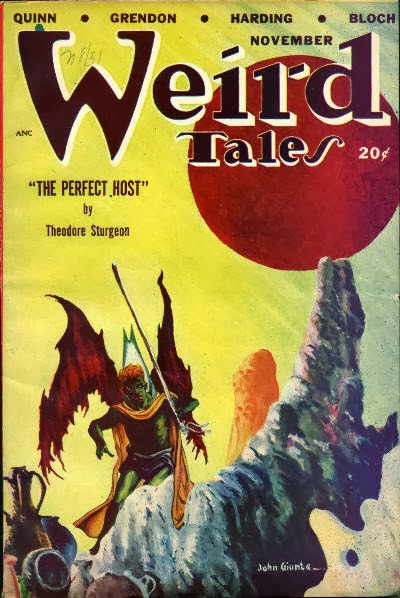
Weird Tales, November 1948. Cover story: "The Perfect Host" by Theodore Sturgeon (?). Cover art by John Giunta. Now we're into the science fiction era and the imagery and technique are those of the science fiction artist. John Giunta was one of the first science fiction artists to come out of fandom and to see his work in print nationally. This could have been the cover of a science fiction novel from the 1960s.

Weird Tales, November 1951. Cover story: None. Cover art by Frank Kelly Freas. Weird Tales may have had a tight budget for most of its run, but it landed some very fine artists, including a young Frank Kelly Freas. This was the second of his three covers for the magazine.

Weird Tales, July 1953. Cover story: None. Cover art by W.H. Silvey. This is among my least favorite covers for Weird Tales. For decades, the magazine had pretty well avoided cheap, exploitative, or cruel imagery on its covers. The exploitation and cruelty here aren't overt, but when a man or a male character is holding something in his hand, that object can be taken as an extension of his hand or of his body in general. In other words, the spoon in this picture is more than just a spoon.

Updated December 9, 2018.
Text and captions copyright 2014, 2023 Terence E. Hanley

Monday, April 14, 2014

John Giunta Update

A reader (also a writer), Christopher M. O'Brien, has kindly provided me with Sam Moskowitz's two-page personalized obituary of John Giunta from Luna Monthly No. 20 (January 1971). Sam Moskowitz may have his detractors, but to his credit, he wrote about people and events about which no one else has written. His obituary of John Giunta has as much personal information on the artist as anyone will ever know.

John Giunta did indeed pass away on November 6, 1970, at age fifty. Unless he was about to turn fifty-one at his death, that would make his birth year 1920. Maybe only the city or state of New York knows his birthdate. Giunta did not die alone, but he lived alone. As Sam Moskowitz wrote:
His death was in the all-too sad tradition of artists which has become almost stereotyped in fiction and moving pictures. He died nearly penniless, receiving public assistance and with art assignments rare and poorly paid. Though only 50, he looked nearly 65, and probably did not weigh much over 100 pounds at the time of his death.
Giunta suffered a stroke in his room at the Village Plaza Hotel in New York. He died eight hours later in the hospital.

"He was a gentle, soft-spoken, kindly, generous individual," Moskowitz wrote, "optimistically striving to better his fortunes throughout his entire life. He was always his own man, losing many important assignments rather than compromise his ideas."

 * * *

I listed Giunta's credits in my previous postings on him. There's one I missed however. In 1949, John Giunta edited a comic book called True Crime Comics. Among the contributors were Giunta's science fiction friends, Sam Moskowitz, Raymond Van Houten, and James V. Taurasi. Also among the contributors was Giunta's nephew, Aldo Giunta. Like his uncle, Aldo Giunta contributed to fan publications. He also had a story, "Jingle in the Jungle," published in If in June 1957.

* * *

In the same issue announcing the death of John Giunta, Luna Monthly also announced the death of the artist Steele Savage. Born in Michigan in 1900 (Correction: Dec. 21, 1898), Savage illustrated a number of books, including science fiction books by John Brunner and Robert A. Heinlein. He also contributed to Famous Fantastic Mysteries in the 1940s. Savage died on December 5, 1970. I was researching Savage's life well before I read of his death in Luna Monthly. My sense is that Steele Savage may have been another in a line of artists (or human beings in general) that is entirely too long: men and women who have lived lonely and very often desperate lives. The question is: Must the artist suffer so that he might create? There have been happy artists, artists with families. N.C. Wyeth is one who comes to mind (although he died suddenly and tragically). Even so, does the artist suffer so that the rest of humanity might gain some joy or pleasure from his work? Did H.P. Lovecraft practically starve himself so that we might have his stories to read? I'm not sure that such things are needful. It may be that the artist is a person who finds himself in a box of a certain kind (as we all do), and though he can escape one kind of box, he can't escape another. And so--despite his suffering and desperation, and very often by heroic effort--he creates.

The Rolling Stones by Robert A. Heinlein, with cover art by Steele Savage (1900-1970). Savage painted in a style that is at once dreamlike and hyperrealistic. That peculiar combination is sometimes referred to as magical realism and was popular in the 1930s, '40s, and '50s, especially in illustration and advertising. Simon Greco (1917-2005) was another practitioner of magical realism. If I remember right, The Rolling Stones has Tribble-like creatures, just in case you're putting together a list of influences on the TV show Star Trek

Thanks to Christopher M. O'Brien for providing the article from Luna Monthly.
Text and captions copyright 2014, 2023 Terence E. Hanley

Saturday, February 8, 2014

John Giunta (1920-1970)-Part 4

I'm not sure that anyone knows when John Giunta was born. One source after another gives his birth year as 1920 without citing a source for that information. (I have based the date given here--circa 1920--on the assumptions that the birth year of 1920 is correct and that Giunta turned twenty sometime after the enumerator of the 1940 census visited his home on April 13, 1940.) As for his death date--I have used the date given by what I take to be a reliable source, the Internet Speculative Fiction Database. The ISFDb has the date--November 6, 1970--but not the place of John Giunta's death. I presume it to have been in New York City or somewhere close-by.

* * *

Victor Gorelick, an editor for Archie Comics, remembers John Giunta:
I liked John Giunta. He was a nice guy who lived by himself and was a big smoker. He was usually on time with his work, but he was a pretty nervous guy, very insecure, but a very nice man. (1)
If Giunta lived alone, he may very well have died alone, in which case he can be added to a list that includes Hannes Bok and Hugh Rankin, two artists who also contributed to Weird Tales. Giunta's relatively young age at his death and the fact that he was "a big smoker" suggest that he died of cancer. Update (Feb. 1, 2021): Giunta actually died of a heart attack according to David Saunders.

* * *

John Giunta is remembered as the artist who got Frank Frazetta started in comic books.
When I was about sixteen [Frazetta recalled] someone in my family introduced me to John Giunta. He was a professional artist who was working for Bernard Bailey's comics publishing company and he really wasn't a very personable guy. He was very aloof and self-conscious and hard for me to talk to, but he was really very talented. He had an exceptional ability, but it was coupled with a total lack of self-confidence and an inability to communicate with people. Being around him really opened up my eyes, though, because he was really that good. He had an interesting style, a good sense of spotting and his blacks worked well. You can see a lot of his influence even today in some of my ink work. (2)
Frazetta, then sixteen, had earlier drawn a homemade comic book called Snowman. "Giunta liked [it] and persuaded Bernard Bailey to publish a revised version in Tally Ho #1 in 1944." (3) Frazetta penciled the story, and Giunta inked it and drew the cover for Tally-Ho Comics #1. Frazetta may or may not have been credited for his work. The Comic Book Database suggests that Frazetta's first credited comic book art was as a penciler and inker in Exciting Comics #59 from January 1948. So, at age nineteen, Frank Frazetta was a professional artist, thanks in part to John Giunta.

* * *

Victor Gorelick called Giunta "a nice guy," while Frazetta remembered that "he wasn't really a very personable guy." To be fair to Giunta, we should note that Frazetta was a teenager when he met Giunta, and that Giunta was only in his mid-twenties. Presumably, Gorelick knew Giunta--then in his forties--in the early 1960s. Frazetta may have been sensitive to perceived slights in a man who was--by both accounts--insecure and lacking in self-confidence. Upon reading those accounts, I couldn't help but think of Roy G. Krenkel, another of Frank Frazetta's mentors and an artist who also lacked confidence in his work.

* * *

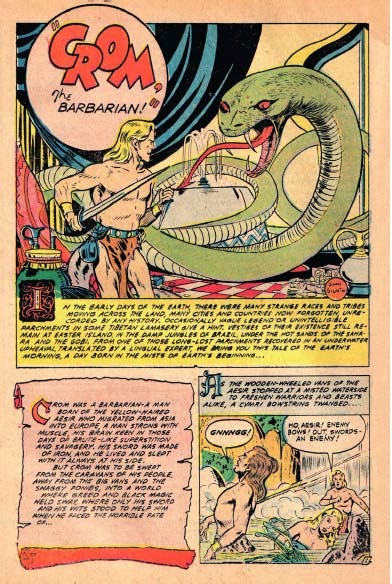
I think it pretty safe to say that Robert E. Howard created the genre of heroic fantasy, at least as we know it today. After Howard died by his own hand in 1936, the mantle of heroic fantasy was taken up by Henry Kuttner, Fritz Leiber, Jr., and others. Unlike other pulp genres, heroic fantasy did not easily make the transition to comic books. That changed with the debut of Crom the Barbarian in the first issue of Out of This World, from June 1950 (4). Gardner Fox, an old hand at comic books and pulp fiction, wrote the script. John Giunta, with one foot in the pulps and one in comic books, was the artist. Both had also contributed to Weird Tales, birthplace of Howard's Conan the Cimmerian. They were probably the perfect combination to revive Conan under the name of Conan's god, Crom. There were other similarities between Crom and Conan. ("Swipes" might be a better word.) I'm not sure that Crom's yellow hair would have thrown anybody off. (5) In any case, Crom appeared in two issues each of Out of This World (6) and Strange Worlds in 1950-1951. Heroic fantasy returned to the comics with a vengeance in 1970 with Marvel Comics' Conan the Barbarian

* * *

John Giunta drew interior illustrations for Weird Tales beginning with the November 1942 issue and ending in May 1950. He also created three covers for "The Unique Magazine" from 1944 to 1949. His last was for "The Damp Man Again" by Allison V. Harding. The Damp Man is a comic book-like villain (also a weird menace kind of villain). As both a comic book artist and pulp artist, John Giunta would have been well qualified to draw the character.

* * *

I'll close by saying that we should remember John Giunta and his work.

John Giunta's Covers for Weird Tales
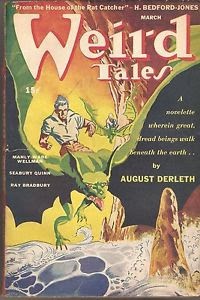
Mar. 1944, "The Trail of Cthulhu" by August Derleth
Nov. 1948
May 1949, "The Damp Man Again" by Allison V. Harding

John Giunta's Interior Illustrations in Weird Tales
Nov. 1942
Jan. 1943
Mar. 1943
July 1943
Sept. 1943
Nov. 1943
Mar. 1944
July 1944
Sept. 1944
May 1947
July 1947
Sept. 1947
Jan. 1948
Mar. 1948
May 1948
July 1948
Nov. 1948
May 1949
July 1949
Sept. 1949
Jan. 1950
May 1950

Further Reading
"John Giunta (1920-1970)" by David Saunders on his website Field Guide To Wild American Pulp Artists, from 2019, here.

Notes
(1) Quoted in The T.H.U.N.D.E.R. Agents Companionedited by Jon B. Cooke (2005), p. 74.
(2) Quoted in Icon: A Retrospective by the Grand Master of Fantastic Art, edited by Arnie Fenner and Cathy Fenner (1998), p. 4.
(3) Fenner and Fenner, p. 4. The actual title is Tally-Ho Comics. The date was December 1944.
(4) Fourteen years to the month after the death of Robert E. Howard.
(5) John Jakes' Conan-like character, Brak the Barbarian, also has yellow hair.
(6) Out of This World was called Out of This World Adventures with issue number two.
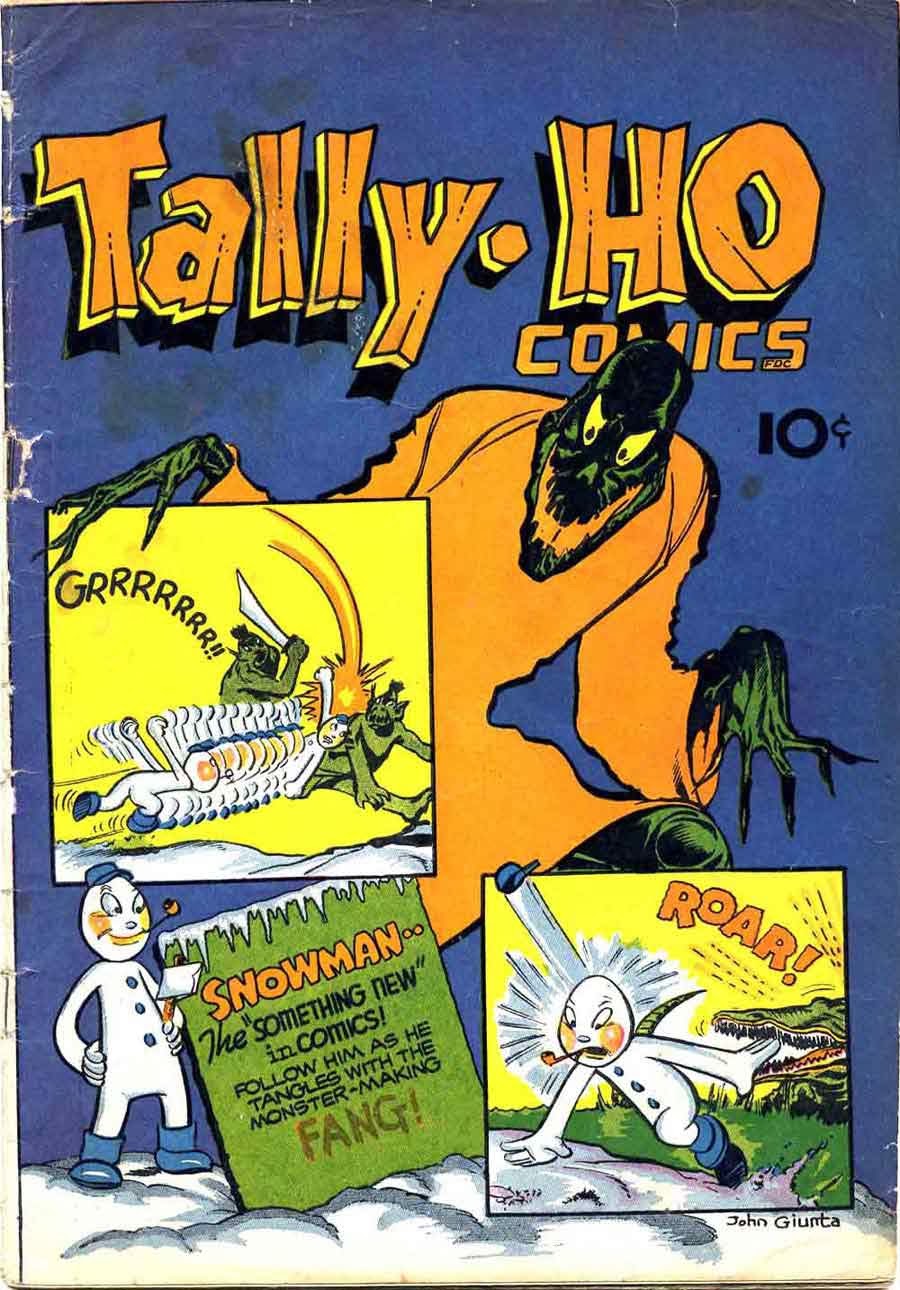
Tally-Ho Comics #1 (Dec. 1944) with cover art by John Giunta and probably an uncredited Frank Frazetta.
"Crom the Barbarian" by Gardner Fox and John Giunta from Out of This World #1, June 1950.
Weird Tales, March 1944, with cover art by John Giunta.
Weird Tales, November 1948. Giunta was again the artist. By the mid to late 1940s, Weird Tales was in a science fiction phase. Giunta's art anticipated that of Richard Powers, John Schoenherr, and Jack Gaughan from the 1950s and '60s. 
Weird Tales, May 1949, with cover art by John Giunta. There were three stories of The Damp Man in Weird Tales. John Giunta illustrated them all and created a cover for the last, "The Damp Man Again."

Updated on February 1, 2022.
Text and captions copyright 2014, 2023 Terence E. Hanley

Thursday, February 6, 2014

John Giunta (1920-1970)-Part 3

According to the book The T.H.U.N.D.E.R. Agents Companion (2005), John Giunta began working in comic books in 1939, when, as a beginning artist, he did lettering and coloring for the Harry "A" Chesler comic book shop. He also reviewed science fiction fanzines in Amazing Mystery Funnies #12 (Dec. 1939)According to the online Comic Book Database, Giunta's earliest credited work as a comic book artist appeared in Spitfire Comics #1, from August 1941. He continued working in comic books for the rest of his life and is credited with published work in all but four years between 1941 and 1970, the year of his death. In addition to Spitfire Comics, he worked on Joker Comics, Suspense Comics, Treasure Comics, Spook Comics, The Mad Hatter, All-Star Comics, All-American Western, Boy Commandoes, Badmen of Tombstone, Strange Worlds, Man Comics, Chamber of Chills, Weird Thrillers, Big Town, Strange Adventures, Mystery in Space, Lost Worlds, Phantom Stranger, Tomb of Terror, Thrills of Tomorrow, Superboy, Journey into Mystery, Two Gun Western, World of Suspense, Strange Tales, World of Fantasy, Eerie, The Fly, Adventures of the Fly, Tales of the Unexpected, Laugh, Pep, House of Mystery, Tales to Astonish, T.H.U.N.D.E.R. Agents, Undersea Agents, Noman, Batman, and Detective Comics. That means that in his lifetime, John Giunta worked for Harvey, Timely, Continental Magazines, Prize Publications, Baily Publishing, O.W. Comics, DC, Avon, Ziff-Davis, Standard/Nedor, Atlas, I.W. Enterprises, Archie Comics, Marvel, and Tower Comics. His work has also been reprinted since his death.

According to the Internet Speculative Fiction Database, John Giunta's first published work in a professional science fiction magazine was an illustration for "Bratton's Idea" by Manly Wade Wellman in the December 1940 issue of Comet, edited by F. Orlin Tremaine. Giunta's second credited illustration was for "The Hound" by Fritz Leiber, Jr., published in Weird Tales in November 1942. For the next eight years, his illustrations in the genres of science fiction and fantasy appeared only in Weird Tales. That changed in December 1950 with his illustrations for Out of This World Adventures. From the early 1950s to the late 1960s, Giunta contributed to Fantastic Adventures, Avon Science Fiction and Fantasy Reader, Fantastic, Infinity Science Fiction, Amazing Stories, Science Fiction Adventures, Venture Science Fiction Magazine, Saturn, Fantastic Universe, If, Galaxy Magazine, and Worlds of Tomorrow. He was also art director for Original Science Fiction Stories and Saturn. And again, his work has been reprinted since his death in 1970.

Those are some long lists for a blog posting, but I have compiled them for a reason. John Giunta was both a comic book artist and a science fiction illustrator. You would hardly know that to look at sources in print or on the Internet. The science fiction sources pretty well ignore his work in comic books, and the comic book sources tell very little about his work as an illustrator. Why is that? Why should there be this unbridged gap between a genre (science fiction) and a form (comic books) that so naturally go together?

To be concluded . . . 

"The Magician from Mars," a comic book character and series created by John Giunta, Malcolm Kildale, and Michael Mirando in Amazing Man Comics (Centaur, 1940-1941). Giunta's interest in science fiction shows through pretty clearly here. If you remember my posting from the other day, Malcolm Kildale was the artist from whom Frank Frazetta seems to have borrowed an image or two.
Roly-Poly Comics #10 (Green Publishing Company, Jan. 1946). "Jay Gee," the artist, was John Giunta. 
Fantasy, a fanzine dated November 15, 1948, with cover art by John Giunta, evidence that he was involved in fandom even after having become a professional artist. 
A somewhat muddy interior illustration for "The Moonrakers," Giunta's own story from If (Jan. 1966). 
The cover of Fantasy-Times: The Science-Fiction Newspaper (Sept. 1956), with a small photograph of John Giunta in the upper right. Bill Blackbeard is in the lower center. Giunta illustrated his story (co-written with James O. Causey) "Hammer of Cain" for Weird Tales in November 1943.

Text and captions copyright 2014, 2023 Terence E. Hanley

John Giunta (1920-1970)-Part 2

Science fiction fandom of the 1930s culminated in the First World Science Fiction Convention, held July 2 to July 4, 1939, at Caravan Hall, in New York City. Science fiction fans, artists, and writers from all over the country flocked to the convention. Forrest J Ackerman and Ray Bradbury came in from Los Angeles, Jack Williamson from New Mexico. Ray Cummings, Manly Wade Wellman, Edmond Hamilton, L. Sprague de Camp, Isaac Asimov, and the esteemed Frank R. Paul also showed up. The convention also boasted the attendance of magazine editors John W. Campbell, Jr., Leo Margulies, Mort Weisinger, Charles D. Hornig, and Farnsworth Wright. Wright was of course the editor of Weird Tales. John Giunta and Wright may have met. Who at this point can say. But by the time Giunta's first illustration appeared in Weird Tales in November 1942, Wright was gone from his post as editor. He was in fact in his grave.

John Giunta was a part of the crowd and in front of the crowd at the First World Science Fiction Convention. Giunta, James V. Taurasi, and Sam Moskowitz auctioned off, among other gems, original art by Virgil Finlay that went for as little as two dollars apiece. (1) In a softball game between the Queens Science Fiction League Cometeers and the Philadelphia Science Fantasy Society Panthers, Giunta replaced the Queens pitcher, A. Langley Searles, in the fourth inning and finished the game despite being pounded by the Panthers. The final score was Queens 23, Philadelphia 11. (2)

Science fiction conventions continue today, but that First World Science Fiction Convention came at the beginning of a fateful summer, for two months later, war began again in Europe. American involvement was still two years off, but science fiction fandom of the 1930s was reaching not only a chronological end but also a sort of spiritual end. As Isaac Asimov wrote:
Beginning with the third decade [of life], after [age] twenty, life becomes filled with adult responsibility and turns to lead. But that second decade, from ten to twenty, is gold; it is in those years that we remember bliss. (3)
Asimov turned twenty in 1940. John Giunta entered his own age of lead that year. Nevertheless, Taurasi and Moskowitz organized a new science fiction fan club, The Cometeers, on October 14, 1940, at Giunta's home. Other members included Ray Van Houten, John Peterson, Elliott Dold, and F. Orlin Tremaine. According to Harry Warner, Jr.:
Membership was by invitation only, and eventually the group either became so exclusive that it lost all contact with civilization, or it disintegrated; the last positive evidence of its survival is at the start of 1944. (4)
I don't know whether Giunta was still a member in 1944, but by then he was well on his way as a comic book artist and magazine illustrator, the career that would carry him through to the end of his brief life.

To be continued . . . 

Notes
(1) The Immortal Storm: A History of Science Fiction Fandom by Sam Moskowitz (1954), p. 221.
(2) Moskowitz, p. 222.
(3) From "Introduction" by Isaac Asimov in Before the Golden Age: A Science Fiction Anthology of the 1930s (1974), p. xiii.
(4) All Our Yesterdays by Harry Warner, Jr. (1969), p. 220.

Updated on February 1, 2022.
Original text copyright 2014, 2023 Terence E. Hanley

Wednesday, February 5, 2014

John Giunta (1920-1970)-Part 1

Aka Jay Gee
Illustrator, Comic Book Artist, Science Fiction Fan, Author, Editor, Publisher, Art Director, Reviewer
Born June 5, 1920, New York, New York
Died November 6, 1970, New York, New York

John Giunta was born on June 5, 1920, in New York City, probably in Brooklyn or Queens. His parents were Italian immigrants. (The surname Giunta is the Italian equivalent of the Spanish word junta.) Giunta's mother was named Jenny, a nickname for Giovanna. According to David Saunders on his website Field Guide to Wild American Pulp Artists, Giunta's father was Francesco Antonio GiuntaHis father may have been Thomas G. Giunta. I think both worked in the garment industry. In 1940, John Giunta was at home in Brooklyn with his mother. He was just nineteen years old but already working as a commercial artist. If Thomas G. Giunta was indeed the father of John Giunta, then there were other Giunta children: Anna, Antonio, and Marie E. Giunta. I haven't found John Giunta in any other census except 1940, nor in any other public records. I don't even know his date of birth.

If John Giunta has any measure of fame today, it's mostly for his collaboration with Frank Frazetta on Frazetta's first published comic book story, "Snowman," from Tally Ho #1 (Dec. 1944). Frazetta was of course a teenaged prodigy and would go on to great fame in the 1960s and beyond. Giunta, who in 1944 was in his mid-twenties, was already a comic book veteran, having started in the business in the late 1930s. However, if you look for biographical information on him in any of the histories of comic books, you will come up empty. On the other hand, if you begin with two sources on science fiction fandom, you will find some interesting tidbits on Giunta's early career as an artist, editor, and publisher.

Science fiction fandom began in the late 1920s with the letters column of Hugo Gernsback's Amazing Stories. During the next decade or so, fans began corresponding with each other, organizing clubs, and issuing their own hectographed and mimeographed magazines. New York City was an epicenter of fandom, Brooklyn and Queens in particular. Much of what we know of early fandom comes from the men who were there and who in later years recounted their experiences. The Immortal Storm: A History of Science Fiction Fandom by Sam Moskowitz (1954) and All Our Yesterdays by Harry Warner, Jr. (1969) are two invaluable sources about a kind of golden age that slipped away, just as youth slips away.

Like other artists and writers in his field, John Giunta gained entry into comic books because of his interest in science fiction and fantasy and because of his activity in fandom. (1) According to Sam Moskowitz, Cosmic Talesissued by New York fans James V. Taurasi, Jack Gillespie, and Robert G. Thompson beginning in 1937, "was the magazine which introduced artists John Giunta and Jack Agnew to the field." (2) Giunta would have been just sixteen or seventeen years old at the time. Taurasi passed editorship to the sister-and-brother team of Gertrude and Louis Kuslan with the September 1938 issue of Cosmic Tales. John Giunta took over for one issue, dated 1940 (Vol. 1, No. 2). By then Giunta had already published his own fanzine, Amazing Wonder Tales, the one and only issue of which was dated August 1938. Giunta subsequently changed the title to Scienti-Tales (Mar./Apr. 1939). He also issued an amateur press magazine called Scientitale Publication. (3)

Earlier that summer--on June 5, 1938, his eighteenth birthday--Giunta had attended the first meeting of the newly reorganized Greater New York Chapter of the Science Fiction League. Sixteen fans were present, including, in the words of Sam Moskowitz, "two amateur artists, John Giunta and Daniel C. Burford." (4) Jack Rubinson and William Sykora were also there. The next event in a chronicle of Giunta's fan activity was the publication of the first mimeographed edition of Fantascience Digest, edited by Robert A. Madle, in January 1939. Staff writers on the magazine included the two aforementioned historians of fandom, Harry Warner, Jr., and Sam Moskowitz. The list of contributors to Fantascience Digest is nothing to sniff at: Henry Kuttner, Ray Bradbury, Ralph Milne Farley, Donald A. Wollheim, and the young John Giunta. (5) That same month, Giunta had his first published credit in a professional science fiction magazine (or prozine), a letter in Startling Stories.

To be continued . . .

Notes
(1) Jerry Siegel and Joe Shuster for example, were keen fans of science fiction and published their own fanzines, Cosmic Stories (1929) and Science Fiction (1933). They also created Superman, a character that had originated in pulp-fictional form. Other science fiction fan artists included Ronald Clyne and Hannes Bok, both of whom contributed to Weird Tales. See All Our Yesterdays by Harry Warner, Jr. (1969), p. 91
(2) The Immortal Storm: A History of Science Fiction Fandom by Sam Moskowitz (1954), p. 135.
(3) "Death of an Artist: John Giunta--A Personalized Obituary" by Sam Moskowitz, Luna Monthly No. 20 (Jan. 1971), pp. 1-2.
(4) Moskowitz, p. 171.
(5) Moskowitz, p. 200.

Amazing Wonder Tales #1, August 1938, a science fiction fanzine with cover art by John Giunta.
Cosmic Tales, July 1941 (Vol. 1, No. 4), with cover art by Giunta. 

Thanks to Christopher M. O'Brien for providing Sam Moskowitz's obituary of John Giunta.
I acknowledge David Saunders in his research on John Giunta. Click here to read what Mr. Saunders wrote.
Updated on February 1, 2021.
Text and captions copyright 2014, 2023 Terence E. Hanley

Monday, January 6, 2014

Man and Monster

The relationships among man, woman, and monster are complicated. Those between woman and monster are perhaps less so. In comparison, the man and the monster have a simple relationship: they are contestants in a primeval struggle. The first and last images here are of monsters that are probably or definitely female. Note that the authors are also female. Both show attacks upon mostly defenseless men. (Note also that none of the images shown here was by Margaret Brundage, the only female cover artist for Weird Tales. That may or may not be significant.) All other covers that follow show men relating to monsters as they relate to animals or to other men: as predator to prey, as rival to rival, or as master to servant. Only one--the Virgil Finlay cover--shows a man as a kind of explorer and monsters as more marvelous than dangerous.

Weird Tales, April 1923. Cover story: "The Whispering Thing" by Laurie McClintock and Culpeper Chunn. Cover art by R.M. Mally. Too many weird tales have the word thing in their titles. Here's one of the first to appear in Weird Tales magazine, from the second issue. The eyes in this picture look upon the protagonist as in the previous category of woman and monster. This time however, the eyes are not just looking. They are also attacking. Their appearance is feminine.

Weird Tales, April 1925. Cover story: "When the Green Star Waned" by Nictzin Dyalhis. Cover art by Andrew Brosnatch. This was Nictzin Dyalhis' first story for Weird Tales and one of the most popular in the period 1925 to 1940. It also helped introduce science fantasy to the magazine. Here the struggle is over. Men have lost. Monsters from the moon have enslaved them. Only men of another kind from the planet Venus can save them. 

Weird Tales, June 1925. Cover story: "Monsters of the Pit" by Paul S. Powers. Cover art by Andrew Brosnatch. In movies of the 1950s, men fought giant everything: ants, praying mantises, tarantulas, gila monsters. Most of the time it had something to do with radioactivity. But the struggle against giants is as old as time. In the Bible, they were Nephilim. Before that they were wooly mammoths, saber-toothed tigers, and giant sloths. Here is just another variation on that same theme: the fight with the giant spider. Bilbo Baggins is engaged in that activity this winter at the movies. Nearly six decades ago, Grant Williams did it in . . .
The Incredible Shrinking Man (1957).

Weird Tales, July 1925. Cover story: "The Werewolf of Ponkert" by H. Warner Munn. Cover art by Andrew Brosnatch. Man against wolf is another old story. If you didn't know the title of the story, you wouldn't know these are monsters, werewolves in fact. I'll soon write about the woman and the wolf. You'll see a powerful difference between those covers and this one.

Weird Tales, Feb. 1931. Cover story: "Siva the Destroyer" by J.-J. des Ormeaux. Cover art by C. Barker Petrie, Jr. In this case the monster is man-like and a god (or demon), yet still monstrous. If the man at the desk were of the opposite sex, this image could have gone into the category of man, woman, and monster. Note the conventional pulp hero dressed in an aviator's getup and throwing hot lead. Note also the large cobra added for good measure.

Weird Tales, August 1931. Cover story: "Tam, Son of the Tiger" (part 2) by Otis Adelbert Kline. Cover art by Curtis C. Senf. I suppose Tam was just another offspring of the Tarzan character. I believe Kline's serial was set in a lost land like Pellucidar. The monster is sort of a lion-tiger cross--pretty much Napoleon Dynamite's favorite animal--with maybe a bit of baboon, hyena, or opossum as well. If the creature were more conventional, I could put this picture in with the category of man and animal. It misses another category as well: Instead of a woman, the hero is saving a pachyderm.

Weird Tales, November 1932. Cover story: "Buccaneers of Venus" (part 1) by Otis Adelbert Kline. Cover art by J. Allen St. John. If Tam was a Tarzan clone, I suppose Otis Adelbert Kline found inspiration for his next serial in Edgar Rice Burroughs' Carson of Venus series. In looking at this illustration, I can't help but be reminded of another:
A scene illustrating one of the Carson of Venus books, created three decades later by Frank Frazetta in his watercolor phase. It could have been an illustration for the same story.

Weird Tales, October 1936. Cover story: "Isle of the Undead" by Lloyd Arthur Eshbach. Cover art by J. Allen St. John. I believe that's a man in the picture. If so, he's pretty broad in the beam and maybe the only naked man to appear on the cover of Weird Tales. If it's a woman then I have her in the wrong category. In either case, the undead are monsters, even if they are humanoid. Notice that they're wearing the standard-issue red robes of the 1930s pulp villain.

Weird Tales, July 1939. Cover story: None. Cover art by Virgil Finlay. Despite the blurb on the cover, this illustration is not for "Giants of Anarchy" according to Jaffery and Cook. Instead it's a picture of a man encountering marvels, none of which threatens him overmuch. In that, this image is unique among the category of man and monster. Update (Feb. 10, 2014): I heard from Lemuel Nash who points out that Finlay's illustration is for "Far Below" by Robert Barbour Johnson. Thanks, Mr. Nash.

Weird Tales, March 1942. Cover story: "Hell on Earth" by Robert Bloch. Cover art by Hannes Bok. This cover could be included in two categories, man and monster; or man and man. But the villain, who is monstrous in his way, has some monsters as his helpers, so I have decided to include it here. That brings up a distinction we can make between the monster that is merely animal-like and driven by animal needs vs. the monster that knows good from evil. The monster capable of evil is usually humanoid or is possessed by a human spirit (as in the werewolf). In other words, an animal is incapable of evil. Because of that, it occupies a spot lower on the hierarchy of monsters. The distinction between the animal/monster and the man/monster goes back to my assertion that the only real monsters in this world are human.

Weird Tales, May 1942, Canadian edition. Cover story: "The Shadow Over Innsmouth" by H.P. Lovecraft. Cover art by Edmond Good. H.P. Lovecraft helped pay the bills at Weird Tales, yet when it came to spots on the cover, he got pretty short shrift. If I count correctly, Lovecraft had the cover story on exactly zero issues in his lifetime and only one after this Canadian edition (in September 1952). Good old Canada. And good old Good--Edmond, that is, the cover artist. The Canadian editions of Weird Tales have been overlooked in most sources. I will have to correct that oversight soon. And I'll have to write about Edmond Good.

Weird Tales, November 1942, Canadian edition. Cover story: "Coven" by Manly Wade Wellman. Cover art by an unknown artist. (His or her signature was probably covered up by the red box on the cover.) The Canadian version of the cover for "Coven" is much different than the American version by Margaret Brundage. (See the previous posting.) The woman is gone, replaced by a man (who kind of looks like Ernie Pyle). The horned and winged creature is less ambiguously a threat. That's not an easy pose to draw by the way. Note the translucent wing and the low lighting on the face.

Weird Tales, September 1943. Cover story: "Black Barter" by Robert Bloch. Cover art by A.R. Tilburne. Another cover showing marvels, although the man is more defenseless than in Virgil Finlay's earlier cover. Tilburne, the artist, excelled at drawing animals, monsters, and trippy, phantasmagoric scenes. We'll see more of him later.

Weird Tales, March 1944. Cover story: "The Trail of Cthulhu" by August Derleth. Cover art by John Giunta. This and the following cover are the only two in this category that show the monster as a helper to the man. John Giunta (1920-1970) was also a comic book artist.
Weird Tales, July 1944, Canadian edition.  Cover story: "The Trail of Cthulhu" by August Derleth. Cover art by an unknown artist. An interesting variation on the same theme. Though completed in 1944, the art looks like it could have come from a generation later.
As Ecclesiastes says, there is nothing new under the sun. Here is Frank Frazetta's very similar scene from Lin Carter's novel Thongor in the City of Magicians (1968). Carter tended to get carried away with exotic names. There are three shown here (Thongor, Zaar, Valkarthan) and this is just the cover. It's worth noting that John Giunta was a mentor to Frank Frazetta when Frazetta was still a teenager.

Weird Tales, January 1950. Cover story: "The Ormolu Clock" by August Derleth. Cover art by Matt Fox. A scene as only Matt Fox could have created it. If there isn't yet a book-length collection of his art, there should be.

Weird Tales, January 1954. Cover story: "Effie's Pets" by Suzanne Pickett. Cover art by W.H. Silvey. This is the only image from the category of man and monster in which the monster is obviously female. She reminds me of a Morlock from the later movie version of The Time Machine. Note the menacing trees, a theme for a later category of covers.

Updated on January 22, 2014.
Captions and text copyright 2014, 2023 Terence E. Hanley