Showing posts with label J.R.R. Tolkien. Show all posts

Thursday, April 30, 2026

Reactions and Reactionaries-Part One

From December 2017, updated for 2026.

I have written these past few weeks about the so-called "New Weird," which may or may not have been new (in 2008) and the practitioners of which may or may not have been doing something innovative in their writing. One thing they seem to have in common is their dislike or disdain for convention or tradition, especially for well-accepted and well-liked writers of the past. China Miéville, for example, dislikes J.R.R. Tolkien for his conservatism, evidently also for his Catholicism. (I guess you can take the British Marxist out of the Church of England, but you can never take the Church of England out of the British Marxist.) Here is Mr. Miéville on Tolkien: "His was a profoundly backward-looking reaction, based on a rural idyll that never existed--feudalism lite." (1) I won't go very far into the idea that socialism is the proper successor to feudalism, with the State assuming the role of the king (and God), the intellectual élite taking the place of the aristocracy and clergy, the people being kept in their place as serfs, and of course no usurping middle class in sight. I just want to give you an idea of how a writer of "the New Weird" feels about an old-time fantasist.

China Miéville's near contemporary Jeff VanderMeer had a few things to say on H.P. Lovecraft and Weird Tales previous to and following the end of his wife's tenure as editor of that magazine. You could have read his essay "Moving Past Lovecraft" on the website Weird Fiction Review, dated September 1, 2012, but it's no longer available there. Too bad. The upshot of Mr. VanderMeer's essay is that Lovecraft is dead and gone and that it's time for something new. I agree with some of the things he wrote. (For example, like him, I don't think Lovecraft should be at the center of weird fiction as if he were Azathoth at the center of Ultimate Chaos. There are other writers and other ideas.) But the author gives too much away with his hackneyed language of the left. Talk about needing something new: we all need a break from this old and tired way of writing and thinking . . .

Observe that: a) Lovecraft; b) Weird Tales magazine under editors other than Ann VanderMeer; and c) weird fiction not approved by Mr. VanderMeer are characterized by worn-out leftist pejoratives: conservative, non-progressive, nostalgia, nostalgic, the dead past, cannibalistic, narrowness, etc. In contrast, a) Jeff and Ann VanderMeer; b) writers of their circle; and c) everything they like are described in approving terms, all equally worn out by writers on the left: inclusiveness, progressive, innovative, transgressive, diverse, etc. I understand that Mr. VanderMeer composed his essay in the heat of the moment. Maybe things have cooled off in the many years since. Maybe that's why we can no longer read his essay.

So, if you're keeping track, China Miéville's dragon-for-the-slaying is J.R.R. Tolkien, while Jeff VanderMeer's is or was H.P. Lovecraft. Their fellow supposedly "New Weird" author K.J. Bishop is a little more positive: in an interview from the website Strange Horizons, from October 18, 2004 (here), she admitted, "I was a Lord of the Rings fan, and I have plenty of regard for Tolkien still." She also seemed to recognize that "the New Weird" may not have been so new after all:
Other kinds of fantasy have always been written; the picaresque has been around for ages, as have folk tales about ordinary people to whom strange things happen, and to me the "New Weird" is coming out of those traditions. The elements of decadence and horror are there in the Arabian Nights and the Brothers Grimm. I think that what appear to be evolutions in the writing are really changes in public taste and what gets published. [Boldface added.]
Maybe Ms. Bishop doesn't quite fit in "the New Weird" category after all.

Next is British author Steph Swainston on Tolkien:
The Brontës had a contribution to make to fantasy literature--their Great Glass Town. Sometimes I wish the fantasy genre had grown from Great Glass Town instead of Middle Earth. But they were ahead of their time, and Charlotte Brontë knew better than to go public with such a private world, even though her brother Branwell pushed her to do it and I suspect Thackeray would have loved it. I like to use variety--and as little repetition of words as possible. It amazes me that so much fantasy writing is leaden and conservative, still influenced by Tolkien's use of a solemn, "epic" style. Anything can happen in fantasy, so why use such stilted prose? [Boldface added.] (2)
That's not so harsh; Ms. Swainston may have made a legitimate point about Tolkien's style. But here again is that critical, if not pejorative, term, conservative. On the other hand, I'm not sure that the Brontës or William Makepeace Thackeray could be called liberal or progressive.

Here is a more informative quote from Steph Swainston:
[Jeff VanderMeer]: Do you believe in the existence of Evil?
[Steph Swainston]: Certainly not. 'Evil' is just a strong word for something you don't like.
More on that topic next.

Notes
(1) From "Tolkien-Middle Earth Meets Middle England" by China Miéville in Socialist Review on line, January 2002, at the following URL:


(2) From "Dangerous Offspring: An Interview with Steph Swainston" by Jeff VanderMeer, Clarkesworld, October 2007, here.

A map drawn by Branwell Brontë of the Brontë family's Glass Town world. The map above is somewhat similar to those showing Robert E. Howard's Hyborian Age and J.R.R. Tolkien's Middle Earth in that there is a bulging continent on the north and a great gulf on the south.

Original text copyright 2017, 2026 Terence E. Hanley

Sunday, July 21, 2024

The Return of Tolkien the Progressive Bugaboo

Two years ago I wrote about a progressive moral panic prompted by the election of Giorgia Meloni to the premiership of Italy. Progressives thought that she is a fascist and the return of Mussolini. They were able to trace her fascistic leanings to an interest she has in the works of J.R.R. Tolkien, also to her attendance of at least one Hobbit Camp in her native country. Tolkien will come up again before the end of this article, so be on the lookout for him.

Now here it is two years later, and though times have changed, times have also not changed. Signora Meloni has been in office for a while now, but there hasn't been any return to fascism, even if she supports, as Mussolini did before her, war against Russia and in Ukraine. I would call that a dark spot on her record. Anyway, Europe was against her ascendancy, too. In September 2022, at around the time of Frodo and Bilbo Baggins' birthdays, Ursula von der Leyen threatened the use of "tools" against Italians and the workings of their democracy, should they choose her. As we all know by now, we're supposed to be in favor of democracy unless it doesn't go our way.

A few weeks ago, Signora Meloni and Frau von der Leyen were at the G7 Summit along with a lot of other people who are called leaders, including our own president, John Gill. Both wore pink. Being Italian, Giorgia Meloni was dressed very stylishly in an outfit that was at once odd, flattering, and very attractive, if not stunning (an overused word). She pulled it off with daring and panache. (Not the outfit, the wearing of the outfit.) Her German/European counterpart was actually only in half-pink. Her bottom half was clothed in Nazi-gray.

In looking at pictures from the summit, I don't see any in which the two were standing very close to each other. I doubt that was mere happenstance. The Italian prime minister is very expressive. Her eye rolls are epic and her glaring is devastating. You don't want to be on the wrong side of her. But very graciously and very gently, she rounded up poor, befuddled John Gill when he started to wander off and brought him back into the group. (She probably saved him from going down a gently sloping surface. We know how dangerous those can be.) Now it turns out that Frau von der Leyen has secured a second term as president of the European Commission, even though Italians, in their wisdom, voted against her. Giorgia Meloni was politic in her response. "We have cooperated so far," she said in an interview with Corriere della Serra, "and will continue to do so in the future." As in France, it took the formation of a coalition of supposed moderates with socialists and other leftists to thwart the people who oppose them, people who love their families, their lives and livelihoods, and their country more than they could ever love an ideology.

We have some of that here, too. All of it actually. Last week, the party of Abraham Lincoln chose its candidates for president and vice-president. And once again--or I should say, continuously--progressives are in a moral panic about all of it, but about one thing in particular. As it turns out, the man who will probably be our next vice-president, like Giorgia Meloni, is a fan of J.R.R. Tolkien. He even named his company, Narya Ventures, after a place in Tolkien's Lord of the Rings saga. But guess what happens when you move--like puzzle master Wil Shortz--the N in Narya to the end of the word? You get Aryan. ARYAN! Yes, the Republican candidate for vice-president, is, like his master, a Nazi! We have the evidence! One of the geniuses on a mainstream media outlet (which will remain nameless in this space) has discovered this bit of knowledge and believes it a key to our understanding of what she calls the far right and the alt-right, "both in Europe and the United States." Watch out, Giorgia Meloni, she's onto you!

J.R.R. Tolkien was without a doubt a conservative thinker and author. He was also a Roman Catholic. To be the one makes him, in the minds (a big word in this case) of progressives, a right-winger, maybe even a Nazi, or at least close to being a Nazi. To be the other makes him more or less a terrorist. Progressives despise conservatives and will do anything, including inciting and carrying out acts of violence, to prevent conservatives from gaining and holding power. (These are called "tools.") They also despise the Catholic Church as a rival belief system: progressivism, leftism, and socialism are jealous gods and will have no other gods before them. They of course also violently resent the power and the prestige of the Church. They believe these things should be theirs and theirs alone. All of that aside, they show themselves to be ridiculous when they say or imply that people who like Tolkien and his works are fascists or Nazis or right-wingers or white supremacists. What's wrong with just liking a story because it's good or powerful, exciting or edifying, or--maybe most important of all--because it carries us away?

Original text copyright 2024 Terence E. Hanley

Tuesday, September 27, 2022

Fantasy Against the Machine

If you're looking for an example of the antipathy that fantasy might have towards science fiction, That Hideous Strength by C.S. Lewis (1945) would be a place to start. One of the basic ideas in this blog is that, being about the past, fantasy and weird fiction (other genres, too) tend towards conservatism. Science fiction is of course about the future and tends to be progressive. That's not a perfect formulation. There is conservative science fiction and progressive fantasy and weird fiction. That Hideous Strength in particular, though, is fantasy rather than science fiction and conservative rather than progressive. The author's opposite--a figure he pretty effectively skewers in That Hideous Strength--is H.G. Wells, a father of science fiction in Britain.

My formulation is useful in its way, but it goes only so far. As always, we should take things as they are and not try to theorize too much, label too much, categorize too much, least of all intellectualize too much. Too many of the horrors of the past century have come from intellectualized systems and from the desire to turn things and people into collectives and categories rather than to recognize and accept them as individuals. Marxism, for example, is a progressive intellectual system that seeks to collectivize, that is, to render individual people into masses. It's a crime and an injustice to murder one person. Masses, though, can be slaughtered without hesitation or compunction.

There were other mass movements that worked their horrors during the twentieth century. Nazism and fascism were two. The facile mind calls them far-right or rightwing, less often conservative. Another imperfect formulation. Nazism and fascism were, I think, more complicated than any of that, certainly irrational and hard to describe. They were backward-looking in their way, but they were also progressive, collectivist, and socialist. We should always remember that: nazism and fascism were socialistic systems. Mussolini was a dyed-in-the-wool socialist. The Nazis had the word socialism in their very name. I'm not sure that these two groups tried to hang their hats on an intellectualized idea like Marxism did. There was a pretty large dose of irrationalism and romanticism in them, especially in nazism, I think. In contrast, the Marxists liked to pass off their system as strictly scientific, never mind such antiscientific ideas as Lysenkoism. Marxists understood then and understand now that if it's scientific, it is, in our modern age, held to be undeniable and indisputable. We have with us now the pejoratives "anti-science" and "science denier," a term that I believe is meant to invoke the far more pernicious idea--a neo-nazi idea, I guess--of being a Holocaust denier. If you question The Science™ you're basically a Nazi, you Nazi, so don't do it. We should remember that Nazis especially had their own brands of pseudoscience, including racial "science." On the other hand, they also came up with real-life, hard-science gadgets such as jet engines, guided missiles, and rockets, in other words, the stuff of science fiction.

I'm writing about this now because of a real-world development of which I was totally unaware until I read about the Italian elections taking place today. (I write on Sunday, September 25, 2022.) The expected winner of the premiership is Giorgia Meloni. (She will make the second female conservative or supposed conservative to take control of a European government this month.) It's probably not too strong to say that progressives hate her. They probably also fear her. (The hate may come from the fear.) They call her far-right and say she's a fascist. I don't know the ins and outs of these things. Good luck trying to understand the intricacies of Italian politics--unless you're Italian. Politics seems to be one of their national hobbies--there is no word for "hobby" in the Italian language--passions, obsessions, and pastimes all rolled into one. It's no coincidence, by the way, that manifesto is an Italian word. They turn to us for hobbies, we to them for manifestiAnyway, I find that Signora Meloni is a fan of fantasy, especially J.R.R. Tolkien's Lord of the Rings. In fact, she considers the books "a sacred text." (1) And she attended at least one of Italy's Hobbit Camps (Campo Hobbit), an institution I had never heard of until today. Things are getting interesting.

So--or allora because we're talking about Italy--if you read about Giorgia Meloni and Hobbit Camps, you are likely to see the words "fascist" and "far-right" over and over again. (See if you can get someone to give you a nickel every time you read them.) For example, here is a link to an article called "How 'Hobbit Camps' Rebirthed Italian Fascism" by John Last, from the website Atlas Obscura, dated October 3, 2017. It's an interesting article, even if it seems meant to scare you. (There is talk about people dressed like the fascists of old, yet all of the pictures in the article are of typical non-scary 1970s people. The flags are a little worrying, though.) There are also attempts to tie Tolkien to fascism and fascist ideas. But then that's a standard tactic for progressives, who seem to fall back on their own faulty formulation, that everything they don't like is fascist. Just look at our current president, John Gill, who has stopped short of calling half of his fellow Americans fully fascist by his use of just two syllables, sem- and -i-, this while standing in front of a lurid, blood-red background, flanked by two faceless members of his military, while shouting and shaking his fists in anger. (2) Sometimes irony can be pretty ironic. (3)

And now I wonder if any government, political party, or political movement has ever been based on a work of science fiction or a science-fictional idea . . .

Anyway again, we should be wary of writers and journalists who let their own ideas about things distort their writing and reporting. If you have already drawn the conclusion that Giorgia Meloni and Hobbit Camps are fascist, then every bit of evidence that you find can only confirm that conclusion. There is no longer any room for balance or straight presentations of fact. Maybe she is and maybe she isn't. Maybe they are and maybe they aren't. But write about those questions. Look for those answers. Don't tell us what you think. We don't really care what you think. And especially don't tell us what to think. Given the facts, we're smart enough to draw our own conclusions.

To get back to C.S. Lewis (remember him from the beginning of this essay?), well, he and Tolkien were friends. Both were Christians. Both were conservative. Both were authors of fantasy. Both were more or less traditionalist and anti-modernist. One at least had some antipathy towards science fiction, especially a prominent author of science fiction, H.G. Wells. Do we know anything about how Tolkien felt about science fiction?

Allora, finally, we have a literary work of the twentieth century, written by a Catholic and culturally conservative author, which has been embraced by what may actually be a pagan political movement. (Remember, believers in Christ hold up a different book as their lone "sacred text.") That political movement may or may not be rightwing or fascist, meaning it may or may not be some possible weird combination of progressive and conservative; working class and middle class; backward-looking and forward-looking; irrational, romantic, and pseudoscientific; and so on. It may or may not hold certain cultural and historical or pseudo-historical ideas that may or may not be diagnostic of fascism. But it's about to take the reins of power in Italy. I have a feeling that it's not fascist and not scary after all. But we're supposed to believe that it is because people who adhere to the other side--a side responsible for its own myriads of atrocities during the last century--tells us to believe that. It's all so convoluted that you could write a book--maybe a long trilogy complete with maps and songs--about it and maybe still not wear out all of the possibilities. And all of this follows the birth week of both Frodo and Bilbo Baggins. What an interesting world we live in!

Notes
(1) According to Jason Horowitz in his article "Hobbits and the Hard Right: How Fantasy Inspires Italy's Potential New Leader," in the New York Times, September 21, 2022.
(2) John Gill, of course, is a character from Star Trek, which has also been called fascist.
(3) Here is a link to another article, "Of Hobbits and Tigers: The Unlikely Heroes of Italy's Radical Right" by Tobias Hof on the website Fair Observer, December 23, 2020.
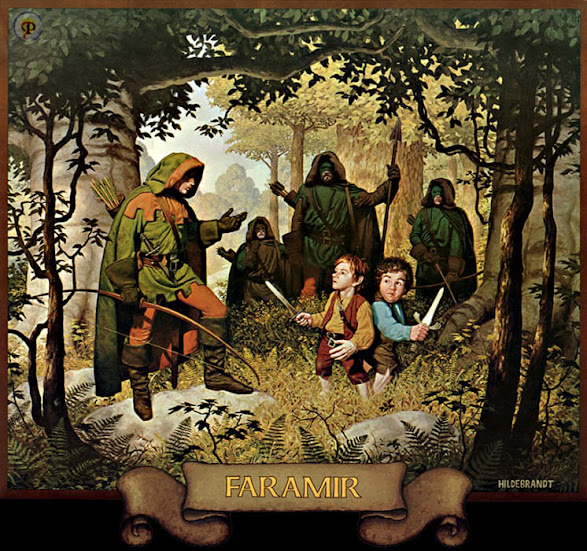
"Faramir," an episode from the Hildebrandt Brothers' J.R.R. Tolkien calendar for June 1977, the month during which the first Hobbit Camp was held in Italy and just six months after Giorgia Meloni was born. Sorry for the digital watermark. I guess some numbskull on the Internet believes that he owns this image just because he digitized it. These things are like a dog peeing on a fire hydrant and calling it his.

Update (Sept. 27, 2022): The news is now that Giorgia Meloni will in fact be prime minister of Italy. She will be the first woman to hold that position. I think that's supposed to make her "historic," but good luck hearing anything about that in the mainstream media. Instead, the drumbeat message of the past couple of days is that she's a fascist. That will go on I'm sure. I have seen a few videos of Signora Meloni speaking in that time. Now I know why the left hates and fears her so much, for she stands firmly and fiercely against their organizing principle, which is that there shall be nothing to intervene between the individual and the State, and now, in the twenty-first century, all of the State's associated corporate and transnational bodies. Let's remember Mussolini's words, which are in contrast to Signora Meloni's: "Everything in the State, nothing outside the State, nothing against the State."

In the videos I have seen, Signora Meloni speaks for faith and family and against the State, for her own nation and people and against internationalism, transnationalism, and globalism, for the things that make us individual, spiritual, and human and against corporatism, consumerism, and materialism. It's worth noting that her opposite, Ursula von der Leyen, German of course, now speaks with all arrogance of "the tools" by which Signora Meloni will be made to heel and the Italian people presumably punished for choosing her. It was a democratic election but with an undesired outcome, and so the media howl and Frau von der Leyen and people like her scheme and plan against it.

In seeing the video of Ursula von der Leyen, I remember two things: First, I remember something that my Italian friend told me, that in World War II, the Nazis did not want to let go of Italy, that they treasured it more than any other place they had conquered. You can ask Italians now how Germans in their country conduct themselves and how they see and treat bell'Italia and her people. Second, I remember the film Roma città aperta (1945) in which the Italian people are shown as being for life, family, children, and humanity. They are full of hope and strive to be free. In contrast, their Nazi occupiers are sterile, perverted, oppressive, despairing, and anti-human, seeking only "morden, morden, morden!" Those are the unforgettable words of Captain Hartmann, who also says, "We Germans refuse to realize that people want to be free."*

We'll see how things go. One thing I know for sure is that we--humanity--will live and be free. Those arrayed against us can only perish along with all of their grand ideas, which are built of course upon foundations of slime.

-----

*Another imperfect formulation: Giorgia Meloni as the Italian Pina (played by Anna Magnani) versus Ursula von der Leyen as the German Nazi Ingrid (dubbed by Roswita Schmidt). Maybe we can work Klaus Schwab into that formulation somehow.

Original text copyright 2022 Terence E. Hanley

Monday, April 18, 2022

"The Man Who Understands Hobbits" by Denis & Charlotte Plimmer-1968

In 1968, husband-and-wife writing team Denis and Charlotte Plimmer interviewed J.R.R. Tolkien. From that interview, they drew an article entitled "The Man Who Understands Hobbits," published in The Daily Telegraph Magazine on March 22, 1968, pages 31ff. The article was reprinted in Weekend Magazine on August 31, 1968, for distribution with Sunday newspapers in Canada.

Below are images of the original article. I have turned an oblique photograph of the cover into a straight-on image. I have also cropped and rearranged images of the text so as to fit the format of this blog. I don't know the source of these images. I don't know why page one is pink. And I don't know who made the annotations. I hope that you find it readable, and beyond that, interesting. I find it interesting that a contributor to Weird Tales also interviewed one of the giants of twentieth-century fantasy. You can fairly say without taking anything away from them that the Plimmers immortalized themselves by interviewing Tolkien. Finally, I don't make any claims as to rights to or ownership of this interview and article nor to the photographs on the cover and contained within (these done by Graham Finleyson). I publish these images based on the doctrine of fair use, for educational and informational purposes only, and I do not profit monetarily from that publication or from this blog.


Original text copyright 2022 Terence E. Hanley

Thursday, April 14, 2022

Denis Plimmer (1914-1981)-Part Two

Denis Harcus Plimmer was from a well-known family in New Zealand. His uncle, William Harcus Plimmer (1875-1959), was a theatre critic. William's grandfather and Denis' great-grandfather was John Plimmer (1812-1905), an early settler in New Zealand and a prominent businessman and booster. Denis Plimmer's father was the actor Harry John Plimmer (1867-1947), subject of the first part of this series. Harry Plimmer was married at least twice, first to (Mary) Josephine Thynne (?-1910), on June 13, 1894, in Sydney, Australia. Harry's second wife and Denis Plimmer's mother was Josephine "Ena" Shanahan Plimmer (1892-1940). Harry and Ena were married on October 27, 1913, in Victoria, Australia. They may have renewed their vows in New York City.

Denis Plimmer was born on September 27, 1914, in Melbourne, Australia, and arrived in America with his parents in January 1918. The family settled in New York City. Harry Plimmer traveled throughout the United States with Ethel Barrymore's acting company beginning in 1918. After that ten-year stint was up, Plimmer acted with the Broadhurst Theater in New York. He retired from acting in 1946.

Denis Plimmer attended college, possibly Columbia University, for four years. His army career, June-September 1943, was cut short by his crosseyed condition. For his part, he became a journalist, writing for the Overseas News Agency during the mid to late 1940s. He was also on the radio with a regular program, Europe This Week/The World This Week, also during the World War II years. He spent more than half of his life in England, from the late 1940s until his death in September 1981 in Westminster. Plimmer had been a pacifist in the 1930s. In 1964, he served as a campaign worker for Americans Abroad for Johnson.

Here is a partial list of Denis Plimmer's works, some of which were with his second wife, Charlotte Plimmer:
  • In Heaven and Earth (play, 1938)
  • "The Meeting" in American newspapers (short short story; syndicated by McClure's Syndicate, 1939) 
  • Land's End (play, 1940) with John Garfield in the cast
  • "Eleven Years" in The American Magazine (vignette, Jan. 1941)
  • "I Love You Ermintrude" in Writer's Digest (article, Nov. 1941)
  • "Death Over Galleon Hall" in Daredevil Detective Stories (novel, Feb. 1942)
  • "Trail’s End" in Dynamic Western Stories (short story, June 1942)
  • "Mr. Potter Finds a Clue" in Daredevil Detective Stories (short story, Aug. 1942)
  • "Mr. Potter and the Prophet Isaiah" in Daredevil Detective Stories (short story, Oct. 1942)
  • "It's Safer in Murmansk," with Stanley Postek, in Free World (article, Aug. 1942)
  • An article in The New Republic (Oct. 29, 1945)
  • "The Harp of David ap Gwylam" in Bluebook (short story, Apr. 1953)
  • "The Man in the Black Coat" in This Week (short story, July 12, 1953)
  • "The Expatriate" in Cosmopolitan (short story, Oct. 1953)
  • "See London for 11 Cents," with Charlotte Plimmer, in The American Magazine (article, Apr. 1954)
  • "We Rediscovered the Rhine," with Charlotte Plimmer, in The American Magazine (article, June 1954)
  • "Separate Rooms" in Cosmopolitan (short story, July 1954)
  • "I Pronounce You" in Esquire (short story, Feb. 1955)
  • "We Discovered Paris Through Its Markets," with Charlotte Plimmer, in The American Magazine (article, Aug. 1955)
  • "Soliloquy on an Autumn Day," with Charlotte Plimmer, in Esquire (short story, Nov. 1955)
  • "Strangers from a Barren Paradise," with Charlotte Plimmer (article)
  • "London's Casbah: Soho," with Charlotte Plimmer, in Esquire (Feb. 1, 1957)
  • "The Royal Home Afloat," with Charlotte Plimmer, in John Bull Illustrated (article, Jan. 24, 1959)
  • "Marching as to War," with Charlotte Plimmer, in Reader's Digest (Nov. 1961)
  • "Tempest in a Riviera Teapot," with Charlotte Plimmer, in The Saturday Evening Post (article, July 14/July 21, 1962)
  • "Storm Over a Royal Love Affair," with Charlotte Plimmer), in Redbook (article, Oct. 1963)
  • "The Man Who Understands Hobbits," with Charlotte Plimmer, in London Daily Telegraph Magazine (Mar. 22 1968, pp. 31-32, 35; published previously in The Telegraphreprinted in Weekend Magazine, Aug. 31, 1968, for distribution with Canadian newspapers)-An article based on an interview with J.R.R. Tolkien
  • The Damn'd Master: An Authentic Account of an Eighteenth Century Slaver, with Charlotte Plimmer, (history, 1971)
  • Slavery: The Anglo-American Involvement, with Charlotte Plimmer, (1973)
  • London: A Visitor's Companion, with Charlotte Plimmer, (travel, 1977)
  • A Matter of Expediency: The Jettison of Admiral Sir Dudley North, with Charlotte Plimmer, (history, 1978)
                          I'll have more on Charlotte Plimmer in the next part of this series, including radio and television scripts she co-authored with her husband.

                          Denis Plimmer's career as an author of genre stories was short, running from November 1940 to September-October 1943. In those three years, Plimmer had nine stories and a poem in Weird Tales, Uncanny Stories, and Uncanny Tales (Canada)--enough to make a book if someone had the mind to put it together. See his Western and detective stories from the same period in the list above. I don't think it's any coincidence that Plimmer's genre fiction career came to an end at around the time he was in and out again from the army. With war on, other things--more important things--were calling.

                          To be continued . . . 

                          Denis Plimmer's Stories & Poem in Weird Tales and Other Weird Fiction Magazines
                          • "The Green Invasion" in Weird Tales (Nov. 1940; reprinted in Uncanny Tales, Apr. 1942)
                          • "Man from the Wrong Time-Track" in Uncanny Stories (Apr. 1941)
                          • "The Devil's Tree" in Weird Tales (poem, July 1941)
                          • "The Coming of Darakk" in Uncanny Tales (Dec. 1941)
                          • "The Stolen God" in Uncanny Tales (Jan. 1942)
                          • "The Channelers" in Uncanny Tales (Feb. 1942)
                          • "The Strange Case of Julian Rayne" in Uncanny Tales (Mar. 1942)
                          • "The Unborn" in Uncanny Tales (Sept. 1942)
                          • "Portrait of the Artist's Mother" in Uncanny Tales (Dec. 1942)
                          • "Louisiana Night" in Uncanny Tales (Sept.-Oct. 1943)
                          I should point out that there was a letter written by an H. Plimmer in Nebula Science Fiction #41 (June 1959). Can we assume that that was by (Denis) H. Plimmer?

                          Denis Plimmer lived long enough to see one of his weird fiction stories reprinted. His only story for Weird Tales, "The Green Invasion," from November 1940, was reprinted in Satanic Omnibus in 1973 and in this volume, Eiskalt ist die Totenhand, edited by Kurt Singer and published in 1974 by Pabel (Vampir Taschenbuch #16). The cover artist was Francisco Javier González Vilanova (1930-1995).

                          Thanks to The FictionMags Index and the Internet Speculative Fiction Database for lists of Denis Plimmer's stories.
                          Original text copyright 2022 Terence E. Hanley

                          Saturday, January 12, 2013

                          Tolkien and Weird Tales-Part 4

                          Tolkien and Howard

                          In his biography of J.R.R. Tolkien, Daniel Grotta observes that "1936 appears to have been a turning point" in the author's life. Tolkien gave a well-received lecture on Beowulf that year. He also had The Hobbit, "his first full-length fairy story," accepted for publication. At age forty-four, Tolkien was on the cusp of a new career as a world-renowned author of fantasy. Nineteen thirty-six was also the year in which Robert E. Howard, creator of Conan, brought his own life to an end.

                          I could write all day about Tolkien and Howard. Lots of people already have. But I don't suppose I would have anything new to say. Instead I'll try to keep it short. The most obvious similarity between the two is in their creation of a world set in our own world's dim past, a world of adventure in which magic holds sway. I haven't seen any discussion of another similarity I have noticed, but the lack of discussion could be because there is nothing to discuss. I won't let that stop me though.

                          Robert E. Howard created Conan and his Hyborian Age in 1932 with a number of stories, background notes, and at least one map. The first Conan story, "The Phoenix on the Sword," was published in Weird Tales in December of that year. Howard went on to write many more tales of his dark and sullen barbarian before his death. Other writers followed with their own pastiches. In the fantasy revival of the 1960s, Conan became very popular and was of course adapted to the comics. That's where this map, based on Howard's original, comes from:


                          As you can see by the legend, the Hyborian Age took place in our own past, "circa 10,000 B.C." The continent over which Conan roams corresponds roughly with Europe, with a little bit of Asia and Africa thrown in as well. Conan is a Cimmerian. That's his country (in yellow) in the northern and western part of the continent. Robert E. Howard must have known a little about geography, but the layout of his countries and their features seems a little odd to me.

                          J.R.R. Tolkien began writing The Hobbit and its sequels in the 1930s. Like Howard before him, Tolkien developed a geography and history of his imaginary land. Bilbo Baggins liked maps. I suppose Tolkien did, too. In any case, here's one depiction of Middle-Earth (1):


                          Tolkien probably did not know anything about Howard or Conan or even Weird Tales when he began designing Middle-Earth. (2) There is some small resemblance between the two continents however. Both face to the west and a barrier sea. (3, 4) Both protrude into that sea on the north and suck themselves in on the south (leaving enough room for a legend in the lower left corner). Both also contain an inland sea on the east, the Vilayet Sea in Conan's world, the Sea of Rhûn in the Hobbits' world. There are several prominent rivers flowing from northeast to southwest on both maps. In the top map, the southernmost large river, the Styx, bends to the south. In the bottom map, its counterpart bends to the north and drains the middle part of the continent. I have the same feeling about this map as about Howard's. Artificial is the obvious word to describe it. A physical geographer would probably have a thing or two to say about both maps. Perhaps the two authors should have consulted with someone like Slartibartfast before proceeding. (5)

                          There's one more thing worth noting here: If you were to overlay one map on the other, you would see that Cimmeria and The Shire are roughly in the same position in their respective continents. Is that a coincidence? I'm not so sure. Howard and Tolkien (Lovecraft, too) favored northern and western lands and peoples over all others. You can't go too far north and west of course. Then you would be in the boondocks. But mostly north and mostly west work out pretty well and make a good native country for your hero.

                          Notes
                          (1) I don't know the source for this map, nor who drew it.
                          (2) According to L. Sprague de Camp, the bee in the bonnet of all Howard and Lovecraft fans, Tolkien did in fact read at least one Conan story, but that wasn't until the 1960s.
                          (3) What lay on the other side of that sea? Another continent of equal wonders?
                          (4) Both continents are also oriented in the same way the continent of Europe is oriented (or should I say "occidented"?).
                          (5) Here's an oddity for you: Blogger's spellchecker accepts Slartibartfast without a problem but puts a red line under Lovecraft.

                          Text copyright 2013, 2023 Terence E. Hanley

                          Tuesday, January 8, 2013

                          Tolkien and Weird Tales-Part 3

                          I have a book called Great Tales of Terror and the Supernatural, published in 1944 by Random House, an American firm based in New York. The publishers were Bennett A. Cerf, Donald S. Klopfer, and Robert K. Haas, all Americans and all born in New York. The two editors of the book were Herbert A. Wise (Cerf's uncle) and Phyllis Fraser (Cerf's wife). They were also Americans. The editors selected fifty-two tales by forty-three authors for inclusion in their anthology. (One story has two co-authors. Ten authors have two stories each.) Of those forty-three authors, twenty-two were British, plus one Armenian-British author (Michael Arlen). Two were French, two were Irish (one of whom was the Irish-American writer Fitz-James O'Brien), one was Danish, and one was German. The balance--fourteen authors--were Americans. Of those dozen-plus-two, most were and are well known: Edgar Allan Poe, Nathaniel Hawthorne, Ambrose Bierce, Henry James, F. Marion Crawford, O. Henry, Edith Wharton, Conrad Aiken, Alexander Woollcott, William Faulkner, and Ernest Hemingway. The last two of course won Nobel Prizes not long after this collection was published. That leaves just three lesser-known American authors: Richard Connell, who is known for just one story, "The Most Dangerous Game"; Edward Lucas White, author of "Lukundoo"; and H.P. Lovecraft, who placed two tales in this collection, "The Rats in the Walls" and "The Dunwich Horror." (The last three stories by the way came from Weird Tales.) Readers of Great Tales of Terror and the Supernatural would probably have been unfamiliar with White and Lovecraft, coming as they did from the pulps. The editors kindly wrote a lengthy introduction to Lovecraft's two tales, which close the book. They refer to "The Dunwich Horror" as a "splendid story." I agree.

                          I haven't read all the stories in Great Tales of Terror and the Supernatural. I'm certain that the editors had good reason to include the stories and authors they did. But were they biased? A larger question: Are publishers, editors, critics, readers, and academia in general biased in favor of British writers when it comes to fantasy? Is there a bias in favor of more "literary" stories or stories from well known authors, especially from the past? Is there an equal bias against pulp fiction and pulp authors or new fiction and new authors? Is there a bias in favor of a specific kind of fantasy and against certain others? The Hobbit is a heroic quest, an Odyssey across Middle Earth. It's a kind of tale as old as literature itself. It also contains elements of a fairy tale, a genre that is also quite old, dating as it does from early in our own childhood. "The Call of Cthulhu" or "At the Mountains of Madness" is something else. Both are also quests, but they are set in the present. More importantly, there isn't any magic, for in the twentieth century science slew magic. Lovecraft's science-fantasy stories may have had precedent in the fiction of Edgar Allan Poe and other nineteenth century authors, but if you think about it, they were startling innovations.

                          Do we then favor the traditional story: the heroic quest, the fairy tale, the ghost story, the Gothic romance, the Utopian novel? Is there opposition to innovation in fantasy fiction--against science-fantasy and science fiction, against a tale set in the present or in the future, on some other planet or in another dimension? Does the general readership favor tales that look to the past while dismissing tales that border on science fiction? I think most people would feel unembarrassed if you found them reading a ghost story or even The Hobbit. But what if they were discovered reading science fiction or--horrors!--a pulp magazine? How would they react to that? With shame and embarrassment? I don't know. In any case, there is even today a stigma attached to certain kinds of fantasy. It's why decades ago Judith Merril started calling science fiction "speculative fiction" or "SF." (2) It's also why respected writers such as Margaret Atwood, Walker Percy, and Cormac McCarthy--all of whom have written science fiction--have also avoided being labeled as science fiction writers. (3)

                          Movies and television are dominated by fantasy. Unfortunately, most of it is throwaway storytelling. Little resonates. The Lord of the Rings series is different. Despite Tolkien's claims that his tales of Middle Earth are not allegorical, we can see our own story unfolding before us, not just the story of the twentieth century, but of all of history. We are in an unceasing struggle against evil. If we win against evil, it's because of our better qualities: heroism, courage, determination, strength, loyalty, friendship, love. The Lord of the Rings is a great piece of moviemaking, but I don't think it won the Oscar for best picture because it's big and epic and loaded with special effects. I think it won because it's a very human story.

                          Finally, if there is any bias in tastes in fantasy fiction, it may be justifiable. Tolkien found his way into print without ever writing for a pulp magazine. It helped that he was a scholar and a professor. It also helped that he wrote for children, at least in The Hobbit. It may even have helped a little that he was British. More than anything, though, Tolkien was a good writer and a good storyteller. Was he a better writer than Lovecraft? That's like comparing apples to oranges. Was he better than the average pulp fictioneer? I'll leave that question open and instead close with a quote from Duke Ellington, whose judgment can be applied just as easily to literature as to music: "There are two kinds of music. Good music, and the other kind."

                          Next: Tolkien and Howard

                          Notes
                          (1) Phyllis Fraser in fact was from plumb in the middle of the country and hailed from Kansas City, Missouri. In addition to being married to Bennett Cerf, she was also a cousin to Ginger Rogers. I can keep going with this: A Hollywood actress for a time, Phyllis Fraser was also related in some vague and distant way to Rita Hayworth and Lucille Ball.
                          (2) This month--January 21 to be exact--marks the 90th anniversary of Judith Merril's birth. Happy Birthday, Judith!
                          (3) According to a friend, science fiction fans hold their own bias and look down their noses at comic books. Even comic books have become hoity-toity and are now split between "graphic novels," which are important, and comic books, which are still trash. By the way, there's a name for the difference between two levels of fantasy: High fantasy refers to stories like The Hobbit which take place in an imagined world. (Tolkien would probably argue that Middle Earth is not wholly imagined.) Low fantasy refers to stories set in our own world. That distinction--high vs. low--doesn't refer to the quality of the work itself. However, the word low certainly has its connotations.

                          Lovecraft, Tolkien, Howard, and other authors of fantasy and science fiction became very popular in the 1960s and '70s with the release of paperback editions of their work. Ballantine Books was in the fore in delivering fantasy to its readers. Lin Carter edited a series called Ballantine Adult Fantasy beginning in 1969. He also presented analysis and history of the genre, including these two volumes, Lovecraft: A Look Behind the Cthulhu Mythos (1972, with cover art by Murray Tinkelman) and Tolkien: A Look Behind the Lord of the Rings (1969, cover artist unknown).

                          Text and captions copyright 2013, 2023 Terence E. Hanley

                          Monday, January 7, 2013

                          Tolkien and Weird Tales-Part 2

                          H.P. Lovecraft was born on August 20, 1890, in Providence, Rhode Island. A mere year and a half separated him in age from J.R.R. Tolkien, who came into the world on January 3, 1892. Lovecraft spent almost his entire life in the city of his birth. His gravestone is inscribed "I am Providence." Born in Bloemfontein in the Orange Free State (now part of the Union of South Africa), Tolkien was removed to England when he was just three years old and spent most of the rest of his life in his parents' native country. (1) Not long after he arrived in England, Tolkien's father died in the Orange Free State. Lovecraft also lost his father when he was a child. Both Lovecraft and Tolkien were educated at home (although both also received formal education). Both were prodigies: Tolkien could read by age four and learned to write soon after, while Lovecraft recited poetry as a toddler and began composing his own verse by age six. "He was a brown-eyed tot with long golden curls," L. Sprague de Camp wrote, adding that Lovecraft's mother "dressed him in a Lord Fauntleroy suit." Tolkien received the same treatment when he was a child:
                          Mabel Tolkien apparently took great pride in dressing her sons in the finery of the day: short black velvet coats and knee-length trousers, large round hats with drawstrings, frilly white satin shirts with wide collars and huge red bows loosely tied at the neck. She also made them wear their hair long and curly. (2)
                          Without putting a name to it, Daniel Grotta seems to be describing a Little Lord Fauntleroy outfit. It's worth noting that Fauntleroy also lost his father when he was a child.

                          Frances Hodgson Burnett must have tapped into a common fantasy in Little Lord Fauntleroy (1885-1886), namely, that of the orphaned boy who is unexpectedly rescued from genteel poverty by a wealthy benefactor or high status. That fantasy came true in some ways for both Lovecraft and Tolkien. However, Lovecraft's benefactor (his grandfather) died in 1904 and the boy was returned to his genteel state, living with his mother and maiden aunts in a life of ever-diminishing means. Lovecraft never completed high school and seldom held a job. Instead, he became an amateur astronomer, scholar, writer, printer, and publisher. Lovecraft began writing professionally in 1919 and contributed to Weird Tales during the magazine's first year in print, 1923. He would continue writing for pulp magazines until his death in 1937. Lovecraft's mother died in 1921, leaving her son a true orphan in the world. Three years later, Lovecraft married and moved to New York City, both on the same day. Both ventures proved to be failures.

                          Tolkien on the other hand received a sound formal education and became a professional and widely respected scholar and writer. (Tolkien was also left an orphan with the death of his mother in 1904.) He served in the British army during World War I and saw combat on the Western Front. (3) Returning to civilian life, he worked as an etymologist, then in academia where he remained until retirement in 1959. By all appearances, Tolkien's marriage was happy and successful. He and his wife had four children, two of whom are still living. Lovecraft on the other hand was literally the last of his line: in his own lifetime, he was the only male living in the United States with the surname Lovecraft.

                          There are other similarities. Despite his Germanic name, Tolkien was very British and conservative. I don't think it's any coincidence at all that the Hobbits who save their land from evil come from the West. Lovecraft was of course a devoted Anglophile and a Tory. He was probably not a racist; he might more properly be called a "racialist." Like Tolkien, Lovecraft favored northern and western Europe over all. There are obvious differences between the two men as well. First, Lovecraft was a materialist, while Tolkien was a devout Catholic. Second, there appears to be little overlap in the books and writers who individually influenced Tolkien and Lovecraft. Also, Tolkien specialized in the Anglo-Saxon period, whereas Lovecraft was enamored of eighteenth-century England. Both now are giants of twentieth-century fantasy. Despite that, both are treated seriously in academic studies, Tolkien perhaps more than Lovecraft. As I noted in my previous posting, Lovecraft and Tolkien (along with other writers of the pulp fiction era) became wildly popular in the 1960s, mostly through mass market paperback editions of their work. Both inspired song, music, movies, television shows, and role-playing games. (First came Dungeons and Dragons in 1974, then Call of Cthulhu in 1981.) Both also inspired imitation, for today it seems every writer of fantasy wants to be either Tolkien or Lovecraft. (4) A question remains: When it comes to fantasy fiction, have Tolkien and other British writers been esteemed more highly than Lovecraft and his compatriots?

                          To be continued . . .

                          Notes
                          (1) Bloemfontein was later the location of an astronomical observatory. If you want to reach for connections, you might remember that Lovecraft was an amateur astronomer. The astronomer Morris K. Jessup spent three years at Bloemfontein. Although he never contributed to Weird Tales, he can be counted among those who wrote about flying saucers, a group that included Vincent H. Gaddis, Donald E. Keyhoe, Millen le Poer Trench (aka Wilma Dorothy Vermilyea), and MacKinlay Kantor, all of whom were contributors. Correction (Jan. 19, 2013): MacKinlay Kantor did not in fact contribute to Weird Tales. Instead, he contributed to Real Detective Tales and Mystery Stories, edited by Edwin Baird, former editor of Weird Tales. Real Detective Tales was a companion magazine to Weird Tales before Jacob Clark Henneberger sold it off in order to keep his "Unique Magazine" in print.
                          (2) From The Biography of J.R.R. Tolkien, Architect of Middle Earth by Daniel Grotta (1978).
                          (3) Lovecraft's mother prevented him from serving in the national guard during the war. As a private in the coastal artillery, he would not have been far from home and in no danger. Even that, it would appear, was too much for her to take. It's fascinating to think how Lovecraft's life would have been different after military service. As he himself wrote, "It would either have killed me or cured me."
                          (4) Time was when they all wanted to be Robert E. Howard, but there are far fewer barbarians crowding the bookrack today than in 1970. Now everyone wants to write great sweeping fantasies (preferably trilogies, tetralogies, or beyond), or tales of the Cthulhu Mythos. I have to ask: Don't we have enough elves, dwarves, and wizards? Aren't there enough stories of Great Old Ones and other dripping horrors?

                          Little Lord Fauntleroy by Frances Hodgson Burnett (1886) was one of the most popular books of its day and inspired a look that we recognize even now. Late Victorian mothers dressed their boys this way, Sarah Phillips Lovecraft and Mabel Suffield Tolkien among them. Perhaps more powerful and subtle is the fantasy of the highly placed benefactor who rescues the poor child from his ordinary life.
                          Not to be outdone by Lovecraft fans, followers of J.R.R. Tolkien formed their own music groups in the 1960s. The Hobbits and Gandalf (pictured here) drew on the Tolkien craze, if only for a while.
                          Coming full circle, here are The Young Rascals in what look like Little Lord Fauntleroy shirts. We are nostalgic for the 1960s, or '70s, or '80s. Then people were nostalgic for the 1920s, or '30s, or '40s, or even before. And so it goes into the remote and irretrievable past.

                          Text and captions copyright 2013, 2023 Terence E. Hanley

                          Sunday, January 6, 2013

                          Tolkien and Weird Tales-Part 1

                          On the morning of March 15, 1937, Howard Phillips Lovecraft, aged forty-six, died in a hospital in Providence, Rhode Island. Despite his frequent travels and an enormous body of correspondence, Lovecraft was essentially a recluse and little known outside a relatively small circle of friends and fans. He had never published a book in hardcover despite repeated opportunity. He had seldom held a job. His brief marriage had ended without issue. Forced into evermore dire circumstances, he more or less died from malnutrition and neglect. Lovecraft was also essentially an amateur. He had made some small arrangements for the handling of his literary estate, but by all appearances, the entirety of his work has fallen into the public domain. (For that we can be thankful.) August Derleth became Lovecraft's champion after his death and published a number of hardbound collections of Lovecraft's stories and poems. Arkham House, the firm co-founded by Derleth expressly for the purpose of reprinting Lovecraft's work, was never a big operation. The initial print run of The Outsider and Others (1939) for instance amounted to 1,268 copies. It would take the explosion in mass market paperbacks of the 1960s for Lovecraft to become truly popular and well known. Today, he is considered among the pantheon of twentieth century authors of fantasy.

                          Six months after Lovecraft's death, on September 21, 1937, to be exact, (1) George Allen & Unwin of London published its own book of fantasy in The Hobbit by J.R.R. TolkienReviewers were enthusiastic in their praise for Tolkien's book. As a result, the initial print run of 1,500 copies sold out by the end of the year. The publisher issued a second printing at the end of 1937. An American edition followed in early 1938. Still more editions rolled off the presses in the decades afterward. Like Lovecraft, Tolkien became enormously popular during the 1960s when college students and the counterculture latched onto his stories. From 1937 until his death in 1973, J.R.R. Tolkien enjoyed an unbroken string of successes and popularity. (2)

                          The Hobbit is a fine book, light in tone, full of imagination, with well wrought imagery, characters, and sequences of action and dialogue. It's aimed at children of course and it's not so British as The Chronicles of Narnia (3). In short, The Hobbit makes for easy and enjoyable reading. It was succeeded by the more adult and challenging Lord of the Rings. Writing in the New York Times, W.H. Auden exulted at the first installment: "No fiction I have read in the last five years has given me more joy than The Fellowship of the Ring." Other critics raved as well: "extraordinary," "distinguished," "one of the great literary achievements of our time," "one of the best wonder tales ever written." Michael Straight of The New Republic was unequivocal: "There are few works of genius in recent literature. This is one." (4)

                          As I write this, The Hobbit is playing in theaters all around the world. It has been nearly a decade since the last of The Lord of the Rings trilogy was released. That film, The Return of the King, went on to win the Academy Award for best picture. There are parallels in the lives of Lovecraft and Tolkien. There are also strong contrasts. In any case, it's hard to imagine that a film based on one of Lovecraft's tales will ever receive an Oscar for best picture. That may have as much to do with moviemaking as it does with source material. Then again, it may not.

                          To be continued . . . 

                          Notes
                          (1) It's worth noting that those two dates--March 15 and September 21--resonate in Western culture. March 15--the Ides of March--is of course the date of the assassination of Julius Caesar. The Feast of Saint Matthew takes place on September 21, the eve of the autumnal equinox, which is, not by coincidence I'm sure, the birthday of both Bilbo and Frodo Baggins.
                          (2) Names, titles, and imagery from Lovecraft and Tolkien even crossed over into popular music in songs by Black Sabbath, Led Zeppelin, and the psychedelic rock group H.P. Lovecraft.
                          (3) Written by Tolkien's friend, C.S. Lewis.
                          (4) If you have the Ballantine editions of The Lord of the Rings from the 1960s, you have already seen these reviews.

                          This is as good a time as any to show three album covers and a group photo for the band H.P. Lovecraft. Note the record label: Philips (with one "l"). The lead singer, George Edwards, had previously worked for Dunwich Records. Could there have been any more appropriate label names for H.P. Lovecraft? Edwards' birthday by the way is August 19, only a day away from Lovecraft's.

                          Text and captions copyright 2013, 2023 Terence E. Hanley