Showing posts with label Star Wars. Show all posts

Sunday, September 1, 2024

Joy Connection

Two years ago, I wrote about Robert A. Heinlein and his book Starship Troopers (1959). Heinlein of course has had his great admirers and his great detractors. There seem to be a lot of words written particularly on Starship Troopers (1959). If you do a simple online search using the terms "Heinlein" and "fascist," you're sure to find plenty to read about him and his novel.

When I wrote in 2022, I referred to an interview with George Michael in which he referred to the group Joy Division as fascist. Actually it was a discussion on the BBC-TV show Eight Days a Week, and Morrissey was in on it, too. And actually the late Mr. Michael referred to what he called the "very fascist elements" of Joy Division's image. So he didn't really say that they were fascist. The host of the show was Robin Denselow. The original broadcast took place on May 25, 1984, now forty years gone and how sad. I guess this is life. Anyway, you can watch the discussion for yourself on your favorite video website.

Joy Division drew its name from the pages of a novel called House of Dolls, written by a pseudonymous author, Ka-Tsetnik 135633, and published in 1955. The reference is to brothels called Freudenabteilungen, or Joy Divisions, operated in Nazi concentration camps during World War II. Joy Division's first album was an EP called An Ideal for Living. On the cover is a drawing of a Nazi Youth beating a drum. That's as much as I know about any connections the band may have had to the elements or imagery of Nazism or fascism. One more thing, Joy Division was previously called Warsaw. I bring this up on the 85th anniversary of the Nazi invasion of Poland.

There was still something hanging out there after I wrote two years ago, for I soon remembered that after the death of Ian Curtis in 1980, Joy Division became New Order. I doubt that the creators of Star Wars have made any connections at all between their universe and the British music scene of the 1980s, but there is a New Order, as well as a First Order, in Star Wars. These are the bad guys. The First Order, from the most recent trilogy, look and act like Nazis in fact. We're supposed to think of them as Nazis and to associate them, I think, with a major political party in America. Whatever, Disney. Oddly, the name of the band New Order came from an article about--I assume--the Khmer Rouge. They were socialists, too, except that they were of the international variety. And like socialists tend to be, they were murderous, just like the Nazis.

There has been a lot of talk of "joy" these past couple of weeks. The other one of our major political parties found strength through joy at their recent national convention. I'm not sure that any insider at that convention or since has used the phrase "strength through joy" in regards to their party or their convention. Maybe I'm the one making connections here. But the phrase "strength through joy" also has Nazi origins. Kraft durch Freude, or Strength Through Joy, was an organization set up in 1933 to promote leisure, sports, travel, and so on in the new Nazi regime. It had lots of its own offices (or divisions), its own programs, too. I would hazard a guess that now, nearly eighty years after the destruction of the Nazi regime, the only remnant of Strength Through Joy is the Volkswagen Beetle. I know, it's weird. More on that in a minute.

But first, the connections go back to music. There was a band called Strength Through Joy.  They released a single called "Sheila from Chicago," backed with "She Said Goodbye," in 1982. (I think this is correct. I'm working with scant information. By the way, The Smiths had a single called "Sheila Take a Bow." I doubt she was the same Sheila. Another by the way: Morrissey had an album called Kill Uncle [1991], named for a movie that I mentioned recently in this space. Connections after connections, references after references.) There was a different band called Strength Through Joy. If you read about them, you will come across the phrase "The Force" and the words gothic, Holocaust, and KAPO. Is there any significance to any of these things? I don't know. In 1980, a Scottish band called Skids recorded an album and a song called "Strength Through Joy." The album sold with another of their albums, The Absolute Game. Their fourth album was called simply Joy.

The Nazi-era organization Kraft durch Freude, or KdF--again, Strength Through Joy--promoted the production and sale of a car it called the KdF-Wagen. That car eventually became the Volkswagen Beetle, the word Volkswagen meaning "People's Car." It's for the people, you know. Always for the people. Even when you kill the people, it's for the people.

Here's an interesting advertisement I found, from Cosmopolitan magazine, 1944. Someone else found it before I did and posted it on the Internet:


The caption begins: "A Dictator's Newest Dream--the 'People's Car'." The original idea is that the People's Car would seat two adults and three children. I guess four soldiers and a machine gun will do. By the way, you should read the bold print in the first column. I don't know about you, but I would prefer to "keep these rights" for myself.

Bob Newhart died last month, on July 18, 2024. He was ninety-four years old. He was a national treasure, I think, a very funny--a naturally funny--man with a great delivery and manner. On May 18, 1983, he appeared on The Tonight Show with Johnny Carson. There is a video of his appearance on that same website I alluded to before. I might as well provide a link. Click here to watch. At the 5:10 mark of that video, hear Bob, who was one-fourth German, talk about, in a German accent, the development of the Volkswagen. What are the holes in the side for? Ventilation. Those are for ventilation . . . and he continues. (I won't give away the punchline.) So did Bob Newhart see the Cosmopolitan ad from 1944? I doubt it. These thoughts come naturally to people who went through the war and those of us who grew up in its shadow and the shadow of what Nazis did to the world and its people. It's still hard to hear a German accent or German speech and not have your thoughts go in that direction. (Erica Jong's narrator feels that way in her novel Fear of Flying, from 1973.) It doesn't help that the whole continent seems to be going in that direction, too, and at a really rapid pace. As fast as lightning maybe?

The Volkswagen is literally "the people's car." During the Nazi era, it and Strength Through Joy were promoted through propaganda. So what other kind of car is promoted through propaganda? This kind of car:


When I say "this kind of car," I don't mean a BMW. (The B stands for Bavarian, by the way. There's some history there.) What I mean is the electric car, which is, like socialism in both its national and international forms, a scam and a folly and built upon the seizure of power by dangerous people and their useful idiots. But note the blurb: "Joy Electrified." (It needs a punctuation mark!) The car is powered--you might say it gets its strength--through electricity, and by driving an electric car, you will experience joy!

Here's an actual headline of an article written by Per Soderstrom and posted on the website Warp News on March 17, 2021 (link here):

"Electric cars for the people!"

Like the KdF-Wagen, the people's car, the car of which he wrote is inexpensive. I wonder if it has any holes in the side. You know, for ventilation.

A year and two months after "Electric cars for the people!" was posted, another electric car article appeared on the website of the Volkswagen Newsroom, this one was on May 20, 2022. Its title:

"Volkswagen joins forces with 'Obi-Wan Kenobi' for the launch of the new all-electric ID. Buzz"

Who knew there would be a connection between Star Wars and electric cars, let alone a Volkswagen? I guess that if you hook your electric car up to one of the biggest moneymakers in entertainment history, it can draw on its power. Or maybe its Force. Anyway, as always, if you follow any line long enough, it will make a circle.

Three years ago today, on September 1, 2021, I wrote about The Listeners by James Gunn. The events in that story transpire over many, many years. Some of them are from about our time, the early twenty-first century. The people of our time drive steam-powered cars in the late Mr. Gunn's book. When I read it, I thought that in that way he hadn't done a good job at prognostication. But then I realized that we have actually done something far more misguided than to return to steam. We have, in actuality, gone back to another old technology that we found more than a century ago to be inferior to the internal combustion engine. (At least steam engines run on combustion.) We gave up on it then in our great practicality and wisdom. Now we're going back. (I thought we weren't supposed to go back. I thought that--like Nazis and Bolsheviks--we were always supposed to go . . . Forward!) So I guess if there's one thing every science fiction writer should know, it's that people are so often stupid, foolish, ignorant, superstitious, also historically, scientifically, and I guess in every other way illiterate. It has always been this way and always will be. Getting into the future won't make us any better or smarter. We will always be human and always fallen.

The American political party that had its national convention recently wants to force people to buy and drive electric cars. And it wants all of us to pay for them. Remember the boldface print in the Cosmopolitan ad: "You can let a government decree when you shall do, what you shall buy, how much you shall pay." That's the first alternative. I like the second one better. (There's a third one, too. We chose that one in 1775.) The same questing after power is at work in the world now as when that ad was first printed. (The same Jew-hatred, too.) The former Great Britain--now Airstrip One--has descended pretty rapidly into tyranny in the past few years. British veterans of World War II must be wondering why they did what they did and why they even fought their war. What was the point if we were just going to give up everything to totalitarian regimes anyway? We in America may not be far behind the British. And if the lights go out here, what hope is there left for this world?

Original text copyright 2024 Terence E. Hanley

Monday, July 3, 2023

The Last of Colloids & Tentacles

A colloid is a suspension of one or more substances in another. Two thirds of the ingredients of a peanut butter and jelly sandwich are colloids. A long time ago, I knew a guy who liked banana and mayonnaise sandwiches. (They smelled like house paint.) Only one third of his ingredients--mayonnaise--is colloidal. Protoplasm is a colloid, too, so when John Corliss Cranmer's giant amoeba gulped down first his daughter-in-law, then his son, people were the meal and the colloid was the eater of the meal. But then the people were made of cells brimming with protoplasm, too, and so it was a case of one big colloidal mass eating lots of little ones--if you're a reductionist, that is.

The word colloid is from the French, originally from the Greek. It means "a substance in a gelatinous or gluey state," originally, simply, "glue." Colloid as a word and a scientific concept is from the mid-nineteenth century, as so many things in our daily lives and so many of the ideas in our busy little brains are. There are other gluey concepts in science, collagen, for example, also the subatomic particles called gluons. There are also gluey crafts and gluey art forms. The collage is the most obvious example of these.

People have made collages for a long, long time, but the collage as a work of art dates from the modern period, maybe from the eighteenth century, certainly no later than the nineteenth or early twentieth century. Georges Braque and Pablo Picasso made collages and coined the term papier collé. Those two artists, along with Juan Gris, were originators first of analytical cubism, then of synthetic cubism. In analytical cubism, the artist looks at his or her subject from many different points if view. That's why, in a work by Picasso for example, you can see both eyes in a portrait seemingly done in profile. So, no, Picasso's people are not part flounder. In synthetic cubism--I think a more playful and not so mathematically exacting variation--a work of cubistic art is synthesized by gluing together scraps and cuttings of paper, thus the collage or papier collé. I guess making collages would have been hard to do before there was a mass and popular press as a source of material.

In moving towards synthesis, or what we might call literary collage, modern authors followed modern artists, I think. The art seems to have come first--synthetic cubism was in flower, if you can call it that, in 1912-1914. Then came the literary works, "The Waste Land" by T.S. Eliot, for example, in 1922, Show Girl by J.P. McEvoy in 1928, John Dos Passos' U.S.A. trilogy in 1930-1936. I think we can include "The Call of Cthulhu" by H.P. Lovecraft (Weird Tales, Feb. 1928) in that list, too. Several stories in the first issue of Weird Tales (Mar. 1923) include notes, clippings, diary entries, and so forth, as if the story were a scrapbook or a collage. That kind of thing would continue in future issues.

"The Call of Cthulhu" also has an analytical approach, as do other works of weird fiction that refer or allude to weird geometries, outré mathematics, and multiple dimensions. Maybe pulp fiction wasn't very far behind mainstream literature in the 1910s-1930s in its move towards modernism. But maybe the pulp fiction genres--especially science fiction--were a little bit ahead because they were in such close contact with the scientific developments of their time. Mainstream authors of the early twentieth century could disregard science. F. Scott Fitzgerald, William Faulkner, Ernest Hemingway, and John Steinbeck didn't write science fiction. But then science and the future barged into the room and Walker Percy, Cormac McCarthy, and Margaret Atwood did and have. How times change.

There will be more on Ms. Atwood in a minute.

Dr. Frankenstein made a kind of collage using parts from different bodies, plus an Abby Normal brain. His goal was the synthesis of life from non-life. "I had worked hard for nearly two years," he wrote, "for the sole purpose of infusing life into an inanimate body." Lightning was the literal spark of life by which he would do it. And so his monster lived. A long line of proto-scientists, semi-scientists, pseudoscientists, and maybe the rarest kind, real scientists, has proposed that early in the earth's history lightning infused life in what they have called the primordial soup or primordial ooze, ooze being a species of colloid. Anthony M. Rud seems to have alluded to the primordial ooze--or jelly in H.G. Wells' formulation--in his story "Ooze" (Weird Tales, March 1923). Since the early nineteenth century, real-life scientists seem to have followed the example of Victor Frankenstein. We, the world over, recently had a deadly encounter with their Frankensteinian brand of science in the form of a lowly virus raised to the top of a Chinese/U.S. government-built Tower of Babel. They'll do it again. We can be sure of that. Next time it's likely to be worse, but that will be good for them because they can take more of what is ours in the process.

Life arising from non-life, called spontaneous generation, was debunked a long time ago. But I guess debunked things don't always stay that way. For example, there are yet again people who believe that a person can change his or her bodily form by some magical process of mind or by a series of practices they call "care," practices that the rest of us can only consider criminal, immoral, and unethical mutilations of the human body, a kind of witch-doctory or pseudo-medical falling-back on superstition, ultimately a literal diabolism. People who can supposedly transform themselves used to be called shape-shifters or skin-walkers, and they did what they did by supernatural processes. Now they go by a different name and we're supposed to believe that there is science behind it.

From the moment we ate from the tree of the knowledge of good and evil, we have believed ourselves to be as gods and to hold in our hands godlike power, godlike authority, and godlike wisdom. Our punishment was expulsion from the Garden and a realization of death. The difference is that we once knew shame and walked in shame, out of the gates and into exile. Now there isn't any shame, only pride, or Pride as it is now capitalized. Now we walk in history every day, as the worst among us might say. Anyway, I guess if we're gods, we can create and mold bodies and parts of bodies, just as Dr. Frankenstein did. In creating our modern-day monster, we will fashion his/her whole body--his veins, his feet, his hands, his organs--everything, including a Frankenstein's schwanzstucker made from the flesh of her forearm--according to our own whims. It won't be real, but we will be required to call it real and her a man. It will in fact be grotesque, a monstrous simulacrum, at once a symbol and a manifestation of our reaching into hell in our efforts to reach into heaven, where we believe we are or shall be enthroned. And, no, she's not gonna be very popular because of it.

Margaret Atwood, who has been called a TERF because she knows what everybody in the whole history of the world knew until ten minutes ago, famously said, "Science fiction is rockets, chemicals and talking squids in outer space." As we know, squids are cephalopods and the bearers of tentacles. So Ms. Atwood has offended not only people who don't know what a woman is, but she has probably also offended a lot of science fiction fans with her opinions on these things. If you're an offended Star Wars fan, though, you might want to just slink away, the reason being that in the Star Wars universe, there is a literal talking squid. His title is Admiral and his name is Ackbar, and though his tentacles are small (they're more like the barbels of a catfish), he is a member of a race called the Mon Calamari, meaning, in una bella lingua of a faraway planet spinning on its axis a long, long time in the future, squid. (The noun is Italian, the possessive pronoun French.)

There are other tentacled aliens in the Star Wars universe. Oola is one. Ahsoka is another. They have tentacles coming out of their heads. The Thermians in Galaxy Quest (1999) are, in their true form, tentacled. They are one form but take another. Call them trans, I guess. Cthulhu of course has tentacles. In Frank Frazetta's interior illustration for The Chessmen of Mars by Edgar Rice Burroughs (1922), there are tentacled heads, called Kaldanes in the story, that frighten and horrify Tara of Helium. In Gino d'Achille's  cover version, the Kaldanes are more spider-like. I believe the Kaldanes have both kinds of members, though, both tentacles and jointed legs. Maybe a Burroughs fan can let us know for sure. That reaching down through the neck to control a host body is also in The Puppet Masters by Robert A. Heinlein (1951), the Star Trek Episode "Operation -- Annihilate!" (1967), and, if I remember right, a skit on SCTV in which cabbage leaves attach themselves to the backs of people's heads. In the Star Trek episode at least, the controlling aliens are colloidal, made by the prop master from bags of fake vomit. By the way, the ninth book in Burroughs' Mars series is The Synthetic Men of Mars, originally published in 1939, and so we have another example of Frankensteinian synthesis in genre fiction.

Colloids are sometimes fun. Give a child a bottle of Elmer's Glue-All along with some construction paper and glitter and see how she entertains herself. But in science fiction, fantasy, and weird fiction, colloids are more often gross, nasty, disgusting, and revolting--when they are not creeping, crawling, encroaching, and deadly in the way shoggoths or the Blob is. We have a different reaction to tentacled creatures, owing, I think, to our hundred-thousand-year experience with them. They are real, discrete, recognizable, nameable, alive. They look back at us with the biggest eyes in nature. And the smartest of them are very smart. More than any of that, though, they seem alien in their star-shaped or radially symmetrical bodies. It's no wonder tentacled creatures became the aliens of science fiction, or more accurately, why science fiction authors, beginning with H.G. Wells, would have fashioned the tentacled creatures of earth into aliens from outer space. Maybe we have atavistic memories of when octopuses first came to our planet, raining down on us in their iron spaceships.

We were made in the image of our Creator, and so we wish to create, thus our art and literature, among so many other great and wonderful things, including most of all love, which allows us an escape into eternity. Where we make our mistake is in believing we can create or re-create the things that he first created. And so Frankensteinian scientists, engineers, and technicians are busy. They believe they can create life (or that life was created) from non-life. They believe they can alter unalterable facts about human nature, human anatomy, and human biology. They believe they can make of us something beyond human, better than human, other than human, transhuman. They're working on synthesizing new forms from fragments of previously existing ones. The coronavirus and a million dead are one result of that. The supposedly counteractive "vaccine" and a million more dead are another. They also believe they can transfer the human mind into a machine, thus surviving their own deaths.* In fact, they appear to see little difference between the ghost and the machine. One can be the other. One is the other. And so we will soon have machines taking the place of human beings. Soon after that, our machines will probably enslave or kill us. If you have never read "I Have No Mouth, and I Must Scream" by Harlan Ellison (1967), you probably should, like right now. It may give you a glimpse into our caliginous--not collagenous but caliginous--future. Anyway, thanks, scientists, but ultimately, thanks, all of us, for we have all done this. Scientists--others, too--are only at the vanguard of our limitless depravity in our fallen state. We fall. The asymptotic curve of our pursuit of perfection--of a perfect and limitless depravity--moves forever upwards.

-----

*Having eaten the forbidden fruit, they believe that the knowledge they have thereby gained will reopen the gates and allow them back into the Garden.

"To Tara's horror, the headless body moved, took the hideous head in its hands and set it on its shoulders." Illustration by Frank Frazetta from The Chessmen of Mars by Edgar Rice Burroughs.

Text copyright 2023 Terence E. Hanley

Tuesday, January 24, 2023

Weird Tales & Weird Fiction-Part Two

Get a drink and a snack. This is a long one.

* * *

Nearly a decade ago, I began a series called "Rivals of Weird Tales." In the first two installments, I covered Golden Fleece Historical Adventure, which was in print in 1938-1939. I wrote about many more titles in installments that followed. What I didn't consider at the time is that these magazines were not really rivals of "The Unique Magazine," for Weird Tales had already won that war and various publishers had already come over to its side by putting out their own magazines of weird fiction. The real rival of the weird tale or of weird fiction may actually be science fiction.

There are beliefs or belief systems behind both weird fiction and science fiction. They stand in opposition to each other, I think. As I have written before, I believe weird fiction to be conservative and about the past. It is based in a belief that that we are faced with limits beyond which we may not go, that there are things beyond our knowledge and control. One of those things is fate, also called weird. No one knows what are its true workings. Fate may also act as destiny, chance, fortune, or even doom. It may be a supernatural force. There may be other supernatural forces at work in the universe, too. And we are at their mercy. Fate punishes those who attempt to exceed the limits imposed upon us by the universe. There can be no exceeding these imposed limits and no escaping from fate.

Science fiction on the other hand is progressive and looks to the future. In the science fiction imagination, there aren't any limits. Donald A. Wollheim wrote that science fiction is based in "a belief in human infinity." What is required in science fiction and by science fiction--among writers, readers, and fans alike--is faith in an infinite future. Nothing is out of reach for us. We will do whatever we imagine. If there is Fate, she is only in our favor. Beyond that, at its extremes, there is no such thing as the supernatural in science fiction. A supernatural science fiction is a contradiction in terms. And yet Donald Wollheim used the word belief. In my discussion of his ideas, I have tacked on the word faith. Fate and faith may be similar in appearance and pronunciation, but they are evidently unrelated words. Faith and science are also unrelated.

Jack Williamson developed a concept in which he contrasted the Greek hero with his Egyptian-Hebraic counterpart. In Williamson's formulation, the utopian tradition is based in the culture and ideas of ancient Greece. In contrast, the anti-utopian or dystopian tradition comes from further east, from Egypt and the Levant. Williamson applied his concept to science fiction, putting forth the idea that H.G. Wells availed himself of both traditions during his writing life. Williamson also placed the writers of the New Wave of the 1960s and '70s in the anti-utopian or Egyptian-Hebraic tradition. That seems right to me. The New Wave seems to have been a reaction to the Superior Man-type story, or at least the typical science fiction story of the Golden Age. Williamson gave Isaac Asimov, Robert A. Heinlein, and Arthur C. Clarke as examples of authors who chose "to show men solving problems to make things better," implicitly towards a more perfect future, perhaps a future without limits.

Not long ago, I began associating in my mind the New Wave-type hero with the heroes or protagonists of weird fiction. The typical science-fictional hero--better (or worse) yet, the typical hero of space opera--is more or less a superman. Nothing is beyond his manifestly superior abilities. He is also a simple character, untroubled by moral, ethical, philosophical, or spiritual doubts or dilemmas. Very often he is a cardboard cutout. Lack of character development is one of the main literary offenses in science fiction in fact. Very often created by physical scientists, technologists, and engineers, the stereotypical science fiction hero functions like a machine. The weird-fictional hero may not be very much different in that way. After all, writers of pulp fiction aren't always the most accomplished of artists. However, the weird-fictional hero is flawed. He suffers. He is punished, humiliated, and defeated. Sometimes he is even killed. In short, he is vulnerable to fate. There are only limits for him, only finitude. If he fails to recognize limits--if he believes he can stride over the world and goes about trying to do it--he is soon brought down. He meets his fate: his weird befalls him.

* * *

If science fiction and weird fiction are rivals, and if the New Wave-type hero is something like the weird-fictional hero, then maybe weird fiction won the war and defeated its rival science fiction, at least in the 1960s and '70s. And then William Gibson's Neuromancer, a Gothic science fiction, came along in 1984 and extended the winning streak (or losing streak, depending on how you look at it) of the Egyptian-Hebraic or anti-utopian or weird-fictional hero into the 1980s and beyond. Are we still living in an era of weird-fictional heroes as the protagonists of many science-fictional milieux?

* * *

These aren't perfect parallels, but maybe weird fiction or the weird tale is ultimately an Old World type, as opposed to science fiction as an American type. We don't believe in limits in America. There is always room for 10% more growth this year, always a need and a drive for more and better. You could say that we have faith in the infinite future. Europe on the other hand is constrained. It is almost everywhere hopelessly mired in the past. It is up against limits and has to satisfy itself with small things, minor things. In our football, one team beats another by a score of 65 to 7. In European football, the final score is 1 to 0 . . . in a game that lasts two hours . . . on a playing field the size of a small country.

I was being a little facetious there, but it seems to me that there is an American-type hero and a European-type hero and almost never the twain shall meet. In The Great Escape (1963) Steve McQueen's character is held in a German POW camp. He escapes, along with scads of other prisoners. Yeah, he gets captured--he's literally snagged at the border--but it's only a matter of time before he tries again. Maybe next time it will work. And in the meantime, he plays at the quintessential American game, baseball. His Old World captors are utterly baffled by it and by him.

In contrast, in The Prisoner (1967-1968), Patrick McGoohan's character, a British secret agent, is taken prisoner and serves time in a not completely unpleasant place called the Village. Every week, or almost every week, he escapes. And every week he is returned to his prison. (He's like the British Gilligan.) In the end, it turns out he can't escape at all, for he has constructed this prison for himself. In one way at least, No. 6 is like Kaspar Hauser: although he has escaped, ultimately he is a victim of himself.

We should note that both Steve McQueen and Patrick McGoohan were native-born Americans--Steve McQueen is from my native state of Indiana. The difference here is that Steve McQueen played an uncomplicated American taken prisoner by an Old World system, while Patrick McGoohan played a much more complicated Briton who was part of an Old World system. The lesson might be that the true American doesn't fall for and can never be captured by European complexities. Marxism and similar intellectual or pseudo-intellectual systems might appeal to the European mind. To us they're trash.

* * *

The American-type hero is like the science-fictional hero, while the European-type hero is like his weird-fictional counterpart. In The Stranger by Albert Camus (1942), the hero is driven inexorably to commit his crime. There is no escaping before he commits it, and there is certainly no escaping afterwards. The book ends with Mersault contemplating his end from within the walls of his cell. Europeans remain in their cells. Americans escape from them, like Tim Robbins' character in The Shawshank Redemption (1994), Clint Eastwood's in Escape from Alcatraz (1979), or Paul Newman as the title character in Cool Hand Luke (1967).

(By the way, an alternate title for The Stranger is The Outsider. Fans of weird fiction, specifically of H.P. Lovecraft, should chew on that for a while.)

In the Italian film Mafioso (1962), Alberto Sordi's character, named Antonio, returns for a visit to his old hometown in Sicily so as to introduce his northern-born wife to his family. (He has moved away to Milano, where he works in a car factory.) While in Sicily, he is tasked by the local don with the killing of a rival mafioso. Antonio can't refuse, of course. He is bound by the past. The twist is that the rival is in New York City. And so Antonio is packed into a crate and flown to the New World--America. He now has an appointment with fate.

In an American movie, the hero would find a way out. In fact, there are hints that Antonio might escape his fate as he is on his way to carry out the hit. A man stops him in the street. He is delayed. Will he figure out how to get out of this? No. He impatiently pushes the man away. He walks into the barber shop. There is his target. He carries out his task. He meets his fate, as does the man in the chair. And Antonio's life is forever afterwards changed.

Our expectations as American viewers is that Antonio will in fact escape. For the European protagonist, though, there is no way out. He is fated--or doomed--and must go on. He must carry out his task. This was, I think, a smart and intentional move by the moviemaker: to place his European protagonist into an American setting, juxtaposing the culture of the past, of that sense of obligation and fate and trapped-ness, against the uniquely American ability and freedom to escape. Or to believe that you can escape. Or to die trying, like Butch Cassidy and the Sundance Kid. 

The impossibility of escape is written right into the title of Jean-Paul Sartre's play No Exit, from 1944. I have never read or seen a performance of that play, but reading a synopsis of it makes me think of the short story "I Have No Mouth and I Must Scream" by Harlan Ellison, first published in IF: Worlds of Science Fiction in March 1967. Yes, it's science fiction, but Ellison's story is also dystopian and post-apocalyptic. You could make a case that "I Have No Mouth and I Must Scream" is almost weird-fictional, or a conte cruel. It was written and published during the New Wave era. It seems to fit with stories of that type and time.

In contrast to Harlan Ellison's story and its no escape, there is After Utopia by Mack Reynolds (1977), about which I wrote not long ago. After Utopia is also a post-apocalyptic and mildly dystopian story. Like The Stranger, Reynolds' story is set in North Africa. Unlike Mersault, the hero, inexplicably named Tracy, escapes--into the future. Like the characters in "I Have No Mouth and I Must Scream," he is faced with a problem that seems unsolvable. But he solves it near the end. He escapes his intolerable life on Earth and sacrifices himself to make things better for all of humanity. (The last living character in Ellison's story also sacrifices himself but in a terrible way. And the people he saves are saved only by death.) In this and other ways, Reynolds' hero is a classic science fiction-type hero rather than his weird-fictional opposite. In his role as a great man, he alters human history and takes on an almost Christlike quality. A curious development from a socialist author.

* * *

In After Utopia, there is a science-fictional fantasy of escape. In this case, the fantasy is an escape into the future--an obvious absurdity fit only for the escapist imagination. In "An Occurrence at Owl Creek Bridge" by Ambrose Bierce (1890), there is another fantasy of escape, but the protagonist is literally snapped back into reality. Bierce's tale is ultimately weird-fictional--and devastating in its hewing to real human experience and real states of the imagination. In the end, the protagonist meets his weird. But does he deserve it? Probably not. Perhaps Bierce's tale is a conte cruel after all. And what of Bierce? We don't know his fate. Maybe he went out like Butch and Sundance.

* * *

There is no escape in Nineteen Eighty-Four (1949) either. Written by an Old World writer and taking place in an Old World setting, George Orwell's bleak novel ends in the bleakest possible way. Its hero, such as he is, is utterly humiliated and defeated. In the end, nothing and no one is saved.

In the current Airstrip One, the real-world country formerly known as the United Kingdom, there is also no escape. A few years ago, an infant named Charlie Gard was kept prisoner in his home country and not allowed to leave to receive medical care. The idea, I guess, is that we are all the property of the State and only the State gets to say where we can go. A few weeks ago, a woman named Isabel Vaughan-Spruce was arrested in Birmingham, England, for praying in her own head. She committed a literal thought crime. She could be imprisoned for it. Maybe her jailers will turn the rats loose on her like O'Brien did to Winston Smith. That'll show her. Anyway, Orwell warned us. Instead of taking it as a warning, though, we're using Nineteen Eighty-Four as an instruction book.

* * *

You can make a case that Superman is a science-fictional hero, whereas Batman is weird-fictional. Both are threatened in their youth, and while Superman escapes his fate--destruction with his parents and planet--Batman does not. He must forever remember the murder of his parents. He must forever seek vengeance after them. He is so fated. Superman is literally superior. His creators were inspired by science fiction. Batman on the other hand is a mortal man. I feel certain that he rose out of the pulp-fiction, weird hero-type stories of the 1930s. Superman wears bright colors and flies out of lofty skyscrapers. He rises up to become himself. He's ready for a Technicolor world. Batman dresses in gray and black and lives in a cave. He descends in order to take on his bat-identity. Film noir is the place for him.

Superman inhabits a science-fictional world. His city is Metropolis, a name straight from the Greek. In contrast, Batman lives in Gotham City, a dark and gloomy place (in the movies it always rains there), a name from the Dark Ages and most recently from the Old English. Gotham City is named for a people who sacked Rome, that pinnacle of antiquity. Gothic is a word often used to describe weird stories. The Gothic romance was a reaction to eighteenth-century onslaughts of reason and rationality. Batman has come out of passion and murder. Superman, on the other hand, is a product of science and reason.

* * *

In Star Wars (1977), Carrie Fisher, a thoroughgoing American, played an Old World character, complete with a faux-British accent. She may be a senator, a title used in a republic, but she isn't addressed as senator. Instead she is the subject of an empire and is called by an Old World title, Princess Leia. Her tormenters bear Old World-sounding titles, too, Darth Vader and Grand Moff Tarkin. Princess Leia is languishing in her cell without hope for escape when two rough-and-ready Americans arrive. One is a farmboy from some podunk place.* The other is a worldly rumrunner in a souped-up spaceship. (In American Graffiti, Harrison Ford drove a hotrod. In Star Wars, he drove an even bigger hotrod.) They rescue her of course and their escapades begin. You could say that Princess Leia starts out in Star Wars as an Old World character. Over the course of the movie, she becomes more American. By the end she's in open rebellion. The two suns of Tatooine will soon set on the Galactic Empire.

*Like Clark Kent, Luke Skywalker is from the hinterlands. Later films reveal him to be a kind of Superior Man, like Superman, with hidden powers and a hidden personal history. Rescued from destruction, he was placed in the care of two bucolic characters. Like Superman and Batman, he is orphaned. Unlike them, he is twice orphaned.

* * *

Science fiction allows for escape. In weird fiction, there is no escape, or no permanent escape. Outer space is the usual medium of science fiction. Originally pitched as "wagon train to the stars," Star Trek begins in its prologue with these words: "Space--the final frontier." The title of Gerard K. O'Neill's book from 1976 is The High Frontier: Human Colonies in Space. Wagon train to the stars, the final frontier, the high frontier, the far frontier: we think of outer space in terms of our own history, of exploring and going beyond frontiers. In Europe, frontiers are borders between countries. You have to wait there while the man studies and eventually stamps your passport. In America, frontiers and borders are of the imagination. They are meant to be pushed outward or crossed outright. You don't have to wait. You just go.

If things go wrong in America, we can always escape, we can cross our borders and frontiers into new places. Things will be better there, or certainly no worse than they are here. John Dillinger (another Hoosier) was famous for his escapes. He always had his eye on the nearest state line. Dillinger tried to escape in the end. He came out of a Clark Gable picture and made a run for it. The FBI shot him and he died ignominiously, facedown in an alleyway. Bonnie and Clyde were always on the run, too. They were shot to pieces, significantly in their car. Will Rogers famously quipped, "We'll be the first nation in the world to go to the poor house in an automobile." It's either that way or the Bonnie and Clyde way--or the Thelma and Louise way. In Paper Moon (1973), there is a race near the end to cross over into Missouri. In contrast, Mark Twain's Huckleberry Finn wants out of the place. With outer space available to us, we can do like Huck did and "light out for the territory." Science fiction, with outer space as its medium, is perfect for the American imagination and the American way of life. It's the road novel and the road picture of the future. Through it and into it, we can escape--or at least we think we can.

Or maybe escape is a childish fantasy. Maybe the Europeans have it right after all. Maybe we all must run up against limits and face our weird.

C.S. Lewis wrote his famous Space Trilogy. Regarding childish fantasies, the last book is subtitled "A Modern Fairy Tale for Grownups." Despite that word space in the title and despite the trips to other planets made inside, I would submit that Lewis' trilogy is not really science fiction, or at least not mainly science fiction. We might better think of it as a reaction to science fiction, especially the naïve progressivism and utopianism of H.G. Wells. In Things to Come (1936), written by Wells, men reach for the stars, seek to escape to and conquer the stars. In The Space Trilogy, the stars and other planets are off limits. No escape is permitted, for humanity--Earth, the Silent Planet--is under quarantine. We are confined here because of our fallen nature. C.S. Lewis' word for us in our fallen state is bentRemember now that our word weird comes from a presumed Proto-Indo-European root *wer-. It means "to bend."
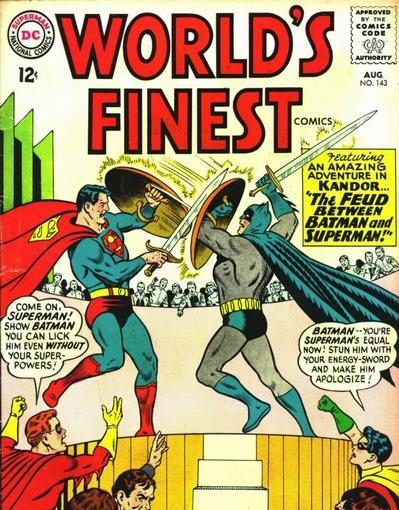
Batman vs. Superman, World's Finest #143, August 1964.

Text copyright 2023 Terence E. Hanley

Wednesday, December 7, 2022

Mary Sue

Speaking of a woman named Mary Sue, it wasn't very long ago that I learned about the Mary Sue-type character used in science fiction and science fiction criticism. You probably already know about Mary Sue. If you don't, it's easy enough to read about her on the Internet.

Mary Sue originally came from Star Trek fan fiction and fanzines. She didn't stop there, though. Some people see Rey, from the last Star Wars trilogy, as a Mary Sue character. It's hard to argue with that idea.

It occurs to me that Mary Sue may be the female version of the Superior Man of science fiction, especially as he appeared in Astounding Science Fiction of the 1930s through the 1950s. (You could call her Mary Superior except that that sounds too much like the name of a Catholic nun.) The Superior Man of science fiction is a powerful and ultimately triumphant character, as opposed to the flawed, weak, or defeated character of weird fiction. There may be something to Jack Williamson's concept of the Egyptian-Hebraic versus the Greek hero or protagonist. Mary Sue may also be triumphant. If she doesn't die in the end, everything comes to her and everything belongs to her. If the comic book superhero is the fulfillment of adolescent male power fantasies, then maybe Mary Sue serves the same kind of purpose for adolescent females and their adult counterparts.

Not long ago, I read an article entitled "The 25 Best Space Opera Books of All Time" by Rachel Brittain. It's on a website called Book Riot, here, and dated October 4, 2022. Because we live in an age of lies, it's hard to say just what their number is, but at least half of the authors in Ms. Brittain's list are women. (Her list seems to serve political rather than literary or critical purposes. In that, it seems pretty well useless. Alternatively, the purpose of this list is to hawk books, in which case it may be useful after all, at least to all who stand to gain financially from it.) That makes me think that at least some of the protagonists in these books are the Mary Sue- or Superior Woman-type character. The same type is all over TV and movies. You'll know her when you see her. She's twenty-five, well-dressed, attractive, and in charge of everything. Her underlings, mostly men, do what she says without question, even though they have more experience and training than she does. She can also beat up every man in sight even though she weighs only 120 pounds and punches with all of the force of a whiffle ball in flight.

Space opera was invented by men and for decades men were its main practitioners, including J. Schlossel and Edmond Hamilton in the pages of Weird Tales. The term--a derisive one at first--was also invented by a man, Wilson Tucker, a critic and an outsider, in 1941. Never mind any of that. At least half of the best space opera books of all time have been written by women. There can be no dissent.

Text copyright 2022, 2023 Terence E. Hanley

Saturday, November 13, 2021

Summer Reading List No. 12-Maza of the Moon by Otis Adelbert Kline

Maza of the Moon by Otis Adelbert Kline was first published as a four-part serial in Argosy, from December 21, 1929, to January 11, 1930, just as the nation was entering its first few months of a great depression. A.C. McClurg of Chicago reprinted Kline's novel (more properly a romance) in a hardbound edition in March 1930. Avon Comics adapted Maza of the Moon as a one-shot comic book called Rocket to the Moon in 1951. Walter Gibson (1897-1985) is now given credit for the script, with Joe Orlando (1927-1998) and it looks like Wally Wood (1927-1981) as artists. I have the Ace Books paperback edition of Maza of the Moon, published in 1965 with a cover illustration by Frank Frazetta (1928-2010). The events in the book begin just a year before, in 1964. Compare that to 1967 for The Moon Maid.

Otis Adelbert Kline (1891-1946) was younger than fellow Chicagoan Edgar Rice Burroughs (1875-1950) by about half a generation. There is a story that Kline and Burroughs were rivals and carried out a literary feud. I don't know anything about that, but it seems to me that Kline and his stories would have been pretty small potatoes to Burroughs. Nonetheless, Maza of the Moon has some real similarities with The Moon Maid, published nearly seven years before in the same magazine (with a different title). It seems clear to me that Kline followed Burroughs' successes by writing in each of the older writer's genres and using all of the same kinds of settings: the Moon, Mars, Venus, the jungles of Earth, and so on.

I'll say straight out that I think Maza of the Moon is a better book than is The Moon Maid. There are a few reasons for that, first of which is that Kline's prose is just plain better. Composed in a more modern style--looser, more informal, more pulpish--Maza of the Moon is actually readable, whereas The Moon Maid is pretty atrociously written. (It's too heavy with Victorian-style prose, a problem, I think, for many nineteenth-century natives who aged into the twentieth.) In some places, Maza is really exciting. There is also a lot of very vivid imagery, especially as the hero first reaches and explores the Moon. On the other hand, like The Moon Maid, Maza of the Moon is unsophisticated, more or less a story for children or adolescents. Its hero is without self-reflection, even after he inadvertently kills off scads of Moon people with a missile he shoots at their home world. In many places, too, Maza of the Moon isn't a novel so much as a simple plot summary. Some of John W. Campbell's early stories have the same kind of simplistic structure in which vast and myriad events are summarized in mere sentences or paragraphs. I guess you've got to tell your whole story within the confines of a popular magazine no matter how much skimping is involved. 

Kline's Moon book has a clever structure. Like a modern-day movie, it has several plot lines running parallel to each other. The story jumps from one to the other, moving all pretty efficiently towards a common climax. The primary plot line is a planetary romance à la ERB in which a Superior Man of Earth journeys to another world, goes through wild adventures and escapes, defeats his enemies, and wins the woman of his dreams. A secondary plot line tells of how men of the Moon invade Earth and wreak havoc here. There is also a 1930s-style super-science plot line and an Alien Abduction plot line (was that a first?), as well as elements of the older Yellow Peril-type story, what is now called an Edisonade (also an older story type), and an account of Ancient Astronauts (something new for the twentieth century). In other words, there is something for everyone in Maza of the Moon. Kline could probably have sold it to any pulp title.

As in Burroughs' Mars and Moon novels, the planetary romance part of Maza of the Moon offers a lot of description of the peoples of the Moon, their culture, their civilization, and so on. It's the same kind of ethnological and anthropological exploration you will find not only in Burroughs' work but also in other Lost Worlds-type stories. If Lost Worlds are descended from stories of Utopia, then there is a utopian element in Maza, perhaps the elusive conservative Utopia of legend. More interesting, I think, is the Alien Invasion plot line, for that is less like Burroughs than it is like H.G. Wells, or even Charles Fort. In Burroughs' earlier book The Moon Men, the Kalkars establish a tyrannical regime on Earth, in other words, a Dystopia. In Maza of the Moon, the invasion coming from our lone satellite (a former planet, by the way, one that made war long ago with Mars) is more nearly apocalyptic.

I think there is an important distinction to be made in that last part, for the Alien Invasion-type story can be either dystopian or apocalyptic. In some people's minds, there isn't much distinction to be made between Dystopia and Apocalypse. (They are especially loose with the term Dystopia. To them, Dystopia is anything unpleasant, even if its only mildly unpleasant.) In some works of fiction, one leads into the other, either by design or by happenstance. Anthem by Ayn Rand (1938) is an example of a post-apocalyptic Dystopia. THX 1138 (1971) and Logan's Run (1976) are two cinematic iterations of the type. Contrast these works with Oryx and Crake by Margaret Atwood (2003), in which Apocalypse follows Dystopia--or brings it to an end. The main action in that novel is set in a Post-Apocalypse.

I think it's important to be precise in these things, though. I think that, narrowly defined, Dystopia describes a society that is perfectly awful and at the same time sophisticated, carefully constructed, carefully maintained. Order and stasis are its main features. It is, in other words, anti-utopian, but it is also, in a different way, anti-apocalyptic, for Apocalypse is chaotic, violent, destructive. And a post-apocalyptic world is one in which everything has broken down, in which structures are simple, if they exist at all, and in which there isn't any great thing either made or maintained. There just aren't the resources for it any longer, especially the resources of mind and heart and demography. Dystopia is not Apocalypse is not Post-Apocalypse. That's how I see it.

I'll have more on these things later, as I always do.

* * *

There are lots of interesting things in Maza of the Moon. I won't go into all of them, but there are:

  • Voice-activated communications (pp. 5-6) and Zoom-like visual communications (pp. 5-6)
  • Solar power (p. 6) and parabolic antennas (p. 91)
  • Atomic power (p. 6) and an explosion that destroys an island in the Pacific Ocean, sending up a great mushroom cloud in the process (pp. 10-11)
  • A United Nations-like organization (p. 6)
  • An Elon Musk-like entrepreneur in the protagonist (pp. 6-7)
  • Supersonic aircraft (p. 8), an airship (p. 9), anti-missile batteries (p. 31), and force fields (p. 133)
  • Eruptions, observed by telescope, on a distant world, which result in an airborne attack on London (p. 16) and two skyscrapers destroyed in New York City: They "toppled to the street, adding to the shambles as panic-stricken people scurrying for shelter were crushed in the ruins." (p. 17)

There are also . . . light sabers! "In her [Maza's] right hand was a short, tubular instrument which greatly resembled a flashlight," the source of a "bright, red ray" used to cut the poor hero loose from his bonds as if he were engulfed by the Sarlacc. (pp. 50 & 49)

And there is . . . a Death Star attack! "Shooting up from the center of the crater [Copernicus] was a bright band of green light." A scientists explains: "'If powerful enough, the green rays will contract and destroy all matter with which they come in contact'." (p. 98) (Han Solo was right: that is a moon.)

And there are . . . UFOs on the Moon! (p. 43) And in the skies above Earth! (p. 73) The Moon people come to Earth in flying globes rather than flying discs, but these are, I think, antecedents to flying saucers and perhaps inspired by the earlier works of Charles Fort.

* * *

So in Maza of the Moon, Otis Adelbert Kline told a Lost Worlds-type story concurrently with an Alien Invasion-type story. He effectively one-upped Burroughs by combining the events of The Moon Maid with those of The Moon Men, all in a single novel-length serial. And his Moon men are defeated in the end and everybody lives happily ever after. Kline may have drawn inspiration from (or copied) Edgar Rice Burroughs, but he was also clearly influenced by H.G. Wells' War of the Worlds (1896) and perhaps also Charles Fort's speculations about interplanetary warfare and visitors coming to Earth from other worlds, haunting our skies in their wondrous craft based on the circle . . .

And speaking of circles, in ending this series, I have circled back to my previous one. But I have three other things to write and show first. Then it's on to a conclusion of "Utopia & Dystopia in Weird Tales."

Argosy, December 21, 1929, with cover art by Robert A. Graef (1879-1951). Note the cinnamon-roll hairstyle like Princess Leia's and the battle of the red versus the green light sabers.

Original text copyright 2021, 2023 Terence E. Hanley

Monday, October 25, 2021

Summer Reading List No. 8-Secret of the Lost Race by Andre Norton

I began reading Secret of the Lost Race by Andre Norton (1959; Ace Books, 1972) late in summer and finished it the day after the equinox. It was originally published as half of an Ace Double with a great cover by Ed Valigursky (1926-2009). The cover artist for my edition is unknown. That's unfortunate, because it's a great and evocative image: colorful, mysterious, inviting to the reader, a depiction of a truly alien landscape. The artist should have received credit, just as every artist should. I'm an artist and so may be biased, but artists have very often given us better, more evocative, more fully realized science-fictional worlds than have authors. We often read science fiction and fantasy based on cover art and illustration versus anything else. Sometimes the story is a disappointment by comparison. Maybe that's more common with visually oriented people versus those who are verbally oriented.

* * *

Andre Norton (1912-2005) can always be counted on to set up a good and intriguing situation. She was also good with sequences of action and adventure. Secret of the Lost Race starts out well by thrusting a young city-dweller into a precarious life on a harsh and distant planet. After a while, though, the story gets bogged down in talk and politics. There is also the introduction of complex physical environments, which can be a problem in any story. I remember a Travis McGee novel in which the story hinges on action taking place within such an environment. I became nearly lost, and because of that, the story was nearly lost to me. I guess a piece of advice for any writer is not to force your story into situations like that. Let it unfold easily instead of with too much complexity. Your readers may not be able to follow you very well through the folds of your own brain.

* * *

The title Secret of the Lost Race may seem a little misleading, but maybe only because we think we already know what is a lost race: lost races are found in lost cities or villages or hamlets situated in lost valleys or lost lands or on lost islands or lost continents. They aren't out there in the great galaxy. Andre Norton didn't commit any literary offense by placing her lost race among the stars, nor by invoking any preconceived notions the reader may have of what is a lost race. I don't feel cheated or misled by her title. I enjoyed Secret of the Lost Race.

Andre's hero is a young man with special, secret, latent powers. He's like Luke Skywalker who doesn't know that he's the son of a Jedi (in one version of the Star Wars story anyway) and can control the Force. But her hero is also like the Superior Man of science fiction tradition (or cliché). He's not ordinary. He's not human. He's a member of a powerful lost race. (Judging from their language, I think they're Welsh.) Only in the end does he find this out. So again we have the Superior Man plot, this time combined with the Lost Race/Lost Worlds plot. Andre Norton wrote for young people. Maybe the Superior Man plot appeals to young people, especially the socially awkward, bookish, or lonely among them: maybe someday their great and special and secret powers will out and the world will recognize them for what they truly are.

* * *

Speaking of Star Wars, there are interesting and innovative weapons in Secret of the Lost Race. They are blades of pure energy, and I think they emerge from a solid handle or haft. There's a force axe and a force blade--a knife, I think. I recognized them right away as light sabers. Maybe the next weapon in the Star Wars galaxy should be a light axe.

* * *

I wanted to write about this book because it steers me back towards my previous series on Edgar Rice Burroughs, Lost Worlds, and Utopia. Those terms--Lost Worlds and Lost Race--can mean more than one thing. Andre Norton showed as much in her book. I have at least six meanings.

A Lost World or Lost Race can be:

  1. Lost as in secret; not easily discoverable nor re-found after first being found. Brigadoon might be an example. This type of world is lost because somebody wants it that way.
  2. Lost, stranded, or frozen in time, i.e., in the past or in a historical phase through which the rest of the world has passed, leaving the Lost World behind. Dian of the Lost Land by Edison Marshall (1935) is an example. Geographic isolation is usually the explanation for this type of Lost World.
  3. Lost as in invoking feelings of longing or nostalgia for something that was greater, happier, and more pleasant than what we have today but has since become lost, i.e., Eden or Paradise or a lost Golden Age. (The lost Golden Age may be the author's own youth, as I suggested in my previous entries on Glory Road by Robert A. Heinlein.)
  4. Lost as in previously unknown; newly discovered, as in Utopia by Thomas More (1516).
  5. Lost as in once known but then lost to the outside world, only to be rediscovered later, like the real-life Viking colonies on Greenland, if they had in fact survived rather than perished, if they had continued developing naturally, and if they had been rediscovered after a couple of centuries of isolation. This kind of Lost World might be lost only accidentally.
  6. Lost as in bewildered, whether it be in time or space, or philosophically, spiritually, psychologically, existentially, etc. The TV show Lost is a good example.

It's important to remember that Lost Worlds can exist not only in space but also in time: a Lost World can be of the future--a future Earth--newly discovered by the Time Traveler, who can be a character but who might also be the author or the reader. Through science fiction and fantasy, we as readers may make our extraordinary voyages and encounter these new and perhaps previously Lost Worlds, all in the comfort of our own rooms. Other planets can be Lost Worlds, too, equivalent to the previously undiscovered lands of the still geographically open earth of our historical past. Lost Worlds can exist in the past, too. Robert E. Howard's stories of Conan and his Hyborian Age are good examples of that. Remember that those stories first appeared in Weird Tales, and so Utopia, by way of the Lost Worlds story, found its way into the pages of "The Unique Magazine." And so I give away half of my thesis in this series.

* * *

If my taxonomy of Lost Worlds is accurate, then maybe Edgar Rice Burroughs' Mars--the Barsoom of John Carter--falls into the third and/or fourth categories, with elements of the second category, too. The idea put forth is that Barsoom is a conservative Utopia, just as Lost Worlds that came before it in literature--worlds created by H. Rider Haggard and Rudyard Kipling for example--were conservative. The conservative Utopia, then, is imperfect. Men must struggle against each other and against the elements and the forces of nature. They must be tested and they must prove themselves. The conservative Utopia of Lost Worlds allows the author and the reader to put himself or herself in the shoes of the protagonist, and so he or she is tested and proves himself or herself. Lost Worlds is wish-fulfillment. That seems pretty plain to me. It seems pretty plain to me, too, that the sixth category of Lost Worlds described above is unlikely to appear in the conservative Utopia, for the Conservative is by definition not a modern man, nor is he tormented by the dilemmas of modernity. (A questioning, seeking, self-aware protagonist in a Lost Worlds setting might make for a good story, though.)

* * *

I'm not saying that I agree with that interpretation exactly, that the Lost Worlds story is the conservative version of Utopia. I would like to read more about it first. Unfortunately, more than one paper on the subject is locked up behind a paywall. (I thought walls were bad.) Anyway, the progressive Utopia is, in contrast, perfect. There is no struggle, only peace. All needs and desires are met by the State, which is coterminous in the progressive imagination with Society. At long last, here is Utopia: a perfect gray sludge of a thoroughly homogenized and dehumanized humanity, living together in perfect happiness, peace, material comfort--and stasis. (You might be able to detect my bias here.) The progressive Utopia is a fantasy, too, not only on the part of the author (Looking Backward: 2000-1887 by Edward Bellamy [1888] is an example) but also of the reader. The problem with the progressive Utopia is that as a literary work, it's usually pretty dull (just like its subjects, their minds, and their lives). The place for the progressive Utopia is actually in the real world; the real-life Progressive prefers to bring his or her fantasy of Utopia to real life. And as we all know, that involves a lot of death. And I mean a lot of death.

* * *

As I've said before, every Utopia is also a Dystopia, because the subjects of Utopia must always be stripped of their humanity. We are not perfect, but in order for Utopia to be brought about, we must be harried into perfection. We are by our very nature free, but in order for there to be Utopia, we must submit to slavery. This is Dystopia, and this is the progressive goal.

* * *

I have three books (or four, depending on how you count) remaining in this series on my summer reading. Next comes Edgar Rice Burroughs and his own description of Dystopia.

Text copyright 2021, 2023 Terence E. Hanley

Monday, April 12, 2021

Utopia & Dystopia in Weird Tales-Part Nine

Mars, Red to Blue

For simplicity's sake, Edgar Rice Burroughs (1875-1950) and his works are thrown into a big bucket called "science fiction." We like to categorize and we want our categorizing to be easy. But Burroughs began writing before there was a well-formed thing called science fiction--"Under the Moons of Mars" was in The All-Story on this day 109 years ago--and by our standards and our current categories, stories of John Carter on Barsoom are more properly called science fantasy*, planetary romance, or swords and planets. I would say that, like Star Wars, Burroughs' Mars books are not science fiction.

And now I take it all back. (But maybe not really.)

By our current categories, Burroughs' Mars books may not be science fiction, but before the Great War and even early in the interwar period, there may not have been any more popular, influential, or pertinent example of the genre, at least on this side of the pond. (On that topic, there are still things to come.) They were the state of science fiction at the time, and they were so powerful in the imagination that they endured for decades, in their pure, original, science-fantasy form, perhaps more deeply and intensely in science fiction, space opera, and space fantasy. (There are swords and sabers--airships, too--on both Barsoom and Tatooine. See the images below.) Even into the Space Age, some people imagined Mars to be the way Burroughs had imagined it. Even some scientists still thought of Mars as a dry but habitable planet (and Venus as wet but also habitable). Canals still webbed the Red Planet's surface. Ruined or dying cities might still be found at their nodes. Decadent or moribund peoples might still haunt those cities and their engulfing, pitiless deserts. Maybe there were or once had been other people in our solar system. Maybe someday we would come upon their artifacts and ruins, like a forlorn and windswept City on the Edge of Forever.

That popular image of Mars persisted even after the mid-sixties Mariner 4 mission showed the planet to be not just mostly dead but all dead--persisted, that is, in the popular imagination if nowhere else. Even in the 1970s, there were artists' images of Mars showing a patchwork of green and red, the green parts tied to each other by ligamentous canals, the two colors waxing and waning, warring with each other within the wider cycle of the Martian year. We so wanted there to be life on Mars. We wanted the green to exist and for it to be plant-life, even if it was just simple moss or lichens. You might look at the Viking missions of a decade after Mariner as acts of quiet desperation, as a kind of grasping at the straws of the idea that the Red Planet was once alive and vibrant and that life might still be found there. The views from a space-borne Mariner weren't enough. We needed a close-up view of things. We needed to touch the surface: the arm of the Viking lander would extend like the forefinger of God, but instead of bestowing life upon Mars, it would detect it. Carl Sagan (1934-1996), an ardent childhood reader of Burroughs, was instrumental in the Viking missions. Although a scientist, Dr. Sagan seems to me to have been more than anything a hopeless romantic. I think he went to his grave believing in life on other planets.

But there would be no Barsoom.

There wasn't even a bacterium.

In January 1980, a little over three years after the Viking landers set down, NBC-TV broadcast The Martian Chronicles, based on stories by Ray Bradbury (1920-2012) and with a screenplay by his friend, Richard Matheson (1926-2013). Both men had been young contributors to Weird Tales. Bradbury loved Burroughs' Mars books so much that as a child he wrote a sequel to The Warlord of Mars (1919). Even in 1980, we were holding on to romantic notions of Mars. But instead of being red, Mars in our imagination had turned blue, not only for the terrible sadness and melancholy of The Martian Chronicles, but also for the cyanotic lack of oxygen in its rarefied air. Red planet, blue mood.

By 1990, when Total Recall was released, Mars had become a kind of cyber-corporate-dystopia. In seven decades, the -topia of Red Planet had seemingly gone from Burroughs' U- to a Philip K. Dick-inspired Dys-. But in the climactic scenes of the movie, the hero Quaid reactivates the ancient Martian atmosphere factory, the vivifying plant in the original Mars books, and the blue of sadness and cyanosis gives way to a cyan sky: Mars is suddenly terraformed and Burroughs' vision is redeemed: Dystopia is banished and Utopia returned to Mars.

To be continued . . .

-----

*I still want to hold on to there being a close connection between science fantasy and Lost Worlds: I think of Burroughs' Mars novels as science fantasy/Lost Worlds set not on a closed Earth but in an open--and limitless--universe. With that being the case, it's a short step from science fantasy to science fiction, and the doors of the universe are thrown open to every kind of storytelling.

The Gods of Mars & The Warlord of Mars by Edgar Rice Burroughs in the Nelson Doubleday edition of 1971. Frank Frazetta's cover illustration is a tour de force of action and painterly technique. I suspect he finished it in a day or less. The Thark's red cloak is reminiscent of the one worn by the ape-creature on Frazetta's cover for the Lancer edition of Conan.

A rear view of this wraparound cover will show a rear view of Dejah Thoris, too. Frazetta had his proclivities. But his choice in depicting the female figure in such a way wasn't just about showing a good shot of her fanny. Or at least I don't think it was. By turning her away from us and posing her the way that he did, I think he heightened the mystery and peril of the situation in which the lovers find themselves. She is firm in the grip of the ape-creatures and is rapidly being carried away by them. John Carter had better do something, and fast, before she disappears from this tableau. (Winslow Homer did the same kind of turning away in his picture-making. I think his purpose was to depersonalize, and thus universalize, his figures.) By the way, if you look quickly enough, you will see the same kind of rear view and split, gray-toned, feminine anatomy in the climactic scenes of Total Recall.

Frank Schoonover (1877-1972) was one of the original John Carter artists. Here is his cover for The Gods of Mars, from 1919. His protagonist is a little goofy-looking. My reason for showing this image is to point out the similarity between Burroughs' desert airships and those run by Jabba the Hutt's gang in Return of the Jedi (1983): George Lucas--just like seemingly everybody else in twentieth-century American fantasy and science fiction--was almost certainly influenced, directly or indirectly, by Edgar Rice Burroughs.

Original text copyright 2021, 2023 Terence E. Hanley