Showing posts with label Theodore Sturgeon. Show all posts

Saturday, August 24, 2024

Weird Tales: The Thirtieth Anniversary

In its March issue of 1953, Weird Tales magazine printed a letter from Irving Glassman of Brooklyn, New York, in observance of the thirtieth anniversary of the magazine. Glassman had one other letter in Weird Tales. That one was printed in the May 1952 issue and reprinted in H.P. Lovecraft in "The Eyrie", edited by S.T. Joshi and Marc A. Michaud (1979). Glassman referred to H.P. Lovecraft in his first letter and made an oblique reference to Lovecraft in his second:

The Editor, WEIRD TALES
9 Rockefeller Plaza, New York 20, N. Y.

My calendar informs me that with the next issue WEIRD TALES celebrates its thirtieth anniversary. I would like to be among those who offer their congratulations to the most long-lived of all imaginative magazines.

I, myself, am too young to have read those early issues of The Unique Magazine but I have read many of those stories in later editions of WT as well as in the Arkham House books. I have in my library a copy of The Moon Terror which, I believe, was the first anthology of stories taken exclusively from your magazine. The Moon Terror is something of a rara avis today and I'm quite proud to own that book.

It would be fitting on this occasion to present a list of what I consider to be the ten best stories to have appeared in WT but such a task, I find, is impossible. At least 50 outstanding phantasies come to mind and there are more than that number which are equally good but which have, for the moment, escaped my memory. For every poorly-written tale that is printed in WT (and that only proves that the editor is human, after all) there are at least a dozen readable ones and of that dozen you will find that about half of them are potential classics. This is not merely my opinion; it is shared by all the readers of your Unique Magazine. Please keep up the good work.

Every best wish to you.

Yours by the Doom that came to Sarnath,
Irving Glassman, Brooklyn, N. Y.

There weren't very many Irving Glassmans in public records. Unfortunately, I can't say for sure who he was.

Weird Tales, March 1953, with a cover story "Slime," by Joseph Payne Brennan and cover art by Virgil Finlay. This is one of my favorite covers by Finlay for "The Unique Magazine." I think it's also one of his best. "Ooze" by Anthony M. Rud was the cover story for the first issue of Weird Tales in March 1923. "Slime" has some similarities to "Ooze." As I wrote recently, it also has some similarities to "It" by Theodore Sturgeon.

Original text copyright 2024 Terence E. Hanley

Thursday, July 11, 2024

Shelley Duvall (1949-2024)

Actress Shelley Duvall died today, July 11, 2024. She was seventy-five years and four days old. Most people remember her as the female lead in The Shining (1980). I remember her for her performance in one of the most powerful and touching episodes of The Twilight Zone, broadcast on September 27, 1986, entitled "A Saucer of Loneliness."

"A Saucer of Loneliness" was adapted by David Gerrold from an original story by Theodore Sturgeon, published in Galaxy Science Fiction in February 1953. Sturgeon's story has been reprinted many times since, and you can understand why once you have read it. Inspiration struck him before he began and he wrote his story in about four hours.

Shelley Duvall played several roles in movie and television adaptations of science fiction, horror, and fantasy stories, as well as tall tales and fairy tales. In 1989, she created and was executive producer of the TV show Nightmare Classics. There were four episodes in all. Three were adapted from original stories by tellers of weird tales Joseph Sheridan Le Fanu, Robert Louis Stevenson, and Ambrose Bierce. Only Henry James out of the four original authors was not in Weird Tales. The Shining was also by an author who was in Weird Tales, Stephen King, though of course he was in a later incarnation of the magazine.

Shelley Duvall was at the height of her career during the 1970s, when great auteurs were at the forefront of moviemaking. She was in fact discovered by one of them, Robert Altman. She had great appeal on screen and unusual looks, too, but then in the 1970s actors and actresses were allowed unusual looks and an unusual manner. In looking at pictures of her today, I realized that she had a passing resemblance to Italian actress Mariangela Melato, who was also an actress of the 1970s and who was also associated with a great auteur, in her case Lina Wertmüller. Mariangela Melato was in The Seduction of Mimi (1972), a very funny movie, but I would recommend watching first Swept Away . . . by an Unusual Destiny in the Blue Sea of August (1974), in which she gave a great performance, in which she looks very beautiful, and which has a great bossa nova soundtrack by Piero Piccioni

Almost all of these people are gone now.

The closing of "A Saucer of Loneliness" may be a comfort to those who still have far to go in life:

". . . even to loneliness there is an end, for those who are lonely enough, long enough."

We send wishes for an end to loneliness for those who are lonely and condolences to the friends and family of Shelley Duvall.

Original text copyright 2024 Terence E. Hanley

Saturday, June 8, 2024

"Microcosmic God" & AI

I have one more post about Theodore Sturgeon and then it's back to the Great Houdini.

One of the stories by Sturgeon that we read in our weird fiction book club is "Microcosmic God," originally in Astounding Science-Fiction in April 1941. It's a compact and well-told story. I would call it novella- or novelette-length. In that, Sturgeon treated his readers well and avoided the bloat. An author of today would have turned it into a mega-novel or even a whole series. "Microcosmic God" has been reprinted again and again. I read it in The Science Fiction Hall of Fame, Volume One (1970). I also read the comic book version adapted by Arnold Drake and drawn by Adolfo Buylla, published in Starstream: Adventures in Science Fiction in 1976.

We decided in our group that the Neoterics in "Microcosmic God" are a kind of artificial intelligence, or AI. I wonder if they were the first example of AI in science fiction. There were of course intelligent machines before Sturgeon's Neoterics. But was any one of those designed specifically to solve problems too great for the human mind, or at least on a convenient time scale? I don't know. Or: maybe not. Anyway, I think Theodore Sturgeon deserves credit for being the first or one of the first science fiction authors to foresee the real-world development of problem-solving artificial intelligence. At the end of "Microscopic God," we are left with the question: what will the Neoterics do (to us) once they emerge from their impenetrable bubble? We can have the same kind of question about our own AI. I think I would take my chances with the former--after all, they are living beings--versus our soulless machines, which are or may be, truth be told, created and promoted by equally soulless human beings.

A two-page spread from Astounding Science-Fiction, April 1941, with a Piranesi-like illustration by Charles Schneeman (1912-1972).

Thanks to Nate Wallace and the other members of our group, Lisa, Scott, Chris, and Carl.
Text copyright 2024 Terence E. Hanley

Thursday, June 6, 2024

"It" in Print & Image

"It" by Theodore Sturgeon (1918-1985) was in Unknown in August 1940. Sturgeon's contemporary, Joseph Payne Brennan (1918-1990), was working for a newspaper in New Haven, Connecticut, at about that time. Brennan had been trying for years to break into print, especially into the pages of his ideal, Weird Tales. Published by Street & Smith, Unknown was in much the same vein as "The Unique Magazine." I think "It" would have fit right into its pages. 

Brennan could easily have read Sturgeon's story the first time around in Unknown. He would have had a second chance to read "It" just a few years later, after he gone to and returned from war in Europe. In 1946, Rinehart published a collection of stories called Who Knocks? The editor of Who Knocks?August W. Derleth (1909-1971), drew from many sources for his contents, including Weird Tales. Less than halfway through the book, readers would have encountered "It." I have a feeling that they and generations of readers since have considered "It" one of their favorites, or at least a very memorable story.

"It" was reprinted again in 1948, first in a very limited paperback edition of 200 copies. A quarter of those were given away at the 6th World Science Fiction Convention, or Torcon, held in Toronto, Canada, from July 3 to July 5, 1948. The paperback version was to promote the publication of Theodore Sturgeon's first collection, Without Sorcery, published by Prime Press, Inc., of Philadelphia, also in 1948. "It" was in that collection as well. One of the men behind Prime Press was Armand E. Waldo (1924-1993), who shared a surname with Theodore Sturgeon, né Edward Hamilton Waldo. Were they related? I don't know.

Joseph Payne Brennan's story "Slime" was published in Weird Tales five years later, in March 1953. The other day, I wrote about how similar is the introduction of his story to that of Sturgeon's. As a fan of weird fiction and fantasy, Brennan would have had at least three chances to read "It" in print before sitting down to write his own story. The influence of one upon the other seems pretty clear to me. But was that a conscious influence? I can't say.


"It" by Theodore Sturgeon was in Unknown in August 1940. The author was all of twenty-two years old at its publication. "It" was illustrated by Edd Cartier (1914-2008). His two illustrations appear above. These images are from a French-language website called Collector's Showcase, accessible by clicking here.

"It" was also in Who Knocks?, a hardbound collection from 1946. The illustrator of that volume was Lee Brown Coye (1907-1981). Unfortunately I don't have any images to show of Coye's illustration or illustrations.

Original text copyright 2024 Terence E. Hanley

Tuesday, June 4, 2024

Killdozer!

Speaking of Theodore Sturgeon, it was twenty years ago today that a man in Granby, Colorado, went on a rampage with a heavily modified bulldozer that has since been dubbed "Killdozer." Maybe that was after Sturgeon's story "Killdozer!", which was published in Astounding Science-Fiction in November 1944. "Killdozer!" was adapted to comic book form in Worlds Unknown in April 1974 by writer Gerry Conway and artist Dick Ayers. Two months before that cover date, in February 1974, NBC had broadcast a made-for-TV movie version of Killdozer! with Clint Walker, Neville Brand, and Robert Urich. We watched that movie when we were kids. I haven't seen it since. Anyway, this makes a quadruple-Killdozer! anniversary year: eighty years since the first publication of the story, fifty since the movie and comic book adaptations, and twenty since the real-life Killdozer rampage. Maybe every thirty years there's a Killdozer outbreak, so watch out, America, in 2034.

Astounding Science-Fiction, November 1944. Cover story: "Killdozer!" by Theodore Sturgeon. Cover art by William Timmins (1915-1985).

Worlds Unknown, April 1974. Cover story: "Killdozer!", originally by Sturgeon, adapted by Gerry Conway. Cover art by . . . I'm not sure. That looks like Gil Kane art under somebody else's inks? Comic books are supposed to be a low art, science fiction barely higher, but I would say that the comic book version of the Killdozer cover is better, and not by a little.

And speaking of influences or possible influences . . . a year after "Killdozer!" was first published, Weird Tales had its own story of a murderous machine. The title is "The Murderous Steam Shovel." The author was Allison V. Harding. This is the first Harding story I have looked at with a woman as the narrator. Her name is Vilma. That might lend some credence to the idea that Jean Milligan (1920-2005) was Allison V. Harding. Whether she was or not, it seems that at least some of the Harding stories were influenced or inspired by stories written by others. This one looks like an example.

"The Murderous Steam Shovel" by Allison V. Harding in a two-page spread in Weird Tales, November 1945. The art is by the rare and elusive Boris Dolgov. It doesn't seem likely to me that the artist for Marvel Comics in 1974 saw this image from nearly three decades before. Nevertheless, he arrived at a similar kind of personified machine. Artist Boris Artzybasheff (1899-1965) also personified machines--to perfection.

Addition:

In 1939, Riverside Press published Mike Mulligan and His Steam Shovel by Virginia Lee Burton. Here's an image of the dust jacket of the first edition, swiped from the Internet. Dolgov's murderous steam shovel looks a little like Virginia Lee Burton's version, named in her book Mary Anne. They're seen from the same angle, and both were drawn with a crayon or charcoal on textured paper. (I think.) I wonder if Dolgov was aware of Virginia's book.

Text and captions copyright 2024 Terence E. Hanley

Sunday, June 2, 2024

Recent Reading No. 2

In our most recent weird fiction book club we read stories by Theodore Sturgeon (1918-1985). Although Sturgeon had eight stories in Weird Tales in 1947-1949, we didn't read any of those. Instead we read several that were in science fiction and fantasy magazines, beginning with "It," published in Unknown in August 1940.

On March 23 of last year, I wrote about swamp monsters in an entry called "The Internet Ooze, Blobs, Jellies, & Slime Database" (click here). Because I had never read it and didn't know anything about it, I did not include it--or "It"-- in my database. It definitely belongs there. I wonder if the monster in "It" was the first swamp monster or muck monster in literature.

Last year and the year before I wrote pretty extensively about Joseph Payne Brennan  as well as his story "Slime," published in Weird Tales in March 1953. In his writing "Slime," think that Brennan was very likely influenced by the first Weird Tales cover story, "Ooze" by Anthony M. Rud, which had preceded it in print by exactly thirty years. A couple of comic book writers and artists of the early 1950s also seem to have been influenced by "Ooze." See Beware #13 (Jan. 1953) and #15 (May 1953).

As I read the first few paragraphs of Theodore Sturgeon's "It," I was struck by the similarity between "Slime" and "It." See what you think.

Here are the first few paragraphs of "It" by Theodore Sturgeon:

     It walked in the woods.
     It was never born. It existed. Under the pine needles the fires burn, deep and smokeless in the mold. In heat and darkness and decay there is growth. There is life and there is growth. It grew, but it was not alive. It walked unbreathing through the woods, and  thought and saw and was hideous and strong and it was not born and it did not live. It grew and moved about without living.
     It crawled out of the darkness and hot damp mold into the cool of a morning. It was huge. It was lumped and crusted with its own hateful substances, and pieces of it dropped off as it went its way, dropped off and lay writhing and stilled, and sank putrescent into the forest loam.
     It had no mercy, no laughter, no beauty. It had strength and great intelligence. And--perhaps it could not be destroyed. It crawled out of its mud in the wood and lay pulsing in the sunlight for a long moment. Patches of it shone wetly in the golden glow, parts of it were nubbled and flaked. And whose dead bones had given it the form of a man?
     It scrabbled painfully with its half-formed hands, beating the ground and the bole of a tree. It rolled and lifted itself up on its crumbling elbows, and it tore up a great handful of herbs and shredded them against its chest, and it paused and gazed at the gray-green juices with intelligent calm. It wavered to its feet, and seized a young sapling and destroyed it, folding the slender trunk back on itself again and again, watching attentively the useless, fibered splinters. And it snatched up a fear-frozen field-creature, crushing it slowly, letting blood and pulpy flesh and fur ooze from between its fingers, run down and rot on the forearms.
     It began searching.

And here are the first few from "Slime" by Joseph Payne Brennan:

     It was a great gray-black hood of horror moving over the floor of the sea. It slid through the soft ooze like a monstrous mantle of slime obscenely animated with questing life. It was by turns viscid and fluid. At times it flattened out and flowed through the carpet of mud like an inky pool; occasionally it paused, seeming to shrink in upon itself, and reared up out of the ooze until it resembled an irregular cone or a kind of gigantic hood. Although it possessed no eyes, it had a marvelously developed sense of touch, and it possessed a sensitivity to minute vibrations which was almost akin to telepathy. It was plastic, essentially shapeless. It could shoot out long tentacle feelers, until it bore a resemblance to a nightmare squid or a huge starfish; it could retract itself into a round flattened disk, or squeeze into an irregular hunched shape so that it looked like a black boulder sunk on the bottom of the sea. 
     It had prowled the black waters endlessly. It had been formed when the earth and the seas were young; it was almost as old as the ocean itself It moved through a night which had no beginning and no dissolution. The black sea basin where it lurked had been dark since the world began--an environment only a little less inimical than the stupendous gulfs of interplanetary space. 
     It was animated by a single, unceasing, never-satisfied drive: a voracious, insatiable hunger. It could survive for months without food, but minutes after eating it was as ravenous as ever. Its appetite was appalling and incalculable.

By that, I think it likely that Brennan was influenced not only by "Ooze" but also by "It." Notice that both passages include the word ooze.

Here's something else to think about: modern-day squatchers believe that signs of Bigfoot in your woods include twisted trees. Here's a smaller passage from the larger passage above:

It wavered to its feet, and seized a young sapling and destroyed it, folding the slender trunk back on itself again and again, watching attentively the useless, fibered splinters.

So another connection is made between the swamp monsters or muck monsters of both fiction and comic books and the Bigfoot creatures of later pseudoscience.

Marvel Comics adapted "It" in the first issue of Supernatural Thrillers, published in December 1923. The cover artist was the essential Steranko.

Original text copyright 2024 Terence E. Hanley

Friday, September 18, 2015

Allison V. Harding-Revelations and Requests

So the Damp Man series by Allison V. Harding had antecedents in stories of water spirits, in "The Water Ghost of Harrowby Hall" by John Kendrick Bangs, and in pulp magazines, comic books, and movies. The movie The Ring (2002) may have been drawn from some of those same sources (and the emo girl in The Incredibles [2004] from the emo girl in The Ring). But what about Allison's other stories? Were there also inspirations for those? This is another place where a study of Allison V. Harding's complete stories would be revealing. 

Like I said, I have read only five of Allison's thirty-six stories: the Damp Man series, "Take the Z-Train," and "The Marmot." "The Marmot" tells the story of an animal that has burrowed under a person's skin. I'm almost sure I have read a similar story, possibly by Fritz Leiber, Jr., but I can't place it. Allison also wrote a story called "The Murderous Steam Shovel," which was published in Weird Tales in November 1945. I haven't read the story, but in reading the title I can't help but think of "Killdozer!" by Theodore Sturgeon from Astounding Science-Fiction, November 1944. Were there other, similarly inspired stories by Allison V. Harding? Maybe you can help by reading her stories in the original and comparing them to other tales of fantasy and science fiction that came before them. I look forward to hearing from anyone feeling up to the task.

Copyright 2015, 2023 Terence E. Hanley

Saturday, September 8, 2012

Weird Tales and Star Trek

Today is the anniversary of the first broadcast of the first episode of the classic television series Star Trek. That first episode was called "The Man Trap" and it aired forty-six years ago, on September 8, 1966. (1) Seventy-eight more episodes followed, the last--"Turnabout Intruder"--on June 3, 1969. Interestingly, a woman was the bad guy in both the first and the last episodes. William Shatner got to pull out the stops in both episodes as well, playing his role in "The Man Trap" as what some people have called "the male Fay Wray." Two more items of trivia before I move on:

Item No. 1: The last episode of Star Trek to be broadcast in its original run was a repeat of "Requiem for Methuselah." (The date was September 2, 1969.) The last word uttered in that last episode? Spock tells Captain Kirk, "Forget." Could that have been a message to fans of the show at the end of its run? After all, they were in as much pain as Captain Kirk at the loss of the woman he loved. Anyway, in a parallel scene from The Wrath of Khan (1982), Spock tells McCoy, "Remember," thereby setting up the next two movies.

Item No. 2: Six days after the broadcast of "Requiem for Methuselah," Star Trek made its debut in syndication. The date? Forty-three years ago today, on September 8, 1969. So today is actually a double anniversary.

I have called this posting "Weird Tales and Star Trek," but the connection between the two is actually pretty tenuous. Although it wasn't the first pulp magazine, Weird Tales was the first American magazine devoted exclusively to fantasy fiction. Subtitled "The Unique Magazine," Weird Tales made its debut in March 1923. The first science fiction magazine--Hugo Gernsback's Amazing Stories--didn't come along until April 1926, by which time "The Unique Magazine" had already printed its first science fiction story, before the term had even been invented. I can't say what that story would have been, but "Ooze," the cover story for the first issue, is a good candidate. In any case, in April 1925, Weird Tales published a story in which the crew of a spacecraft, using sensors to detect a potential problem on a nearby planet, flies to that planet and rescues its helpless natives by destroying a race of monstrous invaders. (The weapons used by the crew of that spacecraft are some sort ray gun. In the story, they are called "blastors.") That sounds an awful lot like the plot for an episode of Star Trek. Instead, it describes the main action in Nictzin Dyalhis' story "When the Green Star Waned."

Despite its originality (especially for TV science fiction), Star Trek relied on developments in science fiction going back decades for its basic setup: interstellar travel, empires, warfare, and organizations of planets; tractor beams, transporters, phasers, and computers; robots, androids, aliens, and monsters--the list could go on and on. Even tribbles had previously appeared in science fiction, though under a different name. (2) To its credit, the show also relied on the work of well known science fiction authors, including Harlan Ellison, Jerome Bixby, and Norman Spinrad. (3) Three writers for Star Trek are worth noting here because they also contributed to Weird Tales: Theodore Sturgeon ("Shore Leave" and "Amok Time"), Fredric Brown ("Arena"), and Robert Bloch ("What Are Little Girls Made Of?", "Catspaw," and "Wolf in the Fold"). Finally, Star Trek derived a great deal from The Outer Limits, an anthology series, which--like The Twilight Zone--owed something in turn to pulp magazines such as Weird Tales. (You can read more about the connection between Star Trek and The Outer Limits in an article called "Star Trek Myths, Part 2: The Outer Limits Connection" by Don Hardenhere.)

One last very tenuous connection between Star Trek and Weird Tales: "The City on the Edge of Forever," written by (or credited to) Harlan Ellison is one of Star Trek's best episodes. It's also the only episode set on Earth during the pulp fiction era. (4) We can imagine an extra in that episode, somewhere in the background, reading a copy of Weird Tales. (5)

Notes
(1) Nineteen sixty-six was a peak year for pop culture in America. In addition to Star Trek, Batman, Dark Shadows, The Newlywed Game, The Green Hornet, The Monkees, The Girl from U.N.C.L.E., Mission: Impossible, and The Hollywood Squares also made their debut. The Beatles released what is arguably their best album, Revolver, while Simon and Garfunkel, Bob Dylan, The Beach Boys, The Byrds, and other groups also released key albums. That was also the year of a UFO flap and of the first sightings of Mothman. By the way, one of the songs on The Byrds' Fifth Dimension (1966) is called "Mr. Spaceman," about space aliens.
(2) They were probably based on a very earthly animal, the guinea pig.
(3) Jerome Bixby wrote "Requiem for Methuselah" as well as three other episodes of Star Trek.
(4) "A Piece of the Action"--the gangster episode--is actually set on another planet.
(5) "The City on the Edge of Forever" is a kind of bridge between the science fiction of the past and of the future in that the Guardian of Forever is a forerunner to Stargate. I have mentioned guinea pigs and Stargate. The person who pointed out that today is an anniversary will be happy.

Weird Tales, April 1925, with a cover story, "When the Green Star Waned" by Nictzin Dyalhis. It was one of the first tales of interplanetary travel or of science-fantasy to appear in "The Unique Magazine."
Star Trek followed in the tradition of science fiction, science-fantasy, and weird fiction pioneered in pulp magazines.
"Remember."
"Forget."

It's ironic that "forget" was the last word spoken in the original run of the television series Star Trek.

Text copyright 2012, 2023 Terence E. Hanley

Saturday, April 7, 2012

Authors of the Golden Age of Science Fiction-Part 3

Golden Age Authors in Weird Tales

Finally, the list. These are some of the authors of the Golden Age of Science Fiction who contributed to Weird Tales. Their names appear here in chronological order of their first contribution to the magazine.

Lester del Rey
Pseudonym of Leonard Knapp
Aka Ramon Felipe Alvarez-del Rey
Born June 2, 1915, Saratoga, Minnesota
Died May 10, 1993, New York, New York

For Weird Tales
"Cross of Fire" (May 1939)

Of the authors on this list, only Lester del Rey was first published in Weird Tales during the Farnsworth Wright era. "Cross of Fire" (May 1939) came early in his career as a writer and editor. Del Rey went on to edit a number of magazines and two lines of books--Ballantine Books and its division, Del Rey Books--all in the genres of science fiction and fantasy. He also wrote the introduction to The Best of C.L. Moore (1975), a collection of ten stories, three of which were drawn from Weird Tales, with six more from Astounding Science-Fiction or its companion magazine Unknown.

Nelson S. Bond
Born November 23, 1908, Scranton, Pennsylvania
Died November 6, 2006, Roanoke, Virginia

For Weird Tales
"The Unusual Romance of Ferdinand Pratt" (Sept. 1940)
"Honeymoon in Bedlam" (Jan. 1941)
"The Downfall of Lancelot Biggs" (Mar. 1941)
"Where Are You, Mr. Biggs?" (Sept. 1941)
"The Ghost of Lancelot Biggs" (Jan. 1942)
"Visibility: Zero" (Sept. 1942)
"The Master of Cotswold" (Jan. 1944)

Nelson Slade Bond enjoyed a varied career as a pulp fiction writer, newspaperman, philatelist, radio scriptwriter, public relations man, bookseller, and literary executor of the estate of James Branch Cabell. Bond wrote seven stories for Weird Tales, at least three of which recount the humorous adventures of the spaceman Lancelot Biggs.

Theodore Sturgeon
Né Edward Hamilton Waldo
Born February 27, 1918, Staten Island, New York
Died May 8, 1985, Eugene, Oregon

For Weird Tales
"Cell Mate" (Jan. 1947)
"Fluffy" (Mar. 1947)
"The Deadly Ratio" (Jan. 1948)
"The Professor's Teddy Bear" (Mar. 1948)
"Abreaction" (July 1948)
"The Perfect Host" (Nov. 1948)
"The Martian and the Moron" (Mar. 1949)
"One Foot and the Grave" (Sept. 1949)

Theodore Sturgeon wrote eight stories for Weird Tales, all dating from 1947-1949. (1) By that time he was a decade into a career that would eventually include scores of short stories, novels, anthologies, and television scripts, including two for Star Trek. Sturgeon is known for--among many other things--his adage in defense of science fiction: "Ninety percent of everything is crud." I presume that "everything" includes religion (or pseudo-religion), yet Sturgeon went along with Dianetics and late in life became an atheist. Sturgeon's adage reminds me of a quote from another writer, Ernest Hemingway: "The most essential gift for a good writer is a built-in, shock-proof, sh-t detector. This is the writer's radar and all great writers have had it."

(1) "Abreaction," the title of one of those stories, is a psychotherapeutic technique involving recalled or relived trauma as a kind of catharsis. L. Ron Hubbard observed abreactive therapy while in a U.S. Navy hospital during World War II and adapted it to the practice of Dianetics and Scientology. I haven't read "Abreaction," but it's interesting that Sturgeon and Hubbard struck upon the same topic, perhaps at about the same time. By the way, The Aberee was the title of an early newsletter (beginning in 1954) on topics related to Dianetics and Scientology. I'm not sure of the meaning of the word aberee, but I presume an aberee is a person who has undergone abreactive therapy. Or maybe an aberee is a person who has become aberrant. If anyone knows, please leave a comment.

Eric Frank Russell
Aka Duncan H. Munro
Born January 6, 1905, near Sandhurst, Berkshire, England
Died February 28, 1978
And
Leslie J. Johnson
Born May 18, 1914, North Liverpool, England
Died ?

For Weird Tales
"Venturer of the Martian Mimics" (Mar. 1947)
"Displaced Person" (Sept. 1948)
"The Ponderer" (Nov. 1948)
"The Big Shot" (Jan. 1949)
"The Rhythm of the Rats" (July 1950)
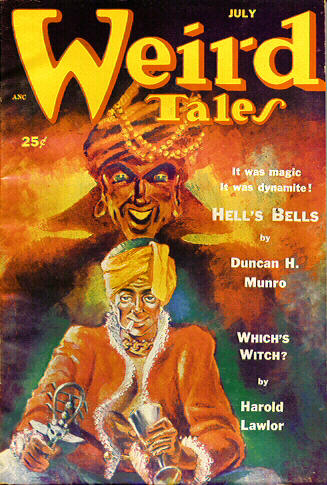
"Hell's Bells" as by Duncan H. Munro (July 1952)
"Eternal Rediffusion" with Leslie J. Johnson (Fall, 1973)

Despite his English origins, Eric Frank Russell was published in Astounding Science-Fiction, Unknown, and Weird Tales, all of which were American magazines. His sometime collaborator was fellow Englishman Leslie J. Johnson, with whom he wrote his first story for Astounding. Russell penned seven tales for Weird Tales, six between 1947 and 1952, and the last in Sam Moskowitz's revival in the early 1970s. Johnson was his co-author on that story, entitled "Eternal Rediffusion." Interestingly, many of Russell's stories are on Fortean topics. Perhaps more interestingly, the Beatles' Apple Corporation purchased the movie rights for his novel Wasp, which never made it to film.

William Tenn
Pseudonym of  Philip Klass
Born May 9, 1920, London, England
Died February 7, 2010, Mount Lebanon, Pennsylvania

For Weird Tales
"Mistress Sary" (May 1947)

William Tenn was the pseudonym of British-born American writer Philip Klass. An army veteran of World War II, Klass began publishing science fiction in 1946. "Mistress Sary," for Weird Tales (May 1947), would have been an early effort. Klass taught English and literature at Penn State University for nearly a quarter of a century.

Robert A. Heinlein
Born July 7, 1907, Butler, Missouri
Died May 8, 1988, Carmel, California

For Weird Tales
"Our Fair City" (Jan. 1949)

Robert A. Heinlein is far too interesting a character to cover in a mere paragraph. Suffice it to say, he was one of the most successful and well-known of science fiction authors by the time Weird Tales printed his story, "Our Fair City," in its January 1949 issue. Some interesting trivia and not-so-trivia: Heinlein graduated from the U.S. Naval Academy and became an officer, as his friend L. Ron Hubbard had done after him. Discharged for medical reasons, Heinlein worked at the Philadelphia Naval Shipyard during World War II and recruited Isaac Asimov and L. Sprague de Camp to work there as well. I wonder whether they were connected to the (apocryphal) Philadelphia Experiment. Even if Heinlein didn't participate in the invention of teleportation, he at least played his part in the invention of the waterbed. Incidentally, two earlier tellers of weird tales, Elizabeth Gaskell and Mark Twain, also mentioned waterbeds in their fiction.

Isaac Asimov
Born Between October 4, 1919, and January 2, 1920, Petrovichi, Russian SFSR
Died April 6, 1992, New York, New York
and
James MacCreigh
Pseudonym of Frederik Pohl
Born November 26, 1919, Brooklyn, New York

For Weird Tales
"Legal Rights" by Isaac Asimov and James MacCreigh (Sept. 1950)

Isaac Asimov and Frederik Pohl are equally interesting characters. Of all the writers on this list, only Pohl is still living--and blogging! His blog, The Way the Future Blogs, is informative and up-to-date. (More so than my own: at this writing, his most recent entry is dated March 30, 2012, mine, only March 28, 2012.) You can reach it by clicking here.

Asimov and Pohl met as teenaged science fiction fans in New York City and became lifelong friends. Their collaborations include "Legal Rights," a story in Weird Tales from 1950, and--four decades later--the non-fiction book Our Angry Earth (1991).

L. Sprague de Camp
Né Lyon Sprague de Camp
Born November 27, 1907, New York, New York
Died November 6, 2000, Plano, Texas
and
(Murray) Fletcher Pratt
Born April 15, 1897, Buffalo, New York
Died June 11, 1956, Long Branch, New Jersey

For Weird Tales
"When the Night Wind Howls" with Fletcher Pratt (Nov. 1951)
"Where To, Please?" (Sept. 1952)
"Caveat Emptor" (Mar. 1953)

L. Sprague de Camp and Fletcher Pratt were another pair of collaborators. Like Asimov, they wrote science fiction and non-fiction. Among de Camp's books was Science-Fiction Handbook (1953), an invaluable work for students of the genre. The book's author seems to have offended and outraged several generations of fans of both H.P. Lovecraft (through his 1975 tome, Lovecraft: A Biography) and Robert E. Howard (through his Conan pastiches and posthumous collaborations). On the plus side for Fletcher Pratt: his wife, Inga Marie Stephens Pratt Clark (1906–1970), was a science fiction illustrator.
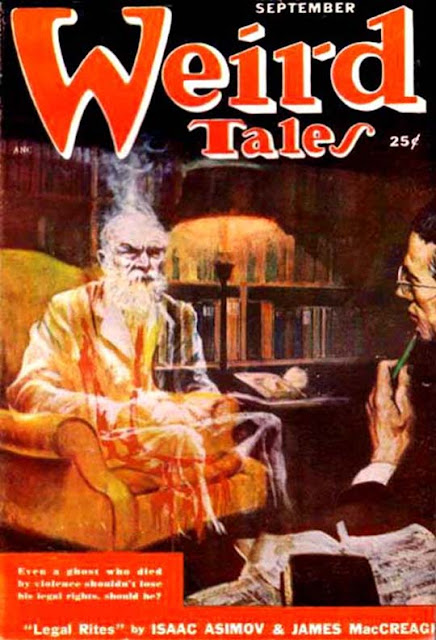
If I have done my research right, only two stories by the authors listed above became Weird Tales cover stories. Here is the first: "Legal Rights" by Isaac Asimov and the pseudonymous James MacCreigh from the September 1950 issue. The artist was Bill Wayne. The man on the right looks suspiciously like Isaac Asimov.
And here's the second, "Hell's Bells" by Duncan H. Munro, aka Eric Frank Russell, from July 1952, with cover art by Jon Arfstrom.

Text and captions copyright 2012, 2023 Terence E. Hanley