Showing posts with label Music. Show all posts

Saturday, November 8, 2025

Train Wrecks & Rocketships

Super 8 (2011) is nostalgic and meta-fictional in more ways than one. Set in 1979, it is self-consciously about the past. You could say there is product placement in the film, but those products are shown not for commercial purposes (or at least not directly) but to recreate the atmosphere of the past. I think this is done mostly in good taste and generally pretty effectively. Super 8 evokes the 1970s pretty well, I think. That's especially true in the character of Cary McCarthy, the kid with the explosives, played by Ryan Lee. The moviemakers seem to have gone back in time to fetch him into the 2010s. I knew kids who looked and acted just like him then.

Super 8 is also self-consciously about the moviemaking of the past. J.J. Abrams (Gen X) wrote and directed it in the Steven Spielberg-Joe Dante-Richard Donner mode of the 1980s. (Two of those three are very early Baby Boomers. Steven Spielberg was born in Ohio.) Mr. Spielberg in fact co-produced Super 8. So the movie is an attempt to recreate two pasts, the real-life adolescent past of the 1970s and the moviemaking past of the 1980s. By the way, Joe Dante directed Explorers (1985), another teenage science fiction movie, which may have been an inspiration for the video for The Smashing Pumpkins song "Rocket," released in 1994. The action in the video crosses the decades by way of an Einsteinian time dilation, and so there is depicted, all together, past, present, and future.

Super 8 is about some kids trying to make a movie when they are interrupted by a train wreck. (A dozen years after the movie was released, a real train wreck occurred on the opposite end of Ohio, in East Palestine. The harm there was real. Unlike in the movie, the response of the U.S. government was slow and ineffective. I suspect that that was a kind of punishment meted out to a bunch of deplorables who would dare to vote for the other party and candidate. On the other hand, it could have been due simply to stupidity and incompetence. Robert A. Heinlein made that formulation in 1941. His insights carry through to today.) In Zapruder-film or Blowup (1966) fashion, they examine their film for evidence of what has happened. So Super 8 is a movie about moviemaking within the movie and refers to moviemaking outside of the movie. I would call that meta. And now it occurs to me that Super 8 is like an adolescent version of Boogie Nights (released in 1997, set in the 1970s and '80s) except that the moviemakers within that film are interrupted by changes in technology, lots of drug use, and those forever pesky human feelings and relationships. Super 8 happens before the apple and Boogie Nights after. The amateur child actors in Super 8, by the way, are better than the adult porn actors are in Boogie Nights, within their respective movies of course.

One more thing about "Rocket" . . .

Awhile back I noticed a similarity--and a distinct difference--in the lyrics of "Rocket" compared to those of "For Pete's Sake" by The Monkees, released in 1967 and used as the closing theme of The Monkees TV show. In the former, the singer--Billy Corgan--closes by exclaiming, "I shall be free/I shall be free." In the latter, the singer--Micky Dolenz--closes with a similar exclamation: "We gotta be free/We gotta be free." The first, though, is about only an individual, while the second is about an entire generation. I versus we. Mr. Corgan was born the year the Monkees song was released, but as a Gen Xer, does he have the same sense of belonging to a generation as did the young people of the 1960s? Or was one of the significant changes of the late 1980s and the whole of the 1990s a sense of separation and isolation among young people from the wider world, including from people their own age? So much of the 1960s was about young people. Could the same thing be said of those later years and decades?

Original text copyright 2025 Terence E. Hanley

Thursday, November 6, 2025

Moviemakers Grok the Past

The Faculty (1998) is meta-fictional. Its characters know they're in an alien invasion story, and they refer to other such stories that have appeared in print and on film. It is from other alien invasion stories that they know that if they can neutralize the alien queen they can have all of their friends back and the threat will be ended.

* * * 

If I remember right, there aren't any meta-references in The Breakfast Club (1985). Times changed in the fourteen years that separated the release of these two films. More than fourteen years separated their respective creators. John Hughes, who wrote and directed The Breakfast Club, was an early Baby Boomer. Kevin Williamson who wrote and Robert Rodriguez who directed The Faculty come from Generation X. I don't know if that explains anything exactly, but it's clear that there were some pretty big changes in our culture between the 1980s and the 1990s and early 2000s. You could write a book or a dozen about those changes and what they might mean.

There have been bigger changes since the early 2000s. People still make teenager movies and high school movies, also alien invasion movies, but I feel certain that these are vastly different from similar movies from the past. And why wouldn't they be? Everything changes. Nonetheless, nostalgia seems to prevail. For example, Shoplifters of the World, released in 2021, is about teenagers living in Colorado in 1987 and lamenting the breakup of The Smiths. (The writer and director of the film, Stephen Kijak, is Gen X.) Last time I wrote I mentioned the film Super 8, which was released in 2011. Super 8 is meta in that it's a movie about a movie, made by teenagers in a small city or town in western Ohio. More importantly, it's meta in that it's self-consciously about the past, being set in 1979, the same year, incidentally, in which Alien was released. Remember that The Smashing Pumpkins' biggest and probably best-loved song is called "1979," the video of which is an exercise in nostalgia in which the singer--the storyteller--sits in the backseat of a car, a 1972 Dodge Charger, as his friends from the past go about their night's activities, like a four-and-a-half-minute American Graffiti (released in 1973, set in 1962). He's not really there. He has placed his current self into the seat he occupied in the past, at the outset of his adolescence. (Billy Corgan is Gen X, too.) He's like a ghost from the future, seeing but unseen in that haunted past. The song "1979," by the way, was released in 1996.

Things may be gained but others are always lost. We try to go back, but it proves impossible. We try to recapture the past and must always fail. We will forever find ourselves thrown upon the shores of today, forever marooned in the present. 

* * *

This blog entry is meta-factual. It's a blog entry about my blog. I noticed this past summer that the number of daily visits jumped by a lot. There were nearly 100,000 visits last month and now about 10,000 per day. I can't say why that is. I have suspected that a large number of those visits are actually made by the engines of artificial intelligence (AI). I have a feeling that I'm being ripped off by a lot of machines which are, to be fair to them, even though they don't need it, prompted to do the ripping off by a lot of lazy, stupid, impatient, and ethically challenged people. You know who you are. Or maybe you don't. I have thought about bringing this blog to an end because of AI. I don't do what I do for the benefit of machines and the machine-like people behind the machines. I do what I do for the benefit of people--real human beings of real human feeling, people questing for knowledge of the past and present and of the human culture of that same past and present. I might sound like Jeremiah, but AI might prove the ruination of the Internet, if it isn't already ruined.

* * *

I promised to cover a couple of real-world developments that I found out about during my five-weeks-and-a-day. I found out about one of those while sitting, in late October, at a computer in a university library . . .

On October 27, 2025, Elon Musk launched an online encyclopedia called Grokipedia. I had a feeling that this new website is AI-generated, and it is. I stay away from AI as much as possible. Remember that a vampire cannot enter your house unless you invite him in, but once he's in, you can never get him to go away again. Anyway, I thought I would have a look, and so I searched for the term "Weird Tales." There is a long entry on Weird Tales in Grokipedia. On the day that I looked, there were 110 footnotes in that entry. Eleven of those are in reference to my blog. I don't take any pride in that. Rewards, accolades, and recognition bestowed by machines are worthless, meaningless. But this makes me think that, yes, many of the visits to my blog are from machines. I would like to tell them: Stay away. You're not invited. You're not welcome here. This blog is for human beings only.

* * *

Like Clea DuVall's character in The Faculty, Elon Musk in his new venture refers to the works of Robert A. Heinlein, specifically in his case to Stranger in a Strange Land (1961) and the Martian word grok. Heinlein may have died nearly four decades ago, but his works and influence live on.

Copyright 2025 Terence E. Hanley 

Friday, October 3, 2025

The Haunted Palace by Edgar Allan Poe

The last poem printed in Weird Tales in 1925 was "The Haunted Palace" by Edgar Allan Poe. It first appeared in a magazine published in Baltimore by Nathan C. Brooks (1809-1898). The original title of the magazine was The North American Quarterly. In or about 1838, Brooks renamed his new charge The American Museum of Science, Literature and the Arts, or The American Museum for short. Evidently, the magazine was also referred to as the Baltimore Museum. That's a lot to go through, but it seems like there is a lack of clarity and precision out there on the Internet as to the original source of "The Haunted Palace." The date of publication by the way was April 1839.

Poe soon incorporated "The Haunted Palace" into his short story "The Fall of the House of Usher," first published in Burton's Gentleman's Magazine in September 1839. "The Haunted Palace" is a poem in six stanzas of eight lines each. In "The Fall of the House of Usher," the stanzas are numbered. In Weird Tales, they are not. Without going through these two versions, I can't say whether they are word for word the same.

I have written before about "The Haunted Palace." First I listed it in Poe's works reprinted in Weird Tales. In writing about Charles Beaumont (1929-1967), I listed some of that author's screen adaptations of other works. These included the screenplay for The Haunted Palace (1963), which is actually an adaptation of "The Case of Charles Dexter Ward" by H.P. Lovecraft (Weird Tales, May-July 1941).

In 2021, I wrote about Les Baxter (1922-1996). Baxter wrote the scores for many Hollywood movies, including The Dunwich Horror, from 1970. Inasmuch as The Haunted Palace was the first film adapted from a work by Lovecraft, the composer of that score, Ronald Stein (1930-1988), should probably get credit for the first recorded musical adaptation of a work by Lovecraft, assuming a movie score is a kind of program music and therefore an adaptation. Prior to that, I had written about what I called "The Other Forms of Lovecraft," listing The Haunted Palace as the first adaptation on film of a work by Lovecraft.

That's a lot about Lovecraft and less about Poe. I'll close by letting you know that, according to Wikipedia, "The Haunted Palace" has been adapted to music four times, first in 1904 by French composer Florent Schmitt (1870-1958).

The cover of an album of musical works based on two stories and a poem by Edgar Allan Poe, including Florent Schmitt's symphonic poem Le Palais hanté, Op. 49, based on "The Haunted Palace" by Poe. I have this image from a very thorough blog entry called "Florent Schmitt and the French Fascination with Edgar Allan Poe: Le Palais hanté (1904)" by Phillip Nones, posted on December 10, 2012, here. Thank you to Mr. Nones and the conductor(s) of that blog. This is the kind of thing the Internet was supposed to be instead of what it is. 

Text copyright 2025 Terence E. Hanley

Sunday, September 1, 2024

Joy Connection

Two years ago, I wrote about Robert A. Heinlein and his book Starship Troopers (1959). Heinlein of course has had his great admirers and his great detractors. There seem to be a lot of words written particularly on Starship Troopers (1959). If you do a simple online search using the terms "Heinlein" and "fascist," you're sure to find plenty to read about him and his novel.

When I wrote in 2022, I referred to an interview with George Michael in which he referred to the group Joy Division as fascist. Actually it was a discussion on the BBC-TV show Eight Days a Week, and Morrissey was in on it, too. And actually the late Mr. Michael referred to what he called the "very fascist elements" of Joy Division's image. So he didn't really say that they were fascist. The host of the show was Robin Denselow. The original broadcast took place on May 25, 1984, now forty years gone and how sad. I guess this is life. Anyway, you can watch the discussion for yourself on your favorite video website.

Joy Division drew its name from the pages of a novel called House of Dolls, written by a pseudonymous author, Ka-Tsetnik 135633, and published in 1955. The reference is to brothels called Freudenabteilungen, or Joy Divisions, operated in Nazi concentration camps during World War II. Joy Division's first album was an EP called An Ideal for Living. On the cover is a drawing of a Nazi Youth beating a drum. That's as much as I know about any connections the band may have had to the elements or imagery of Nazism or fascism. One more thing, Joy Division was previously called Warsaw. I bring this up on the 85th anniversary of the Nazi invasion of Poland.

There was still something hanging out there after I wrote two years ago, for I soon remembered that after the death of Ian Curtis in 1980, Joy Division became New Order. I doubt that the creators of Star Wars have made any connections at all between their universe and the British music scene of the 1980s, but there is a New Order, as well as a First Order, in Star Wars. These are the bad guys. The First Order, from the most recent trilogy, look and act like Nazis in fact. We're supposed to think of them as Nazis and to associate them, I think, with a major political party in America. Whatever, Disney. Oddly, the name of the band New Order came from an article about--I assume--the Khmer Rouge. They were socialists, too, except that they were of the international variety. And like socialists tend to be, they were murderous, just like the Nazis.

There has been a lot of talk of "joy" these past couple of weeks. The other one of our major political parties found strength through joy at their recent national convention. I'm not sure that any insider at that convention or since has used the phrase "strength through joy" in regards to their party or their convention. Maybe I'm the one making connections here. But the phrase "strength through joy" also has Nazi origins. Kraft durch Freude, or Strength Through Joy, was an organization set up in 1933 to promote leisure, sports, travel, and so on in the new Nazi regime. It had lots of its own offices (or divisions), its own programs, too. I would hazard a guess that now, nearly eighty years after the destruction of the Nazi regime, the only remnant of Strength Through Joy is the Volkswagen Beetle. I know, it's weird. More on that in a minute.

But first, the connections go back to music. There was a band called Strength Through Joy.  They released a single called "Sheila from Chicago," backed with "She Said Goodbye," in 1982. (I think this is correct. I'm working with scant information. By the way, The Smiths had a single called "Sheila Take a Bow." I doubt she was the same Sheila. Another by the way: Morrissey had an album called Kill Uncle [1991], named for a movie that I mentioned recently in this space. Connections after connections, references after references.) There was a different band called Strength Through Joy. If you read about them, you will come across the phrase "The Force" and the words gothic, Holocaust, and KAPO. Is there any significance to any of these things? I don't know. In 1980, a Scottish band called Skids recorded an album and a song called "Strength Through Joy." The album sold with another of their albums, The Absolute Game. Their fourth album was called simply Joy.

The Nazi-era organization Kraft durch Freude, or KdF--again, Strength Through Joy--promoted the production and sale of a car it called the KdF-Wagen. That car eventually became the Volkswagen Beetle, the word Volkswagen meaning "People's Car." It's for the people, you know. Always for the people. Even when you kill the people, it's for the people.

Here's an interesting advertisement I found, from Cosmopolitan magazine, 1944. Someone else found it before I did and posted it on the Internet:


The caption begins: "A Dictator's Newest Dream--the 'People's Car'." The original idea is that the People's Car would seat two adults and three children. I guess four soldiers and a machine gun will do. By the way, you should read the bold print in the first column. I don't know about you, but I would prefer to "keep these rights" for myself.

Bob Newhart died last month, on July 18, 2024. He was ninety-four years old. He was a national treasure, I think, a very funny--a naturally funny--man with a great delivery and manner. On May 18, 1983, he appeared on The Tonight Show with Johnny Carson. There is a video of his appearance on that same website I alluded to before. I might as well provide a link. Click here to watch. At the 5:10 mark of that video, hear Bob, who was one-fourth German, talk about, in a German accent, the development of the Volkswagen. What are the holes in the side for? Ventilation. Those are for ventilation . . . and he continues. (I won't give away the punchline.) So did Bob Newhart see the Cosmopolitan ad from 1944? I doubt it. These thoughts come naturally to people who went through the war and those of us who grew up in its shadow and the shadow of what Nazis did to the world and its people. It's still hard to hear a German accent or German speech and not have your thoughts go in that direction. (Erica Jong's narrator feels that way in her novel Fear of Flying, from 1973.) It doesn't help that the whole continent seems to be going in that direction, too, and at a really rapid pace. As fast as lightning maybe?

The Volkswagen is literally "the people's car." During the Nazi era, it and Strength Through Joy were promoted through propaganda. So what other kind of car is promoted through propaganda? This kind of car:


When I say "this kind of car," I don't mean a BMW. (The B stands for Bavarian, by the way. There's some history there.) What I mean is the electric car, which is, like socialism in both its national and international forms, a scam and a folly and built upon the seizure of power by dangerous people and their useful idiots. But note the blurb: "Joy Electrified." (It needs a punctuation mark!) The car is powered--you might say it gets its strength--through electricity, and by driving an electric car, you will experience joy!

Here's an actual headline of an article written by Per Soderstrom and posted on the website Warp News on March 17, 2021 (link here):

"Electric cars for the people!"

Like the KdF-Wagen, the people's car, the car of which he wrote is inexpensive. I wonder if it has any holes in the side. You know, for ventilation.

A year and two months after "Electric cars for the people!" was posted, another electric car article appeared on the website of the Volkswagen Newsroom, this one was on May 20, 2022. Its title:

"Volkswagen joins forces with 'Obi-Wan Kenobi' for the launch of the new all-electric ID. Buzz"

Who knew there would be a connection between Star Wars and electric cars, let alone a Volkswagen? I guess that if you hook your electric car up to one of the biggest moneymakers in entertainment history, it can draw on its power. Or maybe its Force. Anyway, as always, if you follow any line long enough, it will make a circle.

Three years ago today, on September 1, 2021, I wrote about The Listeners by James Gunn. The events in that story transpire over many, many years. Some of them are from about our time, the early twenty-first century. The people of our time drive steam-powered cars in the late Mr. Gunn's book. When I read it, I thought that in that way he hadn't done a good job at prognostication. But then I realized that we have actually done something far more misguided than to return to steam. We have, in actuality, gone back to another old technology that we found more than a century ago to be inferior to the internal combustion engine. (At least steam engines run on combustion.) We gave up on it then in our great practicality and wisdom. Now we're going back. (I thought we weren't supposed to go back. I thought that--like Nazis and Bolsheviks--we were always supposed to go . . . Forward!) So I guess if there's one thing every science fiction writer should know, it's that people are so often stupid, foolish, ignorant, superstitious, also historically, scientifically, and I guess in every other way illiterate. It has always been this way and always will be. Getting into the future won't make us any better or smarter. We will always be human and always fallen.

The American political party that had its national convention recently wants to force people to buy and drive electric cars. And it wants all of us to pay for them. Remember the boldface print in the Cosmopolitan ad: "You can let a government decree when you shall do, what you shall buy, how much you shall pay." That's the first alternative. I like the second one better. (There's a third one, too. We chose that one in 1775.) The same questing after power is at work in the world now as when that ad was first printed. (The same Jew-hatred, too.) The former Great Britain--now Airstrip One--has descended pretty rapidly into tyranny in the past few years. British veterans of World War II must be wondering why they did what they did and why they even fought their war. What was the point if we were just going to give up everything to totalitarian regimes anyway? We in America may not be far behind the British. And if the lights go out here, what hope is there left for this world?

Original text copyright 2024 Terence E. Hanley

Friday, February 10, 2023

Bacharach, Blob, & Brennan

Today I write about a circle. The circle begins with Burt Bacharach, who died two days ago, on February 8, 2023, at age ninety-four. Everyone who grew up in the 1960s through the 1980s remembers his songs. There are so many that are so good and come so quickly to mind that as soon as you hear his name, one of them is bound to start playing in your head.

Burt Bacharach and Mack David collaborated on the theme song for the 1958 film The Blob. If you grew up during the 1950s through the 1970s, you probably saw The Blob either at the theater or on late-night television. Maybe a horror host presented it for your consideration.

The star of The Blob was Steve McQueen, about whom I wrote recently. We think of The Blob as a science-fiction monster movie or an alien invasion movie, but it's also a car movie and a teenager movie (even though Steve McQueen was already twenty-seven when it was released). Teenagers drive around in their cars and save the day in The Blob. The plot is like a cross between the first encounter with Mothman in 1966 and the movie American Graffiti.*

The plot is also like Joseph Payne Brennan's novelette "Slime," from Weird Tales, March 1953. Brennan gets short shrift when it comes to The Blob. You might think that the similarity between the two stories is just a coincidence. Maybe it's a case of convergent evolution. But if you consult the description of the Joseph Payne Brennan Papers at Brown University Library, you will find that there appears to have been legal action involving The Blob and "Slime." The word plagiarism comes up in fact. Unfortunately, we have only a description of the papers available to us on line. It would take a trip to the library, I guess, to find out what it was all about.

Click on the words below for a link:

Joseph Payne Brennan papers (Ms. 2009.011), Brown University Library, Box A, Brown University, Providence, RI 02912

"Slime" was the cover story for the March 1953 issue of Weird Tales. As it so happens, that was the thirtieth-anniversary issue of "The Unique Magazine," an anniversary that seems to have been observed only in "The Eyrie," in a letter by Irving Glassman of Brooklyn, New York, on page 70. That was the last chance for anyone to observe a nice, round-numbered anniversary issue in the original run of Weird Tales. The magazine came to an end exactly a year and a half later, in September 1954. Virgil Finlay did the cover art for both, March 1953 and September 1954.

Thirty years before "Slime," there appeared another slime-blob-jelly-ooze cover, the first in fact for Weird Tales. This was of course in the first issue of Weird Tales, March 1923. The cover story was "Ooze" by Anthony M. Rud. The monster on the cover looks more like an octopus. If you read the story, you will find that it's actually a giant amoeba. Whereas Rud told his story from the point of view of an after-the-fact human investigator, "Slime" begins with the monster.

And that leads into the next few parts of this series.

Two slime-blob-jelly-ooze covers of Weird Tales. On the left is the cover for March 1953, illustrating "Ooze" by Anthony M. Rud. The cover artist was Richard R. Epperly. On the right is the cover for March 1953, illustrating "Slime" by Joseph Payne Brennan. The cover artist was Virgil Finlay. Note that, although thirty years separated these two issues, the cover price was the same. Of course the first issue had a lot more content. As for the cover art, well, Virgil Finlay simply outshone most pulp artists. This is no exception.

*Terrence Steven McQueen (1930-1980) and I share a first name, though his has one more "r" in it. That gave him extra Vrr-oom. He was born in Beech Grove, Indiana, a town that has been swallowed like the Blob by my native city of Indianapolis. James Dean (1931-1955) was also from Indiana. I think Steve McQueen is way cooler. He was also a better driver.

Text copyright 2023 Terence E. Hanley

Sunday, November 20, 2022

Two Recent Losses--and Recent Gains

These losses have nothing to do with fantasy, science fiction, or weird fiction, but I would rather not let them go by without notice. Thoughts of them lead into further thoughts and speculations.

* * *

First, jazz musician Pharoah Sanders died on September 24, 2022. He was eighty-one years old. In listening to his music, one has ineffable feelings about human life and pain, intimations of suffering, melancholy, joy, triumph, and spiritual transcendence. I am saddened that he is gone.

Second, Gal Costa died on November 9, 2022, at age seventy-seven. She was a Brazilian singer of great sensitivity and charm. Although she was part of the Tropicália movement in her native country, she and her music came out of a slightly older Bossa Nova movement. Her death is also a very sad occasion.

* * *

The phrase bossa nova literally means "new wave" or "new trend" in Portuguese. It was first used in reference to a new musical style in Brazil in the late 1950s. At around the same time in France, cinéastes were involved in a movement called the New Wave, or Nouvelle Vague in French. (1) Shortly after that--all of this seems to have happened in about a two- or three-year period--the term New Wave was applied to science fiction written by British authors and published in the magazine New Worlds. There were American authors of New Wave science fiction, too. By the 1970s, the wave had either subsided or washed over and become a part of a greater science fiction. After a few years, new things aren't new anymore.

Although most people are temperamentally conservative, we also like new things. Newness must have been a hard-driving force in the late 1950s and early 1960s. We can speculate that it had to do with demographics, or populations finally beginning to recover from nightmares of world war. Coincidentally, the idea that science fiction might be dying also came up in the late 1950s and early 1960s. Maybe old waves were drawing back as new ones were rolling in.

There has been at least one effort to revive the new waves of the past. That sounds like a contradiction to me. It sounds like the workings of nostalgia, an attempted return to past glories and not at all a progressive or innovative thing. Call it quixotic. Maybe even silly. Alternatively, it might be considered ambitious--or hubristic. We puff ourselves up by imagining that we have made or discovered new things. There's an awful lot of that in this world. Anyway, that new return to the old past is a so-called "New Weird." The term itself first appeared in print in 2002. I suspect it is meant to evoke memory of or an association with the New Wave in science fiction, right down to the initial assonance and monosyllabic construction of the words weird and wave. (In order for it to happen, weird had to be turned back into a noun: another return to the past.) Former editor of Weird Tales magazine Ann Kennedy VanderMeer and her husband Jeff VanderMeer are or were champions of the "New Weird." In 2008, they published an anthology called just that, The New Weird.

Two thousand two was twenty years ago. Two thousand eight was fourteen years ago. What was new then isn't any more. So is there still such a thing as the "New Weird"? Was there ever? Or could it have been an imitation--or a conceit, a self-conscious conceit at that? I can't say. I haven't read any authors of the "New Weird" unless Thomas Ligotti is one of them. I certainly haven't read any literary criticism or any real literary theory behind any of it. I wonder if there are such things. And I wonder if the term New Weird gained any traction at all outside of a small, or medium-sized, circle of writers and editors.

New things are generally made by young people. João Gilberto was still in his twenties when he made his breakthrough as what Antônio Carlos Jobim called "O Baiano bossa-nova." Gal Costa began singing professionally at age eighteen. She was not yet twenty-three when the seminal album Tropicália ou Panis et Circencis was released. Pharoah Sanders made his first record at twenty-four. There are examples after examples. Young people are new in the world. They literally are a new wave. Their elders are less often innovators. Although many of the writers and editors of the "New Weird" were still young adults at the turn of the last century, they are now in middle age.

One of the complications for their generation--Generation X--is that they are outnumbered not only by the generation above them but also by the one below them. Maybe Generation X didn't have all of the opportunities to distinguish themselves that other generations have had. Maybe they didn't have much of a chance to thrive. Then again, maybe that's just bellyaching and excuse-making. Remember that in the 1980s and '90s, Generation X were referred to as the "Slacker Generation."

There's another thing to consider, though, for Generation X is unique in American history. (3) That uniqueness comes from a historical event that came halfway through their generation, possibly at the exact midpoint. Before that, things were normal. After that, all hell broke loose. What happened is that Generation X became prey. Call them instead the Truncated Generation, for millions of their cohorts--their brothers and sisters, their friends, classmates, and coworkers, their lovers, husbands, and wives--were eliminated, tipped in pieces into an enamel pan. Moloch had returned and for decades reigned supreme--until this year. The Truncated Generation were the first to be born into the Moloch State and first to bear the brunt of its murderous violence, its aggressions and depredations. Growing up, they must have been aware of their narrow escape. Is it any wonder, then, that their art is so dark, negative, violent, pessimistic, and nihilistic? That they would create or revive something they have called the "New Weird" in which, apparently, there is an underlying anti-life, anti-human, and anti-child philosophy?

As the wise man of Ecclesiastes wrote, there is nothing new under the sun. One of the claims of the "New Weird"--one of its claims to newness, I think--is that it subverts and combines and mixes the conventional genres and sub-genres that exist under the general heading of fantasy. One thing to consider here is that those conventions may have formed, or at least hardened, during the pulp era. Likewise, the genres and sub-genres of fantasy fiction were drawn apart during that same era and during the paperback era that succeeded it. Before the pulp era, there weren't really conventions within individual genres and sub-genres because those categories had not yet been separated from each other, nor had they been named, described, delineated, or formalized in their conventions. In other words, if there is innovation in the "New Weird," it may just be in the putting back together of things that were drawn apart before living memory began. Proponents of the "New Weird" as both new and a thing unto itself should also consider the fictions and metafictions of writers like Jorge Luis Borges, John Barth, Thomas Pynchon, and Kurt Vonnegut. Could it all have been done before?

Beyond all of that theorizing, there is this question: Where is there left in this world--in our society or in our culture--to make anything new? Technology still leaves us with openings, I guess, and so there appear to be remaining possibilities in science fiction. There are also still openings made by human depravity, which knows no limits. We are witnesses every day to its advances. It runs ahead of us, in fact, each step carrying it, and us, into new territory. Maybe that leaves possibilities for weird fiction, too.

Notes
(1) There is a current French pop group called Nouvelle Vague. One of the primary figures in the original Nouvelle Vague, French filmmaker Jean-Luc Godard, died just this year, on September 13, 2022. He was ninety-one years old.
(2) Many years ago, I met two British birders at a state park in California. They were of an age that they could remember in the early 1960s playing on piles of rubble in London made by the Blitz.
(3) Unique until now anyway, but this new uniqueness goes in the opposite direction. It will be years or decades before we understand just where it goes.

* * *

We're now in the week ahead of Thanksgiving. I write on Saturday, November 19, 2022. It was a cold day today, but sunny. I was out and about. In my very small part of the world, I saw people who seem happy, positive, cheerful, and energetic. Terrible things have fallen behind us this year and we can be happy again now that they're gone. Let us give thanks.

Happy Thanksgiving

to the Readers of

Tellers of Weird Tales!

* * *

There was a lot of Americanized bossa nova during the 1960s and '70s, and there are lots of Anglo names on this record cover from 1968. But there is also the name of the great Brazilian guitarist Laurindo Almeida (1917-1995), who, as it so happens, played on an episode of Star Trek in which the late Nichelle Nichols sang "Beyond Antares." To hear influences of Brazilian music on American (and Canadian) popular music, listen to "Undun" by The Guess Who (1969) and "At Seventeen" by  Janis Ian (1975), also "Sunlight" by The Youngbloods. I have posted this image for its expression: Viva Bossa Nova! 

Text copyright 2022, 2023 Terence E. Hanley

Thursday, November 17, 2022

Literary Circles & Literary Cults

Robert A. Heinlein was such a good and prolific writer and such a full and interesting figure that it will be a long time before the subjects of him and his work are finally worn out. It's fitting that there is a literary society devoted to him. As an English major first time around, I would like to see literary societies devoted to just about anybody.

In reading about Heinlein, I get the sense that he is one of those figures of whom criticism may be considered impermissible, at least in certain circles and on certain topics. There are certain things we're just not allowed to say in regards to him, one of which is that the failure of his second marriage may have been equally his fault as his wife's. And who knows about his first marriage? That was so brief and so long ago that everything from it and everything about it is probably lost.

There are other figures that are similarly considered unassailable. The Islamic Prophet is one. He is believed by his followers, I think, to have been the perfect man. A long time ago, I heard a tall-haired, cigarette-voiced women say the same thing about Elvis. One question that might arise here: If those two men were in a cage match, who would win?

Anyway, Edgar Rice Burroughs is probably in the category of untouchable or unassailable authors. His fans won't permit us to say that he was a pretty lousy writer. Great imagination. Great worlds. But not fully human characters and a terrible writing style. Philip José Farmer is another author with his very devoted fan base. Every year, FarmerCon is held in conjunction with PulpFest. Yes, there is a FarmerCon. I have talked to the men at the Farmer table. Maybe it should be called FarmerTable. I have never read anything by Farmer, though, and so I have nothing to say about his writing. Even if I wanted to say something, and if it were not very favorable, his followers might very well go ballistic. Or since we're talking about Farmer here, maybe that should be ball-istic. But that's only if they could muster enough of the non-science fiction fan's masculinity and vigor to defend themselves and their opinions.

(There's a lot of crossover between science fiction and rock music. Both are led by artists, and the artists have their devoted followers. A lot of rock musicians have been keen on science fiction and have created science-fictional music and science-fictional concept albums. That's a topic for another day, though. One difference between rockers and science fiction fans is that rockers tend to be more vigorous and masculine. For example, Pete Townshend, the true inventor of the Internet by the way, might have been a beanpole when he was young, but that didn't stop him from hitting Roger Daltrey with his guitar. And Roger might be a shrimp, but he still knocked out Pete with one punch. Remember that a famous logo for The Who includes the spear-and-shield symbol of masculinity. [It's hidden in the illustration below.] One of my favorite scenes from The Who's performance at Woodstock is when Pete tells some bearded Marxist freak eff off my effing stage! and then hits him with his guitar. That's how we all ought to respond to these people. Eff off our effing stage! Wham!)

There are women writers in the category of those we're not really allowed to criticize. Virginia Woolf may be one of them. I have a friend whose son was forced to read To the Lighthouse in high school. Imagine being a boy and being tortured in such a way. Don't make them read Virginia Woolf. Let them be boys. Let them read--well, Heinlein. I have a feeling, though, that it is impermissible to say such things. After all, Heinlein and all high school boys are fully charged with toxic masculinity. They are part of a patriarchy that must be smashed. These things have to be gotten rid of. We must read women writers. We must begin with Virginia Woolf.

Margaret Atwood and J.K. Rowling have their devoted fans. There is practically a religion built around The Handmaid's Tale. But neither one of these women is considered untouchable, for both are feminists in the original sense of the word. They're both for, you know, women. And because of that, they must be cancelled, silenced, and erased, the things that, incidentally, women accuse men of doing to women. Women cancelling women. Women silencing women. Women erasing women. Who'd have thunk it? By the way, when I use the words men and women, I mean them in the sense of men and women.

The case of J.K. Rowling reminds me of that of H.P. Lovecraft. When it comes to these two writers, many fans would like to throw out the baby and keep the bathwater. They would rather that Rowling's and Lovecraft's books and stories be anonymous, like the books of the Old Testament, than tolerate the fact that someone has ideas different from their own, or, like Lovecraft, that he has flaws and is therefore human. (Or vice versa.) A reference to babies here is apt.

I don't sense that there are similar circles around writers such as Arthur C. Clarke or Ray Bradbury. (In fact, criticism of Bradbury sometimes seems fashionable.) Maybe it's because they and authors like them did not in their corpus of work create fully realized political, historical, sociological, sexual, or religious systems or worlds. And maybe that's the key: the author who may not be criticized is the same author who creates complete worlds of fantasy into which the reader and fan may fully escape, away from the real world, into the fantastic, where the reader and fan is not frustrated and his life not spoiled, where self-fulfillment, exercises of power, realization of meaning, and even spiritual salvation are possible. Remember here that fan is short for fanatic.

Isaac Asimov may have his circle of defenders or believers. If there is such a circle, some of it would seem lighthearted, as Dr. Asimov seems to have been. Some of it, though, appears more serious, in a cultish kind of way. I think that part has to do with the quasi-Marxism of his psychohistory concept. As we know from critical theory, Marx and his acolytes must never be criticized and everything they do must be tolerated. In contrast, their opponents must not be tolerated and criticism of them and their ideas must be relentless. That might be taking a discussion of Asimov and his psychohistory too far, but remember that we have a weird, scruffy, usually wrong, leftist, Nobel Prize-winning economist who has followed the good doctor in his ideas.

L. Ron Hubbard has his circles of defenders, followers, and believers, but his circles are not literary but something else entirely. They will defend his stories and his writing, but what they're really defending is a belief in their leader. He was-is after all perfect, having purged himself of engrams and raised himself to the eleventieth level of transcendence. So maybe here there are similarities between Hubbard and Heinlein. Maybe one way of looking at the problem of Leslyn MacDonald and her marriage to Robert Heinlein is to see her as a kind of suppressive person. We just don't speak of her--at least in a very favorable way--even though her husband said of her:

Mrs. Heinlein and I are in almost complete collaboration on everything. She never signs any of the stories, but I do better if she's there.

There are of course differences between Hubbard and Heinlein. Maybe you could say that the cult of Heinlein, if there is such a thing, is secular, whereas the cult of Hubbard is pseudo-religious. Also, nobody has ever died because of someone else's faith in and devotion to Heinlein.

Heinlein has his detractors to be sure. He once ran for public office as a Democrat. Now people call him a rightwing kook, a nut job, a fascist. They despise him and never fail to get worked up over him and what he wrote. Some of them seem to suffer from a kind of Heinlein Derangement Syndrome (HDS). They should realize that that's not a good look. The flaw here is that, like his circle of fiercest defenders, sufferers of HDS can't seem to manage thinking about Heinlein and his writings in a dispassionate way. Instead they let their feelings get in the way of their judgment. I guess I have two pieces of advice for people like that: First, if your eye offends you, pluck it out. Second, like Duke Ellington said about music, if it sounds good, it is good. An extension to that might be that no human being is entirely good or entirely bad and nothing that any human being has ever made is perfect. Except for Elvis, we are all imperfect. We are all flawed. That includes Robert A. Heinlein, in his personal life and in everything he ever wrote. In short, in your reading, be even, be discerning, be judicious. If it's good, it's good, and if it's not, it's not. And it doesn't matter who wrote it.

Lifehouse, a multimedia, rock-music-and-science-fiction project created by Pete Townshend inside and outside The Who. Art by James Harvey for Heavy Metal, a project announced for publication in 2020 but maybe not published after all? Note the cables and feeds coming from the lighthouse and into every head.

Pete Townshend and recording equipment, an image that echoes a photograph of James Burke that I posted the other day. Photograph by Chris Morphet / Redferns, originally in The Rolling Stone, February 15, 1969. Again, note the cables and feeds. I do not have rights to either of these images and have reproduced them here under the doctrine of fair use. I will remove them at the request of the copyright holders.

Original text copyright 2022, 2023 Terence E. Hanley

Sunday, December 5, 2021

And Now for Something Completely Different . . .

Not long ago, I wrote about Robert Sheckley and his short science fiction novel The Status Civilization (1960). Now I have reason to write about Sheckley again. That has come about in an unexpected way, by our watching the first part of the documentary The Beatles: Get Back, which is new this season. The scene is Twickenham Film Studios in London. The date is January 8, 1969. The Beatles have been rehearsing for a planned concert. George Harrison arrives in the morning with a snippet of a song he wrote the night before. He talks about his inspiration for the song. The night before, he watched BBC television, first an episode of the science fiction anthology show Out of the Unknown, then a program called Europa--The Titled and the Untitled. That episode of Out of the Unknown is an adaptation of Robert Sheckley's 1959 novel Immortality, Inc.

If you had told me that the Beatles ever wrote and recorded a waltz, I would have been skeptical. But there it is, a waltz in "I Me Mine," written on January 7, 1969, recorded on January 3, 1970, and released on the album Let It Be on May 8, 1970. George was inspired by the waltzing background music in Europa--The Titled and the Untitled. It isn't clear to me how--or whether--he might have been inspired by Immortality, Inc. However, the lyrics of "I Me Mine" have a spiritual meaning. I haven't read Immortality, Inc., but maybe its subject matter led George Harrison down a certain path. I suspect the discord among the members of the group--their clash of egos--also had something to do with Harrison's song. Anyway, if you had told me that the Beatles ever wrote and recorded a song inspired by science fiction, I would have been skeptical of that, too. Other bands did it: the Byrds ("C.T.A. 102," "Mr. Spaceman"), Jimi Hendrix ("Purple Haze," "Third Stone from the Sun"), Jefferson Starship (Blows Against the Empire), and so on. But the Beatles? And then I watched Dick Cavett's interview with George Harrison from 1971, and more than once, the ex-Beatle says, "Big Brother is watching you." So he knew a little about science fiction.

And, yes, Big Brother is watching us.

(George Harrison also mentioned Monty Python's Flying Circus in his interview, thus the title of this entry. It occurs to me that the name of the troupe very faintly echoes the title of a Beatles album, Sgt. Pepper's Lonely Hearts Club Band.)

Thanks to Hlafbrot for pointing out the connection between science fiction and the music of Jimi Hendrix.

Copyright 2021, 2023 Terence E. Hanley

Monday, February 22, 2021

Les Baxter (1922-1996)

I wrote the other day about Gustav Holst (1874-1934) and his suite The Planets from more than a century ago. Listening to his music and looking into the covers of recordings of his music made me think of two topics related to genre fiction. Both involve Les Baxter. If you haven't listened to Les Baxter's music, I would urge you to as soon as you can. There is so much there for fans of popular culture, especially Exotica and what I think of as one of its progenitors, the genre of Lost Worlds.

Leslie Thompson Baxter, called "the Godfather of Exotica," was born on March 14, 1922, in Mexia, a small city in east-central Texas. His parents were Jesse Elliott Baxter (1890-1955) and Leta Thompson Baxter (1890-1964). Both were native Texans and the families of both originated in the Upper South. Les Baxter had one brother, James Edward "Jim" Baxter (1913-1964), an author, playwright, composer, and lyricist who worked with Les in the 1950s and '60s. Les Baxter married just once, in 1953. He and his wife, Patricia C. Baxter, had two children together. Tragically, she died at age thirty-four, after they had been together for just seven years. Les Baxter raised their children on his own after that. So, at the height of his musical career in the 1950s and '60s, Les Baxter lost his parents, his brother, and his wife. Some things are given while others are taken away.

Les Baxter's father, Jesse Baxter, worked as a stenographer, bookkeeper, and realtor, but his family included more than one prominent preacher. His brother, Batsell Baxter (1886-1956), was a preacher, writer, and college president. (More on that below.) Batsell Baxter was the father of Batsell Barrett Baxter (1916-1982), also a preacher, writer, and educator. He started Herald of Truth Bible Hour, a TV show that lasted for decades.

Jesse Baxter's sister, Anna Lee Baxter Hockaday (1892-1970), was married to a preacher, too. He was William Doniphan "Don" Hockaday (1888-1958), a second cousin, twice removed, of Abraham Lincoln (1809-1865). If you look at a picture of Don Hockaday, you might see a resemblance to the Great Emancipator. Don Hockaday's daughter-in-law died just last month. We send condolences to her family. We also find that an important idea is once again affirmed: History is alive in this moment. What we think of as being dead and in the past still lives.

Les Baxter was a musical child prodigy. He started playing piano at age five and as a six-year-old won a scholarship to the Detroit Conservatory of Music. The 1940 census indicates that in 1935 the Baxter family lived in Detroit. That would have been about the time, I think, that Jim Baxter attended Wayne University (now Wayne State University). Jim Baxter went on to write the Western novel The Circle on the Plain (1961) and the play Next Case. He also collaborated with his brother Les and songwriter Karl A. Suessdorf (1911-1982) on the songs "Rovin Gal" and "Calypso Boogie" (both from the movie Bop Girl Goes Calypso [1957]); "A Gun Is My True Love" (from the movie The Dalton Girls [1957]); and "Shooting Star" (from the album Space Escapade [1958]); as well as "Black Sheep," "Destination Honeymoon," and "Memories of Maine."

Les Baxter studied at Pepperdine University, an institution affiliated with the Churches of Christ. Baxter's uncle, Batsell Baxter, served as the first president of Pepperdine from 1937 to 1939. I suspect that Les Baxter was in attendance at about that time. In the census of 1940, Les, aged eighteen, did not have an occupation listed, but in 1942, when he filled out his draft card, he was employed by Central Casting in Hollywood. By age twenty, then, he had begun working in show business. 

Baxter worked as a concert pianist and joined Mel Tormé's vocal group, the Mel-Tones, in or about 1944. The other singers in that group were Betty Beveridge, Ginny O'Connor, and Bernie Parke. Some combination of them appeared in two motion pictures, Pardon My Rhythm (1944) and I'll Remember April (1945). (Baxter played a singing sailor.) Ginny O'Connor soon after married Henry Mancini (1924-1994), another sometime composer of Exotica. (Be sure to listen to his "Lujon.") Les Baxter also played saxophone in Freddy Slack's big band.

Les Baxter was not only a singer and musician but also, of course, a composer, arranger, conductor, and producer of music. He wrote more than 250 scores for radio, television, and movies, including music for the Bob Hope and Abbott and Costello radio shows. I won't go into his list of credits except in the bullet points and record covers shown below. You can easily find his credits on your own on other websites, including on the Internet Movie Database (here). But I wanted to tell you a little more on the life of this extraordinary composer of so much exotic, evocative, and atmospheric music of the postwar era. I also wanted to tell about his influence upon and connections to the old pulp genres of science fiction, fantasy, and weird fiction:

First, as a maker of Exotica, Les Baxter helped to carry some of the moods and forms of more nearly classical music into popular realms of the 1950s through the 1970s. He did this chiefly, I think, by his use of African-influenced percussion, impressionistic woodwinds and strings, and soaring, wordless voices, these first with the Peruvian coloratura singer Yma Sumac (1922-2008), later in other albums of his own. (He produced and composed the music for her first studio album, Voice of the Xtabay, in 1950.)

If you listen to Gustav Holst's Planets (1914-1916, 1918), specifically "Neptune, The Mystic," you will hear wordless voices, but they are in other early twentieth-century compositions, too, such as in Maurice Ravel's Daphnis et Chloé (1912). You can hear the influence of Ravel--Debussy, too--on Les Baxter, but then these two French composers had a large effect on American popular music, especially film scores, in which seemingly every ocean-going movie for decades quoted from Debussy's La Mer. (Be sure to listen, too, to the angelic wordless singing of Edda dell'Orso [b. 1935], who worked extensively with Ennio Morricone [1928-2020] on his own film scores. Addition, March 4, 2021: One more piece of wordless singing: "Madrigals of the Rose Angel" from Harold Budd's album The Pavilion of Dreams [1978].)

The wordless singing and rapid-fire percussion of Exotica found their way into the main title theme of Star Trek, especially in the first season opening. The music was by Alexander Courage (1919-2008) and I think very much influenced by Les Baxter's Exotica. All of these voices remind me of the high, sweet, otherworldly, vocal group- or choral group-type singing in The Wizard of Oz (1939). Remember that Les Baxter started out in a vocal group, singing with a man nicknamed "the Velvet Fog." Talk about atmosphere.

Second, Les Baxter also used the theremin early on, an instrument that is kind of a science fiction instrument anyway but also became one of the essential elements of the science fiction movie soundtrack of the 1950s, such as in Rocketship X-M (1950), The Day the Earth Stood Still (1951), and The Thing from Another World (1951). Here's a chicken-and-egg question: Did science fiction movies use the theremin because of Les Baxter, or was it the other way around? Or maybe both discovered the instrument at the same time.

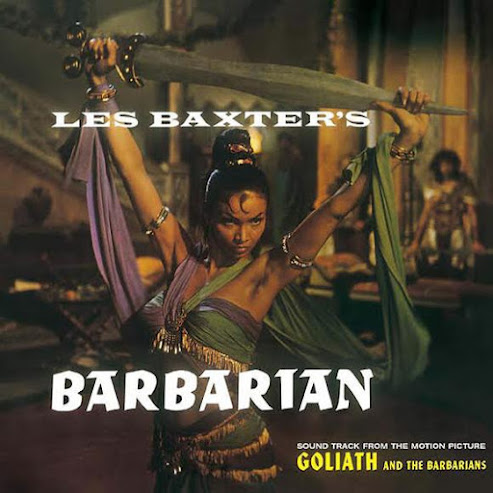
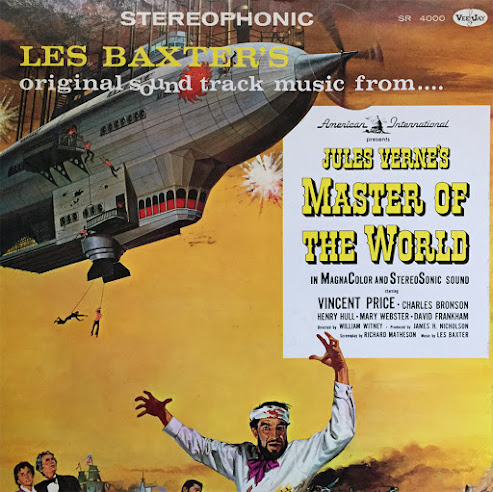
Third, Baxter composed music drawing from or meant to evoke the genres of Lost Worlds and science fiction (see the record covers below), but he also wrote scores for every kind of genre movie, including: The Invisible Boy (science fiction, 1957); The Lone Ranger and the Lost City of Gold (Western and Lost Worlds, 1958); Goliath and the Barbarians (sword and sandal or heroic fantasy, 1959); Master of the World (scientific romance or Vernian science fiction, 1961); Reptilicus (monster movie, 1961); Tales of Terror (weird fiction, 1962); Panic in the Year Zero! (post-apocalypse, 1962); and many others, plus plenty of beach-party and motorcycle exploitation movies.

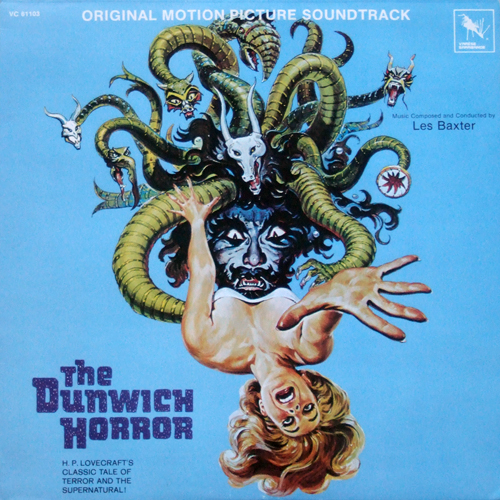
Fourth, he also wrote the score for The Dunwich Horror (1970), the first movie based on a work by H.P. Lovecraft (1890-1937) that also shares its title with the original source. (I think.) So if a movie score is a kind of program music or a kind of adaptation, then Les Baxter might get credit for the first musical adaptation of Lovecraft's work on film. However, the first film adaptation of a work by Lovecraft was actually The Haunted Palace (1963), a film based on "The Case of Charles Dexter Ward" (1927, 1941, 1943). The author of that score was Ronald Stein (1930-1988), whose list of credits might be indistinguishable from Les Baxter's, for these two men wrote music for all of the same kinds of movies. Anyway, Ronald Stein should probably get credit for the first recorded musical adaptation of H.P. Lovecraft's work, assuming, like I said, that a movie score is a kind of program music and therefore an adaptation. (See my article "The Other Forms of Lovecraft," dated October 2, 2018, by clicking here.)

Well, this article has gone on pretty long and it might be time to wrap things up. I'll close by letting you know that Les Baxter died on January 15, 1996, in Newport Beach, California. He was seventy-three years old, but in departing he left behind music that I hope we can listen to forever.

Further Reading

  • "Les Baxter" on the website Space Age Music Maker, here.
  • A website called Les Baxter at this URL: Lesbaxter.com.
  • The Exotic World of Les Baxter, a website accessible by clicking here.
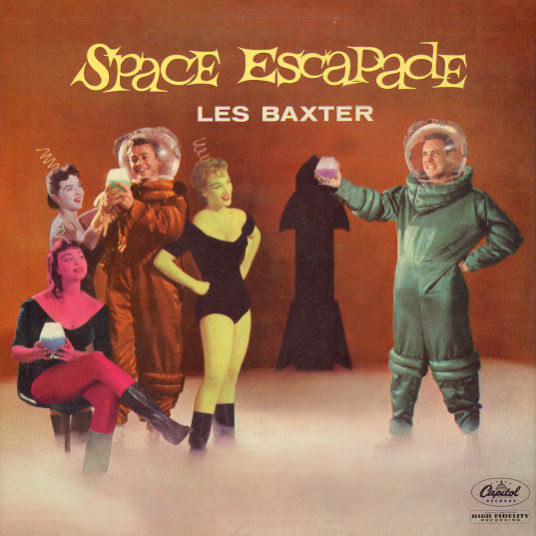
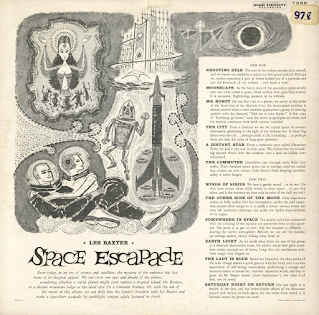
The "banned" record cover of The Planets by Gustav Holst, which I showed the other day, reminded me of this one, for Space Escapade by Les Baxter (1958). The rocketship in the background might be a little phallic, but it also reminds me of the Flatwoods Monster.

Here's the reverse side of that album. I don't know who the artist is, but he or she knew something about science fiction imagery. And talk about a phallic rocketship.

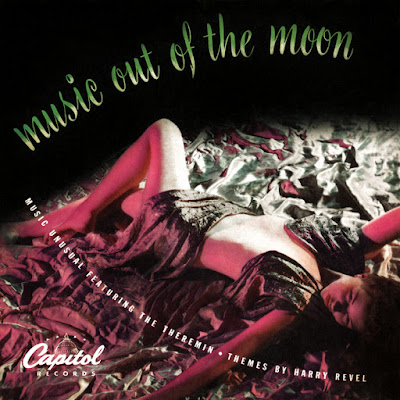
In Music Out of the Moon (1947), Les Baxter collaborated with composer Henry Revel (1905-1958) and theremin player Samuel J. Hoffman (1903-1967). New things with this album included not only music of the theremin but also the full-color cover and the scantily clad model (actress Virginia Clark). One old-fashioned thing about it: it was released on three 78 rpm records. One real-world application: Neil Armstrong played Music Out of the Moon--on the moon!

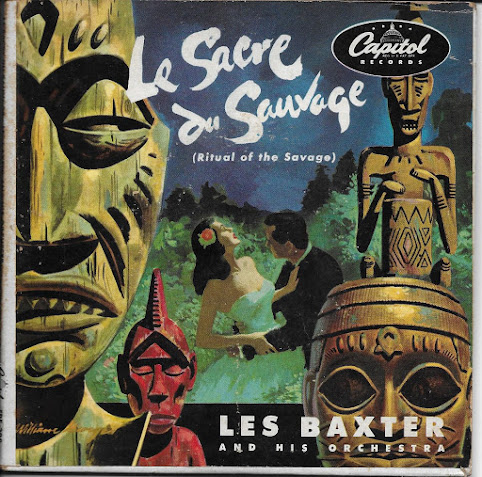
To me, Exotica is related to the Lost Worlds genre of literature but perhaps filtered through the overseas experiences of servicemen and -women during World War II. Think of South Pacific with its "own special island." Whatever its origins, Exotica was very popular during the 1950s and '60s. Here is an early recording in that genre, Le Sacre du Savage or Ritual of the Savage by Les Baxter and his orchestra, from 1951.

The cover artist was William Chapman George, Jr. (Aug. 10, 1926-May 25, 2017), who for some reason is not very well identified on the Internet despite his having been a very accomplished illustrator over the course of a very long career. As an example of his talent, the late Mr. George painted this picture when he was just twenty-five years old. He went on to paint interior illustrations and covers for men's magazines, paperback books, especially Westerns, and packaging for He-Man toys of all things. There is an interview with him in Illustration #8, from 2003. On the other hand, there is very little of him on the Internet Speculative Fiction Database. I hope someone will correct that oversight soon.

A few years ago, I was at a Bigfoot conference in Ohio and stopped at the table of the Explorers Club. One of their promotional items, a flyer or postcard, showed William George's cover for Ritual of the Savage but missing all identifying information. In other words, I think they swiped his artwork and violated somebody or other's copyright. But these are the things people do to the work of the artist. Anyway, I'll have more to say about the Explorers Club in a future article.

Speaking of swipes, here's a movie poster for House of Usher (1960), for which Richard Matheson (1926-2013) wrote the screenplay and Les Baxter wrote the music. The swipe is from Harry Clarke's illustration for "The Premature Burial" by Edgar Allan Poe (1809-1849). (Click on the previous sentence to see it.)

It's strange to think that Edgar Allan Poe and Abraham Lincoln were born less than a month apart.

By 1970, when The Dunwich Horror was released, H.P. Lovecraft had name recognition. Moviemakers didn't have to hide his story behind Poe's byline as they had done just seven years before in The Haunted Palace. I wish I had the name of the cover artist here: he or she deserves some credit for this full-color illustration of a story that had seldom--or maybe never--gotten this kind of treatment before.

Original text copyright 2021, 2023 Terence E. Hanley

Saturday, February 20, 2021

Mars on the Mind

Tonight (February 16, 2021), I heard on the radio a story about the 100-year anniversary of The Planets by the British composer Gustav Holst (1874-1934). I'm not sure why the story was on tonight. Holst wrote The Planets in 1914-1916, and it was first performed in 1918. The first performance of the entire suite took place on November 15, 1920. That's still more than 100 years ago.

Anyway, Holst began his work by composing "Mars, The Bringer of War," the intended or eventual first movement of The Planets.* Holst didn't bring on the war in his composition of "Mars," but it came anyway, war that is, on July 28, 1914, just a few months after he had begun. The Planets made its premiere on September 29, 1918, just a few weeks before the war ended.

Mars was on people's minds in those years. It all began with Giovanni Schiaparelli's observations of what he called canali on the surface of the Red Planet in 1877. Percival Lowell picked up the ball and ran with it in the early 1890s with his own observations of an intricate webwork of canals, as well as other features on Mars. He wrote about these things in three books, Mars (1895), Mars and Its Canals (1906), and Mars As the Abode of Life (1908). His visions of Mars endured for generations, even into the 1960s and '70s.

H.G. Wells carried Lowell's interpretation to a logical and terrifying conclusion in The War of the Worlds (1897, 1898). Finally there came along a lowly pulp story, "Under the Moons of Mars" by Norman Bean, aka Edgar Rice Burroughs, serialized in The All-Story beginning 109 years ago this month, in February 1912. His story was published in book form as A Princess of Mars in 1917. Since then, gazillions of young fans have wanted to be his hero, John Carter, and have fallen in love with Burroughs' princess, Dejah Thoris.

Gustav Holst was influenced by astrology, not pulp fiction, but that hasn't stopped anybody from giving his record covers the science fiction treatment. Here are a few of them. I saved the most science-fiction-y--and the only scandalous one among them--for last.

-----

*Update (Feb. 2, 2022): The part of the soundtrack of Star Wars backing the destruction of the Death Star has its similarities to "Mars, The Bringer of War."

That looks enough like Mars in the background for this image to earn its place as first in this series. In the foreground is an aerial view of the current state of Texas.

I like these highly stylized versions of Saturn, Jupiter, and Mars. The faces of Jupiter and Mars look almost like those of living beings. And Mars here is the Mars of the popular imagination, Percival Lowell's Mars with its canals and oases. 


Here's a version done by the great space artist Chesley Bonestell (1888-1986). Entitled Saturn as Seen from Iapetus, it appeared in the book The Conquest of Space by Willy Ley (1949) and before that in Life magazine. The difference is that the image here is flipped for some reason, maybe to make Saturn read better in visual terms: as your eye drifts across the image, it can ride the ramp of Saturn's rings to reach the title "The Planets."

This is a pretty small picture, but I can still detect a swipe . . .

The picture on the right is by Jean-Auguste-Dominique Ingres, that on the left by Margaret Brundage. I've showed this juxtaposition before in "Brundage and Ingres," dated April 4, 2019, and accessible by clicking here.

Chesley Bonestell seems to have swiped Ingres' painting, too. See the endpapers of The Art of Chesley Bonestell by Ron Miller and Frederick C. Durant III (2001) for that and for another depiction of Percival Lowell's Mars.

This version of The Planets is supposed to have been banned. You can kind of see why. Comic strip fans will recognize the more fully dressed of these two figures as a repurposed Flash Gordon. Here's another one: 

On the cover of the hardbound edition of The Best of C.L. Moore (1975). The figure on the left is the Shambleau from the story of the same name. If you haven't read "Shambleau" yet, you should. Those who have read it know that it takes place on Mars, the Red Planet and Bringer of War. Anyway, one of these images was banned while the other was not. Go figure. The art, by the way, is by Chet Jezierski (b. 1947). 

Text copyright 2021, 2023 Terence E. Hanley