Showing posts with label Mahlon Blaine. Show all posts

Sunday, April 24, 2022

Edgar Rice Burroughs & Had I But Known

Women mystery writers were not the only ones to subscribe to the Had I But Known school of storytelling. Edgar Rice Burroughs (1875-1950) was a subscriber, too. I found that out while reading his Moon Trilogy late last year. The first example below is less overt. The second leaves no doubt as to Burroughs' HIBK status:

In The Moon Maid, Julian paroles Orthis, his once and future enemy, on board their rocketship bound for Mars. In case you don't know that something bad is going to happen as a result, Julian tells you: "Would to God that instead of freeing him I had drawn my revolver and shot him through the heart!" (Ace Books, n.d., p. 44)

In the sequel The Moon Men, bad neighbor Johansen rats on Julian and his family. Or-tis, descended from Orthis, comes and searches their home. As he is searching, Julian considers the reasons for Johansen's betrayal. He thinks he has it figured out, but, alas, he hasn't. He cries out in his mind: "God, had I but known his real reason!" (Ace Books, n.d., p. 50)

I have a feeling that Had I But Known appears a lot in fiction, probably in non-fiction, too. In the hands of a more subtle author, it might be called foreshadowing. The less subtle author essentially follows the title of Ogden Nash's poem: "Don't Guess, Let Me Tell You" (1940).

Illustration by Mahlon Blaine (1894-1969).

Original text copyright 2022 Terence E. Hanley

Saturday, March 11, 2017

The Mamaloi and Hanns Heinz Ewers

The word Mamaloi is new to me. I searched for it on the Internet and came up with a Doobie Brothers song. Here is a passage:

Gypsy, she say I got the fever
I don't know whether to believe her
But when the wind blow from the sea
My soul start to fly away
She give me charm that will protect me
Necklace with stone from far across the sea
But island magic much too strong
It won't let me go this time

The song is about Jamaica. The group hails from California, I guess, but had, in the early 1970s, a Southern/Cajun/Texan kind of vibe. At least that's how I remember them. ("Mamaloi" is from the album Toulouse Street, named for a street in New Orleans. The album also has a song called "Snake Man.") (1) Anyway, if you keep searching, you'll find out that Mamaloi is a name given to a Voodoo sorceress, priestess, or queen. Her male counterpart is Papaloi. Among their powers are the ability "to produce a sleep which is death's twin brother." That's according to Hesketh Prichard in his book Where Black Rules White: A Journey Across and About Hayti (1900). The Mamaloi and Papaloi can also raise the afflicted person--usually a child--from this state of near death only so that he can be used in a human sacrifice.

The raised dead of the Mamaloi sounds a lot like zombie-ism. It seems to me that following the Mamaloi lead might produce some results. But first, before I even started searching, I thought of the musical piece Ma mère l'Oye, or the Mother Goose Suite, by Maurice Ravel (1910). L'oye or l'oie is French for goose. I don't think that's the right track, though. It seems more likely that Mamaloi is a combination of Mama and loi or law. In other words, the Mamaloi is a person of some authority, power, or prestige.

In searching for Mamaloi in literature, I found that, strangely enough, there is a connection to the German author Hanns Heinz Ewers (1871-1943), a fantasist and seeming decadent who lived a strange and interesting life. According to the book Decolonization in Germany: Weimar Narratives of Colonial Loss and Foreign Occupation by Jared Poley (Peter Lang, 2007), Ewers "was deeply fascinated by what he called the Mamaloi." (p. 99) Ewers wrote about the Mamaloi in at least six works, beginning with "Die Mamaloi," from 1907. The subject of "Die Mamaloi" is a Haitian woman, Adelaide, "who kills her son in a voodoo ritual." (p. 99) In that, Ewers seems certain to have read Where Black Rules White.

According to Jared Poley, Ewers' fascination with the Mamaloi was because of her practice of infanticide. (2) Her use of Voodoo magic to afflict a person with near-death seems less the point, and Ewers' use of the word zombie or zombi is uncertain. I found the full text of "Die Mamaloi" in Spanish and searched it for zombie and zombi. No dice. So, again, a seeming miss in the use of those words before William B. Seabrook of 1928. I would add that Ewers is an interesting figure for students and fans of weird fiction. I would like to find a full-length biography and study of his works. I wonder, too, about discovering his works in English.

Note
(1) Notice in "Mamaloi" the phrase "island magic" with its echoes of The Magic Island by William B. Seabrook (1929).
(2) As a moral transgression and an expression of self-loathing, infanticide is likely a sign of decadence in a culture or society. In fact, it would seem a key sign in diagnosing decadence, as it is demonstrates a lack of vigor, confidence, and hope in the individual and his or her society. Jared Poley ties it to "the Baal and Labartu creation myths from the fertile crescent." (p. 99) I am reminded of sacrifices made by Canaanites to Moloch and of the current worldwide practice of abortion, which--whatever its moral implications--is helping to bring about the dissolution of decadent societies. Cannibalism in the modern world, too, is a decadent practice: William Seabrook is supposed to have partaken of human flesh at least once. Aleister Crowley is also supposed to have been a cannibal. In 2001, Armin Meiwes, significantly a German, advertised for someone who would voluntarily be eaten by him. Bernd Jürgen Armando Brandes, significantly a German, answered the ad and ended up in pieces in Meiwes' refrigerator. In 2012, Floridian Rudy Eugene, of Haitian descent, tried to eat the face of a homeless man in Miami. For a time, some people were alarmed that Eugene's actions were the beginnings of a zombie outbreak. Instead, Eugene was probably using a synthetic drug, although his use of marijuana might be enough to explain his psychosis. That brings us to zombies, which are of course, cannibalistic and an ultimate expression of decadence, although wanting to be eaten by another person is probably even more ultimate.

The Sorcerer's Apprentice by Hanns Heinz Ewers in an English edition of 1927, published by John Day, and illustrated by Mahlon Blaine (1894-1969). 

Alraune by Ewers, translated by S. Guy Endore (1900-1970) of The Werewolf of Paris (1933) fame. Published by John Day in 1929, this edition was also illustrated by Mahlon Blaine.

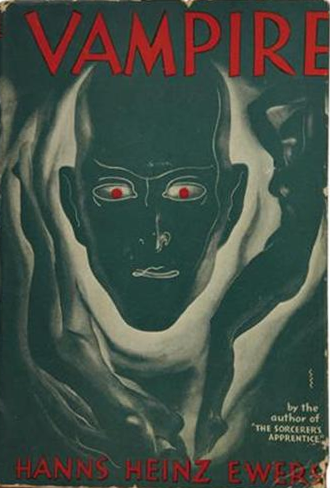
Vampire, the last in Ewers' trilogy of Frank Braun, translated by Fritz Sallagar and published by John Day in 1934. Vampires are associated with zombies as among the undead, moreover, as among the cannibalistic undead.

Blood, a collection of three stories from Heron Press (1930) and including "Mamaloi" from 1907. The pictures were by the children's book illustrator Edgar Parin d'Aulaire (1898-1986).

Although there are many, many more images I might include here on Hanns Heinz Ewers, I have decided to stop with this one, the cover for L'araignée et autres contes fantastiques, a French-language edition with an unknown date. "L'araignée" was originally "Die Spinne," from 1908.

Original text copyright 2017, 2023 Terence E. Hanley

Thursday, December 29, 2011

Weird Tales from France

Weird Tales printed stories from all over the world, often relying heavily on the work of writers long dead. French literature from the nineteenth century was well represented in the magazine's pages. The realists Victor Hugo, Stendhal, and Émile Zola were noticeably absent, but many recognizable names from the previous century appeared in Weird Tales. The lives of these French authors were, in almost every case, marked by financial and romantic difficulties, as well as bouts with melancholy, insanity, alcoholism, drug use, and venereal disease. Most died young, all but Gaston Leroux before Weird Tales began publication in 1923.

Honoré de Balzac
Born May 20, 1799, Tours, France
Died August 18, 1850, Paris, France

For Weird Tales
"A Passion in the Desert" (Dec. 1936)

Honoré de Balzac lived barely more than half a century, yet he is considered a giant among French authors. His magnum opus is La Comédie humaine, an immense collection of literary works left unfinished at his death. Though considered a pioneer of realistic literature, Balzac also wrote fantasy, including La Peau de chagrin (The Magic Skin or The Wild Ass's Skin, 1831) and Melmoth réconcilié (Melmoth Reconciled, 1835), a sequel to Charles Robert Maturin's gothic novel Melmoth the Wanderer (1820).

Balzac began his writing career by knocking out potboilers for the popular press. A century later, the pulps would carry on in that vein. Weird Tales printed his story "A Passion in the Desert" in its December 1936 issue. Ernest Dowson (1867-1900) made one translation of the story (see More Weird Tales from the Victorian Age). It was also committed to film in 1997.

Alexandre Dumas, père
Born July 24, 1802, Villers-Cotterêts, Aisne, France
Died December 5, 1870, Puys (near Dieppe), Seine-Maritime, France

For Weird Tales
"The Wolf -Leader" (eight-part serial, Aug. 1931-Mar. 1932)

Alexandre Dumas, descended from an aristocrat and a Haitian slave, lived a full life in his sixty-eight years on earth. A novelist, playwright, journalist, businessman, revolutionary, and bon vivant, he wrote some of the best known and best loved adventure novels of the nineteenth century, including The Three Musketeers (1844), The Corsican Brothers (1844), and The Count of Monte Cristo (1845-1846). Weird Tales printed his 1857 novel Le Meneur de loups (translated by Alfred Allinson [1852-1929]) as "The Wolf Leader" in an eight-part serial beginning in August 1931.

Théophile Gautier
Born August 30, 1811, Tarbes, Hautes-Pyrénées
Died October 23, 1872, Paris, France

For Weird Tales
"The Mummy's Foot" (Apr. 1926)
"Clarimonde" (Feb. 1928)

Painter, poet, playwright, novelist, journalist, and critic Théophile Gautier covered a lot of ground in his literary career. His weird and fantastic works included the poems Albertus (1832) and La Comédie de la Mort (1838), the play Pierrot Posthume (1847), and the short story "La Morte Amoureuse" (1836), a vampire tale translated by Lafcadio Hearn (1850-1904) and printed in Weird Tales as "Clarimonde" in the issue of February 1928.

Charles P. Baudelaire
Born April 9, 1821, Paris, France
Died August 31, 1867, Paris, France

For Weird Tales
"Spleen" (poem, Feb. 1926)
"Horreur Sympathique" (poem, May 1926)
"Epigraphe Pour Un Livre Condamne" (poem, Mar. 1928)
"Three Poems in Prose": "L'Irreparable," "Les Sept Viellards," "Une Charogne" (prose, translated by Clark Ashton Smith, Aug. 1928)
"The Revenant" (poem, May 1929)
"Song of Autumn" (poem, Oct. 1935)
"The Sick Man" (poem, Apr. 1936)
"Hymn to Beauty" (poem, June 1937)
"The Owls" (poem, Nov. 1941)

Charles Baudelaire had much in common with Edgar Allan Poe, whose work he translated beginning at about the time Poe died in 1849. Like Poe, Baudelaire struggled with poverty, melancholy, and dissolution, dying tragically young and invalid at age forty-six. Despite his brief career, Baudelaire is considered among the greatest French poets of the nineteenth century and influenced many other versifiers, including Rimbaud, Mallarmé, Proust, and T.S. Eliot.

Gustave Flaubert
Born December 12, 1821, Rouen, France
Died May 8, 1880, Rouen, France

For Weird Tales
"The Legend of St. Julian the Hospitable" (Apr. 1928)

An early realist and a champion of style, Gustave Flaubert wrote a key novel of the nineteenth century, Madame Bovary, published in 1857. Sweating over his work, Flaubert wrote little compared to many of his contemporaries. It's curious that the editor of Weird Tales would have found something in Flaubert's oeuvre to print, yet "The Legend of St. Julian the Hospitable" appeared in the April 1928 issue of "The Unique Magazine." The story is more properly called "The Legend of Saint Julian the Hospitalier," in French, "La légende de Saint-Julien l'hospitalier." It comes from Trois Contes (Three Tales), originally published in 1877.

Alphonse Daudet
Born May 13, 1840, Nîmes, France
Died December 16, 1897, Paris, France

For Weird Tales
"The Three Low Masses" (July 1925)

Alphonse Daudet wrote his first novel at fourteen and published his first (and only) book of verse at eighteen. In his short life, he authored plays, novels, short stories, journalistic pieces, and poems. Daudet also married a writer, Julia Allard, and fathered a writer, Léon Daudet (1867-1942). Like many of his fellow French literary figures, he contracted syphilis. He died from its effects while eating dinner. One of the physicians who attempted to revive him was Gilles de la Tourette, for whom Tourette's syndrome is named. Daudet wrote one story reprinted in Weird Tales, "The Three Low Masses."

Paul Verlaine
Born March 30, 1844, Metz, France
Died January 8, 1896, Paris, France

For Weird Tales
"Moonlight" (poem, translated by Timeus Gaylord, pseudonym of Clark Ashton Smith, July 1942)

Like Baudelaire before him, Paul Verlaine lived a short life of emotional and personal turmoil and liberal use of drugs and alcohol. Like Rimbaud and Mallarmé, he was included among fin de siècle decadent poets and literateurs. And like Charles Schulz and William Burroughs, Verlaine shot a fellow human being, in his case, poet Arthur Rimbaud, while in a drunken rage. Weird Tales printed his "Moonlight" in its July 1942 issue.  

Guy de Maupassant
Né Henri-René-Albert-Guy de Maupassant
Born August 5, 1850, near Dieppe, Seine-Inférieure, France
Died July 6, 1893, Passy, Paris, France

For Weird Tales
"The Horla" (Aug. 1926)
"A Ghost" (Feb. 1930)
"On the River" (Feb./Mar. 1931)

Whereas Paul Verlaine shot at other poets, Guy de Maupassant saved them. The beneficiary of Maupassant's good deed was the British poet Algernon Charles Swinburne (1837-1909), who was in the process of drowning off the coast of Normandy when the young Frenchman came to his rescue. By outward appearances, Maupassant's life would seem to have been a happy and prosperous one. He enjoyed a happy childhood, and he was well educated, well connected, and successful in business and literature. But then, in 1892, fired by syphilis, he attempted suicide. Confined to an asylum, he died a year and a half later at age forty-two. His epitaph: "I have coveted everything and taken pleasure in nothing."

Despite his insanity and ultimate self-destruction, Maupassant proved himself a master of the short story. Working in both realistic and fantastic modes, Maupassant authored more than 300 short stories. According to a Finnish website listing his works, thirty-nine of those stories are in the genre of fantasy and horror, including "The Horla" (1887). "The Horla" has been adapted several times (loosely or not) to other media, including the 1963 movie Diary of a Madman starring Vincent Price. Weird Tales printed the story in its August 1926 issue. Two others followed in 1930-1931. Interestingly, Maupassant's last story was entitled "Qui Sait?"--"Who Knows?" (1890).

Gaston Leroux
Born May 6, 1868, Paris, France
Died April 15, 1927, Nice, France

For Weird Tales
"The Inn of Terror" (Aug. 1929)
"The Woman with the Velvet Collar" (Oct. 1929)
"The Mystery of the Four Husbands" (Dec. 1929)
"In Letters of Fire" (Mar. 1930)
"The Crime on Christmas Night" (Dec. 1930)
"The Haunted Chair" (three-part serial, Dec. 1931-Feb. 1932)

Of the French authors I have listed here, only Gaston Leroux lived into the Weird Tales era. Unfortunately, he didn't live long enough to see his work in print in "The Unique Magazine." Nonetheless, Weird Tales published six of his stories, making him the most prolific of French-language short story writers from this group.

In 1907, Leroux abandoned his career as a journalist and turned to writing fiction, averaging more than one novel per year until his death in 1927. The most well known of these is The Phantom of the Opera (1911), adapted to the silver screen many times, though it's hard to beat Lon Chaney's take on the title character from the 1925 silent version. Leroux also wrote mystery novels starring the amateur detective Joseph Rouletabille. And, in a shrewd and forward-looking move, he and writer Arthur Bernède (1871-1937) formed what we would now call a multimedia company with the aim of simultaneously publishing novels and producing film versions of those novels.

The cover of Alexandre Dumas' novel The Wolf Leader, edited by L. Sprague de Camp from a translation by Alfred Allinson and illustrated by the enigmatic Mahlon Blaine (1894-1969).
The frontispiece and title page of the same book. As far as I know, Blaine did not provide illustrations for Weird Tales, but he would have fit right in with the magazine. I should note that Weird Tales contributor Anice Page Cooper interviewed Blaine in the late 1920s and--according to the website of James Vadeboncoeur, Jr.--fell for his fabricated autobiography.
Théophile Gautier's story "The Mummy's Foot" appeared in Vic Ghidalia's 1971 collection The Mummy Walks Among Us.
Here is an illustration by British author, cartoonist, and illustrator Beresford Egan (1905-1984) for Charles Baudelaire's Fleurs Du Mal (1929). The drawing owes a little to the work of Aubrey Beardsley or even Harry Clarke. I have included this particular illustration here because of the man with a mask. You'll see another by scrolling down to Gaston Leroux.
A movie poster for Diary of a Madman (1963), based on "The Horla" by Guy de Maupassant. There's a fine period illustration for the story floating around on the Internet, but none of the versions I found is a good quality image of the entire illustration. This is the state of the vaunted Internet.
The cover of a French-language edition of Gaston Leroux's Phantom of the Opera. The cover artist is unknown.
Here is a more sensational Spanish-language version drawn by an unknown artist.
Postscript

"Portrait of Madame Alphonse Daudet" by Renoir. 
Daudet examines the human heart for St. Valentine's Day, from Les Hommes d'Aujourd'hui, February 15, 1879.
Daudet made it into the pulps with Weird Tales, why not paperback romances as well? Here's an Avon paperback version of Sappho from 1956. The artwork is unsigned.
Weird Tales from October 1929. The cover story is "The Woman with  the Velvet Collar" by Gaston Leroux. The cover artist was Hugh Rankin.

Text and captions copyright 2011, 2023 Terence E. Hanley