Showing posts with label Edgar Allan Poe. Show all posts

Monday, December 8, 2025

More Views of the Hudson River-Part Three

In this centennial year of The New Yorker and The Great Gatsby, I have been writing about New York, its islands, its rivers, its cities, and its towns. Washington Irving (1783-1859) famously wrote about those places, too. (I'm not claiming the fame, only the writing.) And for the past three weeks I have been writing about the Hudson River and places along its banks and in its valley. Other authors of American literature have lived in and written about the Hudson River and its valley. They include some early authors and some late:

James Fenimore Cooper (1789-1851) wrote about the wilds of New York in his novel The Pioneers, or The Sources of the Susquehanna; a Descriptive Tale (1823). There is a long passage about scenery along the Hudson River in Chapter XXVI well worth reading.

Edgar Allan Poe (1809-1849) attended the U.S. Military Academy at West Point in 1830-1831. He lived on Manhattan Island, at the Brennan farmhouse in 1844-1845 and in the Bronx in 1846-1847. There is an Edgar Allan Poe Street in Manhattan, close to the Hudson River, and Poe is known to have taken in views of the river on his writer's walks and rambles. I found an article about Poe and New York. Click on the following title, author's name, and date to read it: "Edgar Allan Poe Won’t be Forgotten on West 84th Street--Nevermore" by Allison Moon on the website West Side Rag, July 19, 2022; updated on July 20, 2022. I also learned that Poe's story "The Mystery of Marie RogĂȘt" (1842) was based on the case of Mary Cecilia Rogers, whose body was found in the Hudson River off Hoboken, New Jersey, in 1841.

Nathaniel Hawthorne (1804-1864) was a New Englander, but he understood the spell of the Hudson. In an article "Gorgeous Hudson River Valley" (The Saturday Evening Post, Apr. 17, 2014), author Edward Readicker-Henderson wrote: "When Nathaniel Hawthorne went up the Hudson on his way to Niagara in 1835, he said he'd been putting it off because he didn't want 'to exchange the pleasures of hope for those of memory.'" Mr. Readicker-Henderson's article is about the Hudson River School of artists, about whom I have written nothing at all. But if you would like a view of the Hudson River of two centuries past, then you should have a look at their work.

Herman Melville (1819-1891) was born in New York City and lived in his childhood in Albany. The Hudson River is mentioned twice in his epic novel Moby-Dick, or The Whale (1851). There is more about Melville in "Melville Ashore" by Edward Tick in the New York Times, August 17, 1986. Again, click to find and read it.

Like Melville, Henry James (1843-1916) was born in New York and spent part of his childhood in Albany. Charles Fort (1874-1932) was born in Albany of Dutch ancestry. He lived with his wife in the Bronx, and that's where he died. Stories by Irving, Poe, and Hawthorne were in Weird Tales magazine. Stories and ideas inspired by Charles Fort were also in its pages.

To be continued . . .

Copyright 2025 Terence E. Hanley

Wednesday, November 12, 2025

A Lovecraft Sighting

I'm fitting things in as I come across them. I hope you don't mind going back and forth between topics this week.

I have been writing about teenager movies and high school movies, also about H.P. Lovecraft. Now I can write about both in the same entry. This past weekend we watched The DUFF, a teenager/high school movie released in 2015. It's a funny and enjoyable movie that hearkens back to previous movies of this type. It begins with an allusion to The Breakfast Club (1985). The principal reminds me of the character Onyx Blackman in Strangers with Candy (1999-2000). I imagine there are other references and allusions as well.

The title character in The DUFF is a girl named Bianca, played by Mae Whitman. She's a fan of horror movies. Rather than decorate the walls of her bedroom with concert posters and pictures of teen heartthrobs, she has chosen horror movie posters and other horror-related art. There is a poster for Murders in the Rue Morgue, starring Bela Lugosi and released in 1932, hanging above her bed. Above the title, in big, prominent letters, is the name of the original author, Edgar Allan Poe. Far less prominent on her wall is a small portrait drawing of H.P. Lovecraft--Lovecraft as teen heartthrob.

There is product placement in The DUFF. There is also president placement. Look for the names or images of Chester Arthur, James Buchanan, and Millard Fillmore, also for the middle initial of George W. Bush. There may be others. Be on the lookout for them. The Internet doesn't seem to have noticed this yet. Maybe you're seeing it here first.

Art by Karoly Grosz (1897-1952).

P.S. I have in the works a long series on Lovecraft. It begins this week.

Text copyright 2025 Terence E. Hanley

Sunday, November 2, 2025

Honest Abe & EAP

I had hoped to write again about Edgar Allan Poe in the anniversary month of his death, but I fell through the cracks of the world and only on Halloween night did I come out again. Things changed a little in that five weeks and a day. I'll write about a couple of them, but first I'll write about the more distant past.

* * *

Nearly two years ago, at Thanksgiving time in 2023, I wrote about Edgar Allan Poe and Abraham Lincoln. I repeated the observation that one of our greatest presidents and one of our greatest writers were born within twenty-four days of each other in 1809. In that they were contemporaries, I wondered then whether Honest Abe ever read Poe. And then I found an answer, and the answer is yes.

I found the answer in a book called Murder for Pleasure: The Life and Times of the Detective Story by Howard Haycraft (1905-1991). I have the "newly enlarged edition" published by Biblo and Tannen in 1974. The original edition was published in 1941. A scholar and historian of the crime and detective genres, Haycraft found his own answer for the question of Did Abraham Lincoln read the works of Edgar Allan Poe? in the work of an earlier author, William Dean Howells (1837-1920), whom I think of as a late 19th-century author but who was old enough to have written about Abraham Lincoln while he was campaigning for president in 1860.

In his book, Haycraft referred to Howells' "little known 'campaign biography'" as the source of his information on Lincoln and Poe. That book is, by name, Lives and Speeches of Abraham Lincoln and Hannibal Hamlin, co-authored with John L. Hayes (who wrote the biography of Hannibal Hamlin) and published in New York and Columbus, Ohio, in 1860. Howells' portion of the book was later reprinted as Life of Abraham Lincoln, including in a facsimile edition of the original, corrected by hand by Lincoln himself and published in 1938 and again in 1960.

Here is what Howells had to say about Abraham Lincoln on the subject of Edgar Allan Poe:

     The bent of his mind is mathematical and metaphysical, and he is therefore pleased with the absolute and logical method of Poe's tales and sketches, in which the problem of mystery is given, and wrought out into everyday facts by processes of cunning analysis. It is said that he suffers no year to pass without a perusal of this author. (1960, pp. 31-32)

And I think: what a wonderful development it is that Abraham Lincoln read Edgar Allan Poe!

* * * 

Howells is supposed to have had a not very high opinion of Poe, but I don't have any illustrative quotes. He seems to have shared that opinion with other prominent writers and critics. Popular culture is democratic, and so we should be careful anytime we find ourselves following the masses or the mob lest we also find our minds deadened, or worse than that, blood on our hands. But almost nobody reads Howells anymore and everyone reads Poe: we have made our judgment and our choice.

* * *

In looking for quotes by Howells on Poe, I found this quote instead:

     Yet every now and then I read a book with perfect comfort and much exhilaration, whose scenes the average Englishman would gasp in. Nothing happens; that is, nobody murders or debauches anybody else; there is no arson or pillage of any sort; there is not a ghost, or a ravening beast, or a hair-breadth escape, or a shipwreck, or a monster of self-sacrifice, or a lady five thousand years old in the whole course of the story; "no promenade, no band of music, nossing!" as Mr. Du Maurier's Frenchman said of the meet for a fox-hunt. Yet it is all alive with the keenest interest for those who enjoy the study of individual traits and general conditions as they make themselves known to American experience.

These words are supposed to have come from an essay in Harper's New Monthly Magazine, Volume 73 (1886), but I haven't found them in an online search. If they are indeed Howells' own, then he (as a realist) set himself up in opposition to the mainstream of American literature, that is if Leslie Fiedler was correct in positing in his Love and Death in the American Novel that "the American novel is pre-eminently a novel of terror," (Delta/Dell, 1966, p. 26) and that "our classic literature is a literature of horror for boys." (p. 29) Howells' brief summary of popular fiction, though, pretty well describes genre fiction, including the contents of Weird Tales.

* * *

I understand what Howells meant. It's good and I think necessary to read fiction in which "nothing happens," not in the Seinfeld sense of nothing happens but in the sense of nothing happens that is terrible or shocking or degrading to the author, his or her characters, or the reader. Readers of today, however, especially in genre fiction, seem to love and revel in violence, gore, destruction, nihilism, and so on. Stop and read instead something like a novel by Anne Tyler, or "Story of a Farm-Girl" by Guy de Maupassant (1881), or one like "Kari Aasen in Heaven" by Johan Bojer (1904; 1927), which is a fantasy to be sure but a nice one.

* * *

William Dean Howells was born in Martinsville, Ohio, now known as Martins Ferry. Like Johnny Appleseed, a fellow Ohioan, his family were Swedenborgians. Like Ambrose Bierce (1842-1914?), also a fellow Ohioan, he worked in his youth as a printer's devil.

During this past very hot summer in the Midwest, I read from The Ohio Guide, compiled by writers of the Works Progress Administration (WPA) and published in 1940, a book I had found at a secondhand store just a few days before. I was staying at a place along a road mentioned in that book, a road now called Cave Road, near Bainbridge, Ohio. It's a strange, fascinating, and mysterious world we live in when one can be carried away by a book, eighty-five years into the past, there to catch a glimpse of the very place in which one now finds himself. I have compared books to sailing ships, but here it seems apt to compare a book to an automobile, with the author as the driver and tour guide, and the reader as the backseat passenger, with eyes wide open and set upon the horizon. Every mile of road is a page in the book. We may turn its pages by traveling the miles.

Howells is in The Ohio Guide. There is mere mention therein of a figure from Ohio folklore of whom I had never heard and about whom Howells wrote in a book I soon found out was entitled The Leatherwood God (1916). As it turns out, the man called the Leatherwood God was not folkloric at all but--like Johnny Appleseed--a real person. His name was John C. Dylkes, and his career as a well-known figure in the Ohio country began in August 1828 in or near Salesville, situated along Leatherwood Creek in Guernsey County. Dylkes claimed to be a celestial being. I imagine him as another in a long line of Americans who fancied themselves important religious and theological figures. Like Ambrose Bierce, Dylkes disappeared without a trace.

* * *

By the way, Edgar Allan Poe's initials--EAP--are an anagram of the word ape, a kind of which is the perpetrator of "The Murders in the Rue Morgue." According to Howard Haycraft and many others, that was the first detective story.

* * *

Finally, I met this past month a retired schoolteacher who was also from Martins Ferry, and I have a friend who is descended from the original settlers of Guernsey County, those who came from the Isle of Guernsey in the early 1800s and who gave that county its name. I will just say that the story of our America is fascinating beyond words and with God's grace will go on and on.

Original text copyright 2025 Terence E. Hanley

Tuesday, October 7, 2025

Poems for Poe, No. 2

At the Grave of Poe

by William James Price
Composed in June 1911. Published in The Baltimore Sun, December 25, 1911. 

Here, with a few forgotten one, reposes
A bard whose fame our long neglect defies
To him the selfish world gave thorns for roses.
And nations wonder where his body lies.
 
His haunting melodies, too few in number,
In alien hearts beyond the ocean live,
While we his virtues doom to endless slumber,
Condemn his faults, and no reward will give.
 
Ere Time's relentless tread at last has crumbled
These hallowed stones into the silent dust,
Will Pride awake, Ingratitude be humbled,
And Truth compel our spirits to be just?

Ah, grant him now a nobleman's estate,
Lest all the dead arise to prove him great!

* * *

Please note: I have inserted breaks where I believe the poet intended to but which the newspaper may have removed for the sake of conserving space in print. Note that Price's poem is in the form of a Shakespearean sonnet, which is broken into stanzas as I have done here.

Posted by Terence E. Hanley on the anniversary of Poe's death, October 7, 2025.

Monday, October 6, 2025

Poems for Poe, No. 1

To Edgar Allan Poe

By Howard Elsmere Fuller

Originally in Contemporary American Poets, edited by Horace C. Baker (Boston, 1928). From the website Poetry Explorer.

Thou art a thing of Death--
Born of the love of Life,
Born of the love of Life-in-Death . . . .

Denizen of a world which hath no name,
Which hath no being out of Mind--
Far-flung, with the mad ecstasy of youth,
To the Attic hills where Pan first sang
To a dew-drenched world
The amorous strains of Creation.
Above, in the star-tossed main,
Thou must have sat,
In the cool grey dawn of things
And watched with knowing Messianic eye
The swirling mists of chaos
Stiffen into a world profane.

With a haunting, dreamy sadness
Is bared thy cryptic soul;
With a rhythmic rune of madness,
Thy melancholy soul.

Sea things with seaweed hair
And faces blanched with pale-eyed Death
Sleep on the motley sands--
The crested wave of the sobbing sea
Hath lapped their blood like wine.
Draped in whispering robes of satin,
There dream in weird, fantastic chambers,
Maidens with waxen faces, fragile fingers,
Drained of life by hectic living
In mansions, grim and sunless.

World-old newness exotic
To this sordid clime
Sprang to thy lips erotic
And flowed like ruby wine.

Sweet gamboler in the dewy gardens
Of jeweled Paradise,
Where ruddy roses ebb and flow
In the cheeks of sylph-like children.
Elves, in their amours sweet with thee
Fresh with the matin dews of time,
Whisper to thee things unknown
To the sodden soul of man.

Demons, ghastly, foul and gory
Infest the Stygian gloom,
Spectres, grim and grey and hoary
Come shrieking from the tomb--

Come shrieking from mouldering mausolea,
Whence vague shadows of the uneasy dead,
Eluding Cerberus, the red-eyed watcher,
Fare forth on the sable wings of night
Peopling the sentient blackness
With ghoulish wraiths of terror.

Tears unceasing, bitter sorrow
Hath seared thy lonely years--
The leprous touch of sorrow,
The agony of tears.

The love of woman was to thee
Divinest torture of the soul.
Radiant life was but to thee
The sad betokening of death.

Soft as the sighs of Eros
Is the music of thy pain,
Sweet as the breath of Zephyr,
Fresh as the cooling rain.

Pilgrims journey far to mourn thee
As they would a thing divine,
And they that sought to scorn thee
Pay thee homage at thy shrine.

* * *

 Posted by Terence E. Hanley, 2025.

Friday, October 3, 2025

The Haunted Palace by Edgar Allan Poe

The last poem printed in Weird Tales in 1925 was "The Haunted Palace" by Edgar Allan Poe. It first appeared in a magazine published in Baltimore by Nathan C. Brooks (1809-1898). The original title of the magazine was The North American Quarterly. In or about 1838, Brooks renamed his new charge The American Museum of Science, Literature and the Arts, or The American Museum for short. Evidently, the magazine was also referred to as the Baltimore Museum. That's a lot to go through, but it seems like there is a lack of clarity and precision out there on the Internet as to the original source of "The Haunted Palace." The date of publication by the way was April 1839.

Poe soon incorporated "The Haunted Palace" into his short story "The Fall of the House of Usher," first published in Burton's Gentleman's Magazine in September 1839. "The Haunted Palace" is a poem in six stanzas of eight lines each. In "The Fall of the House of Usher," the stanzas are numbered. In Weird Tales, they are not. Without going through these two versions, I can't say whether they are word for word the same.

I have written before about "The Haunted Palace." First I listed it in Poe's works reprinted in Weird Tales. In writing about Charles Beaumont (1929-1967), I listed some of that author's screen adaptations of other works. These included the screenplay for The Haunted Palace (1963), which is actually an adaptation of "The Case of Charles Dexter Ward" by H.P. Lovecraft (Weird Tales, May-July 1941).

In 2021, I wrote about Les Baxter (1922-1996). Baxter wrote the scores for many Hollywood movies, including The Dunwich Horror, from 1970. Inasmuch as The Haunted Palace was the first film adapted from a work by Lovecraft, the composer of that score, Ronald Stein (1930-1988), should probably get credit for the first recorded musical adaptation of a work by Lovecraft, assuming a movie score is a kind of program music and therefore an adaptation. Prior to that, I had written about what I called "The Other Forms of Lovecraft," listing The Haunted Palace as the first adaptation on film of a work by Lovecraft.

That's a lot about Lovecraft and less about Poe. I'll close by letting you know that, according to Wikipedia, "The Haunted Palace" has been adapted to music four times, first in 1904 by French composer Florent Schmitt (1870-1958).

The cover of an album of musical works based on two stories and a poem by Edgar Allan Poe, including Florent Schmitt's symphonic poem Le Palais hantĂ©, Op. 49, based on "The Haunted Palace" by Poe. I have this image from a very thorough blog entry called "Florent Schmitt and the French Fascination with Edgar Allan Poe: Le Palais hantĂ© (1904)" by Phillip Nones, posted on December 10, 2012, here. Thank you to Mr. Nones and the conductor(s) of that blog. This is the kind of thing the Internet was supposed to be instead of what it is. 

Text copyright 2025 Terence E. Hanley

Wednesday, September 24, 2025

William James Price (1875-1937)

Insurance Agent, Salesman, Bookkeeper, Poet, Editor, Book Reviewer
Born March 8, 1875, Maryland
Died June 2, 1937, Baltimore, Maryland

William James Price was a poet, editor, and book reviewer. He edited a quarterly magazine of verse called Interludes, published from about 1924 until the early 1930s by Interludes Publishing Company of 2917 Erdman Avenue, Baltimore, Maryland. That happened to be Price's home. In early 1923, Price had the idea of getting together a group of Maryland poets. Coincidentally, this was at around the same time that Weird Tales was first published. Price's idea came to fruition in the Verse Writers' Guild of Maryland. Interludes was its official publication. Price's own poems include the following:

  • "Come Down to Maryland" (1920) 
  • "A Walk Together" (1921)
  • "Woodrow Wilson" (1924)
  • "The Shot Tower Speaks" (1924)
  • "The Wonder Song" (1926)
  • "The Plight of John McBride" in Mystery Magazine (Mar. 1927)
  • "The Ballade for the End of Battles" (1929)

"A Walk Together" reminds me of Robert Frost's poem "The Pasture," from 1915.

Price had four poems in Weird Tales from November 1925 to January 1927. See the list below. He also wrote a poem on Edgar Allan Poe, which was printed with his letter to the editor of the Baltimore Sun on Christmas Day, 1911:

From the Baltimore Sun, December 25, 1911, page 6.
This is the second tribute to Poe written by authors of 1925 about whom I have written this season, Howard Elsmere Fuller (1895-1985) being the first. Price shared pages with Poe in the November 1925 issue of Weird Tales. Poe's poem was "The Conqueror Worm," from 1843, a powerful and devastating work.
 
William James Price was born on March 8, 1875, in Maryland. He worked as an insurance agent, salesman, and bookkeeper. On January 14, 1904, he married Mary Isabel or Isabella Painter or Paynter (1885-1980). Notice that Price's wife had the same (or similar) surname as Orrin C. Painter (1864-1915), who provided the bronze (or iron) gate for the tomb of Edgar Allan Poe and about whom Price wrote in his letter to the editor. Painter also provided a stone to mark Poe's grave, but for some reason it was put in the wrong place, bringing to mind Price's line, "And nations wonder where his body lies." By the way, Painter was also a poet.
 
I haven't been able to find a direct connection between Mary Painter or Paynter and Orrin C. Painter. Records for this family--or at least her branch--seem scarce, even if the latter wrote a history of them. (Where is it?) I should add that the artist, photographer, and explorer William Henry Jackson (1843-1942) married into the family of Orrin Chalfant Painter. William Henry Jackson, strangely enough, was the great-grandfather and namesake of cartoonist Bill Griffith, creator of Zippy the Pinhead. The connections to prominent people could go on, but this mini-biography has to turn back to its subject.
 
There was in Maryland a prominent family of men named William James Price. I don't know what relation, if any, these men had with the poet who shared their name:
  • William James Price, Sr. (1831-1916) was a real estate broker and at one time the largest landowner and taxpayer in Queen Anne's County, Maryland.
  • His son, William James Price, Jr., or the 2nd (1863-1928), was the editor and publisher of the Centreville [Maryland] Observer.
  • His son, William James Price III (1899-1972), was a military man and an investment banker.
After following those leads for entirely too long, I discovered the identity of the poet. I wasn't prepared to rule out any of them in my search, even the Third. Money and versifying may not seem to go together, but they are also not mutually exclusive: let's not forget that Wallace Stevens, who worked in the insurance business, was also a poet of renown. Stevens famously wrote, "Money is a kind of poetry." That quotation brings us back to William James Price, or the Price of poetry, who was also in the insurance business but gave us verse to outlive all of his other work.

William James Price's Poems in Weird Tales
"The Ghostly Lovers" (Nov. 1925)
"The Ghost Girl" (Dec. 1925)
"Italian Love" (Feb. 1926)
"Ballade of Phantom Ships" (Jan. 1927)

Further Reading
  • "A Maryland Society of Poets Is Suggested," letter to the editor in the Baltimore Evening Sun, February 14, 1923, page 15.
  • Other brief articles and items, plus the poems themselves. 
Thanks to The FictionMags Index for the extra credit for William James Price.
Text copyright 2025 Terence E. Hanley 

Wednesday, September 3, 2025

Howard Elsmere Fuller (1895-1985)

Author, Poet, Rural Letter Carrier
Born March 30, 1895, Worthington, Ohio
Died July 19, 1985, Baldwin County, Alabama

Howard Elsmere Fuller is a pretty easy case. I found him pretty quickly but only after finding his mother, Alice I. Fuller. As it turns out, she contributed to Weird Tales, too. And maybe her husband got in on the action as well, though I can't say that for sure. Or if the story by George Fuller came from the Fuller family, maybe it was Alice or Howard who was behind it. Or maybe Howard was behind all three Fuller stories. But then his mother was a writer for magazines, too. Anyway, I'll write first about Howard Elsmere Fuller, who contributed to the August 1925 issue of Weird Tales, one hundred years ago last month. (I'm catching up.)

Howard Elsmere Fuller was born on March 30, 1895, in Worthington, Ohio, to George Henry Fuller (1863-1944) and Alice Irene (Webb) Fuller, also known as Alice I. Clark (1870-1928). (She had lived with foster parents when she was young, thus the two different last names.) Fuller had one older brother, Clarence Clark Fuller (1893-1980). He was an engineer and inventor. I had a close call when I looked up a possible relationship of the Fuller family to Curtis G. Fuller (1912-1991), editor of Fate magazine. That Fuller's father was also named Clarence C. Fuller, but he was a different Clarence and apparently no relation at all.

The Fuller family moved to Loxley, Alabama, in 1908. Although Loxley is close to the utopian community of Fairhope, I didn't get any sense that the Fullers were utopian in their views. As we have seen, tellers of weird tales very often had an affinity for utopian and other fringe beliefs. I have written about Fairhope before. Volney George Mathison (1897-1965) lived there as a child. Ethel Morgan-Dunham (1880-1960) was buried at Fairhope. She, too, lived in Loxley, and now I wonder if she and the Fullers could have known each other. 

Howard E. Fuller served in the U.S. military from August 27, 1918, to December 24, 1918, beginning at Camp Pike in Little Rock, Arkansas. I don't know in which branch he served, but I'll assume it was in the army. The war ended less than three months after he joined. Being discharged on Christmas Eve in 1918 must have been a welcome gift to him and his family.

Fuller worked as a rural letter carrier, apparently for all of his working life. His writing was on the side. He had one story in Weird Tales, "Wolfgang Fex, Criminal" (Aug. 1925). He also had a letter published in "The Eyrie," in May 1925. He traveled to various places in the United States and went to the New York World's Fair in June 1939. The 1st World Science Fiction Convention was held a month later, from July 2 to July 4, 1939. Maybe Fuller was too early to meet any of its attendees.

An item from The Onlooker of Foley, Alabama, July 16, 1925. The newspaper botched Fuller's title and misspelled the word weird, but at least it was something. 

Fuller was a member of the National Amateur Press Association (NAPA). In November 1953, he had a book of his poems published, Excursions in Arcady. A better claim to fame was his authorship of a poem, "To Edgar Allan Poe," published in Contemporary American Poets, edited by Horace C. Baker (Boston, 1928). I have these four lines from the website of the Edgar Allan Poe Society of Baltimore:

With a haunting, dreamy sadness
Is bared the crytic [sic] soul;
With a rhythmic rune of madness.
Thy melancholy soul.

You can read the whole poem on a website called Poetry Explorer by clicking here

Howard Elsmere Fuller died on July 19, 1985, in Baldwin County, Alabama, at age ninety. He was buried at Greenwood Cemetery in Loxley like his parents before him.

Howard Elsmere Fuller's Letter & Story in Weird Tales
Letter to "The Eyrie" (May 1925)
"Wolfgang Fex, Criminal" (Aug. 1925)

Further Reading
Only a few newspaper items, plus his poem, "To Edgar Allan Poe."

Next: Alice I. Fuller

Text copyright 2025 Terence E. Hanley

Saturday, July 19, 2025

James C. Bardin (1887-1959)-Part One

Author, Poet, Playwright, Book Reviewer, Translator, Military Officer, Explorer, Medical Doctor, University Professor, Public Speaker
Born September 25, 1887, Augusta, Georgia
Died October 13, 1959, Veterans Administration Hospital, Salisbury, North Carolina

James Cook Bardin had one essay and one short story in Weird Tales, both in 1925. He was born on September 25, 1887, in Augusta, Georgia, the son of Henry Clay Bardin and Mary Ella (Cook) Bardin. He appears to have attended Harvard University, graduating in 1908, and he attended the University of Virginia, there receiving his medical degree in 1909. Young Dr. Bardin was on the staff of Central State Hospital in Petersburg, Virginia, for one year before beginning as a teacher at the University of Virginia in Charlottesville. Central State Hospital was a hospital for mentally ill black people, the first of its kind in the United States.

James C. Bardin taught Romance languages and history at the University of Virginia for forty-four years, from 1910 until his retirement. He had an admirable career not only as a university professor but also as a writer of both fiction and non-fiction, as well as verse, stage plays, and book reviews. Bardin had short stories in the lowly pulps as well as non-fiction articles in Scientific AmericanVirginia Quarterly Review, and other journals. He was a member of Phi Beta Kappa and the Raven Club, as well as societies in Latin America, where he often traveled. 

The Raven Club, which I think was also called the Raven Society, was a scholastic society at the University of Virginia. A newspaper article from 1909 lets us know at this late date that it was a "society made up of students who [had] distinguished themselves in literary work." That article, "Paying Tribute to Poe's Genius" (The Portsmouth [Virginia] Star, Jan. 18, 1909, page 1) makes it pretty clear that the "Raven" in Raven Club refers to the poem of the same name by Edgar Allan Poe. The article also gives details on the celebration of the centenary of Poe's birth at the university. Poe of course attended the University of Virginia, as did Captain Luke Leary Stevens (1878-1944), teacher of J.C. Henneberger, later co-founder of Weird Tales magazine.

On June 19, 1915, Bardin married Sally Norvell Nelson (1891-1969) in Charlottesville. She was a watercolorist and a volunteer librarian, among other things. They had a son, Captain James Nelson Bardin (1926-2008) of the U.S. Marine Corps. He was also a writer, of non-fiction on aviation and handguns.

James C. Bardin entered the U.S. Army in 1918 as a first lieutenant and eventually attained the rank of lieutenant colonel. He served in the medical corps at Camp Wadsworth, South Carolina, and Camp Cody, New Mexico, in late 1918. Later he was a reserve officer in the geographic division of the Military Intelligence Service. And he served again during World War II. Bardin had been in Paris at the outbreak of the Great War, but he made it back stateside in one way or another. He traveled often and to many different countries. He was a student of the Mayan civilization and its languages. In 1929, he criticized Charles A. Lindbergh's flights over Mayan ruins, a photographic expedition, as being "worthless to science," according to a contemporaneous newspaper article. The current website of the Smithsonian National Air and Space Museum has a different opinion.

Bardin retired to the coastal counties of North Carolina (as Captain Stevens had before him). James C. Bardin, M.D., Ph.D., died on October 13, 1959, at the Veterans Administration Hospital in Salisbury, North Carolina, after a very long stay. He was seventy-two years old. His death came in the same month of the year as Poe's and just six days after that anniversary, the 110th. Bardin was buried at Manteo Cemetery, Dare County, North Carolina.

To be concluded . . .

Dr. James Cook Bardin (1887-1959), from the Waynesboro [Virginia] News-Virginian, December 6, 1938, page 5, on the occasion of a talk Bardin gave on the Spanish Civil War.

Original text copyright 2025 Terence E. Hanley 

Monday, April 21, 2025

Gatz, Kurtz, & Ántonia

For my next feat, I will attempt to connect Shakespeare to Conrad to Fitzgerald and Cather to mid-century urban horror to twenty-first-century cosmic horror. Edgar Allan Poe will make an appearance, too . . .

If you look hard enough and think hard enough, if you let your mind wander freely, you can make connections among any number of fictional works. So I'll give it away right away and let you know that this isn't much of a feat after all. This is just a brain, an eye, and a memory at work. I'll start with three novels in English published in the late nineteenth and early twentieth centuries . . .

Heart of Darkness by Joseph Conrad (1899), My Ántonia by Willa Cather (1918), and The Great Gatsby by F. Scott Fitzgerald (1925) have at least one thing in common, for all three are first-person narratives told by a friend and observer of a great person. Here is Nick Carraway on Jay Gatsby:

If personality is an unbroken series of successful gestures, then there was something gorgeous about him, some heightened sensitivity to the promises of life, as if he were related to one of those intricate machines that register earthquakes ten thousand miles away. This responsiveness had nothing to do with that flabby impressionability which is dignified under the name of the "creative temperament"--it was an extraordinary gift for hope, a romantic readiness such as I have never found in any other person and which it is not likely I shall ever find again. No--Gatsby turned out all right at the end; it is what preyed on Gatsby, what foul dust floated in the wake of his dreams that temporarily closed out my interest in the abortive sorrows and short-winded elations of men. (Chapter 1)

Now Marlow on Kurtz:

"Kurtz discoursed. A voice! a voice! It rang deep to the very last. It survived his strength to hide in the magnificent folds of eloquence the barren darkness of his heart. Oh, he struggled! he struggled! The wastes of his weary brain were haunted by shadowy images now--images of wealth and fame revolving obsequiously round his unextinguishable gift of noble and lofty expression. My Intended, my station, my career, my ideas--these were the subjects for the occasional utterances of elevated sentiments. The shade of the original Kurtz frequented the bedside of the hollow sham, whose fate it was to be buried presently in the mould of primeval earth. But both the diabolic love and the unearthly hate of the mysteries it had penetrated fought for the possession of that soul satiated with primitive emotions, avid of lying fame, of sham distinction, of all the appearances of success and power.

     "Sometimes he was contemptibly childish. He desired to have kings meet him at railway-stations on his return from some ghastly Nowhere, where he intended to accomplish great things." (Chapter III)

And finally Jim Burden on Ăntonia:

     I lay awake for a long while, until the slow-moving moon passed my window on its way up the heavens. I was thinking about Ántonia and her children; about Anna's solicitude for her, Ambrosch's grave affection, Leo's jealous, animal little love. That moment, when they all came tumbling out of the cave into the light, was a sight any man might have come far to see. Ántonia had always been one to leave images in the mind that did not fade--that grew stronger with time. In my memory there was a succession of such pictures, fixed there like the old woodcuts of one's first primer: Ántonia kicking her bare legs against the sides of my pony when we came home in triumph with our snake; Ántonia in her black shawl and fur cap, as she stood by her father's grave in the snowstorm; Ántonia coming in with her work-team along the evening sky-line. She lent herself to immemorial human attitudes which we recognize by instinct as universal and true. I had not been mistaken. She was a battered woman now, not a lovely girl; but she still had that something which fires the imagination, could still stop one's breath for a moment by a look or gesture that somehow revealed the meaning in common things. She had only to stand in the orchard, to put her hand on a little crab tree and look up at the apples, to make you feel the goodness of planting and tending and harvesting at last. All the strong things of her heart came out in her body, that had been so tireless in serving generous emotions. (Book V, Chapter II)

     It was no wonder that her sons stood tall and straight. She was a rich mine of life, like the founders of early races.

Whereas Gatsby has "an extraordinary gift for hope," Kurtz would seem a man in despair, or tipping on its edge. Although his is a "gift of noble and lofty expression," his last words are unclear, ambiguous. What does Kurtz mean when he cries, "The horror! The horror!"? Both are men of ambition, though. As a young man, Gatsby embarked upon a program of self-improvement. His ultimate ambition is to capture the heart of a woman. Kurtz's ambitions lie elsewhere. He has his Intended, but he has gone far away from her and never sees her again, dying as he does in Africa. Gatsby is a quintessentially American character, but Kurtz could be as well, at least at a basic level, for he goes away from woman and civilization into the wilderness. As for Ăntonia, she is another kind of person altogether, "a rich mine of life, like the founders of early races." Only she among these three characters has children.

Like Marlow, Jay Gatsby--originally James Gatz--served on board a craft, in his case the yacht of a wealthy man. Nick describes Gatsby as "extravagantly ambitious." Nothing deters him in his pursuit of his dream. Gatz's journey--soon Gatsby's--takes him from North Dakota to the Great Lakes, the West Indies, the Barbary Coast, finally to Long Island. Like Kurtz, he dies afloat. Whereas Kurtz departs from this earth on a boat bearing him downriver, like a latter-day pharaoh, Gatsby's life ends in a bitterly ironic way, in a swimming pool, on a pneumatic mattress. The yacht of his youth is in the distant past. His last craft is the size and dimensions of an open grave.

Marlow makes a different kind of journey. He travels from a great city into the dark heart of Africa, there to find and fetch back Kurtz, like Orpheus after Eurydice. He is his own Charon, or maybe his boat is a new Argo and his adventures in Africa a new argosy told to men on board a different craft, years later, upon the still, darkening waters of the mouth of the Thames. His earlier boat churns up and down river as he looks for Kurtz, then carries him away. The yawl Nellie, named for a woman, comes to rest in the very opening sentence of Heart of Darkness, and Marlow begins his tale, told only to men.

In his journey upriver, Marlow looks upon the deep, green, and wild world on its banks. This is a place mostly untouched by Europeans. In his upriver journey, his boat beats against the current. The journey downriver is easier on the boat but harder on Kurtz its passenger. In the end, he has on his face a look of "an intense and hopeless despair."

At the end of The Great Gatsby, Nick broods upon his own experience in knowing Gatsby:

     Most of the big shore places were closed now and there were hardly any lights except the shadowy, moving glow of a ferryboat across the Sound. And as the moon rose higher the inessential houses began to melt away until gradually I became aware of the old island here that flowered once for Dutch sailors' eyes--a fresh, green breast of the new world. Its vanished trees, the trees that had made way for Gatsby's house, had once pandered in whispers to the last and greatest of all human dreams; for a transitory enchanted moment man must have held his breath in the presence of this continent, compelled into an aesthetic contemplation he neither understood nor desired, face to face for the last time in history with something commensurate to his capacity for wonder.

Marlow has a darker vision, I think, but Nick Carraway's words on the "fresh, green breast of the new world" are something like Marlow's in his encounter with an old and green and dark Africa. The American encounter with the wilderness is hopeful and full of positive awe and wonder. The European encounter--Marlow's and Kurtz's--must be far less so. And then there is the famous closing of The Great Gatsby:

     Gatsby believed in the green light, the orgastic future that year by year recedes before us. It eluded us then, but that's no matter--tomorrow we will run faster, stretch out our arms farther . . . And one fine morning--

      So we beat on, boats against the current, borne back ceaselessly into the past.

If time is a river without banks, then we can never go ashore and the future is unreachable. The river carries Marlow back to the sea--the point of origin for all of us--and bears Gatsby--all men--into the past. In My Ántonia, there are rivers, riverbanks, and bluffs high above, but these are places for play, or they are part of a great and awesome landscape, or they are rivers to cross: no one in My Ántonia goes lengthwise, up or down a river. And the only sea in Nebraska is a sea of grass. The breath of the prairie wind makes waves across its surface.

In My Ăntonia, Jim Burden and Ăntonia Shimerda also make their journeys. Jim is from the East, specifically Virginia. Ăntonia is from even farther east, from Bohemia. Both arrive in Nebraska--like Jay Gatsby's home state, a place on the Great Plains--as children. Ăntonia remains and lives out her life in this place close to the earth. The plants in her landscape are not wild but cultivated, planted and tended, grown and harvested. Her farm is green and is not one of gray ashes. Like Nick Carraway, Jim Burden goes east, to New York City, thus nearly cutting himself off from his past and his friend. The main characters in The Great Gatsby are from the Midwest and the Great Plains, or what was then or before called the Middle Border, as was their creator. Like Jim Burden, Willa Cather was from Virginia but grew up in Nebraska. Like Gatsby, she died in New York, though in the city rather than on the island. Of these three novels, My Ăntonia is the most positive and affirmative. In fact, it's one of the most beautiful books I have ever read, one brimming with love and affection. Curiously, the last word in both The Great Gatsby and My Ăntonia is "past."

I have written before that someone should look into connections between Edgar Allan Poe and William Shakespeare. I'm not ready just yet to talk about Shakespeare in this essay. Instead I'll make a brief connection between Poe and Conrad. The climactic event in Poe's long short story "The Fall of the House of Usher" (1839) is of course the fall of the House of Usher. Towards the end of Heart of Darkness, Marlow goes to visit with Kurtz's unnamed Intended. He tells her a lie about Kurtz and practically flees from her presence, telling the men who are listening to his tale, "It seemed to me that the house would collapse before I could escape, that the heavens would fall upon my head."

In October 1941, Unknown Worlds published a story by Fritz Leiber, Jr., called "Smoke Ghost." This story is justly famous among fans of fantasy and horror. I don't care much for the ever-finer dividing of genre fiction into evermore minute sub-genres and sub-sub-genres, but I feel okay about calling "Smoke Ghost" an example of urban horror. Here is a passage describing the urban landscape through which the main character, Catesby Wran, moves:

      It had all begun on the elevated. There was a particular little sea of roofs he had grown into the habit of glancing at just as the packed car carrying him homeward lurched around a turn. A dingy, melancholy little world of tar-paper, tarred gravel, and smoky brick. Rusty tin chimneys with odd conical hats suggested abandoned listening posts. There was a washed-out advertisement of some ancient patent medicine on the nearest wall. Superficially it was like ten thousand other drab city roofs. But he always saw it around dusk, either in the smoky half-light, or tinged with red by the flat rays of a dirty sunset, or covered by ghostly wind-blown white sheets of rain-splash, or patched with blackish snow; and it seemed unusually bleak and suggestive, almost beautifully ugly, though in no sense picturesque; dreary, but meaningful. Unconsciously it came to symbolize for Catesby Wran certain disagreeable aspects of the frustrated, frightened century in which he lived, the jangled century of hate and heavy industry and total wars. The quick, daily glance into the half darkness became an integral part of his life. Oddly, he never saw it in the morning, for it was then his habit to sit on the other side of the car, his head buried in the paper.

And now here are the opening paragraphs of Chapter 2 of The Great Gatsby, published sixteen years before:

     About half way between West Egg and New York the motor-road hastily joins the railroad and runs beside it for a quarter of a mile, so as to shrink away from a certain desolate area of land. This is a valley of ashes--a fantastic farm where ashes grow like wheat into ridges and hills and grotesque gardens where ashes take the forms of houses and chimneys and rising smoke and finally, with a transcendent effort, of men who move dimly and already crumbling through the powdery air. Occasionally a line of grey cars crawls along an invisible track, gives out a ghastly creak and comes to rest, and immediately the ash-grey men swarm up with leaden spades and stir up an impenetrable cloud which screens their obscure operations from your sight.

     But above the grey land and the spasms of bleak dust which drift endlessly over it, you perceive, after a moment, the eyes of Doctor T. J. Eckleburg. The eyes of Doctor T. J. Eckleburg are blue and gigantic—their retinas are one yard high. They look out of no face but, instead, from a pair of enormous yellow spectacles which pass over a nonexistent nose. Evidently some wild wag of an oculist set them there to fatten his practice in the borough of Queens, and then sank down himself into eternal blindness or forgot them and moved away. But his eyes, dimmed a little by many paintless days under sun and rain, brood on over the solemn dumping ground. 

Note the descriptions of advertisements in both. This is the America of the twentieth century.

(Is Catesby an intentional echo or eye rhyme of Gatsby?)

My second-to-last connection is between Shakespeare and Conrad. This is actually not a connection I have made. I'm just following the lead of Richard Meek of the University of Hull, who, on a website called Borrowers & Lenders: The Journal of Shakespeare and Appropriation, wrote an essay called "'Nothing like the image and horror of it': King Lear and Heart of Darkness." You can read his essay by clicking here. I don't know Shakespeare well enough to have recognized the influence of King Lear upon Heart of Darkness when I read Conrad's novel, but even I can see that when somebody writes several nevers in a row, he's probably echoing Shakespeare, and that very thing happens when Marlow goes to meet with Kurtz's Intended, who says: "'I cannot believe that I shall never see him again, that nobody will see him again, never, never, never.'"

I wrote about Conrad and Heart of Darkness recently because I was looking into a possible connection between the author, his novel, and the cosmic horror of the twentieth and twenty-first centuries. I didn't find anything conclusive. I don't think Kurtz's final cry is about horror in a cosmic sense. I think his thoughts are elsewhere. But if Heart of Darkness was influenced by King Lear, then there is this:
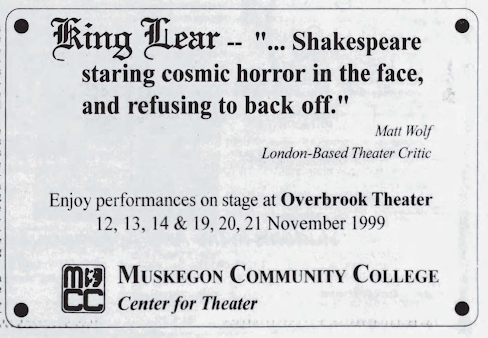
"King Lear -- '. . . Shakespeare staring cosmic horror in the face and refusing to back off,'" a quote from Matt Wolf, "London-Based Theater Critic," in an advertisement for a performance of King Lear, from the Muskegon (Michigan) Chronicle, May 16, 1999, whole page number 77.

A final note: The Great Gatsby is now one hundred years old. More than a few people have written on the book and its anniversary. I have read two otherwise good online essays on it, but both mention our current president, and I wonder why. Is that really necessary? Better yet, will it age well? The answers, I think, are no and most definitely not. Anyway, I hope this essay gives everyone enough to read for a while. It might be some time before I write again.

Original text copyright 2025 Terence E. Hanley

Sunday, March 2, 2025

Four Men-Part Two

I'll set aside Edgar Allan Poe and H.P. Lovecraft before bringing them up again. The four men of the title are:

  • German philosopher Friedrich Nietzsche (1844-1900);
  • French author Guy de Maupassant (1850-1893);
  • American author Robert W. Chambers (1865-1933); and
  • American author and gadfly of science Charles H. Fort (1874-1932).

Some of the stories in the Cosmic Horror Issue of Weird Tales (2023) allude to ideas from two of these men, Nietzsche and Fort. Now that I have read "The Horla" by Guy de Maupassant, I can draw him into this discussion, too, along with Robert W. Chambers.

Robert W. Chambers is mentioned by name in the Cosmic Horror Issue. Guy de Maupassant is not, except very indirectly, for in "A Ghost Story for Christmas" by Paul Cornell, one of the videos watched by the main character during his solitary holiday binge is Diary of a Madman (1963), starring Vincent Price. Although it bears the title of one of Maupassant's stories, Diary of a Madman is mostly based on another, namely, "The Horla." Both stories take the form of diaries, and so it was easy, I guess, to put them together. If the moviemakers had entitled their film The Horla, no one would have known what it was about. Besides that, it probably wouldn't have gotten by the censors.

The main character in "A Ghost Story for Christmas" thinks a little about Vincent Price but not at all about Maupassant. Thematically, "The Horla" is related to Quatermass (1979), a show in which Mr. Cornell and his TV watcher are much more interested. The illustration at the beginning of the story is of John Mills' image on a TV screen, Mills being the star of the show. I don't know whether Mr. Cornell was aware of the thematic connection when he wrote his story. The idea that we are property, or cattle, seems to have come from Charles Fort. No one writing for the Cosmic Horror Issue seems to have looked to "The Horla" for inspiration. I think, though, that "The Horla" must be considered seminal in the history of science fiction. I'll get into that a little more. Right now I'll just say that I can't believe I had never read it before a couple of weeks ago. But then you can't read everything all at once. Where would that leave you?

"The Horla" by Guy de Maupassant was published in two versions, the first in the October 26, 1886, edition of the French newspaper Gil Blas, the second in a hardbound collection called The Horla, published in 1887. I have the first version in Pierre and Jean and Selected Short Stories of Guy de Maupassant (Bantam, 1994). I have the second and I guess definitive version in Selected Tales of Guy de Maupassant (Random House, 1945 and 1950), with illustrations by Adolf Dehn. Even so, this version is different from other translated versions. If you can, you should read these two versions together. I'll quote from them next time, or maybe the time after that if this brief series turns into a long one. By the way, "The Horla" was reprinted in Weird Tales in August 1926, in its author's birth month, as well as the same month that Maupassant's diarist first sees his previously invisible tormenter. 

Translator Charlotte Mandell has suggested that the portmanteau word horla is a combination of the French hors, meaning "outside," and lĂ , meaning "there." The Horla, then, is "the Outsider, the outer, the one Out There," or "the 'what's out there'." (Quoted in Wikipedia.) That's an excellent interpretation, I think, and just another indication that we should always endeavor to look into the meanings of words. A simple English version of the word Horla might be alien, and I think that's what we are to believe about Maupassant's being, that it is an alien, probably an extraterrestrial alien.

H.P. Lovecraft was an admirer of Guy de Maupassant and Robert W. Chambers. Both are mentioned in his essay "Supernatural Horror in Literature." Lovecraft especially liked "The Horla." It's supposed to have been an influence upon him in his composition of "The Call of Cthulhu" (Weird Tales, Feb. 1928). I can't say that that's true. It appears to be one of those things that people say so often that everyone just accepts it. We should have some evidence instead, and then we can believe it for sure. The influence of Chambers upon Lovecraft is more evident. In contrast, any connection to or awareness of Nietzsche in Lovecraft seems tenuous. As for Charles Fort, look no farther than "The Whisperer in Darkness" (Weird Tales, Aug. 1931) for Fort's name in Lovecraft's fiction.

All four men of my title read Poe, for Poe, once he arrived upon this earth, became inescapable. Here is Nietzsche in a discussion of Poe, and others:

     Those great poets, for example, men like Byron, Musset, Poe, Leopardi, Kleist, Gogol--I do not dare mention far greater names, but I mean them--are and must be men of the moment, sensual, absurd, fivefold, irresponsible, and sudden in mistrust and trust; with souls in which they must usually conceal some fracture; often taking revenge with their works for some inner contamination, often seeking with their high flights to escape into forgetfulness from an all-too-faithful memory; idealists from the vicinity of swamps--what torture are these great artists and all the so-called higher men for him who has guessed their true nature!

The quote is from Nietzsche contra Wagner: Out of the Files of a Psychologist (1888). A different version is in Beyond Good and Evil: Prelude to a Philosophy of the Future (1886). So, like Maupassant, Nietzsche sometimes changed what he wrote.

To be continued . . .

An illustration for "The Horla" by Guy de Maupassant, source and artist unknown. This may be in an edition published by P.F. Collier & Son in 1910, although the almost unreadable words above appear to be in French.

Posted early and revised later in the morning on March 2, 2025. I have changed what I have written, too.
Original text copyright 2025 Terence E. Hanley

Thursday, February 27, 2025

Four Men-Part One

Two figures cast their long shadows over the Cosmic Horror Issue of Weird Tales. They are of course Edgar Allan Poe and H.P. Lovecraft. But it seems to me that there is more of Friedrich Nietzsche and Charles Fort than Poe or Lovecraft in Weird Tales #367. From Nietzsche comes the theme and imagery of staring into voids and abysses. From Fort comes the idea that we are merely the property of superior beings from outer space. I think there is very little if anything of Robert W. Chambers in this issue, even if his name is mentioned first.

  • In "A Ghost Story for Christmas" by Paul Cornell, a man stays at home at Christmastime to watch TV. (Fun fun.) Among the shows he watches is Quatermass, a British TV serial from 1979. As I understand it, the premise of the show is that people on Earth are being harvested by aliens for their protein. Human beings, then, are essentially cattle, in other words, property. (Cattle is from the same root word as chattel, i.e., the Latin capitale, meaning "property.") This is the Fortean aspect of Mr. Cornell's story. Now the Nietzschean aspect:

The door opens. He's opened it inward. And he's just looking at darkness. Just space. (p. 24)

I take that to be an oblique reference to a quote from Nietzsche:

Whoever fights monsters should see to it that in the process he does not become a monster. And when you look long into an abyss, the abyss also looks into you. (From Beyond Good and Evil: Prelude to a Philosophy of the Future, Chapter 4, No. 146) (1886)

  • The reference to Nietzsche is more direct in "Night Fishing" by CaitlĂ­n R. Kiernan:

I stare at the box, and I imagine it stares back at me. (p. 38)

The reference to Fort is also more direct:

I think we're fished for. (p. 38)

It's also kind of indirect in that those italicized words refer to Edmond Hamilton's overtly Fortean story "The Space Visitors," from 1930.

  • In "The Last Bonneville" by F. Paul Wilson, the title character says that on his trip to the Moon, he:

"stared in the other direction at all that empty space out there. At the Void. And not only did the Void stare back, it spoke to me--or at least something within the Void spoke." (p. 53)

Here's the Fortean concept to go with the foregoing Nietzschean one:

"We were to be contained--not because we were a disease, as I thought, but because we were playthings."
Whose playthings? According to Bonneville, we are the playthings of "Our Owner." (p. 53) So, again, we're property.

There is an alien presence in "The Traveler" by Francisco Tignini, "Mozaika" by Nancy Kilpatrick, and "Laid to Rest" by Tim Lebbon, while the void appears right in the title of Carol Gyzander's story "Call of the Void -- L'appel du Vide." I can't say that any of these stories has both a Nietzschean and a Fortean aspect.

As for the other two stories, "The City in the Sea: A Hellboy Story" by Christopher Golden and Mike Mignola, and "Concerto in Five Movements" by Ramsey Campbell, Poe and Lovecraft have a more prominent place in the former, while Mr. Campbell's story is the most Lovecraftian of all. And if cosmic horror is a synonym of Lovecraftian horror, then "Concerto in Five Movements" is perhaps closer than any to the concept of cosmic horror.

The title of this little essay is "Four Men," but I have written about only two of the four. The other two will come along in part two of this series.

To be continued . . . 

Original text copyright 2025 Terence E. Hanley

Tuesday, January 21, 2025

Two Poems About Two Crows

Francis Hard, aka Farnsworth Wright, had a poem called "Two Crows" in the January 1925 issue of Weird Tales. Just six years earlier, Wright had been a soldier stationed in France. In composing his poem, he must have drawn on memories of the Great War:

Two Crows
By Francis Hard (Weird Tales, Jan. 1925)

Two crows flapped over dismally
(So wearily, so drearily)
To the blackened limb of a blasted tree;
The shells flew screaming overhead,
And the field was covered thick with dead--
The earth reeked with its dead.

One crow lamented to his mate
(So wearily, so drearily):
"How long, how long must we now wait
For the taste of food that was so good
Before the shrapnel shattered the wood
And loaded the ground with dead?

"The odor sweet of dying men"
(Lamented he so drearily),
"How strangely pleasant was it when
I sensed it first with ravished breath!
But I am sated, and sick to death,
And would fain lie yon with the dead."

A shell came moaning through the air
(So drearily, so eerily)
And burst where the crows were plaining there;
It shivered the wreck of the blasted tree,
And bits of crow fell bloodily
Among the tangled dead.

* * *

A year and a month later, in February 1926, in his capacity as editor, Wright placed a traditional ballad called "The Twa Corbies" ("The Two Crows") in Weird Tales:

The Twa Corbies
(Old Ballad)
[By Anonymous]

As I was walking all alane,
I heard twa corbies making a mane.
The tane unto the tother say:
Where sail we gang and dine today?

In behint yon auld fail dike
I wot there lies a new-slain knight.
Naebody kens that he lies there
But his hawk, his hound, and his lady fair.

His hound is to the hunting gone,
His hawk to fetch the wild-fowl hame,
His lady's ta'en another mate,
So we may mak our dinner sweet.

I'll sit on his white hause-bane,
Ye'll pick out his bonny blue een,
Wi' ae lock o' his gowden hair
We’ll theek our nest when it grows bare.

Mony a one for him makes mane,
But nane sail ken where he is gane.
O'er his white banes, when they are bare,
The wind sall blaw for evermair.

* * *

"The Twa Corbies" was first in print in 1812. A century later, it was reprinted in Ballads Weird and Wonderful (1912), illustrated by Vernon Hill (1887-1972). It seems to me that Farnsworth Wright had read "The Twa Corbies" and was inspired by it in writing his own poem. The refrain, the repeated "wearily," "drearily," and "eerily," would seem to have been inspired by "The Raven" by Edgar Allan Poe and its own refrain of "evermore" and "nevermore," also from its opening line:

Once upon a midnight dreary, while I pondered, weak and weary,

I wrote about "The Twa Corbies" on December 19, 2022. You can read what I wrote by clicking here.

Two corvids on the cover of Weird Tales:

Weird Tales, July 1945, cover art by Lee Brown Coye.

Weird Tales, September 1939, cover art by Virgil Finlay.

And what might be a crow but looks more like a myna:

Weird Tales, January 1946, cover art by Albert Roanoke Tilburne.

Original text copyright 2025 Terence E. Hanley