| "La Cathedrale engloutie" ("The Drowned Cathedral"), a woodcut by M.C. Escher based on one of Claude Debussy's Préludes and before that on the legend of the lost city Ys. |
Tuesday, February 25, 2025
Robert W. Chambers & Lost Lands
Thursday, April 28, 2022
Lemuria, the Theosophical Continent
Mapped by William Scott-Elliot (1849-1919), Lemuria is the Theosophical continent. With fellow Theosophist Charles Webster Leadbetter (1854-1934), Scott-Elliot was also a kind of ethnologist of Lemuria and its fifteen-foot-tall, egg-laying people. There were other people before and after these Lemurians. They occurred in great variety, in varying heights and colors and bodily configurations. In reading about them in Lost Continents: The Atlantis Theme in History, Science, and Literature by L. Sprague de Camp (Dover, 1974), I am reminded of the men of Edgar Rice Burroughs' version of Mars, and I wonder if Burroughs could have been influenced by Theosophy. Both he and they wrote of Lost Worlds. His red Martians also lay eggs.*
Scott-Elliot and Leadbetter remembered Lemuria. So did Richard S. Shaver (1907-1975), and he is credited with a story to that effect, conveniently called "I Remember Lemuria" and published in Amazing Stories in March 1945. Shaver's story was the first in the so-called Shaver Mystery of the mid to late 1940s. The mystery began with a letter to Ziff-Davis of Chicago in which Shaver described a discovery he had made of the ancient and forgotten language Mantong, a kind of proto-Indo-European language for people on the fringes of science and sanity. Editor Raymond A. Palmer (1910-1977) seized on the letter and printed a version of Shaver's Mantong in the January 1944 issue of Amazing Stories. The heading was "Mr. Shaver's Lemurian Alphabet." More than a year passed before Palmer published "I Remember Lemuria." Although Shaver got credit for the story, it was Raymond A. Palmer who turned it into something publishable (and probably readable, too). And it was Palmer, I think, who added the Lemurian/Race Memory-angle. I'm not sure that Shaver was very keen on that addition. Anyway, more stories of Lemuria and the Shaver Mystery followed. I have written about all of this before in my series "The Shaver Mystery." Click on the label on the right to read more.
* * *
Raymond Palmer was familiar with Theosophy and its Lost Worlds. For years he pushed Oahspe, subtitled A New Bible, written anonymously and published in 1882. Palmer was also a Fortean and was responsible for Fate, the world's longest-running and most successful magazine of Forteana. And of course Palmer as much as anyone was responsible for successfully launching flying saucers and keeping them in the air. John Keel in fact dubbed Ray Palmer "the man who invented flying saucers." It's hard to argue with that idea.
Palmer seems to have been a man of boundless energy and enthusiasm, despite the fact that he was badly crippled in childhood and suffered time and again from ill health. He wrote reams of science fiction, science fantasy, space opera, editorial content, and (supposed) non-fiction, most of which is in the realms of Forteana, esoterica, the paranormal, and other fringe topics. He was an editor and publisher for all of his adult life. You might say that he was one of the editors who really shaped science fiction and fantasy during the 1930s to the 1950s. This is where the theorizing begins.
* * *
A few weeks ago, I acquired part of a collection of science fiction, fantasy, and horror assembled by Margaret B. Nicholas and William Nicholas of Bartlett and Marietta, Ohio. Included in it are dozens of digest-sized science fiction and fantasy magazines from the 1950s and '60s. I have been looking through these magazines lately, and something stands out, or seems to stand out. What stands out is that there seems to have been three main strands in the look and feel of these magazines and their contents. First is what you might call the Raymond A. Palmer strand. Lurid, sensationalistic, maybe a little exploitative, fringe-worthy (my new word), this strand is represented by Palmer's own magazines plus some similar titles, such as Amazing Stories, Fantastic Stories of the Imagination, Imagination Stories of Science and Fantasy, Other Worlds Science Stories, and so on. I think this same kind of look and feel was in other magazines, too, such as Planet Stories of the 1940s and even the shudder pulps of the 1930s.
There are copies of Galaxy, Worlds of If, and similar magazines in this collection, too. These represent a second strand, a more conservative, more nearly respectable, maybe even sometimes staid approach to science fiction and fantasy, but especially to science fiction. Science fiction writers of the 1950s often satirized the supposed conservatism and conformity of 1950s America. Yet some of the magazines in which their stories appeared seem to have used (almost) Reader's Digest as their model. It's almost like they were trying to break into mainstream America--to make of themselves something respectable instead of remaining on the fringes, like Palmer and his associates. I don't have any copies of Astounding Science Fiction in this collection, but it seems to me that Astounding under its renowned editor John W. Campbell, Jr. (1910-1971) was of the second type and probably its original. Lest you think Campbell and his writers were strictly science-minded and not given to fringe ideas, remember that the editor of Astounding had his own madman. And remember that Campbell's madman and that madman's ideas were and are far more dangerous and influential in people's lives than was Richard Shaver or anything he ever wrote. There is more about Campbell's madman coming up. In fact, part of the reason I have expanded this series is a discovery I think I have made about John W. Campbell, Jr., his madman, and their circle of writers and hangers-on.
* * *
The third strand of magazines was unique, and it was subtitled just that: The Unique Magazine. Weird Tales had its imitators, but none that lasted or have lasted as far as I can tell. Weird Tales was more or less alone. It stayed to itself. It had its own singular vision. But maybe the third strand represented by Weird Tales ran like a river into another magazine that I have in my new collection. It's a connection--or a continuation--that I had never known about before. I have already mentioned the magazine. It's called Fate.
-----
*Update (May 4, 2022): Reader Carrington B. Dixon has let us know that someone has already looked into the idea that Edgar Rice Burroughs was influenced by Theosophy. That someone was Fritz Leiber, Jr., in an essay called "John Carter: Sword of Theosophy," originally in Amra, September 1959, and reprinted in The Spell of Conan (Ace Books, 1990).
Dale R. Broadhurst looked into the question even more in his article "John Carter Beginnings? Part One: Wondrous Secrets or Outrageous Nonsense?" You can read it on the website Bill & Sue-On Hillman's ERBzine by clicking here. Mr. Broadhurst's conclusion is that Burroughs was not influenced by Theosophy. I suspect that these common ideas were in the zeitgeist of the times in which Madame Blavatsky and Edgar Rice Burroughs lived. There need not have been influence of one on the other.
To be continued . . .
Text copyright 2022 Terence E. Hanley
Monday, October 25, 2021
Summer Reading List No. 8-Secret of the Lost Race by Andre Norton
I began reading Secret of the Lost Race by Andre Norton (1959; Ace Books, 1972) late in summer and finished it the day after the equinox. It was originally published as half of an Ace Double with a great cover by Ed Valigursky (1926-2009). The cover artist for my edition is unknown. That's unfortunate, because it's a great and evocative image: colorful, mysterious, inviting to the reader, a depiction of a truly alien landscape. The artist should have received credit, just as every artist should. I'm an artist and so may be biased, but artists have very often given us better, more evocative, more fully realized science-fictional worlds than have authors. We often read science fiction and fantasy based on cover art and illustration versus anything else. Sometimes the story is a disappointment by comparison. Maybe that's more common with visually oriented people versus those who are verbally oriented.
* * *
Andre Norton (1912-2005) can always be counted on to set up a good and intriguing situation. She was also good with sequences of action and adventure. Secret of the Lost Race starts out well by thrusting a young city-dweller into a precarious life on a harsh and distant planet. After a while, though, the story gets bogged down in talk and politics. There is also the introduction of complex physical environments, which can be a problem in any story. I remember a Travis McGee novel in which the story hinges on action taking place within such an environment. I became nearly lost, and because of that, the story was nearly lost to me. I guess a piece of advice for any writer is not to force your story into situations like that. Let it unfold easily instead of with too much complexity. Your readers may not be able to follow you very well through the folds of your own brain.
* * *
The title Secret of the Lost Race may seem a little misleading, but maybe only because we think we already know what is a lost race: lost races are found in lost cities or villages or hamlets situated in lost valleys or lost lands or on lost islands or lost continents. They aren't out there in the great galaxy. Andre Norton didn't commit any literary offense by placing her lost race among the stars, nor by invoking any preconceived notions the reader may have of what is a lost race. I don't feel cheated or misled by her title. I enjoyed Secret of the Lost Race.
Andre's hero is a young man with special, secret, latent powers. He's like Luke Skywalker who doesn't know that he's the son of a Jedi (in one version of the Star Wars story anyway) and can control the Force. But her hero is also like the Superior Man of science fiction tradition (or cliché). He's not ordinary. He's not human. He's a member of a powerful lost race. (Judging from their language, I think they're Welsh.) Only in the end does he find this out. So again we have the Superior Man plot, this time combined with the Lost Race/Lost Worlds plot. Andre Norton wrote for young people. Maybe the Superior Man plot appeals to young people, especially the socially awkward, bookish, or lonely among them: maybe someday their great and special and secret powers will out and the world will recognize them for what they truly are.
* * *
Speaking of Star Wars, there are interesting and innovative weapons in Secret of the Lost Race. They are blades of pure energy, and I think they emerge from a solid handle or haft. There's a force axe and a force blade--a knife, I think. I recognized them right away as light sabers. Maybe the next weapon in the Star Wars galaxy should be a light axe.
* * *
I wanted to write about this book because it steers me back towards my previous series on Edgar Rice Burroughs, Lost Worlds, and Utopia. Those terms--Lost Worlds and Lost Race--can mean more than one thing. Andre Norton showed as much in her book. I have at least six meanings.
A Lost World or Lost Race can be:
- Lost as in secret; not easily discoverable nor re-found after first being found. Brigadoon might be an example. This type of world is lost because somebody wants it that way.
- Lost, stranded, or frozen in time, i.e., in the past or in a historical phase through which the rest of the world has passed, leaving the Lost World behind. Dian of the Lost Land by Edison Marshall (1935) is an example. Geographic isolation is usually the explanation for this type of Lost World.
- Lost as in invoking feelings of longing or nostalgia for something that was greater, happier, and more pleasant than what we have today but has since become lost, i.e., Eden or Paradise or a lost Golden Age. (The lost Golden Age may be the author's own youth, as I suggested in my previous entries on Glory Road by Robert A. Heinlein.)
- Lost as in previously unknown; newly discovered, as in Utopia by Thomas More (1516).
- Lost as in once known but then lost to the outside world, only to be rediscovered later, like the real-life Viking colonies on Greenland, if they had in fact survived rather than perished, if they had continued developing naturally, and if they had been rediscovered after a couple of centuries of isolation. This kind of Lost World might be lost only accidentally.
- Lost as in bewildered, whether it be in time or space, or philosophically, spiritually, psychologically, existentially, etc. The TV show Lost is a good example.
It's important to remember that Lost Worlds can exist not only in space but also in time: a Lost World can be of the future--a future Earth--newly discovered by the Time Traveler, who can be a character but who might also be the author or the reader. Through science fiction and fantasy, we as readers may make our extraordinary voyages and encounter these new and perhaps previously Lost Worlds, all in the comfort of our own rooms. Other planets can be Lost Worlds, too, equivalent to the previously undiscovered lands of the still geographically open earth of our historical past. Lost Worlds can exist in the past, too. Robert E. Howard's stories of Conan and his Hyborian Age are good examples of that. Remember that those stories first appeared in Weird Tales, and so Utopia, by way of the Lost Worlds story, found its way into the pages of "The Unique Magazine." And so I give away half of my thesis in this series.
* * *
If my taxonomy of Lost Worlds is accurate, then maybe Edgar Rice Burroughs' Mars--the Barsoom of John Carter--falls into the third and/or fourth categories, with elements of the second category, too. The idea put forth is that Barsoom is a conservative Utopia, just as Lost Worlds that came before it in literature--worlds created by H. Rider Haggard and Rudyard Kipling for example--were conservative. The conservative Utopia, then, is imperfect. Men must struggle against each other and against the elements and the forces of nature. They must be tested and they must prove themselves. The conservative Utopia of Lost Worlds allows the author and the reader to put himself or herself in the shoes of the protagonist, and so he or she is tested and proves himself or herself. Lost Worlds is wish-fulfillment. That seems pretty plain to me. It seems pretty plain to me, too, that the sixth category of Lost Worlds described above is unlikely to appear in the conservative Utopia, for the Conservative is by definition not a modern man, nor is he tormented by the dilemmas of modernity. (A questioning, seeking, self-aware protagonist in a Lost Worlds setting might make for a good story, though.)
* * *
I'm not saying that I agree with that interpretation exactly, that the Lost Worlds story is the conservative version of Utopia. I would like to read more about it first. Unfortunately, more than one paper on the subject is locked up behind a paywall. (I thought walls were bad.) Anyway, the progressive Utopia is, in contrast, perfect. There is no struggle, only peace. All needs and desires are met by the State, which is coterminous in the progressive imagination with Society. At long last, here is Utopia: a perfect gray sludge of a thoroughly homogenized and dehumanized humanity, living together in perfect happiness, peace, material comfort--and stasis. (You might be able to detect my bias here.) The progressive Utopia is a fantasy, too, not only on the part of the author (Looking Backward: 2000-1887 by Edward Bellamy [1888] is an example) but also of the reader. The problem with the progressive Utopia is that as a literary work, it's usually pretty dull (just like its subjects, their minds, and their lives). The place for the progressive Utopia is actually in the real world; the real-life Progressive prefers to bring his or her fantasy of Utopia to real life. And as we all know, that involves a lot of death. And I mean a lot of death.
* * *
As I've said before, every Utopia is also a Dystopia, because the subjects of Utopia must always be stripped of their humanity. We are not perfect, but in order for Utopia to be brought about, we must be harried into perfection. We are by our very nature free, but in order for there to be Utopia, we must submit to slavery. This is Dystopia, and this is the progressive goal.
* * *
I have three books (or four, depending on how you count) remaining in this series on my summer reading. Next comes Edgar Rice Burroughs and his own description of Dystopia.
Text copyright 2021, 2023 Terence E. Hanley
Saturday, April 24, 2021
Utopia & Dystopia in Weird Tales-Part Ten
The Encyclopedia of Science Fiction has so many interesting things to say, including these two:
The lost-race story [what I have been calling Lost Worlds] is obviously an opportunity for the setting up of imaginary Utopias [q.v.] and Dystopias [q.v.] [. . .]. (p. 736)
It has been suggested, too, that such stories allow exercises in imaginary cultural anthropology [. . .]. (p. 736)
Then the encyclopedists take it back--the way I took things back last time I wrote--pointing out that Lost World utopias and dystopias "are not as common as might be expected" and that in actuality most Lost Worlds stories "are quite straightforward romantic adventures." (p. 736) That seems right to me. I think of Utopia as a progressive or forward-looking genre in which plot and action are secondary to more satiric, intellectual, or high-literary purposes, all fit for publication in a fine hardbound edition and suited for academic or scholarly study. In contrast, the Lost Worlds/science fantasy-type story seems to me more conservative, romantic, and adventurous, essentially a pulp genre meant for popular consumption. Its aims seem simpler. They would appear non-intellectual and even anti-intellectual: Nobody ever accused Edgar Rice Burroughs of being an intellectual, but in our hyper-intellectualized age (which began, I think, in the 1960s and '70s), Burroughs has become a subject for the same kind of academic or scholarly study previously reserved for more literary works. (1)
* * *
The science fiction encyclopedists also write that, in regards to the Lost Worlds genre,
there is more and better cultural anthropology in offworld stories of planetary exploration and colonization of other worlds [q.v.] (mostly postwar), subgenres that largely superseded the lost-race story, than there are in lost-race stories set on earth. [Emphasis added.] (p. 736)
A lot of science fiction history is packed into that little phrase, "subgenres that largely superseded the lost-race story," for it implies that a big part of science fiction came out of the Lost Worlds/science fantasy tradition established by H. Rider Haggard, Rudyard Kipling, and Edgar Rice Burroughs. That seems right to me, too. If it involves other planets--worlds lost and newly discovered--explorations and odysseys--mysteries and journeys through and in time and space--then it seems likely to have come down to us from the science-fantasy adventures of the nineteenth and early twentieth centuries. (The dystopian and apocalyptic strain of science fiction would appear to have had different origins. That's another topic still to come in this series.) Burroughs in particular seems to have been an originator of the science-fictional (and utopian) hero, which might have been a new type when he wrote but was based on a far older one, as old as the heroes of ancient Greece. More on that soon, too.
* * *
Here is the Encyclopedia of Science Fiction on Utopias:
It can be argued that all utopias are sf, in that they are exercises in hypothetical sociology [q.v.] and political science. Alternatively, it might be argued that only those utopias which embody some notion of scientific advancement qualify as sf--the latter view is in keeping with most definitions of sf [q.v.]. Frank Manuel, in Utopias and Utopian Thought (anth 1966), argues that a significant shift in utopian thought took place when writers changed from talking about a better place (eutopia) to talking about a better time (euchronia), under the influence of notions of historical and social progress. When this happened, utopias ceased to be imaginary constructions with which contemporary society might be compared, and began to be speculative statements about real future possibilities. It seems sensible to regard this as the point at which utopian literature acquired a character conceptually similar to that of sf. (p. 1260)
That's a long quote, almost long enough for its own blog entry, but it gets to a point, which is that categories seemingly fail and definitions lose their precision as time goes by. Utopia by Thomas More, from 1516, is a Utopia. But is Burroughs' Barsoom, first in print in 1912, also a Utopia? An even larger question: Is science fiction of the twentieth century essentially utopian? Or, can we turn it all around and argue that all Utopias are science fiction, as the encyclopedists suggest in their use of the very passive voice? Maybe Charles Fort's concept of continuity in all things applies: science fantasy, planetary and interplanetary romance, and science fiction as a whole are pulp versions of the damned: "By the damned, I mean the excluded," Fort wrote in 1919, shortly after John Carter projected himself to another planet. And that's how I think of the pulp genres: for decades they were excluded, beneath consideration, beneath contempt, not a part of polite society or worthy of academic study, discontinuous with accepted literature. People might have called pulp magazines rags, but in one sense they weren't rags at all, for rag paper is for finely made books and meant to last. Pulps were for the moment, to be read and discarded, to be found again in the trash or on the train, like Jessica Soames' copy of True Story. Printed on acid paper, they were cheap, designed for decay, meant not to last at all. But in them--perhaps now more than then--are lost and decaying worlds and races, all ready for rediscovery, like Haggard's lost valley of Kukuanaland or Burroughs' decaying world of Barsoom. But the pulp genres did and still do lie along a continuum, or more accurately exist in a medium in which all touch and intermingle with all, in which all boundaries are lost. Lost Worlds are Utopia is science fiction is speculative fiction is literary fiction and so on and on . . .
* * *
It seems to me that in his Lost Worlds stories, of which the Mars books are just one iteration, Burroughs didn't actually write utopian fiction. I think that the definition of Utopia is--like Jabba the Hutt--too broad and flabby. I think that, properly speaking, a utopian story is one concerning a perfect or idealized society. (2) A mere fantasy--even in the form of a Lost Worlds story or some exploration of cultural anthropology--isn't really utopian, for if it is, then all of high fantasy and about half of science fiction is subsumed into Utopia (instead of the other way around). If a word can mean anything, then doesn't it really mean nothing at all? Anyway, in writing their stories of Lost Worlds and cultural explorations, these authors seem pretty clearly not to have had utopian aims. I don't think we should put those aims on them. Instead, I think we should keep our definitions narrow and admit that there are far fewer utopian stories than what some theorists would have us believe. Nonetheless, Utopia seems to have passed into science fiction by way of Lost Worlds and science fantasy . . .
To be continued . . .
Notes
(1) Witness "Utopia in the Pulps: The Apocalyptic Pastoralism of Edgar Rice Burroughs" by Michael Orth in Extrapolation, Vol. 27, No. 3, 1986.
(2) It's worth noting here that ideal and idyll are from the same root, meaning "form" or "appearance," more remotely "to know" or "to see." So, Utopia = ideal society, and Lost Worlds ≈ idyllic society.
| European languages make a distinction we don't make very well in American English: to us, all book-length works of fiction are called novels. I like the European way: novels are realistic, while romances are fanciful. Here's another linguistic twist: in German, science fiction and utopian stories are tied to each other in the use of the words utopische, utopischen, utopischer, and so on. (I know nothing about the German language, only the words that I see in this place or that.) Here is an example, the cover of Insula by Paul Eugen Sieg (1899-1950), subtitled "Utopischer Roman," presumably "utopian romance," or maybe, loosely, "science fiction novel." Published in 1953, Insula is about a secret volcanic island--a kind of Lost World--inhabited by a scientist living in a secret city, like Captain Nemo or Ernst Stavro Blofeld. Sieg had previously written other science fiction novels, including Detatom (1936), at the core of which is a journey to Mars and the discovery of "remnants of a technically superior high culture." |
| The German firm Pabel published hundreds of entries in its Utopia Großband series between 1954 and 1963. Here is the cover of No. 58, from October 21, 1957, featuring a novelization of the American film 20 Million Miles to Earth (1957), written by Henry Slesar (1927-2002). The artist was Wolfgang Blaar. |
| A final image, one that I have just discovered, "The People in Today's State" versus "The People in the Future State," a German-Romantic vision from 1904 by Friedrich Eduard Bilz (1842-1922). (That's his self-portrait in the middle.) So, above, examples of the Zukunfstroman, a story of the future, or science fiction; and below, an image of Zukunftstaat, the State of the future, or Utopia, in this case an idyllic or pastoral Utopia with imagery that could have appeared--and did appear--on the cover of Weird Tales a generation later, drawn by another German artist, C.C. Senf (1873-1949). (See especially the woman in pink on the center right of the page.) I'll say it again: What every romantic and idealist fails to see is that every Utopia is also a Dystopia, for we are not perfect, we cannot be made perfect, and we will not be harried into perfection nor used as soulless and inhuman building blocks in the construction of someone else's vision of a perfect human society. |
Original text copyright 2021, 2023 Terence E. Hanley
Monday, February 22, 2021
Les Baxter (1922-1996)
I wrote the other day about Gustav Holst (1874-1934) and his suite The Planets from more than a century ago. Listening to his music and looking into the covers of recordings of his music made me think of two topics related to genre fiction. Both involve Les Baxter. If you haven't listened to Les Baxter's music, I would urge you to as soon as you can. There is so much there for fans of popular culture, especially Exotica and what I think of as one of its progenitors, the genre of Lost Worlds.
Leslie Thompson Baxter, called "the Godfather of Exotica," was born on March 14, 1922, in Mexia, a small city in east-central Texas. His parents were Jesse Elliott Baxter (1890-1955) and Leta Thompson Baxter (1890-1964). Both were native Texans and the families of both originated in the Upper South. Les Baxter had one brother, James Edward "Jim" Baxter (1913-1964), an author, playwright, composer, and lyricist who worked with Les in the 1950s and '60s. Les Baxter married just once, in 1953. He and his wife, Patricia C. Baxter, had two children together. Tragically, she died at age thirty-four, after they had been together for just seven years. Les Baxter raised their children on his own after that. So, at the height of his musical career in the 1950s and '60s, Les Baxter lost his parents, his brother, and his wife. Some things are given while others are taken away.
Les Baxter's father, Jesse Baxter, worked as a stenographer, bookkeeper, and realtor, but his family included more than one prominent preacher. His brother, Batsell Baxter (1886-1956), was a preacher, writer, and college president. (More on that below.) Batsell Baxter was the father of Batsell Barrett Baxter (1916-1982), also a preacher, writer, and educator. He started Herald of Truth Bible Hour, a TV show that lasted for decades.
Jesse Baxter's sister, Anna Lee Baxter Hockaday (1892-1970), was married to a preacher, too. He was William Doniphan "Don" Hockaday (1888-1958), a second cousin, twice removed, of Abraham Lincoln (1809-1865). If you look at a picture of Don Hockaday, you might see a resemblance to the Great Emancipator. Don Hockaday's daughter-in-law died just last month. We send condolences to her family. We also find that an important idea is once again affirmed: History is alive in this moment. What we think of as being dead and in the past still lives.
Les Baxter was a musical child prodigy. He started playing piano at age five and as a six-year-old won a scholarship to the Detroit Conservatory of Music. The 1940 census indicates that in 1935 the Baxter family lived in Detroit. That would have been about the time, I think, that Jim Baxter attended Wayne University (now Wayne State University). Jim Baxter went on to write the Western novel The Circle on the Plain (1961) and the play Next Case. He also collaborated with his brother Les and songwriter Karl A. Suessdorf (1911-1982) on the songs "Rovin Gal" and "Calypso Boogie" (both from the movie Bop Girl Goes Calypso [1957]); "A Gun Is My True Love" (from the movie The Dalton Girls [1957]); and "Shooting Star" (from the album Space Escapade [1958]); as well as "Black Sheep," "Destination Honeymoon," and "Memories of Maine."
Les Baxter studied at Pepperdine University, an institution affiliated with the Churches of Christ. Baxter's uncle, Batsell Baxter, served as the first president of Pepperdine from 1937 to 1939. I suspect that Les Baxter was in attendance at about that time. In the census of 1940, Les, aged eighteen, did not have an occupation listed, but in 1942, when he filled out his draft card, he was employed by Central Casting in Hollywood. By age twenty, then, he had begun working in show business.
Baxter worked as a concert pianist and joined Mel Tormé's vocal group, the Mel-Tones, in or about 1944. The other singers in that group were Betty Beveridge, Ginny O'Connor, and Bernie Parke. Some combination of them appeared in two motion pictures, Pardon My Rhythm (1944) and I'll Remember April (1945). (Baxter played a singing sailor.) Ginny O'Connor soon after married Henry Mancini (1924-1994), another sometime composer of Exotica. (Be sure to listen to his "Lujon.") Les Baxter also played saxophone in Freddy Slack's big band.
Les Baxter was not only a singer and musician but also, of course, a composer, arranger, conductor, and producer of music. He wrote more than 250 scores for radio, television, and movies, including music for the Bob Hope and Abbott and Costello radio shows. I won't go into his list of credits except in the bullet points and record covers shown below. You can easily find his credits on your own on other websites, including on the Internet Movie Database (here). But I wanted to tell you a little more on the life of this extraordinary composer of so much exotic, evocative, and atmospheric music of the postwar era. I also wanted to tell about his influence upon and connections to the old pulp genres of science fiction, fantasy, and weird fiction:
First, as a maker of Exotica, Les Baxter helped to carry some of the moods and forms of more nearly classical music into popular realms of the 1950s through the 1970s. He did this chiefly, I think, by his use of African-influenced percussion, impressionistic woodwinds and strings, and soaring, wordless voices, these first with the Peruvian coloratura singer Yma Sumac (1922-2008), later in other albums of his own. (He produced and composed the music for her first studio album, Voice of the Xtabay, in 1950.)
If you listen to Gustav Holst's Planets (1914-1916, 1918), specifically "Neptune, The Mystic," you will hear wordless voices, but they are in other early twentieth-century compositions, too, such as in Maurice Ravel's Daphnis et Chloé (1912). You can hear the influence of Ravel--Debussy, too--on Les Baxter, but then these two French composers had a large effect on American popular music, especially film scores, in which seemingly every ocean-going movie for decades quoted from Debussy's La Mer. (Be sure to listen, too, to the angelic wordless singing of Edda dell'Orso [b. 1935], who worked extensively with Ennio Morricone [1928-2020] on his own film scores. Addition, March 4, 2021: One more piece of wordless singing: "Madrigals of the Rose Angel" from Harold Budd's album The Pavilion of Dreams [1978].)
The wordless singing and rapid-fire percussion of Exotica found their way into the main title theme of Star Trek, especially in the first season opening. The music was by Alexander Courage (1919-2008) and I think very much influenced by Les Baxter's Exotica. All of these voices remind me of the high, sweet, otherworldly, vocal group- or choral group-type singing in The Wizard of Oz (1939). Remember that Les Baxter started out in a vocal group, singing with a man nicknamed "the Velvet Fog." Talk about atmosphere.
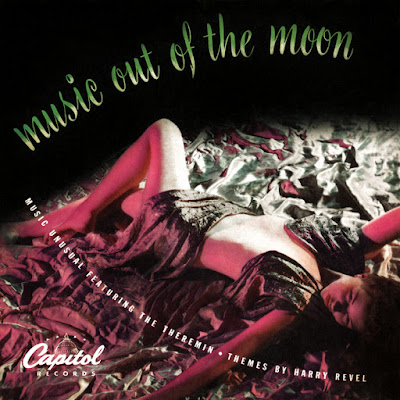
Second, Les Baxter also used the theremin early on, an instrument that is kind of a science fiction instrument anyway but also became one of the essential elements of the science fiction movie soundtrack of the 1950s, such as in Rocketship X-M (1950), The Day the Earth Stood Still (1951), and The Thing from Another World (1951). Here's a chicken-and-egg question: Did science fiction movies use the theremin because of Les Baxter, or was it the other way around? Or maybe both discovered the instrument at the same time.
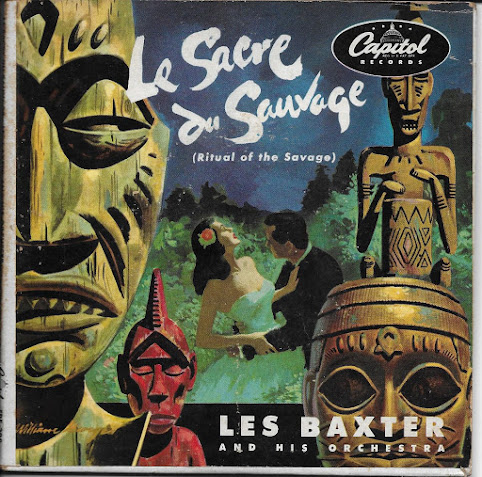
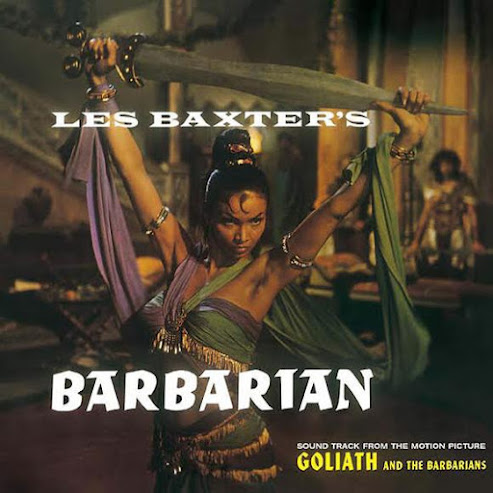
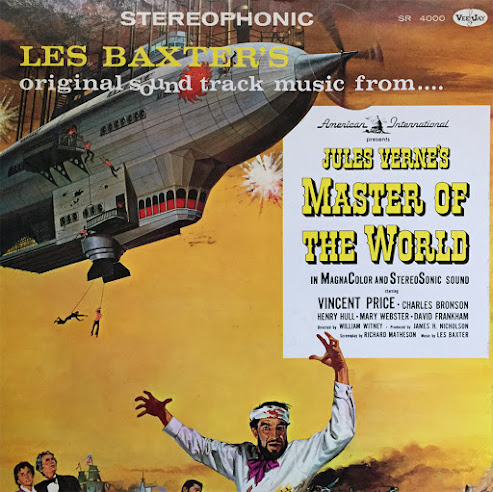
Third, Baxter composed music drawing from or meant to evoke the genres of Lost Worlds and science fiction (see the record covers below), but he also wrote scores for every kind of genre movie, including: The Invisible Boy (science fiction, 1957); The Lone Ranger and the Lost City of Gold (Western and Lost Worlds, 1958); Goliath and the Barbarians (sword and sandal or heroic fantasy, 1959); Master of the World (scientific romance or Vernian science fiction, 1961); Reptilicus (monster movie, 1961); Tales of Terror (weird fiction, 1962); Panic in the Year Zero! (post-apocalypse, 1962); and many others, plus plenty of beach-party and motorcycle exploitation movies.
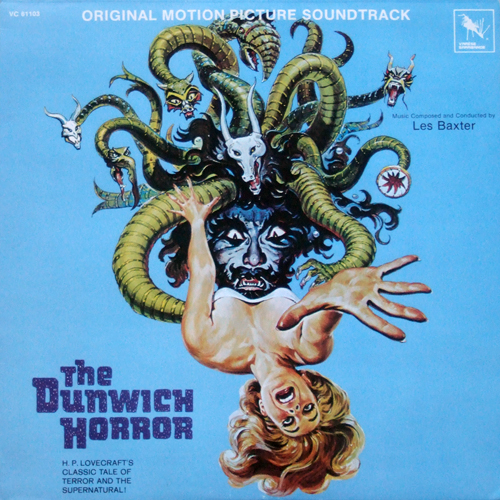
Fourth, he also wrote the score for The Dunwich Horror (1970), the first movie based on a work by H.P. Lovecraft (1890-1937) that also shares its title with the original source. (I think.) So if a movie score is a kind of program music or a kind of adaptation, then Les Baxter might get credit for the first musical adaptation of Lovecraft's work on film. However, the first film adaptation of a work by Lovecraft was actually The Haunted Palace (1963), a film based on "The Case of Charles Dexter Ward" (1927, 1941, 1943). The author of that score was Ronald Stein (1930-1988), whose list of credits might be indistinguishable from Les Baxter's, for these two men wrote music for all of the same kinds of movies. Anyway, Ronald Stein should probably get credit for the first recorded musical adaptation of H.P. Lovecraft's work, assuming, like I said, that a movie score is a kind of program music and therefore an adaptation. (See my article "The Other Forms of Lovecraft," dated October 2, 2018, by clicking here.)
Well, this article has gone on pretty long and it might be time to wrap things up. I'll close by letting you know that Les Baxter died on January 15, 1996, in Newport Beach, California. He was seventy-three years old, but in departing he left behind music that I hope we can listen to forever.
Further Reading
- "Les Baxter" on the website Space Age Music Maker, here.
- A website called Les Baxter at this URL: Lesbaxter.com.
- The Exotic World of Les Baxter, a website accessible by clicking here.
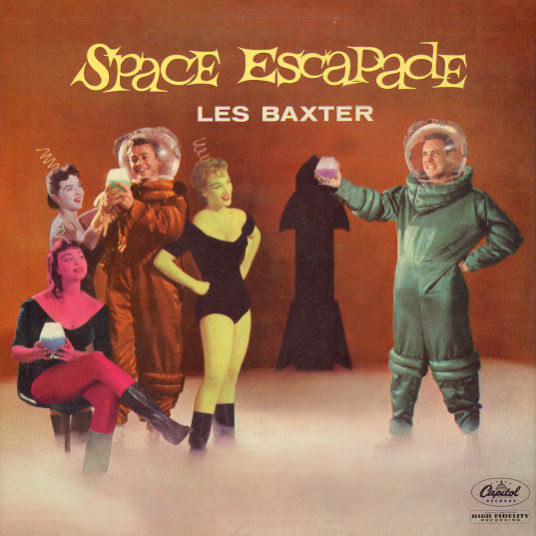
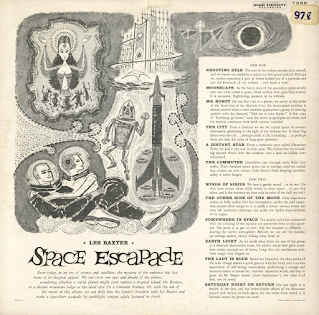
| Here's the reverse side of that album. I don't know who the artist is, but he or she knew something about science fiction imagery. And talk about a phallic rocketship. |
| Speaking of swipes, here's a movie poster for House of Usher (1960), for which Richard Matheson (1926-2013) wrote the screenplay and Les Baxter wrote the music. The swipe is from Harry Clarke's illustration for "The Premature Burial" by Edgar Allan Poe (1809-1849). (Click on the previous sentence to see it.) It's strange to think that Edgar Allan Poe and Abraham Lincoln were born less than a month apart. |
Friday, April 10, 2015
The Stories of Francis Stevens-The Citadel of Fear-Part One
Barren, unpopulated, forsaken even of the Indians, this region had an evil reputation. "Collados del Demonio," Hills of the Fiend, the Mexicans called it. (p. 15)
To be continued . . .
Thursday, March 26, 2015
The Stories of Francis Stevens-The Nightmare
(5) There is even a suggestion of more adventures to come in the life of Mr. Roland C. Jones.
| All-Story Weekly, April 14, 1917, with "The Nightmare" by Francis Stevens as the cover story. Note the use of the word "weird." A new magazine with that word in its title was only six years away. |