Showing posts with label John Jakes. Show all posts

Friday, March 31, 2023

John Jakes (1932-2023)

Author, Advertising Copywriter
Born March 31, 1932, Chicago, Illinois
Died March 11, 2023, Sarasota, Florida

John Jakes has died. Known for his vastly popular historical novels, the late Mr. Jakes got his start as an author of science fiction and fantasy stories. His first published story was "The Dreaming Trees" in Fantastic Adventures, November 1950. According to Isaac Asimov, the Golden Age of Science Fiction ended in 1950. If that's the measure, then John Jakes just barely slipped in before that age came to an end.

John Jakes could have been in Weird Tales, but he wasn't. By the time "The Unique Magazine" folded, he had had nearly three dozen of his stories published, in Fantastic Adventures, Amazing Stories, Super Science Stories, Planet Stories, Imagination, The Magazine of Fantasy and Science Fiction, Space Science Fiction, Avon Science Fiction and Fantasy Reader, Rocket Stories, and Cosmos Science Fiction and Fantasy. He also wrote Westerns and crime and detective stories. Weird Tales was on its way down in the 1950s, while magazine science fiction was taking off. You could hardly have blamed John Jakes for choosing one over the other. (Or maybe he submitted stories to Weird Tales but was turned down.) He certainly wasn't above writing stories of fantasy. A later phase of his career proved as much.

In the early 1960s, Mr. Jakes began writing stories of a yellow-haired warrior loose in a world of monsters and magic. In his "Prefatory Note" to Brak the Barbarian (1968), he acknowledged writing his Brak stories in the shadow of Robert E. Howard. He did so not out of cupidity, as a letter writer to Fantastic Stories of the Imagination had suggested. "My motive for giving birth to Brak and his parallel universe on an old black Underwood was much simpler," the author explained. "There just are not enough stories of this kind to go around any more; not enough, anyway, to please me." And so he wrote.

Fantastic Stories of Imagination published the first Brak story, "Devils in the Walls," in May 1963. Eight more followed, plus several novels and collections of stories, some of which are variants of the original eight stories. I haven't done a close enough study of the Brak stories to say just how many of them there are, but it looks like there are twelve. Also, we shouldn't forget a Brak comic book story, "Spell of the Dragon," with a script by Dan Adkins and John Jakes and artwork by Adkins, Val Mayerik, and Al Milgrom, published in Marvel Comics' Chamber of Chills #2  in January 1973. That makes thirteen.

I have compiled the following lists from information in The FictionMags Index, the Internet Speculative Fiction Database, and Wikipedia, and by consulting my own collection of Brak books:

Brak Stories by John Jakes:

  • "Devils in the Walls" in Fantastic Stories of Imagination (May 1963)
  •  "Witch of the Four Winds" in Fantastic Stories of Imagination (serial, Nov.-Dec. 1963)
  •  "When the Idols Walked" in Fantastic Stories of Imagination (serial, Aug.-Sept. 1964)
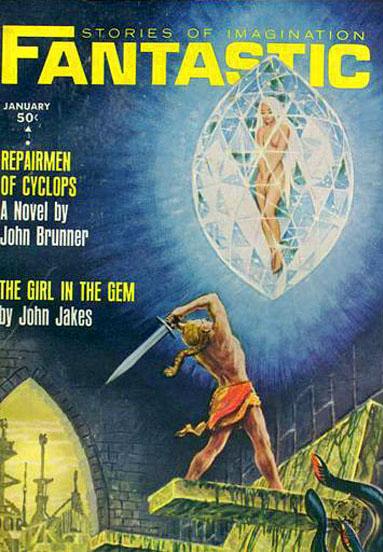
  •  "The Girl in the Gem" in Fantastic Stories of Imagination (Jan. 1965)
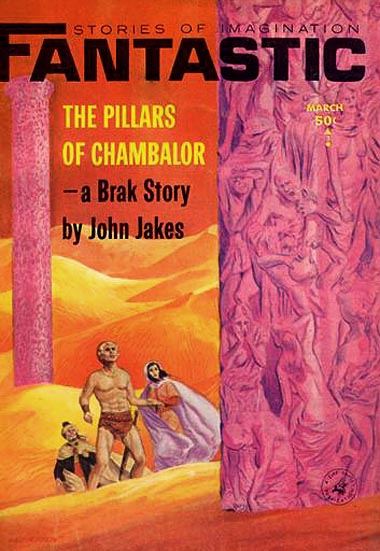
  •  "The Pillars of Chambalor" in Fantastic Stories of Imagination (Mar. 1965)
  •  "The Silk of Shaitan" in Fantastic Stories of Imagination (Apr. 1965)
  •  "The Mirror of Wizardry" in Worlds of Fantasy, Vol. 1, No. 1, (1968)
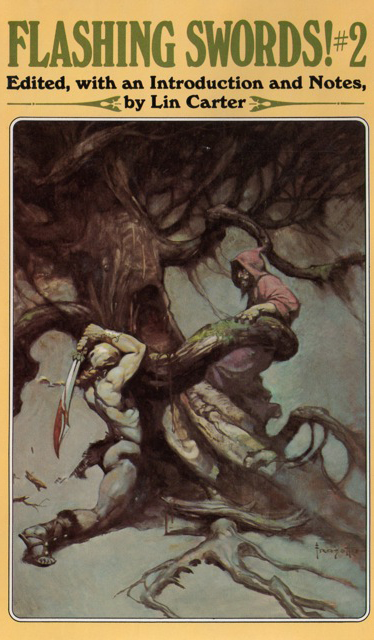
  •  "Ghoul’s Garden" in Flashing Swords! #2, edited by Lin Carter (1973)
  •  "Storm in a Bottle" in Flashing Swords! #4, edited by Lin Carter (1977)

Brak Books by John Jakes:
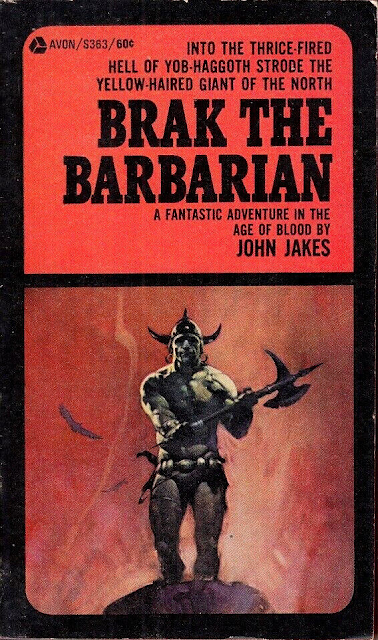
  • Brak the Barbarian (1968), collecting "The Unspeakable Shrine," "Flame Face," "The Courts of the Conjurer" (variant of "The Silk of Shaitan"), "Ghosts of Stone" (variant of "The Pillars of Chambalor"), and "The Barge of Souls"  
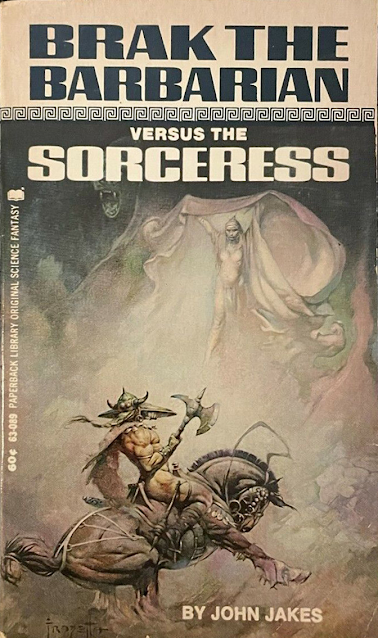
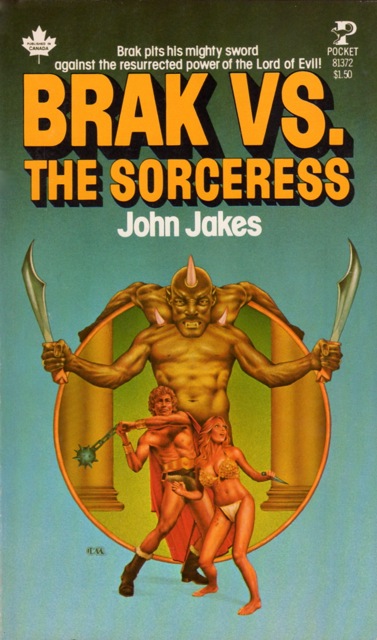
  • Brak the Barbarian Versus the Sorceress (1969), originally "Witch of the Four Winds"
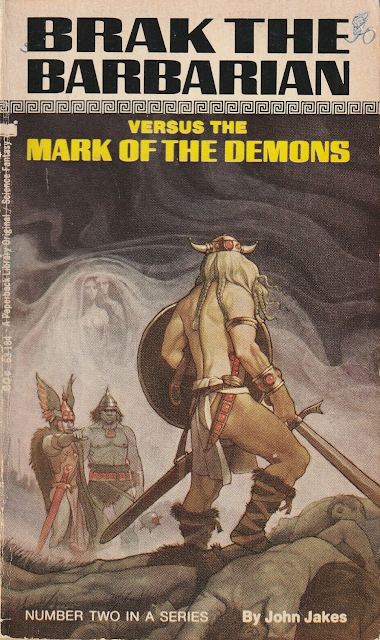
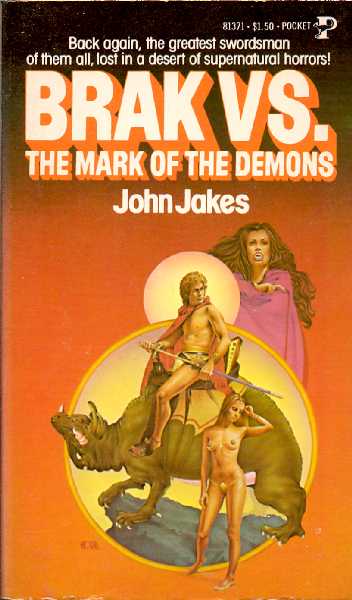
  • Brak the Barbarian Versus the Mark of the Demons (1970)
  • When the Idols Walked (1978), originally "When the Idols Walked"
  • The Fortunes of Brak (1980), collecting "Devils in the Walls," "Ghoul's Garden," "The Girl in the Gem," "Brak in Chains" (variant of "Storm in a Bottle"), and "The Mirror of Wizardry"
I have stopped before the current age of non-books called "books" began.

John Jakes was born in Chicago; graduated from DePauw University in Greencastle, Indiana, in 1953; earned his masters degree at Ohio State University; and worked as an advertising copywriter in Dayton, Ohio, before setting off in 1971 to become a full-time author. (His prefaces were dispatched from Kettering, Ohio.) He sold millions of books from the 1970s to the 1990s, and several of his historical novels were adapted to TV miniseries. He lived on Bird Key in Sarasota, Florida, and died in Sarasota on March 11, 2023. Today would have been his ninety-first birthday. We send condolences to his family, wish John Jakes a happy birthday, and say thank you to him for the reading pleasure he has given the world.

* * *

I wrote about John Jakes in my essay "They Should Have Been in Weird Tales," published in The Weird Tales Story, Expanded and Enhanced, edited by Robert Weinberg and Bob McLain (2021).
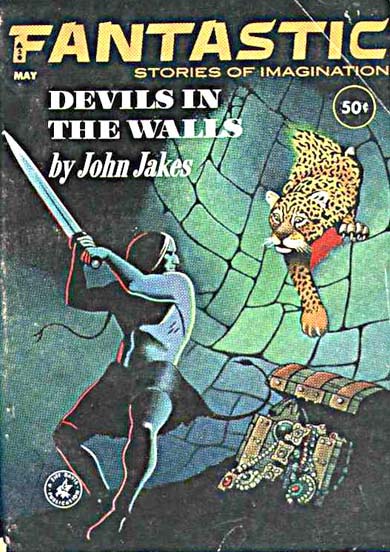
Fantastic Stories of Imagination, May 1963. Cover story: "Devils in the Walls" by John Jakes. Cover art by Vernon Kramer.

Fantastic Stories of Imagination, January 1965. Cover story: "The Girl in the Gem" by John Jakes. Cover art by Ed Emshwiller. Notice the tentacles in the lower right.

Fantastic Stories of Imagination, March 1965. Cover story: "The Pillars of Chambalor" by John Jakes. Cover art by Gray Morrow.

Brak the Barbarian (1968), with cover art by Frank Frazetta.

Brak the Barbarian Versus the Sorceress (1969), with arresting cover art by Frazetta.

Brak the Barbarian Versus the Mark of the Demons (1970), with cover art by Michael Leonard.

Brak vs. the Sorceress (1977), with cover art by Charles Moll.

Brak vs. the Mark of the Demons (1977), again with cover art by Mr. Moll.

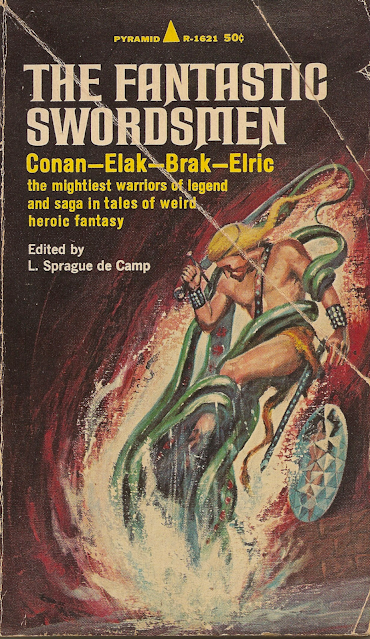
The Fantastic Swordsmen (1967) with a cover story "The Girl in the Gem" by John Jakes and cover art by his friend, Jack Gaughan. Again there are tentacles.

Flashing Swords #2 (1973), with cover art by Frazetta illustrating "Ghoul's Garden" by John Jakes.

Thanks to my correspondent for letting me know about the passing of John Jakes.
Original text copyright 2023 Terence E. Hanley

Saturday, January 8, 2022

Readings Over Christmas No. 1-Mention My Name in Atlantis by John Jakes

I read a lot last year. Book No. 51 was Mention My Name in Atlantis by John Jakes (Daw Books, 1972). Mr. Jakes' book is a kind of mock epic. The lead character and narrator is a Falstaffian figure called Hoptor the Vintner. His sometimes sidekick is Conax the Chimerical, king of a land of barbarians. Mention My Name in Atlantis is also a satire and a parody, including of the typical heroic fantasy hero and pulp writing in general. Here is an illustrative passage:

     "Pox on your map-makers!" screamed Conax. "Can I help it if those feeble-eyed fops are ignorant? I'd invite them to visit, but the thin-blooded villains would surely freeze their privates the minute they crossed the borders of my noble northern nation!"

     "He has florid rhetoric," observed General Pytho. "Rather like the purple phrasing of the tellers of adventure tales, who swap their narratives for a tenth of a zeb a word in the scroll mart." (p. 52)

The story is set in Atlantis and explains what happened to that now sunken continent. In addition to Atlantis, there are other Fortean subjects, namely ancient astronauts, alien abductions, and flying saucers, which are initially interpreted as omens of disaster. (Disaster comes.) All are made continuous with heroic fantasy, a development that seems sure to have irritated purists of both Forteana and Howardiana (if there is such a word). That seems fine to me.

The cover of Mention My Name in Atlantis is by H.J. Bruck (1921-1995), a German-born artist. Bruck included at least two Frazetta swipes in his composition:


Here are the originals:

Look closely. You'll find them. Look closer still and you may find more.

Original text copyright 2022 Terence E. Hanley

Sunday, March 30, 2014

True Detective and Robert W. Chambers

It isn't often that an obscure collection of stories from the nineteenth century draws the attention of twenty-first century television viewers, but such a thing has happened. The collection is The King in Yellow by Robert W. Chambers, from 1895. The television viewers are the people who watched the HBO series True Detective, which premiered on January 12, 2014, and ended its first run on March 9. I say "obscure," but fans of fantasy fiction and weird fiction are and have been well acquainted with The King in Yellow for a long, long time, since H.P. Lovecraft wrote about it in his seminal study, "Supernatural Horror in Literature" (1927), if not before. I regret to say that I haven't seen the show, but I would like to have a look.

The creator of True Detective is Nic Pizzolatto, a writer and teacher from New Orleans. I'm happy to say that Mr. Pizzolatto has a connection to my home state of Indiana, for he taught at DePauw University in Greencastle, only a few blocks away from where I used to live. DePauw also gave us John Jakes, creator of Brak the Barbarian and countless other genre characters.

Nic Pizzolatto seems to be pretty familiar with genre fiction himself. His TV show is named after a pulp magazine first published by Bernarr Macfadden in 1924--ninety years ago this year. He has drawn on The King in Yellow in his plotting and writing for his show, which is set in the author's native Louisiana, the same country haunted by the cult of Cthulhu in Lovecraft's "Call of Cthulhu." One of the characters in that story is--like Mr. Pizzolatto's protagonists--a Louisiana detective, John Raymond Lagrasse. Lovecraft's fictional grimoire, The Necronomicon, doesn't make an appearance in "The Call of Cthulhu," but Lovecraft may very well have based the idea of a book that drives men mad upon reading it on Robert W. Chambers' fictional drama "The King in Yellow." In any case, I wish Mr. Pizzolatto and the makers of his show further success.

Text copyright 2014, 2023 Terence E. Hanley

Monday, September 5, 2011

Weird Tales Books-The Fantastic Swordsmen

The Fantastic Swordsmen edited by L. Sprague de Camp

Heroic fantasy, a subgenre of Weird Tales' stock in trade, evolved during the late 19th and early 20th centuries, but its boom came after the deaths of pioneers such as Lord Dunsany, Robert E. Howard, and Clark Ashton Smith. (I'll use the terms heroic fantasy and sword and sorcery interchangeably here. Feel free to quibble.) Lin Carter played his part in that. Frank Frazetta may have played an even greater part. In any case, paperback fantasy filled the spinner rack during the 1960s and '70s. Not one to miss out on a good thing, Pyramid Books issued its own collection of heroic fantasy, The Fantastic Swordsmen, in 1967, edited by a practitioner of long standing, L. Sprague de Camp. The book includes nine tales, three printed therein for the first time, two originally printed in the pages of Weird Tales, and each introduced by de Camp's biographical and scholarly comments. Each story is also introduced with a map of the world in which it takes place, drawn by cover artist Jack Gaughan after L. Sprague de Camp. There is a Conan story here, and stories of his literary offspring, Elak of Atlantis and Brak the Barbarian. Michael Moorcock also weighs in with an early tale of his hero, Elric of Melniboné.

The Fantastic Swordsmen edited by L. Sprague de Camp
(Pyramid Books, 1967, 204 pages)
"Tellers of Tales" (Introduction) by L. Sprague de Camp
"Black Lotus" by Robert Bloch (Unusual Stories, 1935)
"The Fortress Unvanquishable Save for Sacnoth" by Lord Dunsany (The Sword of Welleran and Other Stories, 1908)
"Drums of Tombalku" by Robert E. Howard and L. Sprague de Camp (Original to this book)
"The Girl in the Gem" by John Jakes (Fantastic Stories of Imagination, Jan. 1965)
"Dragon Moon" by Henry Kuttner (Weird Tales, Jan. 1941)
"The Other Gods" by H.P. Lovecraft (Weird Tales, Oct. 1938)
"The Singing Citadel" by Michael Moorcock (Original to this book)
"The Tower" by Luigi de Pascalis (Translated from the Italian by L. Sprague de Camp and original to this book)

The Fantastic Swordsmen, edited by L. Sprague de Camp (1967). The cover by Jack Gaughan (1930-1985) illustrates John Jakes' contribution to the collection, "The Girl in the Gem." You can see her there in the background, imprisoned in a multifaceted blue oval. 

Text copyright 2011, 2023 Terence E. Hanley