Showing posts with label DAVID MURRAY. Show all posts

1 December 2018

DAVE BURRELL & DAVID MURRAY ‎– BROTHER TO BROTHER (GAZELL, 1993)


1. The Box - Dedicated To Diane
2. Icarus
3. Dancing With Monika
4. New Orleans Blues
5. Brother To Brother
6. What It Means To A Woman


Dave Burrell, piano
David Murray, tenor saxophone, bass clarinet

Gazell ‎– GJCD 4006

LP Rip


2 March 2016

TORINO JAZZ FESTIVAL 2015 David Murray & Lydian Sound Orchestra - Omaggio a Duke Ellington e Billy Strayhorn recorded at Teatro Carignano, Torino, Italy, on monday 1 June 2015 FLAC FM


David Murray, tenor saxophone
- Lydian Sound Orchestra, conducted and arranged by Riccardo Brazzale
Robert Bonisolo, soprano and tenor saxophones
Mattia Cigalini, alto saxophone
Rossano Emili, baritone sax and clarinets
Gianluca Carollo, trumpet and flugelhorn
Roberto Rossi, trombone
Dario Duso, tuba
Paolo Birro, pianoforte
Marc Abrams, bass
Mauro Beggio, drums

this would be better credited the other way round, meaning Lydian Sound Orchestra WITH David Murray, but that is how got officially billed, so... it is anyhow saxophone giant Murray paying tribute to the Duke Ellington & Billy Strayhorn partnership, and it's somehow predictable and occasionally brilliant... arrangements are more or less divided among Murray and orchestra leader Brazzale, and one track dedicated to deceased Marco Tamburini was also included in this programme.  Also included in this folder as track00 a LONG introduction in ITALIAN with bio notes and commentaries - this intro runs for 10'42, you can skip downloading it if you don't understand italian.

(00-radio introduction by Pino Saulo)
01- the Mooche
02- Caravan
03- Sophisticated Lady
04- band intros
05- un Capanno di Montagna in Mezzo al Mare [Riccardo Brazzale]
06- Murray's entrance
07- Chelsea Bridge  [arranged by David Murray]
08- Wig Wise  [arranged by David Murray]
09- Mood Indigo
10- intros
11- Take the A Train  [arranged by Roberto Rossi]
12- Half the Fun
13- Circle of Fourths
14- intros
15- the Star Crossed Lovers
16- Blue Pepper  [arranged by David Murray]
17- In a Mellow Tone
18- radio outro

running time : 99'40" (excluding radio intros)
WITH radio intro and outro it would be 111'08"


FM radio broadcast by "Il Cartellone - Radio Tre Suite Jazz", Radio 3 RAI [third channell of Italian national radio], on tuesday 16 February 2016, 20:35 hours [CET].

1 November 2015

WILLIAM HOOKER ‎– ... IS ETERNAL LIFE (REALITY UNIT CONCEPTS, 1977)


A.  Drum Form (Wings / Prophet Of Dogon / Still Water / Desert Plant / Tune)

B.  Soy: Material / Seven

C.  Passages (Anthill)

D1. Pieces I & II
D2. Above And Beyond


William Hooker, drums, percussion, vocals
Mark Miller, bass (B)
David Murray, tenor saxophone (B)
David S Ware, tenor saxophone (C)
Hasaan Dawkins, alto saxophone, flute, percussion (D1)
Les Goodson, tenor saxophone, flute, percussion (D1)


Recorded at Columbia University, NYC, on 29 May 1975 (A); at the Cubiculo, NYC, on 4 May 1975; at the Langston Hughes Library, Corona, NY, on 5 February 1976 (C);  at the Columbia Branch, New York City Library, on 20 May 1976 (D1) and at WHNB-TV, West Hartford, CT, on 19 November 1976 (D2)

Reality Unit Concepts ‎– RUC 444

LP Rip


6 March 2014

David Murray's -Live at Peace Church, Revisited,.an appeal to Collectors,(and a few Recollections by Dan Serro, its producer)


Recently, in email Conversations with Dan Serro former Kharma label boss and also  producer of David Murray's wonderfully vivid, viscerally exiting, live at the Peace Church, released in 1991, he shared some recollections about the circumstances relating to its creation,
which with his permission i'd like to relay here in edited form...

Before i do that i'll state that i also want to unashamedly ,advertise the fact that D.Serro ,is interested in releasing a couple of very worthwhile projects,on lp, including a duo from the 70's by Byard Lancaster and Yusef Yancy..
a costly exercise that requires a lot of money... i told Dan that we have no hesitation , advertising the fact that he has new Sealed copies of Live at peace church for sale for twenty dollars U.S , about half the price that second hand copies sell for.
My appeal is to Vinyl Aficionados, who might want to buy or are considering buying peace church , to do so directly from Dan Serro, in the knowledge that  you will be helping fund further releases.

i asked Him about the circumstances of its recording and release, saying i felt it was the most vivid aural document he had produced!
here are a few ruminations by him

"It was something that happened by accident.   I had just gotten my recording equipment and a friend told me that i should record this concert at the Peace Church.  I did not know who David was at the time.
 He had just come from California and was new on the scene.   I asked if the musicians would mind and was told no. So i got a truck and took the equipment to the Church and set up.   Just 4 mikes and a small mixer with 4 inputs.
 Many years later i played the tape for a Japanese  custmer who had come in from Japan and was at my place buying records.
 By then David was famous and had a lot of records out.  the guy was a big Murray fan and he wanted me to put out the record.
 I had ran out of money for the records i had pt out on Kharma and told him and he said he would go partners with me on it.
 I contacted David and we made a deal (expensive) and then after paying David and the others i contacted the guy in Japan.
 The Japanese had just had a big stock market loss and he said he couldn't come up with the money.
 Since i had already paid David i could do nothing else but put the record out.
 Limited by contract to 1500 copies.
I agree that it is the best job of recording i ever did....    Don't know if maybe it was the Church that helped or just the way i had miked them but it came out fantastic.

Things happen in strange ways sometimes.   Like the Burton Greene record.   Keshavan was not supposed to be on that record.
He got up on stage while i was recording and i was afraid i would not have enough to put the record out.
It was supposed to be a solo piano record.It is my second favorite record of all of the ones i put out."
Dan Serro

Again,Please consider buying a copy directly from Dan , who is a nice , approachable Man, in the knowledge that you will be helping fund worthwhile projects.
he can be contacted at.
Danola@aol.com


--------------------------------------------------------------------
PS ... hope my confreres here don't mind if this stays at the top of the page for awhile...
We don't go in for paid advertising here on this blog , nor do we use spurious disclaimers about our shares or ask for donations for ourselves  ...,.i'd like to state categorically that neither i or anyone else here is being paid in cash or kind for this !

16 January 2014

SYNTHESIS - 'SENTIMENTS'


ARTHUR BLYTHE, alto sax and percussion
OLU DARA, trumpet and piano
DAVID MURRAY, tenor sax and percussion
KEN HUTSON, bass
RAHSAAN, drums and telephone bells

1. Back from where you came  8:44
2. Flowers for Albert  10:17
3. Sentiments for the New World patriots  9:12
4. A woman is such a lovely being  1:53
5. Sentiments for the African patriots  7:44

Compositions by SYNTHESIS except 'Flowers for Albert' by David Murray

Rec NYC 1976   RA Records RA/101  LP

Arthur Blythe needs our help

4 January 2014

David Murray - Sunny Murray-Muenster,1986, AUD, (in memoriam, glmlr)


In Memoriam, Graham Rogers, aka glmlr- 1948-2013
a Friend and occasional contributor here , avid/rabid, music aficionado,who died of a heart attack in his home in Athens, dec 21st, he raved frequently about Sunny Murray's sizzle cymbal , and loved David Murray also.... R.I.P (whatever that means stripped of all religious context)

This is a great audience recording , one i often return to............He particularly liked it too.


Many thanks to whoever recorded this
---------------------------------------------------------------------------
Seeder/Taper's original notes

David Murray - Sunny Murray Duo, 1986.02.18, Muenster (Germany)

Rheinisches Landesmuseum-Münster, Germany,18. February 1986

David Murray - Sunny Murray Duo

David Murray - ts,bcl
Sunny Murray - dr


1. - 10:40
2. Patricia - 6:49
3. - 12:16
4. Duet - 9:03
5. Hope Scope - 10:09
6. - 7:54
7. Medley incl. Gosts 20:38
8. Let The Music Take You - 8:17
9. Naima 5:35

Enjoy!!


23 April 2013

DAVID MURRAY QT. Bristol 1992


DAVID MURRAY QT

David Murray, ts, bcl
Dave Burrell, p
Tony Overwater, b
Idris Muhammed, d

Nana Vasconcelos, perc (track 6 only)

1. Hope scope  10:45
2. Ballad for the black man  13:38
3. The gates of Hell  14:32
4. Daybreak  15:18
5. Waltz to Heaven  7:40
6. Calle Estrella  9:25
7. Brian Morton interviews David Murray  14:06

Bristol Cathedral.  1992

BBC Radio 3 b'cast

21 April 2013

David Murray-Quintet Unkown Venue NYC,13-Oct 1976,AUD


Here's a great gig , of David Murray  with Bluiett's Quartet, or Visa Versa, the lineup is similar to Endangered Species, with Dara and Wilson again in fine form , yeah an excitingly exploratory show!
thanks to the Dime sharer JackMw for this one!
Exceptional music , despite the tape being Rough around the Edges!
if others want to help out with mirrors please do! i'll try not to use Mega in future.


David Murray Quintet
Unknown venue
New York, NY
October 13, 1976

David Murray ts
Hamiett Bluiett bs
Olu Dara crnt
Fred Hopkins b
Philip Wilson d

Source: Stereo audience tape > ? > CD > EAC v. 1.0 beta 2 (extraction and FLAC encoding) > FLAC compression level 8

Disc one
d1t01 [0:22:35.56]
d1t02 [0:26:29.27]
d1t03 [0:10:52.27]
Total time: 0:59:57.35

Disc two
d2t01 [0:23:23.06]
d2t02 [0:08:01.70]
Total time: 0:31:25.01

8 April 2012

JAMES NEWTON & DAVID MURRAY "SOLOMON'S SON" (CIRCLE, 1977)


Inamorata has provided us with another treasure - but let's 'hear' it in his own words:


James Newton & David Murray: Solomon's Sons (Circle Records, 1977)

Here we go with the second installment of The Complete James Newton on Circle Records. A discography of Newton's Circle recordings will follow in the last installment.


James Newton & David Murray: Solomon's Sons
Circle Records RK 16177/5

Dedicated to Martin Luther King

James Newton, flute
David Murray, alto & tenor sax

A1. Monk's Notice (James Newton)
A2. The Dean (James Newton) DM out
B1. Theme for the Kidd (David Murray)
B2. 3D Family (David Murray) JN out
B3. Solomon's Sons (James Newton)

Recorded live January 16, 1977 at the Smudge Pot, Claremont, CA by Bruce Bidlack.
Produced by Rudolf Kreis

Circle Records RK 16177/5


One further flute solo track from the same concert, Bobby Bradford's "Woman", is included on "Flutes!" (Circle Records RK 7677/7). This show is remarkable as one of the rare (if not the only) officially documented occasions of David Murray playing the alto sax.
This LP was posted before by Wallofsound on Inconstant Sol (http://inconstantsol.blogspot.com/2007/12/james-newton-and-david-murray-solomons.html), with a very interesting description (also see his remarkable posts on DM at http://wallofsound.wordpress.com/category/david-murray/). The flac links are dead; the mp3 links are still active but the files suffer from considerable digital clipping so this is clearly an upgrade.
As with the Flutes! LP, the transfer was de-rumbled and de-clicked but otherwise unchanged. For audio restoration I use the software written by Brian Davies at www.clickrepair.net which I cannot praise highly enough. However, just as any sharp tool, this has to be used with great care in order to avoid damage.

.

30 March 2012

David Murray/James Blood Ulmer & The Blues Orchestra - Live in Milan '12


A concert (World première) that Murray has significantly titled:
"Blood Singin' and Stompin' The Blues".

Rec. live at "Teatro Manzoni", Milan, Italy, on January 29, 2012
(mics recording)

David Murray,tenor sax,conductor,arrangements
James Blood Ulmer,electric guitar & voice
Ravi Best/Shareef Clayton/Mario Hernàndez Morejòn,trumpets
Mark Williams/Terry Greene II/Denis Cuni Rodriguez,trombones
Lakecia Benjamin/Tony Kofi,alto saxes
Jay Rodriguez/Irving Acao,tenor saxes
Alex Harding,baritone sax
Mingus Murray,electric guitar
Llorenc Barcelò,Hammond B3
Steve Colson,piano
Jaribu Shahid,double-bass & electric bass
Chris Beck,drums

1. David intro (04:34)
2. Spreadsology [D.Murray] (11:42)
3. Backwater Blues [B.Smith] (13:47)
4. Let's Talk About Jesus [J.B.Ulmer] (10:03)
5. Grinnin' In Your Face [E.J.House Jr.] (13:52)
6. Love Like Them [C.West] (13:02)
7. Interview Suite [J.B.Ulmer/D.Murray] (18:07)
8. Sittin' On Top Of The World [W.Vinson/L.Chatmon] (12:26)
9. Dead Presidents (encore) [W.Dixon/W.R.Emerson] (09:17)

Total Time 1:46:53

excerpt from Sittin' On Top Of The World

26 July 2011

David Murray Cuban Ensemble - Live in Verona '11


David Murray with a Cuban Ensemble plays the music that Nat King
Cole recorded "en español" at the end of the Fifties. Fanciful.

Rec. live at "Teatro Romano", Verona, Italy, on July 1st,
2011 (mics recording)

David Murray,tenor sax,conductor
Ariel Bringuez Ruiz,tenor sax
Roman Filiu Oreilly,alto sax
Mario Morejon,trumpet
Denis Cuni Rodriguez,trombone
Josè "Pepe" Rivero,piano
Reiner Elizarde Ruano,bass
Georvis Pico Milan,drums

1. El Bodeguero [R.Egües](15:02)
2. Tres Palabras [O.Farrés](19:30]
3. Black Nat [D.Murray](10:32)
4. Quizas, Quizas, Quizas [O.Farrés](14:18)
5. No Me Platiques [V.Garrido](16:55)
6. Piel Canela [B.Capó](11:20)

Total Time 1:27:30

Black Nat

5 January 2011

World Sax Quartet & Max Roach - Live in Rome '81

Recorded about four months after the "historic" meeting :
M’Boom and World Saxophone Quartet at The Cathedral
of St. John the Divine, N.Y.C., June 26, 1981.

Rec. live at "Teatro dell'Opera", Rome, Italy, on October 28,
1981 (mics recording)

Hamiet Bluiett,baritone sax,clarinet (-09)
Julius Hemphill,alto & soprano sax (-09)
Oliver Lake,alto sax (-09)
David Murray,tenor sax,bass clarinet (-09)
+
Max Roach,drums (09-14)

01. Sundance [H.Bluiett] (01:39)
02. Plainsong [J.Hemphill] (06:42)
03. Revue [J.Hemphill] (14:13)
04. Bordertown [J.Hemphill] (08:07)
05. My First Winter [J.Hemphill] (08:31)
06. Hymn For The Old Year [O.Lake] (07:22)
07. Stick [J.Hemphill] (10:20)
08. Ming [D.Murray] (07:43)
09. Max Solo [M.Roach] (20:14)
10. Hattie Wall [H.Bluiett] (03:55)
11. Funny Paper [J.Hemphill] (04:16)
12. Touchic [J.Hemphill] (05:08)
13. I Heard That [H.Bluiett] (04:35)
14. Fast Life [D.Murray] (03:44)

Total Time 1:46:34

31 December 2010

Sunny Murray Quartet - Live in Moers '79


The full version of a concert already published by Moers Music
and now OOP (i think). Two tracks and about 24 more minutes.

Rec. live at "The 8th Moers Festival", Moers, Germany,
on June 3, 1979 (mics recording)

David Murray,tenor sax,bass clarinet
Malachi Favors,bass,percussion
Sunny Murray,drums
Cheikh Tidiane Fall,congas

1. Unknown (10:06)
2. Tree Tops (08:00)
3. Happiness Tears (16:12)
4. Sweet Lovely (11:43)
5. German Dilemma (17:19)
6. Unknown Encore (07:22)

Total Time 1:10:45

30 May 2010

Sunny Murray Trio - Live in Alassio '79


An extemporary trio, even if in those years, the collaboration between
the two Murray was rather frequent.
Maybe Wallofsound (the greatest living authority about D.Murray)
can give an help for naming the unknown tracks.

Rec. live in Alassio, Italy, on September 9, 1979
(mics recording)

David Murray,tenor sax
Wilbur Morris,bass
Sunny Murray,drums

1. German Dilemma (22:13)
2. Unknown (12:46)
3. Unknown (07:08)
4. Unknown (11:28)
5. Sweet Lovely (07:35)

Total Time 1:01:12

23 February 2009

Dave Burrell and David Murray Daybreak


Dave Burrell and David Murray Daybreak
Gazell GJCD 4002

1. Daybreak (Dave Burrell) 12:03
2. Sketch #1 (David Murray) 9:49
3. Blue Hour (Dave Burrell) 13:45
4. Qasbah Rendezvous (Dave Burrell) 8:21

Recorded March 30th 1989 at Morning Star Studio, Springhouse, PA, USA
Produced by Sam Charters

Dave Burrell (p)
David Murray (ts, bcl)

I always think that Dave And David are an unlikely pairing. Burrell’s piano playing is angular and spiky, and he likes abstraction and high-end trills; while Murray’s sax and clarinet style is full-throttle gospel-soaked emotion with a strong attachment to melody. But they are both rooted in the tradition of black jazz. This record features a great collection of duets, and reveals a long-term partnership in which they developed a love for each other’s playing, and a distinctive approach to the music which allows each personality to prosper in the company of the other.

They actually recorded over 14 LPs together, including the other duo performances on Brother to Brother, Windward Passages, and In Concert, and the classic DIW quartet recordings Spirituals, Deep River, Lovers, and Ballads. I think they play notably differently together, than when compared with their performances apart. I think they play notably differently together, than when compared with their performances apart.

I think this is something to do with that respect and interest in the jazz tradition. While this record is far from the sorts of investigation of earlier styles of jazz that both musicians had explored, it is deeply rooted in the emotional practices of those traditions. Murray’s sax seems to soar above Burrell’s piano, to reach ecstatic heights. Once you know that Burrell has a fascination with the music of Jelly Roll Morton and James P. Johnson, and the early influences of blues and gospel on jazz you can hear it in his playing, and you can start to understand why he makes such a satisfactory foil for Murray’s gospel-free-swing style. Burrell’s a much more expansive player than Murray, and as Murray takes the emotive line it allows Burrell to be more acerbic.

It’s Dave Burrell’s composing skills that dominate here, and he produces some lovely themes for the recording date which ebb and flow in the performances. Murray seems much more at home once the playing settles into some form of organisation, but he’s more than happy to match the piano player’s complex lines in duals like the one that opens 'Blue Hour'.

This album features Murray’s most ‘out’ playing of the 1980s, and it is interesting to note that he recorded this at the same time as Ming’s Samba for Columbia, and while he was releasing music for Bob Thiele’s Red Barron; all of the latter tended to the mainstream of the ‘jazz revival’ of the late 80s and early 90s. The production credits go to Sam Charters, who discogs.com suggests is jazz and blues historian Samuel B. Charters. This is probably correct because (if my memory serves me correctly) in the 1990s Gazell, while originally a Scandinavian label, was owned by Sonet (which was previously owned by Charters).

25 January 2009

David Murray Big Band feat. James Newton plays 'The Obscure Works of Duke Ellington & Billy Strayhorn'

David Murray Big Band featuring James Newton plays 'The Obscure Works of Duke Ellington & Billy Strayhorn'
Jazzfest ñ Haus der Kulturen der Welt, November 7th 1998.

African Flower 19:03
Such Sweet Thunder 7:53
Chelsea Bridge 7:36
Love You Madly 7:51
Bloodcount 6:18
Wig Wise 11:11
Praise God 4:21
Warm Valley 12:10
Blue Pepper (Far East Of The Blues) 6:02

Carmen Bradford (vocals)
David Murray (tenor sax, bass clarinet, conductor)
Ricky Ford (tenor sax)
James Newton (flute, conductor)
James Spaulding (alto sax, flute)
John Purcell (saxello, clarinet)
Pablo Calogero (baritone sax)
Craig Harris (trombone)
Frank Lacy (trombone)
Gary Valente (trombone)
Ravi Best (trumpet)
Hugh Ragin (trumpet)
DD Jackson (piano)
Jeff Chambers (bass)
Andrew Cyrille (drums)
Klod Kiavue (percussion)

"James Newton and myself are interested in bringing to light some of Ellington's obscure extended works, while at the same time realizing Billy Strayhorn's influence on Ellington and unveiling the uniqueness of their collaboration" David Murray (http://www.festwochen.de/jazzfest/2002/archiv/jazzfest98.html)

I am in debt to LYM for a copy of the recording.

The first indication of Murray's interest in Ellington in the former's recordings came when Come Sunday appeared on one of the the saxophonist's solo albums, Conceptual Saxophone, in 1978. Given Murray's gospel background the choice may have been connected to the opportunity that the theme gave to Murray to explore his interest in the ecstatic.

There are, though, indications that Murray's interest in Ellington preceded this recording, and goes someway back into Murray's musical origins. Murray grew up in California, and studied on Stanley Crouch’s Black Studies programme at Pomono College and, according to Brian Case's sleeve notes to Conceptual Saxophone, Murray originally came to New York on a research trip for a thesis on Jazz saxophone. According to an interview in the Washington Post with Hollie I West he says specifically the paper was on changes in Saxophone playing since 1959. Case’s sleeve notes also cite Murray’s interest in Paul Gonsalves – Ellington’s long time tenor player – as an influence, and Gonsalves would certainly have been one of the key players in influencing post-1959 players. Many of Murray's later works signaled an interest in Gonsalves, Murray even gave a composition on his 1991 big band recording the title 'Paul Gonsalves'.

Murray went on to record 13 Ellington and seven Billy Strayhorn compositions with his own bands or the WSQ, and many more pieces from the Ellington band book. 'In A Sentimental Mood' gets four outings with different bands. Gary Giddins has suggested other Gonsalves-inspired thinking beyond the debt in muscular tone, when he notes that Murray's solo on Ellington's 'Take the Coltrane' is 27 choruses long, the same length as Gonsalves' solo insertion in the famous Newport performance of 'Diminuendo and Cresendo in Blue'.

Murray also seems to owe a debt to Ellington in his bag band work. Although large ensembles had been a key feature of the California new jazz scene in the early 1970s, and many of Murray's earliest New York appearances were in large bands, his big band recordings always seem (to me at least) to have much of the majesty of Ellington's classic performances.

In this context it's not surprising that Murray would get round to a detailed investigation of the Ellington oeuvre. And this is it: 'The Obscure Works of Duke Ellington & Billy Strayhorn'

I'm not sure why Murray titled the whole performance 'The Obscure Works' because most of the compositions will be well known to Ellington fans, and a number have standard status. This project has clearly been in development for some time, and Murray used the basic idea many times. Giddins refers to a performance of the project in 1997 in Paris with big band plus string orchestra. He also suggested that the concert was recorded, edited and released in 1998, but I haven't been able to track down a copy, let alone another mention of the record. Giddins doesn't give a recording label, like he does for every record release in the book, so I'm even less sure how to find it (if it exists). There is clearly a recording, though because Giddins discusses it over several pages of the book. The band and set seem to be very similar as this one.

The project had several performances including:

Paris 1997
Carmen Bradford (vocals)
David Murray (tenor sax, bass clarinet, conductor)
Ricky Ford (tenor sax)
Hamiet Bluiett (sax)
Arthur Blythe (sax)
James Newton (flute, conductor)
James Spaulding (alto sax, flute)
John Purcell (saxello, clarinet)
Charles Ownes (sax)
Craig Harris (trombone)
George Lewis (trombone)
Ray Anderson (trombone)
Bobby Bradford (trumpet)
DD Jackson (piano)
Art Davis (bass)
Andrew Cyrille (drums)


JazzFest Berlin 98, Saturday 7th November 10:30 pm Auditorium
Carmen Bradford (vocals)
David Murray (tenor sax, bass clarinet, conductor)
Ricky Ford (tenor sax)
James Newton (flute, conductor)
James Spaulding (alto sax, flute)
John Purcell (saxello, clarinet)
Pablo Calogero (baritone sax)
Craig Harris (trombone)
Joe Bowie (trombone)
Gary Valente (trombone)
Bobby Bradford (trumpet)
Ravi Best (trumpet)
Hugh Ragin (trumpet)
DD Jackson (piano)
Art Davis (bass)
Andrew Cyrille (drums)
Klod Kiavue (percussion)


Brecon Jazz Festival, August 1999
Hugh Ragin
Rassul Siddik,
Nathan Breedlove (t)
Craig Harris
Gary Valente
Joe Bowie (tb)
James Newton
John Purcell
James Spaulding
Ricky Ford
Hammiet Bluiett (rds)
Hilton Ruiz (p)
Jaribu
Shahid (b)
Andrew Cyrille (d)
Klod Kiavue (perc)
Carmen Bradford (vo)

A scaled down version of this group played the North Sea Jazz Festival in July 1999 consisting of Murray with, Ragin, Harris, Newton, Purcell, Bluiett, Ruiz, Shahid and Cyrille and possibly one other (http://johnjazz.homestead.com/davidmurray.html).

I would be very interested to find out any further information, hear other performances of the project, and track down a copy of the record Giddins mentions.

5 December 2008

David Murray Milford Graves Real Deal     


David Murray & Milford Graves: Real Deal         
DIW 867

David Murray (tenor saxophone on 1, 2, 3, 5, and 8, bass clarinet on 4 and 7),
Milford Graves (drums and percussion)

1. Stated With Peace (David Murray) 7:50
2. The Third Day (David Murray) 8:50
3. Luxor (David Murray) 8:29
4. Under & Over (Milford Graves) 6:03
5. Moving About (Milford Graves) 11:08
6. Ultimate High Priest (Milford Graves) 6:27
7. Essential Soul (Milford Graves) 10:49
8. Continuity (David Murray) 4:10

Recorded November 3, 1991, at Power Station, NYC

This album came 11 records into Murray's tenure with DIW records and, as would be suggested by a duo performance with Milford Graves, it probably has more in common with Murray's earlier performances than with his other work of that time. During most of October and early 1991 Murray seemed to have been locked in the Power Station recording studio in New York City, and with nothing else to do he embarked on a mammoth recording session with a wide array of different musicians. This duo performance was the last of a run that included a quartet with James Blood Ulmer, Murray's then concert quartet with Bradford Marsalis added on two tracks, and a beautiful quartet/quintet recording with some of his earlier collaborators including Bobby Bradford, Dave Burrell, and Fred Hopkins.

'Moving About' is perhaps the most imaginative and satisfactory of the tracks as a collaboration. While elsewhere the sax and drums sometimes sound like they a running on parallel lines, here the drum textures seem to offer Murray something to work with, and his playing is ecstatic but rooted. Nevertheless my favourite track is 'Essential Soul'. Perhaps because I favour Murray over Graves, and I always feel that this period is the strongest for Murray's Bass Clarinet playing. Here Murray's playing might be more independent, but Graves is more restrained, and he follows Murray's lead even though this is the percussionist's composition. I just adore Murray's exposition. Others may find it meandering, and it doesn't seem to have any sense of direction, or any musical resolution; it's just one of those beautiful Murray journeys. I don't really care where it is going. 'Under & Over' is almost jolly, and there is some real interaction as Murray takes a much more percussive role on Bass Clarinet, and produces some of his best squeals and squarks, in a uncanny copy of his tenor saxophone playing. This was a real instrumental master at work. Luxor investigates the tumultuous side of Murray, and 'The Third Day' is almost middle eastern to my untrained ear, with lots of busy traps playing from Graves.

Graves is venerated as much, I feel, because his recordings are a rare commodity, and yet he is striking even amongst free drummers. He certainly became enamored of complex timbres and his playing is often more musical than rhythmic in the jazz swing sense. In the New York Art Quartet started out as a conventional traps drummer in a strong and idealist group, joining Albert Ayler for Holy Ghost and Love Cry (where he seems toitally dominated), he then appeared intermittently on disk with a range of his own groups and in small scale settings. I do love his work on Nommo with Don Pullen, in a combination of jangle and cavernous percussion with dark piano clusters that shouldn't work, but does. This is real textual stuff, in which who is the percussionist and who the melodist seems a stupid question. I would be interested to find out who had the idea of pairing him with Murray. It isn't that there wasn't a precedent. Murray seemed to like percussive percussionists, and had played with Sunny Murray, Philip Wilson, and Andrew Cyrille within three years of arriving in New York. he then went on to work with some of the best drummers in jazz, followed by experiments with Kahil El'Zabar from the late 1980s into the 1990s. later Murray would explore a whole wider world of percussion in collaborations with African and Caribbean percussionists.

Although it is possible to still buy a new copy of this recording for as little as $18, and a second hand one for as much as $80, it does seem to be out of print. I don't hold this in the top pile of Murray work, but for those willing to spend a little time acclimatising, and especially if they are willing to suspend their belief that music has to have a purpose beyond the moment, this is exactly the real deal.

1 December 2008

Wilber Morris / David Murray / Dennis Charles: Wilber Force


Wilber Morris / David Murray / Dennis Charles: Wilber Force     
DIW 809

Wilber Morris (b)
David Murray (ts 1-4 6,bcl 5)
Dennis Charles (d)

1. Randy (Wilver Morris) 12:55
2. P.C.O.P. #1 (Wilver Morris) 10:00
3. Miss Mack (Wilver Morris) 9:05
4. West Indian Folk Song (Dennis Charles) 8:40
5. Afro-Amer. Ind (Wilver Morris) 10:20
6. P.C.O.P. #2 (Wilver Morris) 11:35  

Recorded live at February 6, 1983 at Kwame, NYC

This seems to be the second recording for Wilber Morris’ sometime bass-drums-sax trio. This one features the young (but long-time Morris associate) David Murray, and recent partner in rhythm (but fixture of the New York scene) Dennis Charles. Morris and Murray were both part of the tide of West Coast musicians setting up in New York in the mid 1970s to play in the loft scene, while Charles had been the powerhouse behind some of the key experimental musicians of New York’s avant guard since the early 1950s.

I bought this as part of my obsessive David Murray collecting, but it is now far from a completists addition. The bassist is clearly the leader here, composing all the themes with short names ( West Indian Folk Song is Charles’), and giving all the numbers their drive and shape. Murray is particularly effective in a trio, and the Morris themes seem to push him to some very different performances. Although I tend to think Murray can do no wrong, even I’d have to admit that he hardly ever subsumes himself into the setting he finds himself. In ‘Afro-Amer.Ind’, though, features his plaintive bass clarinet weaving through Morris’ bass figures and Charles’ choppy cymbal work. A bass and vocal chant leads to a long Murray solo, subsides into a bass solo with a intermittent gentle tap and brushed backing from Charles, before Murray and Charles burst back in stretch to the end. Meditative is probably the adjective. By contrast Charles’ jolly theme suits Murray well, and brings out a strong tight drums and bass performance.

‘Miss Mack’ is more subdued sax and Charles’ lovely drum textures. This one repays repeated listening. It’s remarkable how much is going on amongst the three musicians. The longest track, ‘Randy’, has one of those quirky rhythm-melody themes, and some constant changes of pace driven by bass and drum with Murray holding on for dear life! He does get to squeal a little here, though. there are two ‘PCOP’s, though I’m not clear what they are. A lovely theme set out by sax and bass with cracking physical playing from Charles. There’s a lot of unfocused meandering, but journey’s don’t have to be purposeful if there’s lots to hear on the way, and here the textures are just wonderful. This really is music for the moment that allows you to forget where you’ve come from, and care little about where your heading.

As far as I am aware this was the first time Murray was on a DIW recording, and a decade later this was going to be his main channel for releases. There’s a pattern in Murray’s history where he records as a sideman for a project and seems to establish a relationship that blossoms into a recording contract later on. This was also a bit of a return to small group recordings after septet and octet experiments (usually featuring Morris and his younger brother, Butch) interspersed with quartet recordings.

Although this had a CD release, it wasn't widely available outside Japan, and it doesn't seem to be currently available. Along with Collective Improvisations (featuring Denis Charles and saxophonist Charles Tyler for Bleu Regard in 1981) this is an enjoyable record in its own terms, and a key point in Murray’s career that isn’t that well known.

2 November 2008

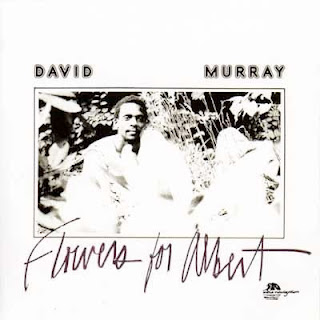
David Murray Flowers For Albert


David Murray Flowers For Albert

India Navigation IN 1026
Recorded live on June 26 1976 at Ladies’ Fort, NYC

David Murray (ts)
Olu Dara (tp)
Fred Hopkins (b)
Phillip Wilson (d)

CD1
1. Flowers For Albert (Murray) (14:18)
2. Santa Barbara and Crenshaw Follies (Murray) (15:53)*
3. Joanne’s Satin Green Dress (Lawrence “Butch” Morris) (12:56)
4. After All This (Murray) (13:59)*

CD2
1. Roscoe (Murray) (9:05)
2. The Hill (Murray) (17:55)*
3. Ballad For A Decomposed Beauty (Murray) (9:18)

* not on original LP.

My second new contribution to the India Navigation fest taking place at http://indianavigation.blogspot.com is David Murray's debut solo release. The original record was made up of parts of a live concert by his then quartet in one of New York’s famous 70s Jazz lofts, the Ladies’ Fort.

I'd been totally immersed in Murray's 1980 work before I tracked a copy of this earlier recording down, and I can still remember being completely thrown. It is quite remarkable how mature all aspect of the record are: his compositions are some of the most notable of the 1970s; his playing is superb; and the group with then regular collaborators Dara, Hopkins and Wilson is one of the best of this period of jazz for my money. There's a small, but very enthusiastic audience, and I try to visualise while listening what it must have been like to sit in a large post-industrial New York space and hear this music for the first time. It still makes the hairs on the back of my neck bristle today; how it must have felt to be there watching as well as listening I can only imagine.

The recording is significant for its music, its place in jazz history, and the way it has been used to interpret Murray. Here's a few thoughts on all that:

There are ten versions of ‘Flowers for Albert’ to be listened to on Murray recordings. This was the first time it was recorded. Most bibliographies note that the title track is named after Albert Ayler, and then infer this as evidence that Murray is an Ayler disciple. The fact that Murray played some of his first New York gigs with his near namesake drummer Sunny Murray – who had been the powerhouse of Ayler’s 1964-5 recordings that included the mighty Spiritual Unity – must have made Murray very aware of Ayler. There are also some undoubted comparisons to be made. The obvious one, most often made, is that both men manipulate the saxophone in a manner that pushes it outside its ‘normal’ musical uses. Murray clearly shares Ayler’s early interest in pushing the mechanics of the instrument to do things few other players realised, or even imagined. Less often noted is the strong roots in, and exploration of, gospel music. Or more specifically the aspects of gospel that relate to the emotional power and ecstatic nature of gospel within African American music.

However, there are far more interesting things at play here. As the title suggests, and as Murray has confirmed in interviews, the flowers are to be left in memorial of Ayler’s death. The melody captures this perfectly. This version start with a Murray solo which tantalises us with fragments of the melody for a good minute before playing it through in its entirety. This is a simple and catchy line, and this interest in song-like melodies is probably the strongest characteristic of all Murray’s work. In interviews Murray tells us that the striking melodic line came into his head as he walked past the place on the bank of the East River where Ayler’s body was found. So, while other commentators make the link to Ayler playing in life as Murray’s major stylistic influence, we should perhaps see the sadness at his death as a catalyst for one example of Murray’s ability to articulate deep emotional responses through musical sound.

In fact the consistent use of the title to link Murray stylistically to Ayler is misguided. Listening to either recording, though, suggest far more interesting connections. For all his supposed influence Ayler only appears once as composer of a Murray recording in the nearly 800 tracks available. The point is important because although Murray tends to record mainly his own compositions and those of his closest associates, a small but significant number of his recorded performances are of pieces widely associated with players who Murray has noted as being significant in his personal development. Duke Ellington and Billy Strayhorn are responsible for the bulk of this category, often those connected to the Ellington band’s long-time tenor player Paul Gonzalves; but compositions also associated with other tenor players like Coleman Hawkins, Sonny Rollins, Ornette Coleman and John Coltrane feature often. The one Ayler composition played by Murray is 'Ghosts' from the mid-1960s, which features on the album Tenors: his celebration of these saxophonists. I've several posts on this issue here if you're interested.

The CD version I post here is expanded from the original vinyl release (the other Murray India Navigation CD re-releases usually cut tracks or performance lengths). This allows us to listen to previously unreleased versions of 'Santa Barbara And Crenshaw Follies' and 'The Hill' which he was to record again later in his career, and 'After All This' which doesn't seem to have been repeated. The twisted melody of 'Follies' precedes a great Murray solo set against marvelous Hopkins bass and Wilson's skipping drum work and off-kilter punctuation from Dara. It's a great example of Murray's earlier interest in hyper-emotional playing around single fragments of the lovely melodies he wrote. Dara seems to understand the process brilliantly, and they pass the solo opportunity on like the baton in a relay. Murray recorded the Hill four times, and on each occasion he produces an epic piece of over 10 minutes. Here it's longer still at over 17 minutes. The dynamic of future recordings is here from the beginning, but it doesn't yet have the majesty it would on Ming four years later.

I love 'Joanne's Green Satin Dress' which has a great two horn theme and some beautiful playing from both Dara and Murray. Dara was later to be quite disparaging about the music he played during this time, as well as critical of players in the New York loft scene. You couldn't tell that he was anything but delighted to be playing in this context on this track; and on the rest of the LP. 'Roscoe' meanders, but is sustained by a strong individual performance from Murray. It's more like a sax solo with percussion sprinkles. 'Ballad For A Decomposed Beauty' is one of the strongest titled pieces Murray recorded, and the sense of decay and melancholy is apparent in the melody and the playing, especially from Murray and Hopkins on bowed bass.

By the way, don't confuse this recording with the 1990 CD released by West Wind records of David Murray and the Low Class Conspiracy Flowers for Albert. This is actually a CD release covering the tracks from two LPs made just three days after the live recording I've been talking about here. The studio recordings were originally released on Circle Records as Live Vol 1: Penthouse Jazz and Live Vol 2: Holy Siege On Intrigue. The band on that occasion was David Murray (ts), Lawrence “Butch” Morris (c), Don Pullen (p), Fred Hopkins (b), and Stanley Crouch (d) [yes, that Mr Crouch].

I've done quite a bit of writing on Murray which (if you haven't done so already) you can explore at your leisure here.

26 October 2008

Clarinet Summit In Concert at the Public Theater Vol. I/II


Clarinet Summit

In Concert at the Public Theater Vol. I/II
India Navigation 1062CD 1991

compiles both volumes released on vinyl as:
India Navigation 1062 (LP - 1984)
India Navigation 1067 (LP - 1985)

Recorded live in Spring 1981 at the Public Theatre, NY

Alvin Batiste (B flat clarinet),
John Carter (B flat clarinet),
Jimmy Hamilton (B flat clarinet),
David Murray (bass clarinet)

1.Introduction
2. Groovin' High 2:33
3. The Jeep's Blues 5:14
4. Mood Indigo (Duke Ellington) 2:06
5. Night Mist Blue (Jimmy Hamilton) 2:06
6. Waltz A Minute (Jimmy Hamilton) 1:11
7. Creole Love Call (Duke Ellington) 2:58
8. Honeysuckle Rose 7:48
9. Sweet Lovely (Murray) 5:59
10. Sticks and Bones 6:40
11. Solo and Ballad for Four Clarinets (John Carter) 12:45
12. The Washington Square Park Episode 6:52
13. Clariflavours (Alvin Batiste) 16:28

also on the vol. II LP (and not on the CD, or this post) 'Satin Doll' (Duke Ellington) 2:40


As a contribution to the new discography blog for India Navigation I thought I'd post this great CD which combines volumes I and II of Clarinet Summit. This is pretty much a clarinet version of the saxophone quartets which were in vogue in the 1980s. Led by John Carter, a featuring Ellington alumnus Jimmy Hamilton, in/out player Alvin Batiste, and David Murray who had taken up bass clarinet few years before.

The programme is an interesting mixture of original compositions from the group members and Ellington originals. The CD features sleeve notes by Stanley Crouch (doing a bit of historical contextualisation) and John Carter (explaining how the date came about). Crouch empaphasises the New Orleans origins of jazz clarinet, evoking Bechet and Barney Bigard as precursors, and rightly says that the music chosen owes much to the success of the performances. Honeysuckle Rose highlights Batiste and Hamilton, and Murray solos on his own Sweet Lovely. The lengthier tracks show John Carter's writing and arranging off to great effect, and are excellent examples of why I rate him as one of the master's of jazz.

Given the long careers of the other three, the much younger Murray acquits himself superbly, and without hesitation. The group practiced for three days before, but they sound completely at ease with each other. This inter-genreational approach was to be a common feature of Murray's later bands.

The recording stands up well after over 25 years, and it is one of the reasons India Navigation was such a collectable label. You'll find a full discographic listing of the label at http://indianavigation.blogspot.com/