Showing posts with label Marquis de Bouillé. Show all posts

Tuesday, September 6, 2011

St. Kitts (10): The Campaign Concludes

This is the tenth and final entry in a series of posts on the St. Kitts campaign of 1782. The St. Kitts campaign took place in what is known as the West Indies theater of the Revolutionary War. [Click for Part 1, Part 2, Part 3, Part 4, Part 5, Part 6, Part 7, Part 8, Part 9].

Surrender

On the evening of February 12th, the officers of the St. Kitts militia petitioned Governor Shirley to be allowed to surrender. They stated that they were “fully determined, from our zeal to our Sovereign, and a proper regard to the interest of this island, to defend it while prudence justified us, or till we should be relieved by his Majesty’s fleet or army”. However, “the fleet and troops which we looked upon for relief, have been arrived near three weeks, without affording us any assistance, and in all human probability cannot, from the superiority of the enemy by sea and land.” They feared that if they did not open surrender negotiations now they “would lose their estates and properties, and possibly would be sent to a French island or Old France.” [1]

Governor Shirley and Brigadier-General Thomas Fraser conceded that surrender had become the best option, and sent envoys to the French.

A French officer, the Chevalier de Goussencourt, noted the event in his journal: “On the 12th, to the great joy of all, we saw a white flag raised on the breach of the redoubt. We could scarcely believe our eyes”. He added, “the toil and hardship that de Bouillé’s army had to undergo are incredible… There were officers and men who slept only one night under their tents during the whole siege.” [2]

The Marquis de Bouillé granted the garrison generous terms, including the provision that the troops could return to England so long as they did not serve again against France for the duration of the war.

On the 13th, the British regulars and the St. Kitts militia (close to 1,000 men in total) marched out of the garrison with the honors of war and laid down their arms. The British regulars had lost about 250 men between the siege of Brimstone Hill and the January 28th battle on the Mooring Hills. The Marquis de Bouillé claimed to have lost a little more than 300 men between these affairs. [3]

The French were buoyant after the fall of the island. One of their officers was later heard to boast “that it was not necessary to keep their intentions any longer secret, that Barbadoes and Antigua were the next objects, then Jamaica, and lastly New York, and then they will consent to make peace…” [4]

Hood Escapes

Hood learned that the garrison surrendered on the evening of the 13th. He later wrote, “Under this situation of things I had no longer any business in Basseterre Road”. He also thought it was only a matter of time before the French army began to place guns and mortars on the high ground along the shore in order to bombard his ships. [5]

Fortunately for Hood, on February 14th, de Grasse’s ships were anchored near Nevis, taking on badly needed provisions that had arrived from Europe. [6]

Hood decided to sail that night, under cover of darkness. He added: “I judged it necessary… that every ship should be under sail as nearly as possible at the same moment, for the better preserving [of] a compact body”. The ships’ captains were instructed to cut their cables at the same time. Hood also had lights fixed to small boats or buoys that were placed alongside each of his ships. At the same time, the lights were extinguished on his vessels. When the British fleet set sail, the decoy lights remained behind, making it appear as if the British were still at anchor. [7]

The French did not discover Hood’s departure until morning. The Chevalier de Villebresme, recalled that “when M. de Grasse went on deck to see his enemies ...., they were fifteen leagues away. De Grasse, more and more surprised at the inventive genius of his opponent, returned to the anchorage that he had left [i.e., Basseterre Roadstead]”. [8]

French ships at sea.

Rodney Arrives

After St. Kitts fell to the French, Nevis capitulated as well. De Bouillé’s army then embarked on de Grasse’s navy and they set sail on February 20th for the French base at Martinique. De Bouillé placed Colonel Arthur Dillon (the Comte de Dillon) in command of the captured islands and left him a garrison of 850 men and part of the artillery. En route, Comte de Barras was dispatched to seize Montserrat with some ships and soldiers of regiment Auxerrois. The island had no regular army garrison. [9]

Meanwhile, Admiral George Brydges Rodney (at right) had at last reached the West Indies. He wrote:

On the 19th of February, after five weeks passage with the fleet under my command, I arrived in Carlisle Bay, Barbadoes, and instantly proceeded to join the fleet under Sir Samuel Hood, in hopes of bringing the enemy’s fleet to battle, and saving the island of St. Christopher’s [i.e., St. Kitts], which I heard they were then besieging. [10]

Rodney immediately sailed for St. Kitts, via Antigua. Meanwhile, Hood left Antigua and sailed for Barbados in hopes of finding Rodney. The two fleets took different routes and initially missed each other. It wasn’t until February 25th that Hood and Rodney finally united, in the waters west of Antigua. At that point, according to Rodney, “Every endeavour was used to arrive off Martinique before the enemy”. De Grasse, however, narrowly reached Martinique first, and anchored in Port Royal Harbor on February 26th. [11]

So concluded the St. Kitts campaign of 1782, a campaign that marked the high point of French fortunes in the West Indies. In the spring of 1782, de Bouillé and de Grasse embarked on the conquest of Jamaica. De Grasse’s fleet, however, was attacked and defeated at The Saintes by the united fleet of Rodney and Hood. This bloody battle ended France’s island-hopping campaign, for while they remained strong on land, thereafter the British controlled the seas.

Notes:

1. The Remembrancer, Vol. 14.

2. John Gilmary Shea (1864). The operations of the French fleet under the Count de Grasse in 1781-2 as described in two contemporary journals.

3. The 1st Foot lost 30 killed, 97 wounded, and 2 missing. The grenadier and light infantry companies of the 15th Foot lost 7 killed, 17 wounded, and 6 missing. The Royal Artillery detachment lost 1 killed, 10 wounded, and 5 missing. Prescott’s loss on January 28th was around 71 men. De Bouille stated his total loss was 13 officers and about 290 men.

4. The statement was allegedly made by Colonel Arthur Dillon; Captain Robert Manners was relaying a statement he received second hand; see Letters and papers of the Duke of Rutland.

5. David Hannay (1895). Letters written by Sir Samuel Hood (Viscount Hood) in 1781-2-3.

6. Shea, ibid.

7. Shea, ibid; Hannay, ibid; Souvenirs du Cheavlier de Villebresme.

8. Souvenirs du Cheavlier de Villebresme (Translation is my own).

9. Shea, ibid; R. de Kerallain (1928). Bougainville à l’Armée du Cte de Grasse. Journal de la Société des Américanistes de Paris, 20, 1-70; Attaque et prise de Saint-Christophe dit le «Gibraltar» des Antilles (janvier-février 1782), in Revue Historique des Armées, Vol. 1, 1974. This article includes extracts from «Mémoires Secrets» de Bouillé. René Chartrand and Francis Back (1991). The French Army in the American War of Independence.

10. George Basil Mundy (1830). The life and correspondence of the late Admiral Lord Rodney, Volume 2.

11. Shea, ibid; Mundy, ibid.

Monday, August 29, 2011

St. Kitts (9): The Limits of Endurance

This is the ninth entry in a series of posts on the St. Kitts campaign of 1782. The St. Kitts campaign took place in what is known as the West Indies theater of the Revolutionary War. [Click for Part 1, Part 2, Part 3, Part 4, Part 5, Part 6, Part 7, or Part 8].

Standoff at Sea

After failing to defeat the British fleet on January 26th, the Comte de Grasse (at right) kept the British navy hemmed in along the southeastern coast of St. Kitts. Each day, the French ships came within sight of the British fleet, and more it looked as if a major attack might commence. The only real combat that occurred, however, was an occasional clash involving a few frigates, schooners, or other, smaller vessels. [1]

De Grasse was frustrated with this business. His fleet had no proper anchorage, and the constant patrols at sea wore down his ships and crew. His vessels ran out of their original store of provisions in early February, and the crews then subsisted on provisions seized or commandeered from merchant ships. The French fleet was also low on ammunition after the several battles with the British on January 25th-26th. De Grasse seems to have feared being caught in this situation once an expected British reinforcement (Admiral George Rodney’s squadron) arrived and made the British fleet larger than his own. [2]

Around the time that the original provisions gave out, de Grasse was arguing that the further prosecution of the siege was inadvisable. However, the Marquis de Bouillé, who commanded the French troops on land, was determined to continue. Through some mysteries grapevine, the British naval officers almost immediately learned of this division and it gave them fresh hope. On February 8th, Captain Robert Manners of the Resolution wrote:

I understand the French commanding officers are all at variance. De Grasse is not for risking his squadron, probably wishing to preserve it for the more important conquest of Jamaica. The Marquis de Bouille declares he will not give the island up, though Dr Grasse should leave him, and [Comte de] Bougainville sides with De Bouille… [3]

De Grasse relented and maintained a thankless watch on the British fleet.

Battered Brimstone Hill

The Marquis de Bouillé’s determination to maintain the siege was well founded. On land the French were at last making good progress battering Brimstone Hill into submission.

On the night of January 31st, French infantry found at the base of Brimstone Hill a large, abandoned cache of artillery. This included eight brass 24-pounders, with 6,000 cannonballs, and two brass 13-inch mortars, with 1,500 shells. These guns had been part of the “travelling artillery of the West Indies,” kept in storage on St. Kitts. As the artillery belonged neither to the British garrison, nor to the island’s militia, neither had thought to remove the guns and mortars to a more secure location when the French invasion began. This windfall allowed the ammunition-starved French army to escalate its bombardment of the British garrison. [4]

A few days later (February 3), de Bouillé was reinforced with a battalion of Regiment Hainault, dispatched from Grenada. Also, the ship of the line Caton lent two of its 18-pounders and ten of its 24-pounders to the besieging army. [5]

----------------------------------------------------

The Marquis de Bouillé (at center, holding sword) at the siege of Brimstone Hill. In the background are burnt-out houses in the town of Sandy Point. At right, a mortar battery fires on the hill. (Excerpt of a French illustration).

Artillery are dragged forward during the siege of Brimstone Hill. (Excerpt of a French illustration).

----------------------------------------------------

The British naval commander, Vice Admiral Samuel Hood, could do little to aid the garrison. Brigadier-General Robert Prescott had returned to Antigua after the inconclusive battle on January 28th. Hood wrote that on February 8th, he was informed by signals from Brimstone Hill “that the enemy’s batteries had been successful in damaging the works and buildings [on the hill], [and] that the garrison was reduced and short of ordnance stores.” Therefore, he dispatched several officers to provide moral support to the garrison, but although the men went at night and worse disguises, all were captured. [6]

By February 11th, the state of the garrison had grown quite grim. Governor Thomas Shirley noted in his journal:

[The French] opened a battery of 4 guns near… the foot of the Hill, against the north-west front, from whence they very much annoyed the garrison on the highest parts. Twenty-three pieces of cannon and all their mortars were this day incessantly played upon the Hill, whereby the breaches already made were greatly widened and the garrison became much reduced by killed and wounded. [7]

Matters were even worse on the 12th. Shirley wrote:

This day, on the northwest front was an entire breach and all the guns disabled. In the curtain were two very large breaches; the whole parapet was destroyed… In the left flank all the guns were disabled and in the left face was a practicable breach of forty feet. [7]

Lieutenant George Lewis Hamilton described the woeful condition of the garrison’s artillery:

Upon our opening the batteries on the lower works, on the first appearance of the enemy, there was two twenty four pounders, four twelve pounders, two nine pounders and one eight inch howitzer mounted… The progress of the enemy, since they have opened their gun batteries, has been so heavy and rapid… that the eight inch howitzer only remains serviceable, and from the present ruinous and exposed state of the whole front[, it] can only be brought into action in the night, when it is supposed that the enemy's fire has abated and they are making approach to assault. [7]

He found the situation to be little better in the upper citadel and concluded that the “guns and carriages… are in the worst state and are absolutely insufficient to prevent the approaches of the enemy.”

The French could clearly see the breeches in the fortress walls, and the Marquis de Bouillé decided to mount an assault. He wrote:

The day of the 13th was to be used to reconnoiter and make dispositions, and the attack was to be on the 14th, one hour before daylight. The Marquis de Chilleau, one of the bravest men that I have known, was to command the head of my attack. The grenadiers and soldiers were full of ardor, and although I assumed that I would lose many, I counted on success. [8]

Notes:

1. John Gilmary Shea (1864). The operations of the French fleet under the Count de Grasse in 1781-2 as described in two contemporary journals; John Ross (1838). Memoirs and correspondence of Admiral Lord de Saumarez, Vol. 1.

2. Shea, ibid.

3. Letters and papers of the Duke of Rutland.

4. The Journal Politique for 1782; Attaque et prise de Saint-Christophe dit le «Gibraltar» des Antilles (janvier-février 1782), in Revue Historique des Armées, Vol. 1, 1974. This article includes extracts from «Mémoires Secrets» de Bouillé; The Remembrancer, Vol. 14.

5. Attaque et prise..., ibid.

6. Attaque et prise..., ibid. Charles Middleton (1907). Letters and papers of Charles, Lord Barham, Volume 1. David Hannay (1895). Letters written by Sir Samuel Hood (Viscount Hood) in 1781-2-3.

7. Algernon Aspinall (1915). West Indian tales of old.

8. Attaque et prise..., ibid. (Translation is my own)

Friday, August 19, 2011

St. Kitts (8): Watching and Waiting

This is the seventh in a series of post on the St. Kitts campaign of 1782. The St. Kitts campaign took place in what is known as the West Indies theater of the Revolutionary War. [Click for Part 1, Part 2, Part 3, Part 4, Part 5, Part 6, or Part 7].

De Bouillé’s March

On January 28th, 1782. The British (under Brigadier-General Robert Prescott) landed troops from the 13th, 28th, and 69th regiments on St. Kitts and fought a French detachment commanded by Comte de Fléchin (Part 7). Although de Fléchin occupied a commanding height, his men were greatly outnumbered, and forced to retreat after an hour or so of heavy fighting. This withdrawal gave the British a clear road into the island’s interior. The Marquis de Bouillé quickly moved to block this opening. According to de Bouillé:

I was told around 4:30pm of the enemy landing and of M. de Flechin’s battle. I departed instantly, after issuing orders… I took 4 pieces of 8 [i.e., four 8-pounders], and I made my march during the night with around 3,000 men.

I was ignorant about the enemy’s force… I deployed my troops in two columns, with one taking the road by the sea, led by M. de Saint-Simon; the other, which I led, by the great road.

I arrived around 9pm at Basse-Terre, where I found in the rear of the town M. de Flechin with his detachment. [1]

At Basseterre, de Bouillé learned that he had more than enough men to defeat Prescott. His chief concern at this point was that the British might get around his left flank and into the mountains. There they might find some way of aiding the besieged garrison on Brimstone Hill. According to de Bouillé, “I had the hussars beat the passes, and I sent detachments to my left, with instructions to prevent an enemy movement to his right.”

When General Prescott discovered this new French force, he pulled back from the Mooring Hills to a more defensible post on St. Timothy’s Hill.

Not longer afterwards, de Bouillé began a pursuit. He wrote:

I made my march in one column. I crossed the field of battle where M. de Flechin had his combat. There I found a great number of wounded, of the English and of ours, which had been abandoned.

As daylight spread on the 29th, de Bouillé could see Prescott’s force on St. Timothy’s Hill. Just offshore were several British frigates. De Bouillé could not attack Prescott without exposing his troops to a devastating fire from front and flank. Even on the Mooring Hills his men were endangered. The British vessels saw “several parties of the enemies troops drawn up in different places” and the frigates opened fire, killing two men.

Soon, both sides withdrew. The British infantry re-embarked on the frigates, having failed to “distress, puzzle, and embarrass the enemy” as Hood had hoped. De Bouillé, with most of his men, returned to the siege of Brimstone Hill.

The Siege Unabated

Brimstone Hill once again became the locus of military operations.

On the night of the 29th, British boats attempted to get troops into Brimstone Hill fortress from a cove near Sandy Point. De Bouillé had 150 men and two cannon in this area, and they repulsed the attempt.

On the 30th, de Bouillé informed Shirley that the British relief force had received a check and reembarked. He asserted that the garrison’s situation was now hopeless and that they should surrender. Governor Shirley declined.

On the night of the 31st, French infantry found at the base of Brimstone Hill a large, abandoned cache of artillery. This included eight brass 24-pounders, with 6,000 cannonballs, and two brass 13-inch mortars, with 1,500 shells. These guns had been part of the “travelling artillery of the West Indies,” kept in storage on St. Kitts. As the artillery belonged neither to the garrison, nor to the militia, neither had thought to remove the guns and mortars to a more secure location when the invasion began. This windfall would allow the French to escalate their bombardment of the British garrison.

The British now looked forward to the arrival of a naval squadron commanded by Admiral George Brydges Rodney. Rodney had intended to set sail for the West Indies in December, but an unfavorable wind kept his fleet grounded until mid-January. When he did set sail, he encountered difficult weather. At the time that Prescott was abandoning his post on St. Kitts, Rodney was still 3 weeks away from the West Indies.

The key questions at this point were: how long could Brimstone Hill hold out against round-the-clock bombardment? How long could the French continue the siege? What would happen when the ships commanded by Rodney and Samuel Hood united?

Notes:

1. Attaque et prise de Saint-Christophe dit le «Gibraltar» des Antilles (janvier-février 1782), in Revue Historique des Armées, Vol. 1, 1974. This article includes extracts from «Mémoires Secrets» de Bouillé. (Translation of those extracts is my own).

Other information in this post is drawn from: David Hannay (1895). Letters written by Sir Samuel Hood (Viscount Hood) in 1781-2-3; Algernon Aspinall (1915). West Indian tales of old; Charles Middleton (1907). Letters and papers of Charles, Lord Barham, Volume 1; George Basil Mundy (1830). The life and correspondence of the late Admiral Lord Rodney, Volume 2; the Journal Politique for 1782; Journal of the capture and recovery of Nevis in Charles Ekins (1824). Naval battles, from 1744 to the peace in 1814.

Friday, July 29, 2011

St. Kitts (7): Battle on Land

This is the seventh in a series of post on the St. Kitts campaign of 1782. The St. Kitts campaign took place in what is known as the West Indies theater of the Revolutionary War. [Click for Part 1, Part 2, Part 3, Part 4, Part 5, or Part 6].

The Siege Continues

While the French and British fleets battled south of St. Kitts (Parts 5 and 6), the Marquis de Bouillé continued to attack Brimstone Hill, despite shortages of guns, mortars, and ammunition (cf. Parts 3 and 4). On the 25th, his men opened fire from a new 5-gun battery on Binkes’ Plantation, a little over 1,000 yards to the east, on high ground that was about level with Brimstone Hill. Enough guns and mortars were in action by now to begin inflicting significant damage to the fortress. According to British Governor Shirley:

the enemy [on the 25th] began an incessant fire upon the garrison with their mortars and cannon and continued it till midnight. This day [the 26th] the enemy's fire destroyed the building wherein our whole stock of rum was deposited, and a store which contained a considerable quantity of provisions and arms, and every building on the Hill except two small rooms. [1]

A new wrinkle for de Bouillé was the presence of British infantry with the fleet commanded by Rear Admiral Samuel Hood. To help protect his northern flank, de Bouillé ordered a battery to be erected that would command Fig Tree Bay, north of Sandy Point Town. To help protect his southern flank, de Bouillé placed a detachment at Basseterre.

The British Landing

The British regular army troops with Hood’s fleet included the 28th Regiment of Foot and the flank companies of the 13th Regiment of Foot. These men were commanded by Brigadier-General Robert Prescott and had been temporarily drawn from the garrison on Antigua. Hood also had the services of troops serving as marines for his fleet; these included the 69th Regiment of Foot and two battalions of His Majesty’s Marines.

According to a second-hand account by John Moore, Prescott presented Hood with a couple of options for relieving the British garrison on Brimstone Hill.

General Prescott offered to join and reinforce the garrison with 700 or 800 men if Lord Hood would land him near Charles Fort at the bottom of the hill [i.e., Brimstone Hill], or if he would give him a couple of frigates to land him at the back of the island. Such was his knowledge of the country that he expected to reach Brimstone Hill from thence by by-paths over the mountains, unknown to the French army. Both these proposals Lord Hood rejected, and proposed to the General to land at some distance from Basseterre, as he said, to make a diversion. [2]

Hood’s reasoning was stated in a letter to Prescott, dated January 27th. He wrote:

It appears to me of great importance to the king’s service to possess a post on shore, and I beg to submit it to your serious consideration. I can land two battalions of marines of 700 each, rank and file; the 69th Regiment of 500 rank and file, which, with the troops in the frigates [i.e., Prescott’s men from Antigua], including officers, would make a body of 2,400; and you might have as many guns, 12- and 9-pounders, as you please. It would certainly, I should imagine, make a diversion in favour of Brimstone Hill, and very much distress, puzzle, and embarrass the enemy. [3]

Hood appears to have believed that this force would be too small to raise the siege, but too large for the French to ignore. He saw little risk in this enterprise, he told Prescott, “because your retreat can always be secure.” In other words, Prescott’s men would be defended by the guns of the Royal Navy.

According to Moore, “General Prescott endeavoured to show the absurdity of this.” It seems Prescott felt that Hood’s plan was overly cautious and only a bold move would save the island. However, “His Lordship, as usual, was deaf to reason, adhered to his opinion, and told the General that if he did not choose to land the troops he would land the marines.”

This last part is undoubtedly true; Hood concluded his letter of the 27th by stating that if Prescott did not this plan, “I shall be inclined to land a party of marines to rout the French from Basseterre, [and] hoist the English flag.”

Prescott could not get to shore without the cooperation of the Royal Navy. Therefore, he reluctantly agreed to follow Hood’s proposal.

The troops from the 13th, 28th, and 69th regiments disembarked on the morning of the 28th, and landed on the shore of Frigate Bay. The marines remained with the fleet. According to Captain William Cornwallis of the Canada, the day was marked by fresh breezes and cloudy weather.” [4]
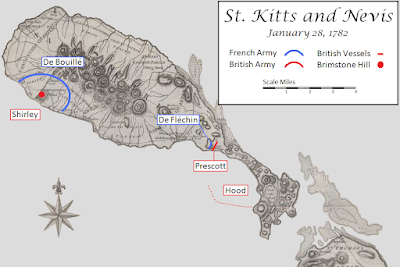
The British Landing (click to enlarge). This map shows the site of the clash on January 28th, 1782 between Prescott and de Fléchin. Also shown is the approximate position of Hood's fleet and de Bouillé's army.

French Forces at Basseterre

The detachment of French troops defending Basseterre was commanded by Le comte de Fléchin, a senior officer in Regiment Touraine [5]. This detachment consisted of the grenadiers and chasseurs from regiments Agénois and Touraine, a portion of Regiment Dillon, and the Volontaires de Bouillé. [6]

Among those stationed near Basseterre was Chevalier de Montlezun, a sous-lieutenant of chasseurs. [7] De Montlezun, still in his teenage years, would later recall tiring days beneath a burning sun and sleepless nights watching for a British attack. His platoon, it seems, dieted chiefly on the fruit of prickly pear plants. These plants abounded on the hills south and east of Basseterre, and one walking across these hills would be tormented by their sharp spines. Nevertheless, according to de Montlezun, the landscape was enchanting. Looking around, he saw green fields of sugarcane surrounded by steep and wild hills, a pale blue salt pond, rows of coconut trees, and a narrow and hilly peninsula, with the ocean lapping on either shore. [8]

It was on this spot that the principal land combat would occur during the St. Kitts campaign and where de Montlezun would have the fight of a lifetime.

When the British infantry landed, de Fléchin moved to confront the British, despite being greatly outnumbered. De Fléchin felt it his duty to delay the British so that de Bouillé would have time to organize a proper defense of the island. De Fléchin left the grenadier company from regiment Touraine and half of his troops from Regiment Dillon to defend Basseterre. The rest were thrown onto the Mooring Hills, southeast of town. From this commanding height they prevented Prescott from moving inland.
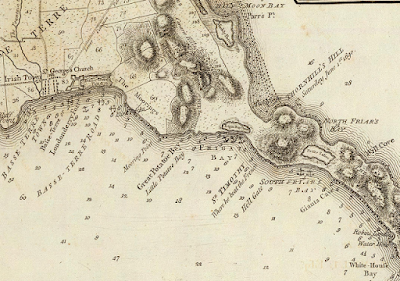
Basseterre, Frigate Bay, and the Mooring Hills (click to enlarge). Basseterre town is at left. Frigate Bay is at center (note the three anchors). The Mooring Hills are just to the left of Frigate Bay, and above Great Potatoe Bay.

The French deployment on the Mooring Hills appears to have been as follows: On the right (closest to the sea) was a detachment of 50 men from Regiment Dillon and the 60-man Volontaires de Bouillé, in the center were the flank companies of regiment Agénois, and one platoon of chasseurs from Regiment Touraine, and on the left was the remainder of the Touraine chasseurs (including de Montlezun). The total force numbered around 300 or so men. [9]

The Battle

The three British regiments assembled in column formation on the beach. Around 1pm, General Prescott ordered the 28th and 69th regiments to occupy the Mooring Hills. According to an eyewitness on Nevis, the British regulars “performed this service with gallantry, though their march was all up hill, and through thick shrubs and prickly pears.” [10]

At the same time that the British infantry were ascending the Mooring Hills from the south, de Fléchin was leading a party of men up the northern slope. As the leading British soldiers neared the summit, they unexpectedly “ran against a detachment of… grenadiers and chasseurs running up at full speed” from the opposite direction. The battle had begun. [11]
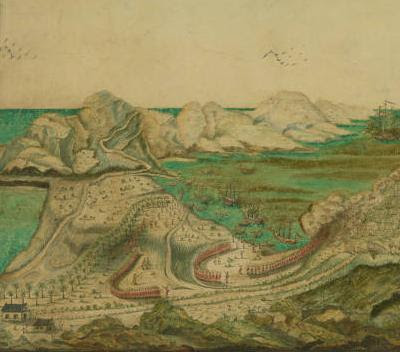
The British Infantry Land on St. Kitts. From a 1782 painting by François Lescalet. Several frigates are shown disembarking men along the shore. The British form on the beach and advance into combat with de Fléchin's men on the hill at right.
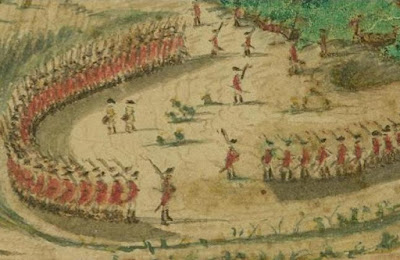
Close up view of British infantry forming on the beach.

De Montlezun and his men were on the British side of the hills when the fighting began. A few British troops were spotted at a dwelling, and de Montlezun was ordered to attack these with his platoon. However, as the chasseurs rushed forward, more and more British troops came into sight, and drew up in a formidable line of battle in an alley of palm trees. De Montlezun’s men would have been slaughtered were it not for the fact that some of the chasseurs on higher ground could see the danger and called for them to come back.
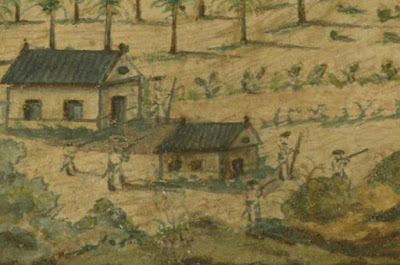
Close up view of chasseurs from Regiment de Touraine. Possibly these men are intended to depict part of de Montlezun’s platoon.

The movement of two British columns up the hill unmasked de Montlezun’s position, and he and his chasseurs began to be shelled by British frigates (they had four in action).

De Montlezun and his men then joined the scramble for control of the hills, where “The musketry fire began at a distance of 10 paces.” He recalled, “Arriving on the line, through a shower of bullets, I had the misfortune to see fall… the valiant Villebrune, second captain of the Agénois chasseurs [12]. The whiteness of his uniform was replaced by a tinge of blood that covered him entirely.”
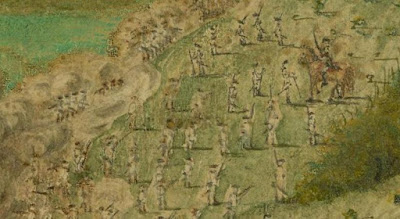
Close up showing Comte de Flechin rallying the French infantry.

According to the biographer of Chevalier de Mirabeau, then a staff officer in Regiment Touraine, “There were on both sides desperate efforts, furious and repeated counter-attacks… Many times, the French overwhelmed by the number of assailants and shot down by the frigates in the bay, seemed about to succumb,” but the infantry, exhorted by their officers, grimly hung on. De Mirabeau “stood out among those most careless of danger,” until finally “His horse was killed, [and] he was shot in the thigh.” [11]

De Montlezun remembered that “The battle dragged on relentlessly. A mulatto, my company drummer, had the courage to beat the charge for the whole hour that the combat lasted.” De Montlezun admired “the imperturbable coolness” of this drummer, “surrounded by blood and carnage”, who could “expect no reward for his dedication.”

Finally, General Prescott ordered his reserve (the grenadier and light infantry companies of the 13th Foot) to sweep around the French left flank.

“At last,” according de Montlezun, “the ammunition was totally exhausted and,” he wrote with considerable exaggeration, “half of the officers and men had died.” Those still on their feet could not contest the advance of the British reserve, which “was in motion to turn our flank and place us between two fires.”

De Fléchin, realizing that the situation had become hopeless, ordered a retreat. The British had won a strong post near shore, and an open road into the interior.

French losses were about 86 men killed or badly wounded (about ¼ of those engaged). These losses were heaviest in the grenadier and chasseur companies of Regiment d’Agénois. [13]

De Fléchin, although defeated, was lionized for having put up such a stiff fight against the British forces.

British losses were approximately 17 killed, 47 wounded, and 7 missing (71 in total). The 69th Foot reportedly lost 5 officers and 29 men killed and wounded; this loss in officers was one of the highest by a British regiment during the war. [14]

Admiral Hood singled out for praise Lieutenant-Colonel (and New York land baron) Philip Skene, who led the 69th in this engagement. [4]

Notes:

In October of last year, I made a preliminary assessment of this combat and concluded that the fighting probably took place on St. Timothy's Hill. Further research has led me to conclude that the action almost certainly took place on "the Mooring Hills" instead. None of the sources is explicit on this point, but it is the logical conclusion in view of several pieces of evidence. Most important to my way of thinking was a statement by the anonymous journalist on Nevis, who wrote "This day 700 regulars, being all the effectives General Prescott brought down with him, were landed under cover of the frigates at Frigate and Potatoe Bays [both locations are shown on the map above]. The French had a body of men posted on the hills above them..." Further, his description of events following the battle (these will be covered in the next post in this series) makes clear that the battlefield was closer to Basseterre town than St. Timothy's Hill. See Note #10, below, for the full account.

1. Excerpts from Shirley’s journal are from Algernon Aspinall (1915). West Indian tales of old.

2. The diary of Sir John Moore, Volume 1.

3. Charles Middleton (1907). Letters and papers of Charles, Lord Barham, Volume 1.

4. David Hannay (1895). Letters written by Sir Samuel Hood (Viscount Hood) in 1781-2-3.

5. Full name: Charles-François-Joseph de Fléchin de Vamin

6. Attaque et prise de Saint-Christophe dit le «Gibraltar» des Antilles (janvier-février 1782), in Revue Historique des Armées, Vol. 1, 1974. This article includes extracts from «Mémoires Secrets» de Bouillé.

7. Full name: Barthélemi-Sernin du Moulin de Montlezun de la Barthelle

8. Baron de Montlezun (1818). Souvenirs des Antilles. Translations of this work are my own.

9. De Montlezun described himself as being on the extreme left and he reported seeing only white-coated troops from regiment Agénois and Touraine to his right. This leads me to believe that the troops from Dillon and the Volontaires de Bouillé were even further to the right (outside his field of vision), and nearest the British fleet. Admiral Hood was under the impression that the British were fighting Irish troops in French service [cf. Note #4]; however, the detachment from Regiment Dillon was the only set of Irish troops in de Fléchin’s command. The total of “300 or so” is an estimate based on inconsistent statements about de Fléchin’s numbers across several sources.

10. Journal of the capture and recovery of Nevis in Charles Ekins (1824). Naval battles, from 1744 to the peace in 1814.

11. Eugéne Berger (1904). Le vicomte de Mirabeau (Mirabeau-Tonneau) 1754-1792. Translations of this work are my own.

12. Full name: Servant-Paul le Saige de Villebrune

13. Statements about French losses varied slightly from source to source. cf. Note #6, above, the Journal Politique of April, 1782 (seconde quinzaine), and other French accounts of the campaign.

14. See Note #10, above, and the Remembrancer for 1782.

Saturday, June 18, 2011

St. Kitts (4): Brimstone Besieged

This is the fourth in a series of post on the St. Kitts campaign of 1782. The St. Kitts campaign took place in what is known as the West Indies theater of the Revolutionary War. [Click for Part 1 or Part 2, or Part 3].

Brimstone Besieged

Governor Thomas Shirley and Brigadier-General Thomas Fraser were faced with overwhelming French numbers. They commanded a little more than 1,000 men, and were opposed by about 7,000 of the enemy [1]. However, Shirley and Fraser defended Brimstone Hill, a virtually impregnable fortress, and they were optimistic that they could hold out long enough to be relieved by the Royal Navy (specifically, the West Indies squadron commanded by Rear Admiral Samuel Hood).

----------------------------------------------------

British Defenses at Brimstone Hill (click to enlarge). This map is based on a 1775 Anthony Ravell map of St. Kitts. Brimstone Hill is at center. Two defenses can be seen on the hill. The square citadel was located on the highest point of the hill. Southeast of the citadel, a fortified “curtain” was placed on a lower plateau. Prior to the siege, the British also held coastal batteries at Fig Tree Bay (upper left) and Fort Charles (center left) on either side of Sandy Point Town. De Bouillé occupied Sandy Point Town on January 12th. On the other side of Brimstone Hill, the French established a camp east of “Goodwin’s Gutt.” [Original Image]

The View Towards Sandy Point (click to enlarge). The view today from Brimstone Hill, looking northwest towards Sandy Point Town. The island of St. Eustatius is visible in the distance. [Original Image by Ukexpat; licensed under the Creative Commons Attribution-Share Alike 3.0 Unported license].

Brimstone Hill in 1783 (click to enlarge). This view is from Sandy Point Town, looking southeast towards Brimstone Hill. The citadel is at the uppermost part of the hill. Part of the curtain is visible on the plateau on the right side of the hill. Fort Charles is on the low-lying promontory at right center.

The View Up the Slope (click to enlarge). The French infantry feared being called upon to assault the British fortress. This modern day image reveals the great difficulty they would have faced. Part of the stone fortifications are visible near the top of the image. These would have been lined with infantry and artillery. [Original Image]

----------------------------------------------------

The Marquis de Bouillé, who commanded the French army, determined that an infantry assault on Brimstone Hill was unlikely to succeed. Therefore, he resolved to use heavy guns to batter the garrison into submission and to only use an assault as a last resort. According to Governor Shirley, de Bouillé “carried on his approaches and opened trenches under all the formalities of the most regular siege." [2] Shirley, for his part, was resolved to keep the French at bay.

On January 15th, the British shelled the town of Sandy Point, which the French had occupied and where de Bouillé had his headquarters. The town soon caught fire and much of it was destroyed.

De Bouillé opened his first entrenchments against Brimstone Hill the night of the 16th-17th. Under cover of darkness, 300 workers, covered by 200 troops from the flank companies and a battalion of fusiliers (possibly Viennois [3]), dug an earthwork about 700 yards northwest of the fortress, on the plantation of one Stafford Somersall. After daybreak, the British spotted the work and began firing on the position.

The French launched a similar operation on the night of January 17th-18th. This time, the earthwork was dug 700 yards southeast of the fortress, on a plantation owned by one Stedman Rawlins. Again, after daybreak, the British used their heavy guns to impede French progress.

The French finally opened fire on Brimstone Hill on the 19th, when, according to Shirley, “a battery of seven mortars… bombarded the garrison very briskly” from Rawlins’ plantation. The British responded with “a warm cannonade.”

----------------------------------------------------

Section of the Rossel de Cercy Painting, Prise des Iles de Saint Christophe et de Nevis (click to enlarge). In this image, the mortar battery on Rawlins’ Plantation can be seen shelling the British fortifications on Brimstone Hill. A part of the defensive “curtain” is at upper center; the citadel is at upper right. [Original image]

----------------------------------------------------

Artillery exchanges were frequent over the days that followed. The French continued to dig entrenchments and gradually put into more and more artillery into action. On the 21st, three mortars became active on Wells’ Estate, east of Brimstone Hill. On the 23rd, a 6 or 7 mortar battery opened fire from Somersall’s plantation, near Sandy Point. [4]

The artillery exchanges were especially punishing for the French on the exposed plain. In a single incident, 20 men (fusiliers from Regiment Touraine and artillerists) were killed or wounded when a British shell ignited the magazine for the Rawlins battery. [5]

On January 24th it appeared that the worst of the garrison’s troubles were over. Samuel Hood came in sight of the island with 22 ships of the line, plus a number of frigates and other vessels. It was not an overwhelming force (indeed, the French navy was larger), but it was well led. Hopes among the British ran high.

Notes:

1. Details of the French order of battle were described previously (see Part 2). The British garrison at this point consisted of about 600 effectives of the regular army (specifically, the first battalion of the 1st Foot and the flank companies of the 15th Foot), 350 militia, and 70 sailors. Governor Shirley mentioned in a journal entry dated January 17th that “A working party of seamen and negroes were employed in placing the mortars and forming platforms for them,” indicating some blacks were on hand, but it seems that they were not considered to be part of the garrison.

2. Information on the British perspective, including Shirley’s journal, comes primarily from Algernon Aspinall (1915). West Indian Tales of Old.

3. The description of French actions is based primarily on a) Attaque et prise de Saint-Christophe dit le «Gibraltar» des Antilles (janvier-février 1782), in Revue Historique des Armées, Vol. 1, 1974. This article includes extracts from «Mémoires Secrets» de Bouillé. For the role of Regiment Viennois, see Paul Jean Louis Azan. Service of the Azans in America.Proceedings of the Massachusetts Historical Society, Volume 50, p 429-433.

4. Note that the battery on Somersall’s plantation was slow to get into action although the first entrenchment was dug there. Presumably the delay is related to the sinking of the Lion Britannique at Sandy Point on January 13 (see Part 3). I suspect the guns used at the Rawlins battery were landed at Old Road on January 13th, but I have not found the name of the transport. The three mortars for the battery established on Wells’ plantation possibly arrived aboard the vessel Citoyen on January 19th. Bougainville's journal mentions on this date that “Le Citoyen est revenu de la Guadeloupe avec 3 mortiers et des munitions de guerre” (R. de Kerallain (1928). Bougainville à l’Armée du Cte de Grasse. Journal de la Société des Américanistes de Paris, 20, 1-70).

5. For the losses in Regiment Touraine, see: Ministère des Affaires Étrangères. (1903). Les combattants Français de la Guerre Américaine: 1778-1783.

Friday, June 10, 2011

St. Kitts (3): Opening Skirmishes

This is the third in a series of post on the St. Kitts campaign of 1782. The St. Kitts campaign took place in what is known as the West Indies theater of the Revolutionary War. [Click for Part 1 or Part 2].

March to Brimstone Hill

The French army, commanded by the Marquis de Bouillé, marched towards Brimstone Hill on the night of January 11-12, 1782. In the lead was a division of troops commanded by Colonel Arthur Dillon. When these troops neared the hill, they filed off to the right and waited for the main body. De Bouillé arrived with the main body at 2:30am. Then, leaving the divisions of Dillon, Saint-Simon, and Damas near the coastal road, he advanced with du Chilleau’s division towards the town of Sandy Point. To reach Sandy Point, the troops marched along a sunken road that skirted the foot of Brimstone Hill. The British sentries above them heard their march and opened fire, but in the dark their aim was erratic. Apparently, some of the British also thought to roll heavy rocks down the hill, and these wounded a few of de Bouillé’s men. [1]

De Bouillé's March (click to enlarge). The French land at Basseterre on the evening of the 11th. That night, the column approaches Brimstone Hill (red dot). De Bouillé and du Chilleau bypass the hill in the early morning hours of the 12th.

Skirmishes at Sandy Point

At daybreak, du Chilleau’s division (regiments Armagnac, Viennois, and Guadeloupe) was on the outskirts of Sandy Point. There the French could hear a small British party in the “hedgerows” (les haies). De Bouillé ordered his vanguard (20 chasseurs from Regiment Armagnac) to charge. The chasseurs promptly killed a few of the British and dispersed the rest. The column then moved into Sandy Point, which was defended on its northern flank by a battery at Fig Tree Bay and on its southern flank (near Brimstone Hill) by Fort Charles. De Bouillé dispatched 100 men from the flank companies to seize the northern battery. The British began a hurried retreat from Sandy Point, preferring to defend Brimstone Hill. It was full light now, and the guns in Fort Charles fired on the tail of the French column as it moved into the town.

François-Claude-Amour de Bouillé

The Marquis de Bouillé had succeeded in placing his men on either side of Brimstone Hill, but now he faced by an array of difficulties. As the French took up their assigned positions, “many disorders” arose, no doubt caused by soldiers plundering. Officers were dispatched from the navy to help restore order. [2]

The French infantry also found themselves harassed by armed blacks. One French officer, who had invited an English lady to dine in camp, was slain while escorting her home. The adjutant of Regiment Viennois was captured and brought to Brimstone Hill. De Bouillé himself was attacked by 30 men while reconnoitering. He escaped thanks to the speed of his horse. His servant, however, was taken.

In retaliation, the French burned at least one plantation.

According to Governor Shirley, “the Marquis de Bouillé sent in a flag to remonstrate against the conduct of the negroes, threatening that unless they should be restrained he would immediately lay waste the country.” The white militia on Brimstone Hill had little appetite for total war. Therefore, “The servant was released and the Adjutant was discharged on parole.” [3]

Setbacks

De Bouillé’s greatest concern was the loss of the transport Lion-Britannique, which was carrying most of the army’s mortars, heavy guns, solid shot and shells. The vessel struck on a rock near Sandy Point and sank. The artillerists aboard (a “valuable species” according to one officer [2]) were brought off safely, and salvage operations soon begun to recover the guns and ammunition. Nevertheless, the incident threatened to significantly prolong the siege of Brimstone Hill.

The following day (the 14th), the French pushed their pickets closer to the British fortress. The British had some storehouses outside the fortress which contained surplus gunpowder. To prevent its capture, the British spread the powder on the ground and set it on fire. The fire, however, got out of control and destroyed some of their provisions, clothing stores, and spare gun and mortar carriages. These losses could not be easily replaced.

Hood Sets Sail

Rear-Admiral Samuel Hood commanded the British fleet in the West Indies, which was based in Barbados. At the time the French set sail for St. Kitts (January 5), they were being watched by two of Hood’s frigates. The commander of one (the Lizard) informed Hood on January 8th that the French were heading north. The other frigate was unable to follow the French very far, and it was not until the 14th that Hood received definite word on the French destination. Once he did (a letter reached him from Governor Shirley), he immediately put his fleet to sea. He had only 20 ships of the line, he was short on provisions, and his only infantry support consisted of two large battalions of marines and the 69th Regiment of Foot. To give his rescue operation a greater chance of success, he decided to stop en route at Antigua where he expected to be resupplied and reinforced. [4]

Notes:

1. The description of French actions is based primarily on a) Attaque et prise de Saint-Christophe dit le «Gibraltar» des Antilles (janvier-février 1782), in Revue Historique des Armées, Vol. 1, 1974. This article includes extracts from «Mémoires Secrets» de Bouillé. b) Journal Politique of April, 1782 (seconde quinzaine). c) Mémoire du marquis de Bouillé

2. cf. R. de Kerallain (1928). Bougainville à l’Armée du Cte de Grasse. Journal de la Société des Américanistes de Paris, 20, 1-70.

Two quoted phrases are derived from Bougainville’s journal:

“many disorders”:

14 . Il y a eu beaucoup de désordres commis à terre. La communication en est interdite aux équipages. Il est permis à la moitié des officiers de chaque vaisseau d'y aller à 4 heures après-midi...

“valuable species”:

Le Lion britannique s'est échoué sur une roche en allant prendre le mouillage sous Sandy-Point. On a sauvé les hommes, espèce bien précieuse, puisqu'il y avait 200 artilleurs; mais il est douteux qu'on puisse sauver 12 mortiers de 12 pouces, et toute l'artillerie que contient ce bâtiment.

3. Information on the British perspective, including Shirley’s journal, comes primarily from Algernon Aspinall (1915). West Indian Tales of Old.

4. An invaluable source on Hood’s actions during this period is Letters written by Sir Samuel Hood (Viscount Hood) in 1781-2-3.

Tuesday, May 24, 2011

St. Kitts (2): The Invasion

This is the second in a series of posts, which will appear from time to time, on the St. Kitts campaign of 1782. The St. Kitts campaign took place in what is known as the West Indies theater of the Revolutionary War. For Part 1, click here.

De Grasse Approaches

A French fleet left Port Royal, Martinique, on January 5, 1782, to attack the British isles of St. Kitts and Nevis. The fleet consisted of 25 ships of the line, the 50-gun Experiment, and a number of frigates and transports. Its commander was Lieutenant-General François-Joseph-Paul de Grasse. Because of calms and fog, the ships became strung out over a considerable distance while en route. Most of the fleet reached St. Kitts on the 11th, but some ships did not arrive until the 13th. [1]

The difficulty of the journey was of little importance. The British West Indies fleet (Rear Admiral Samuel Hood commanding) was at distant Barbados.

The French fleet was spotted from St. Kitts and Nevis long before it reached shore. On the afternoon of January 9th (when the French were still 2 days away), Governor Thomas Shirley received word from Nevis “that a large fleet, consisting of about forty sail, twenty-four of which were large ships and the rest sloops and schooners had appeared in sight of that Island.” Shirley was in Basseterre, the principal town on St. Kitts. There he had a cannon fired as an alarm. A detachment of Royal Artillery, and part of the militia, were ordered to defend the coastal batteries. [2]

The British had little in the way of naval resources on hand. One large vessel, the 64-gun Russell, was in port for repairs, but this ship hurriedly departed on the 10th.

As the French fleet slowly drew closer, the British commanders on St. Kitts – Governor Shirley and Brigadier-General Thomas Fraser– had time to rethink the wisdom of defending the entire coast. At last, the two commanders decided to abandon Basseterre and concentrate their forces on and about Brimstone Hill.

On the morning of January 11th, the St. Kitts brigade of militia assembled in Basseterre. Governor Shirley then marched this force along the coastal road towards Brimstone Hill.

At about the same time, a number of merchant vessels in Basseterre got underway and headed north and west, away from the French fleet.

The French Landing

As the French fleet completed the last leg of the journey, it divided into two parts. The main force headed directly for Basseterre, while a secondary force circled around the island and headed for the town of Sandy Point, near Brimstone Hill.

The secondary force consisted of:

  • 1000 men from regiments Dillon and Royal Comtois aboard transports
  • 500 grenadiers and chasseurs aboard two ships of the line, the Experiment, and several frigates. [3]

St. Kitts: January 11, 1782 (click to enlarge).

The French secondary force reached Sandy Point without difficulty, but no landing was made. The approaches to Sandy Point were defended by two coastal batteries, and the British were in force on nearby Brimstone Hill. Instead, the French attacked the merchant vessels which were streaming along the shore. The merchant vessels hurriedly took shelter under the guns of Brimstone Hill. According to Shirley, some of the merchant vessels were saved from capture “by a well-directed fire from our line of batteries” and “the merchantmen got shelter under the guns of Brimstone Hill and [nearby] Fort Charles.” Nevertheless, the French captured at least 27 vessels. [4]

The French secondary force also spotted the St. Kitts and militia on their march and opened fire. Shirley wrote that the militiamen were “very much annoyed” by the French ships, but the fire did not prevent them from reaching Brimstone Hill.

The main French force, under de Grasse, approached Basseterre and saw that the battery defending the town appeared to have been abandoned. A 60-man company of colonial troops (the Volontaires de Bouillé) approached the fort in two boats, supported by two frigates. When the company found that the battery was undefended, they hoisted the French flag. At about the same time, a delegation of citizens from Basseterre approached the French fleet in a small boat and informed the French that the British had retired to Brimstone Hill and that those who remained behind would offer no resistance.

Meanwhile, the secondary force joined the main fleet at Basseterre, and at about 6pm, the French infantry began to disembark. The French commander, the Marquis de Bouillé, had his troops assemble in four divisions on the shore. They were organized as follows:

  • Colonel de Dillon’s division: Regiments Dillon and Royal Comtois, two companies of grenadiers from Regiment Martinique, and a detachment of Volontaires Étrangers de la Marine (perhaps 1,500 effectives in total).
  • Maréchal de Saint-Simon’s division: Regiments Agénois and Touraine (about 2,000 effectives).
  • Brigadier de Damas’ division: Regiments Auxerrois and Champagne (about 1,200 effectives).
  • Brigadier du Chilleau’s division: Regiments Armagnac (2 battalions), Viennois, and Guadeloupe (perhaps 2,100 effectives). [5]

The disembarkation and assembly proceeded smoothly, and at 9pm Dillon’s division began marching towards Brimstone Hill. The rest of the troops followed 30 minutes later. De Bouillé intended to surround the British fortress under cover of darkness.

Left to right: Grenadiers of Armagnac, Auxerrois, and Viennois. These illustrations show what was essentially the uniform worn by these regiments on St. Kitts; one difference is that the French grenadiers generally wore a tall bearskin cap rather than the cocked hat shown here.

Notes:

1. An invaluable source on French naval operations is John Gilmary Shea's (1864) The Operations of the French Fleet Under the Count de Grasse in 1781-2 as Described in Two Contemporary Journals.

2. Extracts of Shirley’s journal, including that quoted here, appears in Algernon Aspinall's (1915) West Indian Tales of Old.

3. From Attaque et prise de Saint-Christophe dit le «Gibraltar» des Antilles (janvier-février 1782), in Revue Historique des Armées, Vol. 1, 1974. This article includes extracts from «Mémoires Secrets» de Bouillé. A detailed description of de Bouillé’s operations also appears in the Journal Politique of April, 1782 (seconde quinzaine).

4. R. de Kerallain (1928). Bougainville à l’Armée du Cte de Grasse. Journal de la Société des Américanistes de Paris, 20, 1-70.

5. French sources generally claim that they fielded an army of 6,000 men; British sources attribute to the French 8,000 men. I suspect the latter number is more accurate. One French account claims they had “6000 hommes effectifs & de 800 volontaires de la Martinique,” which I take to mean 6,000 effectives of the Metropolitan Army and 800 colonial troops that had been stationed on Martinique. Colonial troops known to have participated in this campaign included Regiment de la Guadeloupe, two companies of grenadiers from Regiment de la Martinique, and the company-sized Volontaires de Bouillé. If one counts soldiers of all ranks, the French army would have totaled well above 7,000 men. De Bouillé only partially identified the size of each of these divisions; I relied on a certain amount of extrapolation to determine the approximate size of Dillon’s and du Chilleau’s divisions. De Bouillé’s exact language in describing the composition of his forces (and how he intended to place them around Brimstone Hill) is as follows:

“La division du Marquis de Saint-Simon, composée de deux mille hommes, des régiments de Touraine et d'Agénois, dut prendre la droite, et se placer entre la vieille rade et Brimstone-Hill, le plus près possible, cependant hors de la portée du canon de la place. Celle du Vicomte de Damas, composée de douze cents hommes, des bataillons d'Auxerrois et de Champagne, à la gauche de la première, pour garder les debouches des montagnes. Celle du Comte Arthur Dillon, compose de 1.200 hommes, des bataillons de Dillon, de Royal comtois, et de deux companies de grenadiers de la Martinique, et les volontaires étrangers de la marine, fut à la gauche de celle de M. de Damas, pour le même objet et pour communiqué avec elle. Celle du Marquis du Chilleau, compose de deux bataillons d’Armagnac, d’un de Viennois, d’un de la Guadeloupe dut être à la gauche de celle de M. de Dillon, et occupier Sandy-point.”

Saturday, May 7, 2011

St. Kitts Campaign Overview

Overview

This is the first in a series of posts, which will appear from time-to-time, on the St. Kitts campaign of 1782. The St. Kitts campaign took place in what is known as the West Indies theater of the Revolutionary War.

The Other Thirteen Colonies

In 1775, half of Britain's colonies in the New World embarked on the Revolutionary War, which ended with their establishment as the United States of America. The remainder stayed loyal. One might suppose that outside the Thirteen Colonies, the inhabitants must have been strongly loyalist in their sentiments. This was not always so. Loyalists and rebels were to be found in every colony. In places like Barbados and St. Kitts in the West Indies, the rebellious spirit was quite strong. However, these colonies were small in size and easily occupied by land forces or dominated by the royal navy. Armed rebellion had no hope of success. [1]

The West Indies

Britain’s West Indies possessions shared a plantation-based economy dominated by sugar cane cultivation. Sugar cane gave these islands an economic power greatly out of proportion to their diminutive size. Because these islands were much valued, they were also much fought over, and changes in ownership were not uncommon. At the time of the Revolutionary War, the islands were colonized by Spain, France, Britain, Holland, or Denmark.

St. Kitts and Nevis

Among Britain’s possessions in the West Indies were the sister islands of St. Christopher’s (commonly called St. Kitts) and Nevis. During the Revolutionary War, the islanders greatly aggravated the British authorities. As one historian put it:

“During the American War, the people of St. Kitts were, to put it mildly, by no means so loyal as they now are. It is, indeed, an admitted fact that they sympathized more or less openly with the revolted colonists, and enriched themselves by carrying on a contraband trade in munitions of war…” [2]

St. Kitts and Nevis in 1782.

In 1782, the islands became a scene of conflict. At the time, St. Kitts was garrisoned by the 1st battalion of the 1st Regiment of Foot, the flank companies (i.e., grenadiers and light infantry) of the 15th Regiment of Foot, and a detachment of Royal Artillery. Nevis was not garrisoned, but both islands had an armed militia that could be called out for emergencies.

The main defensive work was Brimstone Hill on St. Kitts. Steeply-sided Brimstone Hill bordered the sea on one side, and a flat swath of sugar cane fields on the others. The summit was crowned by stone fortifications. A British officer visiting the site remarked,“I have had an opportunity of visiting Brimstone Hill, a position which Nature has rendered almost inaccessible… Casemates for the troops, storehouses, and cisterns were almost all that were necessary. The situation is cool and healthy, the troops suffer as little as they would do in Europe.” He believed an enemy might establish batteries upon a distant hill, but at that distance guns could not breach the walls. “To approach much nearer is almost impossible, and even a breach in works placed on ground so commanding would be of no avail. The garrison may be annoyed by distant firing, and starved out by blockade, but not assaulted.” [3]

The islands were also defended by several low-laying coastal batteries. These protected the principal harbors (and most likely landing points).

Brimstone Hill, as seen from the northwest.

The French Invasion

France entered the Revolutionary War in 1778. At the time, much of the British army, and, to a lesser extent, navy, was tied down in North America. France (and later Spain and Holland) hoped to exploit this weakness and pick off some of Britain’s far-flung possessions. The largest French effort was made in the West Indies. By 1782, France captured the British isles of Dominica, St. Vincent, Grenada, the Grenadines, and Tobago (Britain, in turn, took St. Lucia).

The French fleet in the West Indies was commanded by François-Joseph-Paul de Grasse. In the late summer and fall of 1781, this fleet was in North American waters where it played a decisive role in the siege of Yorktown. When it returned to the West Indies in November, the French fleet had a numerical advantage over the British royal navy. The French hoped to exploit this advantage by capturing another British island. The two initially set their sights on Barbados: Britain’s main naval base in the West Indies. However, the invasion was repeatedly stymied by severe weather. In January they chose to attack St. Kitts and Nevis instead.

The French expedition set sail from Martinique on January 5, 1782, with 6,000 infantrymen, and a train of heavy artillery.

A Part of the West Indies (click to enlarge). St. Kitts and Nevis are at upper left, Martinique near center, and Barbados at lower right.

The Commanders

  • François-Joseph-Paul de Grasse: Known as the hero of Yorktown, but otherwise generally seen as a competent, if not brilliant, officer.
  • François-Claude-Amour de Bouillé. Daring and energetic, de Bouillé was one of the most skilled and successful general officers of the Revolutionary War.
  • Samuel Hood. Commanded the British West Indies’ naval station. He is seen by some historians as the greatest British admiral of the Revolutionary War. It was his responsibility to aid any British isle that came under French attack.
  • Thomas Shirley. Governor-General of Britain’s Leeward Islands, he resided on St. Kitts and led the British militia.
  • Thomas Fraser. He commanded of the British regulars on St. Kitts. It was the joint responsibility of Shirley and Fraser to defend the islands (especially Brimstone Hill) long enough for outside aid to reach them.
----------------------------------------------------

Notes:

1. As best I’ve been able to determine, Britain had, in addition to the Thirteen Colonies, an additional thirteen colonies or provinces in the Americas in 1775 that a) were administered by a governor and b) were not a dependency of some other colonial possession. They were 1) Quebec, 2) Newfoundland, 3) Nova Scotia, 4) St. John’s Island, 5) East Florida, 6) West Florida, 7) Bermuda, 8) Bahamas, 9) Jamaica, 10) The Leeward Islands (Anguilla, Antigua, Barbuda, British Virgin Islands, Montserrat, Nevis, St. Kitts), 11) Dominica, 12) Barbados, 13) The South Caribbee Islands (Grenada, St Vincent and the Grenadines, Tobago)

2. See Algernon Aspinall (1915). West Indian Tales of Old.

The inhabitants of Nevis were probably of similar sympathies, but their actions tended to be overshadowed by those of their larger and wealthier neighbor. Of note is that Alexander Hamilton was born on Nevis in the 1750s.