Showing posts with label Pell's Point. Show all posts

Sunday, November 6, 2011

Mapping Pell's Point

Several weeks ago, one of the folks on RevList, expressed an interest to me in seeing Revolutionary War-era maps of the New York campaign combined with modern satellite imagery. I recently came up with a way to do this using nothing more sophisticated than Microsoft Excel and MS Paint. The results appear below.

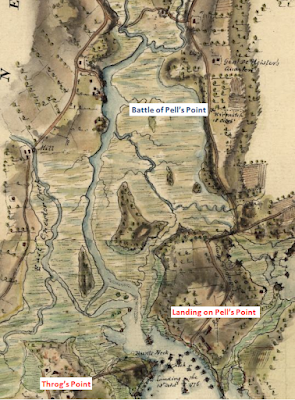
The Revolutionary War map used for this comparison is from a circa 1776 Charles Blaskowitz map that shows the movements of the British army from Throg’s Neck, to the roads leading to White Plains. Below is a segment of his map showing the place where the battle of Pell’s Point was fought.


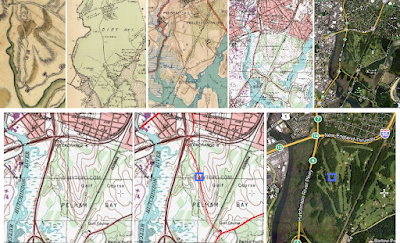
Below are a series of images that show the area today either alone or in combination with part of the Blaskowitz map. The modern maps and the Blaskowitz map don’t align perfectly, but on the whole the comparison shows that the Blaskowitz map was executed skillfully and that it does providea good guide as to the appearance of the area in 1776.

In the part of the Blaskowitz map shown below, the British can be seen landing at Pell's Point on the bottom of the map and marching inland along a road leading north (towards the top). The skirmish site is at upper right.

A note to readers: Most of the people who visit this blog use Microsoft Explorer as their web browser. My recommendation is to use Google Chrome – when you click on one image, it will bring up a slideshow of full-sized versions of all of the images in a given post. It’s a pretty cool effect. Please note, however, that if you have a slow connection, the images in the slideshow may not instantly load.


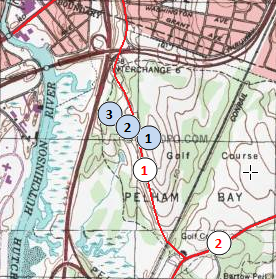
Below is a copy of the map I used in my first blog post on Pell's Point. This roughly shows where the British and American units were in relation to the modern terrain during the main phase of the fighting. The red lines correspond with roads present at the time of the battle.


Three American units are represented by blue circles. They are: 1 = Joseph Read’s 13th Continental Regiment, 2 = William Shepard’s 3rd Continental Regiment, and 3 = Loammi Baldwin’s 26th Continental Regiment. These units were commanded by Colonel John Glover.

Two British units are represented by white circles with red letters. They are 1 = the British light infantry, and 2 = the British grenadiers. Some British and Hessian units that were in the vicinity at the time are not marked on the map for lack of clear guidance from the source material. For example, the 1st Jager Company and possibly Colonel Carl von Donop’s brigade of Hessian grenadiers were somewhere in the wooded area between #1 and #2 (cf. the accounts by Archibald Robertson and Carl Leopold Baurmeister [list]).

Wednesday, October 19, 2011

October 19, 1776

From October 8th to November 1st, I am blogging about the White Plains “campaign” of 1776. Click here for an overview of this project, a listing of the sources used, and other general information.

Synopsis for October 19th: The British consolidated their gains at Pell’s Point.

Previous entry: Afternoon of October 18th; next: October 20th.


On October 18th, the British landed at Pell’s Point and advanced into the New York mainland. This placed Washington in a delicate situation. The only important barrier separating his army from the British was the Bronx River. If the British pushed across the Bronx, the result would be catastrophic: Washington’s army would be hemmed in near Manhattan and possibly forced to surrender. Washington’s army was not strong enough to drive the British back from Pell’s Point nor mobile enough to quickly escape the potential trap (the troops could march quickly, but there was a shortage of wagons to move the provisions and other baggage). Washington therefore focused on defending the crossing points on the Bronx while the stores kept in Manhattan were moved to places of safety.

Meanwhile, the British were enthusiastic about their prospects. Ambrose Serle heard Vice Admiral Richard Howe boast “that the army had landed, and posted themselves upon the heights beyond Kingsbridge; so that now the rebels are nearly surrounded.” But how to finish the campaign was not obvious, and Lieutenant-General Henry Clinton later recalled, “Many plans for our further proceedings became now… the subject of deliberation.”

While the British commanders held their discussions, the men in the ranks discovered many temptations in the neighborhood of Pell’s Point. Almost all of the residents had fled upon the approach of the British army, and abandoned homes dotted the countryside.

According to Colonel Loammi Baldwin (Glover’s brigade), “The enemy lay pretty still this day, only plundering the Point [i.e., Pell’s Point] indiscriminately, showing no more favor to a Tory than a Whig.”

British headquarters tried to curtail this behavior by proclaiming that “The Commander in Chief is greatly disappointed that the repeated orders… for the suppression of plundering and marauding, have not been attended to by the troops,” and warning that there would be “no mercy to any person proved guilty” of these crimes.

The Americans, although hungry and poorly clothed, had largely abstained from this sort of behavior. However, Baldwin found that the men were upset to see that by being “careful of the property of the country people and farmers,” they were “only saving it for our enemies”. Therefore, “near the disputed ground” (East Chester) they began to behave in the same manner: “the fields of corn and stacks of wheat serve for fodder for our horses,” and “the pigs, poultry, etc.” provide a “change of diet for the soldiers”.

Tuesday, October 18, 2011

October 18, 1776 (Part 2)

From October 8th to November 1st, I am blogging about the White Plains “campaign” of 1776. Click here for an overview of this project, a listing of the sources used, and other general information.

Synopsis for the afternoon of October 18th: The British army attacked Glover’s brigade; afterwards they cut one of Washington’s primary supply lines.

Previous entry: Morning of October 18th; next: October 19th.

On the morning of October 18th, the British landed at Pell’s Point and began streaming inland towards New Rochelle and the Boston Post Road. En route, the light infantry received a check from Colonel John Glover’s brigade of Massachusetts Continentals.

The British then halted and Glover anxiously waited for the attack to be renewed. Glover saw in his front “about four thousand [men], with seven pieces of artillery”. He later recalled:

“Oh! the anxiety of mind I was then in for the fate of the day — the lives of seven hundred and fifty men immediately at hazard, and under God their preservation entirely depended on their being well disposed of; besides this, my country, my honour, my own life, and everything that was dear, appeared at that critical moment to be at stake”.

Lieutenant-General William Howe surveyed the scene. He saw “a considerable body appearing in front behind stone walls and in woods”. He then dispatched “some companies of light infantry and a party of chasseurs [jaegers]… to dislodge them”.

Ensign Henry Stirke (light infantry company, 10th Foot) wrote that “The 1st Battalion of Light Infantry pushed the rebels from fence to fence”.

Glover’s Continentals were forced to withdraw, but the withdrawal was conducted slowly and skillfully. Glover was with Joseph Read’s 13th Continental Regiment when the British advance began. He wrote:

“we kept our post under cover of the stone wall… till they came within fifty yards of us, [then we] rose up and gave them the whole charge [i.e., volley] of the battalion; they halted and returned the fire with showers of musketry and cannon balls. We exchanged seven rounds at this post, retreated, and formed in the rear of Colonel Shepard and on his left; they then shouted and pushed on till they came on Shepard, posted behind a fine double stone wall; he rose up and fired by grand divisions, by which he kept up a constant fire, and maintained his part till he exchanged seventeen rounds with them”.

When Shepard’s men were forced back, the British pressed against Colonel Loammi Baldwin’s 26th Continental Regiment. Baldwin observed, “Our troops were as calm and steady as though expecting a shot at a flock of pigeons, and not in the least daunted or confused.” When the British came within range, he wrote, “We galled the enemy very much”.

Finally, Baldwin’s Regiment was also made to retreat.

According to Glover:

“we retreated to the bottom of the hill, and had to pass through a run of water, (the bridge I had taken up before) and then marched up a hill [on] the opposite side of the creek, where I [had] left my artillery; the ground being rough and much broken I was afraid to risk [bringing] it over. The enemy halted, and played away their artillery at us, and we at them… without any damage on our side, and but very little on theirs.”

Glover’s own 14th Continental Regiment had been left with the guns. The regiment had erected a crude fortification while the rest of the brigade was in action and this gave Glover another strong position to defend.

The cannonade drew more of the British army into the battle, including some of the British grenadiers and Hessian Regiment von Knyphausen.

Captain George Harris (grenadier company, 5th Foot) noted, “The grenadiers did not suffer, being only exposed to the fire of the American batteries, which were very ill served.”

Lieutenant Andreas Wiederholdt (Regiment von Knyphausen) wrote, “The enemy had dug in on the high ground facing us and greeted us with a number of cannon shots, but these had no effect because they flew wide. I skirmished with the enemy and they wounded one of my men, for which I sent one of them into the next world with my rifle.”

Artist Charles Lefferts painted these representations of British soldiers. At left is a light infantryman in the 10th Regiment of Foot (Stirke’s company); at right is a grenadier in the 5th Regiment of Foot (Harris’ company).

Glover’s men blocked the route westward, which led towards the Bronx River and the rear of the American army. However, Howe did not attempt to force Glover from his post. Instead, he kept some men facing the Americans while others were sent to occupy high ground to the east. That night, according to Howe, the men “laid… upon their arms with the left upon a creek opposite to East Chester [i.e., opposite Glover’s position] and the right near to [New] Rochelle.”

Glover had done everything in his power to harass and delay the British army. Now it was time to pull back to a safer position:

“At dark we came off, and marched about three miles… after fighting all day without victuals or drink, laying as a picket all night, the heavens over us and the earth under us, which was all we had, having left our baggage at the old encampment we left in the morning. The next morning [we] marched over to Mile Square. I had eight men killed and thirteen wounded, among which was Colonel Shepard, a brave officer.”

British losses were heavier, but not as heavy as the volume of American fire would suggest. Ensign Stirke claimed there were 34 killed and wounded in the 1st Battalion of Light Infantry. Accounts by others suggest that the total British loss was not much higher.

Situation of the armies on October 18th (click to enlarge). Howe’s army crossed from Throg’s Neck (7) to Pell’s Point, and fought Glover’s brigade on his march inland. By the end of the day, the leading elements of his army were near New Rochelle (8). Meanwhile, Charles Lee prepared to defend Mile Square (9) lest the British attempt to cross the Bronx River and surround the American army.

October 18, 1776 (Part 1)

From October 8th to November 1st, I am blogging about the White Plains “campaign” of 1776. Click here for an overview of this project, a listing of the sources used, and other general information.

Synopsis for the morning of October 18th: The British army crossed to Pell’s Point, but were met by Glover’s brigade; Washington’s divisions scrambled to turn back the British advance.

Previous entry: October 17th; next: Afternoon of October 18th.


For a second straight day, the British vanguard marched at 1AM. This time the weather cooperated, and the troops boarded flatboats and crossed from Throg’s Neck to Pell’s Point. As the British ships approached shore, they were fired on by some American sentries [see footnote]. Lieutenant-General Henry Clinton, who commanded the vanguard, recalled, “They… began to fire a few shot. But, as I was certain they could not be in any great force, I ordered the debarkation to proceed”.

The sentries quickly withdrew, and the British began to assemble on the shore. According to Clinton, “The moment the whole avant garde was ashore I… detached Lord Cornwallis with the grenadiers, light infantry, and [jaegers]… to our right”.

Meanwhile, Colonel John Glover was hurrying forward with his brigade of Massachusetts Continentals to contest the British advance. Glover wrote that:

“[The British had] stole a march [of] one and a half miles on us. I marched down to oppose their landing with about seven hundred and fifty men, and three field-pieces, but had not gone more than half the distance before I met their advanced guard, about thirty men; upon which I detached a captain's guard of forty men to meet them, while I could dispose of the main body to advantage.”

Glover’s advanced troops were able to surprise the head of the British column.

Archibald Robertson (Royal Engineers) recalled:

“I was ordered to join the light infantry and grenadiers under Lieutenant General Clinton… I was ordered by the General to the top of a rising ground in front with the advance guard of the light infantry to reconnoitre, but we were immediately fired upon from behind trees and heaps of stones where the rebels lay concealed”.

Ensign Henry Stirke (light infantry company of the 10th Foot, 1st Light Infantry Battalion) was also with the leading troops. He recorded, “we received a very heavy fire, as we marched up a hill, from behind stone walls, pickets etc. by which I had 1 sergeant killed, another, with a private man wounded.”

Glover wrote that the advanced troops “kept the ground till we exchanged five rounds” with the British. Soon, however, they were forced to withdraw. The advanced troops had lost “two men killed and several wounded,” and the British aggressively pressed ahead:

“Their body being much larger than mine… [and] the enemy pushing forward not more than thirty yards distant, I ordered a retreat, which was masterly well done by the captain that commanded the party. The enemy gave a shout and advanced”.

However, as the British light infantry advanced, they ran into Colonel Joseph Read’s 13th Continental Regiment. These men, Glover wrote, were “laying under cover of a stone wall undiscovered till they [the British] came within thirty yards, then rose up and gave them the whole charge [i.e., a volley]; the enemy broke, and retreated for the main body to come up.”

According to Archibald Robertson, “we halted until General Howe came up. The Rebels appeared drawn up in our front behind all the fences and high stone walls.”

One of the clearest indicators of the site of the battle of Pell’s Point is a map prepared by Charles Blaskowitz documenting the movements of the British army in Westchester County. Below is an excerpt of his map (click to enlarge) that shows the British landing on Pell’s Poin.

Note the road network on Pell’s Point: there is a road that goes inland, goes through a marsh, and on the far side of the marsh forms a “V” with one branch going north, and the other brance going east. Blaskowitz indicated that the battle was fought on the road leading to the north.
A comparison with later maps helps make it possible to determine the site of the main phase of the fighting (see especially Part 2). The first row in the image below (click to enlarge) shows a series of maps that illustrate how the road system at Pell’s Point changed over time.

The first map dates to the Revolutionary War. On this map the “V” pattern is quite distinct; the road connecting the V with the shore is also visible, but it is quite short in length. The second map dates to the early 19th Century and the third map dates to the late 19th Century. Both of these maps show the V present in the Blaskowitz map, with a road leading to the shore. These maps show additional roads as well, indicating that the area was becoming more developed. The fourth map is from the 20th-Century, and on this map the V is no longer visible. Instead, the northern branch, on which the battle was fought, was removed to accommodate a golf course. The eastern branch, however, remains. The fifth map is from a modern satellite image. It shows the same road network present in the fourth map. Larger versions of these maps are available are available through the Library of Congress, the David Rumsey Map Collection, Acme Mapper, and Google Maps.

In the second row is a series of close-up views of the area where the road leading north once was. Based on clues in 18th and 19th Century maps, I sketched in the old road network in red. Based on clues in the Blaskowitz map and participant accounts of the battle, I marked the approximate site of the battle with a blue square. Note that Glover’s men were deployed just shy of the crest of a hill. As described above, the battle began when the British were ascending this hill and came under fire from the men in Glover’s advance party. The British were able to seize the high ground, and Glover’s men were deployed somewhat shy of the crest. Glover noted, “The enemy had the advantage of us, being posted on an eminence which commanded the ground we had to march over.” He also referred, in his account of the battle, to “the ground being much in their favour”.
Glover deployed three of his regiments in a staggered manner to meet the British: the lead regiment was on the left of the road, the other two were on the right. Their relative placement (but not absolute position) is indicated in the map below: Blue 1 = Joseph Read’s 13th Continental Regiment, Blue 2 = William Shepard’s 3rd Continental Regiment, Blue 3 = Loammi Baldwin’s 26th Continental Regiment. Red 1 = the route taken by the British light infantry, Red 2 = the route taken by the British grenadiers. The Hessian jaegers (position not marked) likely occupied the woods to the right of the light infantry.
When the British army moved to Pell’s Point, they left behind, at Throg’s Neck, the 2nd and 6th British brigades. These troops made a feint to distract the Americans, by making it appear as if the British army was going to advance overland from Throg’s Neck.

Major-General William Heath scrambled to respond. First he was informed “that the British were opening an embrasure in their work at the end of the causeway [i.e., by Westchester Creek bridge]… [which made it appear that] they intended, under [cover of] a cannonade… to attempt to pass.” Heath instantly ordered a brigade stationed near Valentine’s Hill to hurry towards the bridge. Then, “When the troops had advanced to about half the way… another express met him, informing him that the whole British army were in motion, and seemed to be moving towards the pass at the head of the creek.” Heath ordered the troops to change direction “and march briskly to reinforce the Americans at the pass at the head of the creek.”

General Washington was not deceived by these movements, and he called off Heath’s response. Washington, however, saw a large number of British vessels heading up the East River (a change in wind direction now favored the movement of British ships), and he expressed concern over the possibility that the British might land troops west of Throg’s Neck. Therefore, according to Heath, Washington “ordered him to return immediately, and have his division formed ready for action”.

The other divisions on the New York mainland similarly prepared for a fight. At Mile Square, Major-General Charles Lee positioned his forces (minus Glover’s brigade) to defend the crossings of the Bronx River.

Sergeant John Smith (Lippitt’s Rhode Island State Regiment; Nixon’s brigade) listened to the sound of British cannon fire at Pell’s Point, while his troops moved into position:

“we heard a heard a heavy firing of cannon after breakfast[.] We were ordered to parade ourselves under arms and marched over to General Lee’s quarters who ordered our regiment to take post on a hill… to prevent the enemy’s crossing the land from east to west”.

To further protect these key crossings, George Washington sent Major-General Joseph Spencer’s division to nearby Valentine’s Hill.
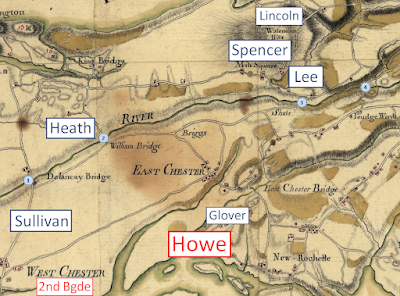

This map shows the distribution of Washington’s army units in Westchester County on October 18, 1776 (click to enlarge). The placement of the units on this map is inexact. North is up at the upper-right corner of the map. A part of the Hudson is at the top of the map, and a part of Long Island Sound is at the bottom.

While Howe’s army landed at Pell’s Point, the 2nd and 6th British brigades conducted a feint on Throg’s Neck. (The 2nd brigade is shown near the head of Westchester Creek; the 6th brigade was in an off-map location near the bridge at extreme lower left). The divisions of William Heath and John Sullivan watched over the British on Throg’s Neck and defended the shoreline between Throg’s Neck and Manhattan (off map, at left). The crossings of the Bronx River are marked by the numbers 1-4. One part of Charles Lee’s division guarded these crossings, while another (John Glover’s brigade) contested the British advance from Pell’s Point. During the day, Joseph Spencer’s division marched from Kingsbridge (upper left) to Valentine’s Hill (upper right).

Footnote: The sentries were probably a detachment of militia. Militia units from Massachusetts, Connecticut, and New Hampshire were placed in various locations along the shore of Long Island Sound and Hudson’s River to watch the movements of the British navy, safeguard caches of supplies, and keep key points out of the hands of the Loyalists. The detachments were not expected to stop a major drive by the British army. New York militiaman Benjamin Bogardus later wrote, “The orders came from [Major] General [Charles] Lee, for all the guard along the shore to draw back and let them [the British] land”.

Monday, October 17, 2011

October 17, 1776

From October 8th to November 1st, I am blogging about the White Plains “campaign” of 1776. Click here for an overview of this project, a listing of the sources used, and other general information.

Synopsis for October 17th: Bad weather delayed the British move to Pell’s Point; William Smallwood commented on the sufferings of the American soldier.

Previous entry: October 16th; next: Morning of October 18th.


The British vanguard marched at 1 AM for the move to Pell’s Point. The move, however, was soon cancelled because of a storm. Ensign Henry Stirke (light infantry company of the 10th Foot, 1st Light Infantry Battalion) recorded in his journal that “very heavy rain, and high wind” “obliged us to return to our quarters at ½ after 3 o’clock [A.M.].”

Lieutenant-General William Howe decided to make the move on the 18th instead.

Lieutenant Tench Tilghman (one of Washington’s aides) was puzzled by the British inactivity:

“The enemy has made no move from Frog's Point. We may say the 17th October is come and nearly past without the predicted blow. The winds have not been favourable to pass Hell-Gate, where several of their transports are now laying; perhaps that may be the reason…. If we can but foil General Howe again, I think we knock him up for the campaign.”

Tilghman expected the British advance to be made overland from Throg’s Neck, not by water to the east; therefore, he was puzzled by the British inactivity. He was right, however, about the winds causing delays for the British.

Captain Frederick Mackenzie (23rd Regiment of Foot) commented on the slow movement of men and supplies from New York City to Throg’s Neck:

“The recruits lately arrived for those regiments which are with the army under General Howe, went though Hellgate this morning in flatboats. The ships with the Hessians [see footnote] cannot go through for want of a proper wind. Several ships with horses and wagons are detained for the same reason. The Senegal sloop of war got through this morning with much difficulty; she touched the shore several times but at last effected the passage with much labor and danger.”

This map illustrates the distribution of Washington’s army units in Westchester County on October 17, 1776 (click to enlarge). North is at the upper-right corner of the map. A part of the Hudson is at the top of the map, and a part of Long Island Sound is at the bottom. By the end of the day, four of Washington’s divisions were on the New York mainland (those of William Heath, John Sullivan, Charles Lee, and Joseph Spencer) as was Benjamin Lincoln's brigade of Massachusetts militia. The placement of the units on this map is inexact.

Washington’s army units were deployed with three objectives in mind:

  • First, units were deployed to defend the crossings of the Bronx River (marked by the numbers 1-4). Glover’s brigade of Lee’s division was positioned in advance of these crossings near the town of East Chester. As long as the British were kept from crossing the Bronx, Washington had a secure connection with upstate New York and New England.
  • Second, units were deployed to contain the British army on Throg’s Neck (partially visible at extreme lower left).
  • Third, units were deployed to guard the shoreline between Throg’s Neck and Manhattan (off the map, at left).

The divisions of Israel Putnam and Nathanael Greene (not shown) defended upper Manhattan, and nearby Fort Constitution in New Jersey. Around this time, Fort Constitution was renamed Fort Lee, after the American general.

Spencer’s division was in a reserve position at Kingsbridge, where it could quickly move to reinforce American forces in either Westchester County or upper Manhattan.

Howe had wanted to land his forces at Pell's Point on this date (bottom of the map), but the move was delayed by bad weather.

On this quiet day, Colonel William Smallwood of the Maryland Battalion (McDougall’s brigade; Lee’s division), wrote about his misgivings with the army. He asserted that “Our Commander-in-Chief is an excellent man,” but he found much fault with the officers below Washington:

“Were our officers good, and our men well trained, it would be impossible [for the British] to effect their purpose…” but “there seems to be a total ignorance of and inattention to” the kind of military discipline “necessary to render an army formidable.” He argued that many of the officers essentially “train” their men “to run away” from the enemy, “and to make them believe they never can be safe unless under cover of an entrenchment… Discipline here is totally neglected, and yet after all it is the only bulwark in war. Had our troops been trained better, and worried less with the pick-axe and spade, by this time our army would have been in a condition to have sought for their enemies in turn.”

Smallwood also complained that the men were poorly fed, and that many were sick from “being often moved, and… exposed to lie on the cold ground… often lying without their tents for several nights”. He added, “We want medicine much; none can be had here. Our sick have [been] and are now suffering extremely.” “I foresee the evils arising from the shameful neglect… One good-seasoned and well-trained soldier, recovered to health, is worth a dozen new recruits, and [it] is often easier [to] get [a well-trained soldier] recovered than [it is] to get a recruit…”

But, Smallwood also saw glimmers of hope. He believed the British “are as much afraid and cautious of us, as we can be… of them”. He remarked also that all ranks in the army understood what was on the line: they must either “fight or starve and surrender at [British] discretion”.

Footnote: The Hessian reinforcement consisted of the Lieb Regiment, Regiment von Dittfurth, and Regiment Prinz Carl, which together formed a brigade under the command of Friedrich Wilhelm von Lossberg. These troops departed Staten Island on October 12th, but were still awaiting the opportunity to join Howe’s army.

Sunday, October 16, 2011

October 16, 1776

From October 8th to November 1st, I am blogging about the White Plains “campaign” of 1776. Click here for an overview of this project, a listing of the sources used, and other general information.

Synopsis for October 16th: Hugh Mercer attacked British troops on Staten Island; George Washington held a council of war; the British army began to move.

Previous entry: October 15th; next: October 17th.


Late in the day on October 15th, Brigadier-General Hugh Mercer led a force consisting of militia from New Jersey, Pennsylvania, and Delaware onto British-held Staten Island. During the night they found and burned some old British camps and they attempted to capture some troops stationed at the town of Richmond. This force, Mercer later learned, consisted of 20 British regulars, 45 Hessians, and a newly-formed Loyalist outfit called the New Jersey Volunteers [see footnote].

Mercer moved one part of his force behind the British so as to cut off their retreat. The rest of his force was to attack at daybreak from three directions. The attack, however, did not go as well as planned. According to Colonel Samuel Patterson, who was with the troops behind the British:

“Colonel [Samuel] Griffin was too eager. He ordered my battalion to attack as soon as it came up. At this time the others had not a man arrived. This then was dawn of day. We began it as hard as we could blaze. The few enemy… were ready at a church and a corner of the street near there. We should not have begun so soon, but came near one of their sentries, who fired at our advanced flanking-party, [commanded by] Captain Rumford, which brought us all to work, and not being light, had liked to have shot our own people. It lasted about one hour in attacking parties of regulars that ran up the hill, and [who] made a small stand in the cedars, and then ran off. We… [had] two of ours killed, and three or four wounded… Colonel Griffin got wounded in the first fire in the heel…. About half an hour after the first attack the general [Hugh Mercer] came up, amidst the smoke, and escaped narrowly from being fired on by our own people, as it was not light [enough] to know him.”

Mercer wrote, “Well disciplined troops would have taken the whole [enemy force] without the loss of a man, but we only took… eight Hessians and nine British, one of those wounded, and besides these, two mortally wounded, left at Richmond town.”

Sometime later, Ensign Samuel Richards (Samuel Wyllys’ 22nd Continental Regiment) was given charge of the prisoners. He recalled that the Hessians “were well built young men, very athletic. As they were the first Hessians we had taken [during the war]… they attracted much attention, and procured for me many civilities and some substantial refreshment [from grateful citizens]”.

Back at American headquarters, George Washington held a council of war with his general officers (Charles Lee, Nathanael Greene, William Heath, Israel Putnam, Joseph Spencer, John Sullivan, and Benjamin Lincoln, among others). According to the minutes of that meeting:

“After much consideration and debate, the following question was stated: whether, (it having appeared that the obstructions in the North River have proved insufficient, and that the enemy's whole force is now in our rear on Frog Point,) it is now deemed possible in our situation to prevent the enemy cutting off the communication with the country and compelling us to fight them at all disadvantages, or surrender prisoners at discretion?”

In other words, could they safely hold their current position given that British vessels could ascend the Hudson and that the main British army had entered Westchester County?

The generals agreed (General Lee was particularly vocal on this point) that they could not prevent the British from cutting their supply lines and that it was necessary to move the army to defend them. However, the general officers also agreed to leave a garrison in and about upper Manhattan.

Afterwards, Major-General Nathanael Greene wrote, “The troops appear to be in good spirits, and I am in hopes, if Howe attacks us, he will meet with a defeat. A battle is daily, nay hourly, expected.” He was chagrined however, that he would have “no share of the honour or glory of the day, if victorious” because he had been ordered to remain with the American troops left guarding the Hudson.

The Americans wasted no time in undertaking the movement into Westchester County. The same day that the general officers met, Benjamin Trumbull observed that “the stores[,] baggage[,] etc.” are being “moved to places of safety with the greatest expedition.”

Meanwhile, Major-General Charles Lee began shifting his units inland to defend the left flank and rear of the army. Glover’s brigade was moved east. Private John Dewey (Shepard’s 3rd Continental Regiment) noted in his journal, “We marched about one mile… and encamped in the woods.” Nixon’s brigade was moved north to guard a key crossing on the Bronx River. Sergeant John Smith (Lippitt’s Rhode Island State Regiment) wrote in his journal that the troops were ordered “to draw 4 days’ provisions and cook it” lest they should have to move “at a moment’s notice”.

Lieutenant-General William Howe was at last ready for his next move: a crossing from Throg’s Neck to Pell’s Point to the east. Although this move would place his army at a greater distance from the Americans, there was no broken bridge at Pell’s Point to prevent the British from marching inland.

In the evening, orders were issued for the vanguard “to strike their tents and load their wagons at 12 tonight, and march at 1 [A.M.]”.

Footnote: The detachment of British regulars at Richmond was commanded by one Captain Stanton of the 14th Foot. Some men of the 6th Foot were also present. These two understrength regiments were weeks later drafted into the other regiments in the British army. The 6th, according to one of Mercer’s prisoners, consisted of only 150 men (see Force or Naval Documents of the American Revolution for their testimony). The Hessian prisoners were from Regiment von Trümbach.

Friday, October 7, 2011

White Plains Project

Overview

This month I'm going to write about the White Plains "campaign" of 1776, which was part of the broader contest between George Washington and William Howe for control of the New York City area. In brief, at the beginning of October, 1776, George Washington's army had its headquarters in upper Manhattan. William Howe wanted to force Washington to retreat or surrender by cutting his supply lines. To this end, Howe moved into New York's Westchester County and tried to circle around Washington’s army.

My plan is to have a post online for each day of the campaign; furthermore, the posts will appear on the anniversary of the historical occurrences. The first post is scheduled for tomorrow (October 8th) and will cover the events of October 8th, 1776. I will continue in this manner through November 1st, on which date the British gave up their pursuit of Washington’s army. Although some days in this campaign were not terribly eventful, I've decided to write about all of them so as to explore how a campaign gradually unfolded over time.

The posts are intended to be brisk and readable and will focus on the battles and skirmishes during this period, the plans of the commanders, and camp life in the two armies.

To improve readability, I will alter capitalization and spelling in the passages I quote to bring the text in line with modern conventions (an example appears below). I will also be omitting passages in the quoted material (leaving ellipses in their place) that bog down the reader with unnecessary detail.

The writing will be geared primarily to folks who are already familiar with the Revolutionary War. In other words, I'm not going to summarize earlier events during the war, provide background information on the major figures, or define terms like "light dragoon" or "howitzer". A set of links to wikipedia articles appears below for those that would like to learn more about the events preceding this campaign and the historical persons that figured prominently during this campaign.

For most of the days in this campaign, I will have the blog post online a little after midnight, U.S. Central Standard Time. If I'm busy certain evenings, then the posts will be online even earlier. I anticipate having four posts online for October 28th, when the battle of White Plains was fought (these will correspond with the events of the morning, mid-day, afternoon, and evening).

Sources

Below is an alphabetical listing of accounts of the White Plains campaign that I anticipate quoting or referring to in the posts in this series. I'm listing all of the sources up front because it's more convenient than having a separate listing at the end of every upcoming post.

Most of the accounts are from works in the public domain that were accessed via Google Books or archive.org. I also greatly relied on several collections of transcribed primary sources: Peter Force’s American Archives (electronic database hosted by Northern Illinois University), the George Washington Papers (Volumes 6 and 7), the Naval Documents of the Revolutionary War (Volumes 6 and 7), and Henry Phelps Johnston (1878). The campaign of 1776 around New York and Brooklyn. Bamford’s diary and Stirke’s journal were accessed through the website of the Maryland Historical Society.

  1. Anderson, Enoch. Henry Hobart Bellas (1896). Personal recollections of Captain Enoch Anderson, an officer of the Delaware regiments in the Revolutionary War. Papers of the Historical Society of Delaware, Issue 16.
  2. Anonymous Loyalist. Cited in Henry Phelps Johnston (1878). The campaign of 1776 around New York and Brooklyn.
  3. Anonymous American officer in New Jersey. Letter in Peter Force’s American Archives.
  4. Baldwin, Loammi. As cited in William Abbatt (1901). The Battle of Pell’s Point.
  5. Bamford, William. Maryland Historical Society (1932-33). Bamford’s Diary: The Revolutionary diary of a British officer. Maryland Historical Magazine.
  6. Baurmeister, Carl Leopold. Bernhard A. Uhlendorf (1957). Revolution in America: Confidential letters and journals 1776-1784 of Adjutant General Major Baurmeister of the Hessian forces.
  7. Bedford, Gunning. William Thompson Read (1870). Life and correspondence of George Read.
  8. Bogardus, Benjamin. New York State Historical Association (1926). Proceedings of the New York State Historical Association, Vol. 24.
  9. Bostwick, Elisha. William S. Powell (1949). A Connecticut soldier under Washington: Elisha Bostwick’s memoirs of the first years of the Revolution. William and Mary Quarterly.
  10. Brooks, John. Maria Campbell and James Freeman Clarke (1848). Revolutionary services and civil life of General William Hull.
  11. Clinton, George. John Hastings (1899). Public Papers of George Clinton, first governor of New York, 1777-1795—1801-1804. Military—Vol. 1.
  12. Clinton, Henry. William B. Willcox (1954). The American Rebellion: Sir Henry Clinton's narrative of his campaigns; 1775-1782.
  13. Craige, Thomas. John C. Dann (1980). The Revolution remembered: Eyewitness accounts of the War for Independence.
  14. Dewey, John. Journal appears in Louis M. Dewey (1898). Life of George Dewey, Rear Admiral, U. S. N., and Dewey family history.
  15. Douglas, William. Excerpts of letters in Henry Phelps Johnston (1878). The campaign of 1776 around New York and Brooklyn.
  16. Duncan, Henry. John Knox Laughton (1902). Journals of Henry Duncan, Captain, Royal Navy. In The Naval Miscellany, Vol. 1; Also excerpted in Naval Documents of the American Revolution.
  17. Ewald, Johann von. Joseph P. Tustin (1979). Diary of the American War: A Hessian journal.
  18. Francis, Jacob. John C. Dann (1980). The Revolution remembered: Eyewitness accounts of the War for Independence.
  19. Glover, John. William Upham (1863). A memoir of Gen. John Glover of Marblehead. Historical Collections of the Essex Institute, Vol. 5; Peter Force’s American Archives; William Gordon (1788). The history of the rise, progress, and establishment of the independence of the United States of America, Vol. 2.
  20. Greene, Nathanael. Peter Force’s American Archives; the George Washington Papers.
  21. Hallowell, Henry. Howard Kendall Sanderson (1909). Lynn in the Revolution.
  22. Hamond, Andrew Snape. Naval Documents of the American Revolution.
  23. Harris, George. Stephen Rumbold Lushington (1840). The life and services of General Lord Harris.
  24. Harrison, Robert. Peter Force’s American Archives; George Washington Papers.
  25. Harrison, William. William Hand Browne (1893). Journal and correspondence of the Maryland Council of Safety: July 7-December 31, 1776. Archives of Maryland, Vol. 12.
  26. Haslet, John. Peter Force’s American Archives.
  27. Heath, William. William Abbatt (1901). Memoirs of Major-General William Heath; Peter Forces’ American Archives; George Washington Papers.
  28. Henshaw, William. Emory Washburn, Charles C. Smith, and Harriet E. Henshaw (1881). The orderly book of Colonel William Henshaw of the American Army.
  29. How, David. Henry B. Dawson (1865). Diary of David How, a private in Colonel Paul Dudley Sargent’s regiment of the Massachusetts line, in the army of the American Revolution.
  30. Howe, William. Reports in Peter Force’s American Archives and in K. G. Davies (1980). Documents of the American Revolution, Vol. 12. Transcripts, 1776; A copy of general orders issued by Howe is in New York Historical Society (1883). The Kemble Papers, Vol. 1. 1773-1789; Howe’s interview by Parliament is in The Parliamentary Register (1779). Vol. 12.
  31. Hull, William. Maria Campbell and James Freeman Clarke (1848). Revolutionary services and civil life of General William Hull.
  32. Kemble, Stephen. New York Historical Society (1883). The Kemble Papers, Vol. 1. 1773-1789.
  33. Kimball, Peter. Charles Carleton Coffin (1881). Diary of Capt. Peter Kimball in 1776. The Granite Monthly, Vol. 4.
  34. Lasher, John. Peter Force’s American Archives.
  35. Leggett, Abraham. Charles I. Bushnell (1865). The narrative of Major Abraham Leggett, of the army of the Revolution.
  36. Lee, Charles. New York Historical Society (1872). The Lee Papers, Vol. 2. 1776-1778.
  37. Mackenzie, Frederick. Journal excerpts are in Naval Documents of the American Revolution.
  38. Markham, Enoch. Clements Robert Markham (1883). A naval career during the old war: Being a narrative of the life of Admiral John Markham.
  39. Martin, Joseph Plumb. George F. Scheer (1962). Private Yankee Doodle: Being a narrative of some of the adventures, dangers, and sufferings of a Revolutionary soldier.
  40. Mercer, Hugh. Peter Force’s American Archives; George Washington Papers; Naval Documents of the American Revolution.
  41. McDougall, Alexander. Peter Force’s American Archives.
  42. McMichael, James. William Henry Engle (1893). Journals and diaries of the War of the Revolution.
  43. Morgan, John. Francis Randolph Packard (1901). The history of medicine in the United States. [Appendix B]
  44. Nash, Solomon. Charles Bushnell (1861). Journal of Solomon Nash.
  45. New York Committee of Safety. Peter Force’s American Archives.
  46. New York Gazette. Frank Moore (1860). Diary of the American Revolution from Newspapers and original documents, Vol. 1.
  47. Ommanney, Cornthwaite. Naval Documents of the American Revolution.
  48. Osborn, George. K. G. Davies (1980). Documents of the American Revolution, Vol. 12. Transcripts, 1776.
  49. Parker, Hyde. Naval Documents of the American Revolution.
  50. Patterson, Samuel. William Thompson Read (1870). Life and correspondence of George Read.
  51. Percy, Hugh. Charles Knowles Bolton (1902). Letters of Hugh Earl Percy from Boston and New York 1774-1776.
  52. Pine, John. William Hand Browne (1893). Journal and correspondence of the Maryland Council of Safety: July 7-December 31, 1776. Archives of Maryland, Vol. 12.
  53. Putnam, Rufus. Rowena Buell (1903). The memoirs of Rufus Putnam.
  54. Rawdon, Francis. Paul David Nelson (2005). Francis Rawdon-Hastings, Marquess of Hastings: Soldier, Peer of the Realm, Governor-General of India.
  55. Reed, Joseph. William B. Reed (1847). Life and correspondence of Joseph Reed, Vol. 1; also in Peter Force’s American Archives.
  56. Richards, Samuel. Samuel Richards (1909). Diary of Samuel Richards: Captain of Connecticut Line War of the Revolution.
  57. Ries, Johann Caspar. As cited in Rodney Atwood (2002). The Hessians.
  58. Robertson, Archibald. Harry Miller Lydenberg (1930). Archibald Robertson: His diaries and sketches in America, 1762-1780.
  59. Serle, Ambrose. Edward H. Tatum (1969). The American journal of Ambrose Serle, secretary to Lord Howe 1776-1778.
  60. Shaw, Samuel. Josiah Quincy (1847). The journals of Major Samuel Shaw, the first American Consul at Canton.
  61. Silliman, Gold. Excerpts of his letters are in Henry Phelps Johnston (1878). The campaign of 1776 around New York and Brooklyn.
  62. Smallwood, William. Peter Force’s American Archives.
  63. Smith, John. Louise Rau (1933). Sergeant John Smith’s diary of 1776. Mississippi Valley Historical Review, Vol. 20.
  64. Stedman, Charles. Charles Stedman (1794). The history of the origin, progress, and termination of the American War, Vol. 1.
  65. Stiles, Ezra. Franklin Bowditch Dexter (1901). The literary diary of Ezra Stiles, Vol. 2.
  66. Stirke, Henry. S. Sydney Bradford (1961). A British officer’s Revolutionary War journal, 1776-1778. Maryland Historical Magazine, Vol. 56.
  67. Sullivan, Thomas. As cited in Matthew H. Spring (2008). With zeal and with bayonets only: The British army on campaign in North America, 1775-1783.
  68. Tallmadge, Benjamin. Benjamin Tallmadge (1858). Memoir of Colonel Benjamin Tallmadge.
  69. Tilghman, Tench. Peter Force’s American Archives.
  70. Trumbull, Benjamin. Connecticut Historical Society (1899). Collections of the Connecticut Historical Society, Vol. 7. Journal of the Campaign at New York 1776-7. Ezra Stiles believed that Trumbull authored an anonymous account of the campaign that was published in newspapers of the time and that appears in his journal (see above) and in Peter Force’s American Archives.
  71. Van Cortlandt, Philip. Jacob Judd. (1976). The Revolutionary War memoir and selected correspondence of Philip van Cortlandt.
  72. Washington, George. Peter Force’s American Archives; George Washington Papers.
  73. Weedon, George. Letter summarized in John R. Sellers (1968). The Virginia Continental Line, 1775-1780; letters also excerpted in Naval Documents of the American Revolution.
  74. Wiederholdt, Andreas. As cited in Rodney Atwood (2002). The Hessians.
  75. Wood, Sylvanus. John C. Dann (1980). The Revolution remembered: Eyewitness accounts of the War for Independence.
Use of Sources

As mentioned above, the text is altered to bring spelling and capitalization in line with modern standards. As an example, here is an excerpt from the journal of Private David How:

"This morning the Enimy Landed at Frogg’s point We ware all a larmed and Marchd Down Almost there And Staid all Day the Enimy Did not offer to March any Distance from there Ships."

This becomes:

"This morning the enemy landed at Frog's Point[.] We were all alarmed and marched down almost [to] there and stayed all day[.] The enemy did not offer to march any distance from their ships."

Background Reading (Wikipedia Articles)

Major events:

Some American officers who feature prominently in this series:

Some British and Hessian officers who feature prominently in this series: