Showing posts with label minis. Show all posts

Thursday, October 6, 2011

Guilford Courthouse Project (Index)

Index to Posts in the Guilford Courthouse in Miniature Series

Overview

Research Posts

Preparing the Miniatures

Preparing the Model Battlefield

The Battle in Miniature

  • Part 1: Background information

Action on the First Line

  • Part 2: Exchange of artillery fire
  • Part 3: British infantry advance
  • Part 4: Infantry fight on the first line
  • Part 5: Webster’s fight on the British left flank

Action on the Second Line

  • Part 6: Actions involving Lawson’s brigade of Virginia militia
  • Part 7: Actions involving Stevens’ brigade of Virginia militia
  • Part 8: Start of the “separate battle” at Guilford Courthouse on the British right flank

Action on the Third Line

  • Part 9: Webster’s attack
  • Part 10: The British Guards attack
  • Part 11: The Americans counterattack
  • Part 12: The Guards are defeated, but the British renew the attack
  • Part 13: The Americans are driven from the third line
  • Part 14: The separate battle continues
  • Part 15: Conclusion of the battle of Guilford Courthouse

Wednesday, October 5, 2011

Guilford Courthouse in Miniature (15)

This is the final entry in a series of posts depicting the battle of Guilford Courthouse in miniature. Previous posts: Part 1, Part 2, Part 3, Part 4, Part 5, Part 6, Part 7, Part 8, Part 9, Part 10, Part 11, Part 12, Part 13, Part 14.

In the “separate battle” at Guilford Courthouse, British forces attacking Lieutenant-Colonel Henry Lee’s flank corps found their flank and rear imperiled by the “Rockbridge Rifles” of Edward Stevens’ brigade of Virginia militia [Part 14].

The British drew men away from their primary attack to counter the Virginians, but they found the riflemen difficult to dislodge. Rifleman Andrew Wiley later remembered, “the British forces… were swept off [a ridge] by the Virginia Riflemen, but formed again and again”. [1]

----------------------------------------------------
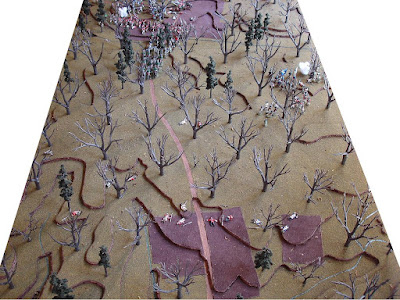
The model battlefield as the battle winds down (click to enlarge). The Americans first line was behind the fields near the bottom of the image, the second line was in the woods in the center, and the third line was at the top (where miniature redcoats can be seen driving back the American Continentals). The green-coated British Legion cavalry are massed behind the infantry. The “separate battle” is occurring along the right edge of the image.

----------------------------------------------------

Meanwhile, Lee attempted to break off the action and join the Continentals on the third line. In his words:

Lee dispensed with his cavalry, heretofore held in the rear to cover retreat in case of disaster, ordering it to close with the left of the continental line, and there to act until it should receive further orders. Upon [Regiment von] Bose... [his troops] now turned with increased animation and with confidence of success. [2]

Lee’s men drove the Guardsmen and Hessians back a little ways. At that point:

Every obstacle now removed, Lee pressed forward... and joined his horse close by Guilford court-house.

However, by the time Lee’s troops reached the courthouse area, the battle for the third line was over. Lee then followed the rest of the army on its retreat.

After Lee retreated, the Rockbridge Rifles were the only sizable group of Americans left on the battlefield (Lee, perhaps, had been unaware of their presence). The Rifles soon were imperiled. At about the same time that Lee left the fight, British Lieutenant-Colonel Banastre Tarleton was dispatched to aid the Hessians and Guardsmen with part of his British Legion cavalry. Tarleton recalled that en route:

[they] found officers and men of both corps wounded, and in possession of the enemy: The prisoners were quickly rescued from the hands of their captors, and the dragoons… [continued on] without delay. As soon as the cavalry arrived, the guards and the Hessians were directed to fire a volley upon the largest party of the militia, and, under the cover of the smoke, Lieutenant-colonel Tarleton doubled round the right flank of the guards, and charged the Americans with considerable effect. The enemy gave way on all sides, and were routed with confusion and loss. [2]

Samuel Houston of the Rockbridge Rifles recalled running for his life from the charging horsemen: “we were obliged to run, and many were sore chased, and some cut down.” [3]

Houston and a number of other riflemen eventually found each other and made their way towards the American encampment.

Darkness and rainfall halted the movement of both armies. Houston’s party, which had several wounded men in it, spent a miserable night in the woods:

all being almost wearied out, we… encamped, where, through darkness and rain, and want of provisions we were in distress. Some parched a little corn. We stretched blankets to shelter some of us from the rain.

The British army encamped on the battlefield. Commissary General Charles Stedman recalled that:

The night… was remarkable for its darkness, accompanied with rain, which fell in torrents…. The cries of the wounded and dying who remained on the field of action during the night exceed all description. Such a complicated scene of horror and distress, it is hoped, for the sake of humanity, rarely occurs, even in a military life. [4]

----------------------------------------------------

British Lieutenant-General Charles Cornwallis had been victorious at the battle of Guilford Courthouse as a victory, but only in a very narrow sense. He had driven the Americans from field, but more than 1 in 4 of his men were killed or wounded in the process. He also failed to achieve his primary objective – restoration of a favorable strategic situation in the southern theater through the destruction of the American army.

American Major-General Nathanael Greene’s army, however, had been greatly damaged. Many of his Continentals had been killed or wounded, and much of his militia was scattered. Some of the North Carolina militia simply went home after the battle; some left out of disgust with what they felt was poor leadership by their commanders.

Greene’s situation was in a sense the opposite of that of Cornwallis. He had been unsuccessful on the tactical level (his defense-in-depth had not stopped the British attack), but he was closer than before to achieving his strategic objectives. Cornwallis gave up his pursuit of Greene’s army and moved eastward where he could be supplied. That move gave Greene an open road into South Carolina, and he soon undertook the reconquest of that state.

When Greene moved south, he expected Cornwallis would abandon North Carolina and try to defend British holdings in South Carolina. Instead, Cornwallis, after being resupplied, moved north into Virginia.

Cornwallis later explained that a retreat into South Carolina would have been difficult to undertake and would further weaken his army. Moreover, he suspected that the fight for control of the South Carolina backcountry would be over before his troops arrived. Cornwallis knew that Virginia was Greene’s main source of men and supplies. He reasoned that no action could better preserve British holdings in the south than taking Virginia out of the war. Furthermore, Virginia was vulnerable: its fine ports and rich plantations were defended by little more than militia.

Neither commander got exactly what he wanted from these moves. Greene had considerable trouble driving the British from the South Carolina backcountry; the campaign in this quarter dragged on for months. Cornwallis had an easy and successful campaign when he first arrived in Virginia, but he was unable to stop Greene’s activity in South Carolina. Furthermore, American resistance in Virginia grew stronger with time. By late summer, 1781, Cornwallis’ operations were largely confined to the coast, and in October his army was besieged and forced to surrender at Yorktown.

----------------------------------------------------

Notes:

1. Pension application of Andrew Wiley.

2. Lee's and Tarleton's accounts of the battle (among others) can be found in this compendium.

3. Houston's account appears in William Henry Foote (1855). Sketches of Virginia....

4. Charles Stedman. (1794). The History of the Origin, Progress, and Termination of the American War, Vol. 2.

Saturday, October 1, 2011

Guilford Courthouse in Miniature (14)

This is Part 13 in a series of posts depicting the battle of Guilford Courthouse in miniature. Previous posts: Part 1, Part 2, Part 3, Part 4, Part 5, Part 6, Part 7, Part 8, Part 9, Part 10, Part 11, Part 12, Part 13.

While British and American regulars battled on the 3rd line at Guilford Courthouse (parts 9-13 in this series), a separate battle took place in the woods to the south. There, Regiment von Bose and the 1st Battalion of Guards advanced against the American light troops in Lieutenant-Colonel Henry Lee’s flank corps.

The British troops were at a disadvantage in the heavily wooded terrain. Commissary General Charles Stedman later wrote:

[The Guards] suffered greatly in ascending a woody height to attack the second line of the Americans, strongly posted upon the top of it, who, availing themselves of the advantages of their situation, retired, as soon as they had discharged their pieces, behind the brow of the hill, which protected them from the shot of the guards, and returned, as soon as they had loaded, and were again in readiness to fire. [1]

The Guards at last seized this hill and pressed on to attack another line of Americans. However:

the battalion was not in regular order when it received the fire of the third American line. The enemy’s fire… poured in not only on the front but flank of the battalion… [until] it was at last entirely broken. Fortunately, at this time, the Hessian regiment of Bose… was advancing in firm and compact order on the left of the guards, to attack the enemy.

The Hessians then wheeled to their right, engaged the Americans, and allowed the Guards to rally. Stedman added:

No sooner had the guards and Hessians defeated the enemy in front, than they found it necessary to return and attack another body of them [the Americans] that appeared in the rear; and in this manner were they obliged to traverse the same ground in various directions, before the enemy were completely put to the rout.

The troops to the rear were probably the Rockbridge Rifles of Brigadier-General Edward Stevens’ brigade of Virginia militia. These troops held a part of the woods in between the British troops in the separate battle and the rest of the British army; thus, they remained on the American second line long after the rest of the Virginia militia had retreated.

The Virginians at last got into action with the 1st Guards. According to Samuel Houston:

we fired on their flank, and that brought down many of them… We pursued them about forty poles [220 yards] to the top of a hill, where they stood, and we retreated from them back to where we formed. Here we repulsed them again; and they a second time made us retreat back to our first ground, where we were deceived by a reinforcement of Hessians, whom we took for our own [both Hessians and Continentals wore blue coats], and cried to them to see if they were our friends, and shouted Liberty! Liberty! and advanced up till they let off some guns; then we fired sharply on them, and made them retreat a little. [2]

----------------------------------------------------

Regiment von Bose drives Virginia riflemen and North Carolina militiamen through the woods at the beginning of the separate battle (here and below, click to enlarge).

In the foreground, the 1st Battalion of Guards struggles against the Rockbridge Rifles. In the background, Regiment von Bose attacks the flank of Lee’s flank corps.

Another view of the above.

----------------------------------------------------

Notes:

1. Charles Stedman. (1794). The History of the Origin, Progress, and Termination of the American War, Vol. 2.

2. Houston's account appears in William Henry Foote (1855). Sketches of Virginia....

Thursday, September 29, 2011

Guilford Courthouse in Miniature (13)

This is Part 13 in a series of posts depicting the battle of Guilford Courthouse in miniature. Previous posts: Part 1, Part 2, Part 3, Part 4, Part 5, Part 6, Part 7, Part 8, Part 9, Part 10, Part 11, Part 12.

At the battle of Guilford Courthouse, British units reached the Americans’ third and final defensive line at different times and attacked in a piecemeal fashion. First Lieutenant-Colonel James Webster led an attack against the American right that was bloodily repulsed (Part 9). Then, the 2nd Battalion of Guards attacked the American left and defeated the troops opposed to them (Part 10). The Guards’ success, however, was short-lived; they were soon mauled made by counterattacking American infantry and cavalry (the 1st Maryland Regiment and Lieutenant-Colonel William Washington’s dragoons; Part 12).

Although these attacks were unsuccessful, the threat they posed was sufficiently great that the American commander, Major-General Nathanael Greene, ordered his army to retreat (Part 11).

The setbacks also did not deter the British from continuing their attacks. The 71st Regiment reached the Guilford Courthouse building more or less opposed, where they threatened the flank and rear of the 1st Maryland Regiment. Webster’s group advanced again and attacked the 2nd Virginia Regiment. Finally, the 23rd Regiment of Foot and the remnants of the Guards began to advance once more.

The American forces still on the field could not hope to repel all of these threats.

Lieutenant-Colonel John Eager Howard was with the 1st Maryland Regiment, and recalled:

I found myself in the cleared ground, and saw the seventy-first regiment near the courthouse, and other columns of the enemy appearing in different directions. Washington's horse having gone off, I found it necessary to retire, which I did leisurely; but many of the guards who were lying on the ground, and who we supposed were wounded, got up and fired at us as we retired. [1]

Then, Webster’s men advanced again and attacked the 2nd Virginia Regiment.

Lewis Griffin of the 2nd Virginia saw his brigade commander get wounded in this clash:

General [Isaac] Huger was wounded in the right hand in my view. I saw him with his Sword in his hand raised above his head encouraging his men when a shot penetrated his hand and his Sword fell in his lap, which he caught up with his left, drew from his pocket a handkerchief, tied up his hand, and moved on, not long after this occurrence we were ordered to retreat. [2]

----------------------------------------------------

At top, the 33rd Regiment of Foot advances against the 2nd Virginia Regiment (click to enlarge). At lower left, the 1st Maryland Regiment holds the open ground; at lower right, the 71st Foot has reached the courthouse building (not shown).

Another view of the above. At bottom and lower left: The 23rd Foot and remnants of the Guards assemble on the edge of the open ground near three-pounders of the Royal Artillery. The 2nd Virginia Regiment is represented by the troops around the red and white flag; the 1st Maryland by the troops around the blue flag.

Another view of the above. In the foreground, the last of the North Carolina militia retreat along the Reedy Fork Road. In the background, the 23rd Foot prepares to advance.

----------------------------------------------------

Finally, the 23rd Regiment of Foot and the remnants of the Guards advanced once more.

According to Lieutenant-General Charles Cornwallis, “the two 6-pounders [of Singleton’s battery] once more fell into our hands; two ammunition-wagons and two other 6-pounders [Finley’s battery], being all the artillery they had in the field, were likewise taken… The 23rd and 71st regiments, with part of the cavalry, were ordered to pursue”. [3]

----------------------------------------------------

At right, the 1st Maryland Regiment retreats along the Reedy Fork Road, while the British Guards, the 23rd, 33rd, and 71st Regiments seize the American artillery.

----------------------------------------------------

The exhausted 23rd and 71st regiments did not advance very far, but the British cavalry thundered down the road after the retreating Continentals. They soon received a check from some troops of the 1st Virginia Regiment, who were acting as rearguard. According to Henry Ingle:

on our retreat we went about 3 quarters of a mile… got into a thicket we had not been there but a little while until we spied the British Light Horse coming through the lane full speed when they got within about 40 yards we stepped out in an open place and fired upon them and there was a dreadful slaughter again of Light horse men &c. [4]

Greene wrote, in concluding his report:

General Huger was the last that was engaged, and gave the enemy a check. We retreated in good order to the Reedy Fork river; and crossed at the ford, about three miles from the field of action, and then halted, and drew up the troops, until we collected most of the stragglers. We lost our artillery, and two ammunition wagons, the greater part of the horses being killed before the retreat began, and it being impossible to move the pieces but along the great road. After collecting our stragglers, we retired… ten miles distant from Guilford. [3]

But the battle was not quite over yet. South of the American third line, a separate battle continued between American riflemen and light infantry and Hessian infantry and British guardsmen.

Notes:

1. Howard is quoted in James Herring and James Barton Longacre (1835). The national portrait gallery of distinguished Americans, Vol. 2.

2. Pension application of Lewis Griffin, transcribed by Will Graves.

3. Cornwallis' and Greene's accounts of the battle (among others) can be found in this compendium.

4. Pension application of Henry Ingle, transcribed by Will Graves.

Monday, September 19, 2011

Guilford Courthouse in Miniature (12)

This is Part 12 in a series of posts depicting the battle of Guilford Courthouse in miniature. Previous posts: Part 1, Part 2, Part 3, Part 4, Part 5, Part 6, Part 7, Part 8, Part 9, Part 10, Part 11.

The 2nd Battalion of Guards was one of the first British units to reach the American third line. They attacked and quickly defeated the 2nd Maryland Regiment. In their pursuit of this regiment, the Guards then captured a battery of guns and gained the American flank and rear (Part 10). This success on their part was short-lived. Moments later they were suddenly counterattacked by the 1st Maryland Regiment and charged by Lieutenant-Colonel William Washington’s light dragoons.

Lieutenant-Colonel John Eager Howard of the 1st Maryland Regiment recalled:

Our men gave them some well directed fires, and we then advanced and continued firing. At this time [Colonel John] Gunby's horse was shot… his horse fell upon him, and it was with difficulty he extricated himself. Major [Archibald] Anderson was killed about this time. As we advanced I observed Washington's horse, and as their movements were quicker than ours, they first charged and broke the enemy. My men followed very quickly, and we passed through the guards, many of whom had been knocked down by the horse without being much hurt. We took some prisoners, and the whole were in our power. [1]

Lieutenant-Colonel Henry Lee, in his history of the southern campaign, wrote that “Gunby… wheeled to his left upon [the Guards]… Here the action was well fought; each corps manfully struggling for victory; when lieutenant colonel Washington… pressed forward with his cavalry… This combined operation was irresistible… the two field pieces were recovered” and the Guards were “driven back with slaughter”.

----------------------------------------------------

From the third line, looking west (here and below, click to enlarge). In the foreground, the 2nd Battalion of Guards melees with the 1st Maryland and William Washington's light dragoons. In the middle ground, British infantry, artillery, and cavalry approach the third line. In the extreme distance lie casualties from the fighting on the first and second lines.

A view of the third line fighting looking south. The 2nd Guards are being mauled at upper left, while other British units approach from the right. At center, the 2nd Virginia Regiment occupies a hillside opposite the 33rd Regiment of Foot.

The 1st Maryland Regiment drives the 2nd Battalion of Guards into the open field.

Washington's light dragoons pursue the remnants of the 2nd Guards.

----------------------------------------------------

Most of the Guards were left prostrate on the field of battle, but a number reached the western edge of the field. Lee believed these men were “saved by the British artillery". He wrote that these guns:

“to stop the ardent pursuit of Washington and Howard, opened upon friends as well as foes; for [Lieutenant-General Charles] Cornwallis, seeing the vigorous advance of these two officers, determined to arrest their progress, though every ball, leveled at them, must pass through the flying guards.” [2]

Neither Howard nor Cornwallis mentioned the British firing on their own men. However, Cornwallis did report that “The enemy's cavalry was soon repulsed by a well-directed fire from two 3-pounders”. [2]

Hundreds of American militia were in the vicinity of this bloody clash, and it seems some were willing to continue the contest. John Wadkins stated that “some of the militia who had stopped at the Court House followed in the rear of the Horse” when they charged the Guards [3]. James Martin claimed that he helped rally “about 500 [men] & was marching them to the Battle Ground” [3].

However, Greene had previously issued orders for the army to retreat (see Part 11), and soon these militia began to move off. Martin noted that when he was approaching the fighting “I met General Stephens [i.e., Brigadier-General Edward Stevens] of [the] Virginia [militia] Corps retreating[.] I asked if the Retreat was by General Greene's Orders[;] he told me it was[.] I then retreated with him” [4].

At the same time that Howard and Washington lost their potential support, the Guards were aided by British troops coming through the woods.

Cornwallis wrote:

the 71st regiment, which, having been impeded by some deep ravine, were now coming out of the wood on the right of the Guards, opposite to the Court-house. By the spirited exertions of Brigadier-General [Charles] O'Hara, though wounded, the second battalion of Guards was soon rallied, and, supported by the grenadiers [of the Guards], returned to the charge with the greatest alacrity. The 23rd regiment arriving at that instant from our left, and Lieut.-Colonel [Banastre] Tarleton having advanced with a part of the cavalry, the enemy were soon put to flight. [2]

Notes:

A challenging aspect of depicting the battle in miniature has involved issues of timing. The sequence of events involving each unit is generally clear, but it’s rather difficult to determine how the events involving one unit corresponded in time with the events involving other units on the battlefield. A source of particular consternation for me has been the retreat of Stevens’ brigade to the third line. In recent posts, Stevens’ men were depicted as reaching the third line only after major combat had begun on the third line (in the second picture, above, they are the block of retreating militia at the top of the image). There are a couple of reasons for this. One is that the 71st Foot is known to have been delayed by rough terrain on its march to the third line (see Cornwallis' quote, above); Stevens’ brigade had to traverse the same ground, and it’s reasonable to think they would have been delayed as well. The other is Martin's pension application (also quoted above), which implies that Stevens’ brigade was still moving towards the courthouse when the Guards were defeated. However, the depiction has ended up looking a bit peculiar – this huge brigade of Virginia militia is shown essentially behind the Guards during the third line fighting. Of course, the alternative would also look a bit odd – having Stevens' brigade reach the third line quickly only to stand idly about while the Guards attacked and routed the 2nd Maryland. (As is, there are already quite a few militia figures shown hovering near the third line, based on Martin’s comment above, and comments by St. George Tucker concerning Lawson’s Virginia brigade [5]). There is, to say the least, room for varying interpretations.

1. Howard is quoted in James Herring and James Barton Longacre (1835). The national portrait gallery of distinguished Americans, Vol. 2.

4. Lee's and Cornwallis' accounts of the battle (among others) can be found in this compendium

3. Pension application of John Wadkins.

4. Pension application of James Martin.

5. Letters of St. George Tucker to his wife (from the Magazine of American History).

Wednesday, September 14, 2011

Guilford Courthouse in Miniature (11)

This is Part 11 in a series of posts depicting the battle of Guilford Courthouse in miniature. Previous posts: Part 1, Part 2, Part 3, Part 4, Part 5, Part 6, Part 7, Part 8, Part 9, Part 10.

At the battle of Guilford Courthouse, Major-General Nathanael Greene used an elaborate defense-in-depth to wear down the advancing British infantry. He hoped they would be primed for defeat by the time they reached the Continentals posted on the the third and final line. However, a number of things had not gone as planned. The North Carolina militia retreated without orders on the first line (Part 4). So too did part of the Virginia militia on the second line (Part 6). Also, Lieutenant-Colonel Henry Lee’s flank corps had become separated from rest of the army (Part 8). Finally, on the third line, the 2nd Maryland regiment gave cursory resistance to the British 2nd Battalion of Guards, then broke and fled (Part 10). Greene later wrote:

[the Guards had] turned our left flank, got into the rear of the Virginia brigade, and appearing to be gaining on our right, which would have encircled the whole of the continental troops, I thought it was most advisable to order a retreat. [1]

There is some unwitting exaggeration in this description. The Guards had gained the rear of the American line, but probably they had not yet advanced as far as the Virginia regiments. The Guards were also much too few in number to encircle “the whole of the continental troops”. Nevertheless, the sudden collapse of his left flank may have appeared to presage the total defeat of his army. Greene's orders to retreat no doubt seemed prudent.

However, the Continental units nearest the 2nd Guards had already chosen to take matters into their own hands.

Lieutenant-Colonel John Eager Howard of the 1st Maryland recalled:

[M]y station being on the left of the first regiment, and next the cleared ground, Captain Gibson, deputy adjutant-general, rode to me, and informed me that a party of the enemy, inferior in number to us, were pushing through the cleared ground and into our rear, and that if we would face about and charge them, we might take them. We had been for some time engaged with a part of Webster's brigade, though not hard pressed, and at that moment their fire had slackened. I rode to [Colonel John] Gunby and gave him the information. He did not hesitate to order the regiment to face about, and we were immediately engaged with the guards. [2]

Also nearby was Lieutenant-Colonel William Washington’s cavalry, which consisted of the 1st and 3rd Light Dragoons, and additional troops raised recently in North Carolina and Virginia.

Lieutenant Philemon Holcombe, who served under Washington, recalled:

Colo[nel] Washington’s command was in view of the conflicting armies and were spectators of the bloody scene for several hours. The Carolina Militia had given way, and the second and third lines of the american army were hard pressed, and the British columns were passing to the rear of the american line, flushed with victory, marching rapidly and in some confusion. [3]

Coolly appraising the situation, Washington did not hesitate to act. In Holcombe’s words, “the brave and gallant William Washington ordered a charge upon their columns”.

The 2nd Battalion of Guards (at center) is simultaneously attacked by the 1st Maryland Regiment (shown here with a blue regimental flag), and Washington's cavalry (the mounted men at left). (Click to enlarge).

Another view of the above; North Carolina militiamen look on as Washington's cavalry charges.

Notes:

1. Greene's account of the battle (among others) can be found in this compendium.

2. Howard is quoted in James Herring and James Barton Longacre (1835). The national portrait gallery of distinguished Americans, Vol. 2.

3. Pension application of Philemon Holcombe.

Saturday, September 10, 2011

Guilford Courthouse in Miniature (10)

This is the tenth in a series of posts depicting the battle of Guilford Courthouse in miniature. Previous posts: Part 1, Part 2, Part 3, Part 4, Part 5, Part 6, Part 7, Part 8, Part 9.

The second battalion of British Guards was placed in reserve at the start of the battle, but before long the battalion entered the action and on the second line it helped defeat both Lawson’s (Part 6) and Stevens’ (Part 7) brigades of Virginia militia. The Guards then pressed on towards the American third line. The units to their left and right were delayed in the woods, and when the Guards reached the third line, they were without support.

The second battalion of Guards found opposite them, in an open field, the 2nd Maryland Regiment. Although the 2nd Maryland was considerably larger, the Guards did not hesitate to attack.

----------------------------------------------------

The Guards Approach the Third Line (click to enlarge). The 2nd Battalion of Guards has entered the field at left and is attacking the 2nd Maryland Regiment. In the foreground, Virginia and North Carolina militia rally. In the distance, Stevens' Virginia militia and several British units approach the edge of the woods, and American light infantry clash with the British left (see Part 9).

----------------------------------------------------

The Marylanders’ regimental commander, Lieutenant-Colonel Benjamin Ford, reacted aggressively. According to an American staff officer (Colonel William Davie), Ford “ordered a charge, that proceeded some distance,” but the brigade commander, Colonel Otho Holland Williams, ordered them to halt and reform their line. The British meanwhile “continued to advance (at the run)”. Soon they brought the disordered Marylanders “under a heavy fire”. [1]

When the 2nd Maryland was ordered to attack again, they gave way and headed for the rear.

Lieutenant-Colonel John Eager Howard blamed this collapse on “the want of officers, and having so many new recruits” in this regiment. Howard’s own regiment, the 1st Maryland, was nearby but provided no immediate assistance. He noted, “This transaction [between the Guards and 2nd Maryland] was in a great measure concealed from the first regiment by the wood, and unevenness of the ground.” [2]

The Guards’ followed the 2nd Maryland into the rear of the American position, and in this pursuit they captured Captain Singleton’s battery of two 6-pounders.

----------------------------------------------------

The Guards pursue the 2nd Maryland and gain the Americans' left flank.

----------------------------------------------------

Notes:

1. Blackwell P. Robinson (1976). The Revolutionary War sketches of William R. Davie, as cited by Lawrence E. Babits (1998). The "Fifth" Maryland at Guilford Courthouse: An exercise in historical accuracy.

2. Howard is quoted in James Herring and James Barton Longacre (1835). The national portrait gallery of distinguished Americans, Vol. 2.

Friday, September 2, 2011

Guilford Courthouse in Miniature (9)

This is the eighth in a series of posts depicting the battle of Guilford Courthouse in miniature. Previous posts: Part 1, Part 2, Part 3, Part 4, Part 5, Part 6, Part 7, Part 8.

At the beginning of the battle, Lieutenant-Colonel James Webster commanded the left half of the British line (the 23rd and 33rd regiments, aided by part of the British Guards and a company of jaegers). With these men, he overcome part of the North Carolinians defending the rail fence (Part 4), and got into a nasty fight with William Washington’s flank corps in the woods (Part 5). During these actions, Webster gravitated to wherever the action was hottest. He boldly led the 23rd Foot through the open fields in front of the North Carolinians on the first line, and then joined the 33rd Foot after its flank was threatened by Washington. [1]

Webster’s men fought with skill and courage, and eventually they pushed through the woods to the Americans’ third and final line. Probably their advance was facilitated by the early and almost total collapse of the second line troops nearest them (i.e., Randolph’s and Holcombe’s regiments of Lawson’s brigade, see Part 6).

In any case, Webster reached the third line before the rest of the British army. Many of the Continentals on the third line were placed on a wooded hillside and hidden from view; Webster, however, could see that part of the line which abutted an old field to his front. He ordered an attack.

According to Lieutenant-Colonel Henry Lee:

Webster… sought with zeal the continental line; and presently approached its right wing. Here was posted the first regiment of Maryland… The enemy rushed into close fire; but so firmly was he received by this body of veterans, supported by Hawe's regiment of Virginia [i.e., the 2nd Virginia] and Kirkwood's company of Delawares… that with equal rapidity he was compelled to recoil from the shock. [2]

A soldier with the 2nd Virginia vividly recalled that the Continentals were positioned “along behind a fence near a creek”, and that “when the British marched up towards us we fired upon them and there was a dreadful slaughter indeed… he could have walked for one hundred yards upon dead men and not have touched the ground.” [3]

According to Lee, Webster fell back across “a ravine in his rear,” “occupied an advantageous height,” and waited “for the approach of the rest of the line.”

Then, the men in Washington’s flank corps tried to exploit this reverse. Sergeant-Major William Seymour of the Delaware regiment wrote, “Washington’s Light Infantry… pursued them up a very steep hill, almost inaccessible”. The British “lay concealed in ambush,” and when the Americans approached they “[rose] up, and [poured] in a very heavy fire” by which the Americans “suffered very much” and “were obliged to retreat”. [4]

Webster's men (at center) approach the 3rd line (here and below, click to enlarge). The blue-coated Continentals are, from left-to-right, the 1st Maryland Regiment, the 2nd Virginia Regiment, and the 1st Virginia Regiment (cf. the third line at Guilford Courthouse). Some of the Virginia militia can be seen retreating from the second third line or rallying behind the Continentals.

The 33rd Foot is staggered by a volley.

“Washington’s light infantry” pursue Webster's men.

Notes:

William Seymour served in Captain Robert Kirkwood’s company of the 1st Delaware Regiment and kept a journal during the southern campaign of the Revolutionary War. At Cowpens, Kirkwood’s company participated in a sudden American counterattack that broke apart the British and turned the battle into a major American victory. Something similar appears to have been attempted on this occasion. The British had fought their way through the militia, only to be bloodily repulsed by the Continentals. The Americans then made a bold counterattack. However, the counterattack at Cowpens is famous, while this counterattack at Guilford Courthouse has been almost wholly forgotten (presumably because the former succeeded while the latter did not). At Cowpens, the American counterattack was made by all of the Continentals and across a short expanse of fairly level ground. At Guilford Courthouse, only “Washington’s Light Infantry” are credited with the counterattack, and the movement was made across a wider and more difficult expanse of ground.

Washington’s Continental light infantry included Kirkwood's Delaware light infantry company, and Captain Phillip Huffman's Virginia light infantry company [cf. Babits & Howard (2009) Long, obstinate, and bloody: The battle of Guilford Courthouse]. Possibly some or all of Colonel Charles Lynch’s Virginia riflemen, who also served in Washington’s flank corps, participated in this counterattack.

1. See the accounts by Charles Cornwallis, Charles Stedman, and Roger Lamb in this compendium of sources.

2. Henry Lee (1812). Memoirs of the War in the Southern Department of the United States.

3. Pension application of Henry Ingle.

4. William Seymour (1896). A journal of the southern expedition: 1780-1783. Papers of the Historical Society of Delaware, 15, 3-42.

Thursday, August 11, 2011

Guilford Courthouse in Miniature (8)

This is the eighth in a series of posts depicting the battle of Guilford Courthouse in miniature. Previous posts: Part 1, Part 2, Part 3, Part 4, Part 5, Part 6, Part 7.

Lieutenant-Colonel Henry Lee had been placed at the head of a flank corps (or “corps of observation”) that consisted of his own legion of infantry and cavalry, some Virginian Continental light infantry, and a corps of riflemen from western North Carolina and Virginia. As briefly noted in Part 1, this corps skirmished with the British on the British march to Guilford Courthouse. Lee’s men then took position on the extreme left end of the first American line.

It so happened that the right end of the British line (Regiment von Bose) passed through this field, giving Lee what he thought was a magnificent opportunity to stymie the British attack. He later wrote:

[the men] raked by their fire the right of the British wing, entirely uncovered… The appearance in this quarter was so favorable that sanguine hopes were entertained by many of the officers, from the manifest advantage possessed, of breaking down the enemy’s right before he approached the fence; and the troops exhibited the appearance of great zeal and alacrity. [1]

However, he claimed that he could not capitalize on the opportunity, because of the rapid collapse of the North Carolina militia on the first line (see Part 4). The sudden retreat of the North Carolinians “threw the corps of Lee out of combination with the army, and also exposed it to destruction.”

Regiment von Bose, aided by the 1st battalion of Guards (brought up from reserve), began to pursue Lee’s men. However, according to Charles Stedman:

the first battalion of the guards, and the regiment of Bose, [were] greatly impeded in advancing by the excessive thickness of the woods, which rendered their bayonets of little use. The broken corps of the enemy were thereby encouraged to make frequent stands, and to throw in an irregular fire… [2]

The pursuit of Lee caused the 1st Guards and Hessians to become separated from the rest of the British army. Soon, they would find themselves in a desperate fight for survival in the deep woods.

----------------------------------------------------

At the beginning of the battle, Regiment von Bose was placed on the right end of the British line, alongside the 71st Regiment of Foot (Fraser’s Highlanders).

However, after the American first line was defeated, the two regiments headed in slightly different directions, and a gap opened between them.

The further the two regiments advanced, the larger the gap became. In this image, the 71st is approaching Brigadier-General Edward Stevens’ brigade, while Regiment von Bose skirmishes with riflemen in Lee’s corps.

However, Regiment von Bose was not without support; the 1st Battalion of British Guards was soon ordered up to their assistance.

Lee’s Legion (foreground) and Campbell’s Virginia riflemen (background) skirmish with the British and Hessians in the woods.

Parties of riflemen contest the Hessians’ advance.

Virginia light infantry cause trouble for the 1st Guards.

----------------------------------------------------

Notes:

In this post I describe the beginning of what is known as the "separate battle" at Guilford Courthouse. I've commented previously on different ways the source material for this part of the battle can be interpreted (see here).

1. Henry Lee. (1812). Memoirs of the War in the Southern Department of the United States.

2. Charles Stedman. (1794). The History of the Origin, Progress, and Termination of the American War, Vol. 2.

Saturday, August 6, 2011

Guilford Courthouse in Miniature (7)

This is the seventh in a series of posts depicting the battle of Guilford Courthouse in miniature. Previous posts: Part 1, Part 2, Part 3, Part 4, Part 5, Part 6.

The second defensive line at Guilford Courthouse was comprised of two brigades Virginia militia. Brigadier-General Edward Stevens commanded the brigade on the left; Brigadier-General Robert Lawson commanded the brigade on the right.

Among those serving in Stevens’ brigade was a young rifleman named Samuel Houston. He recorded in his journal how that morning the men formed a line in the woods and loaded their rifles.

“Presently our brigade major came, ordering [us] to take trees as we pleased. The men run to choose their trees, but with difficulty, many crowding to one, and some far behind others. But we moved by order of our officers, and stood in suspense.” [1]

The men could plainly hear the opening cannonade (Part 2) followed by the roar of muskets and rifles as the first American line came under attack (Part 4). Gradually the sounds of battle drew closer.

Eventually, the 71st Regiment of Foot (Fraser’s Highlanders) emerged through the trees and attacked Stevens’ men. The blow fell not on Houston’s front (on the left end of the brigade), but rather against Stevens’ center and right.

On the first line, the Highlanders quickly overcame resistance by firing and charging with the bayonet. They found Stevens’ men much more difficult to dislodge.

According to American Lieutenant-Colonel Henry Lee, “the Virginia militia… were not so advantageously posted as their comrades of North Carolina, yet gave every indication of maintaining their ground with obstinacy. Stevens… had placed a line of sentinels in his rear with orders to shoot every man that flinched.” [2]

Instead of a single swift charge, the fighting was marked by a long thunderous exchange of rifle and musket fire. According to a Scottish author familiar with the battle, “The ground was level, but the wood was so thick and difficult, that, though the fire rolled in torrents, few were killed on either side.” [3]

Eventually, Stevens was shot in the thigh and his horse killed. [4]

Perhaps at the same time, some of the British Guards had begun to threaten Stevens’ right flank and rear. [5]

In any case, “the Virginians stood their ground & fought until their commander the brave General Stevens ordered them to retreat.” [6] Stevens’ men could hold their head high as they fell back; theirs was the one brigade of militia to wholly carry out their assignment in the Americans’ defense in depth.

----------------------------------------------------

British Guards and Fraser’s Highlanders advance through the woods towards the American second line. Mumford’s regiment of Lawson’s brigade is partially visible at the extreme left. Stevens’ brigade is on the right side of the road. Some of the North Carolinians that had fought on the first line can be seen retreating in the distance. [7]

Guards and Highlanders battle Virginia militia in the woods. At left, the bulk of Lawson’s brigade has taken flight (see Part 6). In the distance is part of the American third line. Some of the North Carolinians that had fought on the first line can be seen retreating towards the third line.

Another view of the above.

----------------------------------------------------

Notes:

1. Houston's account appears in William Henry Foote (1855). Sketches of Virginia....

2. Henry Lee. (1812). Memoirs of the War in the Southern Department of the United States.

3. David Stewart (1825). Sketches... of the Highlanders of Scotland.

4. Lee, ibid; Pension application of Cornelius Sanders.

5. According to Lee, part of the Guards first attacked Lawson’s brigade and then turned on Stevens’ brigade. In his words: “brigadier O’Hara, advancing… with fixed bayonets, aided by the seventy-first… compelled first Lawson’s brigade and then Stevens to abandon the contest.”

6. Pension application of Christopher Hand.

7. This depiction refers to the following statement by British Lieutenant-General Charles Cornwallis:

The 71st regiment and [Guards] Grenadiers, and second battalion of Guards, not knowing what was passing on their right, and hearing the fire advance on their left, continued to move forward, the artillery keeping pace with them on road, followed by the cavalry.

Events “passing on their right” will be covered in the next post in this series. The “advance on their left” refers to Webster’s activity on the British left flank, which I began to describe in Part 5, and which I will take up again in Part 9.