Showing posts with label evolution. Show all posts

16 September 2014

the evolution of the dodgers' first baseman, part 2

in the first installment of the evolution of dodger first basemen, we ended with hall of famer eddie murray signing a free agent deal with the mets, making room for someone else on the evolutionary chain.  the dodgers acquired todd benzinger via trade shortly after losing murray, but a rookie ultimately won the job in spring training.

eric karros (1992-2002)
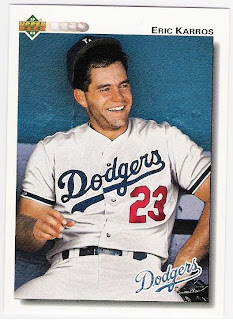
yes, for 11 seasons, karros was the dodgers' first baseman.  that is the longest tenure since gil hodges, who just happened to be karros' dad's favorite player.  karros (shown on his 1992 upper deck card) was never an all-star, but he put up solid numbers.  he won the 1992 nl rookie of the year award with 20 homers and 88 rbi, and had probably his best all-around season in 1995.  that year, he led the dodgers to the postseason for the first time since 1988 with a .298 average and 32 homers and 105 rbi - good enough to win the silver slugger and finish 5th in the mvp voting. he also hit 2 homers with a .500 average in the nlds against the reds, but the dodgers were swept.  following the 2002 season, karros was traded to the cubs, but his name remains at or near the top of many los angeles dodger leader boards today.  karros is the all-time la dodger leader in home runs (270), and he is fourth (behind bill russell, willie davis, and steve garvey) in games played.  he trails only davis and garvey in total bases and doubles, and only garvey in rbi.  karros is also currently the all-time la dodger leader in strikeouts, but matt kemp (should he remain a dodger next year) will pass him as soon as he k's 54 more times.

i suspect that the karros/mark grudzielanek for todd hundley/chad hermanson deal was a salary dump (the dodgers saved themselves over $10 million (if one assumes that karros' option would have kicked in) with the trade, even taking on hundley's salary.  the dodgers had paul loduca behind the plate, so they didn't need hundley, but they did need a first baseman to replace karros.  so, they took the guy who had been playing there for the cubs.

fred mcgriff (2003)
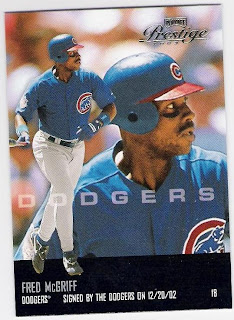
a couple of weeks after trading karros to the cubs, the dodgers signed former southsider first baseman fred mcgriff.  that's his 2003 playoff prestige card, giving a sort of o-pee-chee vibe.  the crime dog had joined the cubs during the 2001 season after it became apparent that the team had gotten rid of mark grace too soon - matt stairs wasn't cutting it as grace's replacement.  mcgriff, who had averaged 30 home runs a season in his previous 16 seasons, needed just 22 to reach 500 for his career, and i sure thought that he would do it with the dodgers.  unfortunately, mcgriff hit only 13 home runs while playing in only 86 games.  in fact, he started only 79 games at first base, with jim tracy using seven other players at first (including ron coomer, robin ventura, daryle ward, paul loduca, mike kinkade, larry barnes, and even jolbert cabrera).  mcgriff returned to the devil rays for the 2004 season, but still fell 7 homers shy of 500.

shawn green (2004)
green, shown playing first on his 2005 upper deck card, had moved to the infield following the team's acquisition of milton bradley just prior to the beginning of the 2004 season.  earlier in spring training, green had worked out at first, but jim tracy said that he would be playing right field once the season began.  so much for that.  2004 turned out to be green's swan song for the dodgers, and he hit 28 homers with 86 rbi and a .266 average.  he also hit 3 homers in the nlds against the cardinals that year.  i was a big shawn green fan even before he joined the dodgers, and i was sad to see him go.

hee-seop choi (2005)
that's a 2005 bowman sterling bat relic card of hee-seop choi, once thought to be the answer for the cubs at first base following the departure of the aforementioned fred mcgriff and some seasoning behind karros.  instead, the cubs dealt choi to the marlins for derrek lee (a good deal as it turned out), and the fish sent choi to the dodgers in the 2004 trade that broke jim tracy's heart.  ok, that might be a bit extreme, but tracy lamented the loss of paul loduca in that trade, and i'm not completely certain that he didn't take some of his frustration out on choi.  choi began the 2005 season as the team's first baseman, and wound up hitting 15 homers with 42 rbi in 133 games, only 78 of which were starts at first base.  choi participated in the home run derby during the all-star break (he had hit 3 homers in a game against the twins in june and 6 in the series against the twinkies) but was essentially just a pinch hitter for tracy following the break.  he lost most of his starts to olmedo saenz in the second half.

nomar garciaparra (2006)
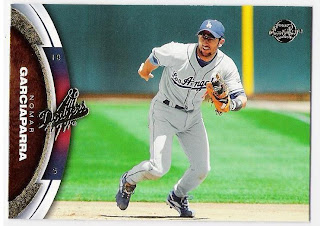
nomah! that's nomar's 2006 upper deck sweet spot update card - not sure why upper deck issued an update to sweet spot, but i'll take it.  there are too few cards of nomar as a dodger.  nomar had never played first base in the major leagues before joining the dodgers, but that's all he played in 2006.  he appeared in 122 games for the dodgers that year, 117 of which were starts at first.  as the nl comeback player of the year, nomar hit .303 with 20 homers, 82 runs scored, and 93 runs driven in.  he made the all-star team and finished 13th in the mvp voting, while helping the dodgers reach the postseason.  despite a move to third in 2007, nomar still played more games at first base, but not as many as james loney, the next step on the evolutionary chain.

james loney (2007-2012)
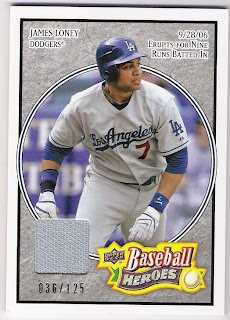
after four 'one and done' first basemen, loney (shown on a 2008 upper deck baseball heroes relic card) brought some stability back to the position.  he hit .331 as a rookie in 2007 in 96 games (85 of which were starts at first) and also hit 15 home runs.  other than a dip in 2010, loney was pretty consistent in his first few seasons with the dodgers, driving in around 90 runs and hitting in the high .280's.  he was slumping in 2012, batting just .254 with 4 homers and 33 rbi after 114 games played, when he was traded to the red sox in the megadeal that landed the dodgers their current first baseman.

adrian gonzalez (2013-present)
that's gonzalez's 2013 topps finest card, by the way.  gonzalez hit .297 as a dodger during the 2012 season after the trade, and then hit .293 in his first full season with the club.  this year, he is batting just .276 (through this past sunday), but he has eclipsed last year's 22 homers and 100 rbi with 23 long balls and 103 runs driven in so far this year.  i am hoping that he eclipses his postseason numbers from last year as well, as he hit over .300 with 3 homers and 7 rbi in the 2013 playoffs.

and so we have reached the end of not only the dodgers' first baseman evolution, but the evolution of each position.  you can use the 'evolution' label to find the posts for all of the positions (some may be slightly outdated as i began this with a run through the managers over five years ago).  it's been fun tracking the history of the dodgers by position using baseball cards, which was one of the goals i had when i started this blog almost 6 years ago, although that also means i am getting closer to the end.

10 September 2014

the evolution of the dodgers' first baseman, part one

it is well known that jackie robinson began his major league career as the dodgers' first baseman in 1947.  unfortunately, i do not own a 1947 bond bread card of jackie's, nor do i own a 1948 leaf card to show in this space.  with that being the case, i'll start the evolution of the dodgers' first baseman with the guy who replaced jackie at first in 1948, gil hodges. this is not a departure from the norm, using a fantastic 1952 bowman card to kick off an evolution post (this is a baseball card blog and i don't have many pre-1950's cards in my collection), but it sure would have been nice to see that leaf card of jackie up top.  maybe someday.

gil hodges (1948-1959)
yes, hodges' 1952 bowman card is fantastic.  i enjoy having it in my collection.  the dodgers enjoyed having hodges' bat in their lineup following his conversion from catcher to first baseman in 1948.  he hit a total of 361 home runs for the dodgers, including 344 during the 12-year span in which he was the team's primary first baseman.  the club also won two world championships (and 6 pennants) with him at first.

norm larker (1960-1961)
norm!  larker (shown on his 1961 topps card) took over for hodges in 1960 and promptly went out and finished second in the national league batting race, .002 behind dick groat and .004 ahead of willie mays.  he was an all-star that year, but came back to earth in 1961, hitting .270 in just 95 games.  he was drafted by the colt .45's in the expansion draft prior to the 1962 season, and he became the very first first baseman in houston's history.  if there were an astros blogger out there doing this same sort of post, larker would be at the very start.

ron fairly (1962-1964)
with larker gone, fairly moved to first from the outfield.  yes, i am showing his 1965 topps card even though he was back in the outfield when the 1965 season rolled around.  before that, however, he enjoyed three solid seasons as the dodger first baseman, averaging 12 homers and 74 rbi.  he was playing more outfield by the end of the '63 season, making way for bill skowron.  as a result, he made only late-inning appearances during the 1963 world series.

wes parker (1965-1972)
skowron left the dodgers after one season, and fairly moved back to the outfield with wes parker taking over at first.  he became part of the team's all switch hitting infield (with jim lefebvre, jim gilliam, and maury wills) and helped the dodgers win the world series against the twins.  parker also won gold gloves in 6 of his 8 seasons spent playing primarily at first (including 1971 - the year of the topps card shown above).  in 1970, he led the national league with 47 doubles, but he was always better known for his skill with the leather, compiling a career .996 fielding percentage as a first baseman.  he retired following the 1972 season at the age of 32.  parker is the only non-hall of famer on rawlings' all-time gold glove team.

bill buckner (1973)
buckner's 1974 topps card lists him as a first baseman because he played in 93 games (83 starts) at the position in 1973.  he hit .275 and played in 140 games overall that year, and was moved back to the outfield in 1974, where he was seen climbing the wall in atlanta trying to get to hank aaron's 715th career home run.

steve garvey (1974-1982)
there aren't a lot of steve garvey cards from his playing days that i haven't shown on the blog yet, but that 1980 kellogg's card is one of them.  the garv took over the first baseman's job and wound up winning the all-star game and national league mvp awards in 1974.  he held on to the job until he left the club as a free agent following the 1982 season, amassing 8 consecutive all-star starts, 4 gold gloves, 4 pennants, and a world series championship during that 9-year span.

greg brock (1983-1986)
brock, shown on his 1986 o-pee-chee card, was a triple-a phenom who had the misfortune of being asked to replace garvey in the dodgers' lineup and maybe even continue the dodgers' string of rookies of the year (they had owned the award since rick sutcliffe won it in 1979, with steve howe winning in 1980, fernando valenzuela in 1981, and steve sax in 1982).  unfortunately, brock hit just .224 with 20 homers in 146 games in his rookie year, finishing 7th in the 1983 nl rookie of the year balloting.  the dodgers still won the west, however, and brock was 0 for 9 in his first taste of postseason play.  the following season, he hit .225 while playing in only 88 games, but still spent more time at first than anybody else.  in 1985, he helped the dodgers return to the postseason with what may have been his best season with the dodgers - he hit .251 with 21 homers and 66 rbi in 129 games.  he got his only postseason hit of his career that year, a home run in game 2 of the nlcs.  he was hitless in his other 11 at bats of the series.  following another lackluster season, brock was traded to the brewers for a couple of tims - crews and leary.

franklin stubbs (1987-1988)
stubbs had been the dodgers' left fielder in 1986, but moved to first to replace brock in 1987.  he had a 'brock-ish' season, however, hitting .233 with 15 homers and 52 rbi in 129 games, 111 of which included some time at first.  in 1988, stubbs appeared in 84 games at first for the dodgers, 54 of which were starts, which was more than mike marshall (54 games, 51 starts) so he gets the nod here for the year that was so improbable.  that's his 1988 score card, by the way.  stubbs started all five games of the '88 world series, hitting .294 with a couple of rbi. interestingly enough, stubbs went to the astros in a trade prior to the 1990 season, but signed with the brewers as a free agent for the 1991 campaign wherein he replaced greg brock as the first baseman for the brew crew.

eddie murray (1989-1991)
the dodgers were likely tired of a lack of production from the first base position since garvey's departure, so they traded for hometown guy eddie murray following their world series triumph over the a's.  steady eddie showed up in 1989 (i was excited to see him in dodger blue on his 1989 upper deck card shown above) and played in 160 games (159 at first) but hit only .247.  he did drive in 88 runs, however, and in 1990 he led all of major league baseball with a .330 average.  too bad for murray that willie mcgee was hitting .335 when he was dealt from the cardinals to the a's (mcgee hit only .274 with oakland, dropping his composite average to .324 for the season).  murray left the dodgers after the 1991 season as a free agent, opening the door for a rookie named eric karros to win the job even though the team had traded for todd benzinger just in case.

18 June 2014

the evolution of the dodger second baseman, part 3

here are the first and second installments, in case you want to catch up on the sometimes annual turnover the dodgers have experienced at second base.

the dodgers were coming off their worst record ever as they headed into the 1993 season.  they lost one of their young second basemen, eric young, in the expansion draft, but they replaced him that same day with another player drafted by the rockies.

jody reed (1993)
the rockies selected reed two rounds after they picked up young.  i would imagine that they had a deal in place with the dodgers to draft and trade reed, which they did in exchange for rudy seanez.  reed (shown on a 1993 fleer final edition card) played in 132 games for the 1993 dodgers, including 129 starts at second.  he hit .276 for the dodgers, helping them climb back to .500.  following the season, he famously declined a contract extension and left as a free agent, ultimately taking less money to sign with the brewers.

the dodgers responded to reed's rejection by trading pedro martinez to the expos for a 24-year old second baseman who was coming off two straight .290+ seasons.  i admit, i was optimistic.

delino deshields (1994-1996)
that's deshields' 1995 pinnacle card, by the way.  as i mentioned, i was hopeful that deshields would be the dodgers' second baseman for a long time based on his play in montreal.  unfortunately, he hit just .250 in the strike shortened 1994 season, and then only .256 the next year.  in 1996, he bottomed out at .224 with a career low .288 on base percentage.  he left as a free agent after that season, and immediately hit .295 for the cardinals in 1997.  meanwhile that same season, pedro won the national league cy young award for the expos, and the dodgers were fielding yet another different second baseman.

wilton guerrero (1997)
guerrero (shown on a 1997 donruss dodgers team set card) started 83 games at second base for the 1997 dodgers.  he hit .291 overall, but had an on base percentage of only .305 - one reason why the dodgers reacquired eric young from the rockies late in the season.

eric young (1998-1999)
young (shown on a 2000 topps card) finally got his shot to be the dodgers' every day second baseman in 1998.  he played in 117 games (112 starts at second) and hit .285 with an obp of .355.  in 1998, he upped that to .371 in 119 games (115 starts at second).  unfortunately, young was traded to the cubs after the 1998 season for terry adams and a couple of minor leaguers.  young was expendable, because the dodgers had plans to move recently acquired mark grudzielanek from short to second in 2000.

mark grudzielanek (2000-2002)
that's grudzielanek's 2001 topps finest card, one of very few cards i have from that release.  the g-man moved from short to second in 2000 and hit .279 while scoring a career high 101 runs. he hit .271 in both 2001 and 2002 as the dodgers' second baseman, but was traded to the cubs prior to the 2003 season.

alex cora (2003-2004)
cora had replaced grudzielanek as the dodgers' shortstop when he moved to second, and now he replaced him at second following the trade with the cubs.  cora (shown on his 2003 upper deck 40 man card) played in a career high 148 games in 2003 (141 appearances and 122 starts at second) and followed that up with 138 games (and appearances at second, with 122 starts there) in 2004.  he hit a career high 10 homers in 2004, including one that was the culmination of an 18-pitch at bat against matt clement and the cubs.  cora left the dodgers as a free agent prior to the 2005 season.

jeff kent (2005-2008)
the dodgers signed socal native kent (that's his 2006 topps heritage card) shortly after the end of the 2004 season.  he started 140 games at second his first season with the club, scoring 100 runs and driving in 105 more.  he represented the blue at the all-star game that season as the national league's starting second baseman, and also won a silver slugger award.  it was the best offensive season the dodgers had seen from a second baseman in quite a while, perhaps since jackie robinson's mvp season of 1949.  in 2006, he helped the team reach the postseason and then went 8 for 13 with a home run in the dodgers' nlds loss to the mets.  kent retired following the 2008 season in which he helped the dodgers reach the nlcs for the first time since 1988, but he was unfortunately held hitless in the series.

one more group to go before we are caught up with this position...

28 May 2014

the evolution of the dodger second baseman, part 2

when we last saw the dodger second baseman, he (paul popovich) was on his way to the expansion montreal expos, so someone needed to step up in 1969.  that someone was…

ted sizemore (1969-1970)
sizemore (seen with his topps rookie team trophy on his 1970 topps card) actually started the season at shortstop (jim lefebvre was at second), but he moved to second when lefebvre got hurt in mid april.  even though he returned to short when lefebvre came back, walt alston eventually switched sizemore back to second when the club reacquired maury wills to play shortstop.  sizemore played 118 of his 159 games in 1969 as the dodgers' second baseman, and hit .271 as he was named the national league's rookie of the year.  in 1970, he appeared in only 96 games, but made 81 starts at second for the dodgers so he retains his title as their primary second baseman.  he hit .306 that year and was dealt following the season to the cardinals in the dick (rich) allen trade.

jim lefebvre (1971)
look who's back.  lefebvre, who had been the team's primary second baseman in 1965 and 1966 and is a former rookie of the year himself, was back at the position in 1971.  that's lefebvre's 1972 o-pee-chee card, by the way.  he played in 102 games as the dodger second baseman in '71 (98 starts) and hit .245 with 12 homers.

lee lacy (1972)
once again, lefebvre began the season as the team's second baseman, but hit a rough patch in early may and gave way to bobby valentine.  soon thereafter, lee lacy (shown on his 1973 o-pee-chee card) was called up from the minors, and he went on to lay claim to the position.  lacy made 58 starts at second - about a dozen more than valentine and 20 or so more than lefebvre.  he hit .259 and scored 34 runs, but didn't play much in september, as the dodgers called up another guy to play some second.

dave lopes (1973-1981)
lopes (shown on a very crooked 1979 kellogg's card) made 11 starts during the last month of the 1972 season, and i guess alston saw enough.  he handed the position over to lopes in 1973, giving him 133 starts that year.  he dabbled in the outfield from time to time, but otherwise held the position through the 1981 world series.  along the way, he led the league in steals twice, won a gold glove, made four all-star teams, and helped the dodgers to four pennants and a world series title.  he was the second baseman on the team of my youth.

steve sax (1982-1988)
like lopes, sax held the dodgers' second base position until they won a world series title.  lopes, however, was traded prior to the 1982 season while saxy left after the 1988 campaign as a free agent.  before that happened, he was the fourth dodger second baseman to win the rookie of the year award, and he made three all-star teams, including the 1983 squad as alluded to on the 1984 topps glossy all-star card above.  in 1986, sax finished second to tim raines in the batting title race, hitting a career high .332 (raines hit .334).  he twice led the national league in errors while with the dodgers and much was made about his difficulties throwing to first base, but he was still my favorite dodger after steve garvey left town.  besides, i don't think of him defensively - my lasting steve sax memory is of him hitting the first pitch of the 1988 season into the left field bleachers at dodger stadium.

willie randolph (1989)
the yankees and dodgers essentially traded second baseman for the 1989 season, although both signed with their new teams as free agents.  with sax gone to the bronx, the dodgers signed willie randolph (seen on a 1989 fleer update card).  randolph appeared in 145 games in 1989, including 139 starts at second.  he hit .282 and was selected to the all-star team.  however, the dodgers traded him to the a's early in the 1990 season for stan javier.

juan samuel (1990-1991)
following the 1989 season, the dodgers traded mike marshall and alejandro pena to the mets for samuel.  they moved him back to his original position of second base (the mets were using him as their center fielder), and he made 101 starts there for the dodgers in 1990.  the following year, samuel started 150 games at second for the blue, and didn't sniff the outfield.  he made the all-star team that year as well, hitting .271 with 74 runs scored and 23 steals.  samuel began the 1992 season as the team's second baseman, but was released in july.  eric young was called up to take his roster spot, but there was another player who actually played second more than anyone else that year.

lenny harris (1992)
yes, i am using cards from 1992 fleer ultra for both samuel and harris in this post.  it's what i had handy.  deal with it.  the second baseman position in 1992 looked something like this:  samuel, 29 starts; mike sharperson, 33 starts; eric young, 35 starts; harris, 65 starts.  harris had been the team's primary third baseman in 1991, and he played some third as well as short and outfield in 1992 as well.  overall, harris hit .271 while fielding at a clip below league average for second basemen.  many thought that young would be the dodgers' second baseman of the future, but they weren't convinced as he was left unprotected in the 1993 expansion draft and was taken by colorado.  as a result, the dodgers worked out a deal with the rockies to acquire one of their later draft picks to fill the hole at second.  that set into motion events that would lead to one of the worst (thanks to hindsight) trades in dodger history.  stay tuned...

06 May 2014

the evolution of the dodger second baseman - beginning with jackie

just two positions left to review in my evolutionary posts.  this one is special to me because i spent most of my playing days at second base, and even though i was a steve garvey fan, i marveled at the dodger lineage at second base.  as a little leaguer, i traced it back from dave lopes to jim lefebvre to jim gilliam to jackie robinson.  i later learned that it wasn't quite that clean, but still.  at some point, it traces back to jackie, which is where i will start.  besides, it gives me a reason to show my 1952 topps jackie robinson card again, now freed from its plastic cage.

jackie robinson (1948-1952)
jackie was named the rookie of the year in 1947 when he was the dodgers' first baseman.  in 1948, brooklyn traded their second baseman, eddie stanky, to boston and gil hodges took over at first with jackie moving to second.  he stayed there for five seasons, winning the mvp award in 1949 and leading the league with a .342 average as well.

jim gilliam (1953-1957)
like jackie, gilliam was named the rookie of the year, but he won the award as the dodgers' second baseman in 1953.  that's his 1954 topps card - i unfortunately don't have a copy of his 1953 topps issue.  although gilliam also played some outfield in 1955 and 1956, he was the team's primary second baseman through 1957.  he finished fifth in the league mvp voting in 1956, when he hit .300 and helped the dodgers return to the world series.

charlie neal (1958-1961)
gilliam moved to the outfield in 1958 as the dodgers moved west, and so charlie neal moved from short to second.  he remained the dodgers' second baseman until he was traded to the mets following the 1961 season.  he made two all-star teams for the dodgers in his tenure as their second baseman, including the 1960 team as noted on his 1960 topps all-star card, and he also won the gold glove at the position in 1959.

jim gilliam (1962-1963)
with neal in new york, jim gilliam returned to the position in 1962, which is the year that the bell brand card shown above was issued.  he finished 6th in the mvp voting in 1963 as the team's second baseman, but once the world series came along, he moved to third base and dick tracewski played second in the dodgers' four game sweep of the yankees.

nate oliver (1964)
oliver was a second year player in 1964 when he hit .243 in 99 games and played more second base than any other dodger.  tracewski and gilliam also spent time at the position that season, but oliver started 97 contests there.  in 1965, however, he played second in only 2 games at the big league level.

jim lefebvre (1965-1966)
another dodger second baseman to win the rookie of the year award, lefebvre (shown on his 1965 topps rookie card) hit .250 with 12 homers en route to the honor.  he did better in 1966, hitting 24 homers with a .274 batting average while being named to the all-star team for the only time in his career.  he also began playing some third base, and spent most of the 1967 season at the hot corner.

ron hunt (1967)
hunt was acquired by the dodgers after the 1966 season from the mets in the tommy davis trade.  topps was abel to get him into the 1967 set as seen above, although the card is a bit of a high number (525).  he spent the 1967 season in los angeles before being traded to the giants prior to the 1968 campaign.  during his stint with the dodgers, hunt started 89 games at second base batting .263 while hitting 3 homers and driving in 33 runs.

paul popovich (1968)
with hunt going to the giants, the dodgers turned to popovich, an offseason acquisition from the cubs, to man second base in 1968.  his 1968 topps card there identifies him as an infielder, and he lived up to that billing by playing second, short, and third in '68.  still, his 80 starts at second base is what qualifies him for a spot in the team's evolutionary chain.  he hit only .232 on the season, and was traded to the expos early in the 1969 season, meaning that the merry-go-round of dodger second basemen would continue...

14 February 2014

the evolution of the dodger shortstop, part 3

this post will wrap up the dodger shortstop evolutionary chain.  at least until hanley ramirez fails to play the majority of time at the position.  we left off a couple of days ago with cesar izturis being injured in 2005.  as a result, ned went out and signed rafael furcal for the 2006 season.

rafael furcal (2006-2007)
furcal, seen above on a 2007 bowman heritage card, had a fantastic inaugural season with the dodgers.  he hit .300, played short in 156 games, stole 37 bases, tied a career high with 15 home runs, and finished 14th in the mvp voting.  he regressed in 2007, but still appeared at short in 138 games that year.  it looked like he had turned things around the following season, as he was hitting .366 through may 5, 2008, but furcal suffered an injury that kept him out of action until the final week of the season.

angel berroa (2008)
berroa was the main beneficiary of furcal's injury in 2008.  nomar garciaparra, chin-lung hu, luis maza, and pablo ozuna all spent some time at short with furcal out, but berroa got more starts (69) than any of them.  overall, he appeared in 84 games and hit .230.  after the season ended, he signed a deal with the yankees, and later almost double dipped with the dodgers.  they signed berroa to a free agent deal after the 2009 season ended, but wound up releasing him towards the end of spring training 2010.

rafael furcal (2009-2010)
furky returned to reclaim the position in the 2008 postseason, and then appeared in 149 games as the dodgers' everyday shortstop in 2009.  he also led the team in appearances at the position in 2010, although the number of games he played there dwindled to 93 that year.  he hit an even .300 in 2010, and made the all-star team for the first time as a dodger.  he appeared in only 37 games for the dodgers in 2011 prior to a trade deadline deal that sent him to saint louis.

jamey carroll (2011)
carroll actually played more second base than shortstop in 2011, but his 54 games started at short narrowly edged dee gordon's 51.  gordon claimed the job towards the end of the season, but i will still acknowledge the time that carroll spent there after furcal was traded.  carroll hit .304 as a shortstop in 2011 and made only 4 errors in 214 chances.  he parlayed his solid play into a free agent deal with the twins for the 2012 season.

dee gordon (2012)
gordon led all dodger shortstops with 73 starts in 2012.  he struggled at the plate, however, as his batting average dropped almost 80 points from his 2011 mark of .304.

hanley ramirez (2013)
it's taken a village to cover the shortstop position for the dodgers since furcal was traded.  in addition to carroll and gordon, the likes of aaron miles, justin sellers, luis cruz, juan uribe, elian herrera, and jerry hairston (and maybe a couple more) have played the position.  in 2012, ned traded for hanley ramirez to try to stabilize things.  he played there in 57 games after coming over from the marlins and then last year appeared in 76 games at short.  injuries limited him to just 86 total appearances, but he hit .345 and finished 8th in the mvp voting.

ramirez is slated to play short for the dodgers in 2014, which is a contract year, so i expect big things.  i also hope he re-signs, because i am pretty tired of the turnstile at short.

coming soon, the evolution of the dodgers' second basemen…stay tuned.

12 February 2014

the evolution of the shortstop, part 2

it's been awhile and i need to finish off these position evolution posts.  here's the second installment of the shortstop evolutionary chain - this time from anderson to izturis.

dave anderson (1984)
andy started 111 games at short in 1984, replacing the dean of the dodgers, bill russell, as the team's first primary shortstop not named wills or russell in 15 years.  he hit .251, and the following year spent more time at third base than short.  that's because the dodgers promoted mariano duncan.

mariano duncan (1985-1987)
duncan appeared at shortstop in 123 games (120 starts) for the dodgers in 1985.  he hit .244 with 38 steals and helped the dodgers reach the playoffs, although he hit just .222 in the nlcs against the cardinals.  in 1986, duncan appeared in 106 games as the dodgers' shortstop, and while he stole 48 bases, his batting average dropped to .229 and he was losing favor as the dodgers' shortstop of the future.  in 1987, duncan's average dropped to .215 and he played at shortstop only slightly more (538 innings to 499) than anderson.  he was demoted to the minor leagues for the entire 1988 season, as the dodgers went out and brought in alfredo griffin.

alfredo griffin (1988-1991)
griffin, seen above admiring one of his mammoth home run blasts on his 1991 topps stadium club card, barely gets the nod in 1988 thanks to his 89 starts at short compared to anderson's 72 starts.  he hit a lousy .199 on the season, and then was even worse at the plate in the postseason - .160 in the nlcs and .188 in the world series - but the dodgers won it all anyway.  griffin had better seasons as the dodgers' primary shortstop in 1989 (136 games, .247 average), 1990 (141 games, .210 average), and 1991 (109 games, .243 average) before returning to the blue jays in 1992.

jose offerman (1992-1995)
offerman hit in the .260's in both 1992 and 1993 as the dodgers' everyday shortstop.  unfortunately, he made 42 and 37 errors in those seasons respectively, earning his nickname 'e-fferman'.  at least that's what i called him.  he lost a fair amount of playing time to rafael bournigal in 1994, but still managed to be the team's primary shortstop.  in his final season as a dodger (1995), offerman remained the everyday shortstop, and even made the all-star team thanks to a .303 average at the break (he wound up hitting .287 on the season).  offerman was traded to the royals after the 1995 season, and kc immediately moved him out of the shortstop position and reaped the offensive benefits that followed.  no joke - offerman averaged .306 over his three seasons with the royals.

greg gagne (1996-1997)
gagne came over from the royals after the 1995 season, but not in the offerman trade - it was his signing as a free agent actually made offerman expendable.  over the course of the next two seasons, gagne missed only 52 games (that's what passed for stability at this position back then) and hit .253 with a little pop.  he finished his career as a dodger, retiring after the '97 season.

jose vizcaino (1998)
el viz returned to the dodgers for the 1998 season, and he wound up leading the team with 65 starts at the position while hitting .262.  juan castro, wilton guerrero, alex cora, and even adrian beltre also spent time there, but vizcaino got the nod most often.  until the dodgers made a trade deadline deal, that is.  after that, mark grudzielanek took over the position.

mark grudzielanek (1999)
the g-man appeared in 123 games for the dodgers in 1999, 119 (118 starts) as a shortstop.  he also hit a robust .326 on the season.  yes, his 2002 upper deck card shown above lists him as a second baseman, and for good reason - he switched to second in 2000.

alex cora (2000-2001)
cora played short for the dodgers in 101 games in 2000 and 132 games in 2001.  he didn't do much offensively, and was an average fielder, but jim tracy played him.  like grudzielanek, cora later moved over to second base.

cesar izturis (2002-2005)
the dodgers went out and acquired izturis in a trade with the blue jays after the 2001 season.  i recall hearing him advertised as a slick fielding prospect and so was not really surprised when he posted obp numbers below .300 during his first two seasons as the dodgers' primary shortstop.  in 2004, however, his third year at the top of the depth chart, izzy put it all together, hitting .288 with an obp of .330 and 25 steals.  he also won the gold glove that year - the first dodger shortstop to do so since maury wills in 1962.  in 2005, izturis again was the dodgers' primary shortstop, at least until an injury sidelined him for the season in august. the following year, he found his starting job lost and was traded to the cubs for greg maddux.

i'll wrap up the shortstop evolution in a couple of days.  stay tuned.