Showing posts with label 1994 bowman. Show all posts

26 December 2014

rhoden and john and hough

i consider don sutton to have been the ace of the team of my youth, but the dodgers of the mid to late 1970's had a pretty strong staff.  i got kind of tired of seeing doug rau pitch seemingly every time we trekked to dodger stadium, but it wasn't because he was a bad pitcher - i just would have rather have seen tommy john or rick rhoden or burt hooton more often.  anyway, it's boxing day and things are slow and i don't have any good post ideas, so here are some non-dodger cards of three members of the dodger pitching staff from the team of my youth.

1988 score rick rhoden
and tommy john
rhoden and tj were reunited on the yankees, although this was john's second time around with the club. here's the back of john's 1981 topps card
for no other reason than to show the 'on disabled list' text that defined his 1975 season and his legacy as well.

here's the back of rhoden's 1988 topps big card for no other reason than to note that rhoden was a fan of both bob gibson and hulk hogan
'his' comment in the ping pong cartoon is not entirely true - rhoden did get to hit as the yankees' dh in a game during the 1988 season.  here's the front of that topps big card, by the way
rhoden sports the same mustache on his 1988 leaf card
which is so much better than 1988 donruss.

here's a 1988 fleer superstars card of rhoden
i wonder what he's got in that gatorade cup.

rhoden finished out his career with the astros in 1989.  here's his 1989 fleer update card
tommy john, meanwhile, began his career in cleveland.  here's a 2003 topps retired signature card showing him in indians' attire.
and let's not forget about charlie hough, who was actually the dodgers' closer in 1977, saving 22 games for the nl champs.  he moved on to texas where he became a starter and found some success.  this is a 1987 donruss all-stars card of the knuckleballer
who finished his career with stints with the white sox and then the marlins.  this is a 1993 topps finest card of hough with the fish
as are these 1994 bowman
and 1994 topps stadium club cards
that last one being the rainbow foil parallel.

i did a 'torchbearer' post for sutton, so i'll do something similar for these guys.  i won't go into too much detail, but if you're wondering, the last batter rick rhoden faced in the majors was joe oliver (who hit into a double play). oliver doubled off of jorge julio in his last at bat; julio hit jorge cantu with his last pitch, cantu fouled out against rex brothers for his final appearance in the majots, so brothers (who was still pitching for the rockies in 2014) is carrying rhoden's torch.

john, meanwhile, allowed a single to devon white just before walking off the mound for the last time.  white singled off of albie lopez his last time up; lopez gave up a single to torii hunter with his last pitch, and hunter just signed with the twins for the 2015 season, so he'll continue to be tommy john's torchbearer for one more year.

finally, hough's last big league pitch resulted in a single to kim batiste, who later grounded out against darren holmes in his last big league at bat. with his final pitch, holmes gave up a single to marlon byrd, who is signed to play for the phillies once again in 2015.

there you have it. three pitchers from the team of my youth wearing other teams' uniforms and their torhbearers.  can you tell i'm running out of ideas for posts?

04 September 2014

the dodgers' tim crews memorial patch

tim crews was a reliever for the dodgers from 1987 through 1992, coming over from the brewers with tim leary in exchange for steve garvey's replacement, greg brock.  he pitched effectively enough - he had a 3.05 era for the club through the 1991 season - but after a subpar 1992 campaign, the dodgers allowed him to leave via free agency.  here's his 1992 o-pee-chee card.
crews signed with the indians, along with another dodger teammate turned free agent, bob ojeda.

it was during spring training in 1993 that crews, along with ojeda and fellow cleveland pitcher steve olin, took a boat ride looking for gators on little lake nellie that ended with crews and olin dead, and ojeda severely injured.  the boat, with crews behind the wheel, had hit an unlit dock, killing olin instantly.  crews died a while later at the hospital.

the dodgers wore a patch in crews' memory for the 1993 season - his number 52 in a black circle.  this was similar to the memorial they wore during the 1978 world series following jim gilliam's passing.  it shows up on a lot of 1994 cards, including cory snyder's 1994 topps card
darryl strawberry's 1994 topps card (this is the gold parallel version)
also has the patch on display, as does his 2005 topps retired card (also the gold parallel version)
since topps recycled the photo.  here's a different photo of darryl with the patch visible on his 1994 topps finest card
later in the season, the dodgers also lost don drysdale and roy campanella, and honored them with a memorial patch on their right sleeves.  i'll address that particular memorial in a separate post, but you can see it, along with the crews patch, on tom candiotti's 1994 donruss card
with a photo taken on a sunny day in dodger stadium.

both patches are again on display (along with a tremendous mustache) on brett butler's 1994 topps stadium card
with just the crews patch (and no mustache) visible on the back
for a while, i had this 1994 upper deck collector's choice card
pegged as the representative for the crews memorial in my binder, but i also considered tim wallach's 1994 topps stadium club card
as well as the rainbow foil parallel
and even thought about jody reed's 1994 fleer flair card
ultimately, i decided that the best card to represent the tim crews memorial patch in my collection is eric karros' 1994 bowman card
crews left behind a family, as did olin, as well as a lot of affected teammates and club personnel.  they were the first active major leaguers to pass away since thurman munson died in 1979.  the indians also wore a patch to honor crews and olin, and i'll show some examples of that later today.

07 April 2014

an initials memorial for the royals' owner

ewing marion kauffman was the founding owner of the kansas city royals.  he made his fortune by building his company, marion laboratories, from a one-man operation (he started by making calcium supplements in his basement) to a near billion dollar operation when it was purchased in 1989 by merrell dow pharmaceuticals.  along the way, he brought baseball back to kansas city in 1969, and funded the construction of a baseball-only stadium in 1973, something that wasn't being done at the time.

after he passed away from bone cancer on august 1, 1993, the royals added his initials to a team logo patch for the remainder of the season.  the memorial is visible on bob hamelin's 1994 bowman card 
and also on tom gordon's 1994 topps card
brian mcrae's 1994 topps card gives a good look at it, too
here's the back of kevin appier's 1994 upper deck card showing the patch as well.
jose lind's 1994 upper deck card does not feature the memorial, but you can see the logo patch that the royals wore prior to adding kauffman's initials
the real reason i scanned lind's card, however, is for the back.  still no memorial patch, but that there's a knife!
but i digress.  the card that represents this particular memorial patch in my collection is mike mcfarlane's 1994 bowman card
the royals also honored kauffman by renaming royals stadium 'ewing m. kauffman stadium' shortly before he died.

11 February 2011

the evolution of the center fielder, part 2

here's part 1, if you want to catch up.  with rudy law in tommy's doghouse, the dodgers were in need of a new center fielder for the 1981 season.  so, they sent mickey hatcher and a couple of minor leaguers to the twins right at the end of spring training to get...

ken landreaux (1981-1985)
landreaux, shown here on his 1984 topps card, had previously been traded for rod carew (with 3 other players).  he arrived in los angeles and was firmly entrenched in center for the next 5 seasons.  in 1981, he hit only .251 but did not make an error all season (219 total chances in center).  his hitting woes followed him into the postseason, and by the end of the nlcs against the expos, landreaux had lost his position to pedro guerrero and derrel thomas.  he would still enter most games as a late inning defensive replacement, and his most memorable play of the year was his catch of bob watson's flyball to end the 1981 world series.

despite the postseason setback, landreaux was still the dodgers' guy in center.  over the next 4 seasons, he hit .271 and averaged 138 games played.  in the 1985 nlcs against the cardinals, landreaux hit .389 with an ops of .977.  he remained with the dodgers through the 1987 season, but gave way as their primary center fielder to reggie williams in 1986.

reggie williams (1986)
williams (shown on his 1987 donruss card which includes the dodger stadium pavilion in the background)gained a roster spot when pedro guerrero went down with an injured knee as the result of a slide gone bad in spring training.  he wound up making 64 starts in center to landreaux's 62.  overall, williams played in 128 games (landreaux appeared in 103) and hit .277 with 4 homers and 32 rbi.  the dodgers were actively looking for a long term replacement in center, and finally landed one when they acquired john shelby from the orioles

john shelby (1987-1989)
the dodgers started the 1987 season with mike ramsey in center.  reggie williams was still around, but he was hitting well below .200 in a part-time role.  so, in may of '87, the dodgers sent tom niedenfuer to baltimore in exchange for t-bone, shown on his 1989 upper deck card.  i recall at the time shelby was surprised to be handed the dodgers' center field job right away, but he earned it in a hurry.  in 120 games, shelby hit 21 home runs and drove in 69 runs.  that turned out to be his career year, but he still managed to hold on to the job through 1989 (although he made only 86 starts in center in '89).  after his poor '89 season, the dodgers moved shelby in early 1990 to detroit and as a result, had a center field by committee, headed by an unlikely outfielder

kirk gibson (1990)
gibson, featured on this fantastically blue 1990 donruss baseball's best card, was still recovering from injury at the start of the season.  with gibby out, shelby played center until he was traded and then stan javier took over.  jose gonzalez also got some playing time.  the dodgers had kal daniels (acquired during the '89 season) and hubie brooks (a newly signed free agent) at the corner outfield spots, so gibby moved to center when he returned to the lineup in june.  he started 69 games in center and only 11 in his normal stomping grounds of left field. clearly, gibson was not the answer to the center field question, and the search was on once again.

brett butler (1991-1994)
butler, shown here on a 1994 bowman (foil) card, joined the dodgers as a free agent prior to the 1991 season.  both brooks and gibson were gone, but daniels was still in left and darryl strawberry was taking over in right.  there was no question who the center fielder would be - butler played in 161 games and hit .296.  he led the league in runs (112) and walks (108) and finished 7th in the mvp voting.  in his 4 years as the dodgers' center fielder, he missed just 15 games.  his full season averages over that span (remember - 1994 was the strike season) were 99 runs scored, 41 steals and a .303 average.  it had been a long time since the dodgers had that kind of production from their center fielder, and that's why dodger fans were pretty upset when fred claire let him go to the mets as a free agent after the 1994 season.
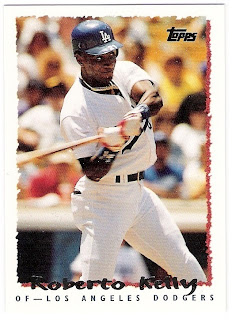
roberto kelly (1995)
at the beginning of the 1995 season, roberto kelly was a brave.  he was traded to the expos in april and then flipped to the dodgers in may.  that's his 1995 topps traded card shown above.  the dodgers had moved raul mondesi to center to start the season, but put him back in right when kelly was acquired (they sent their right fielder henry rodriguez to montreal in the deal that brought kelly to la).  as a dodger, kelly actually played more left field than center field.  he made 59 starts in left and only 48 in center.  that's because the dodgers re-acquired butler in august, and he reclaimed center and kelly moved to left.  still, kelly's 48 starts qualifies him as the dodgers' primary center fielder in 1995.  with butler back in the fold, the dodgers let kelly walk as a free agent after the season.  however, butler's health problems allowed someone else to claim center field in 1996.  and by someone else, i mean one heck of a committee.  still, one guy made more starts than anyone else and that guy was... 
wayne kirby (1996)
butler started the season back in his familiar center field position, and played through may 1 without missing a game.  he was then diagnosed with cancer, and left the team to seek treatment.  with butler battling cancer, the dodgers turned to chad fonville and then to roger cedeno to fill the void.  that didn't go too well, and, dissatisfied with cedeno's performance, the dodgers selected wayne kirby (seen here on his way cool 1997 fleer ultra card) off of waivers from the indians in june.  kirby wound up making 44 starts as the dodgers center fielder.  butler made 34 starts, including 5 at the end of the season when he returned from treatment, while cedeno had 33.  to round things out, chad curtis made 20 starts in center, rookie of the year todd hollandsworth made 17, and chad fonville made 14. kirby was back with the dodgers in 1997, but in a limited role.  that's because brett butler really did reclaim the center field spot in '97.  sort of.
brett butler (1997)
in what would be his final season, butler played in 105 games, but made only 47 starts in center.  by the end of the season, he had been moved to left.  still, those 47 starts led all dodgers.  the other dodger center fielder starters were otis nixon (41), roger cedeno (39), todd hollandsworth (25), and an assortment of other players like darren lewis had the rest.  butler, shown above on his 1997 upper deck card, was given one last start in center on the last day of the season.  he went 1 for 4 with 2 rbi - his final hit was quite fittingly a triple.

with butler retired, the dodgers once again turned to raul mondesi to fill his shoes in center, just as they had back in 1995.  this time, mondesi stuck, but only after a couple other guys had failed.

raul mondesi (1998)
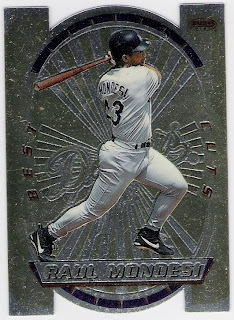
mondesi, shown on a 1996 bowman's best 'best cuts' insert card, made 94 starts in center to go with his 53 starts in right during the dodgers' 1998 campaign.  trenidad hubbard began the season as the dodgers' center fielder, but was replaced by roger cedeno in late april.  cedeno only lasted until mid-may before mondesi took over.  mondesi finished the season with 30 home runs for the second year in a row, and hit .289 when playing center.  still, he would be put back in right in 1999 as the dodgers' revolving door in center continued to spin.

part 3, coming soon...

02 December 2009

the case of butler v. busch, 1995

i am sure you all remember the strike in 1994. no world series. the beginning of the end for the expos. a meaningless first place finish for the dodgers. perhaps worst of all, things weren't resolved as spring training and the 1995 season rolled around, and teams began using replacement players.

these were mostly guys from the low minor leagues who realistically didn't have very good odds of making the big leagues to begin with, but there were a few who did reach the majors after having played in those spring training games as replacement players. one such player was mike busch.busch had played at albuquerque (the dodgers' aaa team) in both 1993 and 1994 without a call-up. he had some power, hitting 22 home runs in 1993 and 27 in 1994. he played first and third, but was blocked by eric karros at first and, to a lesser extent, tim wallach at third. for whatever reason, busch crossed the picket line during spring training and was labeled a 'scab'.

shortly thereafter, the strike was settled, and it was back to usual. later in the season, the dodgers re-acquired brett butler (they had let him walk after the 1994 season thinking that roger cedeno could take over in center). then, a week after that, they called mike busch up from aaa. butler, who had apparently resumed his role as the dodgers' player representative, was not pleased with fred claire's decision and let it be known in the media that mike busch was not welcome.i remember finding it odd that a guy who had not been with the team all year could walk into the clubhouse and make that assertation about a rookie call-up who had played with some of the other guys (like billy ashley and todd hollandsworth). however, i realized that crossing the picket line is a serious offense to the members of the union and obviously resulted in resentment and ostracization. i should state that, while i am not a union member, i understand and value their role in the protection of workers' rights. i read 'the jungle', after all.

in the end, butler, who was subsequently booed by the fans as loudly as busch was cheered, backed down, saying that the dodgers' players would support busch as long as he wore a dodger uniform. but they really didn't ever accept him, i don't think. i was at the game in san diego when the dodgers clinched a playoff spot, and the only guy who took a longer time to get to the on-field celebration than busch was jose offerman who had been benched for the last part of the season.

so who won? not busch - although he would play for the dodgers in 1996 (appearing in only 38 games), he would be released after the season ended, and would not appear in a major league game again. not butler - he was vilified by the fans because of his vocal displeasure of the situation. not the dodgers - sure, they won the west but were swept in the first round of the playoffs. and certainly not the fans.