Showing posts with label 1979 kellogg's. Show all posts

28 May 2014

the evolution of the dodger second baseman, part 2

when we last saw the dodger second baseman, he (paul popovich) was on his way to the expansion montreal expos, so someone needed to step up in 1969.  that someone was…

ted sizemore (1969-1970)
sizemore (seen with his topps rookie team trophy on his 1970 topps card) actually started the season at shortstop (jim lefebvre was at second), but he moved to second when lefebvre got hurt in mid april.  even though he returned to short when lefebvre came back, walt alston eventually switched sizemore back to second when the club reacquired maury wills to play shortstop.  sizemore played 118 of his 159 games in 1969 as the dodgers' second baseman, and hit .271 as he was named the national league's rookie of the year.  in 1970, he appeared in only 96 games, but made 81 starts at second for the dodgers so he retains his title as their primary second baseman.  he hit .306 that year and was dealt following the season to the cardinals in the dick (rich) allen trade.

jim lefebvre (1971)
look who's back.  lefebvre, who had been the team's primary second baseman in 1965 and 1966 and is a former rookie of the year himself, was back at the position in 1971.  that's lefebvre's 1972 o-pee-chee card, by the way.  he played in 102 games as the dodger second baseman in '71 (98 starts) and hit .245 with 12 homers.

lee lacy (1972)
once again, lefebvre began the season as the team's second baseman, but hit a rough patch in early may and gave way to bobby valentine.  soon thereafter, lee lacy (shown on his 1973 o-pee-chee card) was called up from the minors, and he went on to lay claim to the position.  lacy made 58 starts at second - about a dozen more than valentine and 20 or so more than lefebvre.  he hit .259 and scored 34 runs, but didn't play much in september, as the dodgers called up another guy to play some second.

dave lopes (1973-1981)
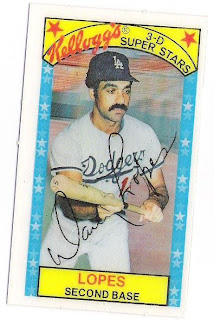
lopes (shown on a very crooked 1979 kellogg's card) made 11 starts during the last month of the 1972 season, and i guess alston saw enough.  he handed the position over to lopes in 1973, giving him 133 starts that year.  he dabbled in the outfield from time to time, but otherwise held the position through the 1981 world series.  along the way, he led the league in steals twice, won a gold glove, made four all-star teams, and helped the dodgers to four pennants and a world series title.  he was the second baseman on the team of my youth.

steve sax (1982-1988)
like lopes, sax held the dodgers' second base position until they won a world series title.  lopes, however, was traded prior to the 1982 season while saxy left after the 1988 campaign as a free agent.  before that happened, he was the fourth dodger second baseman to win the rookie of the year award, and he made three all-star teams, including the 1983 squad as alluded to on the 1984 topps glossy all-star card above.  in 1986, sax finished second to tim raines in the batting title race, hitting a career high .332 (raines hit .334).  he twice led the national league in errors while with the dodgers and much was made about his difficulties throwing to first base, but he was still my favorite dodger after steve garvey left town.  besides, i don't think of him defensively - my lasting steve sax memory is of him hitting the first pitch of the 1988 season into the left field bleachers at dodger stadium.

willie randolph (1989)
the yankees and dodgers essentially traded second baseman for the 1989 season, although both signed with their new teams as free agents.  with sax gone to the bronx, the dodgers signed willie randolph (seen on a 1989 fleer update card).  randolph appeared in 145 games in 1989, including 139 starts at second.  he hit .282 and was selected to the all-star team.  however, the dodgers traded him to the a's early in the 1990 season for stan javier.

juan samuel (1990-1991)
following the 1989 season, the dodgers traded mike marshall and alejandro pena to the mets for samuel.  they moved him back to his original position of second base (the mets were using him as their center fielder), and he made 101 starts there for the dodgers in 1990.  the following year, samuel started 150 games at second for the blue, and didn't sniff the outfield.  he made the all-star team that year as well, hitting .271 with 74 runs scored and 23 steals.  samuel began the 1992 season as the team's second baseman, but was released in july.  eric young was called up to take his roster spot, but there was another player who actually played second more than anyone else that year.

lenny harris (1992)
yes, i am using cards from 1992 fleer ultra for both samuel and harris in this post.  it's what i had handy.  deal with it.  the second baseman position in 1992 looked something like this:  samuel, 29 starts; mike sharperson, 33 starts; eric young, 35 starts; harris, 65 starts.  harris had been the team's primary third baseman in 1991, and he played some third as well as short and outfield in 1992 as well.  overall, harris hit .271 while fielding at a clip below league average for second basemen.  many thought that young would be the dodgers' second baseman of the future, but they weren't convinced as he was left unprotected in the 1993 expansion draft and was taken by colorado.  as a result, the dodgers worked out a deal with the rockies to acquire one of their later draft picks to fill the hole at second.  that set into motion events that would lead to one of the worst (thanks to hindsight) trades in dodger history.  stay tuned...

25 January 2011

the evolution of the center fielder

i'll start this ode to the trail of dodger center fielders with the silver fox, the duke of flatbush, or as his parents named him, edwin donald snider.

duke snider (1949-1958)
in his 10 seasons as the dodgers' primary center fielder, snider hit .306 with 326 home runs, 1035 rbi, over 1000 hits and 3000 total bases, and had an obp of .386 and an ops of .950.  he helped the dodgers to five world series appearances over that stretch and hit 4 home runs in two different fall classics.  he is the gold standard as far as dodger center fielders go, and don demeter had the unenviable task of replacing him when the duke moved to right field in 1959.

don demeter (1959)
(this, by the way, is the copy of demeter's 1958 card that topps sent me from the mcg promotion.  i should have taken one of those multi-card trades and bought a better copy on the bay for $4).  demeter's lone season in the center field spotlight resulted in a .256 batting average and 17 home runs.  the dodgers made the world series, though, and demeter had 3 hits and scored a couple of runs as the dodgers won their first world championship in los angeles.  demeter returned to back-up status in 1960 as tommy davis debuted.

tommy davis (1960)
tommy davis had actually debuted in 1959, getting a single at bat under his belt before the season ended (he struck out pinch-hitting for clem labine against marshall bridges).  in 1960, though, he played in 110 games,  hit .302 with 11 home runs and 44 runs driven in, and finished 5th in the rookie of the year voting.  he shared the center field position in 1960 with the two previous occupants as well as another rookie, willie davis.  the 3-dog would take over the 8 spot in 1961.

willie davis (1961-1973)
willie davis became the holder of most los angeles dodger records during his tenure, virtually all of which was spent as their primary center fielder.  he leads all la dodgers in career war (war, offensive war, and defensive war) as well as at bats, runs, hits, total bases and triples.  in his 13 year run in center for the blue, he amassed over 2000 hits and nearly 1000 runs scored.  the dodgers traded davis to the expos for reliever mike marshall in december of 1973, one day before they acquired the toy cannon to replace him.

jim wynn (1974-1975)
wynn was an all-star in both of his seasons with the dodgers, and may have been the actual mvp in 1974.  he hit 32 home runs and drove in 108.  he also walked 108 times and scored 104 runs.  he hit only .188 in the world series against the a's that year, and is probably best remembered among dodger fans for having joe ferguson cut in front of him in game 1 to catch reggie jackson's fly ball before nailing sal bando at the plate.  wynn was traded to the braves after the 1975 season, and in return, the dodgers got their next center fielder, dusty baker.

dusty baker (1976)
yes, baker played center in 1976 before moving over to left field.  he had played mostly right field for the braves the previous two years, but made the transition fairly easily - just 1 error in 83 games in center.  his offensive production dipped quite a bit, though, as he hit only 4 home runs after hitting no fewer than 17 in his previous four seasons.  the move to left field the following year coincided with the return of baker's power, and opened a spot for another newcomer in center, rick monday.

rick monday (1977)
monday is the guy i remember as the center fielder, since the 1977 team is the one i first followed closely.  he was acquired from the cubs for bill buckner and ivan dejesus (the dodgers also got mike garman in the deal).  he was coming off a career year - 107 runs scored and 32 home runs - when he was traded.  like baker before him, his offensive production declined as he hit just .230 with 15 long balls.  he hit .286 in the nlcs against the phillies, but just .167 in the fall classic against the yankees.  in 1978, monday began the season as the center fielder, but in may they acquired bill north from the a's, and monday began to play a bit more in right and as a pinch hitter.

bill north (1978)
north made 82 starts for the dodgers in center, while monday made 74, so north gets the nod as the dodgers' official center fielder for 1978.  acquired for glenn burke, north hit .234 in 110 games as a dodger, scoring 54 times and stealing 27 bases (he was caught 8 times).  he was pretty quiet in the post season, going hitless in the nlcs and managing just 1 hit in the world series.  monday wasn't too much better - he managed two hits in each series.  north headed north to san francisco as a free agent after the season, meaning that the dodgers would once again have a new primary center fielder in 1979.

derrel thomas (1979)
thomas had joined the dodgers as a free agent prior to the season, and wound up making 93 starts in center.  he also played at every infield position at some point during the season.  in all, he hit .256 and scored 47 runs in 1979.  his value clearly was as a utility player, so the dodgers allowed a rookie to take over in center in 1980.

rudy law (1980)
law debuted in 1978, but didn't appear in the majors again until 1980.  he won the center field job after a good showing in spring training, and he went on to set a dodger rookie record with 40 stolen bases that year.  he found his way into tommy lasorda's doghouse and was made made expendable when the dodgers acquired their next center fielder, kenny landreaux, prior to the 1981 season.

landreaux brought some stability back to center field for the dodgers, so we'll let him kick off part 2, coming soon.