Showing posts with label kosco. Show all posts

27 April 2014

sunday morning target dodgers

here are this week's players from the 1990 target dodger giveaway set.  fourteen players are featured in this post, with the fifteenth member of the sheet making an appearance a little later.

dan bankhead
bankhead was the first african-american pitcher to appear in the major leagues.  his negro league and minor league success didn't translate to big league success, however, and he ended his major league career with a 6.52 era over 52 games.

buzz boyle
boyle spent three seasons (1933-35) patrolling the outfield for the dodgers.  he hit .305 in 1934 and had a 25-game hitting streak while doing so.  that streak stood as the longest in dodger history until joe medwick hit in 27 straight in 1942.  willie davis is the dodger with the longest streak to date, with 31 in 1969.

larry cheney
cheney was traded to the robins from the cubs in 1915.  the next season, he won 18 games and helped brooklyn reach the world series in which he appeared in game 4.  cheney remained with the robins into the 1919 season when he was picked up on waivers by the braves.

cliff dapper
i figured that the only thing i knew about dapper when i saw this card is that he played for the pirates in addition to the dodgers.  i was wrong.  dapper's  big league career began and ended with the dodgers in 1942.  he hit .471 over the course of two weeks early in the '42 season, an average that stands as the highest for any player with 8 or more hits, according to baseball reference.  he served in world war ii from 1943-45, and never made it out of the minor leagues after returning from service.  in 1948, the dodgers famously traded him to double-a atlanta for announcer ernie harwell. as far as i can tell, the pirates uniform comes from dapper's time as a minor league player/manager in the pirates' system.

al downing
downing was traded to the dodgers by the brewers prior to the 1971 season (the guy the dodgers gave up is also on this sheet, and shows up later in the post).  he immediately went out and won 20 games and finished 3rd in the league cy young award voting.  downing wore number 44 for the dodgers, which is the same number worn by hank aaron, who hit a downing pitch in 1974 for home run number 715.

jim hickman
hickman came to the dodgers in the deal that sent tommy davis to the mets.  he only played for la in 1967, and was then traded to the cubs.  hickman's 67 appearances for the dodgers in '67 did not yield any home runs - the only season in which hickman failed to hit a long ball - but did include his lone career pitching performance.  in two innings of work against the giants on june 23, hickman allowed just one run - a home run by willie mays.

gil hodges
hodges is the star of the sheet, no doubt, even though there's a hall of famer on the sheet.  he came up as a catcher, but moved to first base for the dodgers in 1948 when jackie robinson moved to second (the guy that jackie replaced at first is also on this sheet).  hodges stayed at first for 14 seasons, helping the dodgers to 6 world series and hitting 360 home runs in that span.  he was selected by the expansion mets following the 1961 season, and hit the first home run in the team's history in their inaugural game.  he was traded to the senators during the 1963 season who wanted him as their manager.  a few years later, the mets would trade to get hodges back to be their skipper, and they were rewarded as he led them to their 1969 world championship.

rick honeycutt
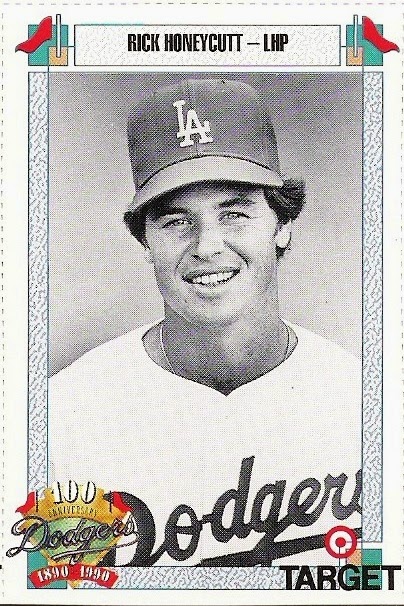
honeycutt joined the dodgers in august of 1983 following a trade with the rangers that sent dave stewart to texas.  his 2.42 era for the rangers wound up leading the league that year, although his total era for the season was 3.03 - higher than mike boddicker's 2.77.  this was a similar situation to eddie murray's lost batting title in 1990 when willie mcgee was traded to the a's and wound up with a lower batting average overall than did murray, but maintained a higher national league average.  these days, the titles are won based on overall averages, not intraleague stats, which would have been good for murray but bad for honeycutt.  anyway, honeycutt pitched for the dodgers for almost exactly four years before being traded to oakland in august of 1987.  the dodgers received tim belcher in exchange, and wound up beating honeycutt and the a's thanks in part to belcher in the 1988 world series.  honeycutt returned to the dodgers as a coach following his retirement, and is currently don mattingly's pitching coach.

andy kosco
kosco spent two seasons with the dodgers - 1969 and 1970.  his 19 home runs and 74 rbi in 1969 led the team, but he was traded to the brewers following the 1970 season for al downing, straight up.

bob o'brien
o'brien gave up a home run to the first batter he faced in the big leagues (cito gaston), but also struck out the side in that same inning of work.  he pitched for the dodgers only in 1971, appearing in 14 games and earning a record of 2-2.  he made four career starts, the first of which ended in a 6-hit shutout against the cardinals.  o'brien made his lone topps appearance on the same 1972 rookie card as charlie hough and mike strahler, although his big league career was over at that point.

luther roy
roy pitched in two games for the brooklyn robins in 1929, giving up 2 runs in 3.2 innings.  those were the final two appearances of his career, a career that saw him post the highest era (7.17) for any player after 1900 who pitched more than 150 innings (since surpassed only by aaron myette).

ed stevens
stevens debuted for the dodgers in 1945, and was their primary first baseman in 1946.  he hit 10 home runs that year, good for second on the team behind pete reiser's 11.  in 1947, stevens was replaced at first base by jackie robinson, and spent most of the season at montreal.  after the season ended, his contract was purchased by the pirates, and he went on to play three more seasons in pittsburgh.

gary weiss
weiss is probably best known for being the last dodger to wear number 1 before it was retired in pee wee reese's honor.  he was a september call up for the dodgers in both 1980 and 1981.  he got into 8 games in 1980, all as a pinch runner, and then played in 14 games in 1981, including four consecutive starts at shortstop.  both of his career hits came in the same game - 9/20/81 against mario soto of the reds - and his lone career rbi was an eventual game winner - a sacrifice fly that scored steve garvey on 9/17/81.

larry white
white was acquired by the dodgers in the deal that sent rick sutcliffe to the indians.  he made his big league debut in 1983 for the dodgers, and pitched well in the four games in which he appeared, giving up just one run in 7 innings of work (the run came courtesy of an rbi single by nolan ryan).  in 1984, white had a couple cups of coffee with the dodgers, finishing the season with the club and striking out the last batter he would face in the big leagues - terry puhl on 9/25/84.

21 January 2013

so, i guess a hall of famer didn't sign a card for me last month

count me among those who thought that dale murphy was a sure hall of famer back in the early 1980's. the start of his career - particularly his first full season (1978) - coincided with my start in following the game, and with the braves in the nl west at that time, i got to see and hear a lot about him.  that's one reason why i was pleased to get a return of my ttm request a few weeks ago.  i had sent him his 1978 topps 'rookie' card, not the 1977 topps kevin pasley card on which murphy also appears. 
getting another copy of a 1978 topps card signed is the other reason i was so pleased, even though it doesn't really up my total of about 250 cards from the set that i have received signed.  the other copy of this card that i have in my ttm binder was signed by lance parrish a while back. ernie whitt signs through the mail, but i won't send him either of the copies i have that are already signed by others.  if i ever pick up another copy of the card, though, whitt will be seeing it in the mail.

here's another card of murphy that is in my collection -it's a 1987 donruss box bottom card
and i own it because he is standing in dodger stadium.  murphy hit only about .250 over his career in dodger stadium, but he had more hits there than anywhere other than atlanta or philadelphia - the two stadiums in which he played the vast majority of his home games.

murphy failed to make it to the hall of fame when the voting was announced a couple of weeks ago, just like everybody else.  i think it was murph's last year on the ballot, however, so his fate will eventually wind up in the hands of the veteran's committee.  another murphy card that i hold near and dear is this one from 2010 topps
you can see why, i believe.  right now, according to baseball reference, matt kemp's career is trending like billy williams'.  that would have been a nice card.

here are some other non-hall of famers who have signed and returned cards for me over the past few weeks.

ron pruitt and his 1978 topps card
like murphy, pruitt was a catcher who also played in the outfield.  he also played third base and first base on occasion.

here is yet another 1978 topps card, this one being the fantastic don gullett card
gullett also signed one of his 2004 upper deck legends cards
it's a card i addressed in the appropriate post over at timeless teams (which gets a new post a bit later today, by the way).  like that murphy donruss card, this one features dodger stadium as a backdrop.

here's another yankee with some sort of ties to the dodgers - it's andy kosco on his 1969 topps card
he's listed as a dodger, but still wearing the pinstripes.

finally, another guy that i thought for sure would be in cooperstown signed a card for me.  it's a 2009 topps update & highlights ring of honor insert card of none other than steve garvey
garvey only got as much as 42% of the vote in one of his 15 years on the hall of fame ballot, and more recently failed to get enough votes via one of the veteran's committees.

thanks to all these former players for signing my cards!

07 December 2012

why acquire aguirre?

hank aguirre was traded to the dodgers in april of 1968.  he had pitched for the tigers for 10 seasons before heading west to los angeles, and led the american league in era in 1962.  aguirre was the victime of bad timing when it came to the postseason, as he broke in to the big leagues with cleveland in 1955, one year after they had been in the world series, and his departure from detroit came in the spring before they would win the fall classic against the cardinals.  

he spent one year with the dodgers and was featured on a 1969 topps card still wearing detroit duds. 
topps took the easy way out and airbrushed out the 'd' on aguirre's hat, but they didn't bother to remove the one on his chest.  aguirre pitched well for the dodgers in '68; he had a 0.69 era in 39 innings of work, but they released him at the end of the season anyway. he wound up pitching for the cubs in 1969 and 1970.  but, because the text at the bottom of his card says 'dodgers', this is a card i will keep.  even if it's a cub in tigers' clothing.

aguirre wasn't the only dodger in 1969 to be caught wearing american league threads.  take andy kosco, for example.  he's wearing yankee pinstripes on his 1969 topps card
this is not as bad as the aguirre, though, as kosco was traded to the dodgers in december of 1968, so he hadn't worn the dodger uniform prior to this card being released.

both the aguirre and the kosco came to me recently via tim wallach.  not the dodgers' third base coach, but rather corey who is trying to collect all of tim wallach's baseball cards.  not just one of each, but all of them.

he also included a 2010 topps heritage hiroki kuroda relic
and a couple of 1974 topps set for my set.
as well as this 2012 topps cut above insert of matt kemp
i think i will take a page out of corey's playbook and ask that people send me their matt kemp cards.  all of them.

thanks for the trade corey!

01 November 2011

the evolution of the right fielder

so far, i have covered the evolution of the dodgers through their managers, catchers, closers, center fielders, and left fielders.  i have even gone through the chain of out of place guys.  here's the first installment of the last of the outfield positions - right field.

carl furillo (1949-1958)
don't you just love 1952 bowman?  i do.  i have about a half dozen dodger cards from that set and they are awesome.  furillo was pretty good himself in right field for the dodgers during their final decade in brooklyn. he was nicknamed 'the reading rifle' in deference to his throwing arm, and he led the league in outfield assists twice - first in 1950 with 18 and then in 1951 with 24.  he also led the league in batting with a .344 average in 1953.  furillo, or the idea of a player like furillo, is one of the reasons i liked the dodgers so much growing up.  he was a guy who played one position for one team, and played it well, for nearly a decade.  unfortunately, even the dodgers ran their team like a business and dumped furillo fairly unceremoniously when injuries limited his effectiveness.

duke snider (1959)
the silver fox slid over to right from center for the 1959 season. actually, the dodgers went with a right field committee of snider, furillo, ron fairly and others, but the duke got the bulk of the playing time.  it was his last big season, too.  he hit 23 home runs, drove in 88 and had an average of .308 in 126 games.  in the postseason, as the dodgers won their second world championship, he hit his final world series home run, giving him 11 for his career which at the time was second only to babe ruth (mickey mantle also had 11 heading into the 1960's).

frank howard (1960-1964)
hondo had enjoyed a cup of coffee with the big club in both 1958 and 1959, but stuck around for good in 1960.  he took over in right field en route to being named the national league's rookie of the year with 23 homers, 77 rbi and a .268 batting average.  in 1961, playing time in right was split amongst howard, fairly, tommy davis, and a cast of others like gordie windhorn.  still, howard got the majority of the playing time, and he remained the primary right fielder for the dodgers until he was traded to the senators after the 1964 season.

ron fairly (1965-1968)
with howard gone and wes parker in the mix, fairly moved from first to right. in fairly's first year as the primary right fielder, the dodgers won their 4th world series title in 11 years, and fairly was a big part of it.  in the fall classic against the twins, fairly scored 7 times and hit .375 with 2 home runs and 6 rbi. he didn't fare quite as well in the 1966 world series, as he was stymied by the baltimore pitching staff just like the rest of the team.  when fairly was traded to the expos a couple of months into the 1969 season, the dodgers moved andy kosco over from left field to replace him.

andy kosco (1969-1970)
kosco hit 19 home runs in 1969 to lead the team.  however, he was batting .274 when he made the switch to right, and by the end of june, about 20 games later, he was hitting right around .250.  in 1970, he continued to struggle, hitting just .228 as the dodgers gave him just slightly more starts in right than either willie crawford or bill russell.  in february of 1971, the dodgers sent kosco to the brewers for al downing, and opened up right field for a kid named bill buckner.

bill buckner (1971)
buckner's eyebrows are fairly tame on his 1971 dell today's team stamp.  billy buck spent just over half of the season out in right for the dodgers, and he hit .277 in 108 total games played.  buckner hit his first career home run and later in the season hit his first career grand slam.  he continued to patrol the outfield in the following years, but gave up his majority stake in right when the dodgers acquired frank robinson in december of 1971.

frank robinson (1972)
there aren't too many cards of frank robinson in a dodger uniform from the period (actually, there is only his 1972 topps high number card) so i'm using a 1972 team issued postcard.  anyway, frobby spent one year in la and it was the worst season of his career to that point.  he played in a then-career low 103 games (starting 86 times in right) and hit only 6 doubles.  he did have 19 home runs, but his batting average was just .251 and he sported a career worst ops of .795, eclipsed only in his final year when he was a player-manager at the age of 40.  this was the guy who had finished third in the al mvp balloting in two of the previous three seasons, and finished 10th in the voting the other year.  it would have been understandable had robinson been in his last year, like the aging rickey henderson that spent his final playing days as a dodger, but after the dodgers traded him to the angels, robinson rebounded with a huge offensive year.  at least the dodgers got andy messersmith out of the deal.

willie crawford (1973-1975)
willie crawford took over in right having spent significant time there already in the previous seasons.  the hometown star hit .295 in each of his first two seasons as the team's primary right fielder.  in 1974, he helped the dodgers return to the postseason and the world series for the first time since 1966.  in the fall classic against the a's, crawford hit .333 with a home run, but the dodgers lost in 5 games.  after the 1975 season, the dodgers decided to give joe ferguson a shot as the full-time right fielder since they had given the catching job to steve yeager, and crawford was deemed expendable.  he was dealt to the cardinals for former dodger rookie of the year ted sizemore, straight up.

reggie smith (1976-1980)
part way through the 1976 season, the dodgers decided to trade joe ferguson to the cardinals for reggie smith. he hit .280 with 10 home runs after the trade, and really made an impact the next two years.  in 1977, reggie was one of the four dodgers to hit 30 home runs in a season, putting his 32 long balls up with steve garvey, ron cey, and dusty baker.  he also hit .307 and led the league with a .427 obp.  it's no coincidence that the dodgers went to the world series that year and in 1978 with smith again providing serious offensive pop.  he missed some significant time in 1979, but still spent more time in right than any of the von joshua-gary thomasson-pedro guerrero and others cavalcade of replacements.  he reclaimed his spot in the lineup for the 1980 season and was hitting .323 when his season was essentially ended by injury at the end of july.  it took a while for smith to get back, but he was able to be on the dodgers' postseason roster in 1981 and was rewarded with the only world series championship of his career.

smith's replacement in right was series co-mvp, pedro guerrero.  he'll lead off the evolution in part 2.

07 June 2011

kosco v. downing

head to head, al downing got the better of andy kosco when they faced each other. kosco was 1 for 9 with a walk and a strikeout in 10 plate appearances against downing over the span of his career.

the reason that i find this interesting is that andy kosco is the guy the dodgers traded to bring al downing into the fold. another reason is that i received through the mail successes from each of them on the same day back in late 2009.

kosco signed and returned his 1970 topps
and 1971 topps
cards.  i kinda wish topps had not put kosco in a late series so that he would have had a second dodger card.  downing was still with the brewers in the 1971 set, so the dodgers were down a player according to the topps checklist.  downing did get the team and text variation treatment on his o-pee-chee card, however, which i am very happy about.  i received four cards back from downing, which was nice considering he had declined to sign my 1978 custom in a previous attempt.

he signed a 1973 topps,
1974 topps,
1975 topps mini,
(featuring dodger stadium!) and a 1976 topps
anyway, kosco played two seasons in la, and was the dodgers' primary right fielder in 1969. that was the year that he led the team in home runs with 19, which was a power onslaught compared to the 10 that led the team in 1968 (thanks len gabrielson). kosco's first home run as a dodger was a grand slam at the expense of former dodger hero, johnny podres, who was pitching, appropriately enough, for the padres at the time.

after missing out on the twins' 1965 world series roster (legend has it that he was the last player cut to trim the postseason roster to 25), kosco finally got a taste of the postseason in 1973 with the nl champion reds. although they lost the nlcs to the mets, kosco had the only two hits for the big red machine in their game 2 loss to jon matlack.

downing, meanwhile, was 5-13 splitting time between oakland and milwaukee in 1970. after the trade, he won 20 games for the dodgers in 1971 to lead the staff, and he finished third in the cy young voting. he wound up winning a total of 46 games for the dodgers in six seasons, and pitched part of a winless seventh season in la to end his big league career in 1977.

here's to both of you, kosco and downing! thanks for signing my cards!