
I think most critics, at least those who pay attention to the international and documentary circuit (i.e., the ones that matter), have all come across the same surprising revelation: 2008 was a great year for film. Of course, a lot of the year's best are left-overs from 2007 (and even some 2006 in the case of
Still Life and
Reprise), but for the American film lover, 2008 provided a cornucopia of heavenly delights from some of cinema's brightest stars (yeah, I know, that sounds like a press release, but I'm sincere). Ninety-nine per cent of the time, I'm weary of calling any film I've just seen a masterpiece (
Céline and Julie Go Boating, which I shamefully saw for the first time this year, is the only film that's coming to mind right now), even if the word was slapped around like a bad VD last year; I heard the word in relation to
No Country for Old Men,
There Will Be Blood,
Zodiac,
The Diving Bell and the Butterfly and even
Ratatouille and
The Bourne Ultimatum. The fact that critics weren't as persistent to make such a bold claim again (except occasionally when mentioning that Pixar flick or that superhero film) doesn't make 2008 any less of a great year. I decided to forgo the tedious process of discerning eligibility for most of these releases, and as I've spent the final weeks of December preparing for my annual list, I've had the chance to scope the Top 10s from the lucky critics who caught all of the major and festival releases before the eve of 2009. Their lists provided the scope for mine as I figured if it was found on someone's list, and I happened to catch it in 2008, it was acceptable (even though the inclusion of British film critics on MovieCityNews'
Awards Scoreboard allowed for
No Country for Old Men to show up once). At the last minute, I also decided to disqualify Carlos Reygadas'
Silent Light, even though it was released for a week in NYC without distribution, on the grounds that I first saw it in April and, as it's being released officially in January, I will have the opportunity to see it on the big screen (which is necessary for this film) then. If you need any other indication of how good a year 2008 was, I even had trouble narrowing the great films I saw to 41, if you count
Silent Light and consider the honorable mentions below. Even if you just skim over the top 20, take a look at the bottom of this post where you'll find a lame "score sheet," the list of films I wanted but didn't get around to seeing and the likely list of films I may write about when I get around to the disappointments (and overpraised films) of the year. Side note: films that premiered in a year other than 2008 are marked as such in parenthesis. So without further adieu... (in descending order)

1.
The Class [
Entre les murs] - dir. Laurent Cantet - France - Sony Pictures Classics
What's more impressive? The fact that
The Class, Laurent Cantet's exuberant Palme d'Or winner, overcomes the dangerous comparison to the startling work of the Dardenne brothers or to the fourth season of television's best show,
The Wire, at the height of its power. Based on the non-fiction book by François Bégaudeau,
The Class is exactly the triumph Cantet has been building toward. With
Human Resources,
Time Out and
Heading South, the director created spellbinding films, all centered around economic turmoil, that managed to be as savagely engrossing as they were challenging.
The Class is more than just the standout of his four exceptional films; it's the perfect synthesis of the idealistic struggle that's been so prevalent in all of his work. Bégaudeau, a thin-shouldered, subtly handsome high school French teacher in his early-30s, plays a version of himself during a rocky single school year at a racially-divided école. Taking place entirely within the grounds of the school, his struggles to engage the frequently apathetic students results in the most troubling display of good intentions and human weakness. Like
4 Months, 3 Weeks and 2 Days, Cantet cultivates an impenetrable mood, unwavering in its feeling of trepidation, his direction consistently matched by the sharp screenplay, adapted by Cantet, Bégaudeau and Robin Campillo.
The Class seated itself on top of my list moments after the credits started to roll, and its haunting power has never faltered. No other film this year dared to open Pandora's box with so much conviction, the capacity to inspire and, best of all, absolute trust in both subject and audience.

2.
Vicky Cristina Barcelona - dir. Woody Allen - Spain/USA - Weinstein Company
No film this year glued a glimmering smile on my face as strongly and thoroughly as Woody Allen's effervescent
Vicky Cristina Barcelona. Perhaps I was witnessing one of my favorite directors come back to life after a decade-long stint of mediocre films, many of which featuring his most incompetent muse to date, Scarlett Johansson, a sad replacement for Diane Keaton and Mia Farrow. Or perhaps it was such a relief to feel those temptations to say that he'd "lost it" dissipate within the film's earliest moments. Ultimately, it doesn't matter whether low expectations and dwindling confidence were to thank for what was easily my best "cinema experience" all year. In ways no other director can compete, Allen pulled me through the ringer with alternating moments of hilarity and stomach-dropping poignancy. As Vicky, the film's substitute for the 'Woody Allen character,' Rebecca Hall nailed neurotic dissatisfaction, culminating in the heart-sinking moment where her entire façade shatters near the end of the film as she tells Javier Bardem, quite simply, "I'm scared." As Cristina, the self-proclaimed free-spirit amid a love-triangle with Bardem and the smoldering Penélope Cruz, Johansson is as tolerable as she's ever been, with Allen exposing the two things most directors miss in the actress: a brimming sexuality that's deeper than physical voluptuousness and the seeping fear that she isn't up to snuff. I have no reservations in claiming
Vicky Cristina Barcelona to be among the highest tier of Allen films, within the ranks of
Stardust Memories,
Manhattan,
Hannah and Her Sisters,
Annie Hall and
Deconstructing Harry.

3.
4 Months, 3 Weeks and 2 Days [
4 luni, 3 săptămâni şi 2 zile] - dir. Cristian Mungiu - Romania - IFC Films (2007)
There is a world of similarities between
The Class and
4 Months, 3 Weeks and 2 Days. For starters, both took home the top prize at Cannes in their respective years. Secondly, both films fit into the strange release schedule that studios have set for their best foreign-language offerings: a week-long run in New York City during December before an official release in January. This causes the grand annoyance of having "dual citizenship" as far as year-end lists and critics awards are concerned. Because I didn't feel like getting into a hopeless argument with myself about where each film belongs (and because I'm not fortunate enough to catch all the films I'd like to at their international premieres), I placed
4 Months, 3 Weeks and 2 Days on my 2008 list because, well, that was when I got the chance to see it; for the record, I caught
The Class at the Saint Louis International Film Festival. Stylistically, both films also mirror one another in being effective off-shoots of fellow Cannes winners the Dardenne brothers, and both are considerably better than their visual and tonal cousin, Darren Aronofsky's overpraised
The Wrestler. It surprised me how well
4 Months, 3 Weeks and 2 Days held up on a second viewing. In alleviating the unshakable dread of seeing it initially (the film really prepares you for the absolute worst), its devastating power starts to reveal itself. Along with Anamaria Marinca's mesmerizing performance, it's the strongest depiction of true feminism I've seen all year. In a way,
4 Months, 3 Weeks and 2 Days is the alternate to a great war film, placing Marinca and Laura Vasiliu, who plays the pregnant girl, in the role of metaphorical soldiers fighting a small (in the grand scheme) battle in the face of personal freedom. And with that in mind, it's even more surprising how apolitical the film is. Its heart cannot be found on its sleeve, and its victories are no cause for celebration.
4 Months, 3 Weeks and 2 Days may be modest, but it's absolutely spellbinding.
4.
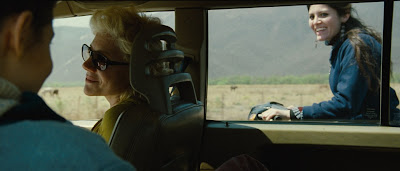
The Headless Woman [
La mujer sin cabeza] - dir. Lucrecia Martel - Argentina/France/Italy/Spain - No US Distributor
Chalk it up to exhaustion if you will, but Lucrecia Martel's third feature,
The Headless Woman, was the grand oversight of the 2008 Cannes Film Festival. Despite arriving with a storm of high expectation and coming from a country whose cinema is reaching a pinnacle of artistic expression, finding anything about
The Headless Woman disappointing is a notion I can't even begin to contemplate. After taking a small step down with
La Niña santa after her exuberant debut
La Ciénaga, Martel is back in extraordinary form, molding a meticulously cinematic adventure about the devastating emotional paralysis a woman (María Onetto) undertakes after a hit-and-run that may have killed a young child. Bárbara Álvarez's cinematography is an absolute marvel, and Martel's ability to frame shots is immaculate. Even when the camera provides the literal visual interpretation of the film's title, Martel sidesteps its potentially hazardous simplicity at every stroke. Unnerving at nearly every turn,
The Headless Woman is Martel's luxurious coming-out party into the world of breathtaking international cinema.
5.
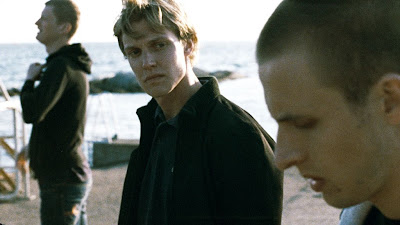
Reprise - dir. Joachim Trier - Norway - Miramax (2006)
With time as my biggest obstacle,
Reprise was the only film in the top 10 that I didn't get around to revisiting (other than
The Class, but I saw more recently than
Reprise). I have no doubt that the film would hold up as well as its placement on this list would suggest, but I'm going to have to resort to directing you to my original post from back in May:
Life Being What It Is.

6.
Otto; or Up with Dead People - dir. Bruce LaBruce - Canada/Germany - Strand Releasing
Even if you're privy to what Canada's most impressive provocateur Bruce LaBruce is selling, it comes as a surprise every single time that he's capable of deeply moving you beneath all that explicit sex and snappy dialogue. I often underestimate the way in which LaBruce, like Gregg Araki, punctures a searing truth and sadness through a well-practiced brand of sympathetic and condemning disposition. In a way,
Otto; or Up with Dead People is the zombie remix of
Super 8½, a depressing/hysterical exposé of LaBruce's favorite subjects, exploitation and pornography. Replacing Bruce, the egotistical porn auteur and occasional "butt double," with Otto (Jey Crisfar), the hoodie-donning, gay, once-vegan zombie,
Otto; or Up with Dead People emerges as a complex, telling examination of the anxieties of the young. [Additional Reading:
Cliquot]
7.
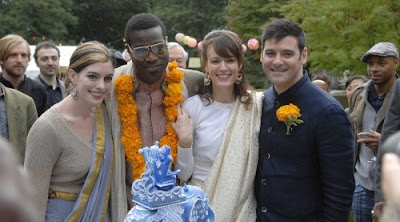
Rachel Getting Married - dir. Jonathan Demme - USA - Sony Pictures Classics
Rachel Getting Married falls into the same category I place David Fincher's
Zodiac. It's acceptable to dislike them, as long as you don't do so for the wrong reasons. If someone drops the phrase, "well, nothing happens," you can cross them off your list of people whose opinions are worthy of respect. The fact that "nothing happens" in both
Zodiac and
Rachel Getting Married is where their brilliance lies. Both take familiar subjects (a hunt for a serial killer; a dysfunctional family reunion or wedding movie, you choose) and display a sublime fascination in the mundane. In easily his finest film to date, Jonathan Demme conducts Jenny Lumet's screenplay like a beautifully enchanting piece of music. It's frequently mystifying, but always grounded.
Rachel Getting Married doesn't sacrifice its bedazzlement or its rawness, allowing the hypnotic dancing sequences to feel perfectly in place with its astute depiction of the unbearable guilt between family members. [Additional Reading:
You Move Me / Like Music]

8. (tie)
Boarding Gate - dir. Olivier Assayas - France/Luxembourg - Magnet Releasing (2007)
Most people, especially those enamored with Asia Argento, cited her teaming with Catherine Breillat for
The Last Mistress as her most appropriate tag-teaming on the list of exceptional directors she's chosen to work with. However, it was with Olivier Assayas in
Boarding Gate that she was able to elicit her most dazzling performance. Although Breillat gave us that exquisite "worm's eye view" of the actress writing in ecstasy, bare breasts and all, and Abel Ferrara had her French-kissing a rottweiler in
Go Go Tales, it suddenly became less important what a director was having Argento do as much as what lied inside her explosiveness. In addition to finding a remarkable center in Argento, Assayas becomes leveled by her, creating the perfect balance for both director and star. It's appropriate, as both receive their harshest criticisms when walking too far out on the plank. Assayas unveils
Boarding Gate's surprising emotional core in Argento's fluttering conscience, and Argento provides stability and significance when the film appears to be falling out of place. The two constantly have their hands around each other's throats, in an act of gorgeous co-survival that brings nothing but best out of one another. I can't think of another film I loved so intensely that others have so vocally detested. [Additional Reading:
Cliquot &
Says you, Goldie Hawn?]

8. (tie)
Summer Hours [
L'heure d'été] - dir. Olivier Assayas - France - IFC Films
Initially, I had listed
Boarding Gate higher than Olivier Assayas' "official" 2008 release (
Boarding Gate premiered at Cannes in 2007), even though I couldn't justify in words why.
Summer Hours is likely the better film of the two, but there's something about the harmony between Asia Argento and Assayas that keeps
Boarding Gate from leaving my mind. Placing
Boarding Gate and
Summer Hours at a tie was the only viable option, even though I probably could have done the same with Gus Van Sant. Like Van Sant, Assayas showed some impressive diversity in 2008. In juggling a metaphysical exploitation film and a somber drama about the dispersion of inheritance after the matriarch (Edith Scob) passes away, Assayas approaches the same multi-faceted issue of globalization, also addressed in
Irma Vep and
demonlover, in two astonishing arenas. Both
Boarding Gate and
Summer Hours are deceptively slight, lacking the sucker punch that Hollywood cinema cowardly uses to justify its existence. Yet in the final stretches of each of the two, Assayas makes everything transcendently clear. Both take the risk of being parodies of their expected conventions (
Summer Hours consciously avoids showing any of the high drama that would typically factor into a film about the death of a mother) but emerge as profound works from the shamefully underrated director.

10.
Paranoid Park - dir. Gus Van Sant - France/USA - IFC Films (2007)
It can be rather troubling picking one of Gus Van Sant's 2008 offerings over the other. Out of all four directors who saw two of their films get official US releases during the year (Woody Allen, Clint Eastwood, David Gordon Green... despite showing up on this list, Olivier Assayas'
Summer Hours won't be released domestically until next year), Van Sant provided the most savory double dip, emitting a newfound optimism after his "Trilogy of Death."
Paranoid Park could easily be seen as the epilogue to said trilogy, adopting an elliptical visual and audible landscape that's totally separate from
Gerry,
Elephant and
Last Days (thanks to Christopher Doyle and Rain Kathy Li's cinematography and the usage of music from a couple Fellini films, as well as the familiar Elliott Smith); however, I like to think of it as Van Sant finally listening to the advice of The B-52's and saying adieu to his own private Idaho as if the lyric, "get out of the state you're in," finally rung true. [Additional Reading:
Cliquot]

11.
The Edge of Heaven [
Auf der anderen Seite] - dir. Fatih Akin - Germany/Turkey/Italy - Strand Releasing (2007)
The trouble with writing about groups of films you love dearly is the fear of redundancy. How many superlatives can I really throw out there? And what's worse, I often find myself resorting to using absolutes (or suggested absolutes) to the point that they begin to mean nothing (the best example of that was a billboard I saw for
Milk where some critic called it "the best live-action, English-language mainstream film of 2008," or something to that extent). Yet I like to think I'm being as sincere as I can be when resorting to them. So when I say that
The Edge of Heaven is unlike any film I can think of in its graceful adoption of the language, skill and intricacy of a cherished novel, I'm trying not to exaggerate. Fatih Akin understands what it takes to make his characters blossom with as little information as possible. All six characters, three sets of parents and their children, radiate onscreen, as fully developed as if he had used written chapters to flesh them out. More than just penetrating the rocky relationship between Turks and Germans,
The Edge of Heaven explores the nature of identity through heritage and family. And more than just intersecting the six's lives for the sake of cheap revelation, Akin places a complex blanket of universality to the characters' struggles, having the separate familial bonds stand as facets of the same truth. Akin is too brilliant of a writer for the incidents to become easily compartmentalized and allows
The Edge of Heaven to pulsate with utter refinement. It should be no surprise that the two films of 2008 that best addressed the turbulence of blood relations (
Rachel Getting Married being the other) would have the most memorable closing credit sequence, accompanied by dazzling single-take images that resonated long after you left the theatre.

12.
Inside [
À l'intérieur] - dir. Alexandre Bustillo, Julien Maury - France - Dimension (2007)
Jarring, uncompromising, relentless, nauseating. Those are only four of the adjectives that came to mind while watching what might be the finest horror film of the decade.
Inside may be too gruesome for most people to stomach, no matter how desensitized you might be. Certainly a home invasion thriller in the vain of a video nasty is nothing new, but co-directors Alexandre Bustillo and Julien Maury do such a spectacular job in matching nail-biting suspense with their buckets of gore that I almost felt as if I was witnessing something completely new. As the predator, simply credited as 'La Femme,' Béatrice Dalle becomes the physical embodiment of absolute terror, as frightening as I'd imagine it was to see Leatherface for the first time. Though the film suffers the mistake of applying motive to Dalle's bloodthirst, the layers of menace run so deep in
Inside that even the silliest explanation (hello,
Haute tension) couldn't alleviate its staggering devastation. [Additional Reading:
Plein de vide &
Says you, Goldie Hawn?]
13.
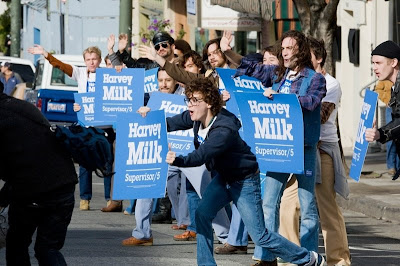
Milk - dir. Gus Van Sant - USA - Focus Features
Politically speaking, 2008 was a year of desperation in the United States. The two most outwardly political films of the holiday season,
Milk and Ron Howard's
Frost/Nixon, relied completely on the outcome of the election to determine how they would be perceived among the public. As many others have alluded to such,
Frost/Nixon became outdated before it even made its first press screening. With Barack Obama's win, the harping on our country's gloomy past in
Frost/Nixon felt out of place. Although it's been suggested that had
Milk been released a month earlier we might not have had to bare the shame of approving Proposition 8 in California,
Milk still holds a mirror up to the spirit of the people, embracing hope and progress even when we know all-too-well the fate of Harvey Milk. And what a relief it was to see that, even when working in the tired realm of the biopic, Van Sant still retained his own signature across
Milk.

14.
Flight of the Red Balloon [
Le voyage du ballon rouge] - dir. Hou Hsiao-hsien - France - IFC Films (2007)
There are so many singular aspects of
Flight of the Red Balloon to marvel at that it's almost stupefying that the film encompasses them with such ease. Firstly, there's Lee Pin Bing's cinematography, with is so ravishing in its golden hues that my eyes almost couldn't handle it. Secondly, there's Juliette Binoche, an actress so gifted that it takes a minute to recognize her in every film she's in. As I said in my round-up of the best performances of 2008, Binoche makes acting look effortless, and as I said earlier this year, there's so much feeling and complexity in the single moment where she tries to wipe her tears away while asking her son how his day was, it's no wonder every major filmmaker wants to work with her. And finally (though you could easily highlight other aspects), there's the way in which Hou Hsiao-hsien uncovers his film, inspired by
The Red Balloon, to reveal a sadness through the imagination of a young boy. It's sensational at every turn. [Additional Reading:
Says you, Goldie Hawn?]

15.
The Duchess of Langeais [
Ne touchez pas la hache] - dir. Jacques Rivette - France/Italy - IFC Films (2007)
In my published review of the latest from Jacques Rivette, I suggested that the general public's disdain for film critics could be entirely summed up in
The Duchess of Langeais. In addition to that, the film also shows the oceans-apart gap between the film lover and the movie-goer.
The Duchess of Langeais, without trying to do so, is the antithesis of the Hollywood period romance. The costumers aren't there to make you swoon, the actors don't adopt painful British accents, the sexual manipulation isn't remotely cheeky and Rivette couldn't care less if you related to or sympathized with either of his leads. I regret not including Guillaume Depardieu, who tragically died a few months ago, on my list of the best performances of the year.

16.
A Christmas Tale [
Un conte de Noël] - dir. Arnaud Desplechin - France - IFC Films
I'm surprised at myself as I write this that I'm ranking
A Christmas Tale so low on the list. When I saw it two months ago, the thought, "this is top 5 material," ran through my head, but as I compiled the list, my enthusiasm waned a bit.
A Christmas Tale is still the spectacular treat I wanted it to be; perhaps its splendor left nothing more to be desired. [Additional Reading:
You Move Me / Like Music]

17.
Love Songs [
Les chansons d'amour] - dir. Christophe Honoré - France - IFC Films (2007)
Officially, Love Songs is the first Christophe Honoré film I've ever liked. In the previous
Ma mère and
Dans Paris, Honoré proved to be a rather cheap imitator of much better filmmakers, and though he plays with Jacques Demy's musical conventions in
Love Songs, it's the first time I've ever really believed him and frequent star Louis Garrel. For both the director and the actor, their undeserved pretension became unmasked, and an authentic brand of glorious melancholy surfaced. [Additional Reading:
Ou, de la tristesse]

18.
In Bruges - dir. Martin McDonagh - UK/USA - Focus Features
Likely,
In Bruges, without question the funniest film of the year, deserves a higher placement. Like Andrea Arnold who followed up her Oscar-winning short
Wasp with a stunning feature-length debut (
Red Road), Martin McDonagh extends the black-as-night, violent comedy of the short
Six Shooter into a scintillatingly bleak comedy about two hitmen (the equally fantastic Brendan Gleeson, who also starred in
Six Shooter, and Colin Farrell) teamed up for a job in Belgium. Ruthless in every respect,
In Bruges was one of the few deserving surprises when this year's Golden Globe nominations were announced and makes its American counterpart
Tropic Thunder cower in comparison.
19.
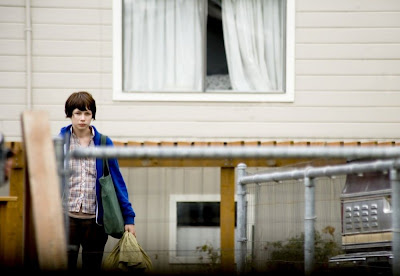
Wendy & Lucy - dir. Kelly Reichardt - USA - Oscilloscope Pictures
Like the two Assayas films on the list,
Wendy & Lucy teases you with its stripped-down demeanor. Before the word "quaint" can even cross your mind (and, really, none of the three are even close to that),
Wendy & Lucy creeps up on you. Reichardt, in her third feature, doesn't achieve the blissfulness of her previous
Old Joy, but
Wendy & Lucy is a more-than-worthy follow-up, aided by a delicate performance from Michelle Williams.

20.
The Last Mistress [
Une vieille maîtresse] - dir. Catherine Breillat - France/Italy - IFC Films (2007)
Those who are familiar with my blog will know that my obsession with Asia Argento is nothing to take lightly. With
The Last Mistress and
Boarding Gate, she's given the two best lines of dialogue of any other film this year. For
Boarding Gate, Argento asking Michael Madsen longingly, "you kept the handcuffs?" works better when you hear it. For
The Last Mistress, on the other hand, Argento telling Amira Casar, "I despise everything feminine... except in young boys," never fails to make me chuckle, even when repeated. Though the film has been called a lesser effort for Breillat, it's nonetheless striking in both familiar and new terms for the director. [Additional Reading:
Vellini Satyricon]
Honorable Mentions:
 Mother of Tears: The Third Mother
 [
La terza madre] - dir. Dario Argento - Italy/USA - Myriad Pictures/Dimension
Dario Argento, is that you? Like
Diary of the Dead, I'm still convinced that Argento hired someone else to make the long-awaited conclusion to his Three Mothers Trilogy. Unlike
Diary of the Dead,
Mother of Tears was watchable, even if it's in unexpected ways. Let's get this straight:
Mother of Tears is bad... made-for-Canadian-television bad. But why do I love it so much? How can the second-most ineptly made film of 2008 (the other involves trees) also be the most fun? I can't come up with any acceptable hypothesis, but bring your jug-o'-wine and savor the sour delights of
Mother of Tears!
 The Free Will
 [
Die Freie Wille] - dir. Matthias Glasner - Germany - Benten Films
The always admirable Benten Films released their best acquisition yet straight to DVD, a harrowing, nearly-three-hour-long account of a convicted rapist's (Jürgen Vogel, who co-wrote the screenplay) return to society after jail time. Matthias Glasner never takes
The Free Will down the easy road. Vogel's phenomenal performance probably ranks somewhere close to Isabelle Huppert in
The Piano Teacher. A friend of mine suggested that having seen two of the year's most lauded films,
Hunger and
Gomorrah, on the small screen hindered his appreciation for them. If only I'd been given the chance,
The Free Will would have likely been shattering on the big screen.
18 More Honorable Mentions (in alphabetical order):
 Blind Mountain
 - dir. Yi Lang - China - Kino (2007)
Boy A - dir. John Crowley - UK - The Weinstein Company (2007)
Dear Zachary: A Letter to a Son About His Father - dir. Kurt Kuene - USA - Oscilloscope Pictures
Frownland - dir. Ronald Bronstein - USA - Self-Distributed (2007)
Gomorrah [
Gomorra] - dir. Matteo Garrone - Italy - IFC Films
Happy-Go-Lucky - dir. Mike Leigh - UK - Miramax
 Hunger
 - dir. Steve McQueen - UK/Ireland - IFC Films
Julia - dir. Erick Zonca - France/USA/Mexico/Belgium - Magnolia
Let the Right One In [Låt den rätte komma in] - dir. Tomas Alfredson - Sweden - Magnet Releasing
Married Life - dir. Ira Sachs - USA/Canada - Sony Pictures Classics (2007)
Noise - dir. Matthew Saville - Australia - Film Movement (2007)
Roman Polanski: Wanted and Desired - dir. Maria Zenovich - USA/UK - ThinkFilm/HBO
 Still Life
 - dir. Jia Zhang-ke - China/Hong Kong - New Yorker (2006)
Tell No One [
Ne le dis à personne] - dir. Guillaume Cantet - France - Music Box Films (2006)
Towelhead [
Nothing Is Private] - dir. Alan Ball - USA - Warner Independent (2007)
The Witnesses [
Les témoins] - dir. André Téchiné - France - Strand Releasing (2007)
XXY - dir. Lucía Puenzo - Argentina/France/Spain - Film Movement (2007)
Yeast - dir. Mary Bronstein - USA - Self-Distributed
Further Readings on the Honorable Mentions:
Jesus Died For Somebody's Sins, But Not Mine... [
Julia]
Noir et blanc [
Married Life]
Short Cuts: 22 March 2008 [
The Witnesses]
Says you, Goldie Hawn? [
XXY]
Films I didn't get the chance to see before compiling this list that had a theatrical run in the US (in no particular order): Serge Bozon's
La France, José Luis Guerín's
In the City of Sylvia [
En la ciudad de Sylvia], Hong Sang-soo's
Woman on the Beach, Wong Kar-wai's
Ashes of Time Redux, Lance Hammer's
Ballast, Courtney Hunt's
Frozen River, Margaret Brown's
The Order of Myths, Alex Gibney's
Taxi to the Dark Side, Nicolas Klotz's
Heartbeat Detector [
La question humaine], Philippe Garrel's
J'entends plus la guitare, Mabrouk El Mechri's
JCVD, John Patrick Shanley's
Doubt, Azazel Jacobs'
Momma's Man, Amos Gitai's
One Day You'll Understand [
Plus tard tu comprendras], Paul Schrader's
Adam Resurrected, Laura Dunn's
The Unforeseen, Rod Lurie's
Noithing But the Truth, Claude Lelouch's
Roman de gareThe Candidates for the Most Disappointing (or Overpraised, even if I marginally liked them) Films of 2008 (I may be forgetting some): Christopher Nolan's
The Dark Knight, Andrew Stanton's
WALL·E, Danny Boyle's
Slumdog Millionaire, Darren Aronofsky's
The Wrestler, David Fincher's
The Curious Case of Benjamin Button, Clint Eastwood's
Gran Torino and
Changeling, James Marsh's
Man on Wire, Charlie Kaufman's
Synecdoche New York, Ari Folman's
Waltz with Bashir, the Coen brothers'
Burn After Reading, Isabel Coixet's
Elegy, Harmony Korine's
Mister Lonely, Wong Kar-wai's
My Blueberry Nights, Carter Smith's
The RuinsUseless Statistics (of the 20):
2 of the films have yet to make their official theatrical run in the US, 8 were released by IFC, 2 star Juliette Binoche, 2 star Asia Argento, 2 star Chiara Mastroianni, 11 were at least co-produced in France, 2 were directed by Olivier Assayas, 2 were directed by Gus Van Sant, 12 premiered at the Cannes Film Festival (some in different years), 2 won the Palme d'or (in different years), 8 have their primary dialogue in English, 5 were made by Americans (from the United States), 5 have bed-couplings between same-sex individuals (4 others imply that at least one of their characters is at least a part-time lesbian), 11 haven't been rated by the MPAA, 15 take place (at least partially) in Europe, 4 star Oscar winners, 10 made their internatial debuts before January 1st 2008, 2 were selected as their country's submission to the foreign language Oscar, 3 were directed by women, 5 are period flicks (1 was set only a few years before it was made), 5 are over two hours long, 18 were written (or at least co-written) by their director, 4 are adapted from novels, 3 are (loosely) based on true stories, 3 have full frontal nudity (!), 1 showed a pregnant woman having her baby cut out, 9 are already available for purchase on DVD in the US (those Blockbuster exclusive IFC titles make that wording necessary), 0 were documentaries, 8 coincide with Roger Ebert's list of the 38 or so best films of 2008, 1 is in the "red" category on Metacritic, 1 is in the "yellow," 3 do not have tabulated scores on there, 1 was seen by both me and my mother, 0 featured Batman