Showing posts with label Jérémie Renier. Show all posts

22 June 2009

Family Ties

Summer Hours [L'heure d'été] - dir. Olivier Assayas - 2008 - France - IFC Films

Written for Gone Cinema Poaching.

Separating Olivier Assayas' films into two camps, the "globe-trotting erotic-thriller" and the "prestige" pic, is an easy action. On a superficial level, Boarding Gate and Summer Hours couldn't be more different. However, when it comes to Assayas' work, most people choose to make the simple connections, such as the one above or noting the similarities between demonlover and Boarding Gate without recognizing their strong dissimilarities. But really, pairing one against the other overlooks the central idea that appears in nearly his entire body of work (I haven't seen any of the films that came before L'eau froide): a search for identity within changing landscapes, even if it's indirect.

In Summer Hours, the search is quite apparent. After the passing of their mother Hélène (Edith Scob), three siblings (Charles Berling, Juliette Binoche, Jérémie Renier) must determine how to deal with their family's inheritance, with special consideration for the fact that each of them live on separate continents. Like really all of the director's films, Summer Hours is almost deceptively slight. Assayas keeps the film free of teary melodrama and unwanted sentimentality, restricting his camera from the actual death of Hélène as well as her funeral. Summer Hours isn't about a family's grief; it's about the value, monetary and sentimental, of what's left behind.

Though its persistent honesty is no small feat, the strength of the film reveals itself fully in its final moments. Once it's decided to sell the family home, the two eldest grandchildren (Alice de Lencquesaing, Emile Berling) throw a party in the nearly empty house. As teenagers and loud music occupy the rooms, Assayas takes the film in a place I never expected, though maybe I should have known better as he's always placed great emphasis on his films' closing scenes, even if they seem initially puzzling. As my hands down choice for the best film to hit theatres this year, I'd be surprised to find a film as sublime as Summer Hours in the remaining months of 2009.

18 January 2008

Asshole 400

If you're feeling superficial: You're in good company! This is my 400th fucking post and instead of making a boring list of films or bitching about the Oscars, I'm just going to post 20 photos of filmic individuals who I'd give the business to (for a variety of reasons...). Yeah, I'm shallow. And no, I'm not sexually confused, but would you really turn down Asia Argento or Grace Jones? Not this faggot.

In no particular order:
Rosanna Arquette (pictured with Thom Yorke, to whom the business would not be given)
Monica Vitti (I like the variety in hair color I get with L'avventura or La notte)
PJ Harvey (Um, she was in Hal Hartley's The Book of Life, so it counts)
Paul Schneider (In George Washington)
The Renier brothers, Jérémie et Yannick (Together... in Private Property)
Romain Duris (Yikes, I'll take him in anything, especially The Beat That My Heart Skipped)
Grégoire Colin (Again, in anything, take your pick, but how about Beau travail?)
Harry Baer (in Gods of the Plague, definitely)
Jane Fonda (pre-exercise tapes, maybe even in Vietnam)
Jean-Marc Barr (Post-The Big Blue)
Lior Ashkenazi (Late Marriage, Walk on Water)
Daniel Hendler (Family Law, though really anything)
Emmanuelle Seigner (particularly in The Diving Bell and the Butterfly, and with Roman Polanski watching)
Gina Gershon (hell, and Jennifer Tilly too)
Grace Jones (!!!!)
Aiden Gillen (Either with crazy hair or as Mayor Carcetti on The Wire)
Alain Delon (Purple Noon or L'Eclisse)
Asia Argento (with blood, lots of it, and her dad filming)
Béatrice Dalle (Betty Blue 4-ever)
Bibi Andersson (Persona)


17 September 2007

France et la mort

Private Property (Nue propriété) - dir. Joachim Lafosse - 2006 - France/Belgium

A friend of mine and I have a little ongoing gag that we use to sound more clever than saying “well, that’s obvious.” Our go-to is usually, “that’s like saying Isabelle Huppert is playing frigid!” Other staples include “Louis Garrel shows his cock in that film?” or, the less clever of the bunch, “Tilda Swinton is amazing in that film?” Well, Madame Huppert has decided not to throw us a bone with Private Property, a ravishing Franco-Belge production of a warring family and their house. Huppert plays the mother of adult twins, François (Yannick Renier) and Thierry (Jérémie Renier, real life brothers, though not twins). The three live in the house together, which Huppert’s ex-husband (Patrick Descamps) has left to his sons. Huppert wants to sell to open a bed and breakfast with her Flemish boyfriend (Kris Cuppens), but it appears to only be over stubborn Thierry’s dead body. The family clashes, naturally, as the close-to-the-point-of-homoeroticism twins differ in their parental relations. Private Property runs nearly ninety-five minutes, and for a film to please for nearly ninety-three of them, it’s no small feat. It’s especially French, but hardly maudlin. In fact, Huppert makes her Pascale rather endearing. How many films can you mention where you see Huppert ironing clothes?? Or getting fucked in the back of a jeep? Or yelling at her ex-husband? It would seem that she would do the latter quite often, but as I said before, her usual frigidity makes her more of an interior actress than her volatile roles might suggest. The ending of the film is questionable as it relates to the rest of the wonderful film, as it somewhat succumbs to the notion that French films must end in some sort of ambiguous tragedy. Instead of any of the characters paying for the sins of the rest of the family, Private Property concludes with mistaken agony. For a film to not beg me to fast-forward through it, I’m more than pleased (especially lately).

A Few Days in September (Queleques jours en septembre) - dir. Santiago Amigorena - 2006 - France/Italy/Portugal

I don’t know if I’m in a cinematic rut or if watching so many tepid films has turned me sour, but sitting down a watching an entire film without pause has really not thrilled me lately. As stated above, Private Property had me in rapture for its running length; A Few Days in September kept me in my seat as well, albeit for different reasons. I read a stimulating interview with Juliette Binoche, the famed French actress and Oscar winner for The English Patient, in which she discussed the choice of roles in her rather luxurious career. As a forty something and with the respect she commands, she pretty much has the pick of the lot; she’s fluent in many languages, perhaps more beautiful now than she was at twenty, and literally has directors banging at her door. She said in the interview that she chose A Few Days in September because, for once, she was offered a role in a pseudo-action film where the woman held the gun (a damsel in distress, she certainly is not). One could see also the appeal of A Few Days in September as it considers itself filled with historical importance. The film takes place in France and Italy several days before the attacks of 9/11, depicting a newly-unified Europe in the dawn of Al-Quida terrorism. Binoche escorts two youths (Sara Forestier and Tom Riley) around the streets of Paris and Venice in a search for her former business partner (a surprising Nick Nolte), and father and step-father, respectively, of the two, all while being tailed by a neurotic hitman (a French-speaking John Turturro). A Few Days in September is a bizarre failure that somehow manages to captivate while puzzling. With the exception of the attractive Forestier (Perfume: The Story of a Murderer), the acting is particularly bad. Binoche has become an actress of extreme confidence, and it’s strangely admirable that she’s so self-assure when she seems so misplaced here. Turturro’s performance is weirdly uncomfortable, a hitman who phones his analyst at all hours of the day to discuss his interior confusion. And Riley, a Brit, delivers a shaky American accent (one that rivals the horrible casting of Brits Juliet Stevenson and Kevin Bishop as dorky Americans in Ventura Pons’ Food of Love), though he does have wonderful chemistry with Forestier. It came as no surprise to me, when researching the film, that the director, an Argentine working in France, made his directorial debut with this film (he’d previously co-wrote screenplays for Post-coïtum animal triste, Peut-être, and Ni pour, ni contre (bien au contraire)). He has no idea what to do with his actors, gifted as they may be, nor does he exude an subtleties in dealing with any of his characters and their bonds with one another. Ultimately, A Few Days in September feels more self-important than it does actually important, but I’ve got to hand it to Amigorena for making this mess curiously alluring.

You Kill Me - dir. John Dahl - 2007 - USA

Call me crazy, but when Téa Leoni is the strongest facet of your film, I get a little scared. Coming from John Dahl, the underrated director of The Last Seduction and Joy Ride, I expected more. You Kill Me is the sort of film that you “get” without actually seeing it. The film follows Frank (Ben Kingsley), a Polish-heritage hitman working in the family business in Buffalo who happens to have a drinking problem. His uncle (Philip Baker Hall, who looks more like Kingsley’s brother than uncle) spots the problem and sends him to San Francisco to clean up. Frank doesn’t want to stop drinking, but he understands that if he’s not part of the business, he’ll get axed, literally. So, off to San Francisco he goes, working in a funeral home while half-assed attending AA meetings with his sponsor (Luke Wilson). At the funeral home, he meets brutally honest Leoni, whom he falls for. Dahl’s handling of Frank’s alcoholism is lousy; during the credit sequence, we figure out he has a drinking problem by tossing a bottle of vodka ahead of him as he shovels snow, making a swig from the bottle his prize for getting to the sidewalk. In fact, I’m not sure whether it’s the obvious humor or the timing of it that makes You Kill Me fall flat. In an unfunny bit, Wilson says that AA is a great place to pick up men, which causes Kingsley to respond, “Oh, I’m not gay.” “I’m sure I’ll get over it,” is the response, and maybe the line might have worked if Wilson wasn’t on his typical autopilot. I suppose we’re supposed to be amused when Frank finally gets in front of the AA group and admits that he’s a contract killer. I suppose we’re supposed to be amused by all of this, but instead, You Kill Me is sour and silly, which is never a good combination.

15 December 2006

Unintentional Double Feature, Part 1: Neo-Neo-Realism

L'enfant - dir. Jean-Pierre Dardenne, Luc Dardenne - 2005 - Belgium/France
+
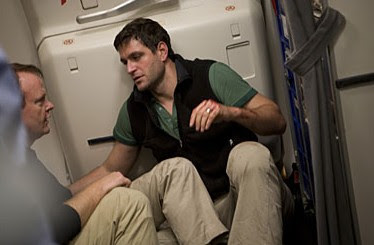
United 93 - dir. Paul Greengrass - 2006 - France/UK/USAOne could state that cinema vérité stems from the long history of neo-realism. Cinema vérité has become the neo-neo-realism, stripping down films to bare essentials, leaving special effects and camera trickery in the proverbial closet. It would be easy to make a connection to the Dogme movement that was so popular in the late-90s, but this would be an inaccurate comparison. To equate films like L’enfant and United 93 to Lars von Trier’s The Idiots (Idioterne) and Thomas Vinterberg’s The Celebration (Festen) would be a rash association, based solely on method and surface. What these films have in common stops at the exterior, from their out-of-focus, wobbly handheld cameras to natural, unflattering lighting. I can’t make any sort of blanket statement about the entirety of the Dogme collection, which includes a number of titles never released in the United States and from various countries, but in relation to the Danes, specifically Von Trier, there’s an unmistakable omnipotent power at work. Roger Ebert rather expertly pointed out in his review of L’enfant that the film exists in a world where “God does not intervene and the directors do not mistake themselves for God.” In a film like this or Paul Greengrass’ masterful United 93, worlds function without this higher power. In a way, they’re godless films where actions progress in a functional cause-and-effect and where supreme interaction never exposes itself.
To call Von Trier’s films Catholic seems a bit silly considering their subject matter, but upon closer examination, Von Trier quite literally assumes the role of this God in nearly every one of his films. His voice, and perhaps his laugh, can be heard and seen within the frames of his films, a concrete stamp of authorship. Both L’enfant and United 93 have a stylization that recalls the ever-present auteur theory, but in varying ways. Those familiar with the Dardenne brothers’ work (Rosetta, The Son [Le fils], La promesse) will quickly recognize their signature vérité style, as well as Jérémie Renier who also played the lead in La promesse as a young boy. Unedited moments of character silence and natural sound fill the frames of L’enfant like all of their previous work. For Greengrass, the handheld camerawork recalls his breakthrough film, Bloody Sunday, which painfully depicted the events of an Irish massacre in the 1970s, and even The Bourne Supremacy. Both L’enfant and United 93 beautifully fit and compliment the directors’ prior works, but the distinction between their films and those of the Danes is still radically opposing. L’enfant and United 93 exist in very separate worlds, despite their aesthetic parallels.

What Von Trier and Vinterberg wanted to accomplish with the Dogme was a fuck-you to the artificial glory of the Hollywood film. They wanted the removal of the bells-and-whistles Hollywood is known for to reveal a greater truth about humanity and character, but their strife proved futile. Reportedly, Von Trier reflected on the Dogme movement as an elitist bickering that hilariously turned into a genre on its own. Von Trier only contributed one film, The Idiots, that followed the rules of the movement, though employed a visual style and truth-emphasis similar with Breaking the Waves and Dancer in the Dark. Yet, each of his films, including The Idiots, resounded with his name, his ideas, and most notably his criticisms. Whether these ideas are his true beliefs or if he’s just playing the role of devil’s advocate doesn’t matter. Breaking the Waves and Dancer in the Dark are films where a divine power has tinkered with the lives of the characters like a puppeteer. Von Trier is kind of like the little boy who places people and objects on the tracks of toy trains, disrupting the constant trek of the plastic vehicle to see how it erupts. The worlds of L’enfant and United 93 do not function as those films do. In L’enfant, the directors introduce us to Bruno (Renier) and Sonia (Deborah François) a week after they’ve had their first child. The film serves as a window into the days that follow, as the two struggle to find money and eventually sell their baby. The consequences of Bruno’s illegal sale of the baby and his shady business transactions come naturally. He’s an impulsive figure who carries out his actions without thought, only to recognize the severity of these actions once things go awry. The things that go wrong are not the metaphorical hurtles on the train track but plausible consequences for the spontaneity and disregard of his decisions. Bruno is not clearly paying for his sins in the Christian idea of repentance, but through the carelessness of his dubious dealings.

United 93 plays like L’enfant in its structure of time. The film functions like a window in time and recognizable history, shot nearly in real time just before the horrendous events of September 11th. The film captures a variety of characters, from air traffic employees, military officials, victims of the tragedy, and the terrorists themselves. We’re given no discernable background about the individuals or even reasoning for why the events are taking place. It’s understood that the terrorists are of the Muslim faith and are carrying out these events as a pledge to their God, but Greengrass never tries to explain, justify, or crucify these men for their actions. That he shows them as fallible, emotionally-torn characters is a commendable decision, though it’s effectively brief in exposure. As in L’enfant, the removal of both conventional narrative and accepted cinematic motifs in United 93 washes away the looming sentimentality that one might expect from a film of this nature.

That both films are told in a matter-of-fact way about pressing issues in no way reflects the laziness or invisibility of the creator. The final fifteen minutes of United 93 are some of the most riveting, intense cinematic moments you may ever see committed to the screen. The scene in L’enfant where Bruno hides in a neighboring room of an abandoned apartment to complete the transaction of selling his baby recalls some of the most dangerous, suspenseful moments Hitchcock has ever created. The audience is never given a glimpse of the individuals taking part in the business deal because the window of L’enfant doesn’t open in that direction. The Dardenne brothers are focused on Bruno, his silent tension, anxiety, and possible conflicting reassurance during this scene. They don’t expect you to understand or even feel the internal struggle Bruno might be going through; they just want you to experience it from where you sit. United 93 and L’enfant assuredly recognize their own distant nature. Film is hardly something that is user-interactive (though hammy DVD features like those on the new Final Destination disc are trying to prove otherwise), and Greengrass and the Dardennes acknowledge this, taking a step back, avoiding their own menacing interference, and allowing the horrors of the world to simply persist. Especially in Dogville and its sequel Manderlay, Von Trier always has something to say about these evils. In L’enfant and United 93, the evils exist without explanation, justification, or deterioration. These evils present themselves in both the theist and godless worlds of the films discussed here but in variable degrees of “realness.” This imbalance between the films in no way suggests a superiority in quality of any of the films, as they all remarkably work within their own right. However, to carelessly lump all these films that strive for cinematic realism together would be a foolish mistake.